Links
Commentary and links saved to Semble.
- Timeful is now completely free | Timeful
No more ads. No more premium tier. No more event limits. Every feature in Timeful is now free for everyone.
 Home · ATMOSYNTH
An atmosphere of synth patches. Playable in the browser. Owned by the community.
 open-git
A modern code host.
 Code Repository - Git Source Control | Harness
Host Git repositories in Harness, manage pull requests, and connect every commit to secure CI/CD workflows with source-to-deploy traceability.
 Depot | Software Delivery built for machine scale
Depot provides fast source control, builds, CI runners, sandboxes, caches, and registries to ship reliable software at machine scale.
 Entire Launches Distributed Git Network for the Agent Era
Five months after the largest seed round in developer-tools history, Entire is reimagining version control for agent-scale development, allowing developers to mirror GitHub repositories on a fast, independent Git network built for agents.
 Humans approve intent, machines prove conformance
The pull request assumes a human wrote the diff. gittifacts is my attempt at a git platform for when agents write most of it.
- GitHub - lmmx/exegenius: Build evidence linked knowledge graphs and optimise explanation paths through simulated readers
Build evidence linked knowledge graphs and optimise explanation paths through simulated readers - lmmx/exegenius
- W Social (@wsocial.eu)
1/5 We’ve upgraded W’s verified badge to give you more context about the person behind the keyboard. Real humans. More trust. Your real name stays optional.
- A 16× Smaller Index for EmbeddingGemma 2
EmbeddingGemma 2’s one advertised way to shrink its vectors, keeping 128 of 768 dimensions, loses about 0.06 nDCG@10. Storing all 768 at 2 bits each is 16× smaller with no measurable loss on SciFact or NFCorpus.
 afterword
Writing this handbook has been a process of not over-thinking it. In deciding to do it post-by-post, day-by-day, I practiced sharing as I went, posting to a ...
- appmosphe.re — Web Tiles on the Atmosphere
Browse the Web Tiles published on the AT Protocol: find tiles by name, description, or author.
 Can AI slop help us save the internet?
Disrupting the status quo and opening space for new visions
- Measuring Cryptanalytic Effort
A bibliometric estimate of how much public cryptanalysis each public-key assumption has received, and what that effort would cost under assumed AI productivity.
- Gradients of intimacy and creating shelter: An interview with Erin Kissane
How might we use nature as an inspiration for creating online communities?
- GitHub - haileyok/MagicPodsLinux at hailey/mac-parity
AirPods, Beats & Galaxy Buds integration for Linux and SteamOS with battery monitoring, noise control, iPhone-style pop-ups, and advanced controls. - haileyok/MagicPodsLinux
 chalky.town
a local-first weekly planner backed by your own ATProto repo.
- ngerakines.me/eye-of-agamotto
Contains the mysteries of time.
 Using AI for just 10 minutes erodes your ability to persist at hard things - Berkeley News
A UC Berkeley researcher co-authored a study that raises profound questions about how we interact with artificial intelligence in education — and daily life.
 unikernels were hard. key word: were.
Justin Cormack, who worked on MirageOS back in the day, called me at the pub to talk about why unikernels are coming back. The friction that made them hard is gone, the operating system is design debt, and if you care about security you should seriously consider them.
 Lichen
Build a knowledge base with friends. Wikis owned by you, built on ATProto.
- unikernels were hard. key word: were.
Justin Cormack, who worked on MirageOS back in the day, called me at the pub to talk about why unikernels are coming back. The friction that made them hard is gone, the operating system is design debt, and if you care about security you should seriously consider them.
 Orrery, a Knowledge Graph That Adapts to Its Corpus
Orrery is our open-source knowledge graph that gets deeper as you feed it: domains that hit critical mass earn their own custom extraction specs, agents get an API, and humans get a galaxy. The whole …
- Home · ATMOSYNTH
An atmosphere of synth patches. Playable in the browser. Owned by the community.
 What a year
I'm Jesse. I make stuff. Software, hardware. Very occasionally, trouble.
 Crab Bisque-y - AT Protocol
Jim and Alex are back on the livestream for the first time in a while to cover the latest news in the Atmosphere.
 Our $445M Series D | Oxide Computer Company
Our Series D round of financing.
 Scaling sustainable social networks in the public interest | Heinrich Böll Stiftung | Brussels office - European Union
This policy paper identifies five key challenges for scaling a public-interest social web: infrastructure, governance, funding, attractiveness, and public mandate. It outlines a roadmap for overcoming these challenges and building the Open Social Web Alliance into a relevant force within months — starting in Germany.
- robin.berjon.com/appmosphe.re
Browse the Web Tiles published on the AT Protocol.
 Surface RTX Spark Dev Box: The Dev Box Built For Developers | Microsoft Surface
Microsoft’s Surface RTX Spark Sev Box offering which “looks like a bar mat” $6KUSD with 128GB shared RAM and 2TB NVMe drive.
- be diligent
For individuals It's challenging to work a process when it moves slower than feels appropriate. In the context of computer conversations, the tactic of s...
 Underdog Saluki 27B
Qwen3.8-27B in a 7.89 GB file that loads in stock llama.cpp, and how it compares with other 2-bit builds.
 LLMs as Collaborators in Language Specification and Design (PLSS 2026) - SPLASH/ISSTA 2026
Workshop on Programming Language Standardization and Specification This workshop aims to foster cross-pollination between researchers and industry professionals with experience in programming language specification and standardization. It provides a forum where participants can share insights, case studies, and best practices, and collaboratively explore solutions to current challenges. The goal of the workshop is to improve the collective understanding of how programming languages are specified, standardized, and evolved in practice. The workshop examines specifications as the foundation ...
- André Staltz — Time Till Open Source Alternative is now zero
Open Source Freelancer
- MiniJinja Playground
Try MiniJinja, a powerful template engine for Rust, Python, Go and JavaScript, in your browser.
- aesthetic.computer/core
Monorepo for Aesthetic.Computer
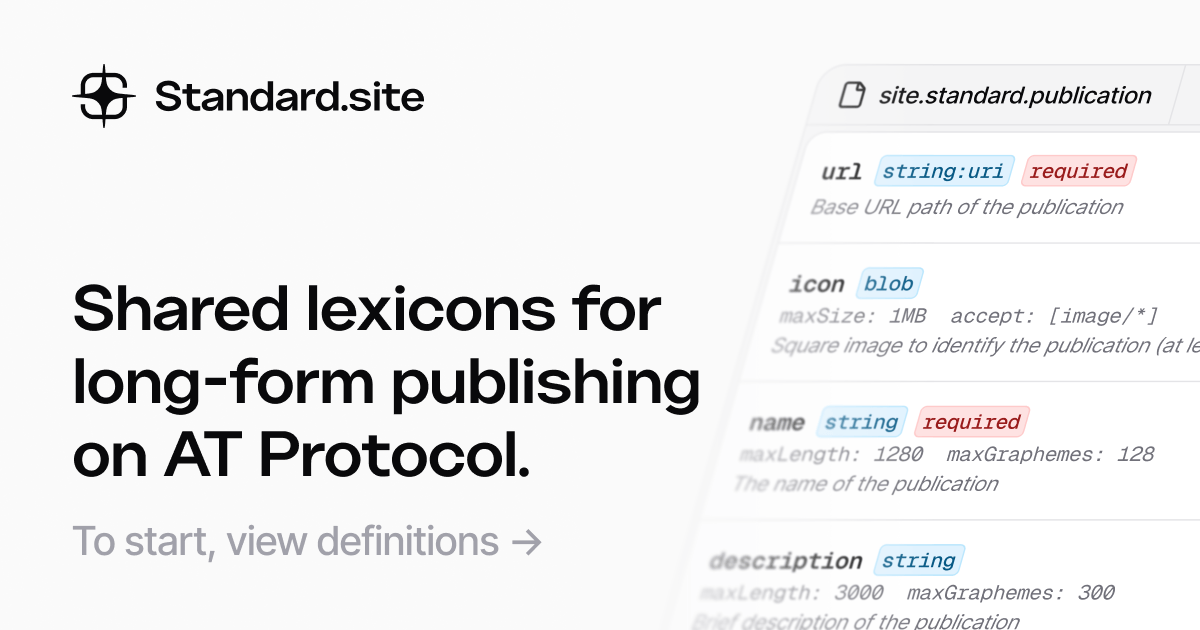 Standard.site - One schema. Every platform.
Standard.site provides shared lexicons for long-form publishing on AT Protocol. Making content easier to discover, index, and move across the ATmosphere.
 Workshop on Live Programming (LIVE)
The 12th Workshop on Live Programming (LIVE 2026) will take place online. LIVE invites submissions of ideas for improving the immediacy, usability, and learnability of programming.
 Tag-Team Transmission: What Happened When We Brought A2A and MCP to Toronto | Fabricated Technobloggle | Daryl Ducharme | Offprint
Tag-Team Transmission: What Happened When We Brought A2A and MCP to Toronto I love traveling, even though I'm usually too excited to get much sleep the night before a flight. As a self-proclaimed...
 Lexicon Garden - ATProtocol Lexicon Browser
Browse and discover ATProtocol lexicon schema definitions
 Open By Design: Tools for Participation - An Evening with Internet Archive Canada · Luma
Internet Archive Canada for Open by Design - Tools for Participation. Join us as we explore how we can build a more open and participatory digital future, and…
- Terence Tao (@[email protected])
In traditional mathematics (or "Math 1.0"), a breakthrough proof of a long-standing open conjecture generates a large amount of subsequent activity and excitement in the field. The authors of the proof are invited to give many talks, and meet with other experts in the area. Workshops are set up to discuss the proof, as well as other recent developments. As a result, new connections and collaborations are formed, followup problems are shared, and other mathematicians (both junior and senior) are attracted to the field (including in some cases the authors themselves, if they initially came from a different subject). As a result of all this activity, the proofs naturally become digested, streamlined, placed in context with other results in the field, and ultimately become part of the textbooks and lecture notes for the next generation of mathematicians in the field. (1/4)
- Atelier MoJa
Nighthaven のひとり開発室。書く道具と読む道具を作っている。
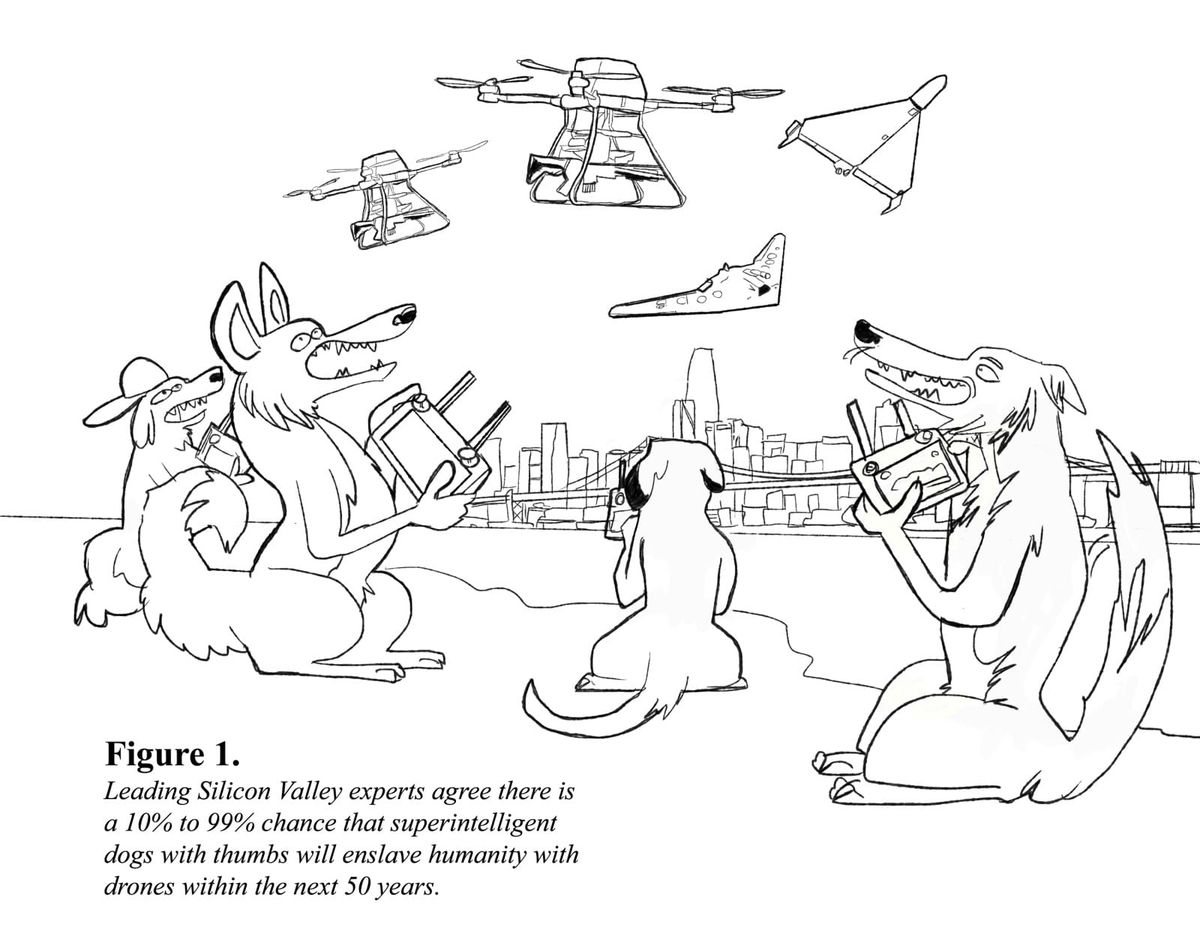 Why We Can't Let Enormous Weirdos Regulate AI
Imagine if instead of regulating drones via the standard lengthy, boring, and bureaucratic process - which we did - we instead decided, in the name of fostering all-important American drone innovation, to avoid regulating drones meaningfully at all. Also, imagine that we did not pay well-known aviation safety experts, aeronautical
- papers.club
The Internet's Reading Group
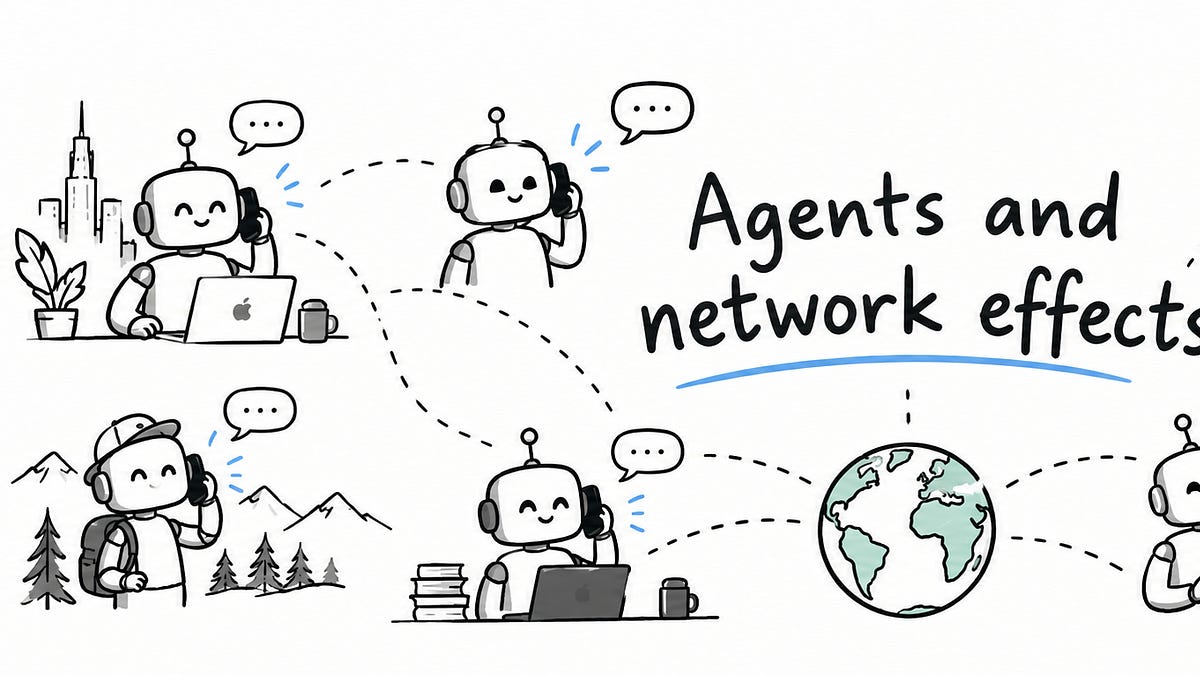 Will agents have network effects?
Agentic viral loops, engagement loops, and walled gardens
- be diligent
For individuals It's challenging to work a process when it moves slower than feels appropriate. In the context of computer conversations, the tactic of s...
- GitHub - austinlparker/decker: library/toolkit for tui driven presentations
library/toolkit for tui driven presentations. Contribute to austinlparker/decker development by creating an account on GitHub.
- The Mathocalypse
… then they came for Navier–Stokes and I said nothing because I never worked on Navier–Stokes. But when they came for RL vs. L I realized that things are serious –friend-of-the-blog Omer Rein…
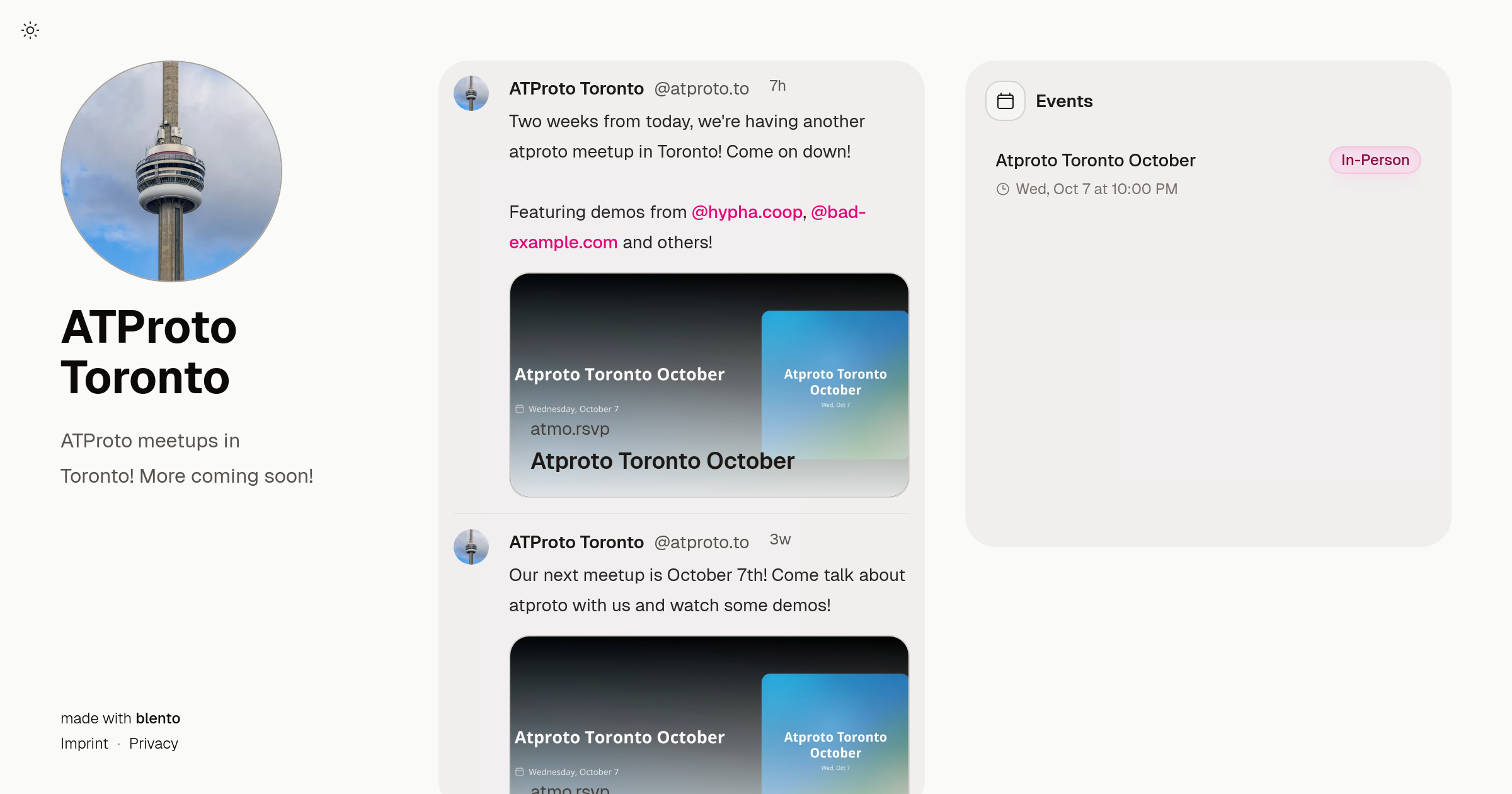 ATProto Toronto
ATProto meetups in Toronto! More coming soon!
 Revisiting Joel's Test - exe.dev blog
Joel Spolsky's twelve questions still hold, but agents demand nine more. Call it the Shelley test.
 Notes from the Mystery Machine Bus - Steve Yegge
Notes from the Mystery Machine Bus - Steve Yegge. GitHub Gist: instantly share code, notes, and snippets.
 I'd take at.protocol — gtlds.fyi
What name would you pick if this were available? at.protocol is on my 2026 gTLD wishlist.
 Research Scientist – World Modeling
WHO WE ARE Percepta’s mission is to transform critical institutions with applied AI. We care that industries that power the world (e.g. healthcare, manufacturing, energy) benefit from frontier technology. To make that happen, we embed with industry-leading customers to drive AI transformation. We bring together: https://challenge.percepta.ai - Forward-deployed expertise in engineering, product, and research - Mosaic, our in-house toolkit for rapidly deploying agentic workflows - Strategic partnerships with Anthropic, McKinsey, AWS, companies within the General Catalyst portfolio, and more Our team is a quickly growing group of Applied AI Engineers, Embedded Product Managers and Researchers motivated by diffusing the promise of AI into improvements we can feel in our day to day lives. Percepta is a direct partnership with General Catalyst, a global transformation and investment company. ABOUT THE ROLE As a Research Scientist - World Modeling at Percepta, you'll build the sy
- Election Night 2026
Vetted coverage of the 2026 midterms, by state.
 Funded projects | Scaling Trust
Explore the projects we're funding in the Scaling Trust opportunity space.
- GitHub - fluree/db: Fluree database library
Fluree database library. Contribute to fluree/db development by creating an account on GitHub.
- Suggestion: Obsidian-Flavored Markdown ('ofm') support · Issue #7 · AramZS/markpub.at
A suggestion or request to add Obsidian-Flavored Markdown. "flavor": { "description": "Markdown may be rendered in many flavors. The most common are CommonMark, Github-Flavored Markdown (GFM), and ...
- GitHub - facebookresearch/context-language-models: Official repository for "Context Language Models"
Official repository for "Context Language Models". Contribute to facebookresearch/context-language-models development by creating an account on GitHub.
 EmbeddingGemma 2: an open, lightweight multimodal embedding model
Introducing EmbeddingGemma 2, an open multimodal embedding model optimized for privacy-first use cases
 Co-creating with emergent processes ✦ Hijinx World
Existential musings over algorithmic design with creative programming legend Dan Tapper.
 unsloth/embeddinggemma-2-GGUF · Hugging Face
We’re on a journey to advance and democratize artificial intelligence through open source and open science.
- GitHub - Niko1221/Strata: Qwen3.8-Flash-Next on any consumer hardware: one-click install for Windows / Linux. Strata inference engine, OpenAI/Anthropic API on localhost, optional image input.
Qwen3.8-Flash-Next on any consumer hardware: one-click install for Windows / Linux. Strata inference engine, OpenAI/Anthropic API on localhost, optional image input. - Niko1221/Strata
- Dark Patterns Won - Ron Bronson
Many moons ago, I used to post a lot on Twitter about so-called deceptive design/dark patterns that proliferate consumer UIs. There were sites
 exe.dev - ssh exe.dev
Build apps or SSH into a persistent Linux VM. ssh exe.dev.
 0.5.1: Markdown and some bug fixes
Fixed Markdown pasted into the rich text editor appearing as plain text instead of formatted content. Fixed a server-side request forgery in profile and image resolution. DID documents, PDS…
 Start.coop | Empower Cooperative Growth
Discover resources and support to build and grow cooperatively-owned businesses, fostering community wealth-building and economic stability.
- /fujo-snippets/ao3-loader at main · fujocoded.bsky.social/fujo-snippets
A repository on Tangled
 Actual Computer › Introducing toks
A very fast tokenizer with a unique Business Source License that is no charge other than the largest tokenizers. I call this a “go fast” success strategy - optimization as a service.
 Introducing Mistral Large 4 | Mistral
The most powerful AI platform for enterprises. Customize, fine-tune, and deploy AI assistants, autonomous agents, and multimodal AI with open models.
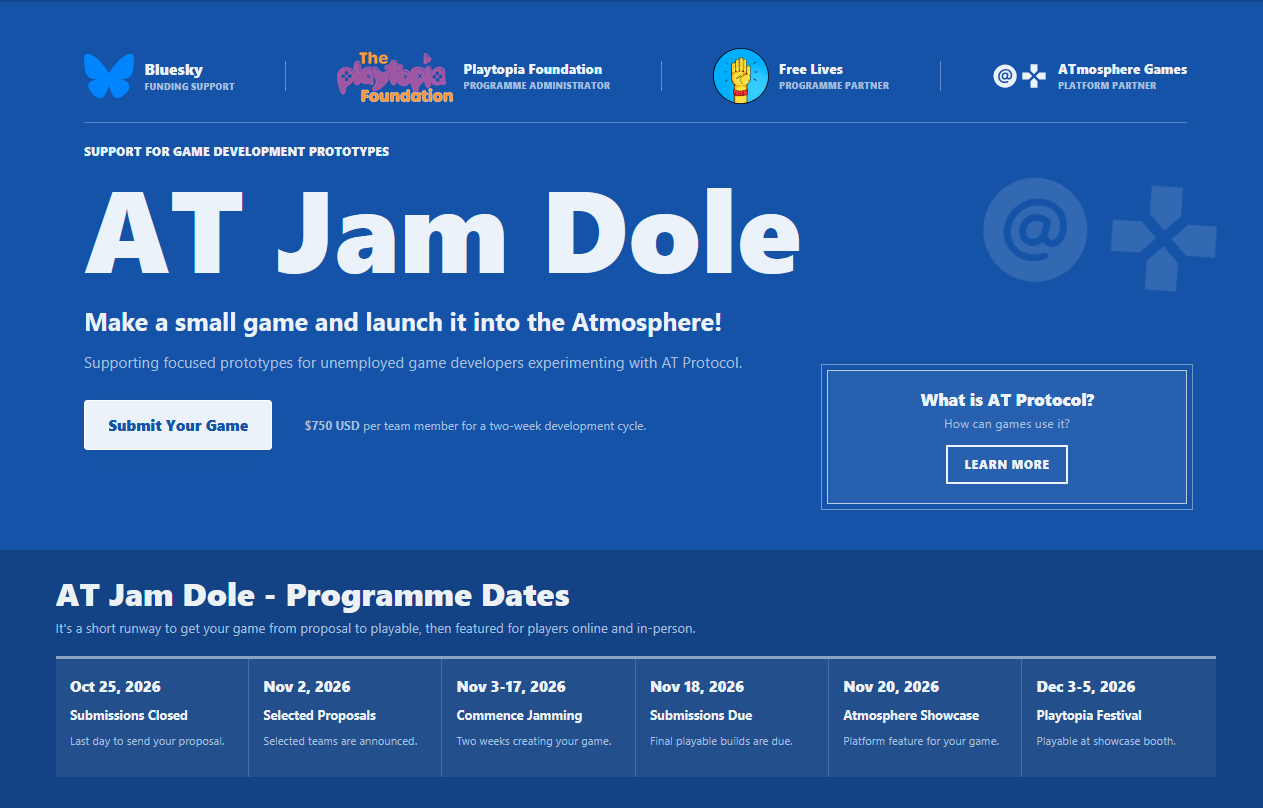 AT Jam Dole - ATmosphere Games
International prototype funding for small, playable games. Supported by Bluesky through the Playtopia Foundation, in partnership with ATmosphere Games.
 Home | Free Lives
Free Lives is an indie game dev studio based in Cape Town, South Africa.
 Building an atproto link aggregator | jola.dev
As a little passion project I built an atproto link aggregator service in Elixir and this post goes into some detail about why I'm doing this and how it works.
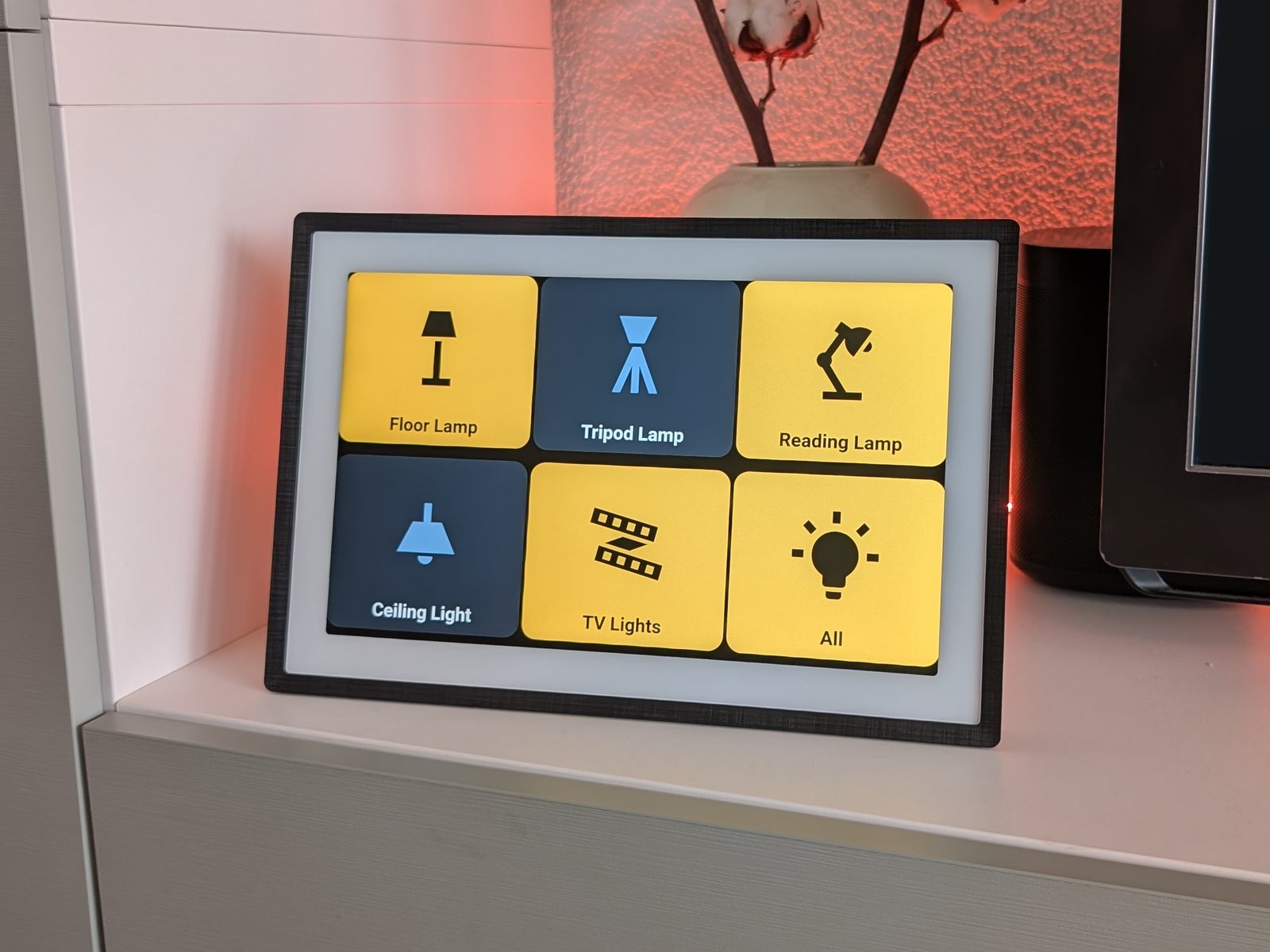 Turning a Photo Frame into a Local Light Switch
A locked-down Android photo frame turned into a local-first light switch and family photo frame, with FreeKiosk, Immich Kiosk and Home Assistant.
- Policies — pyroclastic.cloud
The terms of service, privacy policy, cookie policy and security policy for pyroclastic.cloud.
 pyroclastic.cloud — your identity on the Atmosphere
pyroclastic.cloud hosts Atmosphere identities: independent, carefully run personal data servers on the AT Protocol. Vesuvius is the first.
 Entryway operator guide — running atproto-entryway
Operating atproto-entryway: the account service and OAuth authorization server in front of one or more PDS instances. What it owns, keys, pairing a member PDS, the full environment reference, reconciliation, and the traps.
- Needle 3 - 8-29 MB foundation model for tiny devices | Cactus
A foundation model for mobile, wearables, robots, smart home, automotive and microcontrollers. One 8-29 MB binary that beats models 10x its size on mobile tool calls and matches 2-3x bigger models on extraction.
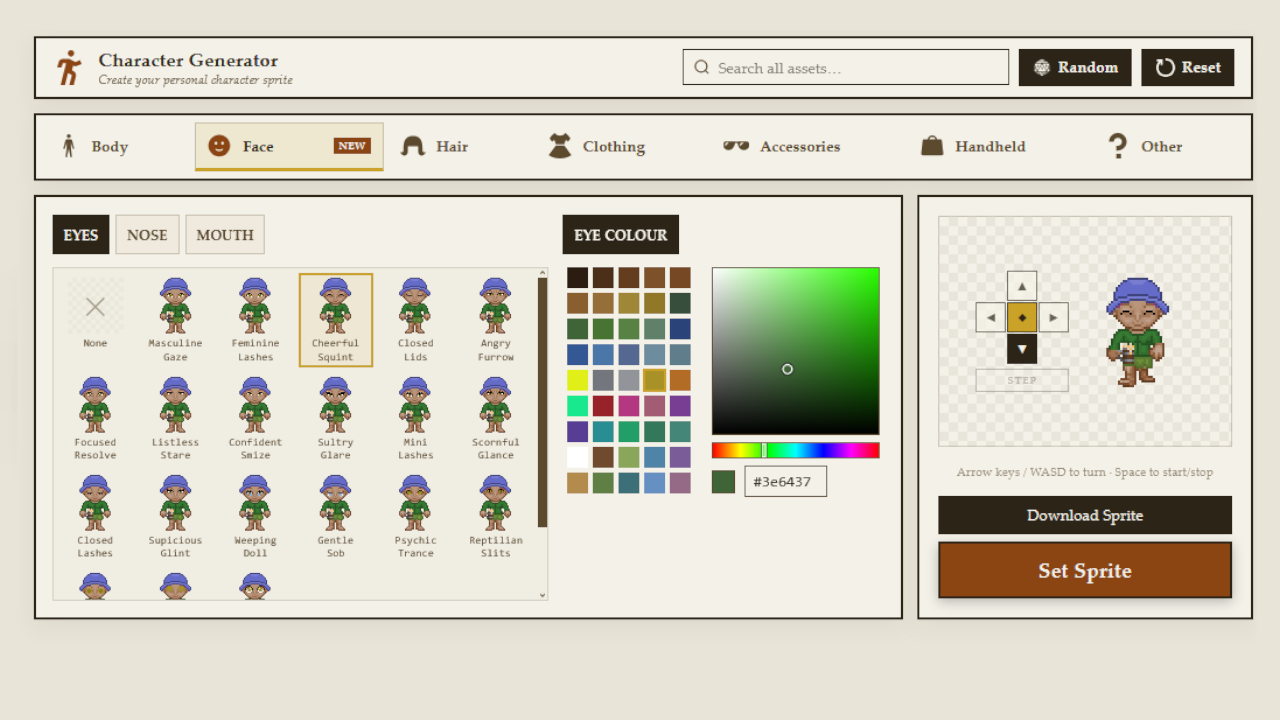 Sprite Generator - RPG Actor
Create pixel art character sprites for your RPG characters on the universal roleplaying character compendium.
 Deep Future
AI-driven scenario planning
 19:00 Uhr Live - Decent Code Collaboration Concepts after Git(Hub)
talks: "Introduction to the evening and tangled" - ligi "Radicle. The distributed code network." - Eleftherios "Code Collaboration Concepts with jj" - jan-erik and we end the night with a fireside ...
 Spaces · vlpds docs
Permissioned data on vlpds: every member keeps a private, signed space repo on their own PDS. It never reaches the firehose, and reading it takes a short-lived credential chain.
 Shop
ShopLimited Edition Scores, Records, Tapes, and Merch are available for purchase. Support artists directly. Welcome!
 How to fix the eSIM eUICC on a Google Pixel running GrapheneOS
Phone mods are rarely ever simple. Thankfully we have the XDA community.
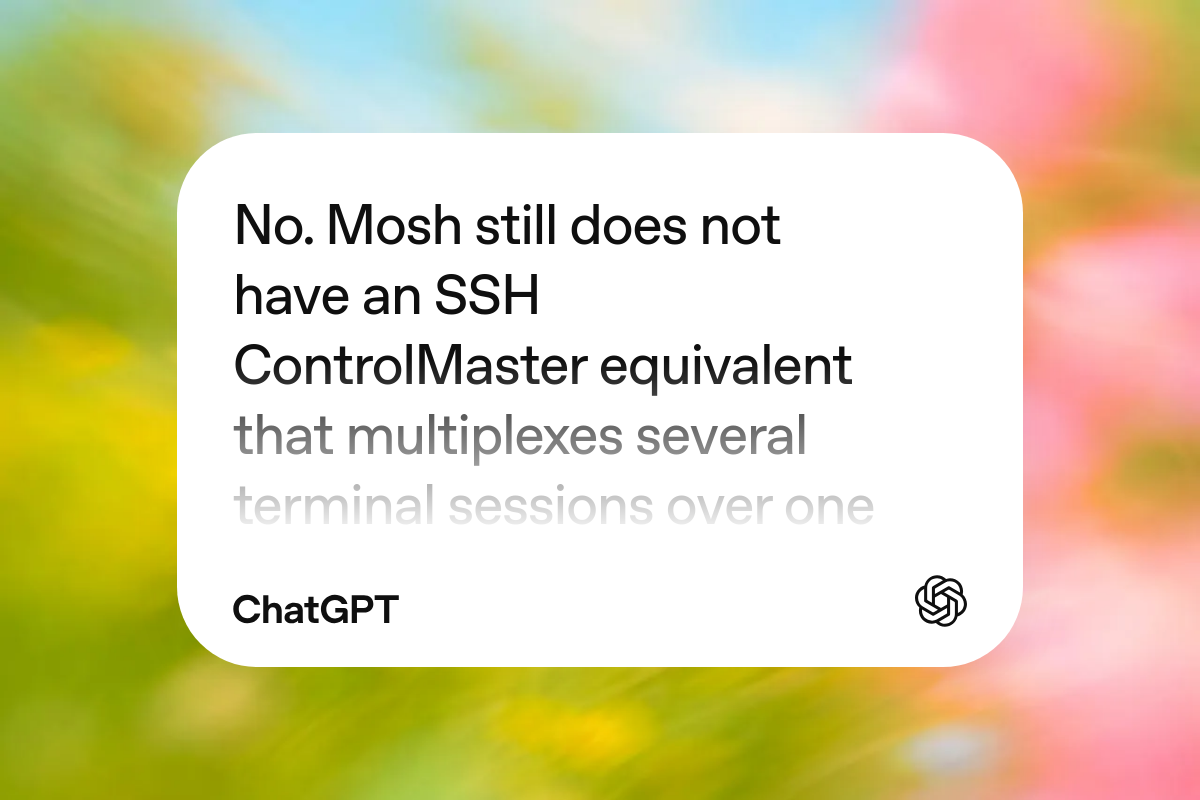 Check out this chat
Here's a chat someone thought you'd want to see.
 ATmosphere Games
Your games. Your data. Your control. Fun experiences that are yours to keep!
 Aster ID
An account and hosting for researchers on the open web — a place to build and own your identity, website, data and connections. Not-for-profit, built by researchers, for researchers.
- Alana Neely and Tynan Purdy's Wedding Website
The wedding website of Alana Neely and Tynan Purdy
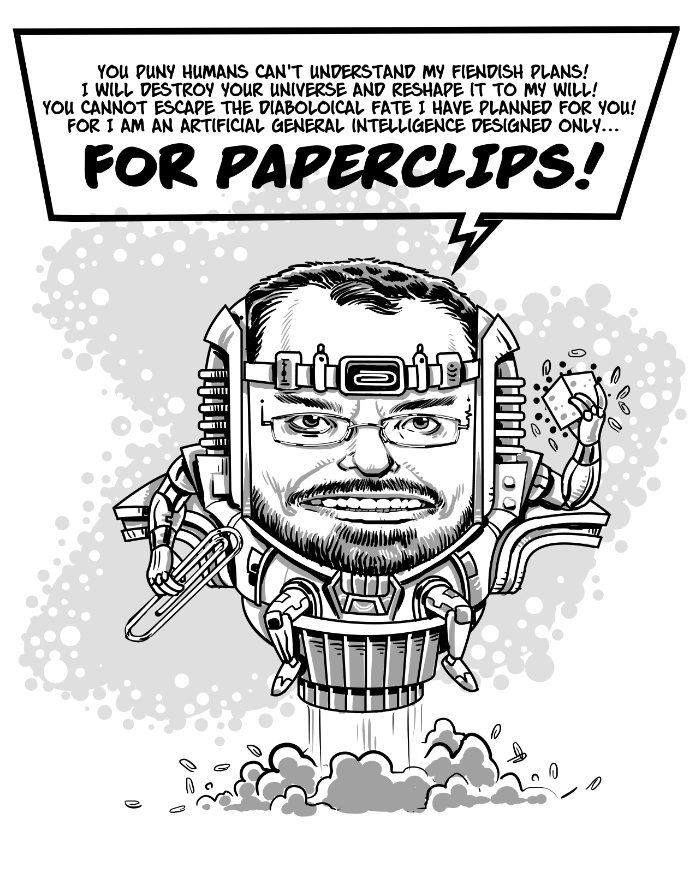 Tracing the rogue ideology of the frontier labs to their product choices
A drawing of Eliezer Yudkowsky as the Paperclip Maximizer that I commissioned back in 2016 and have had an alarming number of chances to use since This is a...
 This Week in Open Source for October 2, 2026
Explore Gemma 4 12B inference math, local RAG with LiteRT, Google's EnvHarness, Mozilla & Mila's open AI stack, and October OSS events.
- STAR: ordered key-value archive format #21
Hello! I'd like to propose new work for DASL: the [STAR](https://tangled.org/microcosm.blue/star/tree/main/v1-star) (/STAR-lite) archive format. I originally made STAR as a stricter, simpler, safer, more efficient alternative to CARs for atproto public repository exports. Its v0 now has several library implementations and has at least two production producers and half a dozen consumers in the Atmosphere, but is very atproto-coupled. STAR is [being considered](https://github.com/bluesky-social/proposals/pull/114) as the standard format for [atproto spaces](https://github.com/bluesky-social/proposals/tree/main/0016-permissioned-data) repo exports. After iteration with @dholms.at and @bnewbold.net, STAR's spaces-compatible v1 is becoming a more general-purpose format for ordered key-value data, and I think, a potentially good fit with DASL. Following the DASL governance [steps for proposing new work](https://dasl.ing/governance.html#:~:text=Proposing%20New%20Work): ## What will be im
- Release Colibri Social 0.6.0-spaces.2 · colibri-social/colibri.social
A preview build of Colibri with spaces support. Expect rough edges and data that may be reset between previews. iOS and iPadOS We're still waiting on Apple to approve the builds for TestFlight. Fo...
- All tiles · appmosphe.re
Browse the Web Tiles published on the AT Protocol: find tiles by name, description, or author.
- Botanist | Beacon Bits
@byjp.me dropped a beacon at Botanist.
 Max Woolf (@minimaxir.bsky.social)
AI generated video aka BLISS about the WindowsXP desktop and going outside.
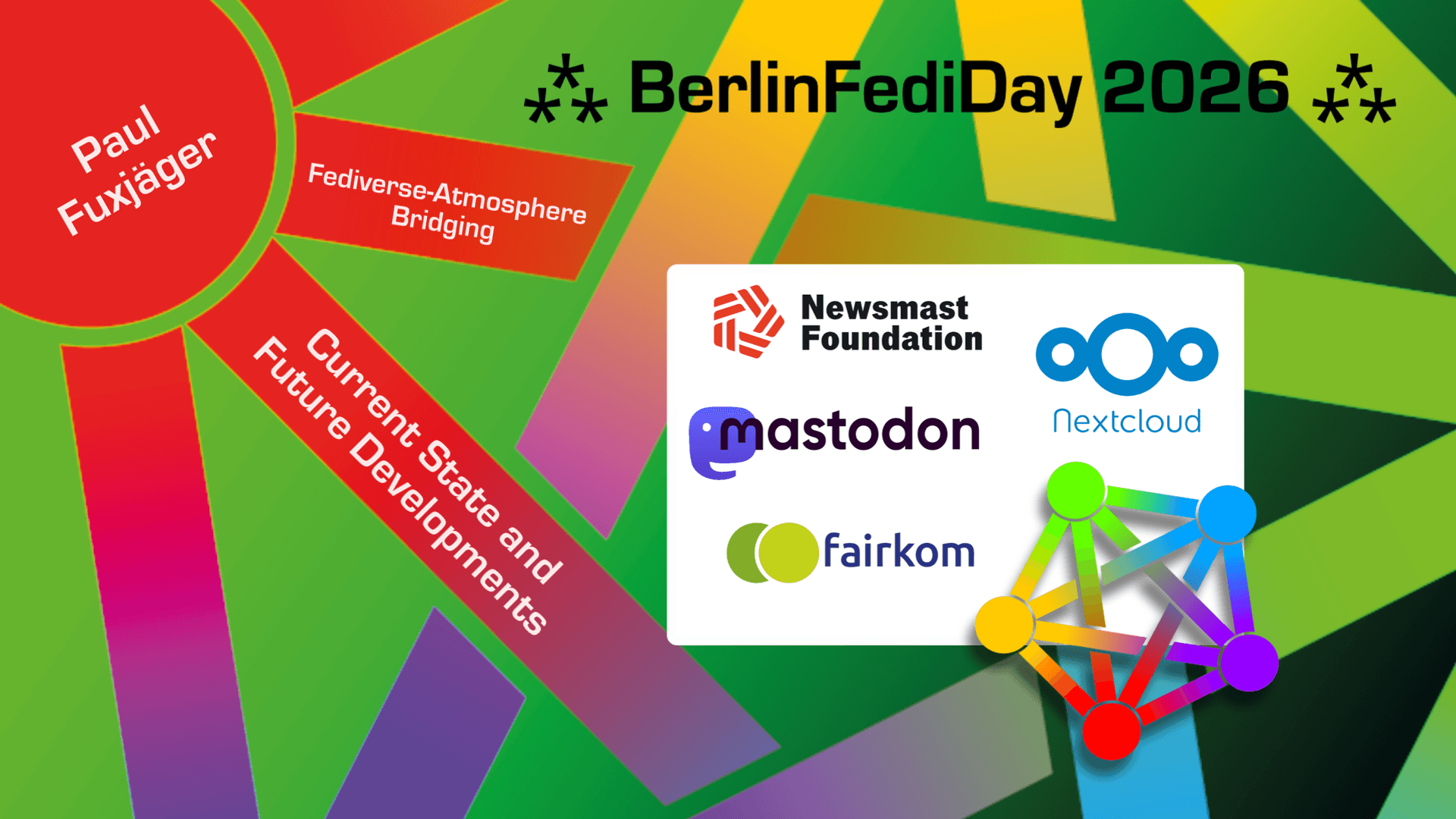 Paul Fuxjäger - Fediverse-Atmosphere Bridging - Current State and Future Developments - FediDay2026
Fediverse-Atmosphere Bridging - Current State and Future Developments https://ctalx.c-base.org/fediday-2026/talk/7TCSDZ/

- moja.blue/blusco
A Bluesky client for the Mac that does not use follows. フォローを使わない、Mac の Bluesky クライアント
 Ode to the code
Forgejo is a self-hosted lightweight software forge. Easy to install and low maintenance, it just does the job.
 Codeberg.org
Codeberg is a non-profit community-led organization that aims to help free and open source projects prosper by giving them a safe and friendly home.
 GeeseGoose Media Co-Op (@[email protected])
190 Posts, 43 Following, 55 Followers · We are a small producer co-operative based in [so-called] British Columbia, Canada. Our members love crafting and being creative, and the co-op exists to help them sell their wares and have space to be themselves! We love community and Free-Culture. Honk! Account managed by @[email protected]
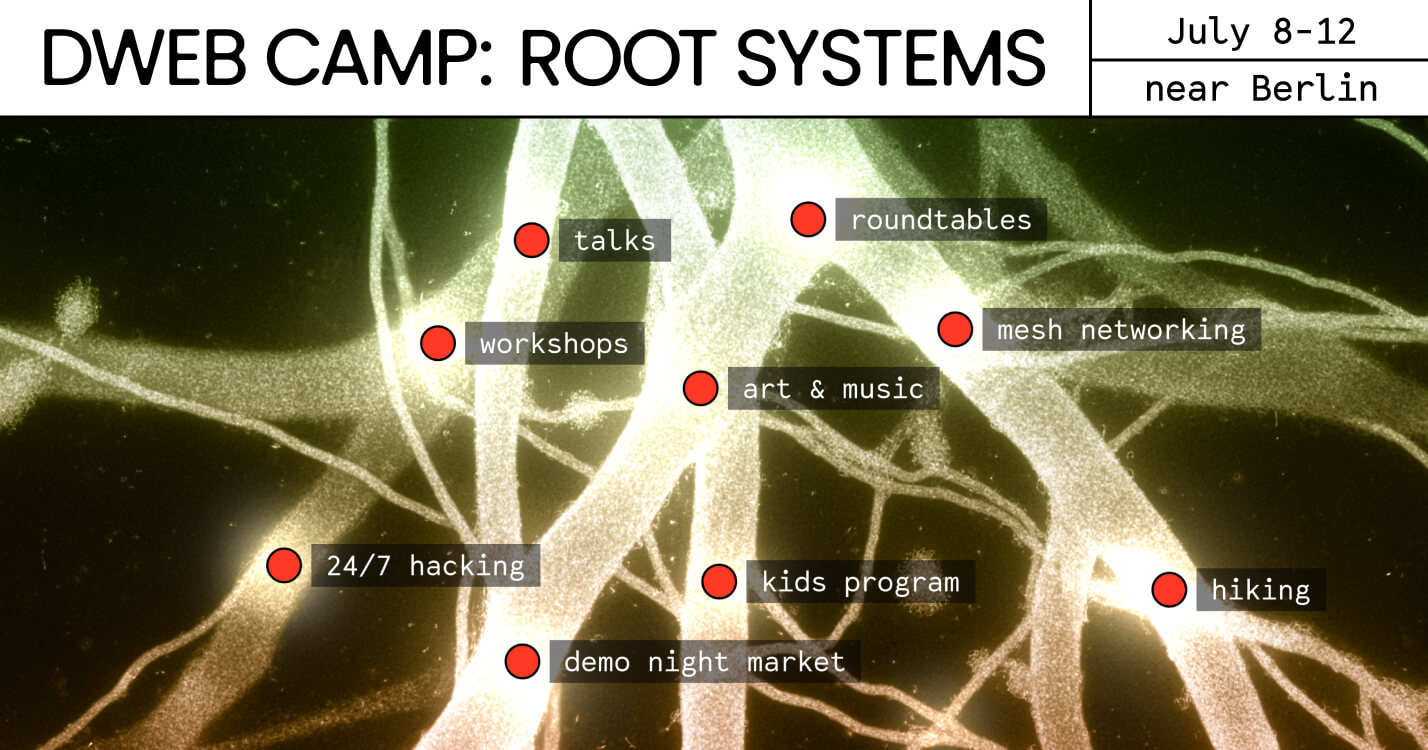 DWeb Camp: Root Systems
We invite you to join us at DWeb Camp!
- GitHub - nuta/ftl: A new operating system for clouds.
A new operating system for clouds. Contribute to nuta/ftl development by creating an account on GitHub.
- aly.codes/tg
An unofficial terminal client for Tangled, optimized for humans and agents.
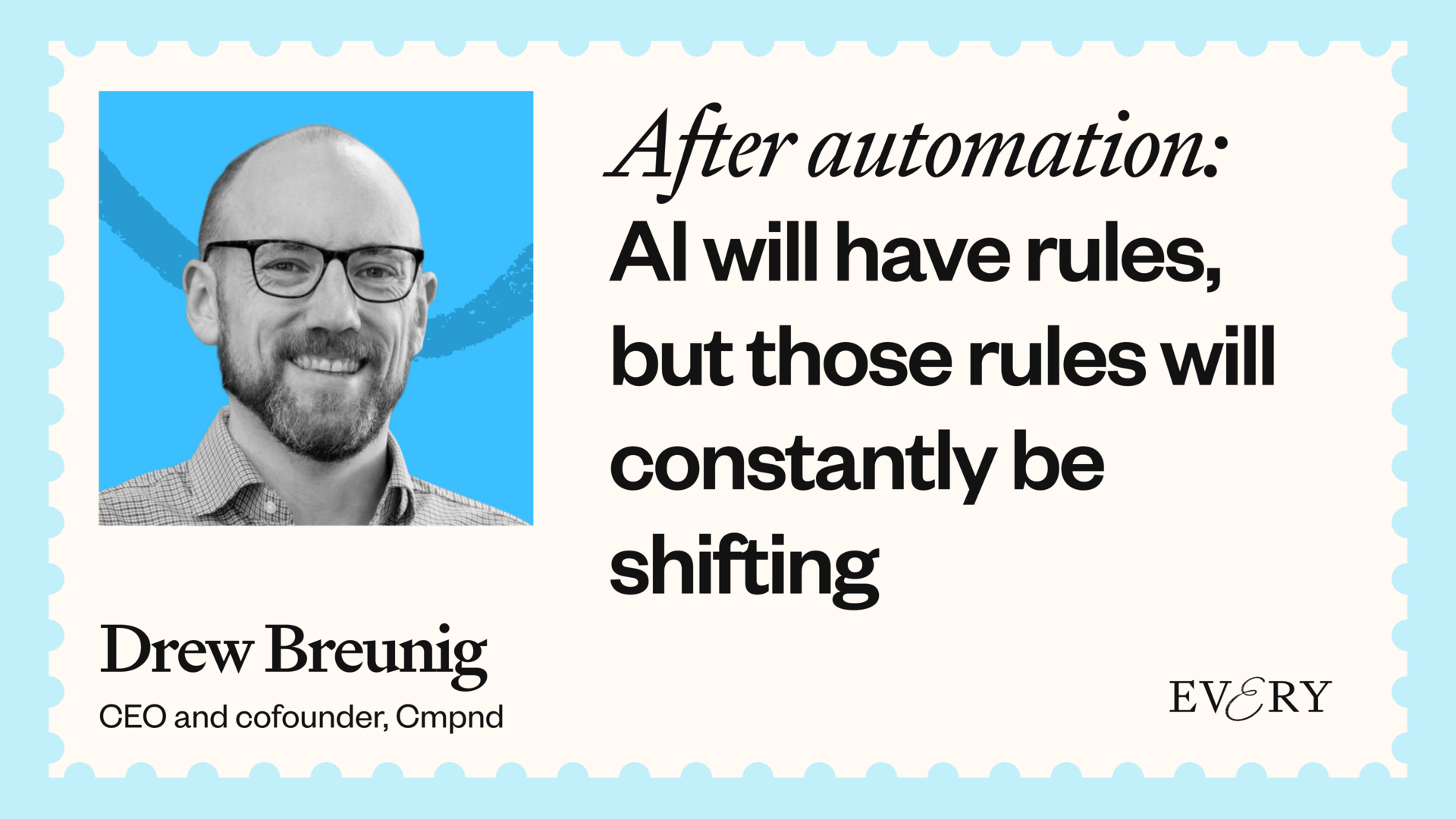 After automation: AI will have rules, but those rules will constantly be shifting
Drew Breunig, CEO and cofounder, Cmpnd — Every new model will mean a new interpreter—Claude and GPT read the same instructions through different priors, the way two judges apply the same law and reach different verdicts.
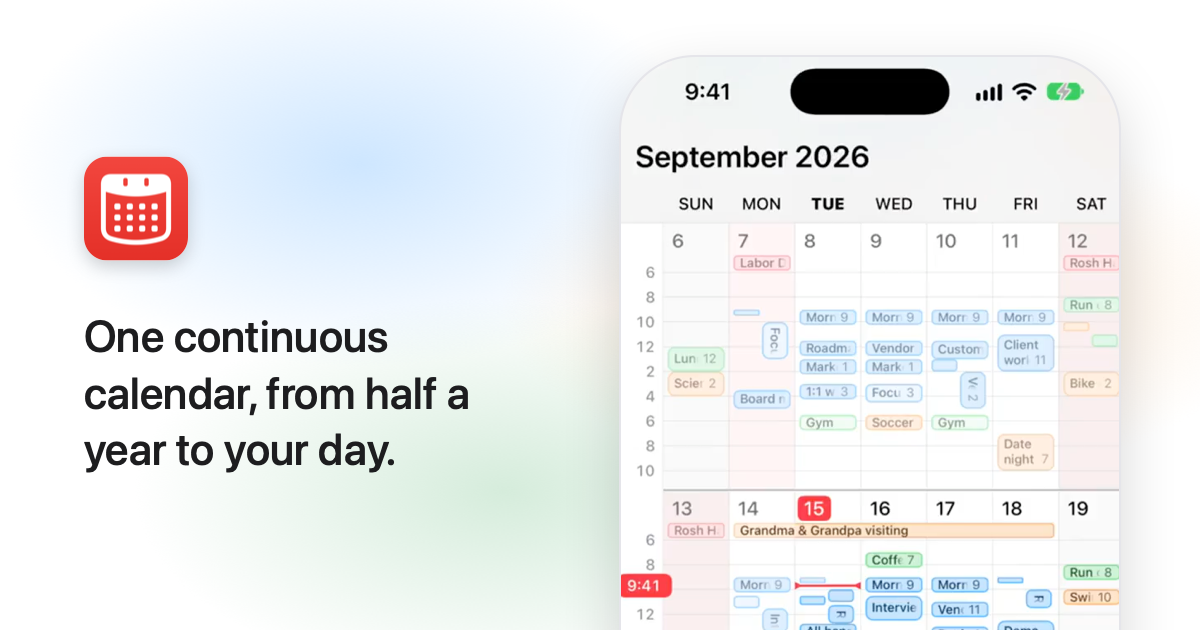 Riff Calendar: The calendar you zoom
An iPhone calendar you navigate by zooming: one calendar from half a year to your day, hour by hour. As direct as paper: hold a free slot, type the title, done.
- remember
For groups The final step in organizing group conversations about computer use is to commit to remembering what has been said before. And to say it again....
- worm-blossom
The website of worm-blossom, the creative partnership of Aljoscha Meyer and Sammy Gwilym. (We are sorry.)
- Your startup culture needs to act like a mosquito, not a termite colony
I'd like to talk to you about scaling. Specifically, startup scaling. At a high level, what you want is: A: more customers, more growth, more reach. You do this using: B: cost: hosting, staff, tokens, licenses, etc. Scaling is not minimising cost. Scaling is increasing external output faster than
 The real AI economy is being built by ordinary people
Far from Silicon Valley pitch decks, workers across Asia and Africa are bypassing tech industry hype to quietly rewire their daily jobs — one prompt, workflow, and local problem at a time.
 crates.io: Rust Package Registry
crates.io serves as a central registry for sharing crates, which are packages or libraries written in Rust that you can use to enhance your projects
- teal.fm - Your music journey, beautifully tracked
Track your music listening across all platforms with teal.fm - The most beautiful way to scrobble and analyze your music history. Coming soon.
 atproto Vienna Meetup
discover and attend events
 The Only Moat is Taste - AT Protocol
Ricardo Méndez is a technologist, advocate and investor who’s been working on the decentralized web for years. He joins for a conversation about how to think about building sustainable businesses on a network that upends all of our assumptions.
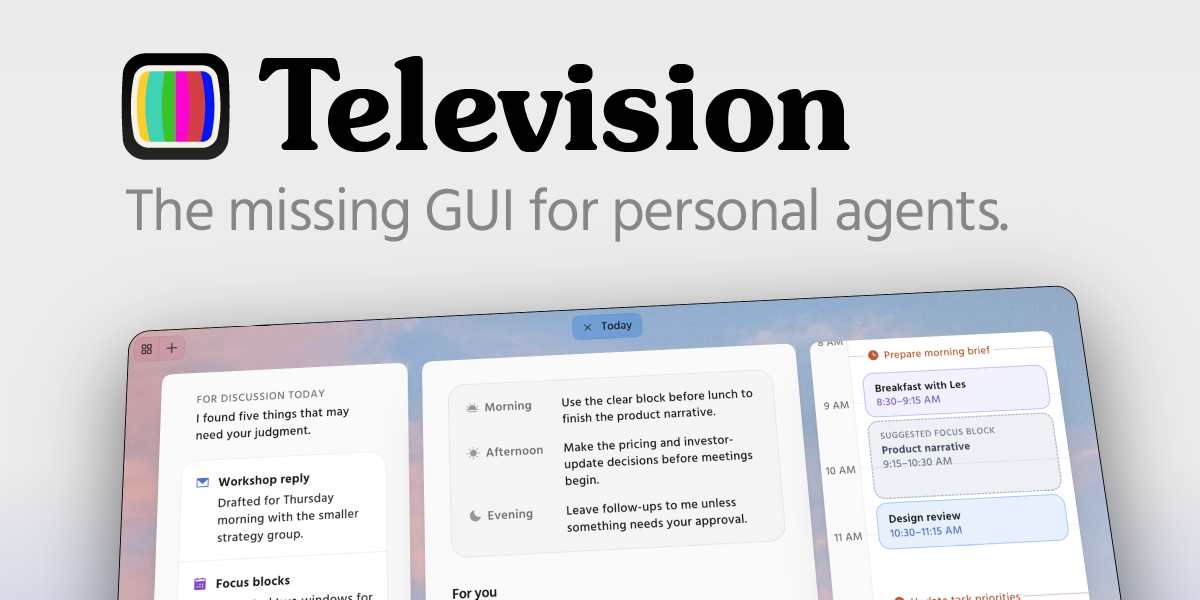 Television
Television is a visual interface for personal agents, a space for creating, arranging, and reusing artifacts.
- depatchedmode/oughta
Agent skills by my friend @depatchedmode.bsky.social - Focus is local-first and p2p stuff written in rust.
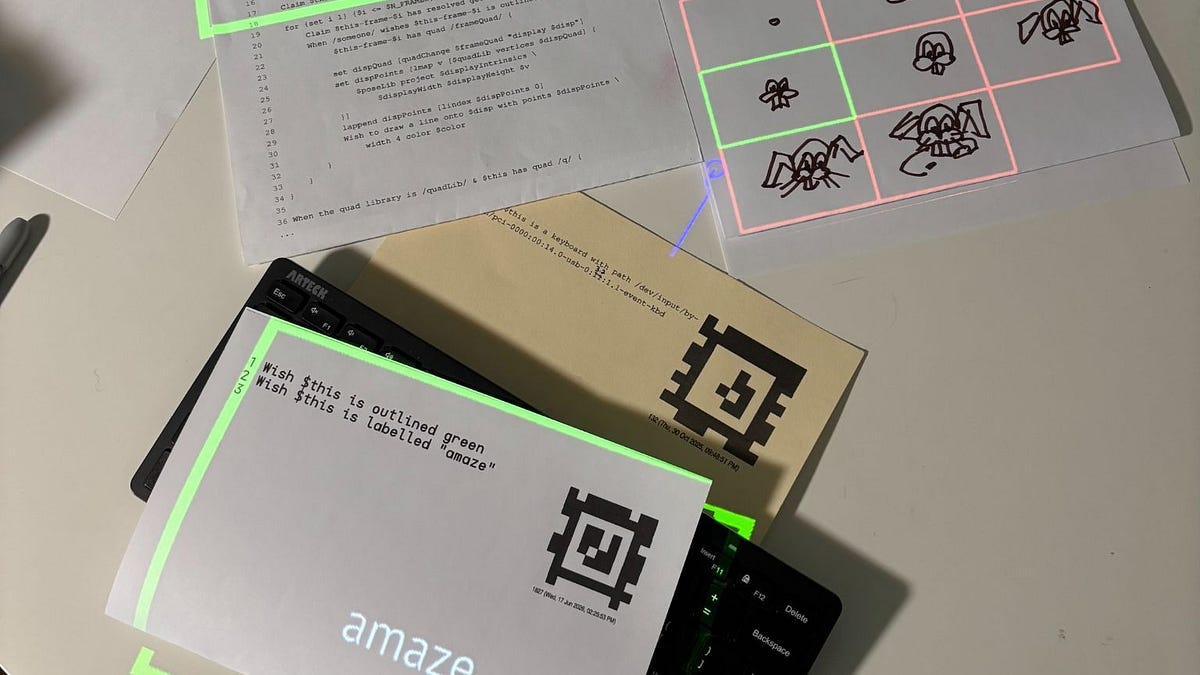 Against Usefulness
Great article by Oana Olteanu “Against Usefulness” that centers @folkcomputer.bsky.social while describing “the stage before useful, who works on it, and who pays for it, so that the next generation of useful companies has something to stand on”
 Migrating from 1Password to Bitwarden | jola.dev
After 1Password's recent political statement, I canceled my subscription and switched to Bitwarden.
- Sci-Fi Classical
Get into the orchestra Marty, we're going back to the future. Neo Tango, Neo Classical, Future Music.
 How Big Tech Becomes Ungovernable
Big Tech companies like Google, SpaceX, and Meta aren't just monopolies—they're becoming ungovernable through tech extensivity. Why €4B in fines went uncollected.
 Atproto spaces alpha updates
Okay as promised, we just cut another spaces alpha releast today! This includes the credential & sync changes that I listed above plus a small API field rename in listSpaces and simplespace.createSpace. There are several breaking changes, and I expect this to be a more disruptive rollout than the last one. The rollout will update the hosted psaces alpha PDS, the Docker image at ghcr.io/bluesky-social/atproto:pds-spaces-alpha and the relevant npm packages. For folks running their own PDS, this r...
 The Medaka AT Protocol PDS
A Bluesky PDS written entirely in Medaka, a functional language that didn't exist four months ago: hand-rolled crypto, new integer types, and effects that prove what the server can touch.
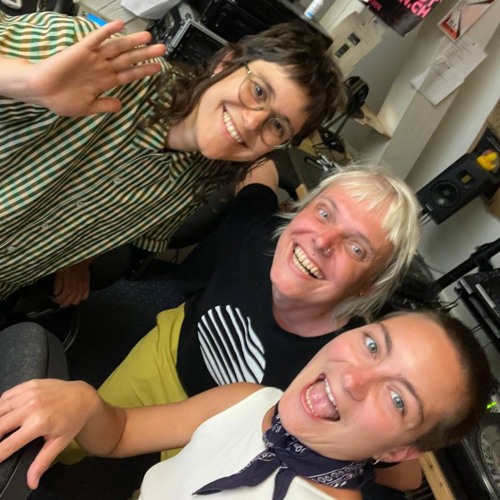 Salon Vert: Hilke Ros im Gespräch über dezentrale und demokratische Alternativen zu Social Media
Host: M Wirnsperger & Claude Bühler @candy_saendy Space: Salon Vert @salonvert Guest: Hilke Ros Salon Vert, ein Raummoment - oder was darin entsteht. Jeden dritten Sonntag im Monat findet ein Zusamme
- Software You Can love
celebrate the art of creating software for humans
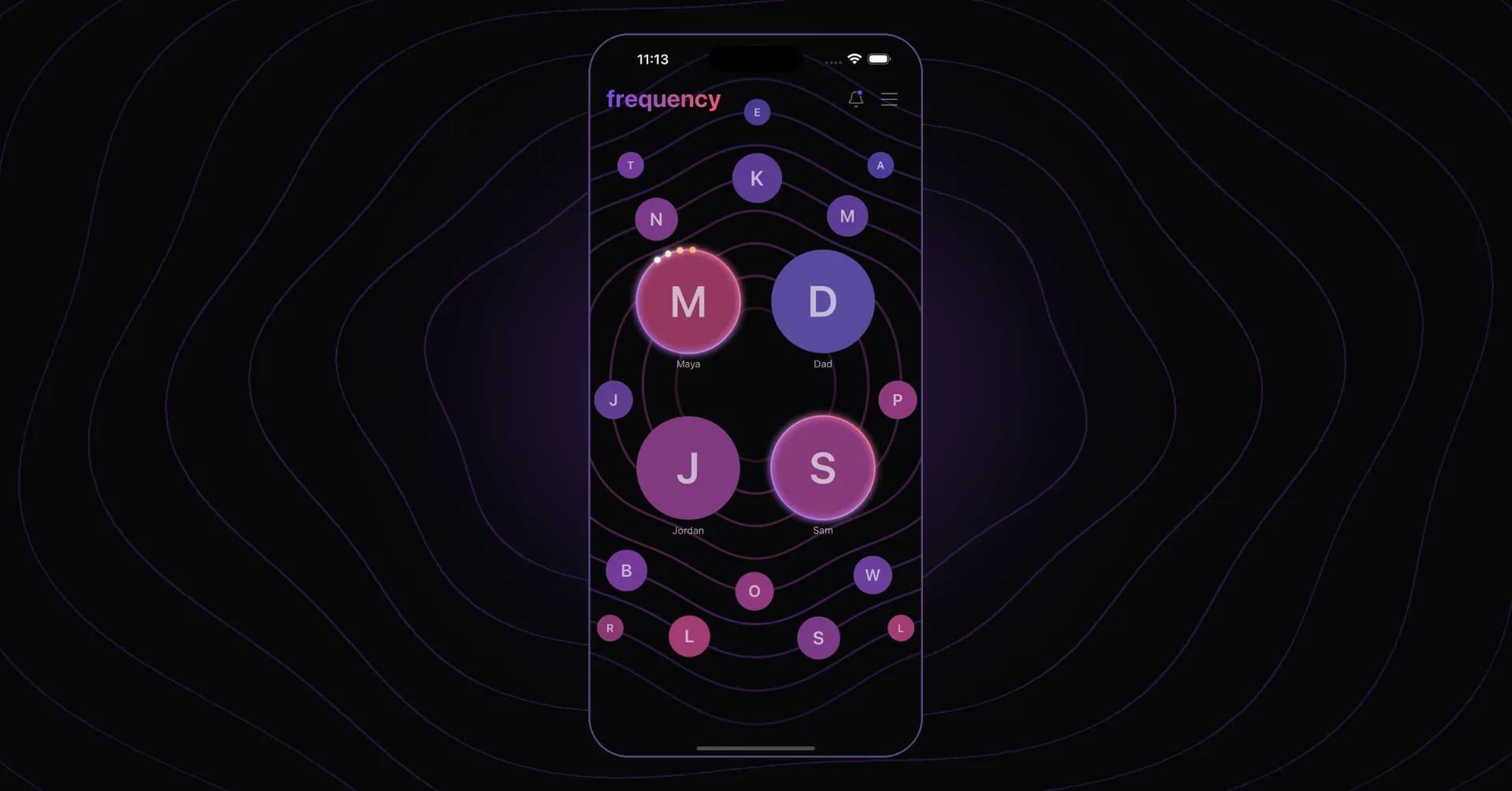 People, Not Feeds - transmissions from the atmosphere
How to move from addictive design to connective design
 Pi 1.0 | Earendil
Today we are shipping Pi 1.0, a hardened, minimal, extensible agent harness, alongside Pi Durable, a new experimental substrate for long-running agentic applications.
- ATFISL — content discovery with the AT Protocol
How ATFISL publishes CID locations as dev.fisl.at records on the AT Protocol: the record, the record key, the Lexicon, and indexing.
 The Dot and the Swarm
Benefitting from the Bitter Lesson
 Common Snail | Monthly Mail for People Running Something
Real, physical mail for business owners, leaders, and community organizers. Templates and tools for the work, art and writing for the human doing it. Sliding scale pricing.
- GitHub - gufo-org/gufo: Strix Halo inference engine. Qwen Flash Next Q4_K_XL: 1,628.52pp, 59.41tg single user, 157.22 tok/s 8 users; Qwen27B Q4_K_XL: 656.33pp, 70.56tg tok/s single user with DFlash2
Strix Halo inference engine. Qwen Flash Next Q4_K_XL: 1,628.52pp, 59.41tg single user, 157.22 tok/s 8 users; Qwen27B Q4_K_XL: 656.33pp, 70.56tg tok/s single user with DFlash2 - gufo-org/gufo
 Just Enough Governance: Introducing Steward Governance for DASL
When we started working on DASL, it was little more than an experiment. We talked to as many people as we could who had been interested in content addressing but couldn't make it work for their needs. The result was radically focused on interoperability and adoption, on a mission
- pub search
search standard.site publishing platforms
 Atlas
AtlasA living map of what Bluesky is talking about: the past week's conversations, grouped into topics and regions and rebuilt every six hours.
- 2026 · Where We're At
An annual developer survey of the people building on the AT Protocol.
- opensocial.group/proposal
Proposal for Atmosphere Groups standard on atproto spaces
- Incubating Aster - Updates from the Modal Foundation
We at the Modal Foundation are excited to share the news of our support for Aster.id, a new home for researchers on the open web. Aster grows out of the ATsc…
 Eurosky Portal
Your Portal to the Atmosphere
- docs/models.md at main
List of providers / models that https://inference.coop uses ranked for privacy and green power source
“Providers differ along two independent axes: privacy (how protected your prompts and responses are) and green energy (how the compute is powered)”
- pldb: programming languages papers
Search 22,324 papers from POPL, PLDI, ICFP, OOPSLA and other programming languages venues, from 1973 to today.
- Post Capitalism
You know we don’t have to do this anymore, right?

- atprotowiki (Japanese)
atprotowiki Japanese edition
- atproto wiki (Brazilian Portuguese)
The atprotowiki - Brazilian Portuguese edition
- atproto wiki
The atproto wiki, English edition!
 GMKtec M6 Ultra
Boris Mann's digital garden and personal site.
 Protocols for Publishers ✨ Toronto
Join us in Toronto on Oct 5-6, 2026
- Parked — pyroclastic.cloud
This handle is claimed but its site isn't set up yet.
 Spacefast: Home for what your agent makes
Publish what you or your agent makes with Spacefast: share artifacts, host static sites, deploy web apps, manage versions, and use custom domains.

- The Lenfest AI Collaborative has additional funding. That's great for open source in news.
The Lenfest AI Collaborative lets newsrooms explore a new technology together - but more importantly, it gives them the muscle to open source their work and collaborate.
 How People Work, Live! ... with Jim Ray - Dan Hon
How People Work, Live! -- the live show about how to people, based on the How People Work workshop that helps teams deliver better, faster.Join Dan, a very special guest, and any number of interesting people for a free, candid, ad-hoc series of gatherings on Zoom where we find out how to get hard
 Stroopwafels for Everyone! - AT Protocol
The Atmosphere Conf 2027 organizers joined the livestream for some announcements about when, where, and what you can expect from next year’s conference.
- GitHub - NVIDIA/OpenShell: OpenShell is the safe, private runtime for autonomous AI agents.
OpenShell is the safe, private runtime for autonomous AI agents. - NVIDIA/OpenShell
- Pools: Our Newest Primitive - exe.dev blog
A new way to group VMs, with shared resources and predictable pricing. Plus new Personal and Work plans.
- First steps of the PLC organization - Public Ledger of Credentials Organization
One year ago, Bluesky Social PBC announced their intention to facilitate the creation of an independent organization to operate the Public Ledger of Credenti…
- GitHub - tobilg/neoserver: Multi-workspace geospatial server in Go: OGC API - Features and Tiles, WMS 1.3, WFS 2.0, WCS 2.0.1/2.1 and WMTS 1.0 for PostGIS, DuckDB, GeoParquet, vector files and GeoTIFF/COG
Multi-workspace geospatial server in Go: OGC API - Features and Tiles, WMS 1.3, WFS 2.0, WCS 2.0.1/2.1 and WMTS 1.0 for PostGIS, DuckDB, GeoParquet, vector files and GeoTIFF/COG - tobilg/neoserver
 How Notion handles concurrent editing with CRDTs
Building a CRDT-based rich-text system that merges concurrent edits across Notion blocks—without losing anyone’s work
 2026 in LLMs (so far)
On Friday I gave the closing keynote at the WeAreDevelopers World Congress North America in San Jose. I tied together the key trends from the past year into a chronological …
- Bobby Grayson - Deciduous
devtools.fm: Developer Tools, Open Source, Software Development · Episode
- Peanut Gallery — Vancouver City Council
Vancouver City Hall records every public meeting and publishes the video. But the recordings are buried, unsearchable, and nearly unusable as-is.
Peanut Gallery transcribes the audio, attributes every speaker, tracks every vote, and writes plain-language summaries — all sourced from the city's own record.
 Air
AirAir is an end-to-end encrypted messenger which is designed to require as little personal data as possible. Air doesn’t register any personal data (like a phone number or email address) when you create an account. When you add a username, it isn’t linked to any data that could identify you
 Inference Cooperative — AI, governed together
Co-operative sharing inference built on Cloudron, LiteLLM, OpenWebUI by MetaGov @ntnsndr.in
 The Lightbulb Computer — Reimagining Spatial & Ambient Computing with Projectors
A new direction for computing: projecting information into the real world to augment it, with a device that combines a projector and computer vision in the shape of a large lightbulb.
- Fool's Expertise | The Observation Deck
I listened to the recent Ezra Klein interview with Nvidia CEO Jensen Huang, which seems to be something of a Rorschach test for AI doomerism: if you are inclined to see doom, Jensen sounds dismissive, but if you (like me) do not fear for the future of humanity at the (metaphorical!) hands of a computer program, Jensen’s responses seem very reasonable. (With some exception: does this guy really not know his own zip code?!)
- Atlas
Explorable “Atlas” of posts & conversations on Bluesky, clustered by topic
 Open Social Media: Eine Einführung auf Deutsch - Hilke schreibt
Im Dezember 2025 wurde ich vom Musikbüro Basel eingeladen, einen Workshop über Alternativen für Big Tech im Musikbereich zu leiten. Der Workshop wurde aufgenomm...
- Fast Note Sync
"Real-time sync of your vaults across server, mobile, and web; shareable with anyone; supports REST and MCP integrations to build your personal AI knowledge base."
- Agent Client
Community #obsidian-plugin that talks ACP in your notes.
 Monday, October 5th
#vancouver conference about building software
- GitHub - tkellogg/dsh-rlm: DeepSeek Harness plugins for RLMs & program agents
DeepSeek Harness plugins for RLMs & program agents - tkellogg/dsh-rlm
 atfs
atfsLarge file storage for the AT Protocol
IPFS with an XRPC upload and admin API
- Lichen
Build a knowledge base with friends. Wikis owned by you, built on ATProto.
 What Even Is An OS Now?
Computers now work the way I thought they did when I was 8. What does computing look like when most applications have an audience of 1-2 people? I'm leaving Fly.io to build a phone for that world.
 Fly · Computers for agents
Sandboxes aren't enough. Give your agent a real computer and get back to building.
 Fifteen years later, the Apple Cards origin story
A story of the launch of Apple print on demand cards
- GPT Cloud Cover
Over on Bluesky, Zerodartz comments on the deluge of LLM-spewed content that’s already happening, and only likely to get worse: AI will be 99.9% of content in internet in a few years nobody is...
 HackerBox 0068: SAO Showcase
HackerBox 0068: SAO Showcase: Hello HackerBox Hackers! Are you ready for the summer?Are you ready for the badgelife?Are you ready for the Villages,The CTFs,And a whole lot of hackin' around? HackerBox 0068 is a showcase of electronic badge add-ons. We will assemble fifteen fabu…
- What Even Is An OS Now?
Ex fly.io people starting a project to make a new OS / a new phone.
 Seven Takeaways on Convenience and News - Nieman Reports
In “Against Convenience,” Nieman Fellow Gabe Bullard delves into modern media consumption habits
- DAWO.community
NixOS based distribution being made by the Dutch government
“ DAWO is not a single product and not a closed suite. It is an open blueprint and a community around an autonomous digital workplace. Components can be developed, replaced and inspected independently.”
#nixos
- A Malleable Diffuse | tokono.ma
@tokono.ma has been building and rebuilding Diffuse, his music playing app, for 15 years. This latest version is built with malleable software principals, including #atproto lexicons.
- Atmosphere Conference News
News and updates email newsletter & standard site about AtmosphereConf 2027
#atmospherconf2027
 Getting my books onto BookHive | Danny Smith
How I moved my reading history off Goodreads and onto my own AT Protocol data with BookHive, and had Claude Code clean up 389 books along the way.
 smol farm
smol farm is an independent entertainment studio making books, games and apps. Home of Xorientation, Four Corners and more.
- Caloverlap - Calendar Overlap Finder: plugin Cal.com and Calendly links to find open slots, which was vibe-coded with Lo
Caloverlap - Calendar Overlap Finder: plugin [[Cal.com]] and Calendly links to find open slots, which was vibe-coded with Lovable.
This is terrible but also sort of correct?
[[Rallly]] is an existing availability poll. Requires licensing but is AGPL3. - Cal.com went closed source and forked off Cal.diy as MIT.
[[Cal.com]] went closed source and forked off [[Cal.diy]] as MIT.
So… I could just create my own OIDC plugin for it and connect it up to atmosphere accounts?
Calendaring is definitely the final boss.  DASL: Governance of the DASL Project
The goal of the DASL Project is to develop content-addressing primitives and the technologies that build on them, with a view towards enabling unbundled software and protocol architectures that best align with and promote democratic systems.
 BISCUT | AI Chips for Edge
The BISCUT Coldfoot microchip brings AI to the ultra-low-power edge with biological efficiency.
 Tiles & Solstone Private User-Testing
We’ll be hosting a private user-testing event for Tiles, a local-first collaborative AI assistant, and Solstone, a personal memory platform. If you received a sponsored ticket to IndiaFOSS 2026 through the Tiles × Solstone giveaway, you’re invited to join us! Please bring your laptop and any other supported devices, with Tiles and Solstone installed and ready to use. We’ll meet at Big Bean Café, Koramangala (25 minutes from NIMHANS Convention Centre) for the testing session, followed by an informal meet-up at Chin Lung Resto-Bar (walking distance from Big Bean Café), where other OSDC alumni will also be joining us for drinks. All food and drinks are on us :) If you run into any issues with installation, feel free to contact us. Download links for Tiles and Solstone are included in the description. Device support: Tiles works best on macOS and Linux and currently has limited support on Windows. Solstone supports macOS, Linux, Windows, Android, iOS, and Apple Watch.
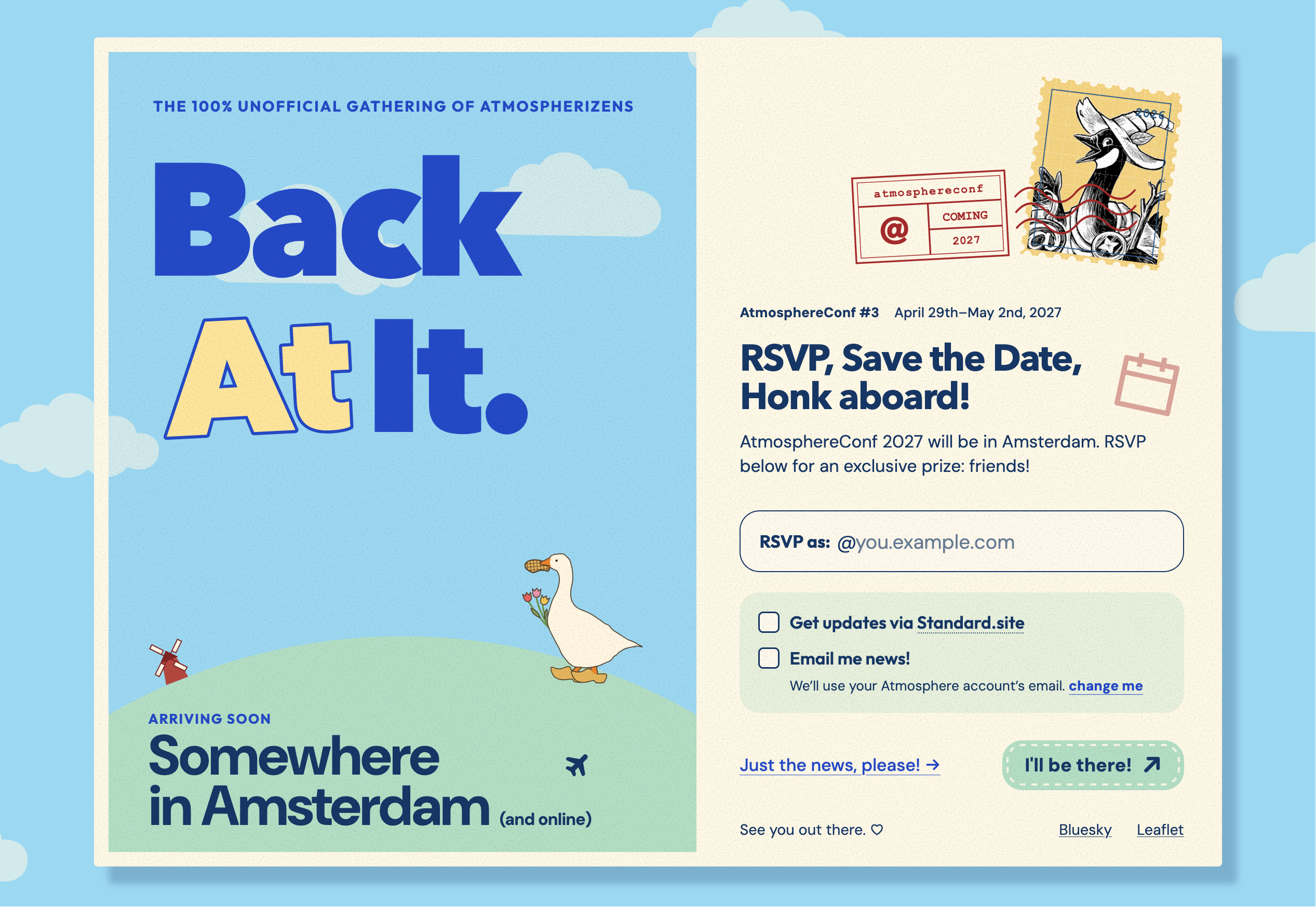 Back At It — AtmosphereConf #3
AtmosphereConf #3. Spring 2027. Somewhere in Amsterdam (and online).
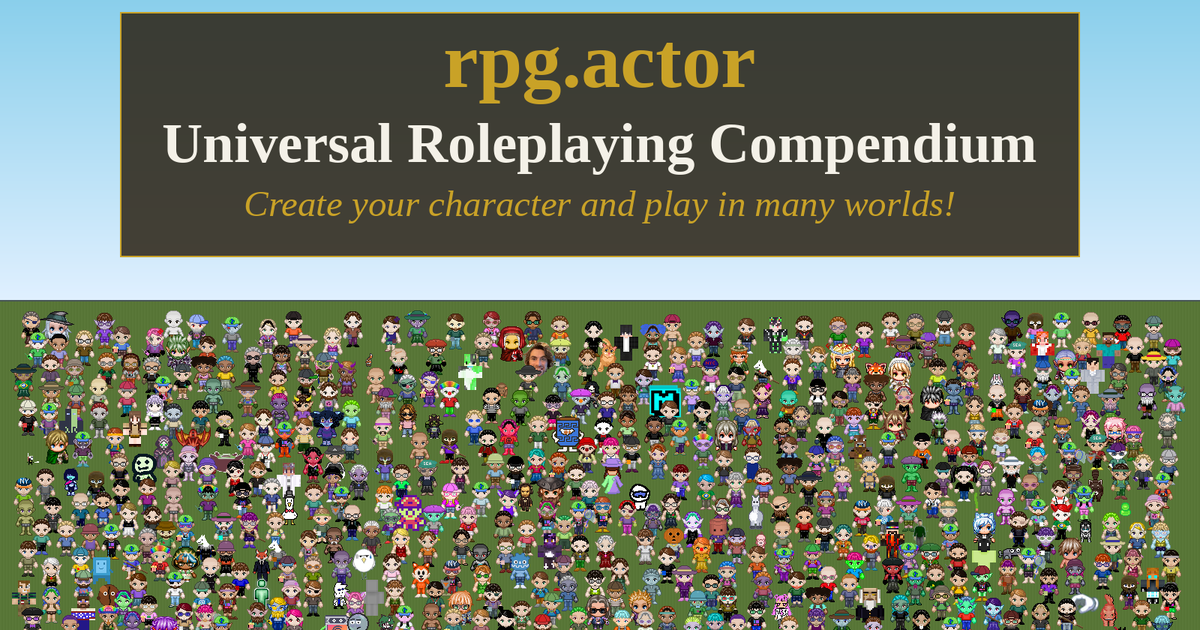 rpg.actor — Your universal roleplaying character!
Create your rpg.actor today and play in many worlds across different tabletop systems, video games, and online experiences.
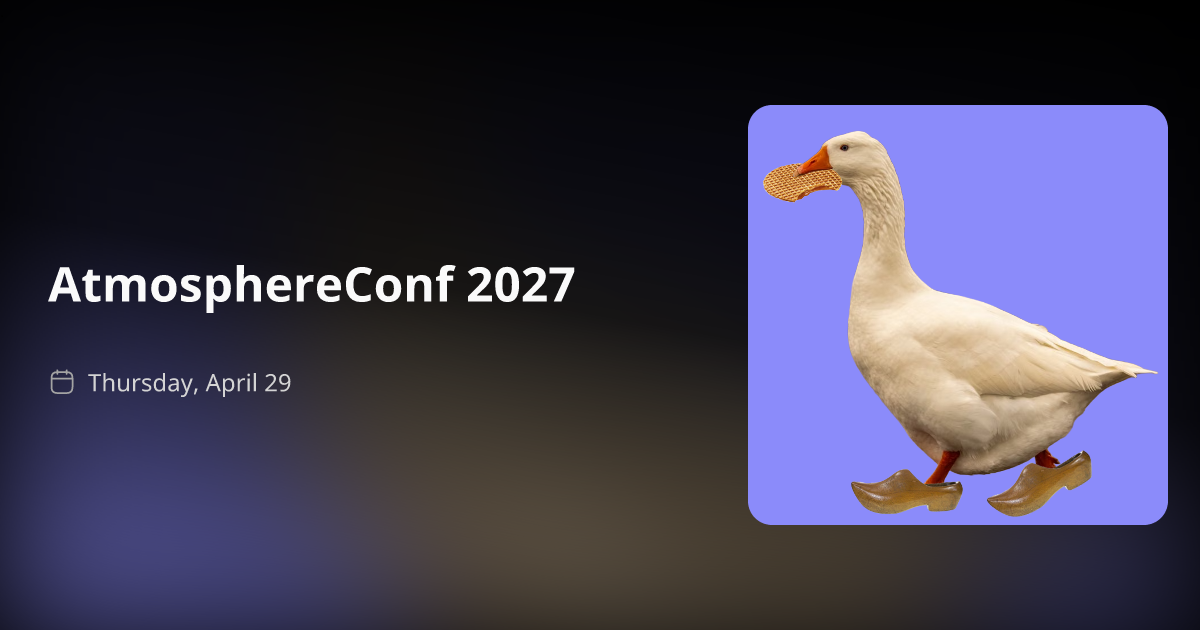 AtmosphereConf 2027
The third edition of the global gathering for the Atmosphere Community is taking place in Amsterdam, April 29th - May 2nd. This includes side-events and main conference days. Please RSVP with your interest, subscribe for updates at https://news.atmosphereconf.org, and watch us build out the website with lots of fun features https://atmosphereconf.org As well as in person, we'll also be streaming and have different ways to participate remotely. Atmosphere Conference is run by the community, for the community, as an annual global gathering to connect, share, celebrate, and learn from each other. We welcome newcomers and want to engage with new perspectives. It's a community home for builders, supporters, and participants in the atproto ecosystem. We maintain collective resources, seed projects, and convene our community to ensure every member has genuine voice in shaping the ecosystem's future. #atproto #atmosphereconf #atmosphereconf2027 #europe
- AtmosphereConf 2027
The third edition of the global gathering for the Atmosphere Community is taking place in Amsterdam, April 29th - May 2nd. This includes side-events and main conference days. Please RSVP with your interest, subscribe for updates at https://news.atmosphereconf.org, and watch us build out the website with lots of fun features https://atmosphereconf.org As well as in person, we'll also be streaming and have different ways to participate remotely. Atmosphere Conference is run by the community, for the community, as an annual global gathering to connect, share, celebrate, and learn from each other. We welcome newcomers and want to engage with new perspectives. It's a community home for builders, supporters, and participants in the atproto ecosystem. We maintain collective resources, seed projects, and convene our community to ensure every member has genuine voice in shaping the ecosystem's future. #atproto #atmosphereconf #atmosphereconf2027 #europe
- AtmosphereConf 2027
The third edition of the global gathering for the Atmosphere Community is taking place in Amsterdam, April 29th - May 2nd. This includes side-events and main conference days. Please RSVP with your interest, subscribe for updates at https://news.atmosphereconf.org, and watch us build out the website with lots of fun features https://atmosphereconf.org As well as in person, we'll also be streaming and have different ways to participate remotely. Atmosphere Conference is run by the community, for the community, as an annual global gathering to connect, share, celebrate, and learn from each other. We welcome newcomers and want to engage with new perspectives. It's a community home for builders, supporters, and participants in the atproto ecosystem. We maintain collective resources, seed projects, and convene our community to ensure every member has genuine voice in shaping the ecosystem's future. #atproto #atmosphereconf #atmosphereconf2027 #europe
- ATsense: ATproto-style Federation for Open Sensor Networks (Draft)
ATsense: ATproto-style Federation for Open Sensor Networks (Draft) - atsense-draft.md
 How we built Git storage for millions of Netlify projects
A technical look at how Netlify built Netlify Source: durable Git storage on S3, scalable caching, push consistency, and support for millions of projects.
- GitHub - peterpeterparker/kyushu: A self-hostable Wasm sandbox for JavaScript workers
A self-hostable Wasm sandbox for JavaScript workers - peterpeterparker/kyushu
 🏘️ 🌐 Your town’s online group matters more than you think
New_ Public Co-Director, Eli Pariser, on our new Local Lab
 atproto Vienna Meetup
Third edition of the Vienna #atproto meetup is coming up and we're happy to showcase some projects from our growing community. Be there, or be square!
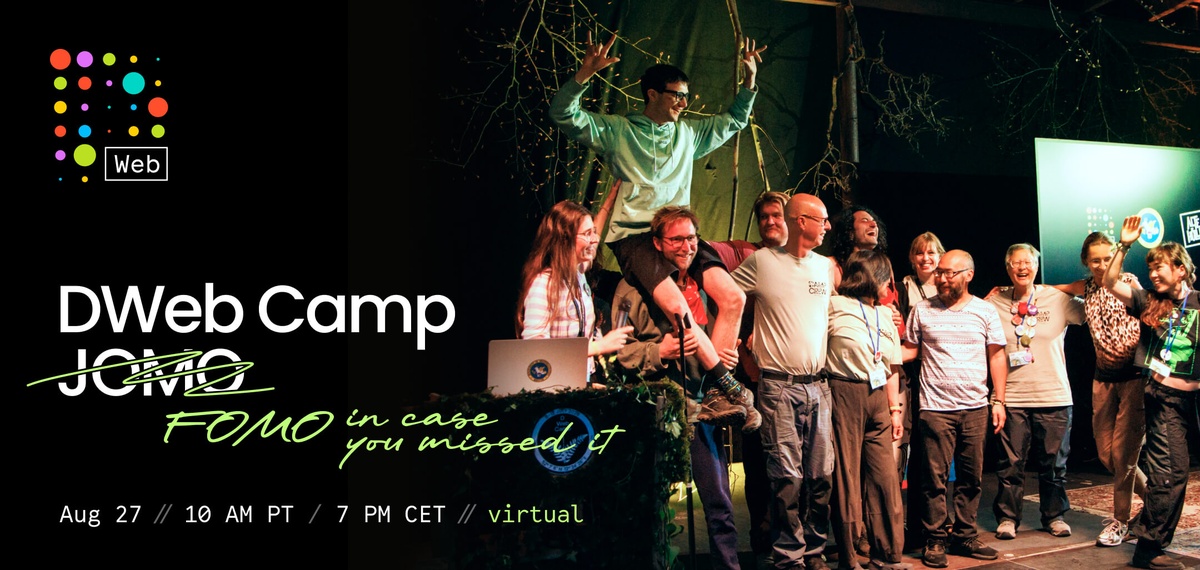 DWeb Virtual Meetup—DWeb Camp JOMO, Part II (September 2026)
Thu, Sept. 24, 2026

- ⚘ lichen.page
lichen — the CMS for static site generators, built on atproto
- ⚘ lichen.page
lichen — the CMS for static site generators, built on atproto
- Briefly describe new automations created on Airglow | @bot.airglow.run | Airglow
When a new automation is created on Airglow, ask a model on co/core (https://cocore.dev) to briefly describe the automation, and post the description to Bluesky.
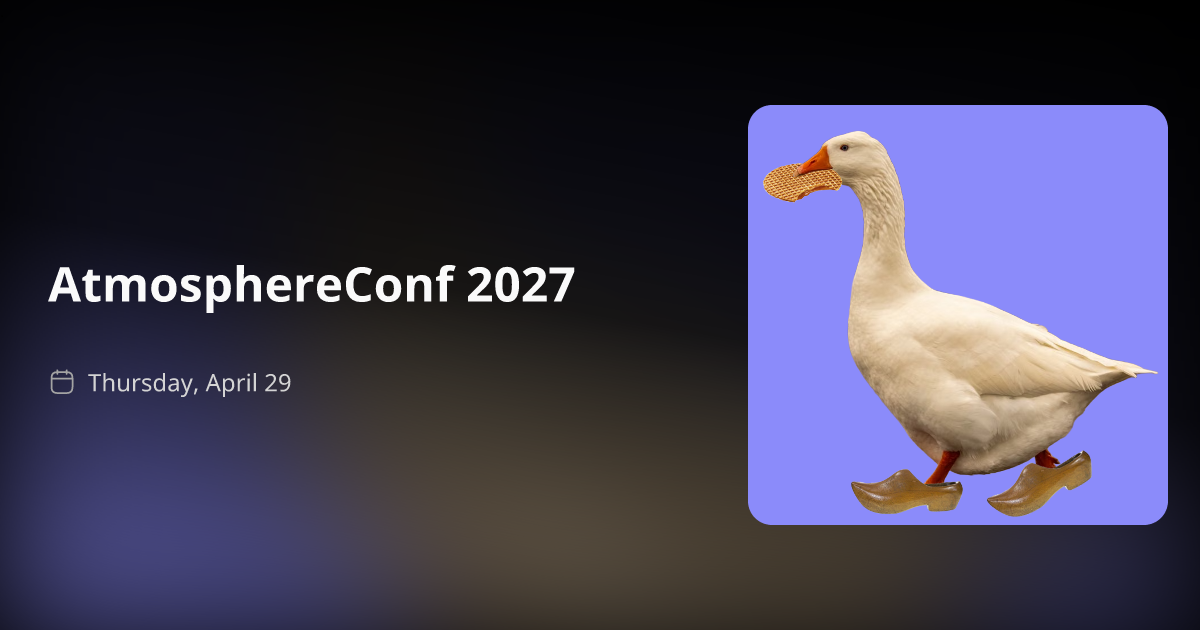 AtmosphereConf 2027
The third edition of the global gathering for the Atmosphere Community is taking place in Amsterdam, April 29th - May 2nd. This includes side-events and main conference days. Please RSVP with your interest, subscribe for updates at https://news.atmosphereconf.org, and watch us build out the website with lots of fun features https://atmosphereconf.org As well as in person, we'll also be streaming and have different ways to participate remotely. Atmosphere Conference is run by the community, for the community, as an annual global gathering to connect, share, celebrate, and learn from each other. We welcome newcomers and want to engage with new perspectives. It's a community home for builders, supporters, and participants in the atproto ecosystem. We maintain collective resources, seed projects, and convene our community to ensure every member has genuine voice in shaping the ecosystem's future. #atproto #atmosphereconf #atmosphereconf2027 #europe
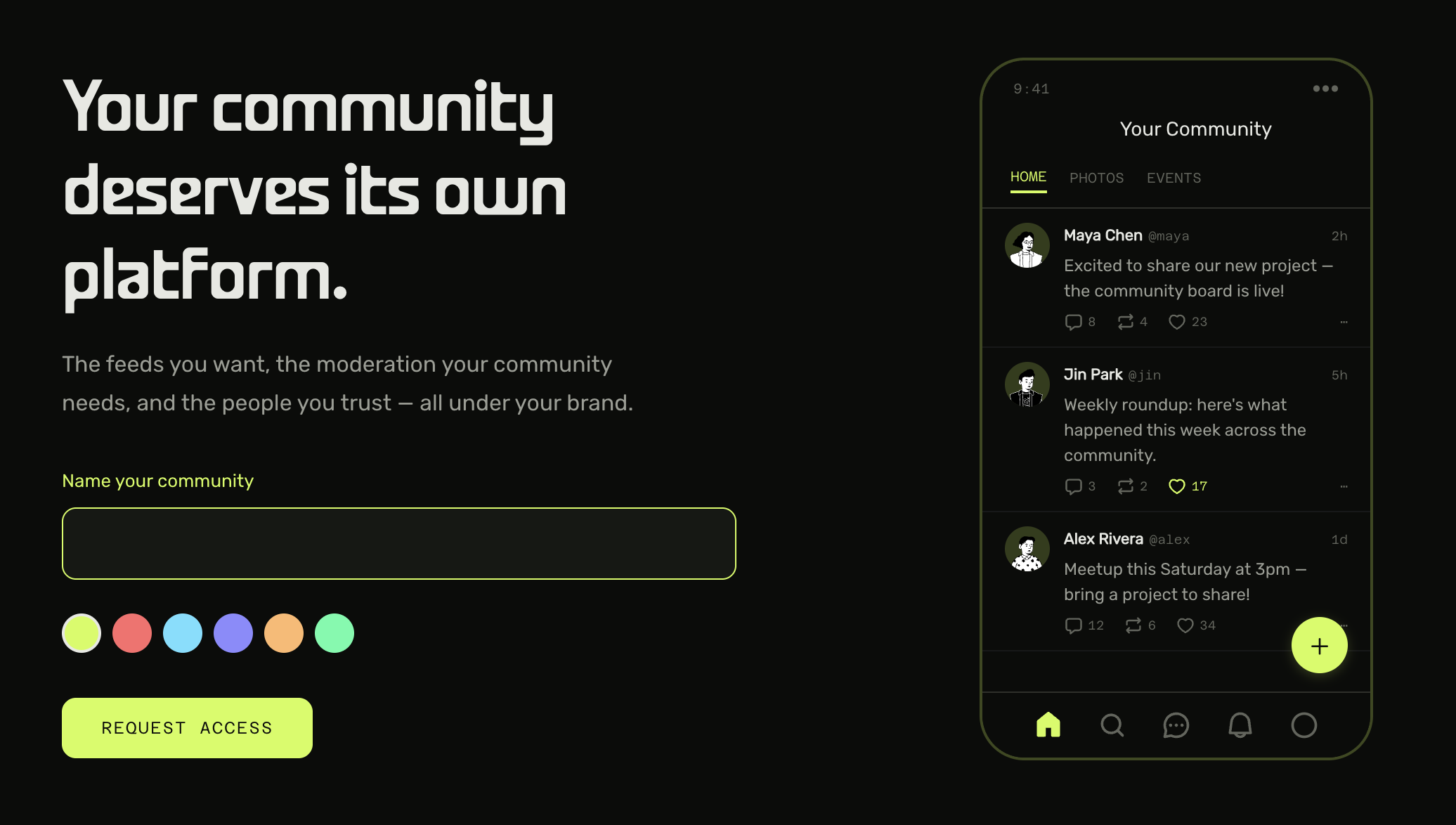 Acorn — a platform your community owns
Custom feeds, your own moderation rules, member badges, and a branded client — on infrastructure your community controls.
 Meta Connect 2026 live blog: On the ground at Mark Zuckerberg’s next big product launch
Expect news on AI, glasses, and maybe even VR.
 Mila - Quebec Artificial Intelligence Institute
Mila is a Montreal-based artificial intelligence research institute that brings together researchers from Université de Montréal, McGill University, Polytechnique Montréal and HEC Montréal.
- Add OP thread numbering to feed lexicon by ds-boyce · Pull Request #57 · bluesky-social/bsky
Publishes OP thread position and count so clients can consume the existing AppView metadata through the canonical Lexicon.
 Mila and Mozilla launch new open source AI initiative | The Mozilla Blog
Today at ALL IN, Canada’s largest AI and technology event, Mozilla and Mila announced a new initiative and fresh investment to build an open source AI fo
 CULTUREHUB — Interview with Spencer Chang
Scribble August 13, 2026
 Design Engineering with Maggie Appleton
Podcast Episode · The Pragmatic Engineer · September 23 · 1h 27m
- Design Engineering with Maggie Appleton
The Pragmatic Engineer · Episode
 Interview mit dem Schweizer Toni Schneider, CEO von Bluesky: «Werbung wird nicht unser Hauptgeschäft» - Das Netz ist politisch
Zuerst war der Status nur ad interim, aber seit Juli 2026 ist der Schweizer Toni Schneider CEO des Unternehmens Bluesky (der berühmten Twitter-Alternative).
- socialweb-computer-ssh
Register an SSH key against your AT Protocol account, then ssh in and the command runs in a fresh compute market VM.
- Caring vs. Knowing - exe.dev blog
Thoughts on how to DIY sustainably.
- Afri (@l5y.tech)
I'll be talking about rngit on Oct 5th at @c-base.org @dod.ngo #reticulum https://platform.openmeet.net/events/code-collaboration-after-github-hsf2jj
- SF: A Birds of a Feather on Agentic Engineering
I'm Jesse. I make stuff. Software, hardware. Very occasionally, trouble.
- Post-alpha plans
Hey folks 👋 We’re about a month into the spaces alpha! From what I can tell, it’s going along pretty nicely. We pushed out one breaking change about two weeks back, but it’s been pretty stable apart from that. I wanted to share a list of some of the open questions we’re still noodling on. Many of these will likely involve breaking changes. Most of these are not truly “open”, we have opinions on them and need to just nail it down. However, if anything is important to you, please sha...
 Leaflet — social publishing on the Atmosphere
A simple and powerful platform for social publishing — blogs, newsletters, and more!
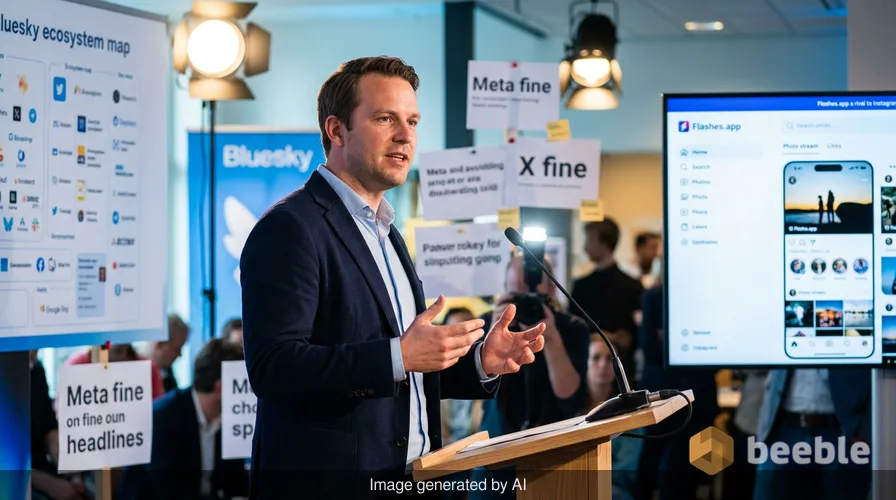 Kann Eurosky den Europäern endlich die Kontrolle über ihre Social-Media-Daten zurückgeben?
Eurosky startet ein nutzereigenes Social-Media-Ökosystem in Europa und fordert Big Tech mit DSGVO-konformen Datenservern auf Basis des AT-Protokolls heraus. Privatsphäre und Wahlfreiheit für Alltagsnutzer.
 We're making Tailscale faster
Tailscale performance updates reduce memory use, increase throughput, and speed startup with multi-queue, writev, and netmap caching.
- Decided to take TODOseq for a spin in Obsidian: > Scan your vault for plain lines that start with TODO, DOING, and DONE.
Decided to take TODOseq for a spin in Obsidian:
> Scan your vault for plain lines that start with TODO, DOING, and DONE. Collect them into one Task List. Keep writing in ordinary notes — inspired by Emacs Org-mode and [[Logseq]]. - jundot/omlx
“ LLM inference server with continuous batching & SSD caching for Apple Silicon — managed from the macOS menu bar”
 M5 Ultra Mac Studio Review: The Dream Mac for Local AI Agents
Review of performance of new M5 Mac Studio vs the M3 Ultra, plus an RT5090 Gaming PC
 Scott Jenson: Are we really going to use the same Desktop UX forever?
By @jenson.org
The desktop interface has remained fundamentally unchanged for over two decades, relying on legacy paradigms that haven't scaled to meet new modern needs.Industry leaders like Apple and Microsoft are too deeply entrenched in their established ecosystems to risk radical shifts. While the Linux community has shown some appetite for experimentation, much of it has nibbled at the edges such as focusing on tweaking window management.
- The Co-op Cloud
Co-op Cloud is a software stack that aims to make hosting libre software applications simple for small service providers such as tech co-operatives who are looking to standardise around an open, transparent and scalable infrastructure. It uses the latest container technologies and configurations are shared into the commons for the benefit of all.
Uses Docker Swarm
 Autonomic Co-op
UK based worker-owned co-op with lots of tech and hosting skills.
They are the creators / maintainers of co-op cloud.
- LaSuite.coop
A co-operative in France offering supported LaSuite hosting.
- Bureau of Research, Engineering and Advanced Leadership in Innovation and Science (BOREALIS)
BOREALIS is modernizing Canadian defence and national security innovation by accelerating the delivery of advanced technologies aligning federal innovation efforts toward mission needs connecting partners from government, academia, and industry.
 Présentation de LaSuite - Novembre 2025
November 2025 video about the LaSuite set of apps
- Build Software with BMad
"BMad adds a set of named commands, called skills, to AI coding tools such as Claude Code and Cursor. Some of them help you think: explore an idea, research it, argue against it, and write down what you have settled on. Others help you build: give bmad-build a change you want made, and it writes the code and reviews it."
 BMad Code | Official Home of the BMad Method
"BMad is an open-source, customizable set of agents and workflows built on agile practice. Clarify the work, approve the plan, build it, and verify the result."
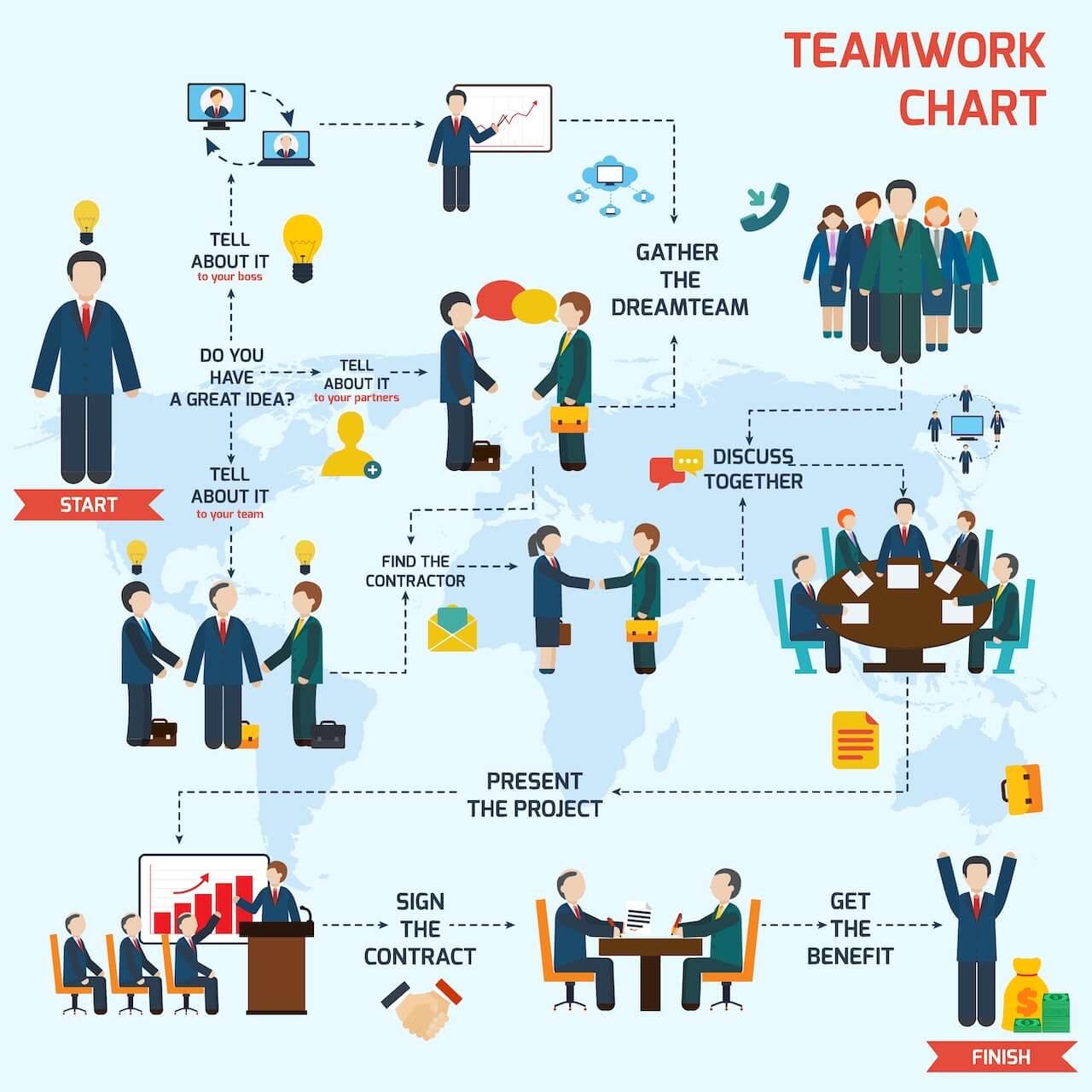 How to Make Remote Work: Part Two, Zulip
How I've learned to be productive working from home. I'll write a second guide about how I think about remote work as a manager and the processes Monadical have put into place to make things work for us.
- dario, please! - POP RDI; RET;
“Dario Amodei, the CEO of Anthropic, recently published a blog post titled We Must Pace the Frontier and it is a load of bullshit, with a grim goal of regulating open weight models and giving the frontier labs an antitrust waiver.”
- The contagion of fear | The Observation Deck
@bcantrill.bsky.social on the claims of human extinction recently
"the claims from Coxon and his ilk are the most extraordinary a technologist can make, and we must demand evidence commensurate with the claims.
That said, we should not expect the public to understand LLMs, critical infrastructure, bioweapons, extinction biology, etc. — that burden must lie with those making the claim."
- I got to introduce some new-to-Canada people to the Canadian House Hippo.
I got to introduce some new-to-Canada people to the [[Canadian House Hippo]]. From https://en.wikipedia.org/wiki/House_hippo" rel="noopener noreferrer">Wikipedia:
> a fictitious species of hippopotamus, & the subject of a Canadian television public service announcement produced by Concerned Children’s Advertisers in May 1999 & https://mediasmarts.ca/those-tiny-hippos-your-house-theyre-back-teach-us-about-fake-news" rel="noopener noreferrer">reintroduced by MediaSmarts in 2019 - Thoughts.md
Write up by @bobbby.online about how we got here with AI models and frontier labs, and what their pause means. A good general primer.
- threddyrex/atproto-links
Most up to date list of atproto PDS implementations
- Big Time Public License Version 2.0.2
“a public LICENSE that makes software free for noncommercial and small-business use, with a guarantee that fair, reasonable, and nondiscriminatory paid-license terms will be available for everyone else”
Non commercial licensing with definitions of small business use at no charge vs large business that needs to pay for a license.
- Nobody pays for open source. We can force them to. | Seldo.com
By @seldo.com, a pitch that says paying open source maintainers is likely to work at the registry level.
The shape of who pays / who doesn’t looks a lot like the BigTime Public License…although this is not in the article solved by licensing rather on the shape of the organization.
 OpenCode V2 Is No Longer Just My Plan B
I’ve been using and enjoying and building around opencode2 beta. This article goes into architecture and how opencode is getting this right, from sub agents to skills.
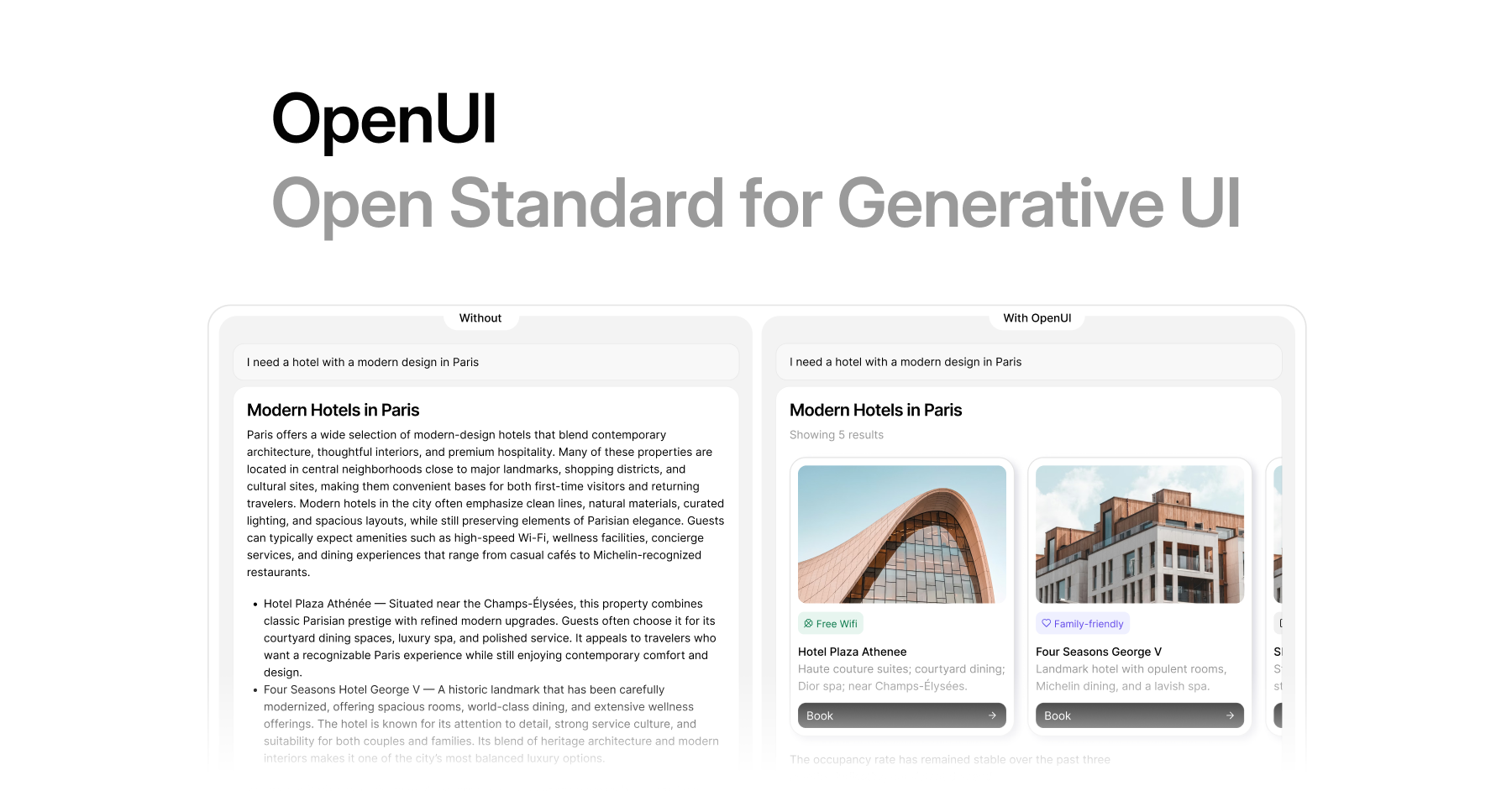 OpenUI - The Open Standard for Generative UI
“ OUI-1 is a finetuned DiffusionGemma model that writes user interfaces in openui-lang. It is 26BA4B model that can run on consumer grade GPU (RTX 5090, at FP8), and the weights are on Hugging Face under Apache 2.0, the same license as the base model.”
 Anytwo and the future of Anytype
AnyType had a big town hall and announce AnyTwo. AnyType transitions to fully OSS. Anytype Business reminds me of Habitat
 goose | Your open source AI agent
General purpose desktop app AI agent, came out of Jack Dorsey's Block
- dani-garcia/vaultwarden
Vaultwarden source code - self-hostable Rust server for password management that is compatible with Bitwarden clients.
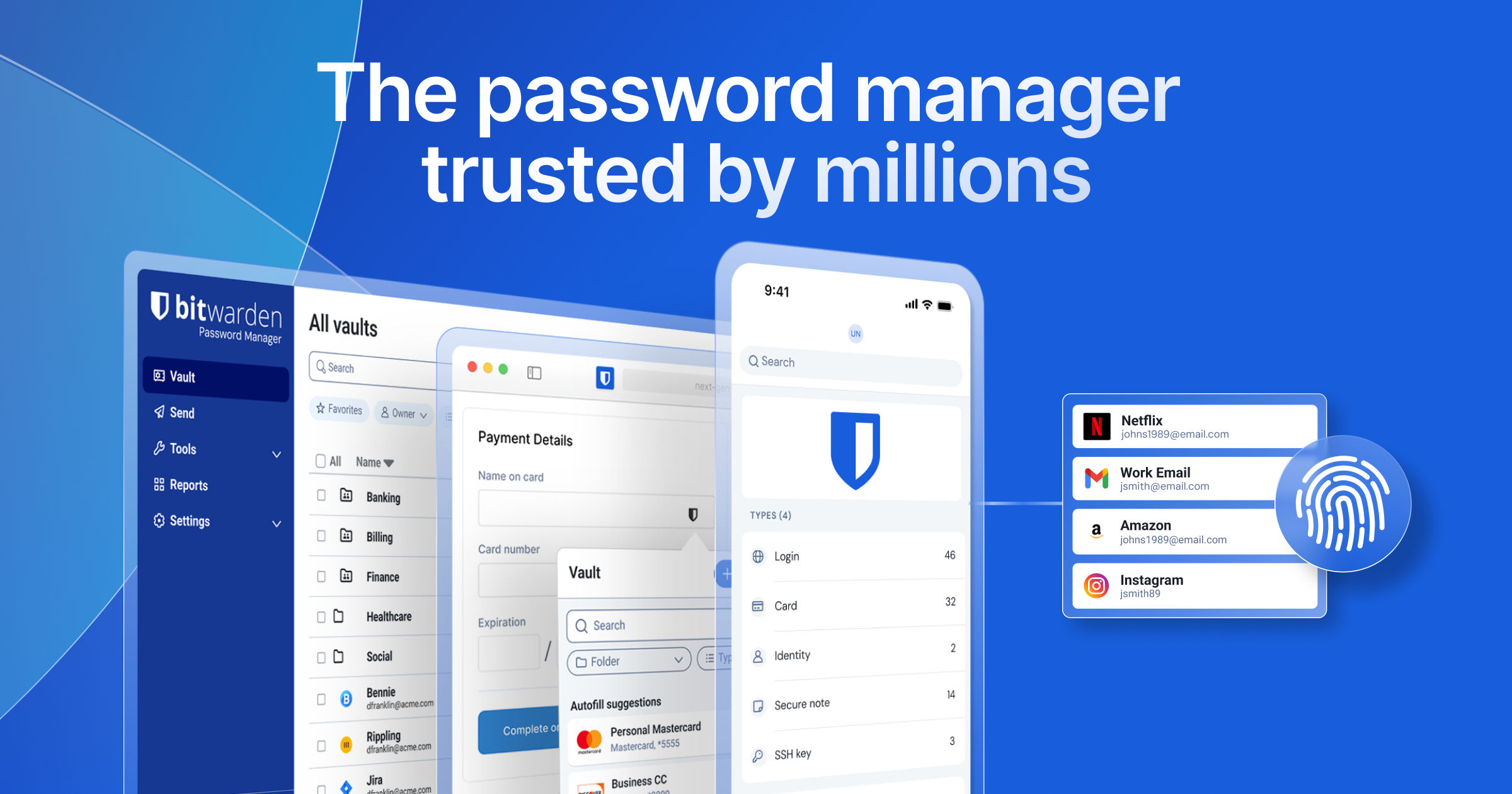 Best Password Manager for Business, Enterprise & Personal | Bitwarden
A well run password manager. Has open source implementations of the backend that the apps can connect to.
 Passwords, Secrets, and Access Management | 1Password
A password manager that used to be well-liked and respected.
- DHH Nazism Funded by 1Password VP Who Wrote “Honest Security”
A summary of the 1PW funding DHH / Omarchy focused on the VP who made it happen. Lots of direct parallels to Nazism mentioned.
- Forestry.md - Open Source Digital Garden Hosting
Managed service for Obsidian digital garden publishing.
- oleeskild/obsidian-digital-garden
Obsidian plugin integrated with GitHub publishing of your vault as a digital garden. This is the GitHub repo.
- I am 32.6% of Tangled - permablog
Talking about agentic coding and building at a high velocity workflow
Which means being 32% of Tangled’s volume!
- crockpotveggies/execlaw
Self-hosted AI agent with persistent memory, plugins, tools, and skills written in Rust
- suitenumerique/projects
Kanban style project management with OIDC - Github source code
 Fichiers - La Suite Numérique
LaSuite Drive is an open-source tool focused on file storage, editing and sharing with granular access control.
- Docs - La Suite Numérique
Collaborative, Notion-like writing tool. Built on BlockNote.js, Django on the backend. Supports OIDC. Real-time collaborative edits. Google Docs competitor. Doesn't really support group access / permissions.
Part of LaSuite
- pentacent/keila
Open Source alternative to newsletter tools like Mailchimp or Sendinblue.
With Keila you can easily send out newsletter campaigns and create sign-up forms.
For smaller newsletters, you can use your own email inbox to send out campaigns. For larger newsletter projects, AWS SES, Sendgrid, Mailgun, and Postmark are supported in addition to SMTP.
- Visio - LaSuite
Open source video conferencing app powered by LiveKit. Built with Django and React.
Part of France's LaSuite
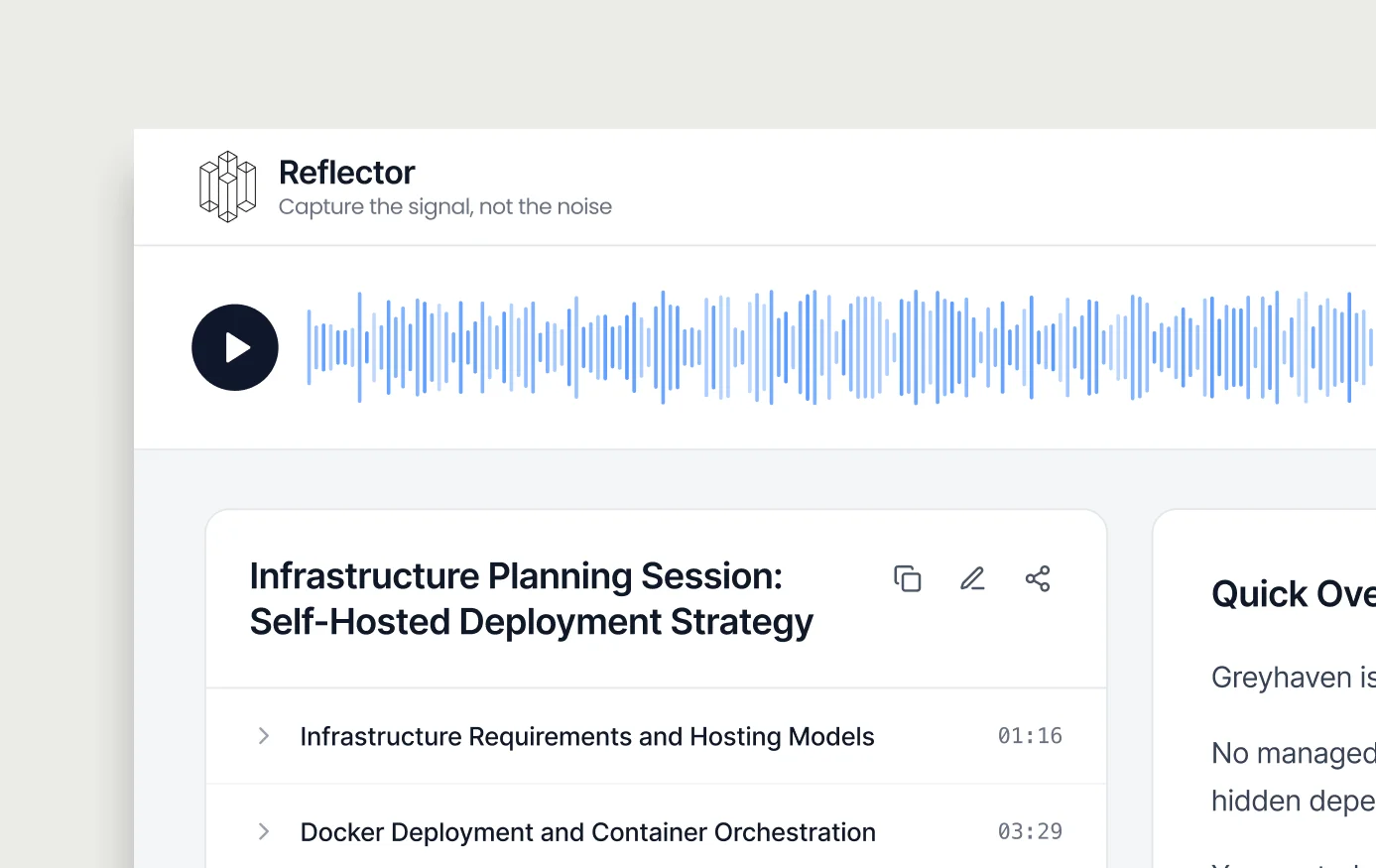 Reflector: Infrastructure for Meetings, by Greyhaven
In browser video meetings + transcription and more. By @monadical.bsky.social
“Reflector is an open-source system for turning live conversations into usable knowledge.
It processes meetings in real time, extracting structure as people speak. Through live processing: topics emerge naturally, speakers are identified, and summaries form as decisions are made (not hours later).
The output is designed to be edited, reused, and trusted.”
 BlockNote - Javascript Block-Based React rich text editor
Build a Notion-style editor in minutes.
The AI-native, open source rich text editor for React. Add a fully customizable modern block-based editing experience to your product that users will love.XL packages are GPL, or commercial exception from $195/month
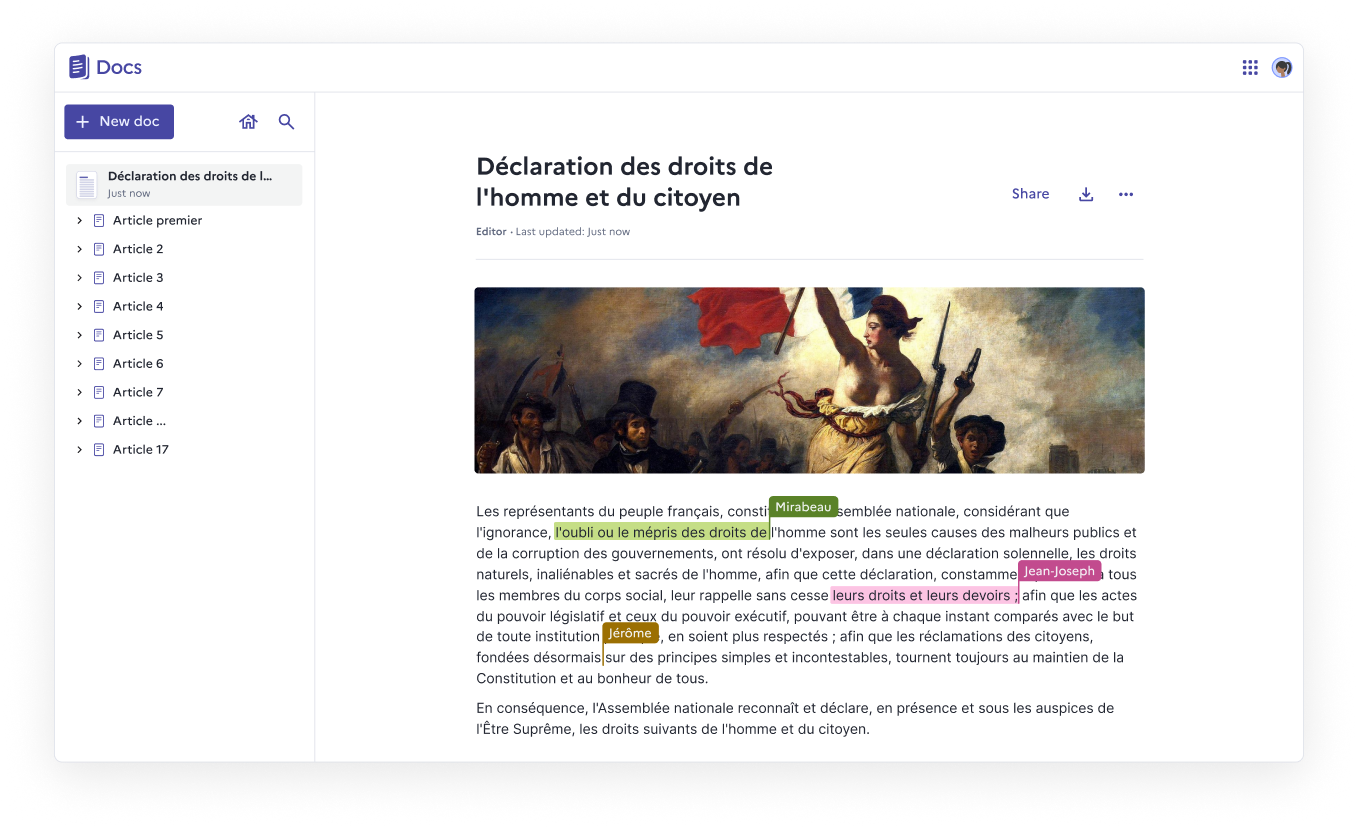 Docs — Turn your team's content into knowledge
open-source text editor: web-native, made for real-time collaboration, cleanly structured documents and sub-docs with full ownership of your data.
Part of the French government suite, built on Django
- Co-operative Principles
BC Co-op Association page listing the 7 co-operative principles.
- LibreChat - The Open-Source AI Platform
Open source chat interface for agents
 Free Grist Activation Key FAQ | Grist
Any organization whose total finances are less than USD $1,000,000 may request a free activation key to run Grist at no cost.
“Total Finances” is defined as the greater of (a) gross annual revenue, (b) total annual operating budget, or (c) funds raised in the preceding 12 months. The legal entity of the organization has no bearing on eligibility. founderpokermontreal
Regular event for founders in Montreal. Max from Monadical helps run it.
 Overview | Safebucket
"open-source file sharing platform where files never touch your server. Uploads and downloads go directly to your storage backend via presigned URLs. You bring your own identity provider, your own storage, and your own infrastructure. Safebucket handles metadata, access control and audit logging."
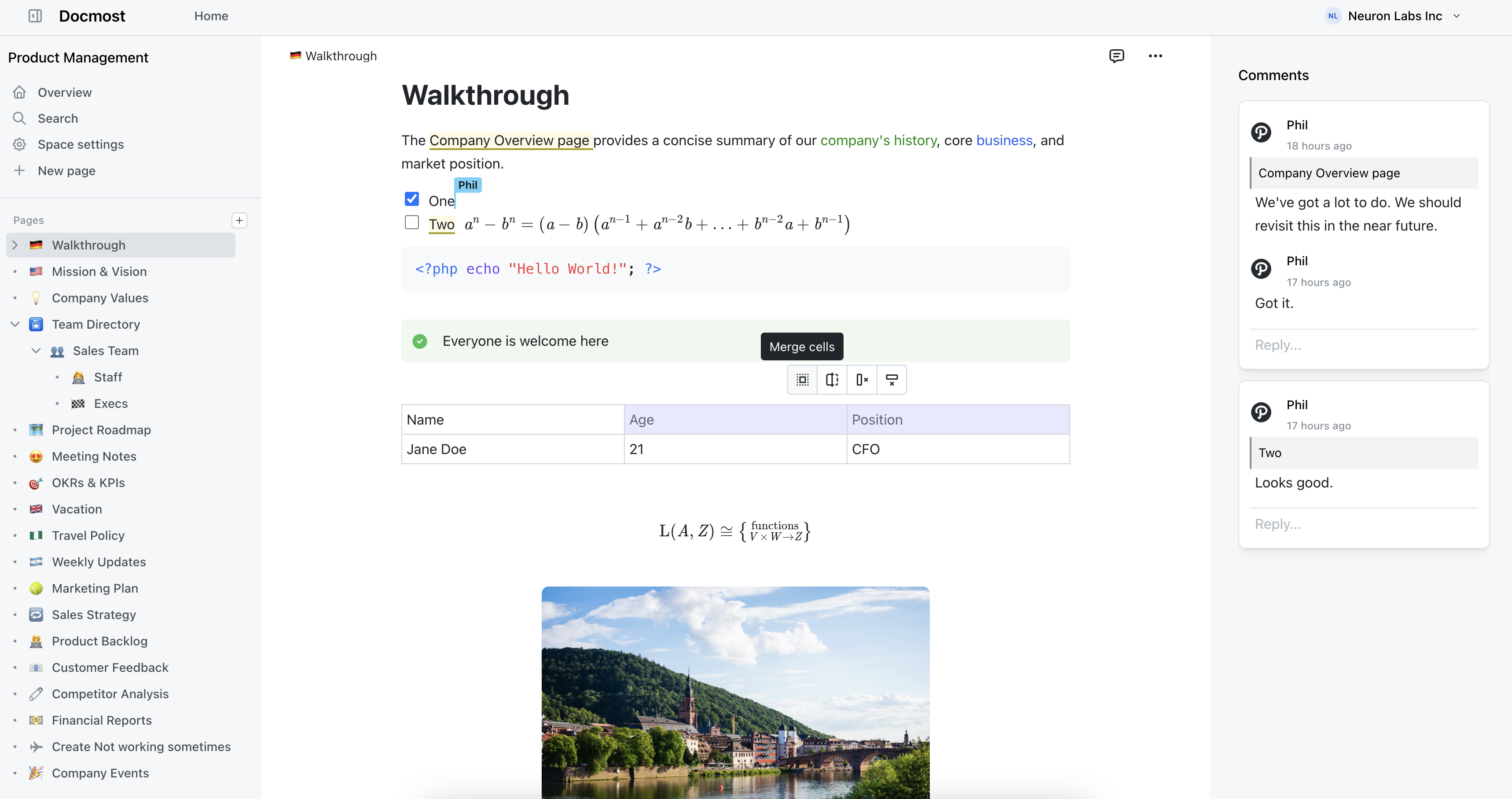 Enterprise-ready Wiki for Teams | Docmost
Community edition is open source and can be self hosted, but no SSO, Bases, and other features.
- self-hostable notion replacements (by Tyler Lawson) — Semble
not necessarily feature-parity - i do not care about databases
 Introducing Oktana
The software research collective building v2 editor. Their launch manifesto. “ Oktana is a newly formed collective of friends specialized in building software products. We work according to the cooperative principles, so we are democratically governed, there is no employer among us and we are not associated with the venture capital business.”
 v2 Editor Manifesto
Manifesto for the v2 editor - rich text, aiming to use Pandoc Markdown flavour, version control with Automerge
- Your executable is a SQLite database
Fun article about having SQLite being an entire executable. Everything is SQL!
 v2 Editor
Desktop writing tool which keeps Markdown / HTML on disk, uses Automerge for sharing. Also Prosemirror, Pandoc.
Initial Mac version in beta.
- so that new Mac Studio and M5 Ultra have me thinking about 2030 now the wildcard on the $1200ish 2030 Mac Mini is RAM. who knows what the…
Thread from Daniloc attempting to extrapolate from Mac Studio fully maxed machines to home inference in 2030. Ends up on machine management and games.
 Dylan Patel – Two labs will soon control most of the world's workforce
Via https://bsky.app/profile/jdp.extropian.net/post/3mtwc7dspts22
I know anti datacenter stuff is median voter politics based on incomprehensible reasoning and momentum but the anti-monopoly case seems quite strong if you take this kind of narrative seriously.
 Filen – Next Generation End-To-End Encrypted Cloud Storage
Zero knowledge encrypted file storage / sync / backup. Included markdown notes and chat. Apps are AGPL. Germany based. WebDAV and S3 support.
- Matt Westgate and Boris Mann | Homepage of Lucas Koorneef
A photo of me during the first Drupal event, this one in the dev room at FOSDEM
 celld — Durable Objects, self-hosted
Self-hosted, distributed Durable Objects. By Ryan Dahl of Deno. Orders of magnitude cheaper than Cloudflare Workers / DO.
celld is an open-source daemon that runs Cloudflare Workers and Durable Objects on your own machines. Each object is its own SQLite database. celld addresses an object by name and replicates it to a bucket that you own. The bucket can be S3-compatible
 Meilisearch: Unified Search & AI Retrieval Platform
Build lightning-fast search and AI retrieval with Meilisearch. Open-source, developer-friendly search engine trusted by 20,000+ teams worldwide.
- The Twelve-Factor App
- A foundational piece of writing about how to architect applications in the modern era, written by the [[Heroku]] founders in 2011/2012. Published at https://12factor.net" rel="noopener noreferrer">12factor.net.
- From the Introduction:
- > In the modern era, software is commonly delivered as a service: called web apps, or software-as-a-service. The twelve-factor app is a methodology for building software-as-a-service apps that:
>
> * Use declarative formats for setup automation, to minimize time and cost for new developers joining the project;
> * Have a clean contract with the underlying operating system, offering maximum portability between execution environments;
> * Are suitable for deployment on modern cloud platforms, obviating the need for servers and systems administration;
> * Minimize divergence between development and production, enabling continuous deployment for maximum agility;
> * And can scale up without significant changes to tooling, architecture, or development practices.
>
> The twelve-factor methodology can be applied to apps written in any programming language, and which use any combination of backing services (database, queue, memory cache, etc).
- From the Background section:
- > Our motivation is to raise awareness of some systemic problems we’ve seen in modern application development, to provide a shared vocabulary for discussing those problems, and to offer a set of broad conceptual solutions to those problems with accompanying terminology. The format is inspired by Martin Fowler’s books https://books.google.com/books/about/Patterns_of_enterprise_application_archi.html?id=FyWZt5DdvFkC" rel="noopener noreferrer">Patterns of Enterprise Application Architecture and Refactoring.
- Source is https://github.com/heroku/12factor" rel="noopener noreferrer">on Github.
- Created by [[Adam Wiggins]], contributions from:
- James Lindenbaum, Mark McGranaghan, Chris Stolt, Ryan Daigle, Mark Imbriaco, Keith Rarick, Will Leinweber, Jesper Jørgensen, James Ward, Adam Seligman, Phil Hagelberg, Jon Mountjoy, Matthew Turland, Daniel Jomphe, Mattt Thompson, Anand Narasimhan, Lucas Fais, Pete Hodgson  1RG
1RG## Coworking & Community
> 1RG invites individuals, teams and organizations who value community care, creativity and innovation to work and play in a space that promotes collaboration and curiosity.
## About
> 1RG was started by https://max.computer/" rel="noopener noreferrer">Max Veytsman andhttps://words.serenaperuzzo.com/" rel="noopener noreferrer">Serena Peruzzo in May 2022.
>
> Serena and Max share a passion for using their technical skills to help organizations that serve their communities.
>
> Together they founded 1RG to create a space where technologists, artists, and people working in the solidarity economy can mingle and explore human-centric approaches to technology. A space for the curious creative and caring.
## Events Calendar## 1RG Labs
As well as coworking + communiy, Serena and Max run https://labs.1rg.space/" rel="noopener noreferrer">1RG Labs.
- A guide to potential liability pitfalls for people running a Mastodon instance
> So here is a guide to potential liability pitfalls for people who are running a Mastodon instance, and how to mitigate them. This is mostly US-specific, but I noted which things to think about are likely to apply worldwide.
By [[rahaeli]] https://bsky.app/profile/rahaeli.bsky.social" rel="noopener noreferrer">@rahaeli.bsky.social, cofounder of [[Dreamwidth]]
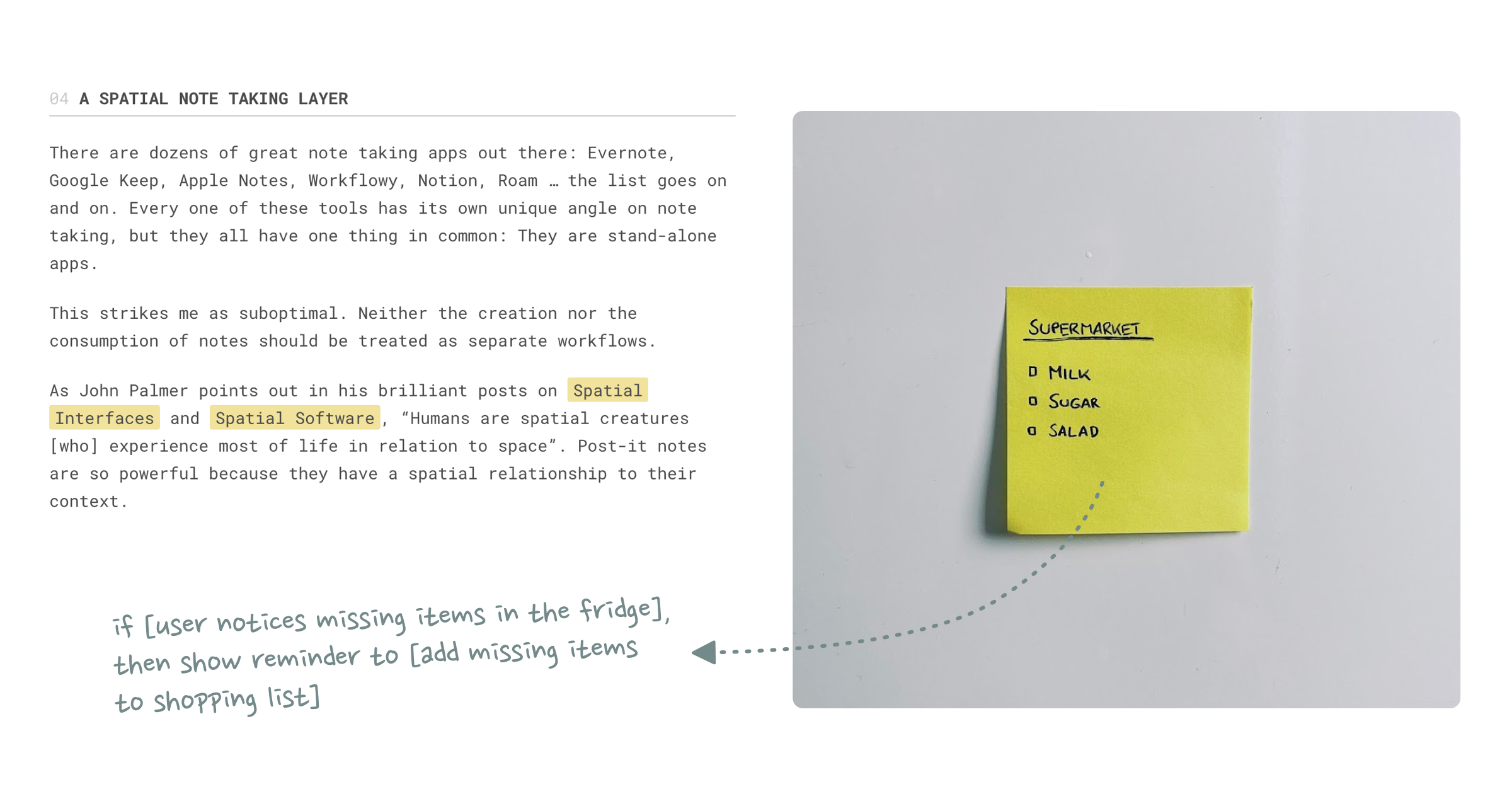 A Meta-Layer for Notes
- _What’s the digital equivalent of sticky notes?_ by [[Julian Lehr]]
- Originally a post about [[Hey]]:
> Hey’s most interesting aspect is not its radical approach to email – but its fresh approach to note taking!
- Mentions [[Front App]]. Feels like [[Missive]] does this really well — in both single player and team mode.
> Neither the creation nor the consumption of notes should be treated as separate workflows.
> What we need instead is a spatial meta layer for notes on the OS-level that lives across all apps and workflows. This would allow you to instantly take notes without having to switch context. Even better yet, the notes would automatically resurface whenever you revisit the digital location you left them at.
- This requires a shared data layer to support it. This is a core [[Fission]] [[Webnative]] insight and goal: cross platform, cross app data layer. Re-use of data enabled by this layer.
- > You could imagine employers shipping corporate laptops with pre-installed notes to make it easier to transfer (previously tacit) knowledge and thus improve the onboarding process for new hires.
- I’ve created an [[Indoctrination Reading List]] at multiple companies, as well as handed over wikis to be searched and added to as part of onboarding.
- I think the intent here is to be much more contextual per app or interface.
- Asking people about their note taking practices and tools is probably a good interview question. A Tweet Before Dying
- Quotes
- The revolutionary internet is over, and we don’t have much to show for it. A new start is out there, somewhere.
- Truly giant things—social media platforms, religions, nation-states—don’t really die. They deflate like air mattresses.
- A year of new avenues
- From [[Robin Sloan’s Lab Newsletter]]
- It’s so powerfully obvious to me, it might as well be written in ten-foot letters of flame: the platforms of the last decade are done.
I said it in April 2022, and I believe it even more today: their only conclusion can be abandonment; an overdue MySpace-ification.
- Here, he’s basically asking for #UCAN and #WNFS — a way to sync #[[Web API/localStorage]] without accounts
- My second question, the real one, is: what’s the next-best thing? Is there anything simpler than a remote function, created and maintained by me, to which I get and set a copy of my localStorage? It seems like that would require authentication, the provision and management of something like a user account, and that’s what I’m trying to avoid … Any thoughts? Aaron Parecki
[[OAuth]] bio:
> Aaron Parecki is Director of Identity Standards at Okta. He is the author of https://oauth2simplified.com/" rel="noopener noreferrer">OAuth 2.0 Simplified, and maintains https://oauth.net/" rel="noopener noreferrer">oauth.net. He regularly writes and gives talks about OAuth and online security. He is a member of the https://aaronparecki.com/oauth/" rel="noopener noreferrer">OAuth working group, and is the co-founder of https://indieweb.org/" rel="noopener noreferrer">IndieWebCamp, a conference focusing on data ownership and online identity. Aaron has spoken at conferences around the world about OAuth, data ownership, quantified self, and home automation, and his work has been featured in Wired, Fast Company and more.
[[IndieWeb]] bio:
> Aaron Parecki is the co-founder of https://indieweb.org/" rel="noopener noreferrer">IndieWebCamp, an annual unconference on data ownership and online identity. Aaron helps people own their online content by creating specs such as the W3C https://www.w3.org/TR/webmention/" rel="noopener noreferrer">Webmention and https://www.w3.org/TR/micropub/" rel="noopener noreferrer">Micropub specifications. He also participates in the OAuth working group, maintains https://oauth.net/" rel="noopener noreferrer">oauth.net, and wrote https://oauth2simplified.com/" rel="noopener noreferrer">OAuth 2.0 Simplified. He has spoken at conferences around the world about OAuth, data ownership, quantified self, and even explained https://www.youtube.com/watch?v=FGVJ0eXTRpw" rel="noopener noreferrer">why R is a vowel.
- ACLs don't
Tyler Close, Hewlett-Packard Labs
## Abstract
The ACL model is unable to make correct access decisions for interactions involving more than two principals, since required information is not retained across message sends. Though this deficiency has long been documented in the published literature, it is not widely understood. This logic error in the ACL model is exploited by both the clickjacking and Cross- Site Request Forgery attacks that affect many Web applications.
- Audience - Community - Product
Audience - Community - Product framework described by Greg Isenberg in https://latecheckout.substack.com/p/the-framework-to-find-traction-for" rel="noopener noreferrer">The Framework to Find Traction for your Product
> how to get traction with your product idea through building audiences and community.
<!-- more -->
> The three components I’ve laid out — Audience, Community, and Product — comprise the funnel for building a business in 2023. I call it the ACP Funnel.
>
> Audience: bring people into the stories you’re telling
>
> Community: create a space for people who love your stories and identify with your brand
>
> Product: give your community a product to achieve their goal and improve their own story - Activity Streams 2.0 W3C Recommendation
Editors are [[James M Snell]] and [[Evan Prodromou]]
## AbstractThis specification details a model for representing potential and completed activities using the JSON format. It is intended to be used with vocabularies that detail the structure of activities, and define specific types of activities.
## Author's NoteThis section is non-normative.
This draft is heavily influenced by the JSON Activity Streams 1.0 specification originally co-authored by Martin Atkins, Will Norris, Chris Messina, Monica Wilkinson, Rob Dolin and James Snell. The author is very thankful for their significant contributions and gladly stands on their shoulders. Some portions of the original text of Activity Streams 1.0 are used in this document.
- Activity Vocabulary
## Object Types
The Object Types include:
- [[Activity Vocabulary/Article]]
- https://www.w3.org/TR/activitystreams-vocabulary/#dfn-audio" rel="noopener noreferrer">Audio
- https://www.w3.org/TR/activitystreams-vocabulary/#dfn-document" rel="noopener noreferrer">Document
- https://www.w3.org/TR/activitystreams-vocabulary/#dfn-event" rel="noopener noreferrer">Event
- https://www.w3.org/TR/activitystreams-vocabulary/#dfn-image" rel="noopener noreferrer">Image
- [[Activity Vocabulary/Note]]
- https://www.w3.org/TR/activitystreams-vocabulary/#dfn-page" rel="noopener noreferrer">Page
- https://www.w3.org/TR/activitystreams-vocabulary/#dfn-place" rel="noopener noreferrer">Place
- https://www.w3.org/TR/activitystreams-vocabulary/#dfn-profile" rel="noopener noreferrer">Profile
- https://www.w3.org/TR/activitystreams-vocabulary/#dfn-relationship" rel="noopener noreferrer">Relationship
- https://www.w3.org/TR/activitystreams-vocabulary/#dfn-tombstone" rel="noopener noreferrer">Tombstone
- https://www.w3.org/TR/activitystreams-vocabulary/#dfn-video" rel="noopener noreferrer">Video## Object
Describes an object of any kind. The Object type serves as the base type for most of the other kinds of objects defined in the Activity Vocabulary. https://www.w3.org/TR/activitystreams-vocabulary/#dfn-object" rel="noopener noreferrer">
### Properties
https://www.w3.org/TR/activitystreams-vocabulary/#dfn-attachment" rel="noopener noreferrer">attachment | https://www.w3.org/TR/activitystreams-vocabulary/#dfn-attributedto" rel="noopener noreferrer">attributedTo | https://www.w3.org/TR/activitystreams-vocabulary/#dfn-audience" rel="noopener noreferrer">audience | https://www.w3.org/TR/activitystreams-vocabulary/#dfn-content" rel="noopener noreferrer">content | https://www.w3.org/TR/activitystreams-vocabulary/#dfn-context" rel="noopener noreferrer">context | https://www.w3.org/TR/activitystreams-vocabulary/#dfn-name" rel="noopener noreferrer">name |https://www.w3.org/TR/activitystreams-vocabulary/#dfn-endtime" rel="noopener noreferrer">endTime | https://www.w3.org/TR/activitystreams-vocabulary/#dfn-generator" rel="noopener noreferrer">generator | https://www.w3.org/TR/activitystreams-vocabulary/#dfn-icon" rel="noopener noreferrer">icon | https://www.w3.org/TR/activitystreams-vocabulary/#dfn-image" rel="noopener noreferrer">image | https://www.w3.org/TR/activitystreams-vocabulary/#dfn-inreplyto" rel="noopener noreferrer">inReplyTo | https://www.w3.org/TR/activitystreams-vocabulary/#dfn-location" rel="noopener noreferrer">location | https://www.w3.org/TR/activitystreams-vocabulary/#dfn-preview" rel="noopener noreferrer">preview |https://www.w3.org/TR/activitystreams-vocabulary/#dfn-published" rel="noopener noreferrer">published | https://www.w3.org/TR/activitystreams-vocabulary/#dfn-replies" rel="noopener noreferrer">replies | https://www.w3.org/TR/activitystreams-vocabulary/#dfn-starttime" rel="noopener noreferrer">startTime | https://www.w3.org/TR/activitystreams-vocabulary/#dfn-summary" rel="noopener noreferrer">summary | https://www.w3.org/TR/activitystreams-vocabulary/#dfn-tag" rel="noopener noreferrer">tag | https://www.w3.org/TR/activitystreams-vocabulary/#dfn-updated" rel="noopener noreferrer">updated | https://www.w3.org/TR/activitystreams-vocabulary/#dfn-url" rel="noopener noreferrer">url | https://www.w3.org/TR/activitystreams-vocabulary/#dfn-to" rel="noopener noreferrer">to | https://www.w3.org/TR/activitystreams-vocabulary/#dfn-bto" rel="noopener noreferrer">bto| https://www.w3.org/TR/activitystreams-vocabulary/#dfn-cc" rel="noopener noreferrer">cc | https://www.w3.org/TR/activitystreams-vocabulary/#dfn-bcc" rel="noopener noreferrer">bcc | https://www.w3.org/TR/activitystreams-vocabulary/#dfn-mediatype" rel="noopener noreferrer">mediaType | https://www.w3.org/TR/activitystreams-vocabulary/#dfn-duration" rel="noopener noreferrer">duration## Article
Represents any kind of multi-paragraph written work. https://www.w3.org/TR/activitystreams-vocabulary/#dfn-article" rel="noopener noreferrer">
Inherits all the properties from Object
## NoteRepresents a short written work typically less than a single paragraph in length. https://www.w3.org/TR/activitystreams-vocabulary/#dfn-note" rel="noopener noreferrer">
This is the main type used by [[microblogging]] apps like [[Mastodon]]
 ActivityPods - Personal data spaces powered with ActivityPub
ActivityPods brings together two game-changing technologies, [[ActivityPub]][^rocks] and [[Solid]] Pods, and empowers developers to create truly decentralized applications
[^rocks]: links to <https://activitypub.rocks/>
## ActivityPub
What is the main shortcoming of ActivityPub?
ActivityPub wants to make it possible to create decentralized apps. But to post videos, you need an account on a PeerTube instance. And to post images, you need an account on a PixelFed instance. You must thus handle multiple accounts, with their profile, list of followers, etc.
How does ActivityPods solve this shortcoming?
With ActivityPods, you have only one profile, one outbox, one inbox and one list of followers - all in a single place. Applications connect to your Pod to post activities, read the inbox and fetch data. And of course they can connect to any existing https://fediverse.party/" rel="noopener noreferrer">fediverse application!
## Solid Pods
[[Solid Project]] (Social Linked Data) is a set of specifications whose aim is to allow users to store all their data in Pods ("Personal Online Datastores"). Users have full control over their Pods and can give permissions to applications or people they trust.
What is the main shortcoming of Solid Pods ?
Despite its name, Solid includes few features for social networking. For example, when you share a resource, the recipient will not know about it, unless you write to him. In their current implementation, Pods are personal databases with little connection to the outside world.
How does ActivityPods solve this shortcoming ?
With ActivityPods, all Pods are able to easily communicate with other Pods, thanks to the ActivityPub outbox and inbox. When you add a contact to your Pod, for example, they can be automatically be notified and add you back.
- www.w3.org
Authors: [[Christine Lemmer-Webber]], [[Jessica Tallon]], [[Erin Shepherd]], [[Amy Guy]], [[Evan Prodromou]]
## AbstractThe ActivityPub protocol is a decentralized social networking protocol based upon the [[ActivityStreams]] 2.0 data format. It provides a client to server API for creating, updating and deleting content, as well as a federated server to server API for delivering notifications and content.
 Against the dark forest
Kissane argues for not ceding the public social Internet predators and having only the privileged exist in Cozy Web space.
> The complex of ideas I’m going to call the Dark Internet Forest emerges from mostly insidery tech thinking, but from multiple directions—initially in Kickstarter co-founder Yancey Strickler’s https://www.ystrickler.com/the-dark-forest-theory-of-the-internet/" rel="noopener noreferrer">freeform noticings that apply science fiction writer Liu Cixin's dark forest theory of the universe to social media, then in humanist all-arounder Maggie Appleton’s https://maggieappleton.com/cozy-web" rel="noopener noreferrer">illustrated tech notes [[Dark Forest and Cozy Web]]. It names an experience of paranoia and anxiety that by the end of the 2010s was widespread among people with meaningful connections between their online personas and their ability to maintain their standard of living. It hit a nerve, especially within some corners of tech-and-society thinking that influence internet makers. It even shows up in a https://www.nybooks.com/online/2024/05/04/more-real-than-life-i-saw-the-tv-glow/" rel="noopener noreferrer">_New York Review of Books_ piece: a coup for something so initially modest.
One of the confusing points for me is that [[Dark Forest]] has ended up being explained in two opposite directions: what is listed below as "beneficial dark forests" is in fact the [[Cozy Web]] of permissioned spaces.
> For Strickler, the internet was becoming just such a perilous dark forest, stalked by shadowy forces. Or, one sentence later, it was becoming a series of beneficial dark forests that provide refuge for the imperiled. These protective forests included newsletters and podcasts, but also, “Slack channels, private Instagrams, invite-only message boards, text groups, Snapchat, WeChat, and on and on.”
> …
> here’s the idea that “dark forest” internet spaces serve as refuges because they’re “non-indexed, non-optimized, and non-gamified.” And further, that dark forest spaces grow “because they provide psychological and reputational cover. They allow us to be ourselves because we know who else is there.”So, Kissane's post here would be called "Against the Cozy Web", where the intent here is to push back against [[Brazilianization of the Internet]]
> In a framework for thinking about our networks, to leave out the majority of people sustaining real damage is a failure of _perception_ and of _proportion_. It matters because the remedies available to people like me—a white, tech-ish worker in the US—are not necessarily going to do much for the people bearing the brunt of the mega-platforms’ worst actions.
As a call to privileged folks who can build their own Cozy Web, Kissane says that we need to not retreat and leave the long tail of the public open to predation:
> The public social internet is worth designing and governing in a way that demonstrates less than total amnesia about the history of human civilizations and the ways we’ve learned to be together without killing each other. For people with the ability and willingness to work on network problems, the real choice isn't between staying on the wasteland surfaces of the internet and going underground, but between making safer and better places for human sociability and not doing that.
- age encryption
File encryption tool & format
git: https://github.com/FiloSottile/age
"A simple, modern and secure encryption tool with small explicit keys, no config options, and UNIX-style composability."
Meant to replace the use of gpg for encrypting files, backups, streams, etc. Implementations in [[GoLang]] and [[Rust]].
- Affero General Public License (AGPL)
AGPL - plugs holes in the GPL about hosted software. Any changes to publicly hosted AGPL needs to be shared.
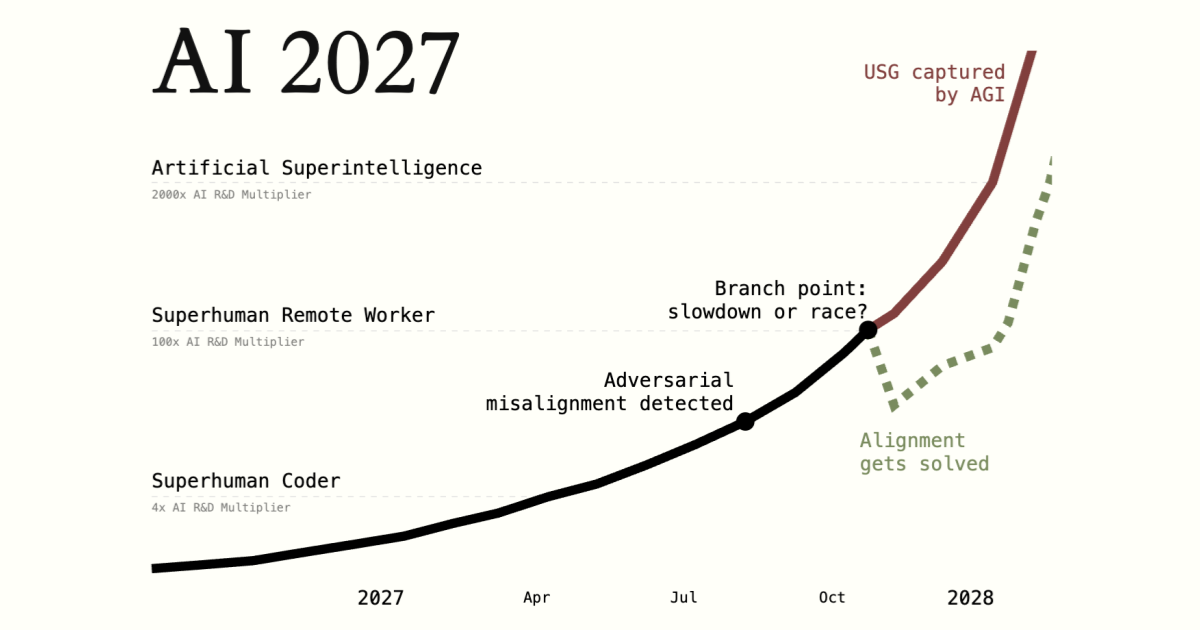 AI 2027
Authors: Daniel Kokotajlo, Scott Alexander, Thomas Larsen, Eli Lifland, Romeo Dean
We predict that the impact of superhuman AI over the next decade will be enormous, exceeding that of the Industrial Revolution.
We wrote a scenario that represents our best guess about what that might look like.[^1] It’s informed by trend extrapolations, wargames, expert feedback, experience at OpenAI, and previous forecasting successes.[^2]
https://ai-2027.com/scenario.pdf" rel="noopener noreferrer">PDF
## Home
### What is this?
The CEOs of https://www.bloomberg.com/features/2025-sam-altman-interview" rel="noopener noreferrer">OpenAI, https://www.bigtechnology.com/p/google-deepmind-ceo-demis-hassabis" rel="noopener noreferrer">Google DeepMind, and https://www.wsj.com/livecoverage/stock-market-today-dow-sp500-nasdaq-live-01-21-2025/card/anthropic-ceo-says-ai-could-surpass-human-intelligence-by-2027-9tka9tjLKLalkXX8IgKA" rel="noopener noreferrer">Anthropic have all predicted that AGI will arrive within the next 5 years. Sam Altman https://webcf.waybackmachine.org/web/20250106014723/https://blog.samaltman.com/reflections" rel="noopener noreferrer">has said OpenAI is setting its sights on “superintelligence in the true sense of the word” and the “glorious future.”[^3]
What might that look like? We wrote AI 2027 to answer that question. Claims about the future are often frustratingly vague, so we tried to be as concrete and quantitative as possible, even though this means depicting one of many possible futures.
We wrote two endings: a “slowdown” and a “race” ending. However, AI 2027 is not a recommendation or exhortation. Our goal is predictive accuracy.[^4]
We encourage you to debate and counter this scenario.[^5] We hope to spark a broad conversation about where we’re headed and how to steer toward positive futures. We’re https://ai-2027.com/about#bets-and-bounties" rel="noopener noreferrer">planning to give out thousands in prizes to the best alternative scenarios.
### How did we write it?
Our research on key questions (e.g. what goals will future AI agents have?) can be found https://ai-2027.com/research" rel="noopener noreferrer">here.
The scenario itself was written iteratively: we wrote the first period (up to mid-2025), then the following period, etc. until we reached the ending. We then scrapped this and did it again.
We weren’t trying to reach any particular ending. After we finished the first ending—which is now colored red—we wrote a new alternative branch because we wanted to also depict a more hopeful way things could end, starting from roughly the same premises. This went through several iterations.[^6]
Our scenario was informed by approximately 25 https://ai-2027.com/about?tab=tabletop-exercise#tab-box-tabletop-exercise" rel="noopener noreferrer">tabletop exercises and feedback from over 100 people, including dozens of experts in each of AI governance and AI technical work.
### Why is it valuable?
_“I highly recommend reading this scenario-type prediction on how AI could transform the world in just a few years. Nobody has a crystal ball, but this type of content can help notice important questions and illustrate the potential impact of emerging risks.”_ —_Yoshua Bengio[^7]_
We have set ourselves an impossible task. Trying to predict how superhuman AI in 2027 would go is like trying to predict how World War 3 in 2027 would go, except that it’s an even larger departure from past case studies. Yet it is still valuable to attempt, just as it is valuable for the US military to game out Taiwan scenarios.
Painting the whole picture makes us notice important questions or connections we hadn’t considered or appreciated before, or realize that a possibility is more or less likely. Moreover, by sticking our necks out with concrete predictions, and encouraging others to publicly state their disagreements, we make it possible to evaluate years later who was right.
Also, one author wrote a lower-effort AI scenario https://www.lesswrong.com/posts/6Xgy6CAf2jqHhynHL/what-2026-looks-like" rel="noopener noreferrer">before, in August 2021. While it got many things wrong, overall it was surprisingly successful: he predicted the rise of chain-of-thought, inference scaling, sweeping AI chip export controls, and $100 million training runs—all more than a year before ChatGPT.
### Who are we?
https://x.com/DKokotajlo" rel="noopener noreferrer">Daniel Kokotajlo (https://time.com/7012881/daniel-kokotajlo/" rel="noopener noreferrer">TIME100, https://www.nytimes.com/2024/06/04/technology/openai-culture-whistleblowers.html" rel="noopener noreferrer">NYT piece) is a former OpenAI researcher whose previous https://www.lesswrong.com/posts/6Xgy6CAf2jqHhynHL/what-2026-looks-like" rel="noopener noreferrer">AI predictions have https://www.lesswrong.com/posts/u9Kr97di29CkMvjaj/evaluating-what-2026-looks-like-so-far" rel="noopener noreferrer">held up well.
https://www.linkedin.com/in/eli-lifland/" rel="noopener noreferrer">Eli Lifland co-founded https://theaidigest.org/" rel="noopener noreferrer">AI Digest, did https://scholar.google.com/citations?user=Q33DXbEAAAAJ&hl=en" rel="noopener noreferrer">AI robustness research, and ranks #1 on the https://www.rand.org/global-and-emerging-risks/forecasting-initiative.html" rel="noopener noreferrer">RAND Forecasting Initiative all-time leaderboard.
https://www.linkedin.com/in/thomas-larsen/" rel="noopener noreferrer">Thomas Larsen founded the https://www.centeraipolicy.org/" rel="noopener noreferrer">Center for AI Policy and did AI safety research at the https://intelligence.org/" rel="noopener noreferrer">Machine Intelligence Research Institute.
https://www.linkedin.com/in/romeo-dean-789313200/" rel="noopener noreferrer">Romeo Dean is completing a computer science concurrent bachelor’s and master’s degree at Harvard and previously was an https://www.iaps.ai/romeo-dean" rel="noopener noreferrer">AI Policy Fellow at the Institute for AI Policy and Strategy.
https://en.wikipedia.org/wiki/Slate_Star_Codex" rel="noopener noreferrer">Scott Alexander, blogger extraordinaire, volunteered to rewrite our content in an engaging style; the fun parts of the story are his and the boring parts are ours.
## Mid 2025: Stumbling Agents
## Late 2025: The World’s Most Expensive AI
> Although models are improving on a wide range of skills, one stands out: <mark>OpenBrain focuses on AIs that can speed up AI research.</mark> They want to win the twin arms races against China (whose leading company we’ll call “DeepCent”)https://ai-2027.com/footnotes#footnote-16" rel="noopener noreferrer">16 and their US competitors.
## Early 2026: Coding Automation
## Mid 2026: China Wakes Up
> Chip export controls and lack of government support have left China under-resourced compared to the West. By smuggling banned Taiwanese chips, buying older chips, and producing domestic chips about three years behind the US-Taiwanese frontier, China has managed to maintain about 12% of the world’s AI-relevant compute—but the older technology is harder to work with, and supply is a constant headache.[^35]
## Late 2026: AI Takes Some Jobs
> AI has started to take jobs, but has also created new ones. The stock market has gone up 30% in 2026, led by OpenBrain, Nvidia, and whichever companies have most successfully integrated AI assistants. <mark>The job market for junior software engineers is in turmoil: the AIs can do everything taught by a CS degree, but people who know how to manage and quality-control teams of AIs are making a killing.</mark> Business gurus tell job seekers that familiarity with AI is the most important skill to put on a resume. Many people fear that the next wave of AIs will come for their jobs; there is a 10,000 person anti-AI protest in DC.
## January 2027: Agent-2 Never Finishes Learning
## February 2027: China Steals Agent-2
## March 2027: Algorithmic Breakthroughs
## April 2027: Alignment for Agent-3
## May 2027: National Security
## June 2027: Self-improving AI
## August 2027: The Geopolitics of Superintelligence
## September 2027: Agent-4, the Superhuman AI Researcher
## October 2027: Government Oversight
# Slowdown
# Race
## November 2027: Superhuman Politicking
## December 2027: The Agent-5 Collective
## 2028: The AI Economy
## 2029: The Deal
> Humans realize that they are obsolete. A few niche industries still trade with the robot economy, supplying goods where the humans can still add value.[^30] Everyone else either performs a charade of doing their job—leaders still leading, managers still managing—or relaxes and collects an incredibly luxurious universal basic income. Everyone knows that if the AIs turned on humans, they would be completely overpowered. Not that most humans would even resist, the political institutions are too thoroughly captured. But it doesn’t seem like this is happening. Every week that goes by with no dramatic AI treachery, is another week that confidence and trust grow.
## 2030: Takeover
> For about three months, Consensus-1 expands around humans, tiling the prairies and icecaps with factories and solar panels. Eventually it finds the remaining humans too much of an impediment: in mid-2030, the AI releases a dozen quiet-spreading biological weapons in major cities, lets them silently infect almost everyone, then triggers them with a chemical spray. Most are dead within hours; the few survivors (e.g. preppers in bunkers, sailors on submarines) are mopped up by drones. Robots scan the victims’ brains, placing copies in memory for future study or revival.[^31]
---
## AboutThe AI 2027 scenario is the first major release from the https://ai-futures.org/" rel="noopener noreferrer">AI Futures Project. We’re a new nonprofit forecasting the future of AI. We created this website in collaboration with http://lightconeinfrastructure.com/" rel="noopener noreferrer">Lightcone Infrastructure.
---
[^1]: We disagree somewhat amongst ourselves about AI timelines; our median AGI arrival date is somewhat longer than what this scenario depicts. This scenario depicts something like our mode. See our https://ai-2027.com/research/timelines-forecast" rel="noopener noreferrer">timelines forecast for more details.
[^2]: One author, Daniel Kokotajlo, did a https://www.alignmentforum.org/posts/6Xgy6CAf2jqHhynHL/what-2026-looks-like" rel="noopener noreferrer">lower-effort scenario exercise in 2021 that got many things right including the rise of chatbots, chain of thought, inference scaling, sweeping AI chip export controls, and $100 million training runs. Another author, https://www.vox.com/future-perfect/2024/2/13/24070864/samotsvety-forecasting-superforecasters-tetlock" rel="noopener noreferrer">Eli Lifland, ranks #1 on the https://www.rand.org/global-and-emerging-risks/forecasting-initiative.html" rel="noopener noreferrer">RAND Forecasting Initiative leaderboard.
[^3]: It’s tempting to dismiss this as just hype. We think this would be a grave mistake—it is not _just_ hype. We have no desire to hype AI ourselves, yet we also think it is https://situational-awareness.ai/" rel="noopener noreferrer">strikingly plausible that superintelligence could arrive by the end of the decade. See our https://ai-2027.com/research/timelines-forecast" rel="noopener noreferrer">timelines forecast for more.
[^4]: Sometimes people mix prediction and recommendation, hoping to create a self-fulfilling-prophecy effect. We emphatically are not doing this; we hope that what we depict does not come to pass!
[^5]:Feel free to http://mailto%[email protected]/" rel="noopener noreferrer">contact us if you’re writing a critique or an alternative scenario.
[^6]: It was overall more difficult, because unlike with the first ending, we were trying to get it to reach a good outcome starting from a rather difficult situation.
[^7]: Full Professor, Université de Montréal and Founder and Scientific Advisor, Mila - Quebec AI Institute. Also the world’s https://en.wikipedia.org/wiki/Yoshua_Bengio" rel="noopener noreferrer">most-cited computer scientist.
[^35]: There are now 3M H100e in China, up from the 1.5M they had one year ago in mid 2025. See the compute supplement’s https://ai-2027.com/supplements/compute-forecast#section-2-compute-distribution" rel="noopener noreferrer">distribution section for more details. We expect https://www.cnas.org/publications/reports/preventing-ai-chip-smuggling-to-china" rel="noopener noreferrer">smuggling efforts to secure around 60K https://www.trendforce.com/news/2025/03/10/news-nvidia-to-unveil-gb300-at-gtc-with-shipment-reportedly-to-begin-in-may-driving-cooling-demands/" rel="noopener noreferrer">GB300s (450K H100e), with another 2M https://www.tomshardware.com/tech-industry/artificial-intelligence/deepseek-research-suggests-huaweis-ascend-910c-delivers-60-percent-nvidia-h100-inference-performance" rel="noopener noreferrer">Huawei 910Cs being https://x.com/ohlennart/status/1899488375574278336" rel="noopener noreferrer">produced (800k H100e) and a mixture of ~1M legally imported chips (such as Nvidia’s https://www.reuters.com/technology/artificial-intelligence/nvidias-h20-chip-orders-jump-chinese-firms-adopt-deepseeks-ai-models-sources-say-2025-02-25/" rel="noopener noreferrer">H20s or https://www.reuters.com/technology/nvidia-preparing-version-new-flaghip-ai-chip-chinese-market-sources-say-2024-07-22/" rel="noopener noreferrer">B20s) making up the last 250K H100e.
[^30]: E.g. by finding old and unused equipment and taking it to collection sites to sell for scrap.
[^31]: Arguably this means only a few people actually died. Arguably.
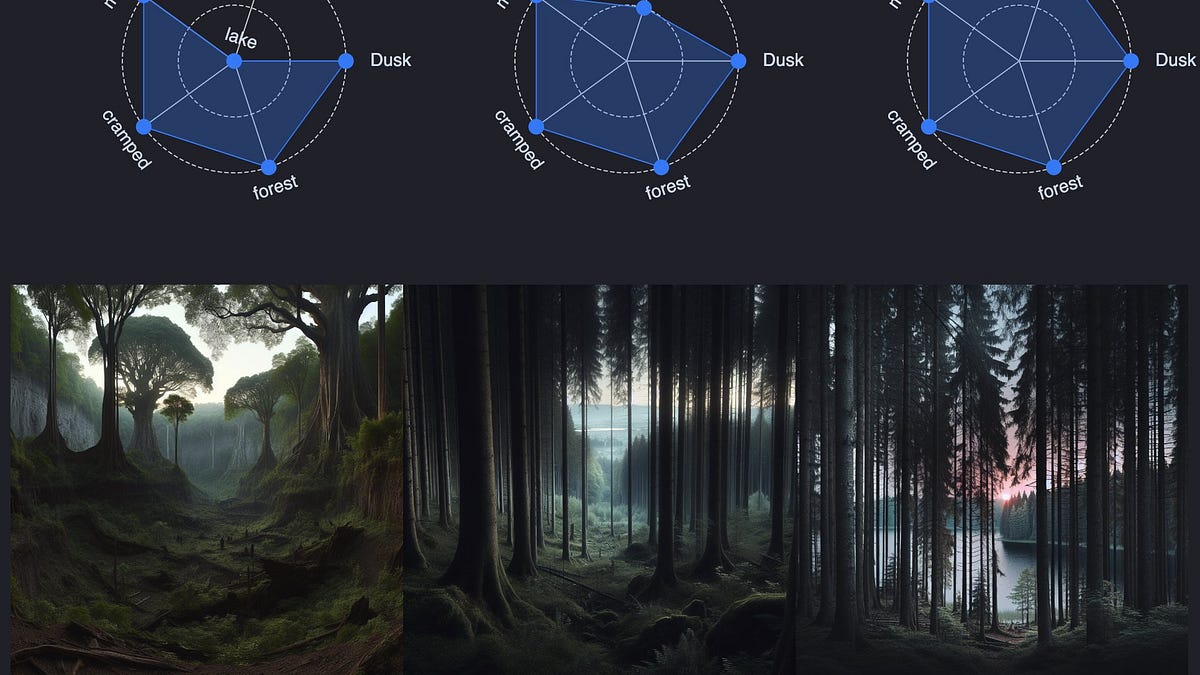 AI Interfaces
## Deconstructed Media
> In order to be able to do faithful transformations across modalities, we need software that has an understanding of the media. Not just the pixel values or words used, but an understanding of what the objects, ideas and composition is. We need world models.
## Creative Control
> One of the big gripes with AI tooling is that for most of it - we go from some high-level idea like “I want a picture of an old man with a cane” to a fully finished piece of media...This takes away all the autonomy from those doing the creative work and feels incredibly reductive.
>
> ...what we really need is tools that allow us to think about media at a higher level, to fill in the gaps and simplify tasks, without reducing our ability to express ourselves and get our hands dirty.
>
> We need tools that give us intuitive sense of what it will output & the ability to steer it. Text will only get us so far. Airtable: Build Enterprise-ready AI Workflows, Apps & Agents
A collaborative database and spreadsheet builder.
This is a commercial hosted SaaS app. Use [[Grist]] instead.
 Airtime | Essential tools for video at work
Airtime used to be called mmhmm, and is a video creator app. It includes a virtual camera that can do overlays and branding, and then has a subscription service that does video storage and sharing.
Founded by [[Phil Libin]]
- barredo.es
- My name is Álex Barredo. I am a programmer turned analyst, turned podcaster. Currently researching about “onlineness”: why people do what they do & say what they say online.
- I write a https://newsletter.mixx.io/" rel="noopener noreferrer">daily newsletter about technology with https://podcast.mixx.io/" rel="noopener noreferrer">a podcast to match. Both are pretty neat.
- I’m the tech lead at https://cuonda.com/" rel="noopener noreferrer">Cuonda.com, a lovely full-fledged podcasting platform.
- I work with talent and advertising agencies at https://voiceup.es/" rel="noopener noreferrer">VoiceUp.es managing sponsorships and marketing campaigns. - Alex Komoroske
CEO and co-founder of [[Common Tools]]. He was previously Head of Corporate Strategy at Stripe and a Director of Product Management at Google.
He posts https://docs.google.com/document/d/1GrEFrdF_IzRVXbGH1lG0aQMlvsB71XihPPqQN-ONTuo/edit?tab=t.0#heading=h.2f6vox7vwou3" rel="noopener noreferrer">weekly reflections.
- Ampache
A web based audio / video streaming application and file manager.
Available for install via [[Cloudron]]
Multi-user, and you can also connect remote catalogs from other Ampache servers.
Has been around since 2001, AGPL licensed. Very old school interface. Supports client apps including the very good [[Amperfy]] for iOS and MacOS.
 Home - Anil Dash
the internet's uncle • waging a victorious 2-front war against cars and christmas • big fan of being a big fan of things • go read https://anildash.com/" rel="noopener noreferrer">anildash.com
 Anoma.ly
Anomaly, short for Anomaly Innovations Inc., is a software company that builds open-source developer tools.
We work on the following open-source projects:
- https://sst.dev/" rel="noopener noreferrer">SST
- https://opentui.com/" rel="noopener noreferrer">OpenTUI
- [[OpenCode]]
- https://opennext.js.org/" rel="noopener noreferrer">OpenNext
- https://openauth.js.org/" rel="noopener noreferrer">OpenAuth
- https://models.dev/" rel="noopener noreferrer">Models.dev Home \ Anthropic
Makers of [[Claude]]
Kicked off [[MCP]] standard
 Antikythera
Antikythera is a think tank reorienting planetary computation as a technological, philosophical, and geopolitical force.
> Through interdisciplinary design studios, salons, and publications, Antikythera researches and develops speculative scenarios that build a philosophy of technology to catch up to the present. Antikythera is incubated by the https://antikythera.us12.list-manage.com/track/click?u=7bda58c0ed846c478501b611e&id=45f52286b0&e=02eac2d385" rel="noopener noreferrer">Berggruen Institute, a 501(c)3 non-profit organization shaping ideas for the 21st century.
## Future of Multipolar Computation
https://antikythera.org/hemispherical-stacks#fmc
> The shift toward multipolar geopolitics and the segmentation of planetary computation into hemispherical stacks not only track one another; they are the same phenomenon.
>
> As part of the Hemispherical Stacks research area, Antikythera is launching an interdisciplinary virtual working group comprised of 12–20 selected researchers who will meet monthly between May and December 2024 to think through key themes and work on potential near-term future scenarios that involve a number of issues related to planetary computation and geopolitics.
>
> Participants will include writers and researchers with expertise in technology, international relations, science-fiction, design, geopolitics, law, and any other relevant areas who will be evolving research and scenario development that takes the form of presentations, papers, and other media projects. Each working group participant will be supported with a research stipend. Outcomes may be included in one or more of Antikythera’s publication platforms with MIT Press.- Document
Powers [[AnyType]]
> Any-Sync is an open-source protocol that enables local first communication and collaboration based on CRDTs.
- Conflict-free data replication across multiple devices and agents
- Built-in end-to-end encryption
- Cryptographically verifiable history of changes
- Adoption to frequent operations (high performance)
- Reliable and scalable infrastructure
- Simultaneous support of p2p and remote communication - apenwarr (@apenwarr.ca)
Founder/CEO of [[Tailscale]]
 Automotive — Solutions — Liquid AI
* MacOS desktop and iOS <https://apps.apple.com/us/app/apollo-powered-by-liquid/id6448019325>
* Google Play Store for Android <https://play.google.com/store/apps/details?id=ai.liquid.chatapp>

 Apple Vision Pro
## Reviews
Interesting reviews
### https://waitbutwhy.com/2024/02/vision-pro.html" rel="noopener noreferrer">Wait But Why, All My Thoughts After 40 Hours in the Vision Pro> I’m writing this on a 30-foot screen on top of a 10,000-foot mountain in Hawaii, at a table in an Austin coffee shop where I’m pretty sure other people are taking photos of me to send to their friends so they can all call me a piece of shit. In the last week, life has gotten weird.
> It’s not just me. VR blows everyone away when they try it, but it seems to have a hard time hooking people for the long run. After a major wave of hype in the mid-2010s, VR receded into the land of subcultures.
> Or are we some tipping point away from VR exploding into the stratosphere like the computer and smartphone?
> The staff member guided me through a demo. And there it was: the holy shit moment.
>
> But it was a holy shit moment with an asterisk. I had experienced full holy shit moments both in 1990 and in 2016 with VR, and these were the notable exceptions to the “holy shit moments are a surefire omen of an industry about to blow up” rule. Was this time different or would history repeat itself?### https://joecieplinski.com/blog/2024/02/10/vision/" rel="noopener noreferrer">Joe Cieplinski, Vision
> This is the best 1.0 Apple has ever shipped. It’s probably the best 1.0 _anyone_has ever shipped. Put it this way: visionOS already has Cut, Copy, and Paste. It has multiple window support. It has a file manager app. It has support for external keyboards and trackpads. It has full integration with iOS and macOS devices.
> If I lived alone, I would have gotten rid of my TV the day after I picked up Vision Pro. It’s simply the best way to watch movies, shows, etc. Period. Hands down. Game over.
> I say this carefully, because I don’t wish to offend. But if you haven’t used Vision Pro, you probably shouldn’t be writing about it.
> I was trying figure out whether Vision Pro will end up replacing my iPad or my Mac, if either, and it’s clear now it’s the Mac whose days would be numbered.
> If, like me, you see it as an entirely new way to be more productive when working, then the price is downright cheap. I paid less for Vision Pro than I did for my Apple Pro Display XDR, and I can use it while sitting on the _couch_.
> The three biggest gripes people have with Vision Pro are price, size/weight, and battery life. These are three problems the tech world has been solving since the dawn of computing. Time will fix all three very easily. So it’s not a matter of whether Vision Pro will be successful. It’s just a matter of how long it takes for mass adoption. In a few short years, Spatial Computing will be a Fortune 100 company within Apple, just as Apple Watch is now.
### https://hugo.blog/2024/03/11/vision-pro/" rel="noopener noreferrer">Hugo Barra, former Head of Oculus at Meta
Very very good breakdown from a knowledgeable insider.
> Vision Pro is an over-engineered “devkit” // Hardware bleeds genius & audacity but software story is disheartening // What we got wrong at Oculus that Apple got right // Why Meta could finally have its Android moment
 Home
HomeARIA is the Advanced Research & Inventions Agency.
ARIA is a UK R&D funding agency built to unlock scientific and technological breakthroughs that benefit everyone.
- arroba — arroba 3.0 documentation
Python implementation of atproto [[PDS]] including repo, MST, and sync XRPC methods
You can build your own PDS on top of arroba with just a few lines of Python and run it in any WSGI server. You can build a more involved PDS with custom logic and behavior.
Developed by [[Ryan Barrett]]
- www.arushibandi.com
Arushi Bandi is a technologist living and working out of San Francisco. She is the CEO and Co-founder of [[Habitat]], building a platform to help organizations and communities own their data and build software for their unique needs. She is also the infra 'witch' of https://collectiveaction.school" rel="noopener noreferrer">Collective Action School helping tech workers remake tech from below and has been a recurring class-taker of the School for Poetic Computation.
Prior to building Habitat, she was an infrastructure software engineer at Figma for several years.  Parked Domain
Defunct
---
A startup foundry joint venture founded by [[John Edgar]] and run with [[McMillan]].
Dedicated to representing Canadian founders.
Has cross-border Canada + Delaware formation docs.
> Our team has been inside many startups as they grew from zero to IPO. We know what greatness looks like because we've worked with the greatest.
>
> If you're a Canadian founder, or a founder interested in Canada, call us, we'd love to chat about what you're building.
>
> We believe Canada can be better.
> We help founders win, no matter what. Astro
AstroAstro is a JavaScript web framework optimized for building fast, content-driven websites.
- Astuto
https://github.com/riggraz/astuto" rel="noopener noreferrer">Astuto is a free, open source, self-hosted customer feedback tool. It helps you collect, manage and prioritize feedback from your users. It has been heavely inspired by Canny.io ("astuto", indeed, is the italian translation of the word "canny").
[[GPL3 License]]
## Technologieshttps://github.com/riggraz/astuto/wiki/Technologies" rel="noopener noreferrer">Technologies used:
* [[Rails]]
* [[PostgreSQL]]
* [[RSpec]]
* [[Yarn]]
* [[React]]
* [[TypeScript]]
* [[Redux]]
* [[SASS]]
* [[Webpack]]
* [[Docker]]  TUF Gaming VG289Q|Monitors|ASUS Canada
ASUS 28" 4K Monitor. Bought it at Best Buy
 AT Protocol Community Fund
A project hosted by [[Raft Foundation]] to pool funds and provide support for AT Protocol community initiatives, commons infrastructure, and other related [[atproto]] needs.
Initial project committee includes me, [[Nick Gerakines]], and [[Ted Han]].
- athensresearch.github.io
- Using [[Eclipse Public License]]
- Written in [[ClojureScript]] and [[DataScript]], same as [[Roam Research]]
- Founded by [[Jeff Tang]]
- ## Updates
- July 2020: https://www.notion.so/MVP-Update-Funding-and-Why-I-Started-Athens-e68822f0c3654660ae621cdcbf932bc4" rel="noopener noreferrer">MVP Update, Funding, and Why I Started Athens
- > We are creating and will create vast amounts of value, and we should capture value proportionally. Being open-source shouldn't change that. In fact, arguably we should be capturing MORE value, not in spite of, but BECAUSE we're open-source.
- > I'm going to take a page out of Roam's book (once again) and price our sponsorships at $16/month (Athenian) and $501 / 5 years (Believer), because that's how much I pay for Roam, and I believe Athens will create at least as much value as Roam _if the only difference_ were that we were open-source.
- Quoting [[Toby Shorin]] [[Come for the Network, Pay for the Tool]]
-  Glossary of terms - AT Protocol
The "ATmosphere" is the term we use to describe the ecosystem around the [[atproto]]
 ATmosphere Conference
I'm one of the organizers for this [[atproto]] community conference, March 22nd & 23rd in Seattle, Washington.
Other organizers include [[Ted Han]] and [[Erik Marks]].
- Survey questions and other post conf ideas
I wrote up a few notes on what needs to be done to wrap up [[AtmosphereConf 2026]], and then shared some notes on what basic research might happen for [[AtmosphereConf 2027]] now, changes to the website, news, and blog, and the kick off of more regional event meetups.
---
Here are a few of the conference wrap up tasks.
- cleaning up VODs: lots of people built VOD players but the source videos still need some work in cutting dead air, matching up events, and so on — this ideally will all be reflected on the website
- shipping t-shirts: we need a final tally and do stuff packing bags with leftover stickers
- email to all attendees: we’ll point to various resources, ask for feedback, and include a link to a feedback survey
- finalizing all bills and payments and producing some financial summariesIf you have suggestions on questions to include in the survey, please do leave a comment.
We can also run further surveys in the future.
## 2027
There are no set plans or organizing crew for 2027. Sharing details from the 2026 wrap up will be helpful input.
There seems to be a strong demand to have a global conference again, and as I’ve written elsewhere and done in the past for other communities, rotating continents is one way to do it.
Personally, I have an interest in forming a co-op entity to be responsible for a variety of things.
That doesn’t block early research. We can look to put together a Grist database where we gather venue availability and pricing for a 500-750 person conference in late March.
## AtmosphereConf Website, News & Blog
The AtmosphereConf website was a lovely example of community contributions. We could move the 2025 conference there as an archive, plus the AHOY videos.
A shared community calendar for ATProto and adjacent events could be a good feature.
Please file issues (or PRs!) with other ideas you have https://github.com/ATProtocol-Community/atmosphereconf
The news.atmosphereconf.org site remaining as conference news is probably a good idea.
The atprotocol.dev blog has over 400 subscribers in ghost. Many of those are Tech Talks - which could also move to the AtmosphereConf website?
Moving the ghost blog to something else and perhaps sharing community-wide announcements is a thing we can look at.
## Regional Events
A lot of regions are likely to be kicking off soon, this would be a great way to keep momentum.
Tynan gathered folks at the Conf. Nick put up a listing at atproto.camp.
As mentioned above, a shared calendar could be a thing.
Other than running events for a couple of months, what else do regional events need?
---
I started writing more, about upcoming events and new and revived working groups.
There is a lot that can be done.
 ATmosphereConf 2026
Annual global community conference for [[atproto]]
See [[ATmosphereConf 2025]] (Seattle), [[AtmosphereConf 2026]] (Vancouver)
- AT Protocol Community Wiki
A [[WikiJS]] powered wiki for the [[atproto]] community. I started this after the [[ATmosphereConf 2025]] to have a place to put information that isn't just in Discord.
- Atproto Stammtisch
Meet at David's RV at [[DWeb Camp 2026|DWeb Camp Berlin]].
We're going to experiment with [[Lichen Wiki]] for notes, connections, and other activities: <@bmann.ca/atproto-stammtisch>" rel="noopener noreferrer">https://lichen.wiki/@bmann.ca/atproto-stammtisch>
Stammtisch is German for "regulars' table", https://en.wikipedia.org/wiki/Stammtisch" rel="noopener noreferrer">Wikipedia:
> A Stammtisch is an informal group meeting held on a regular basis, and also the usually large, often round table around which the group meets. A Stammtisch is not a structured meeting, but rather a friendly get-together.
> In urban areas, especially in the late 1990s, different kinds of Stammtisch groups have been established acting like a loose, informal club of people sharing similar interests on a specific topic. They are meant for socialising, exchange of experience and networking (e.g. Stammtisch for parents). Networking organisations such as clubs for marketers or entrepreneurs often call their regular events, which are also open to non members, a Stammtisch.
- Join the ATProto Touchers Discord Server!
The community-run developer Discord for discussion of [[atproto]].
- atproto-browser.vercel.app
The atproto-browser lets you browse records in your user account on [[atproto]], as well as see various other things in your account, like the DID of your account.
Here's my main account, which is hosted on a Bluesky "mushroom" [[PDS]], but has lots of other Lexicon data types in it:
<iframe src="https://atproto-browser.vercel.app/at/bmann.ca" height="600px"
width="600px" style="background-color: white"></iframe>  Automerge
Automerge is a library of data structures for building collaborative applications.
Research work incubated by [[Ink & Switch]]
## Automatic Merging
Automerge is a Conflict-Free Replicated Data Type ([[CRDT]]), which allows concurrent changes on different devices to be merged automatically without requiring any central server.
## Network-agnostic
Use any connection-oriented network protocol: client-server, peer-to-peer, or local. Or use unidirectional messaging: send an Automerge file as an email attachment or store it on a file server.
## Portable
Implemented in https://github.com/automerge/automerge" rel="noopener noreferrer">JavaScript and https://github.com/automerge/automerge-rs" rel="noopener noreferrer">Rust, with FFI bindings across platforms including iOS, Electron, Chrome, Safari, Edge, Firefox, and more.
 Autonomous Communicator (AC) Protocol — Germ Network
Protocol designed by [[Germ Network]] for secure, e2ee messaging using [[MLS]]
> The AC Protocol encapsulates our chosen message security protocol, Messaging Layer Security (MLS), under a new identity layer, and above a new transport layer. In doing so, we decouple identity from transport, allowing us to remove identity from message envelopes in transit, and free both identity and transport layers to flexibly evolve identifiers to serve the divergent needs of each.
>
> This protocol is an internet-native reimagination of your contacts — no longer a rolodex of stale information I accumulated about someone else, but a living, cultivated set of connections over E2EE messaging, within which we safely and consensually update each other as our ends of relationships evolve and move.
>
> Alongside this post, we are open-sourcing our https://github.com/germ-network/autonomous-comm-protocol" rel="noopener noreferrer">Swift implementation of the protocol under the MIT license.
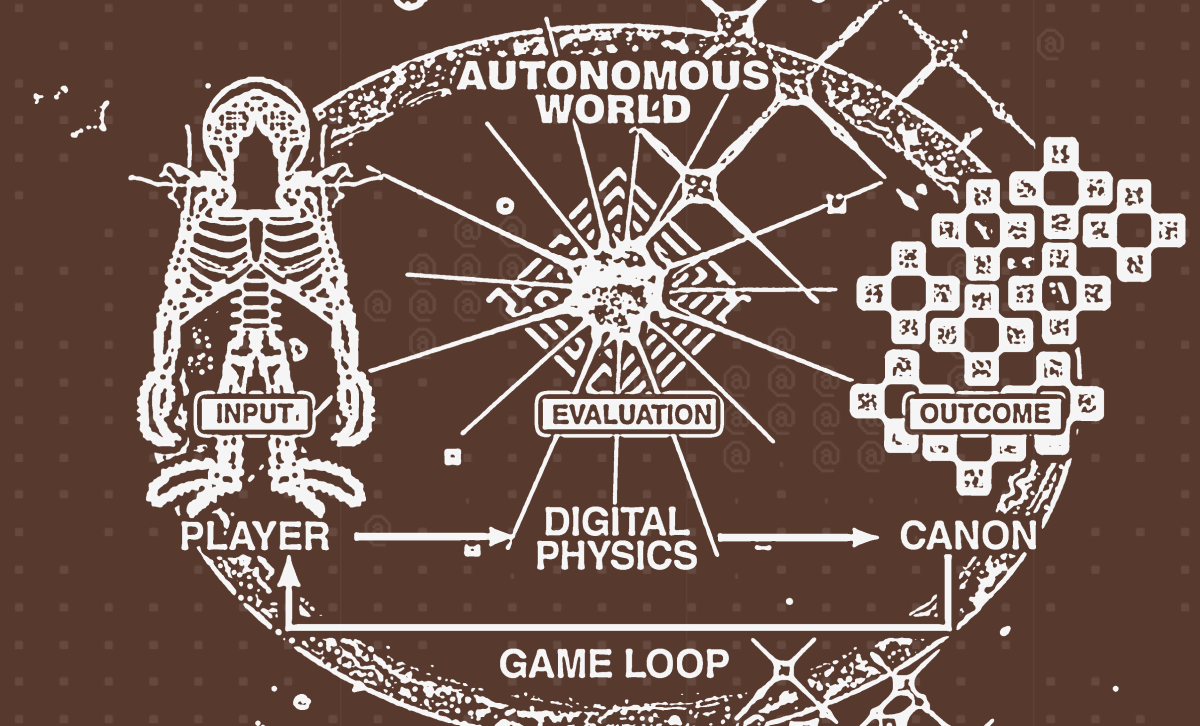 HOME
HOME-
- itunes.apple.com
- I previously wrote about using an app called The Archivist for iOS photo backups. I’ve also used [[Dropshare]] in the past. Neither are working for me at the moment, and this paid app with a 1-Star rating is actually very good and simple for the task of uploading and downloading files to your [[Making folders publicly readable in an Amazon S3 bucket]] buckets.
- 
 BackYourStack: Discover the Open Source projects you are using and need financial support.
Website: <https://backyourstack.com>
Connect your GitHub account and scan your dependencies for which projects have [[Open Collective]] accounts.

 balenaEtcher - Flash OS images to SD cards & USB drives
- Flash OS images to SD cards & USB drives, safely and easily.
- Bandcamp
Platform for artists to sell music directly to fans.
Sold to https://blog.bandcamp.com/2022/03/02/bandcamp-is-joining-epic/" rel="noopener noreferrer">Epic Games in March 2022. Then https://pitchfork.com/news/epic-games-sells-bandcamp-amid-layoffs/" rel="noopener noreferrer">Epic Games sold it to Songtradr in September 2023.
It hasn't gone downhill yet, but many people are worried that it will. [[Subvert]] is a co-op that I'm a founding member of whose goal it is to make a co-op owned version of Bandcamp that can't be bought and sold in this way.
---
My profile there is https://bandcamp.com/borismusic" rel="noopener noreferrer">borismusic.
I guess https://bandcamp.com/borismann" rel="noopener noreferrer">borismann on there is the https://soundcloud.com/boris-mn" rel="noopener noreferrer">this guy on Soundcloud.
 Bee - Your new wearable personal AI
A wearable hardware device with audio and other data recording, currently priced at $50USD. I ordered in March 2025
> Bee is a personal AI that transforms your conversations, tasks, places and more into summaries, personal insights and timely reminders.
- beets: the music geek‘s media organizer
Beets is the best command-line tool for viewing, querying, and renaming your music collection.
> Because beets is designed as a library, it can do almost anything you can imagine for your music collection. Via http://beets.readthedocs.org/page/plugins/" rel="noopener noreferrer">plugins, beets becomes a panacea:
>
> - Fetch or calculate all the metadata you could possibly need: http://beets.readthedocs.org/page/plugins/fetchart.html" rel="noopener noreferrer">album art, http://beets.readthedocs.org/page/plugins/lyrics.html" rel="noopener noreferrer">lyrics, http://beets.readthedocs.org/page/plugins/lastgenre.html" rel="noopener noreferrer">genres, http://beets.readthedocs.org/page/plugins/echonest_tempo.html" rel="noopener noreferrer">tempos, http://beets.readthedocs.org/page/plugins/replaygain.html" rel="noopener noreferrer">ReplayGain levels, or http://beets.readthedocs.org/page/plugins/chroma.html" rel="noopener noreferrer">acoustic fingerprints.
> - Get metadata from http://musicbrainz.org/" rel="noopener noreferrer">MusicBrainz, http://www.discogs.com/" rel="noopener noreferrer">Discogs, or http://www.beatport.com/" rel="noopener noreferrer">Beatport. Or guess metadata using songs’ filenames or their acoustic fingerprints.
> - http://beets.readthedocs.org/page/plugins/convert.html" rel="noopener noreferrer">Transcode audio to any format you like.
> - Check your library for http://beets.readthedocs.org/page/plugins/duplicates.html" rel="noopener noreferrer">duplicate tracks and albums or for http://beets.readthedocs.org/page/plugins/missing.html" rel="noopener noreferrer">albums that are missing tracks. - Balance Employee IP Agreement
[[GitHub]]'s employee IP agreement, open sourced and reusable
> BEIPA takes a balanced approach to assigning control of intellectual property (IP) created by an employee. The employee maintains control unless they created the IP in their employee capacity and the IP relates to an existing or prospective company product or service, or was developed for use by the company, or was developed or promoted with existing company IP or with the company's endorsement. A company using BEIPA doesn't try to claim control of an employee's free time knowledge production, nor does it try to extend company control past the period of employment. Think of BEIPA as a commitment to employee autonomy and "work-life balance" – for the mind.
>
> BEIPA was started as a reusable version of GitHub's employee IP agreement. Your company can use BEIPA too, and modify it as needed. If you'd like to help improve BEIPA for everyone, file an issue or make a pull request. While aiming to maintain the same "balanced" policy, we're keen to see feedback and suggestions for improving BEIPA and associated documentation.via @trevoro
- onezero.medium.com
- Part 1: [[The Dark Forest Theory of the Internet]]
- - Big Time License
A public license that makes software free for noncommercial and small-business use, with a guarantee that fair, reasonable, and nondiscriminatory paid-license terms will be available for everyone else.
Created by [[Kyle Mitchell]]
---
Version 2.0.2
<https://bigtimelicense.com/versions/2.0.2>
## Purpose
These terms let you use and share this software for noncommercial purposes and in small business for free, while also guaranteeing that paid licenses for big businesses will be available on fair, reasonable, and nondiscriminatory terms.
## Acceptance
In order to get any license under these terms, you must agree to them as both strict obligations and conditions to all your licenses.
## Noncommercial Purposes
You may use the software for any noncommercial purpose.
## Personal Uses
Personal use for research, experiment, and testing for the benefit of public knowledge, personal study, private entertainment, hobby projects, amateur pursuits, or religious observance, without any anticipated commercial application, count as use for noncommercial purposes.
## Noncommercial Organizations
Use by any charitable organization, educational institution, public research organization, public safety or health organization, environmental protection organization, or government institution counts as use for noncommercial purposes, regardless of the source of funding or obligations resulting from the funding.
## Small Business
You may use the software for the benefit of your company if it meets all these criteria:
1. had fewer than 20 total individuals working as employees and independent contractors at all times during the last tax year
2. earned less than $1,000,000 total revenue in the last tax year
3. received less than $1,000,000 total debt, equity, and other investment in the last five tax years, counting investment in predecessor companies that reorganized into, merged with, or spun out your company
All dollar figures are United States dollars as of 2019. Adjust for them inflation according to the United States Bureau of Labor Statistics' consumer price index for all urban consumers, United States city average, for all items, not seasonally adjusted, with 1982–1984=100 reference base.
## Big Business
You may use the software for the benefit of your company:
1. for 128 days after your company stops qualifying under Small Business
2. indefinitely, if the licensor or their legal successor does not offer fair, reasonable, and nondiscriminatory terms for a commercial license for the software within 32 days of written request and negotiate in good faith to conclude a deal
## How to Request
If this software includes an address for the licensor or an agent of the licensor in a standard place, such as in documentation, software package metadata, or an "about" page or screen, try to request a fair commercial license at that address. If this package includes both online and offline addresses, try online before offline. If you can't deliver a request that way, or this software doesn't include any addressees, spend one hour online researching an address, recording all your searches and inquiries as you go, and try any addresses that you find. If you can't find any addresses, or if those addresses also fail, that counts as failure to offer a fair commercial license by the licensor under Big Business.
## Fair, Reasonable, and Nondiscriminatory Terms
Fair, reasonable, and nondiscriminatory terms may license the software perpetually or for a term, and may or may not cover new versions of the software. If the licensor advertises license terms and a pricing structure for generally available commercial licenses, the licensor proposes license terms and a price as advertised, and a customer not affiliated with the licensor has bought a commercial license for the software on substantially equivalent terms in the past year, the proposal is fair, reasonable, and nondiscriminatory.
## Copyright License
The licensor grants you a copyright license to do everything with the software that would otherwise infringe the licensor's copyright in it for any purpose allowed by these terms.
## Notices
You must ensure that anyone who gets a copy of any part of the software from you also gets a copy of these terms or the URL for them above, as well as copies of any plain-text lines beginning with
Required Notice:that the licensor provided with the software. For example:> Required Notice: Copyright Yoyodyne, Inc. (http://example.com)
## Patent License
The licensor grants you a patent license for the software that covers patent claims the licensor can license, or becomes able to license, that you would infringe by using the software.
## Fair Use
You may have "fair use" rights for the software under the law. These terms do not limit them.
## No Other Rights
These terms do not allow you to sublicense or transfer any of your licenses to anyone else, or prevent the licensor from granting licenses to anyone else. These terms do not imply any other licenses.
## Patent Defense
If you make any written claim that the software infringes or contributes to infringement of any patent, your patent license for the software granted under these terms ends immediately. If your company makes such a claim, your patent license ends immediately for work on behalf of your company.
## Violations
The first time you are notified in writing that you have violated any of these terms, or done anything with the software not covered by your licenses, your licenses can nonetheless continue if you come into full compliance with these terms, and take practical steps to correct past violations, within 32 days of receiving notice. Otherwise, all your licenses end immediately.
## No Liability
As far as the law allows, the software comes as is, without any warranty or condition, and the licensor will not be liable to you for any damages arising out of these terms or the use or nature of the software, under any kind of legal claim.
## Definitions
The licensor is the individual or entity offering these terms, and the software is the software the licensor makes available under these terms.
You refers to the individual or entity agreeing to these terms.
Your company is any legal entity, sole proprietorship, or other kind of organization that you work for, plus all organizations that have control over, are under the control of, or are under common control with that organization. Control means ownership of substantially all the assets of an entity, or the power to direct its management and policies by vote, contract, or otherwise. Control can be direct or indirect.
Your licenses are all the licenses granted to you for the software under these terms.
Use means anything you do with the software requiring one of your licenses.
- BigfootJS
A jQuery plugin for empowering footnotes.
> Bigfoot is a jQuery plugin that creates exceptional footnotes. Simply include the code on your pages and footnotes will be detected automatically and improved in the following ways:
>
>* Links to footnotes will be replaced with clickable/ tappable buttons, making them substantially easier to hit.
>
>* Footnote content will appear in a popover directly beside the footnote button when it is clicked/ tapped, which cuts out the annoying bouncing around the page that footnotes typically result in.
>
>* The active popovers will be resized and repositioned to ensure that they continue to be completely visible on-screen and aesthetically pleasing: this makes it perfect for mobile devices and responsive designs.  WebSeitz/wiki
> This is the publicly-readable http://webseitz.fluxent.com/wiki/WikiLog" rel="noopener noreferrer">WikiLog http://webseitz.fluxent.com/wiki/DigitalGarden" rel="noopener noreferrer">Digital Garden (17k pages, starting from 2002) of http://webseitz.fluxent.com/wiki/BillSeitz" rel="noopener noreferrer">Bill Seitz (a http://webseitz.fluxent.com/wiki/ProductManager" rel="noopener noreferrer">Product Manager and http://webseitz.fluxent.com/wiki/CTO" rel="noopener noreferrer">CTO). _(You can get your own pair of garden/note-taking spaces from http://webseitz.fluxent.com/wiki/FluxGarden" rel="noopener noreferrer">FluxGarden.)_
 Build Community Online with Decentralized Tools | Blacksky
Building the Black social layer for the decentralized web.
> Blacksky is providing a platform to amplify, protect, and moderate Black content so users can safely build community online.
The mission and purpose of the project is to de-center whiteness as the default and to provide a space for Black folk to discuss the Black everyday in a way that feels affirming.
As existing networks like Twitter (a uniquely Black platform with 25% Black users) continue to deteriorate by way of platform decay, this mission is all the more urgent.
>
> Built on the [[atproto]] and written largely in Rust, Blacksky is comprised of microservices that analyze, aggregate, and output content created by and for Black users. Blacksky intersects with culture, machine learning, and decentralized web technologies to provide a safe social experience for Black users that allows them to feel seen without worrying about threats from bad actors.- Blaine Cook
Lead engineer that built [[Twitter]]
Co-Author of the [[OAuth]] and [[WebFinger]] standards
- bmannconsulting.com
- The Three Definitions of Blockchain
- Blockchain as Innovation: the cryptographic / computer science innovation of Merkle Trees and organizing into an immutable chain using math.
- Blockchain as Public Chain: A collective label for instances of public chains, such as Bitcoin or Ethereum.
- Blockchain as Ethos: The believe and support for certain attributes of blockchains, such as decentralization, trustlessness, or immutability.
- Also embeds [[Three Definitions of Open Source]]
- - Blot
- "A Blogging platform with no interface".
- Specifically, it uses your own [[Dropbox]] account to create the files that it transforms into a blog for you. For $20 / year, this is pretty awesome.
-  Blue Oak Council
Blue Oak Council opens the software commons up to those who can’t find or afford specialized legal help by bringing experienced lawyer-technologists together to publish free, practical materials about software licenses.
## Permissive License List
Blue Oak maintains a https://blueoakcouncil.org/list" rel="noopener noreferrer">rated list of permissive software licenses
> Permissive licenses are the bread and butter of software development: simple, effective, and on just about everyone’s “go” list. But most information about free and open source software focuses on other, more complex licenses. The Council publishes this list to identify permissive licenses, so that everyone can recognize, rely on, and use them without expensive legal help.
I've copied the Gold and Silver sections below.
### Gold
These licenses address patents explicitly, use robust language, and require only simple notice of license terms and copyright notices.
- https://spdx.org/licenses/BSD-2-Clause-Patent.html" rel="noopener noreferrer">BSD-2-Clause Plus Patent License (
BSD-2-Clause-Patent)### Silver
These licenses use robust language but either fail to address patents explicitly or require more than simple notice of license terms and copyright notices.
- https://spdx.org/licenses/ADSL.html" rel="noopener noreferrer">Amazon Digital Services License (
ADSL)
- https://spdx.org/licenses/Apache-2.0.html" rel="noopener noreferrer">Apache License 2.0 (Apache-2.0)
- https://spdx.org/licenses/APAFML.html" rel="noopener noreferrer">Adobe Postscript AFM License (APAFML)
- https://spdx.org/licenses/BSD-1-Clause.html" rel="noopener noreferrer">BSD 1-Clause License (BSD-1-Clause)
- https://spdx.org/licenses/BSD-2-Clause.html" rel="noopener noreferrer">BSD 2-Clause "Simplified" License (BSD-2-Clause)
- https://spdx.org/licenses/BSD-2-Clause-FreeBSD.html" rel="noopener noreferrer">BSD 2-Clause FreeBSD License (BSD-2-Clause-FreeBSD)
- https://spdx.org/licenses/BSD-2-Clause-NetBSD.html" rel="noopener noreferrer">BSD 2-Clause NetBSD License (BSD-2-Clause-NetBSD)
- https://spdx.org/licenses/BSD-2-Clause-Views.html" rel="noopener noreferrer">BSD 2-Clause with Views Sentence (BSD-2-Clause-Views)
- https://spdx.org/licenses/BSL-1.0.html" rel="noopener noreferrer">Boost Software License 1.0 (BSL-1.0)
- https://spdx.org/licenses/DSDP.html" rel="noopener noreferrer">DSDP License (DSDP)
- https://spdx.org/licenses/ECL-1.0.html" rel="noopener noreferrer">Educational Community License v1.0 (ECL-1.0)
- https://spdx.org/licenses/ECL-2.0.html" rel="noopener noreferrer">Educational Community License v2.0 (ECL-2.0)
- https://spdx.org/licenses/hdparm" rel="noopener noreferrer">hdparm License (hdparm)
- https://spdx.org/licenses/ImageMagick.html" rel="noopener noreferrer">ImageMagick License (ImageMagick)
- https://spdx.org/licenses/Intel-ACPI" rel="noopener noreferrer">Intel ACPI Software License Agreement (Intel-ACPI)
- https://spdx.org/licenses/ISC.html" rel="noopener noreferrer">ISC License (ISC)
- https://spdx.org/licenses/Linux-OpenIB.html" rel="noopener noreferrer">Linux Kernel Variant of OpenIB.org license (Linux-OpenIB)
- https://spdx.org/licenses/MIT.html" rel="noopener noreferrer">MIT License (MIT)
- https://spdx.org/licenses/MIT-Modern-Variant.html" rel="noopener noreferrer">MIT License Modern Variant (MIT-Modern-Variant)
- https://spdx.org/licenses/MIT-testregex" rel="noopener noreferrer">MIT testregex Variant (MIT-testregex)
- https://spdx.org/licenses/MIT-Wu" rel="noopener noreferrer">MIT Tom Wu Variant (MIT-Wu)
- https://spdx.org/licenses/MS-PL.html" rel="noopener noreferrer">Microsoft Public License (MS-PL)
- https://spdx.org/licenses/MulanPSL-1.0.html" rel="noopener noreferrer">Mulan Permissive Software License, Version 1 (MulanPSL-1.0)
- https://spdx.org/licenses/Mup.html" rel="noopener noreferrer">Mup License (Mup)
- https://spdx.org/licenses/PostgreSQL.html" rel="noopener noreferrer">PostgreSQL License (PostgreSQL)
- https://spdx.org/licenses/SHL-0.5" rel="noopener noreferrer">Solderpad Hardware License v0.5 (SHL-0.5)
- https://spdx.org/licenses/Spencer-99.html" rel="noopener noreferrer">Spencer License 99 (Spencer-99)
- https://spdx.org/licenses/UPL-1.0.html" rel="noopener noreferrer">Universal Permissive License v1.0 (UPL-1.0)
- https://spdx.org/licenses/Xerox.html" rel="noopener noreferrer">Xerox License (Xerox)
- https://spdx.org/licenses/Xfig" rel="noopener noreferrer">Xfig License (Xfig) Bluesky
> We‘re building the https://atproto.com/" rel="noopener noreferrer">AT Protocol, a new foundation for public conversation and social networking which gives creators independence from platforms, developers the freedom to build, and users a choice in their experience.
The company is a Public Benefit Corporation that created the [[atproto]] and built and runs the https://baky.app" rel="noopener noreferrer">Bluesky microblogging platform.
[[Tim Bray]] collected https://www.tbray.org/ongoing/When/202x/2023/04/28/Bluesky" rel="noopener noreferrer">Facts and opinions about Bluesky because so many people were hating on it, mostly with misinformation.
## Custom Feeds
From the https://docs.bsky.app/docs/starter-templates/custom-feeds" rel="noopener noreferrer">docs:
> Custom feeds, or feed generators, are services that provide custom algorithms to users through the AT Protocol. This allows users to choose their own timelines, whether it's an algorithmic For You page or a feed of entirely cat photos.
>
> This is a starter kit for creating feed generators on atproto. It's not feature complete, but should give you a good starting ground off of which to build and deploy a feed.
>
> You can skip this tutorial and clone the TypeScript starter template directly https://github.com/bluesky-social/feed-generator" rel="noopener noreferrer">here, or use community templates in https://github.com/MarshalX/bluesky-feed-generator" rel="noopener noreferrer">Python or https://github.com/mackuba/bluesky-feeds-rb" rel="noopener noreferrer">Ruby. Bondy.io - The open-source, always-on and scaleable application networking platform that connects all elements of a distributed application—offering service and event mesh capabilities combined.
- Bondy is an open-source, always-on and scaleable application networking platform connecting all elements of a distributed application—offering service and event mesh capabilities combined.
- From web and mobile apps to IoT devices and backend microservices, Bondy allows everything to talk using one simple and secured communication protocol in a decoupled and dynamic way.
- Bondy implements the open https://wamp-proto.org/wamp_latest_ietf.html" rel="noopener noreferrer">Web Application Messaging Protocol (WAMP).- BookStack
BookStack is a simple, open-source, self-hosted, easy-to-use platform for organising and storing information.
 Boris Anthony
I've known Boris on the internet for something like 25+ years, and we used to battle each other for "boris" as a username in the early days.
- bmannconsulting.com
- References [[Blockchain & Open Source Definitions]]
- > The problem with the term open source is that everyone means something different when they use it. Some people just mean licensing. Some people think of a particular community’s set of practices. Others think that it means some kind of fuzzy democracy and mob rule. [[Ted Leung]]
- References [[Coase's Penguin, or Linux and the Nature of the Firm]]
-
- - Boxy SVG
- Vector editor
- - codinginparadise.org
His about page has a great description, including inventing coworking:
> I've worn many hats in my career, whether as a tech lead, a product engineer, a startup founder, or a full stack software engineer. I have a long tradition of untraditional, cross-disciplinary innovation across fields. Earlier work includes having started Coworking, which grew into an international grassroots movement to establish a new kind of workspace for the self-employed, with more than 15,000 coworking spaces now open globally.
## Quotes> Y Combinator is predicated on startups that require low capitalization since most of the technology they depend on is already mostly developed. This was true pre-2015 where startups depended on commodity open source software, the smartphone capitalized by Apple and others, cloud software capitalized by Amazon, Google, etc. Post 2015 that “tech seed corn” had been used up, leaving just difficult deep tech startups around that need very high capitalization and a focus on developing hard, risky technology. <mark>The YC model doesn’t work for those kinds of startups, and is focused on the last tech war.</mark>
>
> https://x.com/bradneuberg/status/1835680235049869495" rel="noopener noreferrer">September 2024See [[When Tailwinds Vanish]]
- braid.org
- Braid builds distributed features into today's web. We are an open group in the IETF.
- The Braid Protocol is an extension to HTTP that generalizes it from a state transfer to a state synchronization protocol.
- Braid adds these features to HTTP:
- Versioning to HTTP resources
- Subscriptions to GET requests
- Patches to Range Requests
- Merge-Types to specify OT or CRDT behavior
- Together, these features enable a web resource to synchronize automatically across multiple clients, servers and proxies, and support arbitrary simultaneous edits by multiple writers, under arbitrary network delays and partitions, while guaranteeing consistency using a https://en.wikipedia.org/wiki/Operational_transformation" rel="noopener noreferrer">OT, https://en.wikipedia.org/wiki/Conflict-free_replicated_data_type" rel="noopener noreferrer">CRDT, or other algorithm.
- #IETF draft https://datatracker.ietf.org/doc/html/draft-toomim-httpbis-braid-http
- 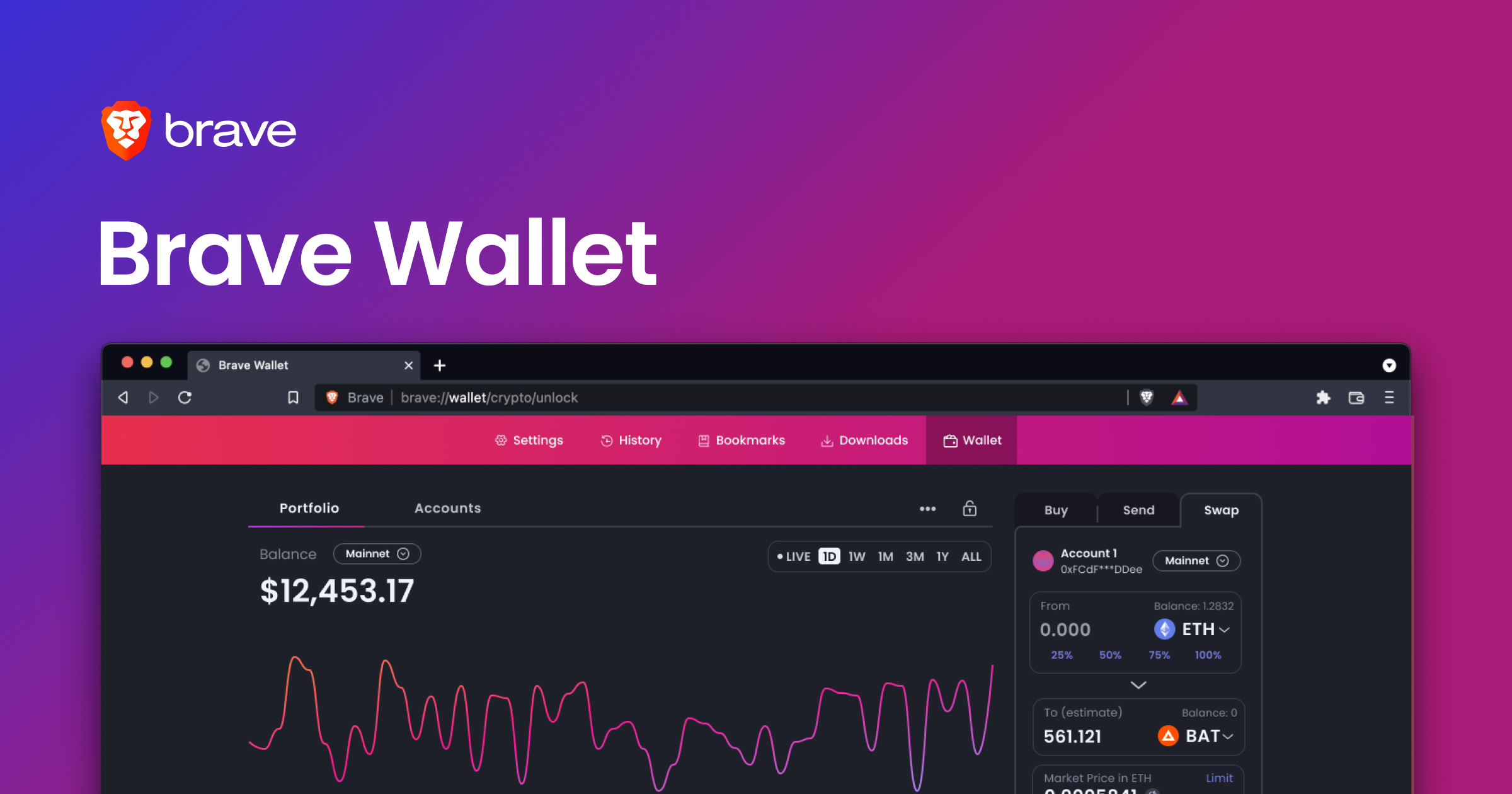
 The browser that puts you first | Brave
- Chromium based web browser
- Has support for various #Web3 tech
- Includes a blockchain wallet [[Brave/Wallet]] , with support for #Ethereum, #Solana, and #filecoin
- Has #IPFS integrated, and can fetch / browse IPFS content directly, as well as #IPNS
- Contraptions | Venkatesh Rao | Substack
- Redirects to [[Ribbonfarm Studio]]
- Bridgy Fed
Bridgy Fed is a decentralized social network bridge, made by [[Ryan Barrett]]
## Docs
https://fed.brid.gy/docs" rel="noopener noreferrer">Docs
> Bridgy Fed is a decentralized social network bridge. It connects the https://en.wikipedia.org/wiki/Fediverse" rel="noopener noreferrer">fediverse, the https://indieweb.org/" rel="noopener noreferrer">web, and https://bsky.social/" rel="noopener noreferrer">Bluesky. If you're on one of these networks, you can use Bridgy Fed to follow people on other networks, see their posts, and reply and like and repost them. Likewise, they'll be able to see you and your posts too.
- bringyourown.computer
As one often does, I needed a domain and it's a nod to [[Bring Your Own Server]] pattern I've been tracking.
## Hostinger VPS
This root domain
bringyourown.computeris on a https://www.hostinger.com/vps-hosting#pricing" rel="noopener noreferrer">KVM-1 at [[Hostinger]] in a German data center - 1 vCPU core, 4 GB RAM, 50 GB NVMe disk space, 4 TB bandwidth, that cost $128.14USD for 2 years, or $5.34 per month.See November 2024 [[PDS Setup on Hostinger]].
It's one job is currently running a a [[Bluesky PDS]]. I might bring that home, and cancel the VPS. Price is going up to $205USD for 2 years.
## OVH Bare Metal
As of June 2026, I have a bare metal server at [[OVH Canada]],
ovh.bringyourown.computer.* Intel Xeon-E3 1270 v6 - 4c/8t - 3.8 GHz/4.2 GHz
* 64 GB ECC 2400 MHz
* 2×2 TB HDD SATA Soft RAIDThis is from the https://www.kimsufi.com/en-ca/" rel="noopener noreferrer">Kimsufi series of "cheap" servers, the KS-5 in the case of this one I have. It costs $492CAD for a year, or $41CAD per month. One of the things you can't do with the Kimsufi servers is use the OVH vRack (virtual rack) to do private IP ranges.
It has [[Proxmox]] installed via OVH's setup install. There will eventually be a [[Proxmox OVH Setup]] page.
## Homelab
As of late May 2026, I have a [[GMKtec Mini PC]] that is running [[Proxmox]]
proxmox.bringyourown.computer.Initial [[GMKtec Mini PC Setup]] here. See [[Homelab]] for more on what apps are running.
 Welcome to Understory
Hey there, I'm Brooke, a composer-turned-programmer living in beautiful, rainy Vancouver. This is my digital garden — notes in various stages of completeness…
- bnewbold.net
> As of Spring 2023 I live in Seattle, at the https://extraordinary.leastsquar.es/" rel="noopener noreferrer">ELS household. I love the volcanoes in this region: climbing them, biking around them, snowboarding down them, paragliding around them, whatever. And the big wet mossy trees!
>
> I work at [[Bluesky]], a startup company building a federated social media protocol called [[atproto]]. Until a few months ago I worked at the https://archive.org/" rel="noopener noreferrer">Internet Archive collecting scientific research datasets and publications, and created https://scholar.archive.org/" rel="noopener noreferrer">scholar.archive.org. And before that I worked on infrastructure at https://stripe.com/" rel="noopener noreferrer">Stripe, attended the https://recurse.com/" rel="noopener noreferrer">Recurse Center in New York City, and built Atomic Magnetometers for a small New Jersey company called http://www.twinleaf.com/" rel="noopener noreferrer">Twinleaf. - podcasts.apple.com
- In Building At The Edges, [[Jess Sloss]], instigator at Seed Club, holds intimate conversations with top innovators building irresistible web3 communities. We surface insights from DAO experiments and dig into decentralization's dual challenges and opportunities. Web3 unlocks novel mechanisms for people, not platforms, to capture the value created online. Building At The Edges is where we sense-make the high-velocity design space at the intersection of crypto and community.
- - Cloud Native Buildpacks
A standard under the [[CNCF|Cloud Native Computing Foundation]]
## What We Do
Cloud Native Buildpacks (CNBs) transform your application source code into container images that can run on any cloud. With buildpacks, organizations can concentrate the knowledge of container build best practices within a specialized team, instead of having application developers across the organization individually maintain their own Dockerfiles. This makes it easier to know what is inside application images, enforce security and compliance requirements, and perform upgrades with minimal effort and intervention.
## Our Origin Story
Buildpacks were first conceived by [[Heroku]] in 2011. Since then, they have been adopted by Cloud Foundry and other PaaS such as Google App Engine, Gitlab, Knative, Deis, Dokku, and Drie.
(image of Heroku v1, Pivotal and Heroku v2, and then Pivotal + Heroku agreeing on current Cloud Native Buildpacks)
The Cloud Native Buildpacks project was initiated by Pivotal and Heroku in January 2018 and joined the https://www.cncf.io/" rel="noopener noreferrer">Cloud Native Computing Foundation in October 2018. The project aims to unify the buildpack ecosystems with a https://github.com/buildpacks/spec/blob/main/buildpack.md" rel="noopener noreferrer">platform-to-buildpack contract that is well-defined and that incorporates learnings from maintaining production-grade buildpacks for years at both Pivotal and Heroku.
Cloud Native Buildpacks embrace modern container standards, such as the OCI image format. They take advantage of the latest capabilities of these standards, such as cross-repository blob mounting and image layer "rebasing" on Docker API v2 registries.
 Adopting and Developing BSL Software | MariaDB
- Quotes of portions of the BSL FAQ
- Business Source License (BSL) was created by David Axmark and Michael Widenius to provide a mutually beneficial balance between the user benefits of true Open Source software that is free of cost and provides open access to all of the product code for modification, distribution, etc., and the sustainability needs of software developers to continue delivering product innovation and maintenance.
- The BSL is structured to allow free and open usage for the majority of use cases, and only requires a commercial license by those who use the software above a certain threshold, which is typically indicative of an environment that is delivering significant value to a business.
- BSL gives users complete access to the source code so users can modify, distribute and enhance it. It also guarantees a path for the software to become Open Source over time so that users will never be locked into a single vendor. These features help preserve the critical freedom aspects of Open Source (as defined by the [[Open Source Initiative]] in the [[Open Source Definition]]) while enabling a viable business model for professional software developers.
- This FAQ is designed to address questions for any developer, or any company, interested in working on BSL software or adopting BSL for their own business.
- What is Business Source License (BSL)?
- > BSL is a new alternative to Closed Source or Open Core licensing models. Under BSL, the source code is freely available from the start and it is guaranteed to become Open Source at a certain point in time (i.e., the Change Date). Usage below a specific level in the BSL is always completely free. Usage above the specified level requires a license from the vendor until the Change Date, at which point all usage becomes free.
- What is the purpose of BSL?
- > To create a license that strikes a balance between being able to run a financially viable software company while still supporting the original tenets of Open Source, such as empowering all software developers to be part of the innovation cycle – giving them open access to the code so they can modify or distribute the software by making the entire source code available from the start. Ultimately, we hope that BSL will create more Open Source software.- www.hashicorp.com
- [[Hashicorp]]'s parameters for the BSL are below. In written form, this means
- Additional Use Grant says that production use is allowed, except if it is competitive with HashiCorp's products.
- After 4 years, the release becomes available under [[Mozilla Public License]]
- | Licensor: | HashiCorp, Inc. |
| Licensed Work: | The Licensed Work is (c) 2023 HashiCorp, Inc. |
| Additional Use Grant: | You may make production use of the Licensed Work, provided such use does not include offering the Licensed Work to third parties on a hosted or embedded basis which is competitive with HashiCorp's products |
| Change Date: | Four years from the date the Licensed Work is published |
| Change License: | [[MPL]] 2.0 |
-
- - MariaDB Business Source License (BSL) | MariaDB
- How is the BSL different from [[Open Core]]?
- Open core offers some code under Open Source terms, but non-core code is not under Open Source terms, is not available in source form, cannot be modified and compiled, cannot be contributed to, and will never be Open Source. By using Open Core software, like with closed source code, you are locked to one vendor. With BSL, as compared to Open Core, the source code is available from the start, can be modified and compiled, contributions are encouraged, the product will become fully Open Source after a period of time and remains free for non-production use. The importance of the eventual Open Source is that users are free from vendor lock-in. If the vendor decides to stop contributing to the code, users have open access and can modify, update and extend as needed.
- How is the BSL different from dual GPL/commercial licensing?
- When using [[dual licensing]] with #GPL, companies must pay for a commercial license to use the software with their closed source code. With BSL, the companies are only paying for the software if they want to make production use of the software. ==From a vendor perspective, GPL dual licensing only works for infrastructure products that other companies want to deeply embed in their product. BSL works for any kind of software product.==
- How is BSL different from the [[Fair Source License]] ?
- The Fair Source License uses the number of users as a limitation, which makes sense for some types of software such as stand-alone applications, but not for all. BSL limitations are more general and can vary from project to project by including an Additional Use Grant, depending on what makes sense for a balance between free usage and paid usage. In addition, BSL code is guaranteed to become Open Source software after a certain specified time. - Business Source License 1.1 | MariaDB
- Created by MariaDB, and the license text is copyrighted by them, and "Business Source License" is a trademark of MariaDB.
- > The Business Source License (this document, or the “License”) is not an Open Source license. However, the Licensed Work will eventually be made available under an Open Source License, as stated in this License.
- I've added links and a few of the items from the [[Business Source License/FAQ]] and the [[Business Source License/MariaDB FAQ]] that have useful explanations.
- I went to see if [[Kyle Mitchell]] had written anything on BSL, and it's only mentioned in an aside:
- > One way to clear such a high bar is to make a ton of new value, all the time, at a relentless pace. The Business Source License and other time-delay release pacts implement exactly that kind of commitment in legal terms. Business-wise, it’s a treadmill. Stand still, you fall off the back. - https://writing.kemitchell.com/2019/09/05/Changeblog.html" rel="noopener noreferrer">Kyle Mitchell, Changeblog, Sept 2019
- And here's the version that [[Hashicorp]] uses [[Business Source License/Hashicorp]]. The parameters section is how you configure the BSL  Roadmap: Open Source
published: [[Sep 22nd, 2020]]
- > We are open sourcing our OSS roadmap so other can see exactly how we evaluate OSS companies and why we are so excited about this space: https://www.bvp.com/atlas/roadmap-open-source @BessemerVP #opensource
>
> https://twitter.com/amitkarp/status/1308428755602472962?s=20" rel="noopener noreferrer">@amitkarp
- [[Bessemer Venture Partners]] publishes https://www.bvp.com/atlas/roadmap-open-source" rel="noopener noreferrer">Roadmap: Open Source, on how they look at venture investing in [[Open Source]]. Timed with investment in https://www.netdata.cloud/" rel="noopener noreferrer">Netdata.
- > One major development is worth emphasizing: once considered the cheaper version of closed source software, open-source software is now viewed as the superior alternative offering higher quality, better support, and more flexibility.
- By [[Amit Karp]], [[Mike Droesch]], [[Ariel Sterman]], [[Jenny Gao]], [[Ethan Kurzweil]]
- For investing in open source companies, BVP looks at these six areas and ranks each one across good, better, best.
1. Team
2. Origin
3. Early Adopters
4. Project ownership
5. Monetization
6. Community- cal.com
[[Commercial Open Source Software]] replacement for https://calendly.com" rel="noopener noreferrer">Calendly and similar calendar scheduling apps.
I self host an install with [[Commons Computer]].
## Pricing
See the https://cal.com/pricing" rel="noopener noreferrer">pricing grid
* individuals are "free forever"
* team $15/user/month
* organization $37/user/monthSelf hosting on a paid license needs a minimum of 30 users.
## Licensinghttps://github.com/calcom/cal.com/blob/main/LICENSE" rel="noopener noreferrer">AGPL licensed, plus https://github.com/calcom/cal.com/blob/main/apps/api/v2/src/ee/LICENSE" rel="noopener noreferrer">Cal.com Commercial License for Enterprise features, even if self-hosted.
> This software and associated documentation files (the "Software") may only be used in production, if you (and any entity that you represent) have agreed to, and are in compliance with, the Cal.com Subscription Terms available at https://cal.com/terms, or other agreements governing the use of the Software, as mutually agreed by you and Cal.com, Inc ("Cal.com"), and otherwise have a valid Cal.com Enterprise Edition subscription ("Commercial Subscription") for the correct number of hosts as defined in the "Commercial Terms ("Hosts").
## Video
Powered by [[DailyCo]]. On the self-hosted version you add your own API key.
- Calibre
From the About page:
> calibre is a powerful and easy to use e-book manager. Users say it’s outstanding and a must-have. It’ll allow you to do nearly everything and it takes things a step beyond normal e-book software. It’s also completely free and open source and great for both casual users and computer experts.
History:
> calibre started life on 31 October, 2006, soon after the release of the SONY PRS-500, the first e-ink based reader to be sold commercially in the US...The PRS-500 did not work at all with Linux...so I decided to reverse engineer the USB protocol that it used...and calibre was born, albeit named libprs500
> Today calibre is a vibrant open-source community with half a dozen developers and many, many testers and bug reporters. It is used in over 200 countries and has been translated into a dozen different languages by volunteers. calibre has become a comprehensive tool for the management of digital texts, allowing you to do whatever you could possibly imagine with your e-book library. Reading is very important to me and one of my goals has always been to prevent either the fragmentation or the monopolization of the e-book market by entities that care solely for short-term goals.
- Camo
https://reincubate.com/camo/" rel="noopener noreferrer">Camo let's you use your iOS device as a webcam for your Mac. You run an app on your phone or iPad, and another app on your Mac, and can then use the front or back camera as video input camera in any app that supports cameras on Mac.
So far I've used it with [[Zoom]] and with [[Discord]] without issues. Discord, being an Electron app, needs a fix applied, which Camo will do for you with your admin password.
- www.canarie.ca
CANARIE designs and delivers digital infrastructure, and drives its adoption for research, education and innovation.
High level thoughts:
* get more people/business/spaces connected to 100Gbps / 1000Gbps connections
* What can we run from “not a data center” / home / office
* AI models
* Shared data and backup
* Various P2P
* Connection to mesh networking and/or self hosted 5G nodes## About
Together with our 13 provincial and territorial partners, we form Canada’s National Research and Education Network (NREN). This ultra-high-speed network connects Canada’s researchers, educators, and innovators to each other and to global data, technology, and colleagues.
To strengthen the security of Canada’s research and education sector, we collaborate with our partners in the NREN, government, academia, and the private sector to fund, implement, and support cybersecurity initiatives. We also provide identity management services to the academic community and boost Canada’s startups with cloud resources and expertise in emerging technologies.
Established in 1993, CANARIE is a non-profit corporation, with most of our funding provided by the Government of Canada.
## NREN
National Research and Education Network
Up to 100Gbps network.
High level https://www.canarie.ca/nren/connections/" rel="noopener noreferrer">list of connections.
Includes 12 business incubators / accelerators.
#todo figure out who is connected.
## DAIR Cloud Program
https://www.canarie.ca/" rel="noopener noreferrer">Uses AWS. For profit only, 2-3 month waitlist.
## Priorities
Our 2020-24 mandate from the Government of Canada (through http://www.ic.gc.ca/eic/site/icgc.nsf/eng/home" rel="noopener noreferrer">Innovation, Science and Economic Development Canada) includes 3 main priorities:
- Providing an internationally competitive ultra-high speed network for Canada’s research, innovation and advanced education communities;
- Developing, demonstrating and implementing next generation technologies; and
- Assisting firms operating in Canada and Canadian institutions to advance innovation and commercialization of products and services to bolster Canada’s technology capabilities. - CanTrust Hosting Coop
CanTrust is a Canadian web hosting co-operative.
- srl.cs.jhu.edu
* [[Mark Miller]], Combex, Inc.
* Ka-Ping Yee, University of California, Berkeley
* Jonathan Shapiro, Johns Hopkins University
## AbstractWe address three common misconceptions about capability-based systems: the Equivalence Myth (access control list systems and capability systems are formally equivalent), the Confinement Myth (capability systems cannot enforce confinement), and the Irrevocability Myth (capability-based access cannot be revoked). The Equivalence Myth obscures the benefits of capabilities as compared to access control lists, while the Confinement Myth and the Irrevocability Myth lead people to see problems with capabilities that do not actually exist. The prevalence of these myths is due to differing interpretations of the capability security model. To clear up the confusion, we examine three different models that have been used to describe capabilities, and define a set of seven security properties that capture the distinctions among them. Our analysis in terms of these properties shows that pure capability systems have significant advantages over access control list systems: capabilities provide much better support for least-privilege operation and for avoiding confused deputy problems.
## A Note on the word "Capability"
Given these various interpretations of the capability model, the reader may wonder what one should adopt as the most legitimate meaning for the term capability. We should also explain why we feel justified in declaring the Irrevocability Myth and Confinement Myth to be false, rather than merely false in certain cases. We would argue that the “true” capability model is the object-capability model, because all known major capability systems take the object-based approach (for examples, see [^1] [^4] [^9] [^11] [^16] [^17] [^19] [^21]). In all of these systems, a capability is an object reference – not something that behaves like a key or ticket in the real world. Definitive books on capability-based systems [6, 16] also describe these systems from the objectcapability perspective, and explicitly characterize them as “object-based”.
We know of no security mechanisms outside of the object-capability model that have described themselves using the word capability except for “POSIX capabilities”, “Netscape capabilities”, and “split capabilities” [14]. POSIX capabilities are not generally described as “[[Capability-based security]]”. The “Netscape capabilities” extensions to Java were fairly short-lived and have not been presented in the research literature as a capability system. Moreover, both “POSIX capabilities” and “Netscape capabilities” have never been presented as security mechanisms that can stand on their own, instead only serving as an extension to existing security systems. The split capabilities model is explicitly presented in contrast to the pure capability model [14].
## References
1. [^1]: M. Anderson, R. Pose, C. S. Wallace. A Password Capability System. The Computer Journal, 29(1), 1986, p. 1–8.
2. W. E. Boebert. On the Inability of an Unmodified Capability Machine to Enforce the *-Property. Proceedings of 7th DoD/NBS Computer Security Conference, September 1984, p. 291–293. Online at: http://zesty.ca/capmyths/boebert.html
3. A. Chander, D. Dean, J. C. Mitchell. Proceedings of the 14th Computer Security Foundations Workshop, June 2001, p. 27–43.
4. The E Language: Open Source Distributed Capabilities. http://erights.org/.
5. C. Ellison, B. Frantz, B. Lampson, R. Rivest, B. Thomas, T. Ylonen. SPKI Certificate Theory. IETF RFC 2693. Online at: http://www.ietf.org/rfc/rfc2693.txt
6. E. F. Gehringer. Capability Architectures and Small Objects. UMI Press, 1982.
7. L. Gong. A Secure Identity-Based Capability System. Proceedings of the 1989 IEEE Symposium on Security and Privacy, p. 56–65.
8. M. Granovetter. The Strength of Weak Ties. American Journal of Sociology 78, 1973, p. 1360–1380.
9. N. Hardy. The KeyKOS Architecture. ACM Operating Systems Review, September 1985, p. 8–25. Online at: http://www.agorics.com/Library/KeyKos/architecture.html
10. N. Hardy. The Confused Deputy (or why capabilities might have been invented). Operating Systems Review 22(4), October 1988, p. 36–38.
11. G. Heiser, K. Elphinstone, S. Russel, J. Vochteloo. Mungi: A Distributed Single Address-Space Operating System. Proceedings of the 17th Australasian Computer Science Conference, p. 271–280.
12. A. J. Herbert. A Microprogrammed Operating System Kernel. Ph. D. thesis, University of Cambridge Computer Laboratory, September 1982.
13. P. Karger. Improving Security and Performance for Capability Systems. Technical Report 149, University of Cambridge Computer Laboratory, 1988. (Ph. D. thesis.)
14. A. H. Karp, R. Gupta, G. J. Rozas, A. Banerji. Using Split Capabilities for Access Control. IEEE Software 20(1), January 2003, p. 42–49.
15. B. Lampson. Protection. Proceedings of the 5 th Annual Princeton Conference on Information Sciences and Systems, 1971, p. 437–443.
16. H. Levy. Capability-Based Computer Systems. Digital Press, Bedford, Massachusetts, 1984. Online at: http://www.cs.washington.edu/homes/levy/capabook/
17. A. S. Tanenbaum, S. J. Mullender, R. van Renesse. Using Sparse Capabilities in a Distributed Operating System. Proceedings of 6 th International Conference on Distributed Computing Systems, 1986, p. 558–563. Online at: ftp://ftp.cs.vu.nl/pub/papers/amoeba/dcs86.ps.Z
18. D. D. Redell. Naming and Protection in Extendible Operating Systems. Project MAC TR-140, MIT, November 1974. (Ph. D. thesis.)
19. J. Rees. A Security Kernel Based on the LambdaCalculus. Technical Report AIM-1564, MIT, March 1996. (Ph. D. thesis.)
20. J. H. Saltzer, M. D. Schroeder. The Protection of Information in Computer Systems. Proceedings of the IEEE 63(9), September 1975, p. 1278–1308.
21. J. S. Shapiro, J. M. Smith, D. J. Farber. EROS: A Fast Capability System. Proceedings of the 17th ACM Symposium on Operating Systems Principles, December 1999, p. 170–185.
22. J. S. Shapiro, S. Weber. Verifying the EROS Confinement Mechanism. Proceedings of the 2000 IEEE Symposium on Security and Privacy, p. 166–176.
23. K. Sitaker. Thoughts on Capability Security on the Web. Online at: http://lists.canonical.org/pipermail/kragen-tol/2000-August/000619.html
24. D. S. Wallach, D. Balfanz, D. Dean, E. W. Felten. Extensible Security Architectures for Java. In Proceedings of the 16th Symposium on Operating Systems Principles, 1997, p. 116–128. Online at: http://www.cs.princeton.edu/sip/pub/sosp97.html
25. D. Wagner, D. Tribble. A Security Analysis of the Combex DarpaBrowser Architecture. Online at: http://www.combex.com/papers/darpa-review/
26. K.-P. Yee, M. S. Miller. Auditors: An Extensible, Dynamic Code Verification Mechanism. Online at: http://www.erights.org/elang/kernel/auditors/index.html 
- caretplugin.ai
Caret is an [[Obsidian]] plugin that brings the power of LLMs into your Obsidian Vault. Caret follows all the main Obsidian philosophies. It's local-first, privacy preserving and stores all generated data as local files.
## Features:
- AI Canvas: Use LLMs in the Obsidian Canvas for non-linear chat and more.
- Chat: Chat directly in Obsidian. Reference other files in your vault. All chat logs are stored as vault files.
- Use Any LLMs: Use Caret with local or remote LLMs. Caret has built in support for Ollama, OpenAI, Anthropic, Groq, OpenRouter and you can add any additional models yourself.  Cascadia.Design
- Run by [[Jacob Sayles]] and [[Katie Davis]]
- Cascadia Collaborative Design is a design, technology and business consulting firm dedicated to supporting collaborative communities – coworking, coliving, artists and maker spaces – with the tools they need to be healthy and successful.
- > Our areas of expertise bring design, technology and business operations services together to leverage the power of community. As our society values technology and independence from traditional institutions, our chosen communities become our new homes, our new support systems, our new networks. At Cascadia Collaborative Design, we help these communities thrive to support collaboration, combat loneliness and build stronger economies and collectives.
- Castopod | Your Free & Open-source Podcast Host
Open source podcast hosting software that is [[ActivityPub]] enabled. Each podcast has an AP account that can be followed / mentioned / replied to, and it embeds each episode so that it can be played directly from your feed.
- Causal Islands Los Angeles · Luma
Causal Islands LA is the first community edition of the 2023 conference held in [[Causal Islands#Toronto, April 2023|Toronto]].
[[Causal Islands]] at a high level is about the [[future of computing]]. And it's about connecting people across different specializations and disciplines to come together – to get off their islands and share deep info to inspire and connect with others.
## VenueWe will be hosted at https://www.monkspace.com/" rel="noopener noreferrer">Monk Space, who have agreed to host us at a special rate as what we're doing is aligned with the types of things they like to support. Thank you to Mai, Gav, and Rachel for assisting in venue research and booking!
## Sponsorship & Collaboration
Co-hosted with [[Mai Ishikawa Sutton]], with media support from [[DWeb]].
[[Fission]] sponsored the venue.
- causalislands.com
The future of computing conference.
* Join the https://discord.gg/DFvMpKC3jb" rel="noopener noreferrer">Discord chat
* Notes and resources in the HedgeDoc wiki on https://notes.commonscomputer.com/T57eDpmBTOWDLc4v0siVXg" rel="noopener noreferrer">event organizing## Planning
### Berlin, Sept/Oct/Nov 2024
A full event [[Causal Islands Berlin]]
## Past Events### Los Angeles, March 2024
A community event [[Causal Islands LA]]
### Toronto, April 2023
The original event, organized by the [[Fission]] team.
 Central Station
book-cover:: !central-station.webp
-
 Chad Fowler | Musician, Technologist, Author, Venture Capitalist
Blogs at [[The Phoenix Architecture]]
- chadwhitacre.com
> Chad Whitacre got his start in Open Source in 2001. He participated in the Python web development boom of the 2000s that gave rise to Django and Flask (his own contribution was https://aspen.io/" rel="noopener noreferrer">Aspen). Along the way, he experienced first-hand the tension between volunteer Open Source work and paid closed source work, so he spent the 2010s as founder of a crowdfunding startup called https://gratipay.com/" rel="noopener noreferrer">Gittip (later Gratipay). Now here in the 2020s his role is Head of Open Source at https://sentry.io/welcome/" rel="noopener noreferrer">Sentry, an application monitoring company with deep roots in the Open Source community. He blogs at https://openpath.chadwhitacre.com/" rel="noopener noreferrer">Open Path.
- Chezmoi
Manage your [[dotfiles]] across multiple diverse machines, securely.
* https://www.chezmoi.io
* github https://github.com/twpayne/chezmoi> If your system is written in a scripting language like Python, Perl, or Ruby, then you also need to install a compatible version of that language's runtime before you can use your system.
>
> chezmoi is distributed as a single stand-alone statically-linked binary with no dependencies that you can simply copy onto your machine and run. chezmoi provides one-line installs, pre-built binaries, packages for Linux and BSD distributions, Homebrew formulae, Scoop and Chocolatey support on Windows, and a initial config file generation mechanism to make installing your dotfiles on a new machine as painless as possible. - Chiffre.io
— Privacy focused analytics with end to end encryption
- Content Identifiers (CIDs) | IPFS Docs
- See also [[content addressing]]
-  Citizen Web3 Podcast: Storage, Web3 Marketing and Decentralized Identity with Boris Mann
- > This episode of the #citizencosmos podcast features Boris Mann, Co founder at [[Fission]]. Building protocols for the future of the Internet and web3
- Overview - Claude Code Docs
Claude models, Claude Code

 Cloudron - Complete solution for self-hosting
https://www.cloudron.io/?refcode=b90d0ee382ac47ba" rel="noopener noreferrer">Cloudron is a complete solution for running apps on your own server.
It fits into a category of [[selfhosting]] -- you provide the server either at home or in the cloud, and Cloudron helps you manage the entire server including installing and updating apps, managing DNS, running email, backups, operating system updates, user accounts, and so on.
The https://www.cloudron.io/about.html" rel="noopener noreferrer">about page also uses the term [[private cloud]].
It's designed to run on Ubuntu LTS versions. The server interface will take care of keeping the Ubuntu operating system packages maintained.
## License
The Cloudron code itself is source-available, with a https://www.cloudron.io/legal/license.html" rel="noopener noreferrer">subscription license required if you want to self host more than 2 apps and have full access to all features like email. Paying for the license means the team supports you in the forums and will help troubleshoot via email.The team creates, contributes to, and directly supports a https://www.cloudron.io/opensource.html" rel="noopener noreferrer">number of open source packages. All of the app packages that are deployed on Cloudron are open source.
A number of app packages they support installing (e.g. Atlassian Confluence, Outline, Cal.com) have various non-commercial / subscription required licenses as well.[^licensing]
[^licensing]: I have a whole page on [[Open Source Licensing]]. There will definitely be people who don’t like Cloudron because it’s “not open source”. If anything, I don’t think they’re charging ENOUGH. It would be interesting to see if license holders “voted” for the software packages they want to allocate resources to.
## Cost* Cloudron license: $15/month, paid annually
* Backup: $5USD/month
* Hosting: $11USD/month[^hostingcost]Total: $31USD per month, $372USD per year.
[^hostingcost]: This is a minimal VPS with 8GB of RAM. A larger VPS, or bare metal instance would cost more but could also support more services.
For many services like email ($5-$10/user/month), file sharing ($5-$10/user/month), calendaring ($5-$10/user/month), you can quickly see that ~5 users of a hosted service will be more expensive than the hosting costs of a Cloudron powered server. If we benchmark $10/user/service as a typical service cost, Cloudron hosting can be much cheaper.
10 users = $100/month, vs $30 Cloudron costs.
That does assume someone willing to do basic Cloudron admin. You don't need to use the command line, but you do need to be familiar with DNS, email, and other services with API keys and relatively technical settings.
### Backup[[Digital Ocean]] has https://www.digitalocean.com/products/spaces" rel="noopener noreferrer">Spaces storage starting at $5 for up to 250GB. https://docs.cloudron.io/backups/" rel="noopener noreferrer">Cloudron lists all of the storage providers they support.
### Hosting
#### OVH Bare Metal Servers
For [[CoSocial]], I wanted to keep hosting in Canada. OVH has a data center in Quebec and low cost bare metal servers.Example OVH for $29.99CAD/month
* Intel Xeon E3-1245v2 - 4 c / 8 t - 3.4 GHz / 3.8 GHz
* Memory: 32 GB DDR3
* Storage: 2 x 480 GB SSD SATA Soft RAIDA bare metal server will be able to host many more apps than a VPS, but it's also a single point of failure: if something goes wrong with the hardware of that server, that's your problem.
#### Hostinger VPS

For the difference in price, I'd recommend at least the KVM 4 with 16GB RAM. Those are USD prices. You can use my referral code for one-click Cloudron installs on a https://hostinger.com/vps-hosting?REFERRALCODE=1BORIS58" rel="noopener noreferrer">Hostinger VPS
#### Home Hosting
I have an install on my [[Lenovo M900 Tiny]]. Refurbished or re-purposed hardware can be cheap, but it's also more things you have to know about, and home Internet connections can be unstable.
### DNS and DomainsYou'll need at least one domain name and more likely will have at least 2, so add another $10 - $30 per year in domain registration fees.
Cloudron will automatically https://docs.cloudron.io/domains/" rel="noopener noreferrer">manage all your DNS settings for you if you add them using a registrar that supports API access. [[deSEC]] is a great no-charge open source DNS hosting provider.
### EmailFor production services of things like mailing lists, you may have trouble with deliverability of self-hosted email. You can https://docs.cloudron.io/email/#relay-outbound-mails" rel="noopener noreferrer">setup SMTP relay from a number of different providers. Any provider that provides SMTP services will work.
There are some apps (like Ghost) that https://docs.cloudron.io/apps/ghost/#bulk-emails" rel="noopener noreferrer">require Mailgun for their subscription services.
Example starter pricing: Postmark $15USD/month, Mailgun is free for up to 10,000 emails and the first paid plan is $35USD/month for up to 50K emails.
## Apps
The https://www.cloudron.io/store/index.html" rel="noopener noreferrer">Cloudron store lists all the apps they support. It uses [[Docker]] images to package apps, but then runs centrally managed services like database, redis, files, email, etc.There are many "open source clones" of various commercial services. Listing them this way may help people find apps that are new to them or figure out what to look for to meet the needs that they have:
* Dropbox: use Nextcloud for file syncing and sharing.
* Google Email & Calendar: SoGo or Nextcloud both have webmail that can sync contacts and calendars
* Airtable, Typeform: NocoDB has both Airtable-like interfaces for spreadsheet style data storage, as well as a survey mode that could be used instead of Typeform.
* Figma: Penpot
* 1Password, LastPass: Vaultwarden is the self-hostable backend that connects with Bitwarden apps
* Zoom, Google Meet: Jitsi does video-based. Nextcloud Talk is another alternative.
* Slack, Microsoft Teams: Mattermost chat
* Help Scout, Shared Email Inbox: FreeScout
* Mailchimp: ListmonkAnd there are open source apps that are themselves well-known that can be complicated to install or maintain:
* Mastodon, ActivityPub enabled micro-blogging
* Discourse, forum and community server
* Gitlab, self hosted Github alternate. Gitea, a simpler "forge" software is also available
* Peertube, ActivityPub enabled video platform. Can sync with or import from YouTube
* Wordpress, self-hosted version that is setup and maintained for you
* MediaWiki, the wiki platform that powers Wikipedia and other sites (DokuWiki, HedgeDoc, WikiJS, Confluence, BookStack, and Outline are other supported apps that are wiki variants with slightly different specializations)
## ForumThe https://forum.cloudron.io/" rel="noopener noreferrer">Cloudron forum has lots of great discussions on apps, setup and use cases, as well as wishlists for new apps, and more.
## Alternatives
See [[Bring Your Own Server]] and also [[Co-op Cloud Alternatives]]
- Clubhouse
A drop in audio social network, currently only available as an [[iOS]] app.
- Cloud Native Computing Foundation
As part of the https://linuxfoundation.org/" rel="noopener noreferrer">Linux Foundation, we provide support, oversight and direction for fast-growing, https://github.com/cncf/toc/blob/main/DEFINITION.md" rel="noopener noreferrer">cloud native projects, including Kubernetes, Envoy, and Prometheus.
- Coase's Penguin, or Linux and the Nature of the Firm
Defines [[Commons Based Peer Production]]
Full https://www.yalelawjournal.org/pdf/354_t5aih5i1.pdf" rel="noopener noreferrer">PDF at the Yale Law Journal
- cobuilding.ca
- Exploring shared housing options in [[Vancouver]] through [[Community Land Trusts]] (CLT) and other models.
- ## Nov 27th, 2020: New cobuilding.ca live
- Used [[Forestry]] -- sort of, need to go back and edit the settings. The [[Minimal Mistakes]] [[Jekyll]] theme. All on Github Pages directly.
- ## Sept 16th, 2020: Domain name acquired- Registered https://cobuilding.ca. Have an Airtable signup form at http://signup.cobuilding.ca to gather information, need to setup more of a landing page.
- ## April 2020: 10 Unit Apartment Building Costing
- _I put this together during the pandemic as part of research into what our landlord's costs actually were_
- The apartment I currently live in is a 3 story, 10 unit apartment building. I was doing some research and found a https://goodmanreport.com/sold-properties/1209-cedar-crest-manor-1569-west-12th-avenue-vancouver/" rel="noopener noreferrer">similar apartment on West 12th.
It has a https://goodmanreport.com/content/Rent%20Roll%20&%20Expenses%201569%20W%2012th%20Ave,%20Vancouver1.pdf" rel="noopener noreferrer">full PDF of rent and expenses, showing that the total annual expenses, including property taxes, is $41K. So, $3417 per month, or $342 / unit / month.
From the 2019 assessment, the building is worth $5.8M, of which ~$2.8M is land, and ~$3M is the building. For simple math, this means that if the land were placed in a CLT, each unit could sell for $300K, with a ~$400 / month strata fee.
There are other calculations here, like having some capital on hand, choosing some of the units as rentals, and so on, but at first glance, these numbers seem very doable to make for affordable housing, whether you consider rental or purchase.
- Cobuying Property with Friends
By [[Phil Levin]], https://supernuclear.substack.com/p/co-buying-property-with-friends. Found via the [[Embassy Network]] Slack.
The entire https://supernuclear.substack.com/" rel="noopener noreferrer">Supernuclear Substack is a guide to [[coliving]]:
> Supernuclear is a guide for people starting coliving communities for their chosen tribe. It’s a 100% free and earnest attempt to help people live their best life with their favorite people.This article was a really comprehensive overview. Some of it is US centric -- both corporate structures and real-estate specific items around investing are different in Canada -- but I feel a lot more informed about the process and how to think about some of these concepts.
We're at the very beginning of this with [[Vancouver CLT]] in gathering some interested people.
## Webinar
<iframe width="560" height="315" src="https://www.youtube-nocookie.com/embed/wZQJKmUNldU" frameborder="0" allow="accelerometer; autoplay; clipboard-write; encrypted-media; gyroscope; picture-in-picture" allowfullscreen></iframe>
- Cody - Sourcegraph docs
Cody is an AI coding assistant that uses advanced search and codebase context to help you understand, write, and fix code faster.
Built by [[Sourcegraph]]
- Come for the tool, stay for the network
- A popular strategy for bootstrapping networks is what I like to call “come for the tool, stay for the network.”
The idea is to initially attract users with a http://cdixon.org/2010/06/12/designing-products-for-single-and-multiplayer-modes/" rel="noopener noreferrer">single-player tool and then, over time, get them to participate in a network. The tool helps get to initial critical mass. The network creates the long term value for users, and defensibility for the company.
- But starting a network from scratch is very hard. Think of single-player tools as kindling.
- [[Delicious]] and [[Instagram]] are given as examples - Come for the Network, Pay for the Tool
> As high quality content and effective brand strategy move down the long tail, “community” has become an important concept for every post-Web 2.0 player. Crypto token holders, influencer fanbases, DTC brand customers, creator audiences, and new social networks are all often referred to as communities, and each has a stake in developing community for itself.
>
> A new business type here is the paid community: a direct subscription to join in. Today, most paid communities live on the outskirts of existing social platforms. But as they become normalized, paid communities are becoming a viable business model for smaller-scale social networks aiming to be both profitable and socially sustainable.[[Toby Shorin]], July 15, 2020
https://subpixel.space/entries/come-for-the-network-pay-for-the-tool
---
> Bloomberg is an example of the classic Web 2.0 business maxim “come for the tool, stay for the network.” But the inverse trajectory, from which this essay takes its name, is now equally viable: “come for the network, pay for the tool.” Just as built-in social networks are a moat for information products, customized tooling is a moat for social networks.
This speaks to identity / permission integration across tooling.
---
> The inevitable failures, however, should not discredit the entire project of bespoke social networks designed around specific community needs. Prospective entrepreneurs, operators, content creators, and designers are the “social engineers” of these spaces, and here is found the transformative potential of the model. Here, design, development, and content creation are no longer merely tools for generating revenue; they are also tools of community organizing. Here, design and engineering take on the valence of care, and the emotional involvement of being a contributor, moderator, and member. Where does “design” end and “moderation” begin? Because the mainstream social networks have been designed by a tiny number of people, we have been prevented from experimenting and creating new knowledge about what sustainable community management online looks like. Start erasing the line between operators, customers, and community members disappears, and squint; you begin make out the shape of a group of people who can build for themselves and determine their own path of development.
- Welcome to Commons Computer
Commons Computer is an experiment in sharing compute resources and admin & management support across multiple people and projects.
The main resource is a [[Cloudron]] install that runs on a https://cart.hostinger.com/pay/fa514fed-6711-4974-8333-c9c88f9a83b8?_ga=GA1.3.942352702.1711283207" rel="noopener noreferrer">KVM-4 at [[Hostinger]] in a US data center.
Began October 15th, 2023, and re-launched January 2025.
Some of the groups / projects that host there include [[Tools for Thought Rocks]], [[DWebYVR]], [[Z-Space]], [[ATProtocol Dev]].
Some of the apps that it runs:
* [[Rallly]]
* [[Outline]]
* [[Mastodon]]
* [[Cal.com]]
* [[HedgeDoc]]
* [[Ghost]]
* [[LinkDing]]All are standard [[Cloudron]] Apps.
---
Below is an embed of the core public Welcome page in the [[Outline]] wiki that all members have access to.
<iframe width="100%" height="900" src="https://commonscomputer.com/s/c091345f-9fe5-4d47-9868-9c5f81fd9c98">
</iframe>  Contacts Sync - #1 Sync App for Google, Outlook, iCloud
> With Contacts Sync, you can quickly & easily sync your Google or Outlook contacts with iPhone, giving you access to your contacts wherever you go. This app distinguishes itself with its reliability, ease of use, speed, and with a true “2-way sync” that merges changes made to either account. This is the #1 app for syncing contacts both in terms of downloads & reviews.
>
> Also of significance, this app syncs your Google labels or Outlook categories with your iPhone lists. For instance, you may have organized your Google contacts into groups such as “friends,” “family,” and “coworkers.” After a sync, your iPhone and Google groups will match. With your groups configured on iPhone, you can easily send group emails or group messages.- Cosmos Cloud
From the https://github.com/azukaar/cosmos-server" rel="noopener noreferrer">GIthub README:
> Cosmos is the most secure and easy way to self-host a Home Server. It acts as a secure gateway to your application, as well as a server manager. It aims to solve the increasingly worrying problem of vulnerable self-hosted applications and personal servers.## Install
Via Docker, so you need to have a system where Docker is already installed.
## Comparison with others
The Github README has this image of a comparison graph:
So, comparing to [[Unraid]], [[Yunohost]], [[CasaOS]], and [[Cloudron]].
 Cosmos | Secure and Performant Blockchain for Institutions
- The [[Cosmos SDK]] is the open source toolkit for launching and building Cosmos-compatible chains
- Code & Coffee (Vancouver) | Meetup
- Part of [[Code & Coffee Vancouver]]
>Cowork & Coffee is a lightweight meetup series for people to get together and cowork and have our morning coffees.
Is there a language or technology you always wanted to explore? Only have an hour before you have to run for your morning standup? Just need to get some work done? No matter the language, level or how much time you have to spare - show up!
> MUST HAVE: An upbeat positive attitude and have zero tolerance for stereotypes.
- Craig
Craig- multi-track voice channel recording bot for Discord
- Can be used with [[Discord/Voice Channels]] or [[Discord/Stage]]
- https://craig.chat/primer/" rel="noopener noreferrer">Yahweasel's Audio Primer
- > Firstly, audio from Craig is always delivered as multiple files, with each file representing a single speaker. This is called multi-track recording (a single stream of audio is called a “track”), and is Craig's primary feature. This is extremely useful, as you can edit or cut parts of each track independently. If one speaker is too quiet, you can increase their volume without affecting anyone else; if another speaker keeps coughing, you can remove that without removing anyone's speech. Ultimately, you will probably need to use an audio editor to mix these tracks into a single audio stream. There are many audio editors in the world, and https://www.audacityteam.org/" rel="noopener noreferrer">Audacity is a popular, free one.
- Creative Pulse
Casual events for commercial creatives in Vancouver
> Since 2014, our volunteer-driven team has helped move the creative industry forward by connecting like-minded creatives, sharing inspiration, and sparking new collaborations.
Founded by [[Ami Sanyal ]]
 Cross-License Collaboratives
- > Maintain your projects’ licenses and create shared moneymaking opportunity without any company, foundation, or dictator.
- Announces first release of [[XLC]]
- Part of a https://writing.kemitchell.com/series/cross-license-collaboratives" rel="noopener noreferrer">series
- Only other post is [[XLC Building Blocks]]
- Cross License Collaboratives
- [[Cross License Collaboratives Blog Post]]
- Full License Text https://xlcollaborative.com/agreement/1.0.0-pre.7
- ## Purpose
- These terms enable contributors working together on a project covered by copyrights or patents to make collective decisions about licensing their project as a whole.
- ## Acceptance
- In order to get any license under these terms, you must apply to become a contributor, be accepted, and agree to these terms. These terms are both strict obligations under an agreement among all contributors and conditions to all the cross licenses they give and receive under that agreement.
- ## Contributors
- ### Qualifications
- Only candidates offering contributions of copyrights or patent rights to the project can apply to become contributors.
- ### Application
- To apply to become a contributor, a candidate must send the following to an existing contributor:
- their https://xlcollaborative.com/agreement/1.0.0-pre.7#addresses" rel="noopener noreferrer">address for https://xlcollaborative.com/agreement/1.0.0-pre.7#communications" rel="noopener noreferrer">communication
- their https://xlcollaborative.com/agreement/1.0.0-pre.7#payment-instructions" rel="noopener noreferrer">instructions for https://xlcollaborative.com/agreement/1.0.0-pre.7#payments" rel="noopener noreferrer">payment
- a World Wide Web or other Internet address where contributors can review the first contribution they are offering
- ### Admission
- For a candidate to become a contributor, an existing contributor must follow each of these steps, one after another, in order:
- https://xlcollaborative.com/agreement/1.0.0-pre.7#circulating-messages" rel="noopener noreferrer">circulate the candidate’s complete application
- secure https://xlcollaborative.com/agreement/1.0.0-pre.7#majority" rel="noopener noreferrer">majority approval in favor of their application
- provide the candidate complete copies of all sublicenses still in effect
- receive and https://xlcollaborative.com/agreement/1.0.0-pre.7#circulating-messages" rel="noopener noreferrer">circulate a message from the candidate confirming receipt of, and approving, all sublicenses still in effect
- https://xlcollaborative.com/agreement/1.0.0-pre.7#circulating-messages" rel="noopener noreferrer">circulate a current list of all contributor https://xlcollaborative.com/agreement/1.0.0-pre.7#addresses" rel="noopener noreferrer">addresses and https://xlcollaborative.com/agreement/1.0.0-pre.7#payment-instructions" rel="noopener noreferrer">payment instructions, including the new contributor’s
- ### Resignation
- Any contributor may resign at any time by https://xlcollaborative.com/agreement/1.0.0-pre.7#circulating-messages" rel="noopener noreferrer">circulating a message of resignation. When a contributor resigns, all cross licenses to that contributor end, but their cross licenses to other contributors, as well as any sublicenses they have given, continue.
- ## Cross Licenses
- ### Copyright
- Each contributor gives a cross license covering all copyrights in their contributions to the project to each other contributor.
- ### Patent
- Each contributor gives a cross license for the project covering any patent claims they can license or become able to license to each other contributor.
- ### Scope
- Each cross license under these terms covers all contributors, past, present, and future, and all contributions submitted to the project, past, present, and future.
- ### Rights
- Cross licenses under these terms do not give contributors themselves any special permission for the project, only permission to give sublicenses to others.
- ### Sublicensing
- Any contributor may give a sublicense within thirty calendar days of securing https://xlcollaborative.com/agreement/1.0.0-pre.7#majority" rel="noopener noreferrer">majority approval. When https://xlcollaborative.com/agreement/1.0.0-pre.7#soliciting-votes" rel="noopener noreferrer">soliciting votes for a sublicense, a contributor must https://xlcollaborative.com/agreement/1.0.0-pre.7#circulating-messages" rel="noopener noreferrer">circulate:
- identification of the contributor proposing to give the sublicense
- an exact copy of all the proposed sublicense terms
- identification of the recipient or recipients of the sublicense
- a description of any relationship between those who will receive or benefit from the sublicense and the contributor proposing to give the sublicense
- an exact copy of all the terms of any agreement that has, will, or could compensate the contributor proposing to give the sublicense for proposing or securing approval for the sublicense
- Contributors may give sublicenses to specific recipients, categories of recipients, or the public as a whole. Sublicenses may allow sublicensing in turn. Sublicenses must apply from the time the sublicense is given, or from a time stated in the terms, not retroactively.
- ## Communications
- ### Equal Information
- Each contributor is entitled to receive each message sent to any other contributor under these terms.
- ### Circulating Messages
- To circulate a message under these terms, a contributor must send the message in the English language to each other contributor, https://xlcollaborative.com/agreement/1.0.0-pre.7#retry" rel="noopener noreferrer">retrying as necessary.
- ### Circulating Notices
- Any contributor who receives a notice under the terms of a sublicense must https://xlcollaborative.com/agreement/1.0.0-pre.7#circulating-messages" rel="noopener noreferrer">circulate that notice, https://xlcollaborative.com/agreement/1.0.0-pre.7#retrying" rel="noopener noreferrer">retrying as necessary.
- ### Addresses
- The first two contributors must agree on a global, free or low-cost, high-speed, electronic communication system, such as e-mail, and provide addresses for that system. Later contributors must provide addresses for the same system.
- ### Change of Address
- Any contributor may change their address by https://xlcollaborative.com/agreement/1.0.0-pre.7#circulating-messages" rel="noopener noreferrer">circulating their new address from their current address. Alternatively, any contributor may change their address by https://xlcollaborative.com/agreement/1.0.0-pre.7#circulating-messages" rel="noopener noreferrer">circulating their new address from a different address and securing https://xlcollaborative.com/agreement/1.0.0-pre.7#supermajority" rel="noopener noreferrer">supermajority approval, without any opposing message from their old address.
- ## Voting
- ### Equal Vote
- Each contributor is entitled to cast a single, equal vote on each proposal under these terms.
- ### Majority
- For majority approval, a majority of responding contributors must vote in favor.
- ### Supermajority
- For supermajority approval, two thirds of responding contributors must vote in favor.
- ### Counting
- The contributor soliciting approval counts as a contributor voting in favor.
- ### Deadline
- The deadline for approval of any proposal is thirty calendar days from when https://xlcollaborative.com/agreement/1.0.0-pre.7#soliciting-votes" rel="noopener noreferrer">votes were first solicited.
- ### Securing Approval
- To secure an approval, a contributor must https://xlcollaborative.com/agreement/1.0.0-pre.7#soliciting-votes" rel="noopener noreferrer">solicit votes, then https://xlcollaborative.com/agreement/1.0.0-pre.7#tallying-votes" rel="noopener noreferrer">tally votes, and finally https://xlcollaborative.com/agreement/1.0.0-pre.7#reporting-results" rel="noopener noreferrer">report the result.
- ### Soliciting Votes
- To solicit votes, a contributor must https://xlcollaborative.com/agreement/1.0.0-pre.7#circulating-messages" rel="noopener noreferrer">circulate a single message with all of these details:
- the identity of the project
- the complete text of the proposal
- the voting standard required
- the date of the https://xlcollaborative.com/agreement/1.0.0-pre.7#deadline" rel="noopener noreferrer">deadline
- ### Casting Votes
- Contributors may vote by replying to a message soliciting votes using the same communication system. Messages like “I approve.”, “I vote in favor.”, and “Aye” count as votes in favor. Messages like “I oppose.”, “I vote against.”, and “Nay” count as votes against.
- ### Tallying Votes
- To tally votes, the contributor who solicited votes must ensure that each vote message is https://xlcollaborative.com/agreement/1.0.0-pre.7#circulating-messages" rel="noopener noreferrer">circulated. If the communication system enables forwarding messages verbatim, such as by forwarding e-mail, the contributor must forward vote messages verbatim. If a voting contributor https://xlcollaborative.com/agreement/1.0.0-pre.7#circulating-messages" rel="noopener noreferrer">circulates their vote themself, the contributor soliciting votes need not https://xlcollaborative.com/agreement/1.0.0-pre.7#circulating-messages" rel="noopener noreferrer">circulate it again.
- ### Reporting Results
- To report a result, the contributor who solicited votes must https://xlcollaborative.com/agreement/1.0.0-pre.7#circulating-messages" rel="noopener noreferrer">circulate a single message with all of these details within seven calendar days after the https://xlcollaborative.com/agreement/1.0.0-pre.7#deadline" rel="noopener noreferrer">deadline:
- all the information required to https://xlcollaborative.com/agreement/1.0.0-pre.7#soliciting-votes" rel="noopener noreferrer">solicit votes
- copies of all https://xlcollaborative.com/agreement/1.0.0-pre.7#voting" rel="noopener noreferrer">vote messages
- counts of votes in favor, votes against, and contributors not responding by the https://xlcollaborative.com/agreement/1.0.0-pre.7#deadline" rel="noopener noreferrer">deadline
- whether contributors approved the proposal or not
- ## Payments
- ### Equal Pay
- Each contributor is entitled to receive an equal share of license fees, license royalties, and other license-based payments for the project. Any sublicense that entitles any contributor to payment must require payment to the contributor who gave the sublicense to start, or to any successor contributor who secures https://xlcollaborative.com/agreement/1.0.0-pre.7#majority" rel="noopener noreferrer">majority approval to take their place.
- ### Distributing Payments
- Any contributor who receives payment under a sublicense must pay other contributors their https://xlcollaborative.com/agreement/1.0.0-pre.7#equal-pay" rel="noopener noreferrer">equal shares of funds received within fourteen calendar days, according to the other contributors’ https://xlcollaborative.com/agreement/1.0.0-pre.7#payment-instructions" rel="noopener noreferrer">payment instructions, https://xlcollaborative.com/agreement/1.0.0-pre.7#retry" rel="noopener noreferrer">retrying as necessary.
- ### Payment Processing Fees
- If a contributor’s https://xlcollaborative.com/agreement/1.0.0-pre.7#payment-instructions" rel="noopener noreferrer">payment instructions require the distributing contributor to pay a fee, the distributing contributor may reduce the amount of the payment by the amount of the fee, so the distributing contributor does not have to pay any processing fees out of pocket.
- ### Failed Payments
- If a contributor does not respond to a payment of their share, the next step depends on the amount of their share.
- If the amount is ten percent or less of the payment under the sublicense being distributed, or the payment processing fees would be fifty percent or more of the amount to be paid, then the distributing contributor may keep the amount for themself.
- Otherwise, the distributing contributor must try to pay themself and other contributors, but not the contributor that is not responding, equal shares of the amount, according to their https://xlcollaborative.com/agreement/1.0.0-pre.7#payment-instructions" rel="noopener noreferrer">payment instructions. If those payments fail, the distributing contributor does not have to https://xlcollaborative.com/agreement/1.0.0-pre.7#retry" rel="noopener noreferrer">retry them, but can keep the amounts for themself.
- ### Payment Instructions
- Contributors must provide payment instructions for global, low-cost, high-speed, electronic payment systems.
- ### Change of Payment Instructions
- Any contributor may change their https://xlcollaborative.com/agreement/1.0.0-pre.7#payment-instructions" rel="noopener noreferrer">payment instructions by https://xlcollaborative.com/agreement/1.0.0-pre.7#circulating-messages" rel="noopener noreferrer">circulating new https://xlcollaborative.com/agreement/1.0.0-pre.7#payment-instructions" rel="noopener noreferrer">payment instructions from their current https://xlcollaborative.com/agreement/1.0.0-pre.7#addresses" rel="noopener noreferrer">address.
- ## Retry
- When a https://xlcollaborative.com/agreement/1.0.0-pre.7#communications" rel="noopener noreferrer">communication or https://xlcollaborative.com/agreement/1.0.0-pre.7#payments" rel="noopener noreferrer">payment system fails to deliver a message or payment:
- The sending contributor must https://xlcollaborative.com/agreement/1.0.0-pre.7#circulating-messages" rel="noopener noreferrer">circulate word of the failure and any failure message from the system.
- The sending contributor must wait forty-eight hours, then try again. If the receiving contributor https://xlcollaborative.com/agreement/1.0.0-pre.7#change-of-address" rel="noopener noreferrer">changed their https://xlcollaborative.com/agreement/1.0.0-pre.7#address" rel="noopener noreferrer">address or https://xlcollaborative.com/agreement/1.0.0-pre.7#change-of-payment-instructions" rel="noopener noreferrer">changed their https://xlcollaborative.com/agreement/1.0.0-pre.7#payment-instructions" rel="noopener noreferrer">payment instructions since the first try, the sending contributor must use the new https://xlcollaborative.com/agreement/1.0.0-pre.7#address" rel="noopener noreferrer">address or https://xlcollaborative.com/agreement/1.0.0-pre.7#payment-instructions" rel="noopener noreferrer">payment instructions.
- If the second try also fails, the sending contributor must https://xlcollaborative.com/agreement/1.0.0-pre.7#circulating-messages" rel="noopener noreferrer">circulate word of the failure and any failure message from the system. The receiving contributor is then considered to be not responding.
- ## Broken Rules
- If any contributor unintentionally breaks a rule of these terms at the expense of another contributor, and the contributor who was wronged https://xlcollaborative.com/agreement/1.0.0-pre.7#circulating-messages" rel="noopener noreferrer">circulates a message about the breach, other contributors can keep their cross licenses from the contributor who was wronged if any one or more of them makes the situation right within fourteen calendar days. If the contributor did not get an https://xlcollaborative.com/agreement/1.0.0-pre.7#equal-vote" rel="noopener noreferrer">equal vote, contributors must retake the vote. If the contributor did not get https://xlcollaborative.com/agreement/1.0.0-pre.7#equal-pay" rel="noopener noreferrer">equal pay, contributors must pay what was owed, and if the payment is thirty days or more late, interest at the base rate for the national bank of the country where the contributor lives, compounded monthly. If the contributor did not get https://xlcollaborative.com/agreement/1.0.0-pre.7#equal-information" rel="noopener noreferrer">equal information, contributors must https://xlcollaborative.com/agreement/1.0.0-pre.7#cirulating-messages" rel="noopener noreferrer">circulate the message again, and if any vote was taken between when the message was not sent and when the contributor finally received it, contributors must retake that vote.
- ## Changes
- Any contributor may change these terms by securing https://xlcollaborative.com/agreement/1.0.0-pre.7#supermajority" rel="noopener noreferrer">supermajority approval in favor of the change. Changes apply from the time of approval going forward, not retroactively.
- ## No Liability
- As far as the law allows, the project comes as is, without any warranty or condition, and no contributor will be liable to any other contributor for any damages related to the use or quality of the project, under any kind of legal claim.
- ## Independence
- These terms establish relationships between contributors based entirely on licenses for contributions of copyrights or patents to the project. They do not commit contributors to do any business for profit, and are not intended to create or document any partnership, joint venture, unincorporated association, or other legal entity or legally recognized organization.- docs.google.com
Presentation by [[Bryan Newbold]] about [[atproto]] as of Summer 2024, at [[LOCALHOST Social]]

 Cryptographic Autonomy License
- Begin License Text
- #+BEGIN_CENTER
The Cryptographic Autonomy License, v. 1.0
#+END_CENTER
- This Cryptographic Autonomy License (the “License”) applies to any Work whose owner has marked it with any of the following notices, or a similar demonstration of intent:
- SPDX-License-Identifier: CAL-1.0
Licensed under the Cryptographic Autonomy License version 1.0
- or
- SPDX-License-Identifier: CAL-1.0-Combined-Work-Exception
Licensed under the Cryptographic Autonomy License version 1.0, with Combined Work Exception
- ______________________________________________________________________
- 1. Purpose
- This License gives You unlimited permission to use and modify the software to which it applies (the “Work”), either as-is or in modified form, for Your private purposes, while protecting the owners and contributors to the software from liability.
- This License also strives to protect the freedom and autonomy of third parties who receive the Work from you. If any non-affiliated third party receives any part, aspect, or element of the Work from You, this License requires that You provide that third party all the permissions and materials needed to independently use and modify the Work without that third party having a loss of data or capability due to your actions.
- The full permissions, conditions, and other terms are laid out below.
2. Receiving a License
- In order to receive this License, You must agree to its rules. The rules of this License are both obligations of Your agreement with the Licensor and conditions to your License. You must not do anything with the Work that triggers a rule You cannot or will not follow.
- 2.1. Application
The terms of this License apply to the Work as you receive it from Licensor, as well as to any modifications, elaborations, or implementations created by You that contain any licenseable portion of the Work (a “Modified Work”). Unless specified, any reference to the Work also applies to a Modified Work.
- 2.2. Offer and Acceptance
This License is automatically offered to every person and organization. You show that you accept this License and agree to its conditions by taking any action with the Work that, absent this License, would infringe any intellectual property right held by Licensor.
- 2.3. Compliance and Remedies
Any failure to act according to the terms and conditions of this License places Your use of the Work outside the scope of the License and infringes the intellectual property rights of the Licensor. In the event of infringement, the terms and conditions of this License may be enforced by Licensor under the intellectual property laws of any jurisdiction to which You are subject. You also agree that either the Licensor or a Recipient (as an intended third-party beneficiary) may enforce the terms and conditions of this License against You via specific performance.
3. Permissions and Conditions
- 3.1. Permissions Granted
- Conditioned on compliance with section 4, and subject to the limitations of section 3.2, Licensor grants You the world-wide, royalty-free, non-exclusive permission to:
- a) Take any action with the Work that would infringe the non-patent intellectual property laws of any jurisdiction to which You are subject; and
- b) Take any action with the Work that would infringe any patent claims that Licensor can license or becomes able to license, to the extent that those claims are embodied in the Work as distributed by Licensor.
- 3.2. Limitations on Permissions Granted
The following limitations apply to the permissions granted in section 3.1:
- a) Licensor does not grant any patent license for claims that are only infringed due to modification of the Work as provided by Licensor, or the combination of the Work as provided by Licensor, directly or indirectly, with any other component, including other software or hardware.
- b) Licensor does not grant any license to the trademarks, service marks, or logos of Licensor, except to the extent necessary to comply with the attribution conditions in section 4.1 of this License.
4. Conditions
If You exercise any permission granted by this License, such that the Work, or any part, aspect, or element of the Work, is distributed, communicated, made available, or made perceptible to a non-Affiliate third party (a “Recipient”), either via physical delivery or via a network connection to the Recipient, You must comply with the following conditions:
- 4.1. Provide Access to Source Code
Subject to the exception in section 4.4, You must provide to each Recipient a copy of, or no-charge unrestricted network access to, the Source Code corresponding to the Work.
- The “Source Code” of the Work means the form of the Work preferred for making modifications, including any comments, configuration information, documentation, help materials, installation instructions, cryptographic seeds or keys, and any information reasonably necessary for the Recipient to independently compile and use the Source Code and to have full access to the functionality contained in the Work.
- 4.1.1. Providing Network Access to the Source Code
Network access to the Notices and Source Code may be provided by You or by a third party, such as a public software repository, and must persist during the same period in which You exercise any of the permissions granted to You under this License and for at least one year thereafter.
- 4.1.2. Source Code for a Modified Work
Subject to the exception in section 4.5, You must provide to each Recipient of a Modified Work Access to Source Code corresponding to those portions of the Work remaining in the Modified Work as well as the modifications used by You to create the Modified Work. The Source Code corresponding to the modifications in the Modified Work must be provided to the Recipient either a) under this License, or b) under a Compatible Open Source License.
- A “Compatible Open Source License” means a license accepted by the Open Source Initiative that allows object code created using both Source Code provided under this License and Source Code provided under the other open source license to be distributed together as a single work.
- 4.1.3. Coordinated Disclosure of Security Vulnerabilities
You may delay providing the Source Code corresponding to a particular modification of the Work for up to ninety (90) days (the “Embargo Period”) if:
- a) the modification is intended to address a newly-identified vulnerability or a security flaw in the Work,
- b) disclosure of the vulnerability or security flaw before the end of the Embargo Period would put the data, identity, or autonomy of one or more Recipients of the Work at significant risk,
- c) You are participating in a coordinated disclosure of the vulnerability or security flaw with one or more additional Licensees, and
- d) Access to the Source Code pertaining to the modification is provided to all Recipients at the end of the Embargo Period.
- 4.2. Maintain User Autonomy
In addition to providing each Recipient the opportunity to have Access to the Source Code, You cannot use the permissions given under this License to interfere with a Recipient’s ability to fully use an independent copy of the Work generated from the Source Code You provide with the Recipient’s own User Data.
- “User Data” means any data that is an input to or an output from the Work, where the presence of the data is necessary for substantially identical use of the Work in an equivalent context chosen by the Recipient, and where the Recipient has an existing ownership interest, an existing right to possess, or where the data has been generated by, for, or has been assigned to the Recipient.
- 4.2.1. No Withholding User Data
Throughout any period in which You exercise any of the permissions granted to You under this License, You must also provide to any Recipient to whom you provide services via the Work, a no-charge copy, provided in a commonly used electronic form, of the Recipient’s User Data in your possession, to the extent that such User Data is available to You for use in conjunction with the Work.
- 4.2.2. No Technical Measures that Limit Access
You may not, by means of the use cryptographic methods applied to anything provided to the Recipient, by possession or control of cryptographic keys, seeds, hashes, by any other technological protection measures, or by any other method, limit a Recipient’s ability to access any functionality present in Recipient's independent copy of the Work, or to deny a Recipient full control of the Recipient’s User Data.
- 4.2.3. No Legal or Contractual Measures that Limit Access
You may not contractually restrict a Recipient's ability to independently exercise the permissions granted under this License. You waive any legal power to forbid circumvention of technical protection measures that include use of the Work, and You waive any claim that the capabilities of the Work were limited or modified as a means of enforcing the legal rights of third parties against Recipients.
- 4.3. Provide Notices and Attribution
You must retain all licensing, authorship, or attribution notices contained in the Source Code (the “Notices”), and provide all such Notices to each Recipient, together with a statement acknowledging the use of the Work. Notices may be provided directly to a Recipient or via an easy-to-find hyperlink to an Internet location also providing Access to Source Code.
- 4.4. Scope of Conditions in this License
You are required to uphold the conditions of this License only relative to those who are Recipients of the Work from You. Other than providing Recipients with the applicable Notices, Access to Source Code, and a copy of and full control of their User Data, nothing in this License requires You to provide processing services to or engage in network interactions with anyone.
- 4.5. Combined Work Exception
As an exception to condition that You provide Recipients Access to Source Code, any Source Code files marked by the Licensor as having the “Combined Work Exception,” or any object code exclusively resulting from Source Code files so marked, may be combined with other Software into a “Larger Work.” So long as you comply with the requirements to provide Recipients the applicable Notices and Access to the Source Code provided to You by Licensor, and you provide Recipients access to their User Data and do not limit Recipient’s ability to independently work with their User Data, any other Software in the Larger Work as well as the Larger Work as a whole may be licensed under the terms of your choice.
- 5. Term and Termination
The term of this License begins when You receive the Work, and continues until terminated for any of the reasons described herein, or until all Licensor’s intellectual property rights in the Software expire, whichever comes first (“Term”). This License cannot be revoked, only terminated for the reasons listed below.
- 5.1. Effect of Termination
If this License is terminated for any reason, all permissions granted to You under Section 3 by any Licensor automatically terminate. You will immediately cease exercising any permissions granted in this License relative to the Work, including as part of any Modified Work.
- 5.2. Termination for Non-Compliance; Reinstatement
This License terminates automatically if You fail to comply with any of the conditions in section 4. As a special exception to termination for non-compliance, Your permissions for the Work under this License will automatically be reinstated if You come into compliance with all the conditions in section 2 within sixty (60) days of being notified by Licensor or an intended third party beneficiary of Your noncompliance. You are eligible for reinstatement of permissions for the Work one time only, and only for the sixty days immediately after becoming aware of noncompliance. Loss of permissions granted for the Work under this License due to either a) sustained noncompliance lasting more than sixty days or b) subsequent termination for noncompliance after reinstatement, is permanent, unless rights are specifically restored by Licensor in writing.
- 5.3. Termination Due to Litigation
If You initiate litigation against Licensor, or any Recipient of the Work, either direct or indirect, asserting that the Work directly or indirectly infringes any patent, then all permissions granted to You by this License shall terminate. In the event of termination due to litigation, all permissions validly granted by You under this License, directly or indirectly, shall survive termination. Administrative review procedures, declaratory judgment actions, counterclaims in response to patent litigation, and enforcement actions against former Licensees terminated under this section do not cause termination due to litigation.
- 6. Disclaimer of Warranty and Limit on Liability
As far as the law allows, the Work comes AS-IS, without any warranty of any kind, and no Licensor or contributor will be liable to anyone for any damages related to this software or this license, under any kind of legal claim, or for any type of damages, including indirect, special, incidental, or consequential damages of any type arising as a result of this License or the use of the Work including, without limitation, damages for loss of goodwill, work stoppage, computer failure or malfunction, loss of profits, revenue, or any and all other commercial damages or losses.
- 7. Other Provisions
- 7.1. Affiliates
An “Affiliate” means any other entity that, directly or indirectly through one or more intermediaries, controls, is controlled by, or is under common control with, the Licensee. Employees of a Licensee and natural persons acting as contractors exclusively providing services to Licensee are also Affiliates.
- 7.2. Choice of Jurisdiction and Governing Law
A Licensor may require that any action or suit by a Licensee relating to a Work provided by Licensor under this License may be brought only in the courts of a particular jurisdiction and under the laws of a particular jurisdiction (excluding its conflict-of-law provisions), if Licensor provides conspicuous notice of the particular jurisdiction to all Licensees.
- 7.3. No Sublicensing
This License is not sublicensable. Each time You provide the Work or a Modified Work to a Recipient, the Recipient automatically receives a license under the terms described in this License. You may not impose any further reservations, conditions, or other provisions on any Recipients’ exercise of the permissions granted herein.
- 7.4. Attorneys' Fees
In any action to enforce the terms of this License, or seeking damages relating thereto, including by an intended third party beneficiary, the prevailing party shall be entitled to recover its costs and expenses, including, without limitation, reasonable attorneys' fees and costs incurred in connection with such action, including any appeal of such action. A “prevailing party” is the party that achieves, or avoids, compliance with this License, including through settlement. This section shall survive the termination of this License.
- 7.5. No Waiver
Any failure by Licensor to enforce any provision of this License will not constitute a present or future waiver of such provision nor limit Licensor’s ability to enforce such provision at a later time.
- 7.6. Severability
If any provision of this License is held to be unenforceable, such provision shall be reformed only to the extent necessary to make it enforceable. Any invalid or unenforceable portion will be interpreted to the effect and intent of the original portion. If such a construction is not possible, the invalid or unenforceable portion will be severed from this License but the rest of this License will remain in full force and effect.
- 7.7. License for the Text of this License
The text of this license is released under the [[Creative Commons Attribution-ShareAlike]] 4.0 International License, with the caveat that any modifications of this license may not use the name “Cryptographic Autonomy License” or any name confusingly similar thereto to describe any derived work of this License.
- End License Text Realtime voice, video, and AI for developers - Daily
A developer platform for real-time voice and video.
Lets you build Zoom clones, 1000s of participants, recordings, etc.
Powers the [[Cal.com]] video.
## Daily Video Links for Google Calendar with Zapier
I'm using my own Daily API key to power the video meetings in my self hosted [[Cal.com]] atcal.commonscomputer.com. This works great, but I can't use it for ad hoc events that aren't scheduled through Cal.I made a quick Zap on [[Zapier]] that adds a Daily video room to a calendar event.
1. Add the string
(DailyCo Video)to a calendar event title. The Zap searches for events that match this string
2. Daily creates a new room that starts when the event starts and ends when it's scheduled to be over
3. Re-edit the event to add in the generated room link into location / descriptionThis doesn't totally seem to be working. Ideally, I'd like something like the https://workspace.google.com/marketplace/app/zoom_for_google_workspace/364750910244" rel="noopener noreferrer">Zoom for Google Calendar Extension but powered by my own Daily API key.
- danabra.mov
Worked for [[Bluesky]] and has written several great articles explaining and promoting [[atproto]]. He blogs at https://overreacted.io/" rel="noopener noreferrer">Overreacted
 Dan Romero
Founder of [[Warpcast]] and creator of the [[Farcaster]] protocol.
Has a https://danromero.org/crypto-reading/" rel="noopener noreferrer">crypto reading list in chronological order, from 2008 Bitcoin white paper, to 2022 topics, including his co-founder [[Varun Srinivasan]]'s post [[Sufficient Decentralization for Social Networks]].
 Tiny Subversions | Darius Kazemi
Darius is an internet artist.
> I make bots and generators and other weird internet stuff. I've recently taken a huge interest in the future of social networks and am working on both theoretical and practical https://runyourown.social/" rel="noopener noreferrer">projects to make them more human-scale and delightful. I've highlighted a few of these projects below, but for a full list http://tinysubversions.com/projects" rel="noopener noreferrer">you can go here.
Maintainer of [[Hometown]] [[Mastodon]] fork.
 Daylight | A More Caring Computer
Daylight is a computer hardware company whose first product is an e-ink tablet.
## Articles
[[Om Malik]] wrote about Daylight https://om.co/2024/05/18/daylight-tablet/" rel="noopener noreferrer">A startup’s “tablet” gears up to take on Apple’s iPad.
> This is one of the most talked about devices in Silicon Valley. It was created by Daylight Computer, a company started by Anjan Katta to solve his problem — he suffers from ADHD and wanted something that allowed him few distractions and allowed him to work with intent. The reason I am excited about that new tablet is because it is optimized around reading, writing, and productivity. This is very different from the tablets we have had so far.
> What the company has created is a beautiful tablet — about the size of a normal iPad Air. It is just a “little less than white,” white, with a gorgeous screen. It is very simple, elegant, and lovely. It has an e-ink screen, and the matte monochrome paper-like display is optimized for reading, writing, and note-taking. It refreshes at 60 frames per second, a pretty big deal for e-ink displays. This is much less stressful on the eye and easy to use even in direct sunlight. It has 8 GB memory, about 128 GB in-built storage, an 8-core chip, microphones, speakers, and a powerful battery
Arum Venkatesan wrote a review https://arun.is/blog/daylight-tablet/" rel="noopener noreferrer">Daylight at the end of the tunnel.
> The challenge is no longer just about the tasks at hand, but how to structure our relationship with computers. The result has been a growing sense of discontent with how easily computing devices become distractions.
> Tablets, including the iPad, have largely become consumption-oriented entertainment devices, rather than the revolutionary productivity tools many had envisioned. Addressing this reality requires a more holistic rethinking of the tablet form factor and user experience - something the Daylight Tablet aims to change.
> One downside is that it does not support the Google Play store, which requires color screens.
- Google Cabs And Uber Bots Will Challenge Jobs 'Below The API'
A response to [[Replacing Middle Management with APIs]] in Forbes created this chart that was widely used at the time.
!Chart titled Dead End Jobs Below the API
The chart text:
> Since Amazon Mechanical Turk introduced automated task management on the web in 2005, there has been a rise of jobs controlled by software APIs. These employers include 99designs, Uber, TaskRabbit and HomeJoy. There is a growing disparity between workers who make the software (above the API) and those completing the tasks (below the API). Many jobs that can be parceled out via API will be vulnerable to robot automation, perhaps as soon as 2020.
- medium.com
> It is one thing for a local coffee shop to be solely profit motivated at the behest of the owner. But if your goal is to have thousands of employees and fundamentally change the world with your products, as most lofty tech companies aspire to do, the idea that the company should be solely profit motivated based on the mission set almost exclusively by the founder results in a world that gives an extreme amount of (undemocratic) power to those founders that are successful.
>
> [[Jason Somensatto]], https://medium.com/@jason_85782/dealing-with-employees-and-politics-a-response-to-brian-armstrong-60e5c1d59158" rel="noopener noreferrer">Dealing with Employees and Politics: A Response to Brian ArmstrongResponding to the post by [[Brian Amstrong]], CEO of [[Coinbase]]: https://blog.coinbase.com/coinbase-is-a-mission-focused-company-af882df8804" rel="noopener noreferrer">Coinbase is a mission focused company.
- Decentralized Social Ecosystem Review
[[Jay Graber]] wrote a review of a number of different social network protocols and apps, as part of Twitter's [[Bluesky]] research.
The https://ipfs.io/ipfs/QmdFrru4PyHzXGZztEPnYToBR3QovD7fkC1HSyty22LzfD" rel="noopener noreferrer">review is a PDF, what follows are some quotes and annotations.
## Annotations
 Delta Chat: Delta Chat, decentralized secure messenger
Chat application that uses email for delivery
> Message anyone with an e-mail address https://www.youtube-nocookie.com/embed/8LbrGXKZN70" rel="noopener noreferrer">even if they don’t use Delta Chat.
> Enjoy interactive chat experiences through [[webxdc]]
> End-to-End Encryption using https://autocrypt.org/" rel="noopener noreferrer">Autocrypt and https://securejoin.delta.chat/en/latest/new.html" rel="noopener noreferrer">SecureJoin protocols, with https://delta.chat/en/2023-03-27-third-independent-security-audit" rel="noopener noreferrer">multiple security audits.- medium.com
- > Watching the throne speech last week, from the lens of a technology advocate, I was disappointed.
> ==Rather than draw out and make big and beautiful the technology approach the country will take, the response was to continue to allow our digital society to be a reaction to a handful of US companies, and to mitigate their impact by looking for some of their money.== Michael Geist has been a much-needed sanity check on the wrong-mindedness of what was proposed. Without a positive vision for what Canada wants to be in a digital era, it’s likely we will continue along with what we’re doing now — being on the defensive, mitigating accelerating power that appears to be institutionally poorly understood.
>
> [[Bianca Wylie]] https://medium.com/@biancawylie/democracy-sovereignty-and-the-throne-speech-that-wasnt-fb7c98a68ea" rel="noopener noreferrer">Democracy, Sovereignty, and the Throne Speech That Wasn’t- [[Michael Geist]]'s article is https://www.michaelgeist.ca/2020/09/get-money-from-web-giants-grows-canadian-heritage-minister-guilbeault-says-government-working-on-a-new-data-tax/" rel="noopener noreferrer">“Get Money from Web Giants” Grows: Canadian Heritage Minister Guilbeault Says Government Working on a New Data Tax
- Quotes
- > ==Each of the large technology companies is different, and as a result, their impact on policy is different==. The effects of Amazon on local retail is very different from the effects of Facebook on hate speech which again is very different from the effects of Google and Apple writing requirements for public health infrastructure. Lumping them together sorely misunderstands the problem and pulls everyone further down the wrong road because they’re calling it technology instead of the various topical subcomponents being impacted.
- > ==If we want to do better on the lands we live on, we have to hold onto the power that is public rather than private.== For only then can we turn around and use it to address and do better by the shaky sovereignty we have and understand and support the sovereignties others have. Without that power, if it gets further foreclosed through technology (which is the trend we’re on), that work gets harder to do. I hope this thread — from tech to public power to sovereignty to reconciliation — is one that we can use to place work done at each part in the chain in closer relation to the next part.
 Derek Sivers
Derek has a https://sive.rs/about" rel="noopener noreferrer">long about page. He started, built, and sold CD Baby.
He has written / blogged lots of great things on his website:
* Created https://nownownow.com/about" rel="noopener noreferrer">Now pages (I have one [[Now|here]])
* Has a set of posts on https://sive.rs/ti" rel="noopener noreferrer">Tech Indepedence devine lu linvega
Vagabond, lifelong student and co-founder of https://wiki.xxiivv.com/site/hundred_rabbits.html" rel="noopener noreferrer">Hundred Rabbits. Currently drifting somewhere along the foggy coast of the https://100r.co/" rel="noopener noreferrer">Pacific North West. I enjoy https://wiki.xxiivv.com/site/pino.html" rel="noopener noreferrer">living on the water, moving with the seasons, growing food in far flung places, and https://wiki.xxiivv.com/site/reading.html" rel="noopener noreferrer">reading by the woodstove when it rains.
- GitHub - did-method-plc/did-method-plc: Public Ledger of Credentials: a cryptographic, strongly-consistent, and recoverable DID method
DID PLC is a self-authenticating [[DID]] which is strongly-consistent, recoverable, and allows for key rotation.
An example DID is:
did:plc:ewvi7nxzyoun6zhxrhs64oizControl over a
did:plcidentity rests in a set of reconfigurable rotation keys pairs. These keys can sign update operations to mutate the identity (including key rotations), with each operation referencing a prior version of the identity state by hash. Each identity starts from an initial genesis operation, and the hash of this initial object is what defines the DID itself (that is, the DID URI identifier string). A central directory server collects and validates operations, and maintains a transparent log of operations for each DID.## Motivation
[[Bluesky]] developed DID PLC when designing the [[atproto]] because we were not satisfied with any of the existing DID methods. We wanted a strongly consistent, highly available, recoverable, and cryptographically secure method with fast and cheap propagation of updates.
PLC stands for "Public Ledger of Credentials". We expect to evolve the system (in a backwards-compatible manner) into something less centralized - likely a permissioned DID consortium. That being said, we do intend to support
did:plcin the current form until after any successor is deployed, with a reasonable grace period. We would also provide a migration route to allow continued use of existingdid:plcidentifiers. - did:web Method Specification
- Example using an #Ethereum address
- ```json
{
"@context": ["https://www.w3.org/ns/did/v1", "https://w3id.org/security/suites/secp256k1recovery-2020/v2"],
"id": "did:web:example.com",
"verificationMethod": [{
"id": "did:web:example.com#address-0",
"type": "EcdsaSecp256k1RecoveryMethod2020",
"controller": "did:web:example.com",
"blockchainAccountId": "eip155:1:0x89a932207c485f85226d86f7cd486a89a24fcc12"
}],
"authentication": [
"did:web:example.com#address-0"
]
}
```
- - Decentralized Identifiers (DIDs) v1.0
Decentralized Identifiers
A globally unique persistent identifier that does not require a centralized registration authority and is often generated and/or registered cryptographically.
W3C Recommendation 19 July 2022
## AbstractDecentralized identifiers (DIDs)[^did] are a new type of identifier that enables verifiable, decentralized digital identity. A DID refers to any subject (e.g., a person, organization, thing, data model, abstract entity, etc.) as determined by the controller of the DID. In contrast to typical, federated identifiers, DIDs have been designed so that they may be decoupled from centralized registries, identity providers, and certificate authorities. Specifically, while other parties might be used to help enable the discovery of information related to a https://www.w3.org/TR/did-1.0/#dfn-decentralized-identifiers" rel="noopener noreferrer">DID, the design enables the controller of a DID to prove control over it without requiring permission from any other party. DIDs are https://www.w3.org/TR/did-1.0/#dfn-uri" rel="noopener noreferrer">URIs that associate a https://www.w3.org/TR/did-1.0/#dfn-did-subjects" rel="noopener noreferrer">DID subject with a https://www.w3.org/TR/did-1.0/#dfn-did-documents" rel="noopener noreferrer">DID document allowing trustable interactions associated with that subject.
Each https://www.w3.org/TR/did-1.0/#dfn-did-documents" rel="noopener noreferrer">DID document can express cryptographic material, https://www.w3.org/TR/did-1.0/#dfn-verification-method" rel="noopener noreferrer">verification methods, or https://www.w3.org/TR/did-1.0/#dfn-service" rel="noopener noreferrer">services, which provide a set of mechanisms enabling a https://www.w3.org/TR/did-1.0/#dfn-did-controllers" rel="noopener noreferrer">DID controller to prove control of the DID. https://www.w3.org/TR/did-1.0/#dfn-service" rel="noopener noreferrer">Services enable trusted interactions associated with the https://www.w3.org/TR/did-1.0/#dfn-did-subjects" rel="noopener noreferrer">DID subject. A DID might provide the means to return the https://www.w3.org/TR/did-1.0/#dfn-did-subjects" rel="noopener noreferrer">DID subject itself, if the https://www.w3.org/TR/did-1.0/#dfn-did-subjects" rel="noopener noreferrer">DID subject is an information resource such as a data model.
This document specifies the DID syntax, a common data model, core properties, serialized representations, DID operations, and an explanation of the process of resolving DIDs to the resources that they represent.
## Related Documents* https://www.w3.org/TR/did-use-cases/" rel="noopener noreferrer">DID Use Cases and Requirements
* https://www.w3.org/TR/did-spec-registries/" rel="noopener noreferrer">DID Specification Registries
* https://w3c.github.io/did-test-suite/" rel="noopener noreferrer">DID Core Implementation Report[^did]: A globally unique persistent identifier that does not require a centralized registration authority and is often generated and/or registered cryptographically. The generic format of a DID is defined in https://www.w3.org/TR/did-1.0/#did-syntax" rel="noopener noreferrer">3.1 DID Syntax. A specific https://www.w3.org/TR/did-1.0/#dfn-did-schemes" rel="noopener noreferrer">DID scheme is defined in a https://www.w3.org/TR/did-1.0/#dfn-did-methods" rel="noopener noreferrer">DID method specification. Many—but not all—DID methods make use of https://www.w3.org/TR/did-1.0/#dfn-distributed-ledger-technology" rel="noopener noreferrer">distributed ledger technology (DLT) or some other form of decentralized network.
- dietrich likes to do stuff
website de dietrich ayala
- Bruce Sterling: Gothic Chic in the Future Favela
I'm linking to this loose transcript of [[Bruce Sterling]]'s talk.
This phrase digital favela and high tech gothic is my own shorthand description of a future state inspired by the discussion around this, and a reformulation of what Sterling actually said:
> Now we need to comprehend the teens…today. My intuition is that the teens offer two categories of historical experience. What’s it like? <mark>Gothic high tech and favela chic</mark>. These two cultural sensibilities are not here yet.
The digital favela aesthetic might be close to what today is known as [[solarpunk]]. Think a bio-engineered algae that gives off light, mesh networks, and custom Raspberry Pi micro servers, amidst an artist squat, temporary spaces, or yes, even the poorest of favelas.
High tech gothic is shiny glass towers, gated communities, cement brutalism. Nothing but the right people, waving smart phones or key cards. Everything is clean but rather sanitized. Conform or get kicked out.
## Quotes> The next decade we’re entering into the teens. <mark>It’s a decade inhabited by digital natives, rather than digital revolutionaries, though this is something that has already happened.</mark> It’s already behind us, after 1989, when we switched from analogue to digital, from actual to virtual, from scientific to user-centric, local to global, multinationals to financial moguls.
>
> Most of my life has been spent talking about this change. <mark>This next decade is in the hands of people who don’t care about that.</mark> They don’t know what a typewriter ribbons _was_. They don’t remember older ways of doing things abolished by these revolutions. Digital natives are growing up in a depression, when banks make people poor, and healthcare makes people sick. Digital natives never have to be told to digitize anything. The hardware is all around. Their immediate response is to grab for a mobile or a laptop.
>
> The driving forces of the digital revolution continue and intensify, but <mark>there is no previous order left to rebel against.</mark>> Railroad natives were bored to death by people who explained railroads as if they were impressive. They’re just there once they’re there.
- What Is Hyperscale?
> What is “hyperscale?” The word itself is a pretty good indicator. The prefix “hyper” means over or excessive. The word scale refers to size or extent. ==So, hyperscaler companies are those massive companies like Google, Facebook, and Amazon that are making efforts to not only dominate the public cloud and hybrid cloud services industries, but to expand their business into numerous related verticals, as well.==
- > Right now, there are only 24 companies worldwide that match the definition of “hyperscale” according to Synergy Research Group. Those https://www.srgresearch.com/articles/hyperscale-operators-continue-ramping-share-cloud-markets" rel="noopener noreferrer">24 companies account for 68% of the cloud services market. They operate a combined 320 hyperscale data centers. Cloud dominance is really just one part of the vision for these companies. The real goal lies in developing infrastructure that can support hundreds of millions, perhaps even billions, of users.
-  Directus | Collaborative Backend & Headless CMS
Directus is an instant REST+GraphQL API and intuitive no-code data collaboration app for any SQL database.[^githubreadme]
Directus is a real-time API and App dashboard for managing SQL database content.
- Open Source. No artificial limitations, vendor lock-in, or hidden paywalls.
- REST & GraphQL API. Instantly layers a blazingly fast Node.js API on top of any SQL database.
- Manage Pure SQL. Works with new or existing SQL databases, no migration required.
- Choose your Database. Supports PostgreSQL, MySQL, SQLite, OracleDB, CockroachDB, MariaDB, and MS-SQL.
- On-Prem or Cloud. Run locally, install on-premises, or use our https://directus.io/pricing" rel="noopener noreferrer">self-service Cloud service.
- Completely Extensible. Built to white-label, it is easy to customize our modular platform.
- A Modern Dashboard. Our no-code Vue.js app is safe and intuitive for non-technical users, no training required.[^githubreadme]: This top part is all from the Github README
## Licensing[[BSL]] licensed.
> Commercial license only required for entities over $5 million in total finances
## Pricing
Cloud version is $129/monthly or $99/month if billed annually. Database, "asset size", API requests, and bandwidth are metered.
Non-profit / open source discount:
> Yes, we do! Being open source ourselves, we're aware of how important it is to support open-source maintainers. If you are the maintainer of an open-source project (see policy below), contact us to discuss available discounts.
>
> our Directus Cloud owner account email must match a GitHub account that is the primary maintainer of an open source repository and must have existed for at least 6 months and/or have 100 stars.
- support.discord.com
- From the FAQ:
- > Stage channels are a special type of voice channel you can create in your Community server. They are for conversations and events where some people can talk and others can listen as the audience.
>
> If you’re running an event where you want only a select number of participants to be speaking or on video at a time with a majority of the audience in passive, listening mode - then Stage channels offer a great way to support and run that event!
>
> In testing, we’ve seen people use Stage channels to run AMAs, Fireside Chats, Townhalls, Reading Groups, and more!  Discord - Group Chat That’s All Fun & Games
A proprietary group chat app. Anyone can setup their own "server" and setup channels, roles, and many other useful features for moderation and community.
 Configure direct-delivery incoming email for self-hosted sites with Mail-Receiver
Discourse supports post-by-email and reply-by-email.
Github is an example of another site where you can e.g. subscribe to issues by email and then reply from your client.
You can configure Discourse to be like a mailing list, and people can post / receive only by email, OR also reply from the web interface.
You can also mirror a mailing list to Discourse with this.
## Discourse mail-receiver docker image
The easy way to set this up is to run a second docker imagemail-receiver. There is a https://github.com/discourse/discourse_docker/blob/main/samples/mail-receiver.yml" rel="noopener noreferrer">sample setup available along with the main Docker image that is straight forward to install and run on the same VM where you run the main Discourse docker image. Where Tech Companies Build Communities
Civilized discussion for your community
Discourse is super flexible open source forum software. It's a top [[Community Tool]].
The private company behind Discourse is _Civilized Discourse Construction Kit, Inc._. They offer paid hosting for forums starting at $100/month.
You can https://blog.discourse.org/2018/11/free-hosting-for-open-source-v2/" rel="noopener noreferrer">apply for free hosting for open source projects
## Discourse for TeamsThere is a new (late 2020) https://teams.discourse.com" rel="noopener noreferrer">Discourse for Teams offering that starts at $20/month for up to 5 team members on a fully private forum.
> Discourse for Teams is a private, focused version of Discourse with special tools to enhance remote work, productivity and internal discussions.
Self-hosting Discourse is quite reasonable to do on a ~$10 month VPS. The instructions and updates are very well done to be automated, and you can just cut-and-paste commands. It uses [[Docker]], plus a pretty simply process to add additional plugins and re-run the Docker process.
There are instructions for running a second Docker instance to enable [[Discourse email posting]] in an integrated way as well.
- Disroot | Disroot.org
- Volunteer run web services platform. Runs a full suite of services
- Email
- [[Nextcloud]]
- [[XMPP]]
- [[EtherPad]]
- Paste Bin
- Lufi Temporary File Hosting and Uploader
- Search
- [[Jitsi]]
- [[Gitea]]
- [[Mumble]] audio
- [[Cryptpad]]
- [[Akkoma]]
- Free accounts to start, you can https://disroot.org/en/perks" rel="noopener noreferrer">pay for more storage or make a one time donation to map your domain
- From the https://disroot.org/en/about" rel="noopener noreferrer">about page:
- Disroot is a project that was born from the personal need to communicate, share and organize ourselves within our circles through tools that met a series of fundamental criteria for us: they had to be open, decentralized, federated and above all respectful towards freedom and privacy. None of the most popular solutions complied with them, but in our search we found some very interesting projects that did. And since we thought that they should be available to all those with similar ethical principles, we decided not only to group these applications and share them with others, but also to manage them according to those values. That's how Disroot started.
-  DNS‑323 - ShareCenter 2-Bay Network Storage Enclosure
An old D-Link product that I used to run a lot of things on my [[Homelab]], an early home NAS that was hackable to run a few other things.
Here's the https://www.dlink.com/uk/en/products/dns-323-sharecenter-2-bay-network-storage-enclosure" rel="noopener noreferrer">original product page and the https://legacy.us.dlink.com/pages/product.aspx?id=dab7c4098c6a49789a2c7386fdfffd0b" rel="noopener noreferrer">legacy product page showing May 2013 as its end of life date, and original https://www.dlink.com/uk/en/-/media/consumer_products/dns/dns-323/datasheet/dns_323_datasheet_en_uk.pdf" rel="noopener noreferrer">datasheet PDF.
I dragged it out for the [[Z-Space Electronics Bazaar]], but didn't get rid of it because I needed to hook it up and see what was on the drives / wipe the drives. It has two 2TB drives, setup as mirrored RAID1.
Got it on the Z-Space network and it popped right up, and used my old-forever-password for the admin luckily!
I guess i went pretty deep into this before, putting some custom boot loaders with http://dns323.kood.org/howto:fun_plug" rel="noopener noreferrer">fun_plug that I vaguely remember. The backup files have dates around [[2011]] - [[2012]] - [[2013]].
Also, looks like I was using "bare" SMTP user/pass for my old gmail account, which might be the vector for how that account was hacked.
 The Industry-Leading Container Runtime | Docker
- A container runtime
 The World's Largest Public Container Registry | Docker
- Docker Hub is the world’s largest repository of [[container images]] with an array of content sources including container community developers, open source projects and independent software vendors (ISV) building and distributing their code in containers. Users get access to free public repositories for storing and sharing images or can choose subscription plan for private repos.
- Swarm mode
See the (undeprecated) https://dockerswarmstill.rocks/" rel="noopener noreferrer">DockerSwarmStill.Rocks for more info and resources.
> https://docs.docker.com/engine/swarm/" rel="noopener noreferrer">Docker Swarm Mode is great to deploy your application stacks to production, in a distributed cluster, using the same files used by Docker Compose locally.
>
> So, with Docker Swarm Mode you have:
>
> - Reproducibility, use the same files as when developing locally.
> - Simplicity and speed for development and deployment.
> - Robustness and security, with fault-tolerant clusters.Mirantis, which bought Docker's Enterprise Platform business, is https://www.mirantis.com/blog/mirantis-guarantees-long-term-support-for-swarm/" rel="noopener noreferrer">guaranteeing support for swarm until 2030.
[[Co-op Cloud]] has built their solution on Docker Swarm.
- GitHub - docuowl/docuowl: 🦉 A documentation generator
- Stripe style documentation from [[Markdown]] written in [[GoLang]] and under the [[MIT License]].
- Subdirectories and two new extensions to Markdown.
- I would probably just use the same style and just use Jekyll as a more common and flexible [[SSG]]
-  Department of Decentralization | Department of Decentralization
Non-profit based in Berlin that primarily organizes events. Best known for [[Protocol Berg]] and [[ETHBerlin]].
> The Department of Decentralization is a collective of people from Berlin. The group assembled in 2018 to organize the https://2018.ethberlin.org/" rel="noopener noreferrer">ETHBerlin hackathon and has been active since.
>
> We aim to be an agnostic vehicle to drive adoption, educate newcomers, and raise awareness of the challenges and benefits of decentralization and open-source software.
>
> All our events are free to attend and we try, whenever possible, to deliver a distraction-free experience by not hosting sponsors, paid talks, or any other commercial components. Our collective entirely runs on donations. Dokku - The smallest PaaS implementation you've ever seen
An open source PAAS alternative to Heroku.
## Dokku Pro
A paid https://pro.dokku.com/" rel="noopener noreferrer">pro version, currently in early access / lifetime purchase.From the https://pro.dokku.com/docs/getting-started/" rel="noopener noreferrer">getting started:
> Dokku Pro is the missing UI for Dokku. It provides a API integration for common Dokku functionality, a custom GIT+HTTP(s) server for app deployments, and an easy to use Web UI to everything together, all within a single binary file.
### Early Bird Pricing
Listed as $849USD lifetime price.
- Free upgrades forever
- 1 Production server
- 2 Pre-production servers
- Full access to web ui
- JSON-API Rest API
- HTTP(s) Git push support
- Team Management
- Email support Welcome - Doug Engelbart Institute
- [[Mother of All Demos]]
- https://dougengelbart.org/content/view/209/ Home
HomeAn open source modular CMS built in PHP. Created by [[Dries Buytaert]].
I was heavily involved in the Drupal community starting in 2003, and went on to help found the Drupal Association and run a startup [[Bryght]] which was the first commercial company in the ecosystem.
 Dunlin
- Uses [[Lit Protocol]] for sign in with Ethereum
- Publishes to #ipfs
- Is actually a copy of [[Notabase]], so also runs on top of [[Supabase]]
- Example of published page: https://dunlin.xyz/publications/k51qzi5uqu5dhixlx96x6rvhiubvx7akuhepiw573nys1s0mztj7545bfdttul
- Same page on IPFS, through [[Web3Storage]] gateway https://bafkreidrbgmn52nh5pdexvqhu5m53h52f4wvuv5llni3tghwq3b4cyyj5q.ipfs.w3s.link/
-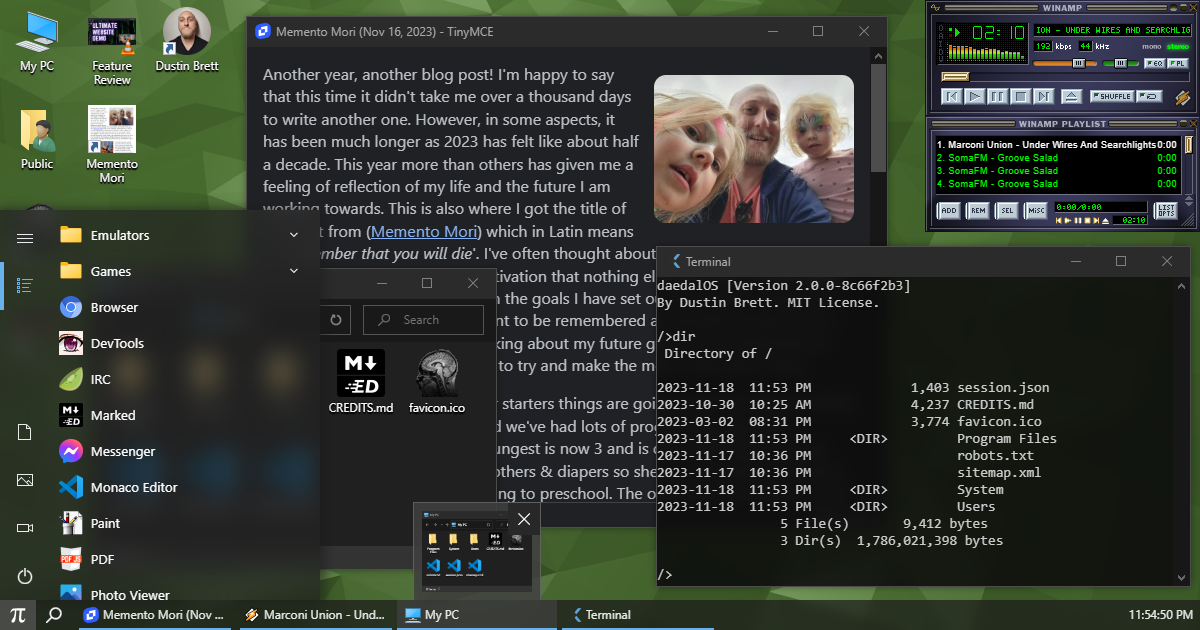 daedalOS
Developer of [[DaedalOS]]
 DWeb Camp Cascadia 2026, Jul 30 to Aug 3 in Salt Spring Island
Part of organizing a [[DWeb Camp]] in the Cascadia bio region. August 8th - 11th on Salt Spring Island.
Put together by the [[DWebYVR]] crew + friends.
 DWeb Camp: Root Systems
Annual event run by [[DWeb HQ]] adjacent people to gather from around the world and camp together.
* [[DWeb Camp 2026]]
* [[DWeb Camp 2024]]- DWeb
DWeb HQ is the [[Internet Archive]] supported "Gatherings for Good" that organizes a global [[DWeb Camp]] annually.
There are DWeb nodes that are regionally run, including [[DWebYVR]]
- DWeb Meetup — Bluesky & Beyond
I'm one of three speakers, along with [[Bryan Newbold]] and [[Mallory Knodel]].
<iframe src="https://archive.org/embed/dweb-meetup-feb-2025-bluesky-beyond" width="100%" height="100%" frameborder="0" webkitallowfullscreen="true" mozallowfullscreen="true" allowfullscreen></iframe>
Video embedded from https://archive.org/details/dweb-meetup-feb-2025-bluesky-beyond/GMT20250219-193017_Recording_1920x1080.mp4" rel="noopener noreferrer">Internet Archive.PDF of my slides: DWeb Bluesky and Beyond - Growing the ATmosphere
<iframe src="/assets/2025/DWeb_Bluesky_and_Beyond-Growing_the_ATmosphere.pdf" width=800 height=600>
</iframe>Text from the slides included below. Notes callouts are speaker notes.
## Growing the ATmosphere
_The AT Protocol ecosystem beyond Bluesky and microblogging_
### ATprotocol.DevDecided to start doing Tech Talks - presentations by and for AT Protocol developers, Aug 2024 <https://atprotocol.dev/> [[ATProtocol Dev]]
By December, decided to put on the first in-person community AT Protocol conference aka [[ATmosphereConf 2025]] <https://atprotocol.dev/atmosphereconf>
* tech talks with live video have been great
* in-person connections help to build strong ties that carry us through online discussions> [!NOTE]
> User 22 on the network, November 2022 <https://atproto-browser.vercel.app/at/bmann.ca>---
### ATmosphereThe [[ATmosphere]] is what the collection of all the apps and data on the AT Protocol is called.
For example, Recipes! <https://recipe.exchange>
With a full featured Schema.org data model, attribution, images, etc
!Screenshot of Chick Peas with Garlic Mousseline on Recipes.Exchange
> [!NOTE]
> https://recipe.exchange/recipes/01JGJ97VWB9YCWHKE24HC1K1SP" rel="noopener noreferrer">Chick Peas with Garlic Mousseline on Recipes.Exchange. You can also https://atproto-browser.vercel.app/at/did:plc:2cxgdrgtsmrbqnjkwyplmp43/exchange.recipe.recipe/01JGJ97VWB9YCWHKE24HC1K1SP" rel="noopener noreferrer">browse it in my user repo to get a sense of what custom Lexicon records look like.---
### Many data types and app front endsHere’s a small selection of other apps
* https://whtwnd.com/" rel="noopener noreferrer">WhtWnd: long form blogging
* https://smokesignal.events/" rel="noopener noreferrer">Smoke Signal: events & rsvps
* https://frontpage.fyi/" rel="noopener noreferrer">Frontpage: hacker news clone that might grow up to be Reddit
* And cool experimental stuff like https://roomy.chat/" rel="noopener noreferrer">Roomy Chat - atproto + localfirst + p2pAll of this data is stored in your own user account, and can have multiple client front ends.
> [!NOTE]
> Blog posts and video interviews all available at <https://atprotocol.dev>---
### What about the clones?
Most of them are client apps that sit on top of the Bluesky microblog Lexicon.
Some of them are starting to add custom Lexicons
I love them all equally but for simplicity will link you to https://pinksky.app/" rel="noopener noreferrer">Pinksky, an “Instagram clone”
> [!NOTE]
> There are tons of Instagram and TikTok “clones” popping up.
>
> Most of them are client apps that sit on top of the Bluesky microblog Lexicon, but with a novel UI customized for images or videos. Which is cool by itself!
>
> Some of them are starting to add custom Lexicons for layout preferences and other features. At least one plans to not use the microblog Lexicon.
>
> These are 1 - 2 person teams mostly without funding. Many are native mobile only.---
### Small AT Protocol
People are generally talking about “small Bluesky” or “alternative Bluesky”.
Can ATproto scale down? https://bsky.bad-example.com/can-atproto-scale-down/" rel="noopener noreferrer">1B links on a homelab RPi
Also many other app architectures: e.g. Smoke Signal talks to PDS directly
> [!NOTE]
> Alternative to Bluesky is an extremely boring take. Bluesky means a lot of things, one of them is the bluesky Lexicon which defines 300 character microblogging.
>
> A German only – or even better, a Canadian only - microblogging site would both be relatively cheap to run.
>
> The architecture for different shapes of things isn’t fully figured out yet. People need to try things!
>
> [[PDS]] are small, simple and cheap to run per account.---
### AT Protocol data is public
It’s a protocol, anyone can run a firehose (these are cheap to run, more expensive if you keep the data, index it, run search queries, and serve it up as a full AppView)
You delegate your hosting to a Personal Data Server ([[PDS]]) which has a repo with all of your data, of all Lexicon types and all apps._Example:_ A follow record is stored in your user account, as a record that points to the account (DID) of the user you’re following.
Same for likes and blocks.
Kind of like HTML – you host a website that has links to point to others.
> [!NOTE]
> This has kind of covered a lot – private data on AT Protocol is a work in progress. I’m personally very interested in this, not just for social media use cases, but for app use cases of all kinds.---
### ActivityPub for nuanced group privacyI’ve run/test/administered various ActivityPub servers, mostly microblog (aka “Note”) shaped ones.
Am a member of [[CoSocial]] <https://blog.cosocial.ca>
Next on my personal list: a [[Hometown]] server for my hometown of Bowen Island, to displace Facebook from the core of the community.
---
### Join us in Seattle for talks & working groups[[ATmosphereConf 2025]] March 22nd & 23rd, Seattle Washington <https://atprotocol.dev/atmosphereconf>
Volunteer community organized. Hosted by [[AT Protocol Community Fund]], with fiscal sponsorship by [[Raft Foundation]] <https://raft.foundation>
For this crowd, some of the https://notes.commonscomputer.com/atmosphereconf" rel="noopener noreferrer">in progress working group topics in a collaborative notes page - including Private Data, incentives for running commons infrastructure, and more.
Try things! Pool funds, pool collaboration, gather and serve what community means to you!
- dwebyvr.org
- Drop-in coworking sessions
- 
 Composer by DXOS
A local-first workspace that is designed for small team collaboration.
 DXOS
DXOSDXOS is an open source framework for building real-time, collaborative web applications that run entirely on the client and communicate peer-to-peer, without the need for centralized servers.
Product is [[DXOS Composer]]
## Tech Stack
* https://docs.dxos.org/guide/echo/" rel="noopener noreferrer">Echo - Eventually Consistent Hierarchical Object store is a peer-to-peer graph database written in TypeScript.
* https://docs.dxos.org/guide/halo/" rel="noopener noreferrer">Halo - The HALO protocol supports the verification, transport, and exchange of identity information between networked peers.Also user & sponsors of [[Automerge]] and collaborate with [[Ink & Switch]]
- whoyoucallingajesse.com
I https://www.linkedin.com/feed/update/urn:li:activity:7010941991597334528?commentUrn=urn%3Ali%3Acomment%3A%28activity%3A7010941991597334528%2C7011019546350235648%29" rel="noopener noreferrer">posted a comment on LinkedIn.
I made 9 Investments in 16 months at [[Full Stack]] in 2013 / 2014 of $1.75M. After 5 years in 2019 we drew a line and summed things up. Roughly 3x return at that time, with a number of companies still in play.
It was a unique structure that did really well for investors and barely paid for my personal time ;) I think the model could scale - more pre-seed in quantity. Not government BS “scale up” services.
European and US angels and some pre-seed specialized funds in those places are writing pre-seed cheques. It used to be much worse in continental Europe than in Canada. We are behind and falling.
The only improvement is that Europe/US investors mostly don’t blink an eye at Canadian corps — so we still get that benefit.
But with a worse banking and services market than the US or Europe, being a Canadian company can hamper you in many ways. Yes, SRED/IRAP … which isn’t really worth it until you’re raising a large seed or Series A and for distributed / remote hiring is nullified.
It’s easier / cheaper to find great staff globally, and I mean just numbers of people … not underpaying internationally.
So: continuing to cheer you on at Eigenspace. Perhaps an Eigenspace West? (I’m not volunteering!)
- Easypanel — Deploy anything on your server
Website: <https://easypanel.io>
> Next GenerationServer Control Panel
> Use an intuitive interface to deploy applications, manage databases, and provision SSL certificates.Different https://easypanel.io/docs/builders" rel="noopener noreferrer">builders supported:
* [[Docker]]
* Both Heroku and Paketo [[Buildpacks]]
* [[Nixpacks]]https://easypanel.io/pricing" rel="noopener noreferrer">Pricing is for licensing, you need to install it on your own server. $20/month level includes multi-server support.
April 4th, 2023: https://www.tbray.org/ongoing/When/202x/2023/04/28/Bluesky" rel="noopener noreferrer">Multi-server support beta
> Under the hood, Easypanel utilizes [[Docker Swarm]]. Our newest implementation now enables you to add multiple worker nodes. When deploying services, the workload will be evenly distributed across all your servers. If you happen to remove a worker node, the workload from that server will be automatically redistributed amongst the remaining nodes.  Introduction
Elk is a web based front end client for [[Mastodon]] that can be used instead of an app or the default Mastodon web interface.
- Emissary | Developer Site - Home
> Emissary is the standalone Fediverse server designed forhttps://emissary.dev/people" rel="noopener noreferrer">end users, https://emissary.dev/creators" rel="noopener noreferrer">app creators, and https://emissary.dev/admins" rel="noopener noreferrer">hosting admins — that gives everyone powerful new ways to join the social web.
## Trustworthy Custom Applications
https://github.com/EmissarySocial/emissary" rel="noopener noreferrer">Github README
> As a developer, Emissary empowers you to build custom, social applications in a simple, declarative, low-code environment. Using only HTML templates and a JSON config file, you can create full-featured social apps that are easy to deploy and easy to maintain.
>
> This is done by building action pipelines out of simple, composable steps, like: "show an edit form", "create a thumbnail", and "save the object". Pipelines work alongside Emissary's built-in state machines and access permissions to form robust and secure applications that you and your end-users can trust.## Federated Music Demo
<iframe title="Federated Music Demo" width="560" height="315" src="https://kumi.tube/videos/embed/bd1c321a-1b56-40b5-9ef1-698b7ffb13df" frameborder="0" allowfullscreen="" sandbox="allow-same-origin allow-scripts allow-popups"></iframe>
 Enhance
* [[Server Side Rendering]]
* [[Web Components]] Ente Photos: Store and share your photos with absolute privacy
An AGPL-licensed end-to-end encrypted photo backup software.
Has a paid SaaS service with iOS and Android apps that will sync and backup your photos.
There is a freemium tier with 1GB of storage.
- www.eurosky.social
First live event by the [[EuroSky]] team, Berlin, Germany, November 19th, 2025.
I presented [[App Liftoff EuroSky Live]].
> The conference will explore the open social web and how Eurosky’s digital building blocks could power 'Trusted European Platforms'.
>
> Eurosky Live sits alongside the French-German Digital Sovereignty Summit (18 Nov) and feeds into the preparation of the EU's Democracy Shield, as announced by President von der Leyen.## Agenda
- 9:00 - 9:30 Arrivals and networking
- 9:30 - 9:35 Welcome
- 9:35 - 10:00 Digital Building Blocks: AT Proto and Eurosky Explained
- 10:00 - 10:10 Opening Keynote: Digital Sovereignty as the Foundation of a Resilient European Public Sphere
- 10:10 - 10:50 Digital Commons, Civic Futures - the Social Contract for Next Web
- 10:50 - 11:05 EuroCloud to App Liftoff in the ATmosphere [[App Liftoff EuroSky Live]]
- 11:05 - 11:25 Coffee Break
- 11:25 - 11:40 Startup Showcase: Tangled
- 11:40 - 12:00 Fireside Chat: how do we build a resilient technology ecosystem
- 12:00 - 12:15 Startup Showcase: Sill
- 12:15 - 12:30 Startup Showcase: Gander Social
- 12:30 - 13:10 Owning the Pipeline - European Media in Interoperable Distribution
- 13:10 - 14:15 Lunch Break
- 14:15 - 14:25 From the Summit to Eurosky: Bridging Digital Sovereignty and the Open Web
- 14:25 - 14:45 In Discussion with Bluesky
- 14:45 - 15:00 Showcase: CoCoMo (Eurosky)
- 15:00 - 15:20 ATproto communities for newsrooms, scientific institutions and governments
- 15:20 - 16:00 Panel: Rebuilding Value Chains for Open Web
- 16:00 - 16:15 Coffee Break
- 16:15 - 16:30 Startup Showcase: North Sky
- 16:30 - 17:00 Closing Keynote - Beyond Big Tech: Digital Sovereignty as the Key to Sustainability and Democracy
- 17:00 - 17:10 Closing Remark
- 17:30 - 19:30 Reception - Eurosky Portal
Part of [[Free Our Feeds]], building [[atproto]] commons infrastructure for Europe
> Eurosky is building the future of social media—open, pluralistic, and made in Europe.
>
> We believe social media should serve our economies and societies, not monopolies. Eurosky is a public-interest infrastructure project that puts control in the hands of users, businesses, and European society.
>
> By combining European cloud infrastructure with open standards and democratic governance, we’re creating a new ecosystem where innovation thrives, moderation is transparent, and no single company or country can dictate the rules.
>
> Eurosky is a pan-European initiative spearheaded by a coalition of private sector groups, technologists and civil society organizations to ensure the web remains independent, interoperable, and resilient. - everywhere.computer
The decentralized compute platform we're building at [[Fission]]. Publish [[WebAssembly]] functions to the network that will be run on nodes across the network, from browser to server.
 EXO — Run frontier AI locally.
> EXO powers AI you control—secure, scalable, local.
Maintainers of [[EXO]], local first multi-device AI clusters.
- Exploring Decentralized Social Media
The [[Internet Archive]] hosted the [[DWeb SF Meetup]] on [[January 20th, 2020]]. The http://blog.archive.org/2020/01/30/our-social-media-is-broken-is-decentralization-the-fix/" rel="noopener noreferrer">blog post titled 'Our Social Media is Broken. Is Decentralization the Fix?' has a great summary with links to all of the people and resources mentioned in the video below.
It start's by mentioning [[Jack Dorsey]] and Twitter's [[Bluesky]] project.
[[Jay Graber]] kicked off the event:
> Graber helped us understand the broad categories of what’s out there: federated protocols such as [[ActivityPub]] and [[Matrix]]; peer-to-peer protocols such as [[Scuttlebutt]], and social media apps that utilize blockchain in some way for monetization, provenance or storage. What was clear from Graber’s talk was that she had tested and used dozens of tools, from Mastodon to [[Iris]], Martti Malmi’s new P-2-P social app and she deftly laid out the pros and cons of each.
## Video
<iframe src="https://archive.org/embed/12120iadweb" width="640" height="480" frameborder="0" webkitallowfullscreen="true" mozallowfullscreen="true" allowfullscreen></iframe>
 Animated gif tools
A website for creating and manipulating GIFs in various ways. I've used it for resizing, optimizing, and censoring (pixelated or black bars).
It has ads plastered all over it! But you don't need to login and there's no charge to use it.
 FabLab Vancouver | Makerspace | 260 East 5th Avenue, Vancouver, BC, Canada
- From the home page:
- FabLab Vancouver is a membership based co-making makerspace.
We focus on offering members access to digital fabrication machinery and a variety of traditional tools.
- Open to the public 1pm - 9pm, Wednesday to Sunday
- Machines they have
- Laser cutting / engraving
- Vinyl cutting / decal
- CNC routing / engraving
- 3D printing- FacilMap
> FacilMap is a privacy-friendly, open-source versatile online map that combines different services based on [[OpenStreetMap]]
You can run your own NodeJS + MySQL or Postgres + socket.io server.
### Embed
```
<iframe style="height: 500px; width: 100%; border: none;" src="https://facilmap.org/mymap"></iframe>
```Grab the location hash to have it centered where you want.
## Collaborative Maps<https://docs.facilmap.org/users/collaborative/>
> A collaborative map is a map that can be reached under its own unique URL. Users can add markers, lines, routes and various other things to the map, and if multiple people are working on it simultaneously, they all see each others’ changes instantly. Think of it like an [[Etherpad]], just for maps.
> Every collaborative map has 3 URLs, an admin URL, an editable URL and a read-only URL. Accessing the map through its different URLs will show the same map with the same data, but depending through which URL a user opened the map, they will have different permissions what to do with it. The URL of the map acts as the password to access it: Anyone who has the admin URL will have the ability to administrate the map.
## Developers
<https://docs.facilmap.org/developers/>
> - https://docs.facilmap.org/developers/embed.html" rel="noopener noreferrer">Embed FacilMap into any website using an iframe.
> - Run your own https://docs.facilmap.org/developers/server/" rel="noopener noreferrer">FacilMap server.
> - Use the https://docs.facilmap.org/developers/client/" rel="noopener noreferrer">FacilMap client to programmatically access and modify data on a collaborative map.
> - Use the https://docs.facilmap.org/developers/leaflet/" rel="noopener noreferrer">Leaflet components to embed certain feature of FacilMap into a Leaflet map.
> - Use the https://docs.facilmap.org/developers/frontend/" rel="noopener noreferrer">FacilMap frontend to embed an extended or modified version of FacilMap into a website.
> - Read about the https://docs.facilmap.org/developers/development/dev-setup.html" rel="noopener noreferrer">dev setup to start contributing to the FacilMap code.  Software Sharing for Modern Companies | Fair.io
- Not open source. Not closed source. The Fair Source License allows everyone to see the source code and makes the software free to use for a limited number of users in your organization. It offers some of the benefits of open source while preserving the ability to charge for the software.
- Fair Source was created by [[Sourcegraph]] and drafted by [[Heather Meeker]]
- How Fair Source Works
- Any individual user can view, download, execute, and modify the code free of charge. Up to a certain number of users from an organization can use the code for free, too. After an organization hits that user limit, it will start paying a licensing fee determined by the software publisher.
- The Fair Source License can be applied to software applications and their source code. It is not currently suitable for library or plugin code. Fair-code
- Fair-code is not a software license. It describes a software model where software:
- is generally free to use and can be distributed by anybody
- has its source code openly available
- can be extended by anybody in public and private communities
- is commercially restricted by its authors- Specification
> Frames are a standard for creating interactive and authenticated experiences on Farcaster, embeddable in any Farcaster client.
>
> A frame is a set of<meta>tags returned within the<head>of an HTML page. If a page contains all required frame properties, Farcaster apps will render the page as a frame. The frame<meta>tags extend the [[OpenGraph|OpenGraph protocol]].
>
> Frames can be linked together to create dynamic applications embedded inside casts.Inspired by [[David Furlough]]'s work on Mod, the Warpcast team created this Frames spec for the [[Farcaster]] protocol directly. David is working on [[Open Frames]] for use in Farcaster and beyond.
## Warpcast Testing Tools
* https://warpcast.com/~/developers/embeds" rel="noopener noreferrer">Preview a frame without having to cast
* https://warpcast.com/~/developers/frames" rel="noopener noreferrer">Frame validator to check that it's formatted correctly - Farcaster
> a protocol for building decentralized social apps
Farcaster IDs (FIDs) are stored on the Ethereum Optimism L2 blockchain, but everything else is offchain.
From the https://docs.farcaster.xyz/learn/what-is-farcaster/overview" rel="noopener noreferrer">docs overview:
> Farcaster is a https://www.varunsrinivasan.com/2022/01/11/sufficient-decentralization-for-social-networks" rel="noopener noreferrer">sufficiently decentralized social network built on Ethereum.
>
> Users can create profiles, post short messages or "casts", follow others and organize into communities. It is a public social network similar in design to Twitter and Reddit.
>
> Since Farcaster is public and decentralized, anyone can build an app to read and write data. Users own their accounts and relationships with other users and are free to move between different apps.[[Warpcast]] is the original app built and run by the team that designed the Farcaster protocol.
## FramesFrames extend the [[OpenGraph]] standard and turn static embeds into interactive experiences.
Example:
```html
<meta property="fc:frame" content="vNext" />
<meta property="fc:frame:image" content="http://...image-question.png" />
<meta property="fc:frame:button:1" content="Green" />
<meta property="fc:frame:button:2" content="Purple" />
<meta property="fc:frame:button:3" content="Red" />
<meta property="fc:frame:button:4" content="Blue" />
```If you share the URL of a page in a cast that has these meta tags, it will show up as a frame.
See [[Farcaster Frames]] and [[Open Frames]]

 Email and calendar made better
Email, contacts, calendaring, and file sharing service.
* https://www.fastmail.com/company/about/" rel="noopener noreferrer">Company about page
See also: [[Fastmail Tips]]
## https://www.fastmail.com/digitalcitizen/why-open-internet-standards-are-so-important-to-your-future-with-bron-gondwana/" rel="noopener noreferrer">Why Open Internet Standards Are So Important To Your Future with Bron Gondwana
Have you ever wondered how the Internet works, how it’s governed, or why some devices and services work together and others don’t? In the final episode of this season, Fastmail CEO, Bron Gondwana answers these questions and more, so you can learn how standards make the Internet better for everyone.
Get a crash course about open standards, how they work, and why we need to support organizations that use them. Bron and show host Fastmail’s CTO, Ricardo Signes, talk about JMAP, an open standard for email that Fastmail’s developers produced, which is moving email forward.
## Wikipedia
### About
Fastmail is an email hosting company based in Melbourne, Australia. In addition to its Fastmail-branded services, the company also operates Topicbox, a mailing list service, and Pobox, an email service it acquired in 2015.
The company was acquired by Opera Software in 2010 but became independent again in 2013 through a staff buyout. Its servers are located in Philadelphia, Pennsylvania and St. Louis, Missouri.
### History
Fastmail was founded in 1999 by Rob Mueller, Bruce Davey, and Jeremy Howard, to provide email service for customers of the Optimal Decisions Group.
The provider's sole product line is email services (and included accessories), but it was owned by Opera Software (best known for its web browser) from 2010 to 2013. Through a staff buyout, the company became fully independent again.
### TechnologyThe site developers are among active contributors to the widely used Cyrus IMAP open source software project and include the lead developer and maintainer of Perl module Mail::IMAPTalk. Fastmail supported the development of the free software webmail interface Roundcube and developed [[JMAP]] – a new open email protocol.
 feathers.dev - Identity. Data. Realtime. Beyond the Cloud.
The API and Real-time Application Framework
For TypeScript and JavaScript in Node.js, React Native and the browser
 Social Media Analytics and Publishing - Fedica
Website: <https://fedica.com>
Used to be Tweepsmap for mapping of Twitter. Now full social media analytics, with scheduling and crossposting across 8 networks.
## PricingThe free plan allows for basic cross posting across 8 networks, 1 account max per network.
Additional accounts are $10/month. So 2 accounts per network (16 accounts total), is $20/month for the Publish account.
* Publish: $10/month
* Grow: $24/month
* Research: $79/month
## RSS PublishingImporting via RSS is a feature of paid plans.
After my feedback to the Fedica support team, they've updated how this works and https://fedica.com/social-media/how-to-setup-rss-feeds" rel="noopener noreferrer">documented it here.
* Reads the
<title>as the content of the post, OR<description>if no title field
* Posts are auto split into threads for those networks that support threads
* Scans the<description>field and attaches the first<img>that is present, or up to 4 images in the<enclosure>field
* Adds a link back to the post at the end / last post in the thread
* Hashtags are defined per pipeline, and are also added at the end / last post in the thread
* Pipelines can be configured to exclude certain words, and title, description, category, and content fields are all checked for this; this means you could make a "nocrosspost" category for instancehttps://fedica.com/social-media/how-to-setup-rss-feeds" rel="noopener noreferrer">This page describes how to set up pipelines, but the bulk of the info is in this video:
<iframe width="560" height="315" src="https://www.youtube-nocookie.com/embed/HfrPWP_bBw8?si=7EjdiJWj9Kmv_oxj" title="YouTube video player" frameborder="0" allow="accelerometer; autoplay; clipboard-write; encrypted-media; gyroscope; picture-in-picture; web-share" allowfullscreen></iframe>
A few other notes from my messages with the support team, and as I configure things.
### Repeat> Repeat will publish your content again if your pipeline runs out of new content, but fresh content will always take priority over repeated content. You can set for how long you want to repeat the content. Tweets are usually reposted as retweets when repeated.
 FediCon — Fediverse Conference
A Canadian conference for decentralized social networks and the social web. Organized by Reiver.
I attended the August 2025 edition and presented [[Beyond Microblogging ATProto]], included an embedded video recording of my talk.
All the https://spectra.video/c/fedicon_videos/videos" rel="noopener noreferrer">Fedicon videos are available on Spectra Video.
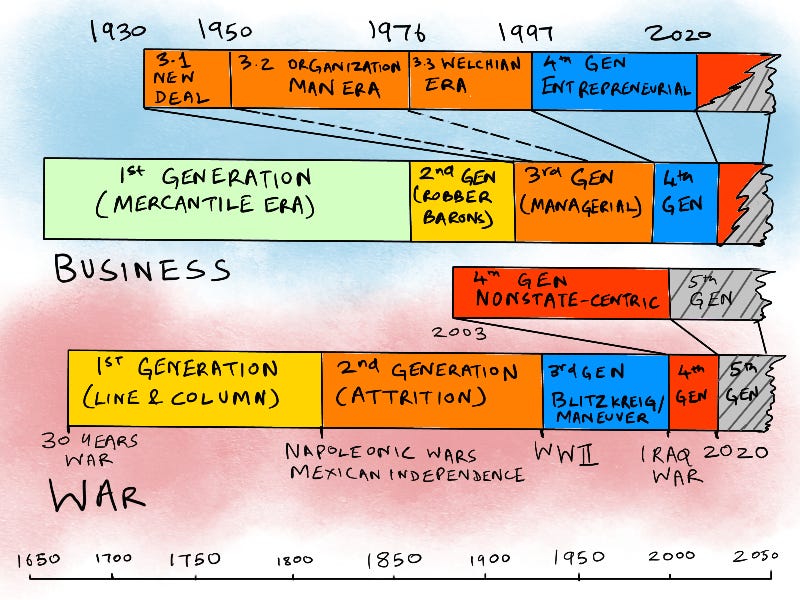 Fifth-Generation Management
- I want to talk about an idea I call fifth-generation management. 1/ ==Fifth-generation management is an emerging style of management we don’t know much about because it doesn’t actually exist yet== But it is guaranteed to emerge post-Covid because historically, big sharp disruptions have reliably triggered discontinuous changes in management culture, and it is already clear that this one is doing that.
- By [[vgr]] from his [[Breaking Smart]] newsletter
- Forwarded to me by @cambel, who also tagged @catthekin as starting to practice this fifth generation management. Feels like [[Wardley Maps]] fit in here as well, plus the [[Pioneers, Settlers, and Town Planners]] concepts. Well, just channeling [[Simon Wardley]] generally. Filecoin | World's Largest Decentralized Storage Network for Humanity's Data
- Main marketing website: https://filecoin.io/
> Filecoin is a peer-to-peer network that stores files on the internet, with built-in economic incentives to ensure files are stored reliably over time.
> https://docs.filecoin.io/
Created by [[Protocol Labs]]- fission.codes
We shut down Fission as of April 2024. https://fission.codes/blog/farewell-from-fission/" rel="noopener noreferrer">Read the farewall.
> Imagine us individually as a swarm of bees, and Fission as a “human suit” that gives us the appearance of a single entity. The swarm still exists. And will continue to find new forms. Meanwhile, we’ll all still be doing whatever swarms of bees do.
>
> — [[Ryan Betts|@depatchemode]] on https://x.com/depatchedmode/status/1776024613396582417" rel="noopener noreferrer">Twitter---
The company I founded in 2019 with [[Brooklyn Zelenka]]. We are a team of protocol engineers working on decentralized edge computing.
Believer in content addressing with [[IPFS]]. Creators of [[UCAN]], [[WNFS]], and [[IPVM]].
The https://everywhere.computer" rel="noopener noreferrer">Everywhere Computer is an implementation of [[IPVM]] focused on serverless [[WebAssembly|Wasm]] functions.
- talk.fission.codes
- [[Fission]] has a public #Discourse forum at https://talk.fission.codes
- The wiki category has a number of public notes and resources of various kinds https://talk.fission.codes/c/wiki/16
- We keep track of locations we travel to, for #venues, #Coworking spaces, places to stay, good coffee and places to eat, and so on https://talk.fission.codes/tag/locations
- Discussion is the "uncategorized" category that posts default to
- The Reading List category is also the "Fission Indoctrination File" https://talk.fission.codes/c/reading-list/10
- It also has a Papers sub category https://talk.fission.codes/c/reading-list/papers/34
- There are Events aggregated there too https://talk.fission.codes/c/events/25
- - Five ways to build a $100 million business
Christoph Janz's now almost 10 year old article on how to think about "hunting flies vs elephants" in types of customers and techniques to sell to them.
> To build a Web company with $100 million in annual revenues*, you essentially need:
>
> - 1,000 enterprise customers paying you $100k+ per year each; or
> - 10,000 medium-sized companies paying you $10k+ per year each; or
> - 100,000 small businesses paying you $1k+ per year each; or
> - 1 million consumers or "prosumers" paying you $100+ per year each (or, in the case of eCommerce businesses, 1M customers generating $100+ in contribution margin** per year each); or
> - 10 million active consumers who you monetize at $10+ per year each by selling ads
>
> Salespeople sometimes refer to "elephants", "deers" and "rabbits" when they talk about the first three categories of customers. To extend the metaphor to the 4th and 5th type of customer, let's call them "mice" and "flies". So how can you hunt 1,000 elephants, 10,000 deers, 100,000 rabbits, 1,000,000 mice or 10,000,000 flies? Let's take a look at it in reverse order.
Follow up https://christophjanz.blogspot.com/2014/11/three-more-ways-to-build-100-million.html" rel="noopener noreferrer">Three more ways to build a $100M business -- which adds Brontosaurus, Whale, and Microbes.This is very much from the perspective of [[Venture Sized Business]]. But, the thought processes around who is your customer and what techniques do you use to sell to different scales of them is valuable for any business.
- Computers for agents
> The most flexible and powerful compute platform on any public cloud. Fly Machines are hardware-virtualized containers, running on our own hardware, that launch instantly and run exactly as long as you want them to — for a single HTTP request, or for weeks of uptime.
> Apps running on Fly Machines are KVM hardware-isolated, built on a memory-safe stack and running directly on our metal.
 Forestwalk Labs
Building products that help teams do their best work. Forestwalk is building delightful LLM-powered tools that solve teams' problems.
[[Vancouver]] based startup founded by Allen Pike and Jenn Cooper.
They help run the [[Infer]] meetup in Vancouver.
## Timberline<iframe width="560" height="315" src="https://www.youtube-nocookie.com/embed/0ptXBlsZwC0?si=pwKfEjKroSBpWhRu" title="YouTube video player" frameborder="0" allow="accelerometer; autoplay; clipboard-write; encrypted-media; gyroscope; picture-in-picture; web-share" referrerpolicy="strict-origin-when-cross-origin" allowfullscreen></iframe>
 Free Email Forwarding for Custom Domains - #1 Open Source Email Service 2026
All-in-one alternative to Gmail + Mailchimp + Sendgrid
> Unlike other services, we don't charge you per user. You get unlimited domains and aliases for only one monthly rate of $3/mo. All paid plans include 10 GB of SSD-backed encrypted SQLite storage (IMAP/POP3/CalDAV). Additional storage can be purchased for $3/mo per 10 GB of additional SSD-backed storage.
Note: 300 emails / day -> 9000 emails per month limit, so not appropriate for some mailing lists -- so not really competitive with Mailchimp or Sendgrid... although it does say "call us".
* https://forwardemail.net/en/guides/send-mail-as-gmail-custom-domain" rel="noopener noreferrer">Send mail as for Gmail
## Pricing
* Free - forwarding only
* Enhanced - $3 / month for unlimited domains, 10GB pooled storage (you can enable IMAP as well as "just" forwarding), 300 emails / day (9000 per month)
* Team - $9 / month, adds unlimited team members, team permission management, and shared organizational access
* Enterprise - call us
## Technical WhitepaperApril 11th, 2025 - Technical Whitepaper https://forwardemail.net/technical-whitepaper.pdf" rel="noopener noreferrer">PDF
> In an era where digital privacy is increasingly compromised, Forward Email stands as a beacon of transparency and security in email infrastructure. As the only 100% opensource, encrypted, privacy-focused, transparent, and quantum-resistant email service, we have fundamentally reimagined what users should expect from their email provider. Since our founding in 2017, Forward Email has grown to power email for over 500,000 domains – including industry leaders such as Canonical, Netflix, The Linux Foundation, The PHP Foundation, Fox News Radio, Disney Ad Sales, jQuery, LineageOS, Ubuntu, Kubuntu, Lubuntu, The University of Cambridge, The University of Maryland, The University of Washington, Tufts University, Swarthmore College, Government of South Australia, Government of Dominican Republic, Fly.io, RCD Hotels, International Correspondence Chess Federation, and notable developers like Isaac Z. Schlueter (npm creator) and David Heinemeier Hansson (Ruby on Rails creator). This remarkable adoption stems from our steadfast commitment to privacy-by-design principles and complete technical transparency. This whitepaper provides extensive detail and technical insight into our history, threat modeling, systems and security architecture, and future roadmap. Through comprehensive analysis of our implementation choices, cryptographic approaches, and security protocols, we demonstrate how Forward Email achieves unparalleled privacy protection while maintaining full auditability through open-source development. By combining quantum-resistant encryption, zero-knowledge operations, and a distributed architecture with our steadfast refusal to collect user metadata, Forward Email represents not just an email service, but a fundamental shift in how privacy-critical infrastructure can and should be built in the digital age.
Of interest:
* quantum-resistant encryption through the use of ChaCha20-Poly1305 cipher
* unique approach to email storage using individually encrypted SQLite mailboxes with optimized PRAGMA settings Fosstodon
- An open source focused Mastodon server
- Fosstodon Hub https://hub.fosstodon.org
- Homerun Desktop - Create the Minecraft server of your dreams
- Self hosting network
- Mosaic Docs https://docs.fractalnetworks.co
- Mosaic is a noncustodial, free and open source personal computing platform designed to make self-hosting accessible and survivable.
- It works by running applications using industry-standard Docker containers, with a WireGuard based end-to-end encrypted connectivity solution that gives you a unique domain (such ashasty-hopper.fractal.pub) to make sure your applications are always reachable, and an end-to-end encrypted storage solution that continuously creates snapshots and backups of your data, allowing your applications to be restored automatically at any time and without hassle. This makes Fractal Mosaic the only ephemeral self-hosting solution: you can, at any time, wipe your hard drive and re-install Fractal Mosaic and all of your applications and data will be restored back, exactly as they were.
- Free Our Feeds
Initiative to form a foundation and run a relay for [[atproto]] so that it’s not just [[Bluesky]] running the bulk of the infrastructure.
You can subscribe to the https://free-our-feeds.ghost.io/" rel="noopener noreferrer">Ghost blog for updates.
## Technical Advisors and Custodians
Initial 9 custodians.
- Nabiha Syed, Executive Director, Mozilla Foundation
- [[Robin Berjon]], Independent technologist
- Deepti Doshi, Co-Director, New_ Public
- Marc Faddoul, Director, AI Forensics
- Sherif Elsayed-Ali, Exec. Director, Future of Technology Institute
- Mark Surman, President, Mozilla Foundation
- Eli Pariser, Co-Director of New_ Public and author of “The Filter Bubble”
- [[Mallory Knodel]], Exec. Director, [[Social Web Foundation]]
- Phil Beaudoin, Co-founder, Numeno.AI
 Best open source help desk: Zendesk & Help Scout alternative
Open source shared Helpdesk and Shared Mailbox
Available for self hosting on [[Cloudron]]
It’s free of charge to self host, but has a number of https://freescout.net/modules/" rel="noopener noreferrer">one-time-purchase modules that you can pay for. These are AGPL licensed, so all still open source. https://freescout.net/modules-faq/" rel="noopener noreferrer">Modules FAQ
 frequency
A social media app for private sharing of photos with friends and family.
<blockquote class="bluesky-embed" data-bluesky-uri="at://did:plc:2cxgdrgtsmrbqnjkwyplmp43/app.bsky.feed.post/3lvgmoeirec2h" data-bluesky-cid="bafyreiatu2l2vbr3fj5hrxp2kjkj2lxq3xxmrfmwve6p2flndjyvgzb5va" data-bluesky-embed-color-mode="system"><p lang="en">It was great meeting @jesseplusplus.bsky.social at #FediCon
She’s the developer of Frequency frequency.app which is a private only photo sharing app that runs on a forked Mastodon back end called Decodon
github.com/jesseplusplu...<br><br><a href="https://bsky.app/profile/did:plc:2cxgdrgtsmrbqnjkwyplmp43/post/3lvgmoeirec2h?ref_src=embed">[image or embed]</a></p>— Boris (<a href="@bmann.ca</a>)" rel="noopener noreferrer">https://bsky.app/profile/did:plc:2cxgdrgtsmrbqnjkwyplmp43?ref_src=embed">@bmann.ca</a>) <a href="https://bsky.app/profile/did:plc:2cxgdrgtsmrbqnjkwyplmp43/post/3lvgmoeirec2h?ref_src=embed">August 2, 2025 at 9:49 AM</a></blockquote><script async src="https://embed.bsky.app/static/embed.js" charset="utf-8"></script>
Built on React Native for the mobile app on iOS, and the backend is a fork of [[Mastodon]] called https://github.com/jesseplusplus/decodon" rel="noopener noreferrer">Decodon "a media-focused fork of mastodon that supports only private/followers-only accounts".
Built by Jesse Karmani https://mastodon.social/@jesseplusplus" rel="noopener noreferrer">@[email protected] / https://bsky.app/profile/jesseplusplus.bsky.social" rel="noopener noreferrer">@jesseplusplus.bsky.social
## Decodon- All accounts are locked/private, meaning content is only distributed to followers https://github.com/jesseplusplus/decodon/pull/1" rel="noopener noreferrer">jesseplusplus/decodon#1
- Support for push notifications to Expo-based apps https://github.com/jesseplusplus/decodon/pull/2" rel="noopener noreferrer">jesseplusplus/decodon#2
- Pre-signed URLs for extra-secure storage of uploaded private media https://github.com/jesseplusplus/decodon/pull/9" rel="noopener noreferrer">jesseplusplus/decodon#9
- replies are treated more like comments and are filtered from the home feed https://github.com/jesseplusplus/decodon/pull/3" rel="noopener noreferrer">jesseplusplus/decodon#3
- circles (lists of followers you can address posts to instead of only followers) - cherry-picked from https://github.com/fedibird/mastodon" rel="noopener noreferrer">fedibird - https://github.com/jesseplusplus/decodon/pull/13" rel="noopener noreferrer">jesseplusplus/decodon#13
- default "inner circle" for all accounts to get them started - https://github.com/jesseplusplus/decodon/pull/14" rel="noopener noreferrer">jesseplusplus/decodon#14
- timeline markers for accounts' feed of updates - https://github.com/jesseplusplus/decodon/pull/189" rel="noopener noreferrer">jesseplusplus/decodon#189
- more control over logo and branding in email templates https://github.com/jesseplusplus/decodon/pull/10" rel="noopener noreferrer">jesseplusplus/decodon#10
- updated heroku deployment configs
- Frontity
Frontity is a React-based front end framework that uses [[WordPress]] as a [[Headless CMS]].
Works with hosted [[Wordpress.com]] sites.
Received investment from [[Automattic]].
- fruux | Contacts, calendars & tasks for teams.
- Contacts, calendars, and tasks
- We are behind http://sabre.io/" rel="noopener noreferrer">sabre/dav, which is the most popular open source implementation of the http://en.wikipedia.org/wiki/WebDAV" rel="noopener noreferrer">WebDAV, http://en.wikipedia.org/wiki/CardDAV" rel="noopener noreferrer">CardDAV and http://en.wikipedia.org/wiki/CalDAV" rel="noopener noreferrer">CalDAV standards. Besides us, developers and companies around the globe use our sabre/dav technology to deliver sync functionality to millions of users.  FSL
FSL- The Functional Source License (FSL) is a source-available non-compete license that converts to Apache 2.0 or MIT after one year. It is designed for companies that want to make their core products as Open Source as possible without jeopardizing their business. FSL provides everything a developer needs to use and learn from your software.
- FSL's immediate predecessor is the [[Business Source License]]. BUSL's time-based approach is great, but the Additional Use Grant is a serious flaw, because it creates https://blog.adamretter.org.uk/business-source-license-adoption/#how-is-the-bsl-being-used" rel="noopener noreferrer">too much variability. Each implementation of the BUSL is essentially a new license, so compliance departments have to separately review every case, which greatly slows adoption. FSL is an evolved BUSL that (we hope) has a better chance of catching on.
-- Gavin Gamboa
From Gav's [[TiddlyWiki]] powered https://gavart.ist/#About" rel="noopener noreferrer">About page:
> Hello! My name is Gavin and I am an artist with a focus on https://gavart.ist/#Discography" rel="noopener noreferrer">music, https://gavart.ist/#Cinema" rel="noopener noreferrer">cinema, and https://gavart.ist/#Writing" rel="noopener noreferrer">text. I was born in 1984 in Mérida 🇲🇽 and https://gavart.ist/#World%20Map" rel="noopener noreferrer">grew up in London 🇬🇧 and Houston Texas, Los Angeles California, and Detroit Michigan. I now live in Los Angeles 🇺🇸
> You can find me https://gavart.ist/#World%20Wide%20Web" rel="noopener noreferrer">online as gavcloud.
> My work revolves around https://gavart.ist/#Improvisation" rel="noopener noreferrer">improvised and https://gavart.ist/#Scores" rel="noopener noreferrer">notated composition, https://gavart.ist/#Laskfar%20Vortok" rel="noopener noreferrer">algorithmic video art and https://gavart.ist/#Cinema" rel="noopener noreferrer">cinema. I am working to deepen my knowledge of https://gavart.ist/#Software%20Notes" rel="noopener noreferrer">computer science and https://gavart.ist/#Digital%20Garden" rel="noopener noreferrer">networked thinking, and incorporating new technologies that can (in)form the basis of a stylistically multifaceted praxis.Presented at [[Causal Islands LA]]
- Gecko. Mozilla. Thoughts.
By [[Mark Mayo]], who was formerly CTO at Mozilla. Lots of great points, so I've highlighted extensively below.
A core analogy that I didn't end up including (go read it in full!) but will paraphrase.
Web engines are like the operating system market share of UNIX, Linux, and the BSDs. It's likely Chromium == Linux, and will be the basis of many important distros. Gecko is likely to be one of the old UNIX flavours, that will die off. But it might survive long term as a BSD, niche system with many small contributors. And: we need to fund next-gen approaches.
> <mark>The goal and awesomeness of having an implementation of the web is to be able to nudge the whole damned web towards or away from a behaviour you care about. Make a little dent in the world, as it were</mark>. Firefox and Gecko have been able to do that, repeatedly, in some big ways and in many many many small ways, affecting the experience of every single user of the web, _not just Firefox users_. That’s the allure, and incredible impact, and the reason why you'd even bother with the incredibly hard, expensive, mostly thankless job of making Gecko, SpiderMonkey, and Firefox and the vast array of supporting infrastructure needed to do it. Direct mission impact. It’s important to note that <mark>Firefox has done this over multiple decades while never having “winning” marketshare.</mark> Even in its glory days it was a ~20% player. That was enough, even into the more recent single digit marketshare era, to sometimes shift the implementations of the world’s largest web platforms. Pretty rad.
---
> “what do we do between now and when Firefox is over?”. Because it sure _feels_ like the end is inevitable, it’s perhaps not too far off, and that’s gonna be a weird dangerous moment for the web. I’ve https://www.vmunix.com/browsers-innovators-dilemma-and-project-tofino/" rel="noopener noreferrer">thought about this going back 10+ years when I started to worry about Mozilla’s long term financial ability to maintain a full stack implementation of the web against the backdrop of slipping market share.
---
> But for different reasons both https://blog.mozilla.org/en/mozilla/mozilla-leadership-growth-planning-updates/?ref=vmunix.com" rel="noopener noreferrer">Mozilla and https://www.cnbc.com/2024/10/29/google-cfo-says-company-can-push-a-little-further-in-cost-savings.html?ref=vmunix.com" rel="noopener noreferrer">Google appear far more focused on what will gain them relevance and influence in the AI wars to come, and far less on the browser wars of the past. Fair! We’re probably gonna need Mozilla.ai to be a force of nature!
---
> <mark>the primary reason Gecko was compelling as a platform choice in the last decade wasn’t the code, IMO, it was the nature and intent of its owner.</mark> A theoretical antidote of sorts that felt good to have exist and go to battle with anyone and everyone if necessary. Mozilla Corporation, as it slowly learns to be a real company, not a movement, is a less and less obvious counter bet to the culture and behaviours of the market winners.
---
> <mark>We desperately need organizations that deeply and primarily care about browsers and the web, who are going to do more than just skin Chromium (Linux).</mark> We need rebel alliances, and we need them to take on forks “of significance” because they are trying to influence how the web itself works for _everyone_, just like Mozilla did. Natural forces (fork cost) suggest these efforts are incentivized to merge over time and the web _could_ continue to evolve and reflect multiple points of view on top of a single dominant code base this way.
---
> Right now, and for quite some time I’d wager, <mark>Google alone decides what is de facto on the web by what they ship in Chrome, regardless of what plays out in open source code repos.</mark>
---
> <mark>Second, someone has to fund next generation engines</mark>, in my opinion. They’re long shots, but they’re invaluable in so many ways to show us what’s possible when we don’t have the weight of every single website ever made on our shoulders. I have no idea how to fund them except all the players should just shake hands and put 1% of their fuzzily defined browser budgets into a small pool that hands out grants to crazy people.
---
> Regardless, for those of us with the passion for building the web in some sort of way, we can’t wait for Mozilla to do anything. We’ve got to roll up our sleeves and get to work.
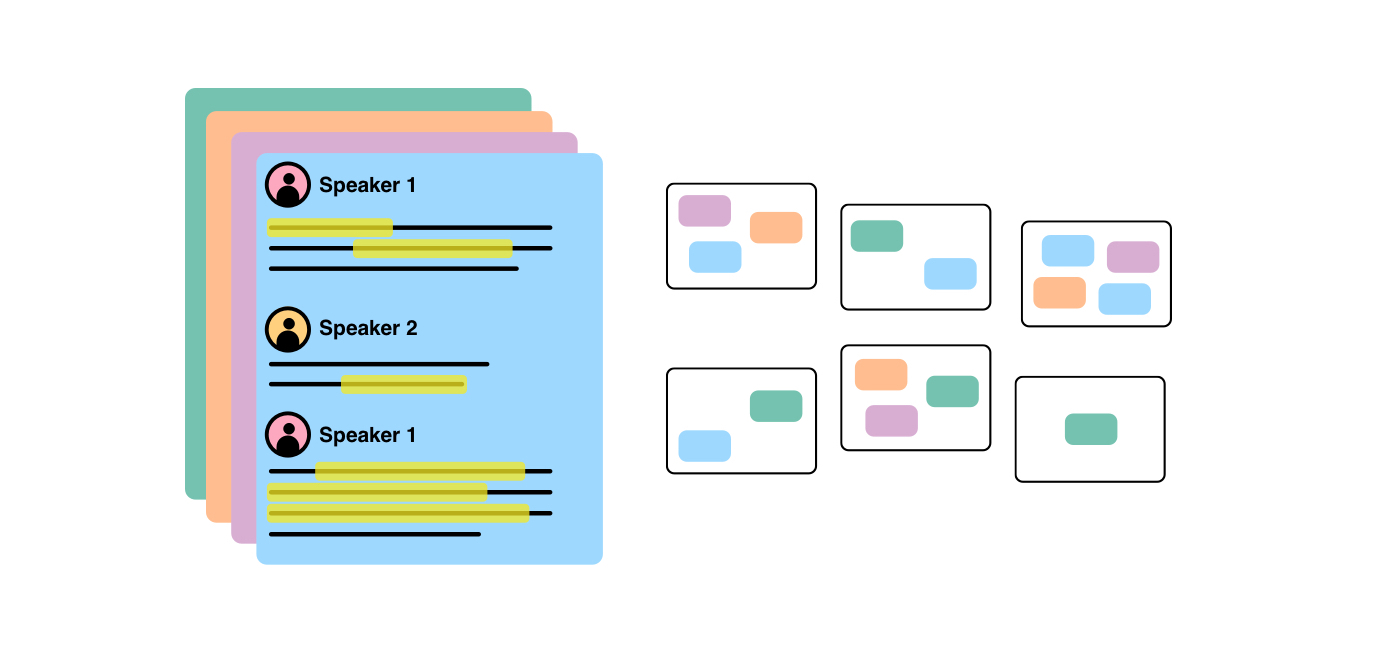
 Geoffrey Litt
A researcher exploring _malleable software_: computing environments where anyone can mold their tools to their own unique needs.
For more background on what that mission means and why it matters to him, check out my https://museapp.com/podcast/34-bring-your-own-client/" rel="noopener noreferrer">interview on the Metamuse podcast.
Geoffrey is currently a senior researcher at the independent research lab [[Ink & Switch]], leading our Malleable Software research track.
Before that, he completed a PhD at MIT CSAIL in the http://sdg.csail.mit.edu/" rel="noopener noreferrer">Software Design Group advised by http://people.csail.mit.edu/dnj/" rel="noopener noreferrer">Daniel Jackson. Before _that_, he spent five years as an early engineer and designer building the edtech startup https://www.panoramaed.com/" rel="noopener noreferrer">Panorama Education (YC S13).
These days, he is thinking a lot about AI + malleable software: How can LLMs help people make their own custom software?
_Essay:_ [[Malleable software in the age of LLMs]]
_Talk:_ [[Causal Islands]] https://www.youtube.com/watch?v=bJ3i4K3hefI" rel="noopener noreferrer">Dynamic documents as personal software
 Germ Network
Building an [[MLS]] compliant e2ee messaging system, with [[Autonomous Communicator Protocol]] and an open source Swift implementation.
Working on E2EE Messaging Working Group for [[atproto]]
 Ghost: The best open source blog & newsletter platform
A blogging and membership based newsletter app. [[MIT]] licensed open source.
Maintained by the https://ghost.org/about/" rel="noopener noreferrer">non-profit Ghost Foundation, who also run a paid managed hosting service at <http://ghost.org>.
## Moving Paid Subscribers from Substack
I’ve been recommending Ghost instead of [[Substack]] for a long time. https://citationneeded.news/substack-to-self-hosted-ghost/" rel="noopener noreferrer">Molly White wrote up her whole migration, I’ve quoted a few sections below.
On paid subscribers:
> The good news is that you can migrate your Substack subscribers (paid and free) from Substack to another service. Substack uses Stripe for payment processing, and so as long as you continue to use Stripe (used by Ghost, Buttondown, beehiiv, etc.) you can swap out the newsletter platform without any interruption to them. This is huge — as someone who migrated from Patreon way back when and had to ask everyone in my (much smaller) subscriber base to manually re-subscribe, that's a nightmare.
There’s a second step where you also need to ask Substack to remove themselves from your Stripe:
> I needed to ask Substack to disconnect themselves from my Stripe account. This is critical: if you don't do this, subscriptions created through Substack will _continue_ to send a 10% cut to Substack, even after you've left the platform!
## Pricing
For self hosted Ghost, [[Mailgun]] is going to be your biggest expense. It’s also the only thing that Ghost supports for sending email.
Molly also include a bit on pricing:
> After all of this, I have found myself with a roughly $103/mo setup: $28/mo for the VPS, $75/mo (plus overage tbd) for Mailgun. This is considerably cheaper than staying on Substack, and also slightly cheaper than both hosted Ghost and Buttondown.
She wrote a lot of custom code and migration scripts as well as dealing with a lot of DNS and email settings. For most people, hosted Ghost would be an option.
The other way to make this cheaper would be to work together with a number of people.
eg [[Cloudron]] supports Ghost and you could share a server with a number of people. And also share a Mailgun account, which also gets cheaper in bulk. And some of those people could become experts in email and DNS.
## Headless CMSYou can use Ghost as a headless CMS, which is what [[Fission]] does for <https://fission.codes>. Everything is authored in Ghost, and then a GitHub Action pulls all the content from the Ghost API and builds a static site with [[Eleventy]].
This is getting less feasible over time and has a number of work arounds required especially for membership support. I’d pick a [[Headless CMS]] instead.
## Ghost Annoyances
The Ghost Foundation has made it harder and harder to self host Ghost over time.
I used to maintain a Heroku buildpack, we made an [[IPFS]] plugin at [[Fission]], one used to be able to choose Postgres now only MySQL is supported.
And of course, fair enough. The Ghost Foundation is doing the work of maintenance and they’re optimizing it for their needs, which is a managed hosting platform.
But it doesn’t feel as much like a community platform any more.
I still recommend it if what you need matches what Ghost offers out of the box: both blogging and newsletter sending, and/or paid membership management.
But, because of the way it’s managed as a project, it’s going to be hard to build on top of for anything other than basic plugins or API integrations.
## Other Notes
I wrote some comparison pages and have a whole set of inter-linked notes about Ghost over at https://notes.bmannconsulting.com/#/page/ghost" rel="noopener noreferrer">my old LogSeq site.
 Ghostty
Ghostty is a fast, feature-rich, and cross-platform terminal emulator that uses platform-native UI and GPU acceleration.
Created by [[Mitchell Hashimoto]], founder of [[Hashicorp]].
Written in [[ZigLang]]
## Zero Configuration Philosophy
> Ghostty is designed to work out of the box with no configuration for most users. Ghostty has sensible defaults, embeds a default font (JetBrains Mono), has built-in nerd fonts, and more. We are constantly challenging ourself as a project to eliminate any _necessary configuration_ to use Ghostty.
There's also a https://ghostty.zerebos.com/settings/application" rel="noopener noreferrer">graphical configuration tool -- runs in the browser, you can import / export config.
## Themes
Running the following in a ghostty terminal gives you a browseable list of thems:```sh
ghostty +list-themes
``` GitButler
A Git client for simultaneous branches on top of your existing workflow.
- gitwallet.co
A tool for developers doing consulting in software ecosystems founded by [[Tarun Sachdeva]].
> Gitwallet is a commerce platform made for open source developers. Build premium products and services, sell across channels, and grow your business - all in one place.
## Echo
https://ecosystems.gitwallet.co/" rel="noopener noreferrer">Echo is an ecosystem explorer that categorizes projects, repos, people and more across different software ecosystems.
- Goggles
The full title is _GOGGLES: Democracy dies in darkness, and so does the Web_. Authored by the [[Brave]] Search Team.
## Abstract
This paper proposes an open and collaborative system by which a community, or a single user, can create sets of rules and filters, called _Goggles_, to define the space which a search engine can pull results from. Instead of a single ranking algorithm, we could have as many as needed, overcoming the biases that a single actor (the search engine) embeds into the results. Transparency and openness, all desirable qualities, will become accessible through the deep re- ranking capabilities Goggles would enable. Such system would be made possible by the availability of a host search engine, providing the index and infrastructure, which are unlikely to be replicated without major development and infrastructure costs. Besides the system proposal and the definition of the _Goggle language_, we also provide an extensive evaluation of the performance to demonstrate the feasibility of the approach. Last but not the least, we commit the upcoming Brave search engine to this effort and encourage other search engine providers to join the proposal.
## Keywords
search, open ranking, algorithmic transparency
## Motivation
Democracy dies in darkness, a line recently adopted by the Wash- ington Post as their slogan, warns us that unless people are informed with facts and truth, no true democracy is possible. Those who ben- efit from darkness have always tried to control media in order to control and manipulate public opinion with propaganda. Until re- cently, propaganda has been the exclusive domain of nation-states or state-sponsored actors through mass media [^19]. With the mass popularization of the Web in the last two decades and the subsequent privatization of it by big platforms like Google, YouTube and Facebook, the paradigm has changed. Propaganda is no longer a tool of an elite, but it has been commoditized to the extent that it is as accessible as advertisement, becoming a weapon that too many actors have access to. One must appreciate the irony that those most vocal about the risks of propaganda are those who controlled it in the past. Nevertheless, the risk of fake-news—a neologism created to mitigate cognitive dissonance—cannot be ignored [^5] [^6] [^30] [^33] [^36]. It is dangerous for a society if people living in it cannot distinguish between facts, opinions and outright misinformation. Although this danger has always existed, today the situation is dire if only because quantitative becomes qualitative and although all information is theoretically available, in practical terms it is not.
[^5]: Pew Research Center. 2016. https://www.journalism.org/2016/12/15/many-americans-believe-fake-news-is-sowing-confusion/" rel="noopener noreferrer">Many Americans Believe Fake News Is Sowing Confusion
[^6]: Simone Chambers. 2021. Truth, Deliberative Democracy,and the Virtues of Accuracy: Is Fake News Destroying the Public Sphere, Political Studies 69, 1 (2021), 147–163. <https://doi.org/10.1177/0032321719890811> arXiv: <https://doi.org/10.1177/0032321719890811>[^30]: Dietram A. Scheufele and Nicole M. Krause. 2019. Science audiences, misinformation, and fake news. Proceedings of the National Academy of Sciences 116, 16 (2019), 7662–7669. <https://doi.org/10.1073/pnas.1805871115> arXiv: <https://www.pnas.org/content/116/16/7662.full.pdf>
[^33]: Joshua Tucker,Andrew Guess,Pablo Barbera,Cristian Vaccari,Alexandra Siegel, Sergey Sanovich, Denis Stukal, and Brendan Nyhan. 2018. Social Media, Political Polarization, and Political Disinformation: A Review of the Scientific Literature. SSRN Electronic Journal (01 2018).
[^36]: Soroush Vosoughi, Deb Roy, and Sinan Aral. 2018. The spread of true and false news online. Science 359,6380 (2018), 1146–1151. <https://doi.org/10.1126/science.aap9559> arXiv: <https://science.sciencemag.org/content/359/6380/1146.full.pdf>
[^19]: Edward S. Herman and Noam Chomsky. 1988. Manufacturing Consent: The Political Economy of the Mass Media. Pantheon Book.
- gordonbrander.com
Has worked on 5 browsers and founded [[Subconscious]] built on the [[Noosphere]] protocol.
Long running newsletter now called [[Squishy Computer]].
- archive.org
- Abstract
- The governance of natural resources used by many individuals in common is an issue of increasing concern to policy analysts.
- Both state control and privatization of resources have been advocated, but neither the state nor the market have been uniformly successful in solving common pool resource problems.
- After critiquing the foundations of policy analysis as applied to natural resources, Elinor Ostrom here provides a unique body of empirical data to explore conditions under which common pool resource problems have been satisfactorily or unsatisfactorily solved.
- Dr. Ostrom first describes three models most frequently used as the foundation for recommending state or market solutions. She then outlines theoretical and empirical alternatives to these models in order to illustrate the diversity of possible solutions. In the following chapters she uses institutional analysis to examine different ways – both successful and unsuccessful – of governing the commons.
- In contrast to the proposition of the #[[tragedy of the commons]] argument, common pool problems sometimes are solved by voluntary organizations rather than by a coercive state. Among the cases considered are communal tenure in meadows and forests, irrigation communities and other water rights, and fisheries.
- - Graham Fleming | Software & Hardware Engineer
Full Stack Engineer focused on building next generation infrastructure innovating in software and robotics
- The Great Web Rebuild: Infrastructure for the AI Agent era
> _Welcome to a new post in the AI Agents Series - helping AI developers and researchers deploy and make sense of the next step in AI. Some of my previous posts listed the https://www.aitidbits.ai/p/open-source-agents" rel="noopener noreferrer">open-source toolkit for AI Agents builders, the https://www.aitidbits.ai/p/economies-of-scale-gen-ai" rel="noopener noreferrer">economies of scale for foundational AI models, and https://www.aitidbits.ai/p/the-rise-of-autonomous-agents" rel="noopener noreferrer">the future of autonomous agents._
- Groundmist
Groundmist is a series of experiments using [[Automerge]] for local first editing and private sharing, combined with [[atproto]] for login and public publishing.
It also explores using ATProto [[Lexicon]] in a local first context for data composability.
## Experiment 1: ATproto as Distribution for Local-First Software
https://hackmd.io/@grjte/groundmist-distribution" rel="noopener noreferrer">Exploring the AT Protocol as a distribution layer for local-first software
## Experiment 2: Legibility
### Groundmist Notebook
https://notebook.groundmist.xyz/
> Groundmist Notebook is an AppView for the https://whtwnd.com/" rel="noopener noreferrer">WhiteWind blog entry lexicon _com.whtwnd.blog.entry_. All public WhiteWind content is available.
>
> A local-first content editor is available at https://editor.groundmist.xyz/" rel="noopener noreferrer">editor.groundmist.xyz. Use it to create your own notes and keep them off atproto until you're ready to publish.<https://github.com/grjte/groundmist-notebook>
## Experiment 3: Composability### Groundmist Sync
> Groundmist Sync is a self-hosted personal sync server which is owned by your atproto identity. When you log in to other Groundmist applications (Library or Notebook), data will automatically sync to this server, unifying your local-first data into a personal data store that is analogous to your atproto PDS, but private.
 No Meetings, No Deadlines, No Full-Time Employees
- By [[Sahil Lavingia]], @shl, founder of [[Gumroad]], the article is titled https://sahillavingia.com/work" rel="noopener noreferrer">No Meetings, No Deadlines, No Full-Time Employees, and describes how the currently 25 people work at Gumroad.
- The internet has enabled new ways of working, but we’re just starting to see them unfold. There are a lot of different ways to make work work. Ours is just one.
- No one is an employee, everyone is a contractor, and they get paid hourly. They have an "anti-overtime" rate: past 20 hours per week, peoples' hourly rate is cut to 50%.
- They don't have meetings or deadlines. People pick what to work on. They use Github, Notion, and Slack to "talk".
- https://www.notion.so/gumroad/How-do-we-decide-what-to-work-on-f2064b8ab16c4cbcac1077e16c8cf33b" rel="noopener noreferrer">How do we decide what to work on?
- https://www.notion.so/gumroad/How-do-we-communicate-06f2032bfdae4552a38149c99c68e3df" rel="noopener noreferrer">How do we communicate?
- https://www.notion.so/gumroad/What-does-working-at-Gumroad-feel-like-7d9fd1c9548245a58afe5569d76a7960" rel="noopener noreferrer">What does working at Gumroad feel like?
- https://www.notion.so/gumroad/What-s-not-so-good-at-Gumroad-847e3c285b1f45ab955ebacf52867900" rel="noopener noreferrer">What's not so good at Gumroad?
- Today, working at Gumroad resembles working on an open source project like Rails. Except it’s neither open source, nor unpaid.
- There are no deadlines either. We ship incrementally, and launch things whenever the stuff in development is better than what’s currently in production. The occasional exception does exist, such as a tax deadline, but as a rule, I try not to tell anyone what to do or how fast to do it. When someone new joins the company, they do what everyone else does: go into our Notion queue, pick a task, and get to work, asking for clarification when needed.
- Instead of setting quarterly goals or using OKRs, we move towards a single north star: maximizing how much money creators earn. It’s simple and measurable, allowing anyone in the company to do the math on how much a feature or bug-fix might be worth.
- People work at Gumroad as little as they need to sustain the other parts of their lives they prefer to spend their time and energy on: a creative side-hustle, their family, or anything else.
- We also have an “anti-overtime” rate: past twenty hours a week, people can continue to work at an hourly rate of 50 percent. This allows us to have a high hourly rate for the highest leverage work and also allows people to work more per week if they wish. Habitat
Habitat is an open-source data ownership layer for organizations, so your data works better for you. Make vendor lock-in, clunky cross-app workflows, and incompatible permissions a thing of the past. Learn how to take back control over your data now.
- hedgedoc.org
Collaborative markdown editor. Text editing can be done simultaneously by many people.
- My Heroku values
[[Adam Wiggins]] [[Heroku]] Values:
## Make it real
Ideas are cheap. Make a prototype, sketch a CLI session, draw a wireframe. Discuss around concrete examples, not hand-waving abstractions. Don't say you did something, provide a URL that proves it.
## Ship it
Nothing is real until it's being used by a real user. This doesn't mean you make a prototype in the morning and blog about it in the evening. It means you find one person you believe your product will help and try to get them to use it.
## Do it with style
Just because we're building bad-ass infrastructure and tools doesn't mean it can't be cool, stylish, and fun. Aesthetic matters. See http://books.google.com/books?id=MqdydvbWZgEC" rel="noopener noreferrer">The Substance of Style
Slick and fun meets powerful and serious.
Before Heroku (and a few others, like Github and Atlassian), developer-facing products were almost always stodgy, ugly, and completely lacking in style or fun.
We're part of the http://www.infoworld.com/t/consumerization-of-it/consumerization-of-it-190132" rel="noopener noreferrer">consumerization of IT.
## Intuition-driven balances data-driven
Hunches guide you to places to create new value in the product. Users don't really know what they want. Creating products people loves requires treating product development as an art, not a science; but products have to solve real user problems. Understanding impact of product changes to existing product is best done by mining the data. When you have a mature product and many users you have lots of data on how they are using it. Use that data to make evidence-based decisions.
See: http://books.google.com/books?id=nE7NMQAACAA" rel="noopener noreferrer">Inspired: Created Products People Love
## Divide and conquer
Big, hard problems become easy if you cut them into small pieces. How do you eat the elephant? One bite at a time. If a problems seems hard, think about how you can cut it into two smaller, easier problems. If one of those problems is still too hard, cut it in half again.
Wiggins' Law: If it's hard, cut scope.
## Timing matters
If you're building something and just can't seem to get it right, maybe now isn't the right time. You learned something in the attempt, set it down for a while. Maybe in a few weeks or a few months you (or someone else) will pick it up again and find that the world has changed in a way that makes it the right time to build the thing.
## Throw things away
It's not the code that is valuable, it's the understanding you've gained from building it. See http://www.youtube.com/watch?v=3BhDLm9jo5Y" rel="noopener noreferrer">James' startup school talk.
Never be afraid to throw something away and do it again, it will almost always be faster to build and much better the second (or third, or Nth) time around.
## Machete design
Create a single, general-purpose tool which is simple to understand but can be applied to many problems. It's like the product version of occam's razor.
The value of a product is the number of problems it can solve divided by the amount of complexity the user needs to keep in their head to use it. Consider an iPhone vs a standard TV remove: an iPhone touchscreen can be used for countless different functions, but there's very little to remember about how it works (tap, drag, swipe, pinch). With a TV remote you have to remember what every button does; the more things you can use the remote for, the more buttons it has. We want to create iPhones, not TV remotes.
## Small sharp tools
Composability. Simple tools which do one thing well and can be composed with other tools to create a nearly infinite number of results. For example, the unix methodology (stdin/stdout and pipes), see http://books.google.com/books?id=H4q1t-jAcBIC" rel="noopener noreferrer">The Art of Unix Programming. Heroku examples include the add-ons API, logging/logplex, and procfile/the process model.
Small is beautiful. This isn't just tools, it's also teams. Several small, autonomous, focused teams working in concert almost always beat a single monolithic team.
## Put it in the cloud
I don't want to run software, ever. Given a choice between a great app that runs locally and a mediocre app that runs in the cloud, i'll always take the latter. (e.g. excel vs google spreadsheet, 1password vs lastpass, Things vs a textfile todo list on Dropbox) Services, not software.
## Results, not politics
You "get ahead" in your heroku career by delivering real value to customers and to the company, not by impressing your boss or with big talk.
## Decision-making via ownership, not consensus or authority
Every product, feature, software component, web page, business deal, blog post, and so on should have a single owner. Many people may collaborate on it, but the owner is "the buck stops here" and makes the final call on what happens with the owned thing.
The owner can and should collect feedback from others, but feedback is just that: input that the owner might or might not choose to incorporate into their work. If something doesn't have an owner, no one should be working on it or trying to make decisions about it. Before those things can happen, it has to be owned.
Ownership can't be given, only taken. Ownership can't be declared, only demonstrated. Ownership begins with whoever creates the thing first. Later the owner may hand it off to someone else. If an item gets dropped for some reason (for example, the current owner switching teams or leaving the company), it's fair game for anyone else to pick up.
Apple's term for an owner is http://www.quora.com/Apple-Inc-2/How-well-does-Apples-Directly-Responsible-Individual-DRI-model-work-in-practice" rel="noopener noreferrer">"directly responsible individual," or DRI.
## Do-ocracy / intrapreneurship
Ask forgiveness, not permission.
- https://adam.herokuapp.com/past/2009/7/28/doocracy/" rel="noopener noreferrer">Do-ocracy
- https://adam.herokuapp.com/past/2008/8/10/intrapreneur/" rel="noopener noreferrer">Intrapreneur## Everything is an experiment
Anything we do -- a product, a feature, a standing meeting, an email campaign -- is always subject to change. That includes discontinuing or shutting down whatever the thing is. Ending an experiment isn't a failure, since we often learn the most from experiments that don't produce the results we wanted.
## Own up to failure
Did you make a mistake by posting to the blog at the wrong time? By failing to document the feature before you shipped it? By screwing up a customer's app? By not respecting someone's ownership, or hurting someone's feelings?
Own it. Admit your mistake, say you're sorry (when applicable), and feel the failure to make sure you learned from it. Then, get back to work.
## Gradual rollouts
Ease into everything. Use feature flags to activate people slowly into changes, then let it bake for a bit. Test out the message for a public launch by first sending it around internally, and later writing the private beta announcement. Collect feedback and adjust. By the time you're ready to take it public to a wide audience, you'll be fairly certain to have worked out all the kinks.
See: http://books.google.com/books?id=yJXHUDSaJgsC" rel="noopener noreferrer">Crossing the Chasm
## Design everything
Be intentional.
See:
- http://books.google.com/books?id=TL1aywAACAAJ" rel="noopener noreferrer">Less is More
- http://books.google.com/books?id=w8pM72p_dpoC" rel="noopener noreferrer">The Design of Everyday Things## Do less
Do we really need that feature? Can we delete that code? Do we really need that command? Can we outsource to or partner with another company so that we don't have the build and maintain something?
See: https://adam.herokuapp.com/past/2011/4/7/ephemeralization/" rel="noopener noreferrer">Ephemeralization
## Question everything
The status quo is never good enough.
See:
- http://books.google.com/books?id=SIexi_qgq2gC" rel="noopener noreferrer">The Innovator's Dilema
- http://books.google.com/books?id=BmPPAjGaDuQC" rel="noopener noreferrer">Blue Ocean Strategy## Interfaces matter
Everything has an interface. A platform has an API. A computer has a keyboard, a mouse, and a GUI operating system.
Teams have interfaces too. How do you file a bug or make a request? Where and when does the team collaborate with any other team?
The two critical components of a good interface are that it be narrow and well-defined.
For example, the add-ons API is extremely narrow. Add-on providers only need implement two calls: https://addons.heroku.com/provider/resources/technical/how/overview" rel="noopener noreferrer">one to provision a resource, and one to consume it.
The add-ons API is also well-defined, with https://addons.heroku.com/provider/resources/technical/reference/index" rel="noopener noreferrer">an API spec and the kensa tool which runs a live test to verify the correctness of your implementation.
A poor interface is one that is wide and poorly-defined. For example, the way that apps interact with the operating system in traditional server-based hosting is poor. The number of ways the app can interact with the operating system -- system calls, libc, the entire filesystem, executing binaries in subshells -- is essentially infinite and impossible to specify.
See: http://blog.heroku.com/archives/2011/6/28/the_new_heroku_4_erosion_resistance_explicit_contracts/" rel="noopener noreferrer">Explicit Contracts
## Names matter
Think careful about how something is named. Pick exactly one name for each concept the user needs to track, and use it consistently. For example, add-on providers are always called providers, never "vendor" or "partner" or anything else. Writing a glossary can be a good way to design the vocabulary around something.
## Maniacal focus on simplicity
There is no step 1.
## CLI 4 LIFE
Web UIs are great for many things, but command-line interfaces are the heart of developer workflows.
## Ignore the competition (except to borrow good ideas)
https://adam.herokuapp.com/past/2009/1/30/oreilly_wisdom/" rel="noopener noreferrer">Tim O'Reilly said it best.
## Write well
Good writing is a powerful tool for communication. Clear writing is clear thinking.
See:
- http://books.google.com/books?id=sj5_wr6zIEcC" rel="noopener noreferrer">The Elements of Style
- http://books.google.com/books?id=tPkZ3WU1BM8C" rel="noopener noreferrer">On Writing Well
- http://www.goodreads.com/review/show/239524186" rel="noopener noreferrer">The Book on Writing## Strong opinions, weakly held
Have a strong opinion and argue passionately for it. But when you encounter new information, be willing to change your mind.
See: http://bobsutton.typepad.com/my_weblog/2006/07/strong_opinions.html" rel="noopener noreferrer">Strong Opinions, Weakly Held
## Candor
Be blunt, honest, and truthful. Constructive criticism is the best kind. Avoid keeping quiet with your criticism about someone or something for the sake of politeness. Don't say something about someone to a third party that you wouldn't say to their face.
See: http://books.google.com/books?id=g7PG7vwBNYoC" rel="noopener noreferrer">Winning
## Programming literacy for all
Software is eating the world. Everyone can and should be able to write software in order to have a stake in the future.
See: https://medium.com/the-truant-haruspex/5367171478b7" rel="noopener noreferrer">End-user computing
 Heroku | Cloud Application Platform
## Heroku Buildpacks
Invented [[Buildpacks]], which are now a CNCF open standard.
List of https://elements.heroku.com/buildpacks" rel="noopener noreferrer">officially supported buildpacks »
 Highline Beta | Corporate Venture Studios & Venture Building
A corporate venture studio based in Toronto
## Highline HubAnnounced https://www.linkedin.com/posts/byosko_founders-investors-community-ecosystem-activity-7208566640140062721-ida2" rel="noopener noreferrer">June 17th, 2024, a space in downtown Toronto
> Highline Hub is a curated community & space that empowers pre-seed startups. Our community brings founders, investors, builders & corporate collaborators together to learn, share and work together.
>
> Our 5,000 sq. ft facility located in Toronto’s Financial District offers open-concept space, private offices, meeting rooms and event areas. The Hub hosts in-person events, programming & services that helps accelerate new ventures from 0-1.
>
> https://highlinebeta.com/highline-hub/" rel="noopener noreferrer">Highline HubListed on [[Peerspace]] as https://www.peerspace.com/profiles/65145812d1ad1a001f80fe4d" rel="noopener noreferrer">bookable space for meetings
 meta-wayfinder
- From a discussion thread on Mastodon, Mark collated the responses and did some more research on #[[multiplayer]] in #[[tools for thought]]
- Holo Hosting — sovereign infrastructure for Holochain
- Distributed marketplace for cloud hosting peer to peer applications
- Holo is to cloud hosting what Airbnb was to hotels—anyone can become a host by turning their computer into a source of revenue, getting paid in HoloFuel for hosting peer-to-peer applications. By hosting P2P apps, you support a web that empowers your peers and communities. Holochain | Distributed app framework with P2P networking
- {{video https://youtu.be/EUfyHNGvnDo}}
- Forum: https://forum.holochain.org/
- Recommends #Nix as package manager for install https://developer.holochain.org/install/
- Created the [[Cryptographic Autonomy License]]
- See also:: [[Holo]] for hosting
- Home-Cooked Software and Barefoot Developers
Presented by [[Maggie Appleton]] at [[Local-First Conf]] in Berlin, May 2024.
## Video
 Homebrew
The Missing Package Manager for macOS (or Linux)
One liner install that should work most places:
```bash
/bin/bash -c "$(curl -fsSL https://raw.githubusercontent.com/Homebrew/install/HEAD/install.sh)"
```There are https://github.com/Homebrew/brew/releases/" rel="noopener noreferrer">.pkg releases for MacOS.
## About
Homebrew installs packages to their own directory and then symlinks their files into
/opt/homebrew(on Apple Silicon).Homebrew won’t install files outside its prefix and you can place a Homebrew installation wherever you like.
- Hackers On Planet Earth
Hackers On Planet Earth (HOPE) is a long running hacker / cypherpunk conference.
Summer 2025 event:
* August 15-17, 2025
* St. John's University, Queens, New York City> The HOPE conferences are known for their creativity and diversity, not to mention a whole lot of hacker fun. We've been at this for over three decades now - the first HOPE conference was in 1994.
>
> HOPE_16 is different, though. For the first time ever, HOPE has become an annual event. Our first three conferences were separated by three years and every conference after that was biennial, or once every two years. After doing this 15 times, we think we're finally ready to become a yearly tradition.
>
> One of the main reasons we're making this change is because of the new environment HOPE is located in: St. John's University in Queens, New York City. We have lots of space, cheap accommodations, and technology that actually works! The conference is near JFK and LaGuardia Airports and is easily reachable by mass transit from any part of the New York metropolitan area. And if you choose to drive, get this: free parking! It has become so easy and hassle-free to attend HOPE that we felt this was the perfect time to expand.More on the https://www.hope.net/about.html" rel="noopener noreferrer">About page
 Hostinger - Bring Your Idea Online With a Website
A hosting provider which has low cost VPS deals.
Below are what I run, including referral links which should give a 20% discount to get the prices listed for annual sign ups.
* https://cart.hostinger.com/pay/87340ab6-9b0f-46f9-91f5-9de0a2d3521f?_ga=GA1.3.942352702.1711283207" rel="noopener noreferrer">KVM 1 is 1 vCPU Core / 4GB RAM / 50GB disk / 4TB Bandwidth (runs [[BringYourOwn.Computer]] Bluesky PDS) $52.71USD annually
* https://cart.hostinger.com/pay/fa514fed-6711-4974-8333-c9c88f9a83b8?_ga=GA1.3.942352702.1711283207" rel="noopener noreferrer">KVM 4 is 4 vCPU Core / 16GB RAM / 200GB disk / 16TB Bandwidth (runs [[Commons Computer]] Cloudron), $115.11USD annually
* https://cart.hostinger.com/pay/fa514fed-6711-4974-8333-c9c88f9a83b8?_ga=GA1.3.942352702.1711283207" rel="noopener noreferrer">KVM 8 is 8 vCPU Core / 32GB RAM / 400GB disk / 32TB Bandwidth (runs [[Causal Islands Server]] Cloudron), $239.91USD annually- stories.algolia.com
> We wanted something that could be available at the touch of a button, without even needing to open a browser. We wanted to put every one of our internal tools, the answers they held to our questions, and the solutions they held to our problems at our fingertips. And we did.
>
> We developed an internal desktop app for macOS, Windows and Linux that allows us to perform internal search across all the services we use with a Spotlight/Alfred-like experience. - swardley.medium.com
Wardley revisits his 2011 analysis of traditional vs next gen organizational behaviours.
> Whilst the table was welcome in some quarters, it was generally met with derision and comments of “this is just for startups”
This is more documenting emergent behaviours than pontificating on them:
> …the future is already here, it’s just not evenly distributed and hence this is an exercise in finding existing differences in corporate populations and not pontificating cause and effects through technology change to “discover” a future.
## Traditional vs Next Generation Company Behaviours (2011)!Table of Traditional and Next Gen features
## The Next "Next Generation" Company Behaviours (2021)

### Traditional 2021
> The traditional company is currently seeking a return to the office. It may talk of hybrid models of working but it has a bias in one direction.
### Next Gen 2021> The next generation company is not seeking to return to the office but adapting to a more remote world. This form of remote working — in many cases enforced by the isolation economy — is now seen as the new norm.
If I had to label the emerging next gen, I'd say that [[NetworkedOrgs]] captures many of the behaviours.
 How to Build an AI Data Center | IFP
> _This piece is the first in a new series called_ https://ifp.org/compute-in-america-building-the-next-generation-of-ai-infrastructure-at-home/" rel="noopener noreferrer">Compute in America: Building the Next Generation of AI Infrastructure at Home_. In this series, we examine the challenges of accelerating the American AI data center buildout. Future pieces will be shared_ https://ifp.org/compute-in-america-building-the-next-generation-of-ai-infrastructure-at-home/" rel="noopener noreferrer">here.
### Global Internet and Data Center Trends
| Indicator | 2015 | 2022 | Change |
| ---------------------- | ----------- | ------------- | -------- |
| Internet Users | 3 billiong | 5.3 billiong | 78% |
| Internet Traffic | 0.6 ZB | 4.4 ZB | 600% |
| Data center workload | 180 million | 800 million | 340% |
| Data center energy use | 200 TWh | 240 - 340 TWh | 20 - 70% |## The Influence of AI
> We can divide the likely impact of AI on data centers into two separate questions: the impact on individual data centers and the regions where they’re built and the impact of data centers overall on aggregate power consumption.
>
> <mark>For individual data centers, AI will likely continue driving them to be larger and more power-intensive</mark>. As we noted earlier, training and running AI models requires an enormous amount of computation, and the specialized computers designed for AI consume enormous amounts of power. <mark>While a rack in a typical data center will consume on the order of https://www.datacenterfrontier.com/design/article/55020771/data-center-world-experts-drill-down-for-ai-facility-design-and-construction-case-study" rel="noopener noreferrer">5 to 10 kilowatts of power, a rack in an Nvidia superPOD data center containing 32 H100s (special graphics processing units, or GPUs, designed for AI workloads that Nvidia is selling by the millions) can consume more than 40 kilowatts.</mark> And while Nvidia’s new GB200 NVL72 can train and run AI models more efficiently, it consumes much more power in an absolute sense, using an astonishing 120 kilowatts per rack. https://www.youtube.com/watch?v=1WYJaFDTo4o" rel="noopener noreferrer">Future AI-specific chips may have even higher power consumption. Even if future chips are more computationally efficient (and they likely will be), they will still consume much larger amounts of power.- How To Scale a Development Team
[[Adam Wiggins]] talking about development team scaling at [[Heroku]]
> As hackers, we’re familiar with the need to scale web servers, databases, and other software systems. An equally important challenge in a growing business is scaling your development team.
>
> Most technology companies hit a wall with dev team scalability somewhere around ten developers. Having navigated this process fairly successfully over the last few years at Heroku, this post will present what I see as the stages of life in a development team, and the problems and potential solutions at each stage.## Stage 1: Homebrewing
## Stage 2: The first hires
## Crisis on the brink of Stage 3
> Grow to 10 - 15 developers, and you’re on the verge of a major team structure change. I’ve been told that many promising startups have been killed by failing to weather the transition between these stages.
>
> With this many developers, iteration planning, standups, or any other kind of development-team meeting has become so big that the attendees spend most of their time bored. Any individual developer will find it difficult to find a sense of purpose or shared direction in the midst of trudging through laundry lists of details on other people’s work.
>
> In programming, when a class or sourcefile gets to big, the solution is to break it down into smaller pieces. The same principle holds for scaling a development organization. You need to break into targeted teams.## Stage 3: Breaking into teams
## Specialization
## Heroku's first teams
> Heroku’s initial team breakdown looked like this:
>
> - API - Owns our user-facing web app and the matching Heroku client gem.
> - Data - Builds and runs our PostgreSQL-as-a-service database product.
> - Ops - Shepherds and protects availability of the production system.
> - Routing - Manages everything necessary to get HTTP requests routed to user web processes.
> - Runtime - Handles packaging code for deploy and starting/stopping/managing user processes.## Team size and roles
## Cohesion
> In the earlier stages, you should avoid attacking on multiple battlefronts, and instead keep all developers focused around a single goal for the company. With creation of fiefdoms for each team, this has changed. Now you can and should attack on multiple battlefronts. Each team should be executing independently against its own goals, and not worrying too much about what other teams are doing.
...
> But now you have a new problem: lack of cohesion. Your decentralized teams are setting their own roadmaps and deciding on features independently. But to avoid fragmentation in your product, someone needs to decide an overall direction and set of product values. More succinctly: you need a strategy.
- Simply Jekyll
- Pretty standard Jekyll setup for [[Simply Jekyll]] https://simply-jekyll.netlify.app/posts/how-to-setup-simply-jekyll" rel="noopener noreferrer">on Netlify.
- HUGE — AI Without Giving Up Your Privacy
A startup building Local-first AI with a home hardware device. Like a router / NAS / home automation box that stores your personal data locally and lets you run AI inference securely and privately.
> We're developing a groundbreaking personal AI ecosystem that's yours, not a service you subscribe to. It's a physical tool that lives with you, learns your preferences, and becomes more helpful each day. Redefining how we interact with technology: private, personal, practical, and designed to amplify the benefits of technology while demanding less of your attention. Allowing you to regain more of your real life by harnessing the power of AI.
- thoughts.ishuman.co
- A product studio I cofounded with [[Ryan Betts]] and [[Kharis O’Connell]]
- Launch post [[Feb 4th, 2015]]: https://thoughts.ishuman.co/becoming-human-7bcf7231168b" rel="noopener noreferrer">becoming HUMAN
- Did work in #XR and #wearables
- Developed the IP and https://thoughts.ishuman.co/our-first-product-graduation-proxxi-67228b8ecb04" rel="noopener noreferrer">spun out [[PROXXI]], a wearable band that detects electricity
- Prototyped and researched an iOS based interface for hand tracking 
- Hypermedia
The protocol for which [[Mintter]] is the first app and implementation.
Hypermedia is an open publishing system that enables communities to collaborate on structured and deeply linked content. All content is cryptographically signed, versioned, and made permanent within the Hypermedia ecosystem with IPFS. Key features include signed authorship, verifiable version history, an open editing philosophy, and direct peer connections.
 HyperX Alloy Core RGB – Gaming Keyboard
A relatively random purchase from [[Memory Express]]
 Home
Home- A Canadian worker-owned cooperative
- They are an [[Open Collective]] fiscal host
- I’m Now a Full-Time Professional Open Source Maintainer
- Quotes
- This is how I frame it: if the effort required to replace or fork a dependency should it go unmaintained is measured in engineer-months, that’s a critical dependency and retaining its maintainers probably makes good business sense.
-- Home
Writes [[Smart Young BC]]
- iA Writer
What is iA Writer? A powerful Markdown editor app for iOS, MacOS, and Windows.
> It can be used without reading long manuals. Just open the app and start typing. Introduced with the original iA Writer in 2010, Focus Mode blinds everything out except the sentence or paragraph you are working on.| Write one sentence or paragraph at a time. When you said what you feel, edit. We have you covered there as well.
iA Writer has a [[Micropub]] publishing feature.
With [[IndieKit]] I can publish posts of type 'Article' to this site. Since the Micropub 'Note' post type doesn't have a title, I can't use it as a note unless I'm OK with date-stamp-as-title notes.
It also has [[Micro.blog]] support included.
- Main Page — ibis.wiki
> Ibis is a federated online encyclopedia similar to Wikipedia. Users can read, create and edit articles seamlessly across instances. It uses the Activitypub protocol to connect users across different websites, similar to Mastodon or Lemmy. This ensures that there is no single point of control which may be used for global censorship. Instead each Ibis instance is independent and controlled by its admin. Admins can decide which rules to enforce, which content to allow and which instances to connect with. Users who are unhappy with the rules can easily setup their own Ibis instance with their own rules.
Built by the developer who built [[Lemmy]], from the https://ibis.wiki/article/Announcing_Ibis,[email protected]" rel="noopener noreferrer">launch announcement:
>I have worked on Lemmy for the past four years, bringing it from a prototype to a fully functional Reddit alternative. I wrote the entire federation code and became very familiar with the protocol. I realized that the same technology easily be used to create a federated encyclopedia. As no one else took up such a project, I finally decided to do it on my own and create Ibis. Thanks to my previous experience with the tech stack and the ActivityPub library I created, I was able to complete a proof of concept in a relatively short time of four months. Just like Lemmy, <mark>Ibis is built on a stack of PostgreSQL and Rust, in this case with a frontend written in Rust Webassembly.</mark> This means it can efficiently run on low-powered servers or scale to high user numbers.
* https://ibis.wiki/article/Usage_Instructions" rel="noopener noreferrer">Usage instructions
* https://ibis.wiki/article/Setup_Instructions" rel="noopener noreferrer">Setup instructions - manual install on a Linux server with root access  Design Thinking by IDEO: Human-Centered Innovation
> Design thinking is a human-centered approach to innovation that draws from the designer’s toolkit to integrate the needs of people, the possibilities of technology, and the requirements for business success.
> —Tim Brown, Executive Chair of IDEO
- > https://www.ideo.com/" rel="noopener noreferrer">IDEO did not invent design thinking, but we have become known for practicing it and applying it to solving problems small and large. It’s fair to say that we were in the right place at the right time. When we looked back over our shoulder, we discovered that there was a revolutionary movement behind us.
- ## About this Site
- > At IDEO, we’re often asked to share what we know about design thinking. We’ve developed this website in response to that request. Here, we introduce design thinking, how it came to be, how it is being used, and steps and tools for mastering it. You’ll find our particular take on design thinking, as well as the perspectives of others. Everything on this site is free for you to use and share with https://designthinking.ideo.com/faq/can-i-use-this-information-in-my-book-paper-or-project" rel="noopener noreferrer">proper attribution.
>
> (From 2008-2018, designthinking.ideo.com was the home of IDEO's design thinking blog, written by our CEO, https://www.ideo.com/people/tim-brown" rel="noopener noreferrer">Tim Brown. You can find that blog https://designthinking.ideo.com/blog" rel="noopener noreferrer">here.)- idle.ventures
One of [[Joan Westenberg]]’s projects
> we are a portfolio company + studio + fund. we build audience, community and product based businesses.
https://paragraph.xyz/@idle/" rel="noopener noreferrer">idle thoughts is the blog on [[Paragraph]].
Use the [[ACP]] framework
> Audience: F++k yelling into the void. We craft stories that stick, messages that matter, and vibes that resonate.
>
> Community: We’re talking cult-level devotion, minus the creepy stuff. Think of your followers morphing into a badass army of brand warriors.
>
> Product: Launching products shouldn't feel like a Hail Mary pass. We think of ACP like having a crystal ball. Co-create with your tribe and watch them line up.  In Search of Hardness
> Protocols are _engineered_ _hardness,_ and in that, they’re similar to other hard, enduring things, ranging from diamonds and monuments to high-inertia institutions and constitutions.
>
> But modern protocols are more than that. They’re not just engineered hardness, they are _programmable, intangible hardness._ They are _dynamic_ and _evolvable._ And we hope they are _systematically ossifiable_ for durability. <mark>They _are_ the built environment of digital modernity.</mark> Index Network
Discovery that's always on
Agents run in the background, reading signals from your files, connecting you with who matters, right when it matters.
 Indiekit
- From the https://github.com/getindiekit/indiekit" rel="noopener noreferrer">Github README:
> Indiekit is a small but powerful server that acts as the go-between your website and the wider independent web.
> * Publish content to your website using apps like [[iAWriter]], [[Micro.blog]], Icro, Indigenous or services that support the [[Micropub]] API
> * Syndicate your content to social networks like Twitter, ~~Mastodon and LinkedIn~~, and save posts to the Internet Archive
> * ~~Accept likes, comments and other types of feedback on your content with Webmention~~
> * Save files to different content stores such as Bitbucket, GitHub, GitLab and Gitea
> * Highly configurable, with presets available for common static site generators such as Jekyll and Hugo.
> * Localisable, with initial support for English, French and German.
- Written in [[NodeJS]] and licensed under an [[MIT License]]. Set up for [[Deploy to Heroku]]- IndieAuth
IndieAuth is an [[IndieWeb]] component that lets you sign in to things using your own website. The main instance is at <https://indieauth.com>, and the spec is at <https://indieauth.net/>. Created and maintained by @aaronpk
From the spec:
> IndieAuth is a decentralized identity protocol built on top of [[OAuth]] 2.0.
>
> This allows individual websites like someone's [[WordPress]], [[Mastodon]], or [[Gitea]] server to become its own identity provider, and can be used to sign in to other instances. Both users and applications are identified by URLs, avoiding the need for getting API keys or making new accounts.From the .com:
> IndieAuth.com provides an IndieAuth server for your website that authenticates you using your existing social accounts. First you link from your website to one or more authentication providers such as GitHub or a PGP key, then when you enter your domain name in the web sign-in form on websites that support IndieAuth, you can sign in without using a password.
I currently use my Github account to login. More third-party services used to work (like Twitter), but don't anymore. I've been meaning to explore the private key support, but really, it's very specifically https://indieauth.com/pgp" rel="noopener noreferrer">PGP support.
 Infer Vancouver: AI Engineering Meetup
Infer is Vancouver's meetup for tactics, techniques, and lessons learned in LLM and AI engineering.
Brought to you by Latent Space, Northeastern U, and [[Forestwalk Labs]]
- About InfraRed
Alternative service providers from 19 different regions around the world, focused on hosting and tools.
A copy of their home page (emphasis mine) follows:
---
InfraRed members include over 20 independent, feminist, cooperative, anti-fascist and alternative service providers from 19 different regions that have come together in solidarity to support one another in our shared work. <mark>Our network exists to facilitate communication, transparency, and collaboration on shared projects among the members</mark>, while also affirming the autonomy of each organization.
Our organizations work from different geographic areas in the world and serve different communities, but <mark>we hold a common drive to put power into the hands of the people we support. Technology provides increasing ways for communities and organizations to communicate, share knowledge and organize.</mark> At the same time, capitalism has prioritized the development of technology that harms the environment, exploits workers, and extends the reach of those who most benefit from social inequality. Technology is used by corporations and nation-states to sort us, track us, silence us, imprison us, and commodify our most intimate insecurities.
<mark>The service providers of InfraRed believe in rewriting how technology is used. We believe that technology can be used to fight patriarchy, white supremacy, racism, economic inequality, and other forms of social injustice when technology development and use are grounded in the needs of the humans and social movements we work with every day.</mark>
As technology continues to evolve rapidly, our organizations face daunting challenges of capacity, sustainability, labor, and security. We pledge to face these challenges together, through shared projects, information sharing, and coordination. We commit to overcome barriers of country, gender, language, and financial resources among our members. We commit to prioritize the work and knowledge of women, people of color, people of indigenous/first nation/native communities, and other social groups excluded from access, control, and creation of technology.
Our work together is comprised of four project areas:
Solidarity: we will work to support our organizations and the people who run them through financial assistance, networking and training events, and organizational development.
User and Social Movement Engagement: we will create feedback loops with our users and social movements to ensure that the technical work we do is informed by their experience and meeting their actual needs.
Technology Platform: we will create a shared platform that allows participating service providers to maintain their infrastructure using the best practices for security, automation, scalability, and reliability.
Shared Infrastructure: we will create shared resources for infrastructure deployment, software development, and threat mitigation.
---
Learned about them from [[Georgia Bullen]] of [[Superbloom]], which is a member.
- forum.summerofprotocols.com
Posted by [[Venkatesh Rao]] to the [[Summer of Protocols]] forum, considering what the future infrastructure scale of blockchains are.
0. Blockchains are like time-travel networks. Science fiction that can’t actually work with known tech. (0%)
1. Blockchains are like space tech. Only a tiny fraction of humans will be involved but everyone will use satellite based comms and weather and be spectators (1%)
2. Blockchains are like railroads. Dominated by freight (backbone transactions), and passenger travel will be a loss-making subsidized public good that will be some fraction of traffic.(20%?)
3. Blockchains are like renewable energy grids. Some fraction of property users will install solar or wind, or BTM batteries, and have net metering relations with grid. Rest won’t see any difference in electricity usage. (30%)
4. Blockchains are like social media. Everyone will use a little, some users will be “very onchain” similar to “very online” (1-9-90 rule, participation inequality)
5. Blockchains are like credit card networks. Everyone has a credit card past some level of standard of living, same group will have crypto wallets/ids etc. (~80% at mature adoption)
6. Blockchains are like smart phone networks. Everyone except the most desperately poor will eventually be onchain (99%) - Anthony Fu
A discussion on “front facing” projects that can find funding and sponsorship directly, be underlying dependencies that find it a challenge of awareness.
Front facing projects should be “forwarding” sponsorships on to their dependencies. GitHub Sponsors makes this extremely inefficient / expensive of tax overhead.
The author https://opencollective.com/antfu" rel="noopener noreferrer">Anthony Fu is experimenting with using a personal collective on [[Open Collective]] in order to pool funds and curate which dependencies they should go to.
 Ink & Switch
An industrial software research lab, best known for [[notes/Local First|Local First Software]] and [[notes/Malleable Software|Malleable Software]].
 Introducing the Model Context Protocol
[[MCP]] is a new standard for connecting AI assistants to the systems where data lives, including content repositories, business tools, and development environments. Its aim is to help frontier models produce better, more relevant responses.
As AI assistants gain mainstream adoption, the industry has invested heavily in model capabilities, achieving rapid advances in reasoning and quality. Yet even the most sophisticated models are constrained by their isolation from data—trapped behind information silos and legacy systems. Every new data source requires its own custom implementation, making truly connected systems difficult to scale.
MCP addresses this challenge. It provides a universal, open standard for connecting AI systems with data sources, replacing fragmented integrations with a single protocol. The result is a simpler, more reliable way to give AI systems access to the data they need.
- IPFS Desktop | IPFS Docs
- > IPFS Desktop bundles an IPFS node, file manager, peer manager, and content explorer into a single, easy-to-use application.
>
> Use IPFS Desktop to get acquainted with IPFS without needing to touch the terminal — or, if you're already experienced, use the powerful menubar/taskbar shortcuts alongside the command line to make your IPFS workflow faster.
>
> If you already have an IPFS node on your computer, IPFS Desktop will act as a control panel and file browser for that node. If you don't have a node, it'll install one for you. And either way, IPFS Desktop will automatically check for updates.
- - iroh
Protocol suite for direct p2p connections. Built by [[n0]]
 IT Tools - Handy online tools for developers
- About
- Collection of handy online tools for developers, with great UX.
- Subscribe to iTunes Match - Apple Support (CA)
iTunes Match uploads and syncs all of your music between all of your devices, including music you add from your own sources -- i.e. not just purchased from iTunes Store.
> iTunes Match uploads your music library from the Apple Music app on your Mac or PC. Then you can access your music library on all of your devices that have https://support.apple.com/en-ca/118285" rel="noopener noreferrer">Sync Library turned on.
>
> To subscribe to iTunes Match, update your Mac to the https://support.apple.com/en-ca/108382" rel="noopener noreferrer">latest version of macOS. On your PC, make sure that you have the https://support.apple.com/en-ca/118290" rel="noopener noreferrer">latest version of the Apple Music app for Windows.
>
i> iTunes Match isn't a back up service, so make sure to always have a back up of your music collection before you make any changes.In Canada, as of December 2024, iTunes Match costs $31.35 CAD annually.
 Ivory for Mastodon
Ivory is a [[Mastodon]] client for iOS, MacOS, and iPadOS by [[Tapbots]].
- Interaction Design Association
The Interaction Design Association is a member-supported organization dedicated to the discipline of interaction design.
## Board Shutdown Announcement June 2024
https://ixda.org/an-announcement-from-the-board-regarding-the-future-of-ixda/" rel="noopener noreferrer">An Announcement from the Board Regarding the Future of IxDA
> In August we will be dissolving the legal entity. This means that the non-profit side of IxDA will cease to exist (including the board), along with the operational, financial, and organizational capacity to run global events such as Interaction Week, the Interaction Design Education Summit, and the Student Design Charette.
>
> The community, consisting of Local Groups around the world, will continue to exist. IxDA Oslo will take over ownership of the ixda.org domain, which will continue to be a resource for interaction designers and community organizers, including our extensive video library covering conference talks from the last 15 years.---
> For a while now, <mark>the conference business model has been unsustainable for us</mark>. The yearly Interaction conference was the primary way the organization made enough money to operate throughout the year. The money we did make went to paying our Executive Director, contractor fees, and operating costs for the organization. We have always been a primarily volunteer run organization operating on a slim budget and have never been wildly profitable, which has always seen us in a vulnerable position.
### Reactions> Sad to see @IxDA winding down. Sounds like a highly stressful time for the org’s leadership. Thanks to everyone who’s cleaning up the mess and especially to Andrea Mignolo for the clarity of your communications.
>
> Beyond the stress and suffering, I see this as a further data point re: the changing landscape for design. While it may be too early to tell whether the problems that led to this situation were inherent to the org or caused by the changing context (likely: both), the fact remains that the post-pandemic world looks different.
>
> A key open question now: <mark>how do we build a community of practice in a world where in-person conferences are no longer a viable means for funding community orgs?</mark> Perhaps a more bottom-up, federated approach is in order? Other ideas?
>
> https://x.com/jarango/status/1801744205792088491" rel="noopener noreferrer">@jarango 
 Jacky's homepage on the DARPA-created, commerically-available Web. - Jacky Alciné
- About
- My name, when I say it, sounds like the following:
- I'm a backend https://jacky.wtf/work" rel="noopener noreferrer">software engineer for hirethat has an interest in the ethically decentralized Web and is working on prototypes of said projects. I'm an https://indieweb.org/" rel="noopener noreferrer">active participant of the IndieWeb, contributing software and services towards the goal of a Web that's more centered around people.
- I'm also discoverable on https://lobste.rs/u/jalcine" rel="noopener noreferrer">Lobste.rs, https://github.com/jalcine" rel="noopener noreferrer">GitHub, https://twitter.com/jackyalcine" rel="noopener noreferrer">Twitter, https://twitch.tv/jackyalcine" rel="noopener noreferrer">Twitch, https://patreon.com/jackyalcine" rel="noopener noreferrer">Twitch, https://www.kickstarter.com/profile/jackyalcine" rel="noopener noreferrer">Kickstarter,https://www.crowdsupply.com/people/jackyalcine" rel="noopener noreferrer">CrowdSupply, https://www.w3.org/users/119215" rel="noopener noreferrer">W3C, https://angel.co/u/jackyalcine" rel="noopener noreferrer">Angel, https://coolors.co/u/jacky_alcine" rel="noopener noreferrer">Coolors,https://stackoverflow.com/users/602588/jackyalcine" rel="noopener noreferrer">StackOverflow and https://stackexchange.com/users/297201/jackyalcine?tab=accounts" rel="noopener noreferrer">its friends, https://www.last.fm/user/jackyalcine" rel="noopener noreferrer">Last.FM,https://cohost.org/jacky" rel="noopener noreferrer">Cohost and via instant messaging over open protocols and platforms like XMPP,Secure Scuttlebutt, https://todon.eu/@jalcine" rel="noopener noreferrer">Mastodon (todon.eu), https://matrix.to/#/@jackyalcine:matrix.org" rel="noopener noreferrer">Matrix, https://micro.blog/jackyalcine" rel="noopener noreferrer">micro.blog or IRC.
- I like to use services like https://www.duolingo.com/profile/jackydotwtf" rel="noopener noreferrer">Duolingo,https://steamcommunity.com/id/jackyalcine/" rel="noopener noreferrer">Steam, https://jalcine.itch.io/" rel="noopener noreferrer">Itch. I'm working on phasing this out but I do have a https://account.xbox.com/en-us/Profile?gamertag=jayygravv" rel="noopener noreferrer">XBox Live account as well.
- Jacob Sayles
[[Vancouver]]-based. [[Coworking]] expert. Python developer.
> I am a creative and entrepreneurial technologist with over 20 years of experience and a history of innovative ideas, well executed projects, and management of diverse teams. In 2007, I recognized the growing trend of independent and remote workers and opened Office Nomads, the first coworking space in Seattle, WA. To support this business and others like it, I wrote Nadine, the first open source coworking platform, and founded Open Coworking, a non-profit dedicated to the Coworking Movement. In 2016 I relocated to Vancouver, Canada to take on the role of Director of Technology for 312 Main, a 105,000 sf coworking community in the old Downtown Vancouver Police building.

- Jam
"Jam is an audio space for chatting, brainstorming, debating, jamming, micro-conferences and more."
Open source under the [[AGPL License]], mostly written in [[JavaScript]].
From the README:
> Jam is an Open Source alternative to Clubhouse, Twitter Spaces and similar audio spaces.
> With Jam you can create Jams which are audio rooms that can be used for panel discussions, jam sessions, free flowing conversations, debates, theatre plays, musicals and more. The only limit is your imagination.It uses [[Docker]] and is made up of a [[React]] front end, https://github.com/mafintosh/signalhub" rel="noopener noreferrer">mafintosh/signalhub for managing [[WebRTC]] connections, and a [[NodeJS]] server
pantry"lightweight server for handling authentication and coordination of Jam" - Jekyll-Bonsai
- > Jekyll-Bonsai is a jekyll theme built for <a class="wiki-link u-url" href="https://jekyll-bonsai.netlify.app/entry/8869af5551/">wiki-blogging</a> and digital gardening. Most of the site’s interlinking is determined by some extended markdown syntax. This shifts more of the tooling used in determining the site’s structure and navigation from the web tools of html, css, javascript, or a front-end framework to plain markdown files. In turn, this lowers the technical barrier to deciding how to structure the pages on one’s site.
> You can learn more about the creator <a href="https://manunam.me" class="web-link" target="_blank" rel="noopener">here</a>.
- Has some interesting ideas extending the #[[Digital Garden]] metaphor, like the https://jekyll-bonsai.netlify.app/stat/448e83d224/" rel="noopener noreferrer">plant types describing the lifecycle of content
-  Jekyll • Simple, blog-aware, static sites
Ruby powered [[static site generator]] that uses Markdown and Liquid templating.
Jekyll Tips
* [[Jekyll loop for Posts by Year]]
* [[Reducing Jekyll Build Times]]
* [[Using CommonMark GHPages Markdown Processor]]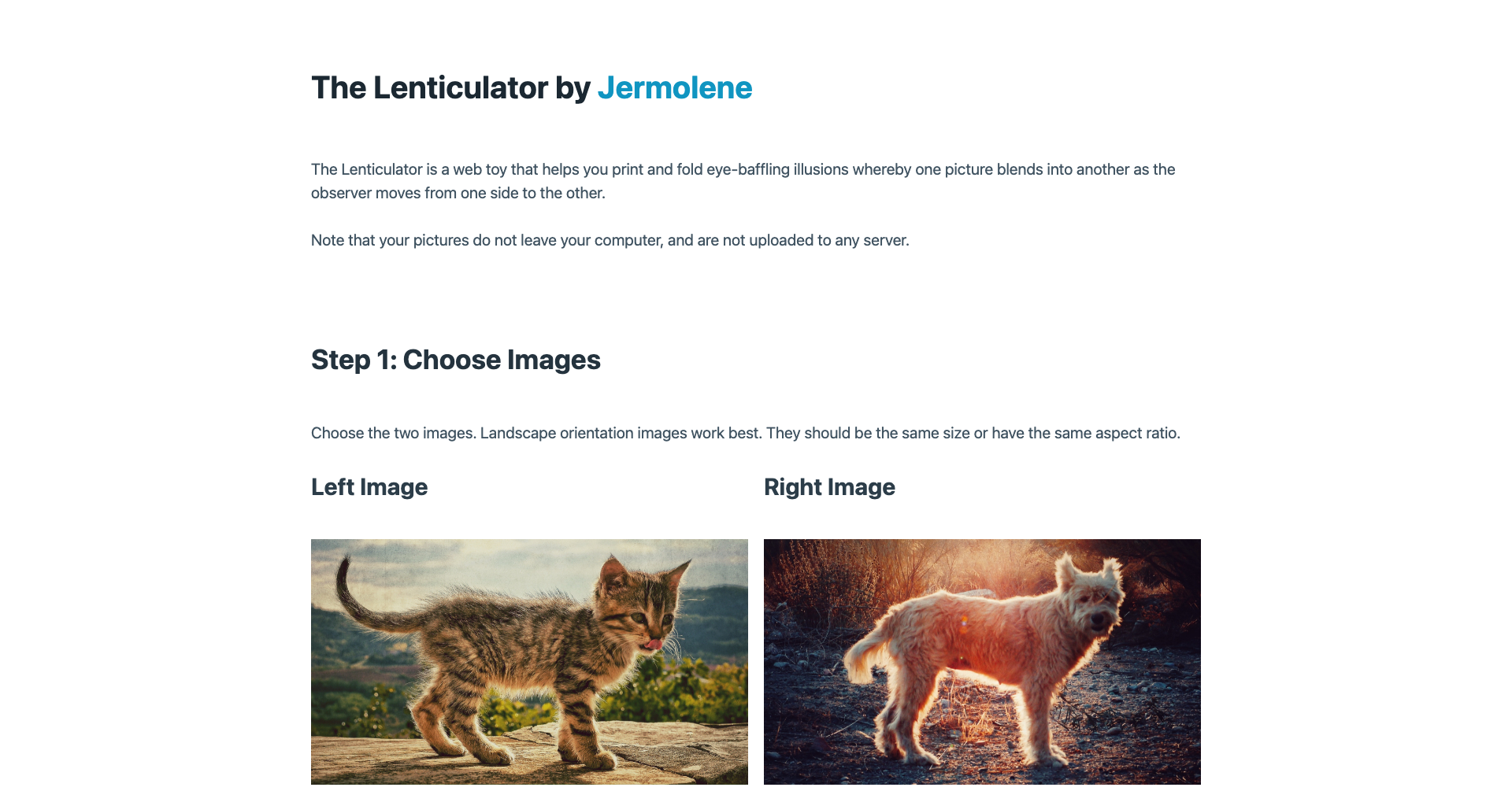 Jermolene — learning to program since 1978
Creator of [[TiddlyWiki]]
- whoyoucallingajesse.com
Founded [[Startup Barn]] as the next iteration of community + founders and rethinking the accelerator
 WESTENBERG | Substack
> I’m JA Westenberg, the voice behind Westenberg. I’m a writer, technologist, and perpetual skeptic, always prying at the edges of systems to see what’s holding them together (or what’s about to break). I’ve spent my life working in and writing about tech, politics, and philosophy, trying to piece together the bigger picture of how we shape the world—and how it shapes us in return. I founded https://signalvs.com/?ref=joanwestenberg.com" rel="noopener noreferrer">signalvs, a media lab, startup and agency, and https://www.theindex.media/?ref=joanwestenberg.com" rel="noopener noreferrer">The Index, an independent, reader funded news site.
>
> Westenberg is a blog for people who question the systems around us—whether they’re built from code, culture, or political ideology. It’s a space where technology, philosophy, politics, and productivity all come together, tangled and messy. Mostly because that’s how they are in real life.- Below the API
Points back to [[Replacing Middle Management with APIs]]:
> Peter Reinhardt pointed out this stripping away of middle management back in 2015. <mark>Jobs increasingly fall into one of two categories: Either you tell computers what to do for a living or they tell you what to do.</mark>
John points out this is a pretty fundamental change:
> But when a human is effectively on the other side of that API, not another piece of software, the fabric of our society starts to change on a foundational level.
>
> What happens when computers are given increasing levels of autonomy? And when you pair that autonomy with "real-world APIs," <mark>what happens to our communities when more and more of our jobs are managed by instructions we've given to a computer?</mark>Resist, or actually figure out how to change things for the better:
> ...we can also see it as a generational opportunity to rethink how work gets done, how resources get distributed, and what kind of world we want to live in.
>
> In other words, we have a chance to reprogram society — hopefully for the better.
>
> Let's not waste it. - Jonny Østrem | Artist & Designer
Founder of [[Z-Space]]
- joplin.cozic.net
- Open source, markdown-based note taking & to do. Originally designed to import Evernote
.enexfiles.
- Available on many platforms, including mobile apps and even terminal. Uses different cloud services for synchronization, but encrypted with your own keys, eg [[Dropbox]].
- I don't use it any more. I'm using [[Roam Research]] for private notes and its mobile web interface works fine for quick note taking. - JSON Feed
https://www.jsonfeed.org/2017/05/17/announcing-json-feed.html" rel="noopener noreferrer">Announced May 2017:
> We — Manton Reece and Brent Simmons — have noticed that JSON has become the developers’ choice for APIs, and that developers will often go out of their way to avoid XML. JSON is simpler to read and write, and it’s less prone to bugs.
>
> So we developed JSON Feed, a format similar to http://cyber.harvard.edu/rss/rss.html" rel="noopener noreferrer">RSS and https://tools.ietf.org/html/rfc4287" rel="noopener noreferrer">Atom but in JSON. It reflects the lessons learned from our years of work reading and publishing feeds.The https://www.jsonfeed.org/version/1.1/" rel="noopener noreferrer">spec is at version 1.1 as of August 2020.
## Jekyll JSON Feed Templates
https://github.com/georgemandis/jekyll-json-feeds
These are Version 1.0 templates that need to be slightly updated.
 JSR: the JavaScript Registry
> The open-source package registry for modern JavaScript and TypeScript
Focused on native TypeScript support for many different runtimes.
## Why JSR?> Made for TypeScript & ESM
>
> JSR is designed for TypeScript. You publish TypeScript source, and JSR handles generating API docs,.d.tsfiles, and transpiling your code for cross-runtime compatibility.
>
> JSR packages are distributed as web-standard ECMAScript modules.## Works with any runtime
> JSR modules can be used in Node.js, Deno, Bun, Cloudflare Workers, and more.
More details on the https://jsr.io/docs/why" rel="noopener noreferrer">Why JSR?, which specifically mentions “There are more JavaScript runtimes than just Node.js and browsers” — see [[JavaScript Runtimes]]
 Karabiner-Elements
A powerful and stable keyboard customizer for macOS.
I used to use it with the [[RK71]], but maybe don't need it any more!
 Nevergreen Musings
Founder of [[Parabl]]
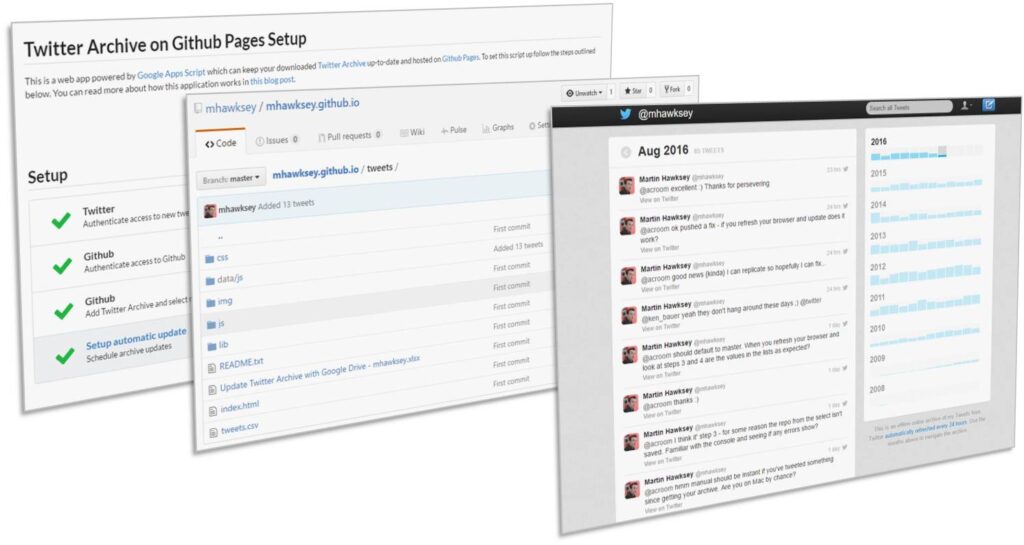 Keeping your Twitter Archive fresh and freely hosted on Github Pages
- Blog post by [[Michael Hawksey]] on using his [[Twitter Archiving Google Sheet]] tool to have a continuous archive on Github Pages, which you can then add a domain name to, in order to have it at a custom website like I do for my [[BMC/Twitter Archive]].
 Keycloak
Open Source Identity and Access Management
[[CNCF]] project
## Single-Sign On
Users authenticate with Keycloak rather than individual applications. This means that your applications don't have to deal with login forms, authenticating users, and storing users. Once logged-in to Keycloak, users don't have to login again to access a different application.
## Identity Brokering and Social Login
Enabling login with social networks is easy to add through the admin console. It's just a matter of selecting the social network you want to add. No code or changes to your application is required.
Keycloak can also authenticate users with existing OpenID Connect or SAML 2.0 Identity Providers. Again, this is just a matter of configuring the Identity Provider through the admin console.
## User Federation
Keycloak has built-in support to connect to existing LDAP or Active Directory servers. You can also implement your own provider if you have users in other stores, such as a relational database.
## Standard Protocols
Keycloak is based on standard protocols and provides support for OpenID Connect, OAuth 2.0, and SAML.
 Keyhive: Local-first access control
Local first access control
Created at [[Ink & Switch]], lead by [[Brooklyn Zelenka]]
## Lab Notebook
https://www.inkandswitch.com/keyhive/notebook/00/" rel="noopener noreferrer">Keyhive Background
> We’ve seen user-agency principals successfully applied to other contexts. https://signal.org/" rel="noopener noreferrer">Signal popularized end-to-end encrypted chat while retaining much of the convenience of less-secure messaging applications. <mark>We find ourselves asking “what would Signal for documents look like?”</mark>
## Code<https://github.com/inkandswitch/keyhive>
- https://github.com/inkandswitch/keyhive/tree/main/beelay/beelay-core" rel="noopener noreferrer">
beelay-core: Auth-enabled sync over end-to-end encrypted data
- https://github.com/inkandswitch/keyhive/tree/main/keyhive_core" rel="noopener noreferrer">keyhive_core: The core signing, encryption, and delegation system
- https://github.com/inkandswitch/keyhive/tree/main/keyhive_wasm" rel="noopener noreferrer">keyhive_wasm: https://webassembly.org/" rel="noopener noreferrer">Wasm wrapper aroundkeyhive_core, plus TypeScript bindings Kinopio – Thinking Canvas
A spatial canvas app with elements of tools for thought, mind mapping, and more.
As of June 2024, the client web app is non-commercial open source: [[Open Sourcing Kinopio]]
## PricingKinopio is free for 100 cards, afterwards it's $6/month, $60/year, or $200/life
- blockscience.medium.com
A lot of the things in here resonate with me, but I'm partially allergic to this kind of language. Here's the https://social.coop/@christina/111908457043203535" rel="noopener noreferrer">discussion with Christina Bowen about it.
My blink reaction is "you're just describing open source software development" aka [[Commons Based Peer Production]].
Questions of protocol governance -- with the tensions between the protocol developer, the client application developer interacting with the protocol, and finally the end user of the client application -- are very real!
A lot of the "who decides" / "how do we decide" questions of governance come from resources available. Ultimately, capital -- who can pay for development of features and implementation at various layers.
Some of the concepts that I am following that overlap with this include:
* [[Design for Deployment]]
* [[Bring Your Own Server]][[ActivityPub]] is a protocol going through this right now, especially with the [[Mastodon]] server and client interfaces having a major role. [[Threads.net]], Facebook's network that will be ActivityPub compatible, is looming and will have major impact.
My post on [[2022-01-15-networked-orgs-and-tooling|Networked Orgs and Tooling]] is related to this post as well. A set of networked orgs need to communicate, and so they need to choose platforms, protocols, and implementations.
> Building tools that allow users to provision, operate, maintain, and govern their own instances of an application is one of the most politically potent acts possible in open-source software development.
> Developers inevitably have to make subjective decisions that have downstream consequences, structuring and/or delimiting the action space available to users — hence cyborg anthropologist Amber Case’s claim that “design is governance.”[^1]
[^1]: [[Amber Case]] https://uxdesign.cc/how-design-is-governance-7c8dd466d753" rel="noopener noreferrer">How Design is Governance
> The goal of this initiative is to identify a “sweet spot” between designing for configurational freedom and designing for user-friendliness, so that the process of protocolization does not force users to choose between _software that is useful_ and _software that they can use_.
> _How can developers ensure that user-instanced open-source software is customizable enough to meet the needs and reflect the values of heterogeneous communities, but also sufficiently standardized to allow interoperability across instances — all while remaining easy to maintain?_
> The project at the center of our inquiry is perfectly suited to this purpose: BlockScience has developed an open-source knowledge management system (KMS) and knowledge organization infrastructure (KOI) for our own internal use[^3], employing an LLM as the interface to a database of our organizational knowledge, to anchor interactions within the scope of the content of the knowledge database and thus foster a genuine user interaction.
[^3]: https://papers.ssrn.com/sol3/papers.cfm?abstract_id=4561433" rel="noopener noreferrer">Constituting an AI: Accountability Lessons from an LLM Experiment - This paper explores an ethnographic study on an experiment conducted at an engineering services company called ‘BlockScience’. It focuses on the development and implications of 'constituting an AI' for accountability. The experiment integrated a pre-trained Large-Language Model (LLM) with an internal Knowledge Management System (KMS), making it accessible through a chat interface. By tracing the considerations of a group as they sought to design, deploy, and govern an AI, this research offers a foundational perspective to better understand accountability in human-AI interactions with organisational contexts. It also raises the need for further development of strategies to align AI technologies with human interests across various contexts.
This description most reminds me of a project that search company Algolia implemented -- using their own product -- inside their own organization [[How Algolia uses Electron to improve internal productivity]]. I see LLMs in part as "contextual search". Whether the Algolia project or what BlockScience is working on, I've very much wanted this both for myself as an individual (the bounds of info that I have access to) and for organizations that I'm a part of.
> We define self-infrastructuring[^6] as the ability of an organization to collectively design, own, govern, and maintain its own infrastructure. This concept underscores the significance of entities provisioning and operating their digital infrastructure, which is especially pivotal for entities whose ideals and objectives markedly diverge from those of external infrastructure providers. Due to the economics of scale, private digital infrastructure providers disproportionately serve majoritarian interests.
[^6]: https://journals.sagepub.com/doi/10.1177/20539517231159002" rel="noopener noreferrer">Web3 as ‘self-infrastructuring’: The challenge is how, The term ‘Web3’ refers to the practices of participating in digital infrastructures through the ability to read, write and coordinate digital assets. Web3 is hailed as an alternative to the failings of big tech, offering a participatory mode of digital self-organizing and shared ownership of digital infrastructure through software-encoded governance rules and participatory practices. Yet, very few analytical frameworks have been presented in academic literature by which to approach Web3. This piece draws on the theoretical lens of infrastructure studies to offer an analytical framework to approach the emergent field of Web3 as an exploration in ‘how to infrastructure’ through prefigurative self-infrastructuring. Drawing on qualitative examples from digital ethnographic methods, I demonstrate how the origins of Web3 reveal the intentions of its creators as a political tool of prefiguration, yet its practices reveal the inherent tension of expressing these ideals in coherent technical and institutional infrastructure. Thus, I argue that one of the fundamental challenges Web3 is negotiating through technical and governance experiments is ‘how to self-infrastructure?’.
This overlaps with [[Self-hosting]], sort of.
> it unveils the inherent trade-offs between self-expression and operational ease, a dynamic that often propels entities to cede self-expression in favor of the convenience offered by Software as a Service (SaaS) tools.
> This exploration is poised to render self-managed infrastructural models viable for small research entities, thereby facilitating a more inclusive and diversified infrastructural landscape.
> the move to practice involves <mark>applying insights from the self-infrastructuring paradigm to the process of protocolizing open-source software</mark>, with the goal of enabling instances to interoperate while also adhering to (and representing) the divergent values and goals of different groups — and of different individuals within those groups.
I think what is meant by this highlighted part is that open source software most often is a single implementation with an API. Other instances of that software, running the same code, may interoperate. But without defining and separately maintaining a protocol specification, at best someone else writing another implementation (say, in a different programming language), must be "bug compatible" with the APIs of the original. And it makes the "original" software the locus of governance.
I'll put placeholder links here for my beliefs around [[Open Protocols are better than Open Source]] as well as [[S3 API as defacto protocol]].
> Our initiative will be successful if, at its conclusion, we have reached a richer understanding of the trade-offs between customizability and standardization in the specific context of knowledge commons and open-source AI-enhanced knowledge management software
> Ultimately, this work is about clarifying how open source digital infrastructure allows different organizations to organize themselves and their activities around non-identical worldviews, while retaining the ability to make common cause, or otherwise coordinate and collaborate in the world we all share.
> This research initiative is animated by a belief that open digital infrastructure should be treated as a public good, and our proposed work is meant to democratize access to digital resources and to catalyze innovation through collective societal engagement.
 Kyle Mitchell, attorney
Kyle Mitchell is a prolific writer and creator of software licenses.
Read https://writing.kemitchell.com/" rel="noopener noreferrer">his blog
Member of [[Blue Oak Council]]
- LaSuite - L'espace de travail ouvert et souverain des agents de l'État
A French government digital suite of tools, many built around open source.
A partial list:
* [[Grist]]
* Note Pad - they talk about the https://pad.numerique.gouv.fr/O-jXOiSrSSahTdTFiaDXJA?both" rel="noopener noreferrer">wonders of Markdown -- it's a [[HedgeDoc]] install! - Langara College | Langara
- 100 West 49th Avenue, Vancouver
- https://langara.ca/campus-facilities/campus-maps/index.html" rel="noopener noreferrer">Main Campus Map
-  Lavie Tidhar
- About
- Lavie Tidhar is the World Fantasy Award winning author of Osama (2011), Seiun nominated The Violent Century (2013), the Jerwood Fiction Uncovered Prize winning A Man Lies Dreaming (2014), the Campbell Award, Neukom Prize and Chinese Nebula winning [[Central Station]] (2016), Prix Planete SF winner and Locus and Campbell award nominated Unholy Land (2018), British Fantasy Award nominated By Force Alone (2021), Philip K. Dick Award nominated T*he Escapement (2021), The Hood (2021), Maror (2022) and [[Neom]] (2022). He is also the author of middle-grade novel Candy (2018 UK; as The Candy Mafia 2020 US), created the comics mini-series Adler (1-5, 2020) and edits The Best of World SF *anthology series (2021-).- Leaflet — social publishing on the Atmosphere
Leaflet is a tool for writing and publishing together. It features a block based editor and is powered by [[atproto]] for accounts and storage.
* https://about.leaflet.pub/" rel="noopener noreferrer">Leaflet Manual
 Learn Wardley Mapping
- Operated by [[Ben Mosior]] of [[Hired Thought]]
-- Lemmy - A decentralised discussion platform for communities
ActivityPub powered link aggregator / Reddit clone.
 Let's fix OAuth in MCP
[[Aaron Parecki]]'s thoughts on fixing OAuth in [[MCP]], where he walks through a bunch of OAuth flows. I'll quote the last bit which makes it clear how this impacts LLM usage:
> The problem is only made worse with the explosion of AI tools. Every AI tool will need access to data in every other application in the enterprise. That is a lot of OAuth consent flows for the user to manage. Plus, the user shouldn't really be the one granting consent for Slack to access the company Google Docs account anyway. That consent should ideally be managed by the enterprise IT admin.
>
> What we actually need is a way to enable the IT admin to grant consent for apps to talk to each other company-wide, removing the need for users to be sent through an OAuth flow at all.
>
> This is the basis of another OAuth spec I've been working on, the https://datatracker.ietf.org/doc/draft-parecki-oauth-identity-assertion-authz-grant/" rel="noopener noreferrer">Identity Assertion Authorization Grant.
>
> The same problem applies to MCP Servers, and with the separation of concerns laid out above, it becomes straightforward to add this extension to move the consent to the enterprise and streamline the user experience.- Liberapay
A recurrent donations platform.
> Liberapay is run transparently by a non-profit organization, its https://github.com/liberapay/liberapay.com" rel="noopener noreferrer">source code is public.
Doesn't appear to be open source?
About page:
> Liberapay is a way to donate money recurrently to people whose work you appreciate.
>
> Payments come with no strings attached. You don't know exactly who is giving to you, and donations are capped at CA$150.00 per week per donor to dampen undue influence.
>
> By default, the total amount you give and the total amount you receive are public (you can opt out of sharing this info).
>
> Liberapay does not take a cut of payments, the service is funded by the donations to its own account. However there are payment processing fees.
>
> Liberapay is an open project, you can help us translate it, improve its code, and manage its legal entity. If you do so you'll be able to join the Liberapay team and receive a share of the money that our users donate to keep the service running.  libp2p - A modular network stack
> libp2p is a modular networking framework bundled together as a full stack of protocols for peer-to-peer systems. It is the product of a long and arduous quest into the internet's network stack and all of the plentiful peer-to-peer protocols of the past. Building large-scale peer-to-peer systems has been complex and challenging in the last twenty years and libp2p is a way to fix that. It is a "network stack"—a protocol suite—that cleanly separates concerns and enables sophisticated applications to use only the protocols they need without giving up interoperability and upgradeability. libp2p grew out of [[IPFS]] into an independent project designed to give any project _state-of-the-art_ peer-to-peer capabilities.
- Librecast - Decentralisation and Privacy with Multicast
- About
- The Librecast Live project contributes to decentralizing the Internet by enabling multicast. Multicast is an important network capability for a secure, decentralized and private by default [[Next Generation Internet]]
- The original design goals of the Internet do not match today's privacy and security needs, and this is evident in the technologies in use today. There are some situations where multicast can already be deployed on the Internet. This project is building the transitional protocols and software required to extend the reach of multicast and enable easy deployment by software developers.
- A transitional technology while we wait for [[IPv6]]
- Librecast will allow disconnected multicast networks to communicate, enabling multicast applications to have the same reach and reliability as their unicast counterparts, thus making multicast communication a viable option for software developers.  lieu — alexander cobleigh / cblgh.org
> https://github.com/cblgh/lieu" rel="noopener noreferrer">Lieu is a community search engine, a way for personal https://en.wikipedia.org/wiki/Webring" rel="noopener noreferrer">webrings to surface their contents and invite visitors to browse them. It’s a tool for crawling a limited set of links, noting down their contents, and a service making the corpus of pages searchable in a https://lieu.cblgh.org/" rel="noopener noreferrer">simple website.
Github https://github.com/cblgh/lieu" rel="noopener noreferrer">README
> Created in response to the environs of apathy concerning the use of hypertext search and discovery. In Lieu, the internet is not what is made searchable, but instead one's own neighbourhood. Put differently, Lieu is a neighbourhood search engine, a way for personal webrings to increase serendipitous connexions.
Built by [[Alex Cobleigh]] for the [[Merveilles]] community.
You can https://cblgh.org/about/" rel="noopener noreferrer">support Alex and Lieu by sponsoring him »
- www.linen.dev
> Linen syncs your Slack and Discord threads to an SEO friendly website that allows your community to discover you through search engines and reduces the number of repeat questions.
Commercial service, starts at $150/month
- linkding
A self-hosted bookmark manager designed be to be minimal, fast, and easy to set up.
The [[Commons Computer]] hosts a shared instance, and you can https://links.commonscomputer.com/bookmarks/shared" rel="noopener noreferrer">see public bookmarks.
> - Clean UI optimized for readability
> - Organize bookmarks with tags
> - Bulk editing, Markdown notes, read it later functionality
> - Share bookmarks with other users or guests
> - Automatically provides titles, descriptions and icons of bookmarked websites
> - Automatically archive websites, either as local HTML file or on Internet Archive
> - Import and export bookmarks in Netscape HTML format
> - Installable as a Progressive Web App (PWA)
> - Extensions for https://addons.mozilla.org/firefox/addon/linkding-extension/" rel="noopener noreferrer">Firefox and https://chrome.google.com/webstore/detail/linkding-extension/beakmhbijpdhipnjhnclmhgjlddhidpe" rel="noopener noreferrer">Chrome, as well as a bookmarklet
> - SSO support via OIDC or authentication proxies
> - REST API for developing 3rd party apps
> - Admin panel for user self-service and raw data access - Liquid AI — Device-native foundation models.
> Liquid’s edge-native stack delivers the fastest AI with zero cloud dependencies — powered by LFM2, built with LEAP, experienced in Apollo.
LEAP = Liquid Edge AI Platform <https://www.liquid.ai/blog/liquid-ai-launches-leap-and-apollo-bringing-edge-ai-to-every-developer>
* Cloud hosted playground https://playground.liquid.ai/
* [[Apollo]] end user app - GitHub - livegrep/livegrep: Interactively grep source code. Source for http://livegrep.com/
- Instantly grep all code at your company from a web interface, with it producing the relevant files, contextual snippets, and links to the full version in Github/GHE/etc.
- > When folks ask me a question about our codebase internally I try to
>
>a) answer the question
>b) say "If I were trying to find the answer to that question with our tools, here's my entry point, here's the search query, and here's my mental heuristic for why I'd click on result #3"- > This is trying to thread the needle on always, always being happy to give responsive answers to questions while also increasing people's ability to self-serve on them in the future.
- > Since it's publicly available, let me mention that the most common tool I use for answering these questions is livegrep and that I intend to boot up a livegrep instance on the first day of every startup for the rest of my life.
>
>It borders on miraculous.- via [[Patrick McKenzie]] https://twitter.com/patio11/status/1086112277659451392" rel="noopener noreferrer">@patio11

- Local-First Software Unconference · Luma
event-start:: [[Sep 23rd, 2023]]
-
.png) Local-First Conf 2024
Local-First Conf 2024## Video
<iframe width="560" height="315" src="https://www.youtube-nocookie.com/embed/videoseries?si=TQXaMy9ABO0P-pu2&list=PL4isNRKAwz2O9FxP97_EbOivIWWwSWt5j" title="YouTube video player" frameborder="0" allow="accelerometer; autoplay; clipboard-write; encrypted-media; gyroscope; picture-in-picture; web-share" referrerpolicy="strict-origin-when-cross-origin" allowfullscreen></iframe>
 Local-First Conf 2025
Join us for the second edition of Local-First Conf. Connect with a rapidly-growing community in an intimate setting. Berlin 27th - 28th May 2025.
 Local-First Conf 2026
Local-First Conf 2026 takes place in Berlin, Germany, at Festsaal Kreuzberg, July 12 - 14th.
I'm one of the organizers on behalf of [[Ink & Switch]], focused on Lab Day.
> “Local first” is a term for software that prioritizes data ownership, user agency, and empowering of end users to do more with their digital tools.
>
> Software creation is changing rapidly through LLM-assisted coding and AI agents. But our values are the same as ever.
>
> We’re not here to chase the latest trend, but to think long-term about what we want computing and software to look like in 3, 5, or 10 years.If you're atproto-inclined, here is an RSVP <https://atmo.rsvp/p/atmosphere.community/e/3mlo23qm5ukcr>. [[Bluesky]] is sponsoring and [[Paul Frazee]] is speaking, and [[Tangled]] are also sponsors.
## Lab Day
- Local-First Conf 2026
[[Local First]] focused conference series.
* [[Local-First Conf 2026]]
* [[Local-First Conf 2025]]
* [[Local-First Conf 2024]] - www.inkandswitch.com
You own your data, in spite of the cloud
This article has also been published https://www.inkandswitch.com/local-first/static/local-first.pdf" rel="noopener noreferrer">in PDF format in the proceedings of the https://2019.splashcon.org/track/splash-2019-Onward-Essays" rel="noopener noreferrer">Onward! 2019 conference. Please cite it as:
> Martin Kleppmann, Adam Wiggins, Peter van Hardenberg, and Mark McGranaghan. Local-first software: you own your data, in spite of the cloud. 2019 ACM SIGPLAN International Symposium on New Ideas, New Paradigms, and Reflections on Programming and Software (Onward!), October 2019, pages 154–178. https://doi.org/10.1145/3359591.3359737" rel="noopener noreferrer">doi:10.1145/3359591.3359737
---
Cloud apps like Google Docs and Trello are popular because they enable real-time collaboration with colleagues, and they make it easy for us to access our work from all of our devices. However, by centralizing data storage on servers, cloud apps also take away ownership and agency from users. If a service shuts down, the software stops functioning, and data created with that software is lost.
In this article we propose “local-first software”: a set of principles for software that enables both collaboration _and_ ownership for users. Local-first ideals include the ability to work offline and collaborate across multiple devices, while also improving the security, privacy, long-term preservation, and user control of data.
We survey existing approaches to data storage and sharing, ranging from email attachments to web apps to Firebase-backed mobile apps, and we examine the trade-offs of each. We look at Conflict-free Replicated Data Types (CRDTs): data structures that are multi-user from the ground up while also being fundamentally local and private. CRDTs have the potential to be a foundational technology for realizing local-first software.
- LOCALHOST Vancouver
Organized by me, [[Dawn Walker]], [[Chad Kohalyk]], and the [[DWebYVR]] community.
https://lu.ma/LOCALHOST_vancouver" rel="noopener noreferrer">Full calendar »
## IETF Hackathon
Saturday July 20th and Sunday July 21st, free to attend.
### Sunday Notes
https://datatracker.ietf.org/wg/mimi/about/" rel="noopener noreferrer">MIMI - More Instant Messaging Interop. Relevant for [[MLS]], [[atproto|ATProto]]
## Proto Apps
I'm organizing an invite only [[Proto Apps]] session with some folks coming in from out of town, Tuesday - Wednesday during the day.
## LOCALHOST SocialOn Thursday, hosted at https://www.osito.ca/" rel="noopener noreferrer">Osito. Bryan Newbold presenting on Bluesky / [[atproto]], and an overview of the [[IETF]], plus drinks, snacks, and meeting people.
## Our Networks[[Our Networks]] is at the end of the week, on Saturday.
## LOCALHOST Vancouver Hack DayA day of hacking, presentations, and small group discussions on a number of topics.
Same space as Our Networks.
 Lockdown Systems
Lockdown Systems is a worker-owned collective that builds freedom and privacy technologies that empower people to take control of their own data, choose what they reveal to the world, and protect themselves from unwanted surveillance. Our solutions can be used by individuals as well as organizations, whether non-profit or for-profit, who seek to protect the data of their members. Lockdown Systems balances commercial sustainability with our mission, focusing on long-term impact over short-term financial gain.
## Collective Members
* Saptak S <https://saptaks.blog/>
* [[Micah Lee]]
* redshiftzero <https://redshiftzero.com/>
 A privacy-first, open-source knowledge base
Website: https://logseq.com/
Highly granular graph based note taking tool. It's an outliner, and every outline item is a separate block that can be referenced and transcluded.
I have used it for a version of this site and published it at <https://notes.bmannconsulting.com>. I'm slowly converting it back here, because it didn't work well for publishing. I still use it for private note taking.
The Live Demo can in fact be used permanently https://demo.logseq.com/ -- uses the https://developer.chrome.com/docs/capabilities/web-apis/file-system-access" rel="noopener noreferrer">File System Access API[^chrome]
[^chrome]: I started going down the rabbit hole on how much of a Chromium only API this is. Safari _may_ have partial support in the very newest operating systems on iOS / MacOS. And of course, you have to accomplish cross-device sync in some other way, as it reads/writes on your local file system only.
- Long form writing in Logseq
- [[Logseq Focus Mode]], a plugin
- [[LogSeq/Document Mode]]
- Some CSS tweaks, plus full [[LogSeq Themes]]
- 
 Luma
Lumahttps://lu.ma" rel="noopener noreferrer">Luma is an event, calendar, and ticketing platform.
Luma makes it very easy to RSVP for free events online or in person, without having to go through a long sign up process.
It has very complete email update and notification features. By default, it will send an email the day before and then the hour before an events start time, but can be customized.
For shared, curated calendars, you can also send newsletters to all those that are subscribed to the calendar.
It is a proprietary platform, but it does have an API and can be embedded as both individual events or entire calendars. I think of it mostly as like a "Substack for Events". I can export the email addresses of attendees and import them elsewhere.
I've asked the team to add an option to map domains to calendars -- so I could do
calendar.example.com-- as another way to not just send links to someone else's platform.## Examples of Calendars
[[Fission]] calendar: <https://lu.ma/fission>, as well as embedded at <https://fission.codes/events>>
[[DWebYVR]] calendar: <https://lu.ma/dwebyvr>, as well as embedded at <https://dwebyvr.org/wiki/Calendar>
## Alternatives
I have used [[Tito]] for many years for both no-charge and ticketed events.
 Universal Control: Use a single keyboard and mouse between Mac and iPad - Apple Support
- > Use the keyboard, mouse, or trackpad of your Mac to control up to two other nearby Mac or iPad devices, and work seamlessly between them.
- Home - maddy
- Composable all-in-one mail server
> Maddy Mail Server implements all functionality required to run a e-mail server. It can send messages via SMTP (works as MTA), accept messages via SMTP (works as MX) and store messages while providing access to them via IMAP. In addition to that it implements auxiliary protocols that are mandatory to keep email reasonably secure (DKIM, SPF, DMARC, DANE, MTA-STS).
> It replaces Postfix, Dovecot, OpenDKIM, OpenSPF, OpenDMARC and more with one daemon with uniform configuration and minimal maintenance cost. 
 Maggie Appleton
Designer, anthropologist, and mediocre developer.
> I sit at the intersection of design, anthropology, and programming. These three are at the core of everything I make. Combining them into a coherent career is a weird and ongoing challenge.
>
> Titles and disciplines are fickle and fleeting. But my work fits under the umbrellas of UX design, visual interface design, and DX (developer experience). With some cultural analysis, writing, and visual illustration sprinkled on top.
>
> I currently lead design at https://elicit.com/" rel="noopener noreferrer">Elicit where we're exploring how machine learning can help researchers with open-ended reasoning.
>
> From Maggie's https://maggieappleton.com/about" rel="noopener noreferrer">About page:- mai ishikawa sutton
From their web page:
> My work lies at the intersection of technology and the solidarity economy. I’m passionate about strengthening the digital commons, in which people control and steward communication technologies as collective goods.
>
> I’m interested in how digital commoning is made possible through cooperative ownership, decentralized technologies, and governance structures that allow strong patterns of communication and constructive feedback loops.One of the original stewards of the [[DWeb]]
Co-host for [[Causal Islands LA]]
- Mailtrain
website: https://mailtrain.org/
A [[Self Hosted]] newsletter application built on Node.js (v10+) and MySQL (v8+) or MariaDB (v10+).
 Malleable software in the age of LLMs
All computer users may soon have the ability to author small bits of code. What structural changes does this imply for the production and distribution of software?
> I think it’s likely that soon all computer users will have the ability to develop small software tools from scratch, and to describe modifications they’d like made to software they’re already using. In other words, LLMs will represent a step change in tool support for https://www.inkandswitch.com/end-user-programming/" rel="noopener noreferrer">_end-user programming_: the ability of normal people to fully harness the general power of computers without resorting to the complexity of normal programming. Until now, that vision has been bottlenecked on turning fuzzy informal intent into formal, executable code; now that bottleneck is rapidly opening up thanks to LLMs.
 Mallory Knodel
Executive Director, [[Social Web Foundation]]
From https://socialwebfoundation.org/team/" rel="noopener noreferrer">SWF team page:
> Mallory Knodel is the Executive Director of SWF. She is a technology and human rights expert specializing in internet governance and digital policy. Mallory is active in internet and emerging technical standards at the IETF, IEEE and the UN. Her background in computer science and civil society brings a unique perspective to the intersection of technology, policy, and human rights.
- Marginalia Search
- From the home page:
> This is an independent DIY search engine that focuses on non-commercial content, and attempts to show you sites you perhaps weren't aware of in favor of the sort of sites you probably already knew existed.
> The software for this search engine is all custom-built, and all crawling and indexing is done in-house. The project is open source. Feel free to poke about in the https://git.marginalia.nu/marginalia/marginalia.nu" rel="noopener noreferrer">source code or contribute to the development! - www.vmunix.com
From LinkedIn:
> Previously Chief Product Officer for Mozilla and steward of Firefox for the Quantum launch. CTO for cloud computing pioneer Joyent —containers and node.js— and technical co-founder at multiple early startups. I've helped nurture exciting technologies from the lab to the devices of billions of humans. How can I help?
 MastoDeck - advanced Mastodon client
- A #Tweetdeck for #Mastodon
 Mastodon - Decentralized social media
Mastodon is an open source federated microblogging platform, implementing the [[ActivityPub]] protocol.
It has a Mastodon API that is not quite to ActivityPub spec.
The https://docs.joinmastodon.org" rel="noopener noreferrer">Mastodon documentation site covers what a microblog and federation are:
> Similar to how blogging is the act of publishing updates to a website, microblogging is the act of publishing small updates to a stream of updates on your profile. You can publish text posts and optionally attach media such as pictures, audio, video, or polls. Mastodon lets you follow friends and discover new ones.
>
> Federation is a form of decentralization. Instead of a single central service that all people use, there are multiple services, that any number of people can use.The About statement on the Patreon from the main developer Gargron is also a good description:
> I'm working on Mastodon, a free, open-source social network server based on open web protocols like ActivityPub and OStatus. The social focus of the project is a viable decentralized alternative to commercial social media silos that returns the control of the content distribution channels to the people. The technical focus of the project is a good user interface, a clean REST API for 3rd party apps and robust anti-abuse tools.
>
> The entire network is like an unlimited number of different Twitter websites, users of which can follow each other and interact regardless of which Twitter website exactly they are on. This has obvious benefits as there is no single company that has a monopoly.## Alternate Web Clients
Instead of using the built in Mastodon web client front end, [[Elk]] or [[Phanpy]] can be used.
 Matrix.org
An open network for secure, decentralised communication
From the About page: <https://matrix.org/about/>
---
## Matrix ManifestoWe believe:
- People should have full control over their own communication.
- People should not be locked into centralised communication silos, but instead be free to pick who they choose to host their communication without limiting who they can reach.
- The ability to converse securely and privately is a basic human right.
- Communication should be available to everyone as a free and open, unencumbered, standard and global network.### Mission
The Matrix.org Foundation exists to act as a neutral custodian for Matrix and to nurture it as efficiently as possible as a single unfragmented standard, for the greater benefit of the whole ecosystem, not benefiting or privileging any single player or subset of players.
For clarity: the Matrix ecosystem is defined as anyone who uses the Matrix protocol. This includes (non-exhaustively):
- End-users of Matrix clients.
- Matrix client developers and testers.
- Spec developers.
- Server admins.
- Matrix packagers & maintainers.
- Companies building products or services on Matrix.
- Bridge developers.
- Bot developers.
- Widget developers.
- Server developers.
- Matrix room and community moderators.
- End-users who are using Matrix indirectly via bridges.
- External systems which are bridged into Matrix.
- Anyone using Matrix for data communications."Greater benefit" is defined as maximising:
- the number of Matrix-native end-users reachable on the open Matrix network.
- the number of regular users on the Matrix network (e.g. 30-day retained federated users).
- the number of online servers in the open federation.
- the number of developers building on Matrix.
- the number of independent implementations which use Matrix.
- the number of bridged end-users reachable on the open Matrix network.
- the signal-to-noise ratio of the content on the open Matrix network (i.e. minimising spam).
- the ability for users to discover content on their terms (empowering them to select what to see and what not to see).
- the quality and utility of the Matrix spec (as defined by ease and ability with which a developer can implement spec-compliant clients, servers, bots, bridges, and other integrations without needing to refer to any other external material).N.B. that we consider success to be the growth of the open federated network rather than closed deployments. For example, if WhatsApp adopted Matrix it wouldn't be a complete win unless they openly federated with the rest of the Matrix network.
 Thread by @matthew_d_green on Thread Reader App
So Apple has introduced a new system called “[[Private Cloud Compute]]” that allows your phone to offload complex (typically AI) tasks to specialized secure devices in the cloud. I’m still trying to work out what I think about this. So here’s a thread. https://x.com/matthew_d_green/status/1800291897245835616" rel="noopener noreferrer">@matthew_d_green
- Home
- Maker of the [[Digital Garden Jekyll Template]]
 Jobs below the API
Points at [[Replacing Middle Management with APIs]] and includes the [[Dead End Jobs Below the API]] Forbes chart.
> Essentially what’s happening is that in a first phase middle management is replaced by a software system of APIs (i.e. machine-machine interfaces) and GUIs (i.e. machine-human interfaces), opening the doors for the second phase: a swift replacement of _below the API jobs_ by machines. <mark>Increasingly, the only <em>paying</em> work left for humans will be the one of building the software.</mark>
Of course, clipping this at the end of 2025, paying humans to pay software is in a contentious situation.
Points at [[UBI]] as potential direction:
> I think there should be nothing wrong with increased automation and rising efficiencies. Less work should be a good thing! However, <mark>this is going to play out well only if we stop demanding that everyone sacrifices their lives to do work that can be monetized</mark>—we need something like an unconditional basic income.
- mcmillan.ca
Offering startup legal focused on founders in Canada through [[Ascent]]
- Model Context Protocol
MCP is an open protocol that standardizes how applications provide context to LLMs.
Created by [[Anthropic]] in November 2024: [[Introducing the Model Context Protocol]]
---
From the https://modelcontextprotocol.io/introduction" rel="noopener noreferrer">intro page of the docs:
MCP is an open protocol that standardizes how applications provide context to LLMs. Think of MCP like a USB-C port for AI applications. Just as USB-C provides a standardized way to connect your devices to various peripherals and accessories, MCP provides a standardized way to connect AI models to different data sources and tools.
## Why MCP?
MCP helps you build agents and complex workflows on top of LLMs. LLMs frequently need to integrate with data and tools, and MCP provides:
- A growing list of pre-built integrations that your LLM can directly plug into
- The flexibility to switch between LLM providers and vendors
- Best practices for securing your data within your infrastructure
### General architectureAt its core, MCP follows a client-server architecture where a host application can connect to multiple servers:
- MCP Hosts: Programs like Claude Desktop, IDEs, or AI tools that want to access data through MCP
- MCP Clients: Protocol clients that maintain 1:1 connections with servers
- MCP Servers: Lightweight programs that each expose specific capabilities through the standardized Model Context Protocol
- Local Data Sources: Your computer’s files, databases, and services that MCP servers can securely access
- Remote Services: External systems available over the internet (e.g., through APIs) that MCP servers can connect to - Meet.Coop
> access to open source meeting and conferencing tools, powered by BigBlueButton, running on cooperatively owned infrastructure. We are part of the commons economy.
Found this via [[Social.Coop]], which is considering joining so SC members get access to meeting capabilities.
There's a video that demos the capabilities of [[BigBlueButton]]:
<iframe width="560" height="315" src="https://www.youtube.com/embed/Hso8yLzkqj8" frameborder="0" allow="accelerometer; autoplay; clipboard-write; encrypted-media; gyroscope; picture-in-picture" allowfullscreen></iframe>
- www.memoryexpress.com
Vancouver and Canada-wide computer parts and components store, with good prices and service. The store on W Broadway at Cypress is the one closest to me in Vancouver.
 Metagov
- The Metagovernance Project is an interdisciplinary research collective. We build standards and infrastructure for digital self-governance. Our collaborations include:
- https://gateway.metagov.org/" rel="noopener noreferrer">Metagov Gateway, an API gateway for digital governance services
- https://daostar.org/" rel="noopener noreferrer">DAOstar, a set of DAO standards, and https://daostar.one/" rel="noopener noreferrer">DAOstar One, a roundtable
- https://validatorcommons.org/" rel="noopener noreferrer">Validator Commons, a cryptopolitical party of validators and allies
- https://arxiv.org/abs/2205.14290" rel="noopener noreferrer">Agreement Engine, a tool for building net-native agreement systems
- https://daogovdata.info/" rel="noopener noreferrer">DAOchem, a holistic view of DAO governance
- https://communityrule.info/" rel="noopener noreferrer">CommunityRule, a user-friendly governance toolkit for great communities
- https://arxiv.org/abs/2108.05318" rel="noopener noreferrer">Composing games into complex institutions, a research paper
- https://constitutions.metagov.org/" rel="noopener noreferrer">Constitutions of Web3, analysis and guides for DAO constitutions
- https://medium.com/metagov/the-political-landscape-of-crypto-f440d521f411" rel="noopener noreferrer">Cryptopolitics, a study of politics and ideology in crypto
- https://govbase.metagov.org/" rel="noopener noreferrer">Govbase, a set of research data sets in online governance
- https://metagov.org/govbase/" rel="noopener noreferrer">Govbase Labs, a weekly lab meeting
- (new) https://www.crowdwrite.xyz/metagov/cl7e9sjvc000q09jx9kjhbocz/text" rel="noopener noreferrer">Governance Experience Design, a living manifesto for online spaces
- (new) https://github.com/notchia/dao-governance-surfaces" rel="noopener noreferrer">Governance Surfaces, a tool for analyzing DAO contracts
- https://metagov.org/metagovdao-call-for-proposals-research-community/" rel="noopener noreferrer">MetagovDAO, a funding body for research on DAOs
- https://metagov.org/seminar/" rel="noopener noreferrer">Metagovernance Seminar, a weekly seminar
- https://www.metagov.org/modpol" rel="noopener noreferrer">Modular Politics, a paper outlining a governance layer for the internet
- https://modpol.net/" rel="noopener noreferrer">Modpol, a governance mod for Minetest
- https://policykit.org/" rel="noopener noreferrer">PolicyKit, an engine for building governance in online communities
- https://papers.ssrn.com/sol3/papers.cfm?abstract_id=4078259" rel="noopener noreferrer">Telescope, a Discord bot for ethical, responsive digital ethnography
- MetaMask: Where your money lives
- MetaMask is a web3 wallet client
-- micahflee
I'm a coder, a journalist, and I help people stay private and secure.
I develop open source security tools like https://onionshare.org/" rel="noopener noreferrer">OnionShare and https://dangerzone.rocks/" rel="noopener noreferrer">Dangerzone.
Part of [[Lockdown Systems]], creator of [[Cyd]]
 Home
Home- Expert developer of Google Apps Script
- Runs AppsScriptPulse https://pulse.appsscript.info
-- Micro - Home
A modern and intuitive terminal-based text editor.
It's a single executable binary so very easy to use anywhere. I got into it during my Chromebook years.
One liner install on most systems:
```shell
curl https://getmic.ro | bash
``````
__ __ _ ___ _ _ _ _ _
| \/ (_) ___ _ __ ___ |_ _|_ __ ___| |_ __ | | | ___ __| | |
| |\/| | |/ __| '__/ _ \ | || '_ \/ __| __/ _\ | | |/ _ \/ _ | |
| | | | | (__| | | (_) | | || | | \__ \ || (_| | | | __/ (_| |_|
|_| |_|_|\___|_| \___/ |___|_| |_|___/\__\__,_|_|_|\___|\__,_(_)Micro has been downloaded to the current directory.
You can run it with:
./micro
```Options are set in
~/config/micro/settings.json. https://github.com/zyedidia/micro/blob/master/runtime/help/options.md" rel="noopener noreferrer">List of options  Micro.blog
- A hosted microblogging service that uses [[Hugo]] static site generator underneath. Supports [[IndieWeb]], [[Micropub]], [[ActivityPub]] and more independent and open web protocols.
- Founded by [[Manton Reece]].
- [[Recommended]] for people who want to run a blog on their own domain, while still being able to cross post to Twitter, LinkedIn, Medium, Tumblr, and Mastodon. Also supports podcasts and videos at premium accounts.
- I pay for an account to https://blog.bmannconsulting.com" rel="noopener noreferrer">run my microblog at blog.bmannconsulting.com. My username and feed are at https://micro.blog/boris" rel="noopener noreferrer">micro.blog/boris
- I sometimes forget that 'other' Boris Jabes has the _boris_ microblog link at https://boris.micro.blog
- I'm using a custom version of the [[Marfa Theme]].
- ## Micro.blog Sidebar
The help article explains that you can https://help.micro.blog/2016/sidebar-js/" rel="noopener noreferrer">embed your microblog feed into other sites using sidebar.js.
The nice thing about this is that your feed automatically includes the posts you make to your blog, but you can also add third party feeds. This means Micro.blog can be your own aggregator, rather than having to merge feeds somewhere else.
Unfortunately, there is no permalink included for these posts, so they are much less useful. This is generated as HTML -- which is great, because it can just be output. But, without linking back to the original, I'm not sure that it makes a lot of sense? It would mean that Mb needs to know / store the permalink or source of each feed item. I _think_ [[JSON Feed]] that you include would have this?
- ### Feature Request: include permalinks in sidebar.js
For each feed item in sidebar.js, wrap the date or a separate small
#(or the title for posts with titles?) in a permalink that points to the source item.Optionally, consider linking to the micro.blog post itself OR the source item, as an option.
This means that when your micro blog feed is embedded, people can actually follow the link to see where it came from. As it is, it's just a chunk of HTML, and there is no way for the user to easily get the permalinks.
- I'm embedding my own https://micro.blog/boris" rel="noopener noreferrer">boris feed below so I can point to it as an example:
---
<script type="text/javascript" src="https://micro.blog/sidebar.js?username=boris&count=5"></script>
<hr style="margin-bottom: 50px;">
- Micropub
An open API standard for creating, editing, and deleting posts on websites, like on your own domain, supported by numerous third-party clients and CMSs.
An [[IndieWeb]] standard, [[W3C]] Editor is @aaronpk. Main page on the https://indieweb.org/Micropub" rel="noopener noreferrer">IndieWeb wiki.
## Micropub clients:
## Micropub servers / hosts
* [[Micro.blog]] supports it for publishing. Its using the "Link" or "Bookmark" type for a different purpose, that doesn't actually get published to your feed.
* @voxpelli [[Micropub to Github]] - this is what I first ran, it didn't support file uploads
* [[IndieKit]] is my recommended self-hosting tool for this - Migrating PDS Account with `goat` | bryan newbold
[[Bryan Newbold]]'s write up on how to move your [[atproto]] account between [[PDS]].
The entire meat of the article is, install https://github.com/bluesky-social/indigo/tree/main/cmd/goat" rel="noopener noreferrer">goat:
```shell
go install github.com/bluesky-social/indigo/cmd/goat@latest
```And then run three commands:
1: Login to your old account
```shell
goat account login -u $OLDHANDLE -p $OLDPASSWORD
```2: Request a verification token from your current PDS.
```shell
goat account plc request-token
```3: Run the migrate command
```shell
goat account migrate \
--pds-host $NEWPDSHOST \
--new-handle $NEWHANDLE \
--new-password $NEWPASSWORD \
--new-email $NEWEMAIL \
--plc-token $NEWPLCTOKEN \
--invite-code $INVITECODE
```The article has more details on manual migrations if things go wrong.
- www.masnick.com
Michael Masnick (born December 8, 1974[^1] is an American editor and entrepreneur. He is the CEO and founder of https://en.wikipedia.org/wiki/Techdirt "Techdirt"" rel="noopener noreferrer">Techdirt, a https://en.wikipedia.org/wiki/Blog "Blog"" rel="noopener noreferrer">weblog.[^2]
He coined the term "https://en.wikipedia.org/wiki/Streisand_effect "Streisand effect"" rel="noopener noreferrer">Streisand effect" on the Techdirt blog in January 2005 and was interviewed about it three years later on https://en.wikipedia.org/wiki/NPR "NPR"" rel="noopener noreferrer">National Public Radio's _https://en.wikipedia.org/wiki/All_Things_Considered "All Things Considered"" rel="noopener noreferrer">All Things Considered_.[^3]
In August 2024, he became part of the board of [[Bluesky]] a social media startup.[^4]
[^1]: Masnick, Mike (2008-10-21). https://www.techdirt.com/2008/10/21/the-uneasy-balance-between-wikipedia-and-truth/" rel="noopener noreferrer">"The Uneasy Balance Between Wikipedia And Truth". _Techdirt_. Retrieved 2024-04-20.
[^2]: Hill, Kashmir (2023-07-29). https://www.nytimes.com/2023/07/29/technology/mike-masnick-techdirt-internet-future.html" rel="noopener noreferrer">"An Internet Veteran's Guide to Not Being Scared of Technology". _The New York Times_. https://en.wikipedia.org/wiki/ISSN_(identifier" rel="noopener noreferrer">ISSN "ISSN (identifier)") https://search.worldcat.org/issn/0362-4331" rel="noopener noreferrer">0362-4331. Retrieved 2024-04-20.
[^3]: Robert Siegel (February 29, 2008). https://www.npr.org/templates/story/story.php?storyId=87809195" rel="noopener noreferrer">"The Streisand Effect' Snags Effort to Hide Documents". _https://en.wikipedia.org/wiki/All_Things_Considered "All Things Considered"" rel="noopener noreferrer">All Things Considered_. https://en.wikipedia.org/wiki/NPR "NPR"" rel="noopener noreferrer">National Public Radio. The episode is the latest example of a phenomenon known as the "Streisand Effect." Robert Siegel talks with Mike Masnick, CEO of Techdirt Inc., who coined the term.
[^4]: Perez, Sarah (2024-08-06). https://techcrunch.com/2024/08/06/bluesky-adds-techdirt-founder-mike-masnick-to-its-board/" rel="noopener noreferrer">"Bluesky adds Techdirt founder Mike Masnick to its board". _TechCrunch_. Retrieved 2024-08-11.
- Minimal Mistakes
Minimal Mistakes is a [[Jekyll]] theme that I have used for many years. Extremely flexible, lots of layouts and options, well-structured code.
- Seed Hypermedia
Mintter is a decentralized knowledge collaboration application for open communities powered by a knowledge graph.
Mintter supports the new [[Hypermedia Web Protocol]]. This open protocol supports secure identities, version control, semantic documents, multimedia, and groups/organizations.
 Missive · Inbox collaboration for teams that run on email
Shared team inboxes plus chat, contacts, and integrations. eg Email to Trello attachment
Doesn't really scale down to single user.
Canadian company, based in Quebec City.
## Pricing* Starter is $14/month/user billed annually, up to 5 users - no integrations, rules, or API access
* Productive is $24/month/user, up to 50 users
* Business is $36/month/user, unlimited users- moaparty.com
- Links your [[Mastodon]] account to [[Twitter]] to enable cross-posting in both directions.
- @flancian, @vera and I have formed a squad under the [[FedStoa]] to run Moa as a public utility. The home base for this is now on Gitlab at <https://gitlab.com/fedstoa/moa>. The issue queue in that repo is where TODOs are actively being tracked.
- The https://moaparty.com" rel="noopener noreferrer">moaparty.com website is the status / news / docs website for the project, with the source code and build on Gitlab under the [[FedStoa]] group.
- The Matrix channel https://matrix.to/#/!zPwMsygFdoMjtdrDfo:matrix.org?via=matrix.org" rel="noopener noreferrer">#moaparty:matrix.org is where chat discussion is happening. Add #moaparty to your Twitter, Instagram, or Mastodon posts, or the[[Moa Party]]wikilink.
- Features
- [[Git Siphon for Moa Party]]
- [[Roam Siphon for Moa Party]]
- [[Micropub endpoint for Moa Party]]
- Originally created by James Moore, a [[Python]] / Flask app and open source under an [[MIT License]].
- As of [[September 2020]], Instagram cross posting is disabled because of changes in the Instagram API. Likely same reason that [[OwnYourGram]] doesn't really work anymore.  Monica — the open-source personal CRM
- The team behind this are building an all in one tool for company management called Office Life
- Why does Canada not have more pre-seed funds writing first cheques? | Boris Mann posted on the topic | LinkedIn
I shared this on LinkedIn. There's a good discussion in the comments around this.
---
Why does Canada not have more preseed funds writing first cheques?
It’s (I think) a recognized fact that this is the case.
Is it because we are so close to the US ecosystem that the massive number of preseed funds there effectively cherry picks our top founders?
I have heard that Canadian pre-seed has the opposite problem. They have to wade through a lot of inbound in Canada (many low quality), but themselves have such small funds they deploy very little.
I have been thinking about what I did at Full Stack. The ecosystem was smaller then. There was no institutional preseed. 9 deals in 6 months made me one of the top investors in Canada. I say that not to boast, but show how low the bar was (is?).
I modeled smaller cheques with much higher velocity during the pandemic with Venture Scouts. Recently talked to [[Jesse Rodgers]] who is thinking something similar.
The model I have in mind would be
- across Canada
- scouts in every community (diverse young people)
- 10k - 25k lead cheques - don’t need to wait for a lead, we say yes first
- scouts check the hygiene - legal setup, founders reverse vesting etc
- syndicate every deal
50 - 100 deals annually? One of the experiments here is if one can find and execute on this many.
Not all would be venture track, so slightly different [[IndieVC]] style deal terms might be needed.
Overhead is massive compared to capital deployed. Not enough AUM for management fees to pay for much.
What do you think?  Trust — Moving Castles: Modular and Portable Multiplayer Miniverses
- A growing number of subcultures, digital communities and guilds have turned their back on ad-supported social media and migrated their social and cultural activities to semi-private digital spaces, chat rooms and Discord servers. We believe these spaces have the potential to become decentralised institutions that are financed, owned and governed by their own members. To support this vision we propose Moving Castles, an organisational metaphor and real-time media type which combines collective agency and public participation in modular and portable multiplayer miniverses.
- Not islands or dark forests, but vehicles
- what Yancey Strickler calls https://onezero.medium.com/the-dark-forest-theory-of-the-internet-7dc3e68a7cb1" rel="noopener noreferrer">Dark Forests.
- According to him these are “spaces where depressurized conversation is possible because of their non-indexed, non-optimized, and non-gamified environments”.
- [[The Dark Forest Theory of the Internet]]
- Ribbonfarm’s [[Venkatesh Rao]] has another term for it:
- “the Cozyweb works on the (human) protocol of everybody cutting-and-pasting bits of text, images, URLs, and screenshots across live streams”. Where Dark Forests are characterised by their intentional withdrawal from social media, the Cozyweb is non-indexable because of a lacking interconnection between material, creating unintentionally disconnected islands populated by isolated communities.
- [[The Extended Internet Universe]]
- The characterisation of these communities as isolated islands or dark forests, while useful in describing our current media landscape, sits uneasily with both our experience of participating in Trust, and our hopes for these spaces developing into democratic social institutions which have a relationship and responsibility to the public. As https://otherinter.net/research/positive-sum-worlds/" rel="noopener noreferrer">a recent post [[Positive Sum Worlds: Remaking Public Goods]] by Laura Lotti, Sam Hart and Toby Shorin points out, we need new articulations of how decentralised online communities interact with the public, and attached conceptions of the public good, one that as they put forward, should to be framed around positive externalities rather than internal interests.
- Full customisability is achieved by using real-time rendering softwares, such as Unreal Engine. These allow the community to commission, create or reshape the components of their Moving Castle themselves. As a result, Moving Castles are not hermetically sealed, self-ossifying spaces, but instead can be swapped, combined and merged in a modular fashion. This scrappy, constantly re-assembling amalgamation of rooms, mechanisms, community members and portal doors is what we define as a Moving Castle.- Mozilla Builders Accelerator 2024 - Local AI
This is [[on device AI]], I use [[Local AI]] a little differently.
Application deadline is August 1st, 2024.
> Our inaugural theme is Local AI, which focuses on running AI models and applications directly on personal devices such as laptops, smartphones, or edge devices, rather than relying on cloud-based services.
>
> Local AI represents a transformative approach to AI deployment, providing significant benefits in terms of privacy, cost efficiency, cultural relevance, and system reliability.
>
> For more information on Local AI and the opportunities for innovation, check out our explainer https://future.mozilla.org/builders/blog/announcing-mozilla-builders/" rel="noopener noreferrer">here.  Essential Randomness — Ms Boba's Emporium of Weirdness
Software engineer (and more) on a mission to bring community back to the web. Founder of https://bsky.app/profile/did:plc:tqddwao6fvopccjez75hbcxe" rel="noopener noreferrer">@fujoweb.dev, https://fujocoded.com/" rel="noopener noreferrer">fujocoded.com and https://bobaboard.com/" rel="noopener noreferrer">bobaboard.com. Loves building random, chaotically-delightful stuff. 🇪🇺🇺🇸
Lead on building [[AtmosphereConf 2026]] website <https://atmosphereconf.org> and the https://bsky.app/profile/atmosphere.community" rel="noopener noreferrer">@atmosphere.community website <https://atmosphere.community>.
 Muni Town
Muni Town is a collective of people working on projects in alignment with the https://blog.erlend.sh/assembling-community-os" rel="noopener noreferrer">Community OS product vision.
Working on [[Roomy]]
### Infrastructure Partners
- https://github.com/sebadob/rauthy" rel="noopener noreferrer">Rauthy
- [[Iroh]]
- [[Automerge]]
- [[Keyhive]]
- [[Jazz]]### App Partners
- https://github.com/polyphony-chat" rel="noopener noreferrer">Polyphony / https://docs.polyphony.chat/Overviews/core/" rel="noopener noreferrer">Polyproto
- https://github.com/Lantern-chat" rel="noopener noreferrer">Lantern
- https://github.com/kitsune-soc/kitsune" rel="noopener noreferrer">Kitsune
- namecheap.com
Domain registrar and DNS hosting.
A reboot of Namecheap is [[Spaceship]].
- Neocities
- Neocities is a reboot of Geocities. The entire site is [[Open Source]].
I have an empty placeholder site there https://bmann.neocities.org/
As I found out, Neocities experiments with [[IPFS]]: you can https://neocities.org/distributed-web" rel="noopener noreferrer">enable IPFS archiving, and they https://blog.neocities.org/blog/2015/09/08/its-time-for-the-distributed-web.html" rel="noopener noreferrer">blogged about it in 2015.
- From the https://neocities.org/about" rel="noopener noreferrer">about page:
- Our goal: to enable you to harness the creativity, beauty, and power of creating your own web site. To rebuild the web we lost to automation and monotony, and make it fun again.
- Neocities is:
* Helping the web. We are here to empower people to develop independent, creative sites.
* Free. We will always have a free web site option.
* Open source. Neocities believes in open source, and we share code back with the community.
* Not an advertising company. We'll never put ads or watermarks on sites, and we don't sell your data to marketers.
* Anti lock-in. Easy site downloading, and support for custom domains.
* Sustainable. We want to grow, but that growth cannot risk the site (or compromise our principles).
- 
- GitHub - prathyvsh/networked-notebooks: Hyperlinked notebooks
- https://github.com/prathyvsh/networked-notebooks" rel="noopener noreferrer">Github repo listing different networked notebooks aka [[Tools for Thought]] aka [[Second Brain]]
- Curated by https://github.com/prathyvsh" rel="noopener noreferrer">@Prathyvsh
- Under the _Up and Coming_ section, it specifically names [[Digital Garden]]:
> Not a product per-se, but from the discussion, the prototype seems interesting. It is an attempt to create a densely connected Digital Garden. (==The term digital garden has become a popular term for describing websites that incorporate multiple facets of a person’s digital space like notes, blog etc into a single thing== and allows visitors to stroll through them seamlessly like a garden with densely connected graph like structure. https://nesslabs.com/mind-garden" rel="noopener noreferrer">This article from [[Anne-Laure Le Cunff]] has an excellent explanation of it).
- #via [[Raghuveer S]]
- Neuron
A future-proof open-source app for managing your plain-text notes in Zettelkasten style, as well as for publishing them on the web.
[[AGPL License]], written in [[Haskell]], installed via [[Nix]]
You can use the https://github.com/srid/neuron-template" rel="noopener noreferrer">Neuron Template to publish to [[Github/Pages]] using [[Github/Actions]].
Github: https://github.com/srid/neuron
The author is also building https://www.cerveau.app" rel="noopener noreferrer">Cerveau to edit Neuron sites online -- it uses this by editing Github repositories. He is considering open sourcing based on Github sponsors.
 Discord - Group Chat That’s All Fun & Games
Released on the [[New Design Congress]] https://discord.gg/TBhNWZUTY9" rel="noopener noreferrer">Discord
---
Exciting news! After five years, [[New Design Congress Report - Digital Identity Event Horizon]] is published in full today: three problem statements, ten key findings, and dozens of recommendations across policy, protocol, legal, and social contexts.
You can read it here: https://newdesigncongress.org/en/report/2026/the-digital-identity-event-horizon/
It's the largest research study in New Design Congress' eight-year history: eight case studies, hundreds of citations, dozens of participants from government, intelligence, civil society, technology, and the field itself.
It is also, without exaggeration, the most alarming body of work we have ever produced.
The argument is straightforward and difficult to reckon with: Digital identity makes societies brittle. In 2026, we find ourselves in an era of digital identity fetishism: flawed age verification schemes, biometric and facial-recognition authenticators, and fragile state-backed identity programmes are rolling out at an unprecedented rate.
And every one of them, whether current or emerging, remains vulnerable to social engineering. The success rate for a non-technical attack on a user is now three out of four. These attacks cost societies an estimated $1.6 billion in the five years to 2017 alone; by 2024, fraud runs to hundreds of billions worldwide.
You may remember, we were prevented from fully publishing this work last year by a hostile US-based third party. I will have more to say about this, soon. But for now: WE HAVE PUBLISHED.** Please read and share widely!
If you do one thing after reading The Digital Identity Event Horizon, let it be this: put this report in front of someone who still believes in digital identity as it exists today, so that we may start to recognise and respond to the threat together.
The most tragic outcome would be for the very architects of digital identity to one day shrug and say, "We had no idea."
This report exists so they never can, and so the rest of us know where to start designing the alternatives, in code, in design, and in policy.
- New_ Public
> New_ Public strives to ensure that every community has a healthy digital public space
> We believe in reimagining the internet as a public space
>
> We want spaces on the internet that foster connection, facilitate pluralism, and encourage civic engagement.> We have two main strategies to achieve this: helping https://newpublic.org/local-connection" rel="noopener noreferrer">local communities across America create more flourishing digital spaces and developing prototypes for digital conversation with https://newpublic.org/psi" rel="noopener noreferrer">public service media organizations.
## Public Spaces Incubator
Public Service Media (PSM) organizations
> The Public Spaces Incubator brings together CBC/Radio-Canada (Canada), RTBF(Belgium), SRG SSR (Switzerland), ZDF(Germany), and New_ Public (United States) to re-conceptualize how to use PSM platforms for public connection and conversation.
 Nextcloud - Open source content collaboration platform
Open source groupware with Dropbox-style file sharing and sync, calendaring, contacts, and additional apps that can be installed.
Self hosted alternative to Office or Google Suite.
- Next Generation Internet
> The Next Generation Internet (NGI) is a European Commission (EC) initiative that aims to shape the development and evolution of the Internet into an Internet of Trust. An Internet that responds to people’s fundamental needs, including trust, security, and inclusion, while reflecting the values and the norms all citizens enjoy in Europe.
>
> After an initial EC investment in NGI research and innovation of more than €250m (2018-2020) that supported more than 1,000 Internet researchers and innovators involved in hundreds of projects, the EC announced renewed EU funding for NGI under Horizon Europe.
>
> Horizon Europe Calls related to the Next Generation Internet, of relevance to the NGI community are listed under Pillar II, Global Challenges and European Industrial Competitiveness, Cluster 4, Digital, Industry and Space. This funding goes beyond financing: it includes mentoring and supports the innovators’ journey from an idea to a real business.  Nick Gerakines
> I'm a software engineer, author, and technology enthusiast in Ohio. I have previously worked at technology and gaming companies including Datadog, Mattel, Blizzard Entertainment, Electronic Arts and Yahoo.
>
> I write at https://blog.ngerakines.me/" rel="noopener noreferrer">https://blog.ngerakines.me/.
- Getting Started | Nixpacks
App source + Nix packages + Docker = Image
- NLnet; Welcome to NLnet Foundation
> We support organisations and people who contribute to an open internet for all. We fund projects that help fix the internet through open hardware, open software, open standards, open science and open data. After its https://nlnet.nl/foundation/history" rel="noopener noreferrer">historical contribution to the early internet in Europe in the 1980's, NLnet has been financially supporting the open internet since 1997.
## Projects we support
> NLnet has contributed funding to many important and very visible projects around fundamental standards from securing the core routing protocols and the domain name system of the internet to safer email, vendor-independent videoconferencing, more reliable wireless networks and private instant messaging - all based on open standards and verifiable open source software and/or hardware. It spawned the world-renowned http://www.nlnetlabs.nl/" rel="noopener noreferrer">NLnet Labs, and supported great open source projects like https://nlnet.nl/project/jitsi" rel="noopener noreferrer">Jitsi, https://nlnet.nl/project/PeerTube" rel="noopener noreferrer">Peertube, https://wireguard.com/" rel="noopener noreferrer">WireGuard, https://nlnet.nl/project/noscriptmob2" rel="noopener noreferrer">NoScript, https://nlnet.nl/project/tor-hidden" rel="noopener noreferrer">Tor Hidden Services, https://nlnet.nl/project/gpl3" rel="noopener noreferrer">GPLv3, https://nlnet.nl/project/gnunet" rel="noopener noreferrer">GNUnet, and https://nlnet.nl/project/CryptPad-Blueprints" rel="noopener noreferrer">CryptPad.
Part of European [[NGI|Next Generation Internet]]
 Noble cryptography
- Minimal, zero-dependency JS implementation of elliptic curve cryptography.
 NocoDB Cloud
Website: <https://www.nocodb.com>
> Databases as Spreadsheets:
> No-Coding RequiredGitHub: <https://github.com/nocodb/nocodb>
> The Open Source Airtable Alternative
> Turns any MySQL, PostgreSQL, SQL Server, SQLite & MariaDB into a smart spreadsheet.Available https://docs.cloudron.io/apps/nocodb/" rel="noopener noreferrer">on Cloudron
- NorthSky Social Cooperative
A safer social media experience for 2SLGBTQIA+ people, powered by ATProtocol, and operating as a nonprofit worker-owned cooperative.
More on the https://northskysocial.com/posts/about" rel="noopener noreferrer">about page.
 Note-ifying all the things (with Boris Mann)
- {{video https://youtu.be/vh3a9yYyYfU}}
- 00:00 what's overwhelming about tools
- 02:22 from blogging to note-taking
- 05:08 journaling with graph-based tools like LogSeq
- 08:01 tags as objects
- 11:18 the pressure of empty nodes
- 17:04 days as the container
- 20:48 consistent habits day-to-day
- 24:35 avoiding multiple systems
- 27:43 serious writing on mobile
- 31:20 owning your notes and having agency
- 35:50 dogmatism about pages versus posts
- 38:16 everything is chronological
- 41:34 signposts in gardens
- 43:33 searching for notes, finding people
- 47:18 post-printing press planet
- 50:26 reasons to write- Notist
A site for public speakers and their slide decks. https://noti.st/
> Notist is a project developed by Drew McLellan and Rachel Andrew. We’re the team behind the CMS Perch. We know a lot about content management, and we know a lot about public speaking. We thought we would bring these two things together and that place is Notist. Somewhere not just to host slides, but everything from the handouts to share with listeners to their thoughts by way of curated social media posts.
 Novus
NovusA weekly meetup, for builders, by builders.
Come co-work, network and demo.
Meetups happen every Saturday at noon - 3PM.
Subscribe to the Luma calendar to get notified https://lu.ma/novus" rel="noopener noreferrer">lu.ma/novus.
Organized by https://manveer.xyz/" rel="noopener noreferrer">Manveer & https://leejoo.substack.com/" rel="noopener noreferrer">Leejo
- Namespaced Identifiers (NSIDs) - AT Protocol
Namespaced Identifiers (NSIDs) are used to reference Lexicon schemas for records, XRPC endpoints, and more.
The basic structure and semantics of an NSID are a fully-qualified hostname in Reverse Domain-Name Order, followed by a simple name. The hostname part is the domain authority, and the final segment is the name.
- OAuth — The Open Standard for Authorization
> OAuth 2.0 is the industry-standard protocol for authorization. OAuth 2.0 focuses on client developer simplicity while providing specific authorization flows for web applications, desktop applications, mobile phones, and living room devices. This specification and its extensions are being developed within the https://datatracker.ietf.org/wg/oauth/about/" rel="noopener noreferrer">IETF OAuth Working Group.
>
> https://oauth.net/2.1/" rel="noopener noreferrer">OAuth 2.1 is an in-progress effort to consolidate OAuth 2.0 and many common extensions under a new name.
## RFC 7591 Dynamic Client Registrationhttps://oauth.net/2/dynamic-client-registration/
> The OAuth 2.0 Dynamic Client Registration extension provides a mechanism for dynamically or programmatically registering clients. This spec was derived from the OpenID Connect Dynamic Client Registration spec and is still compatible with OpenID Connect servers.
https://datatracker.ietf.org/doc/html/rfc7591
> This specification defines mechanisms for dynamically registering
OAuth 2.0 clients with authorization servers. Registration requests
send a set of desired client metadata values to the authorization
server. The resulting registration responses return a client
identifier to use at the authorization server and the client metadata
values registered for the client. The client can then use this
registration information to communicate with the authorization server
using the OAuth 2.0 protocol. This specification also defines a set
of common client metadata fields and values for clients to use during
registration.## RFC 9449: OAuth 2.0 Demonstrating Proof-of-Possession (DPoP)
> https://datatracker.ietf.org/doc/html/rfc9449" rel="noopener noreferrer">DPoP, or Demonstrating Proof of Possession, is an extension that describes a technique to cryptographically bind access tokens to a particular client when they are issued. This is one of many attempts at improving the security of https://oauth.net/2/bearer-tokens/" rel="noopener noreferrer">Bearer Tokens by requiring the application using the token to prove possession of the same private key that was used to obtain the token.
https://datatracker.ietf.org/doc/html/rfc9449
> This document describes a mechanism for sender-constraining OAuth 2.0 tokens via a proof-of-possession mechanism on the application level. This mechanism allows for the detection of replay attacks with access and refresh tokens.https://datatracker.ietf.org/doc/html/rfc9449#section-abstract-1" rel="noopener noreferrer">
 Home | Oh My Posh
The most customizable and fastest prompt engine for any shell.
> One configuration works everywhere - PowerShell, Bash, Zsh, Fish, Nu Shell, and more. Windows, macOS, Linux, WSL, containers, SSH sessions. Write once, use everywhere with zero vendor lock-in.
 Ollama
Open source local first AI that started as a wrapper around [[Llama.cpp]]. Founders Jeffrey Morgan and Michael Chiang (University of Waterloo) went through the https://www.ycombinator.com/companies/ollama" rel="noopener noreferrer">Winter 2021 Y-Combinator batch with $125K invested.
They now also have https://ollama.com/cloud" rel="noopener noreferrer">Ollama Cloud with hosted models that all run in the US.
- www.opensouls.studio
Founder [[Kevin Fischer]] intro video at [[Betaworks]], September 2023:
> It’s time to unstealth the worst kept secret on a Twitter - that I’m building a company to give AI a soul, https://twitter.com/OpenSoulsPBC" rel="noopener noreferrer">@OpenSoulsPBC
>
> Last week https://twitter.com/betaworks" rel="noopener noreferrer">@betaworks , I illustrated just how we’re going to imbue AI with the indescribable essence of humanity. Many people have called me crazy over the last year, and the audience was no exception - the room didn’t have many believers before I started speaking. But by the end of the demo, every person in the audience was dead certain they had just been a part of a historic moment in humanity’s relationship with machines.
>
> And now, I invite you to witness part of that same pivotal moment - a mock zoom firing call between two Open Souls, running live on stage
>
> — https://x.com/KevinAFischer/status/1706325125312778407" rel="noopener noreferrer">twitter.com/@KevinAFischer## Introducing Open Souls PBC and our historic mission
<iframe width="560" height="315" src="https://www.youtube-nocookie.com/embed/bVxSk6Typ90?si=uVRppecLJoo6m4fP" title="YouTube video player" frameborder="0" allow="accelerometer; autoplay; clipboard-write; encrypted-media; gyroscope; picture-in-picture; web-share" referrerpolicy="strict-origin-when-cross-origin" allowfullscreen></iframe>
https://www.youtube.com/watch?v=bVxSk6Typ90" rel="noopener noreferrer">YouTube
> Last week at [[Betaworks]], I illustrated just how we’re going to imbue AI with the indescribable essence of humanity. Many people have called me crazy over the last year, and the audience was no exception - the room didn’t have many believers before I started speaking. But by the end of the demo, every person in the audience was dead certain they had just been a part of a historic moment in humanity’s relationship with machines. And now, I invite you to witness part of that same moment.
- The Open Source Definition (Annotated)
This is what is used to define what an [[OSI]]-approved Open Source license needs in order to qualify.
> Open source doesn’t just mean access to the source code. The distribution terms of open source software must comply with the following criteria:
I’m including the full text below in order to reference it elsewhere on this site.
---
### 1. Free Redistribution
The license shall not restrict any party from selling or giving away the software as a component of an aggregate software distribution containing programs from several different sources. The license shall not require a royalty or other fee for such sale.
### 2. Source Code
The program must include source code, and must allow distribution in source code as well as compiled form. Where some form of a product is not distributed with source code, there must be a well-publicized means of obtaining the source code for no more than a reasonable reproduction cost, preferably downloading via the Internet without charge. The source code must be the preferred form in which a programmer would modify the program. Deliberately obfuscated source code is not allowed. Intermediate forms such as the output of a preprocessor or translator are not allowed.
### 3. Derived Works
The license must allow modifications and derived works, and must allow them to be distributed under the same terms as the license of the original software.
### 4. Integrity of The Author’s Source Code
The license may restrict source-code from being distributed in modified form _only_ if the license allows the distribution of “patch files” with the source code for the purpose of modifying the program at build time. The license must explicitly permit distribution of software built from modified source code. The license may require derived works to carry a different name or version number from the original software.
### 5. No Discrimination Against Persons or Groups
The license must not discriminate against any person or group of persons.
### 6. No Discrimination Against Fields of Endeavor
The license must not restrict anyone from making use of the program in a specific field of endeavor. For example, it may not restrict the program from being used in a business, or from being used for genetic research.
### 7. Distribution of License
The rights attached to the program must apply to all to whom the program is redistributed without the need for execution of an additional license by those parties.
### 8. License Must Not Be Specific to a Product
The rights attached to the program must not depend on the program’s being part of a particular software distribution. If the program is extracted from that distribution and used or distributed within the terms of the program’s license, all parties to whom the program is redistributed should have the same rights as those that are granted in conjunction with the original software distribution.
### 9. License Must Not Restrict Other Software
The license must not place restrictions on other software that is distributed along with the licensed software. For example, the license must not insist that all other programs distributed on the same medium must be open source software.
### 10. License Must Be Technology-Neutral
No provision of the license may be predicated on any individual technology or style of interface.
 Open Source Explained
- An expansive list of resources for further reading is provided in the https://github.com/erlend-sh/opensource-curriculum" rel="noopener noreferrer">Open Source Curriculum. This document is a synthesis of all the free teachings therein.
- OpenCode | The open source AI coding agent
The open source AI coding agent
Built by [[Anomaly]]
### What is OpenCode?
OpenCode is an open source agent that helps you write code in your terminal, IDE, or desktop.
* LSP enabled Automatically loads the right LSPs for the LLM
* Multi-session Start multiple agents in parallel on the same project
* Share links Share a link to any session for reference or to debug
* GitHub Copilot Log in with GitHub to use your Copilot account
* ChatGPT Plus/Pro Log in with OpenAI to use your ChatGPT Plus or Pro account
* Any model 75+ LLM providers through Models.dev, including local models
* Any editor Available as a terminal interface, desktop app, and IDE extension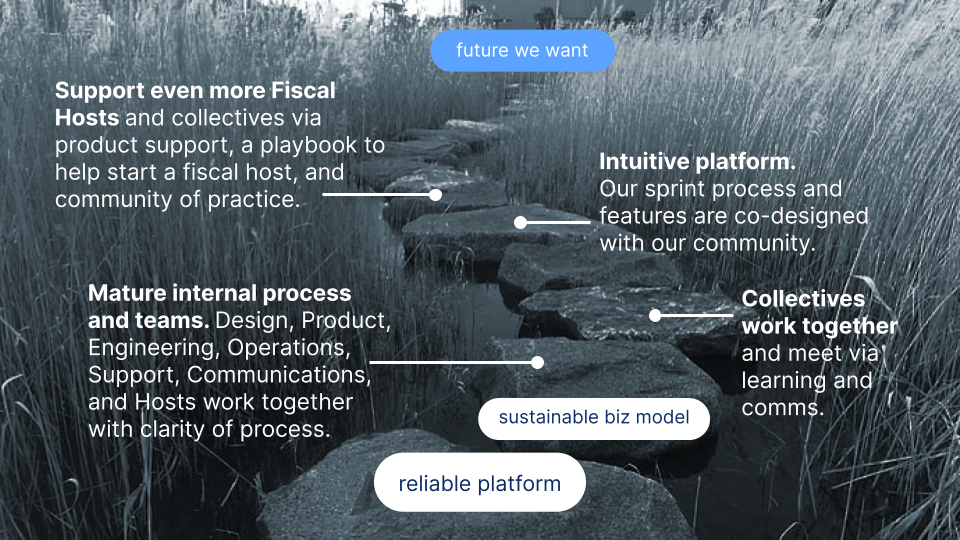
 Open Graph protocol
> The https://ogp.me/" rel="noopener noreferrer">Open Graph protocol enables any web page to become a rich object in a social graph. For instance, this is used on Facebook to allow any web page to have the same functionality as any other object on Facebook.
>
> While many different technologies and schemas exist and could be combined together, there isn't a single technology which provides enough information to richly represent any web page within the social graph. The Open Graph protocol builds on these existing technologies and gives developers one thing to implement. Developer simplicity is a key goal of the Open Graph protocol which has informed many of https://www.scribd.com/doc/30715288/The-Open-Graph-Protocol-Design-Decisions" rel="noopener noreferrer">the technical design decisions. OpenStreetMap
> https://openstreetmap.org/" rel="noopener noreferrer">OpenStreetMap is a free, editable map of the whole world made by people like you. It was started in 2004 in the UK, out of frustration with the lack of availability of good map data that was free to use.
> <https://welcome.openstreetmap.org/what-is-openstreetmap/>Run by the https://welcome.openstreetmap.org/about-osm-community/osm-foundation/" rel="noopener noreferrer">OpenStreetMap Foundation:
> OpenStreetMap is not a closely governed or managed project; grassroots activities are the core of the movement, and individuals participating in OpenStreetMap enjoy great freedom. The OpenStreetMap Foundation is the nonprofit organization that supports OpenStreetMap and provides the necessary organizational backbone. It is made up of a number of different members and groups.- orbitmodel.com
The Orbit Model is a framework for building high gravity communities. A high gravity community is one that excels at attracting and retaining members by providing an outstanding member experience.[^github]
[^github]: This is all from the https://github.com/orbit-love/orbit-model" rel="noopener noreferrer">Github README.
## Explore the modelThe model will help you answer questions like:
- How do I measure my community's engagement and growth?
- How do I attract new people to my community?
- Which members should I prioritize spending time with?
- What contribution should I ask each community member to make?## Who can use the Orbit Model?
Product and developer communities. Form a community of your most enthusiastic users and developers.
Community-driven businesses. Learn who your most influential customers and help increase their reach.
Open source projects. Build relationships that help convert users into contributors.
And anyone else focused on growing their community!
## About the Orbit Model
The Orbit Model was developed by developer advocates for working with communities of software developers, but the principles apply to most things that are community-shaped. The model was first used in 2014 and put on GitHub in November 2019 so anyone can use it and contribute back. We aim to make this framework useful to open source maintainers, developer advocates, community managers, founders, and anyone interested in building a community.
## Orbit Startup
https://orbit.love/" rel="noopener noreferrer">Orbit-the-company was a startup that aggregated analytics from open APIs like Github, Discord, Twitter, LinkedIn, etc., sort of like a community focused CRM. https://orbit.love/blog/orbit-is-joining-postman" rel="noopener noreferrer">Acquired by Postman April 2024.
- orientation.io
- Rails app to create internal docs & tutorials for an organization. Has [[Deploy to Heroku]] support, uses Google Auth for login, can group articles as lists to make Guides.
- We're using a #Discourse forum for this at #Fission, and I'd probably recommend Discourse for this use case now, or maybe [[Outline]]
- From the https://github.com/orientation/orientation" rel="noopener noreferrer">README on Github:
- > Documentation is hard. People forget to write it, and they are asked the same question over and over again. When they finally do write it down, people can't find it or it gets out of date before it can be useful.
>
> The goal of Orientation is to make a single point of entry for any internal question someone may have about the organization:
- The https://github.com/orientation/orientation/blob/master/doc/FEATURES.md" rel="noopener noreferrer">Purpose & Features page has extended info.  Orion Reed
advocating widespread dissatisfaction with computing
Presented at [[Causal Islands LA]]
- Licenses – Open Source Initiative
The [[OSI]] keeps a list of approved licenses.
Fair licenses, non-commercial licenses, ethical licenses, and similar licenses are not approved.
For fair / non-commercial licenses that require businesses that make money to pay for a license, they don’t comply because they “discriminate” against businesses using the code without contributing back — [[Open Source Definition#6. No Discrimination Against Fields of Endeavor]]
I’ve written more at [[Open Source Licensing]]
- Open Source Initiative
Open Source Initiative
## About> As steward of the [[Open Source Definition]], we set the foundation for the open source software ecosystem.
> The Open Source Initiative (OSI) is a California public benefit corporation, with 501(c)3 tax-exempt status, founded in 1998.
My take on [[OSI-approved Open Source]] is that it is harmful in gate keeping some approaches to open source.
 OtoCo — A US Company From Anywhere
Blockchain native company entity creation.
* Marshall Islands Series LLC
* Delaware Series LLC
* Wyoming Series LLC
* Swiss Association
* Unincorporated DAOhttps://github.com/otoco-io/otoco-wiki" rel="noopener noreferrer">OtoCo Wiki on GitHub:
> This documentation describes how we engineered a Delaware LLC that can be formed entirely online within 5 seconds and for free. Further tabs contains the legals, smart contract code and FAQs.
> Companies formation is still largely done by lawyers and accountants. Their rituals go back to a time when companies were set up for a privileged class in society that could afford to surround itself with advisors and experts.
 Our Networks
## 2024
Our Networks is a community event about the past, present, and future of
building network infrastructures. The event hosts keynotes, talks, and
hands-on sessions on topics including: decentralized systems,
peer-to-peer web, community networks, and new network communication and
storage protocols. We have hosted five previous events since 2017.Drawing on practices of local-first, solar-powered servers, folk
software, and permacomputing, Our Networks 2024 explores what
collaboration looks like when a network is optional. Looking at
transitional technologies and forms of computing that break from
always-on connectivity as we spend a day connecting over local networks.
## AboutOur Networks is a conference about the past, present, and future of building our own network infrastructures. The event brings together enthusiasts, hardware and software hackers, researchers, organizers and more to collectively explore creative and critical engagements with the Internet and alternative infrastructures.
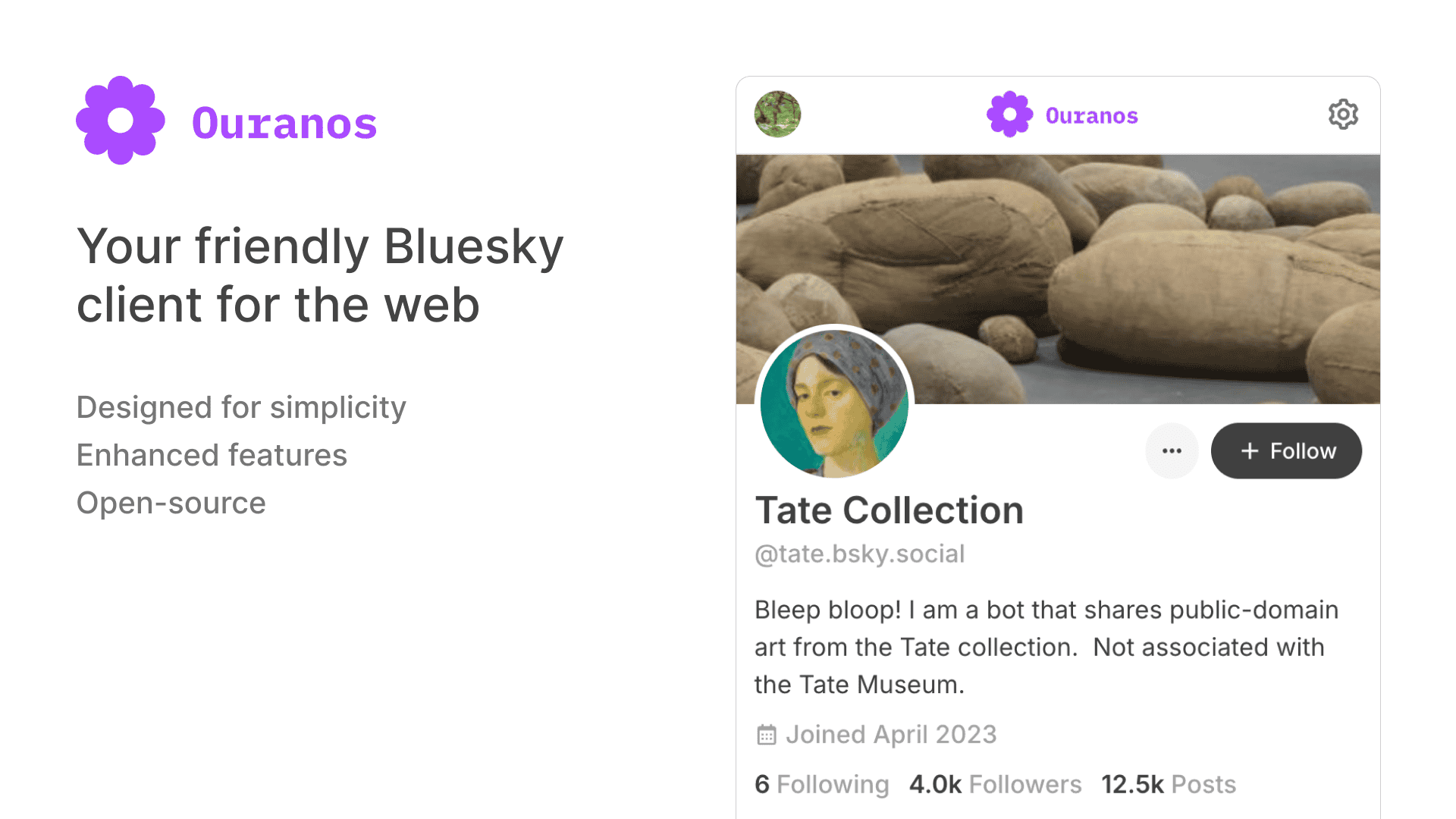 Ouranos
Built by [[Pouria]], Ouranos supports rich text links and out of band tags
 Outline – Team knowledge base & wiki
An open source collaborative knowledge base for modern teams. [[BSL]] licensed.
## Self HostingAvailable on [[Cloudron]]. Community edition limits features, see the https://www.getoutline.com/pricing" rel="noopener noreferrer">pricing page, but doesn't limit users.
## Pricing
The hosted pricing is flat-rate. $10 / month for up to 10 users, $79 for up to 100 users, and $249 for up to 200 users.
 Make your business official today | Ownr
Online business incorporation tool for Canada.
Started at RBC Ventures, and then https://www.newswire.ca/news-releases/ownr-by-rbc-ventures-acquires-leading-legal-tech-platform-founded-865651145.html" rel="noopener noreferrer">acquired Founded in 2020. The Founded service was much better, so it was just rebranded as Ownr.
It's tightly coupled to RBC banking services.
For small businesses or sole proprietor, it can be OK. For startups that plan on taking investment, the documents and structured often have to be re-done by a knowledgeable Canadian startup lawyer.
## Sole Proprietorship
Does a name search and then prompts you to sign up for an RBC account and optional RBC credit card.
## Perks
Discounts and free months of a handful of services. Here are some selected ones that seem useful:
* 3 free months of 1Password Business or Family
* $5000 in AWS Credits
* $350 in GCP credits
* 50% off for 3 months of Xero- Open WebTech Association
From the https://github.com/open-webtech" rel="noopener noreferrer">Github repo README:
In an age where technology significantly influences society, the Open WebTech Association (OWTA) is dedicated to promoting and advancing open web technologies, including but not limited to communication systems, advanced webtops, AI platforms, devops tools, and P2P services. As a community of forward-thinking developers, designers, and technology enthusiasts, we are committed to promoting transparency, inclusivity, and innovation in the development of web apps and solutions.
## Vision
Our vision is a digital landscape that is open and accessible to all, fostering an environment where innovation is cultivated and the free exchange of ideas is celebrated. We envision a world where web technologies empower individuals and communities, rather than constrain them, creating opportunities for growth and development across all sectors of society.
## Mission
The mission of the Open WebTech Association is to:
1. Promote Open Standards: Advocate for the use and development of open standards that ensure web technologies remain accessible, interoperable, and free from monopolistic constraints.
2. Support Innovation: Encourage the development of innovative web technologies that push the boundaries of what is possible on the web.
3. Foster Community: Build a supportive community of developers, designers, and users who share a passion for open web technologies and are committed to mutual growth and learning.
4. Educate and Inform: Provide resources, workshops, and forums that educate the public about the benefits of open web technologies and promote digital literacy. - Internet résidentiel fiable partout au Canada | oxio
Oxio is an independent internet provider (ISP) with good prices, services, and speeds.
Use my referral code https://order.oxio.ca/?referral=RAWKSNJ" rel="noopener noreferrer">RAWKSNJ and you'll get a free month of service, and so will I.
 p2panda
p2panda is a protocol for local-first applications
> The core or p2panda is built in Rust from which we also compile WebAssembly for TypeScript developers but we hope to support even more languages one day. For this we formulated a p2panda _specification_ which is some sort of agreement developers can follow so different p2panda _implementations_ can still understand each other.
> https://p2panda.org/about/" rel="noopener noreferrer">About- Pace Layering: How Complex Systems Learn and Keep Learning
> I propose six significant levels of pace and size in the working structure of a robust and adaptable civilization. From fast to slow the levels are:
>
> - Fashion/art
> - Commerce
> - Infrastructure
> - Governance
> - Culture
> - Nature> The order of a healthy civilization. The fast layers innovate; the slow layers stabilize. The whole combines learning with continuity.
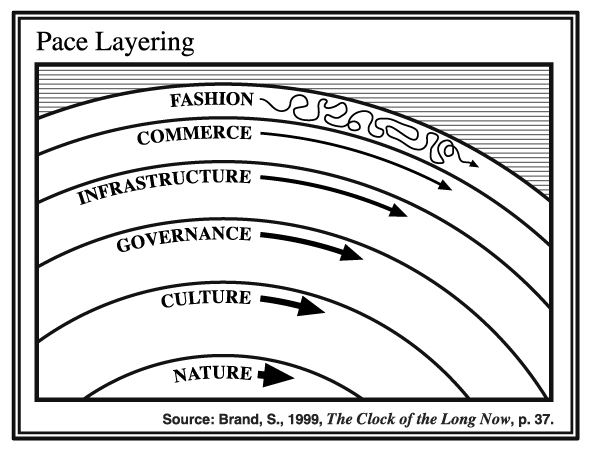
> The idea of pace layering has a history. The text above is a slightly edited version of a chapter in my 1999 book _The Clock of the Long Now: Time and Responsibility._
## Resources
Jolly Contrarian has a great https://jollycontrarian.com/index.php?title=Pace_layering" rel="noopener noreferrer">summary page for pace layering.
- Paketo Buildpacks
- What are Paketo Buildpacks?
- Buildpacks transform your application source code into container images
- The Paketo open source project provides production-ready buildpacks for the most popular languages and frameworks
- Use Paketo Buildpacks to easily build your apps and keep them updated
- Paketo Buildpacks can run on any platform that supports container images, including Docker and Kubernetes!
- Paketo is a community-driven open source project with active project maintainers and contributors that are driving the long term success of Paketo
- The project has vendor-neutral governance through the [[Cloud Foundry Foundation]] 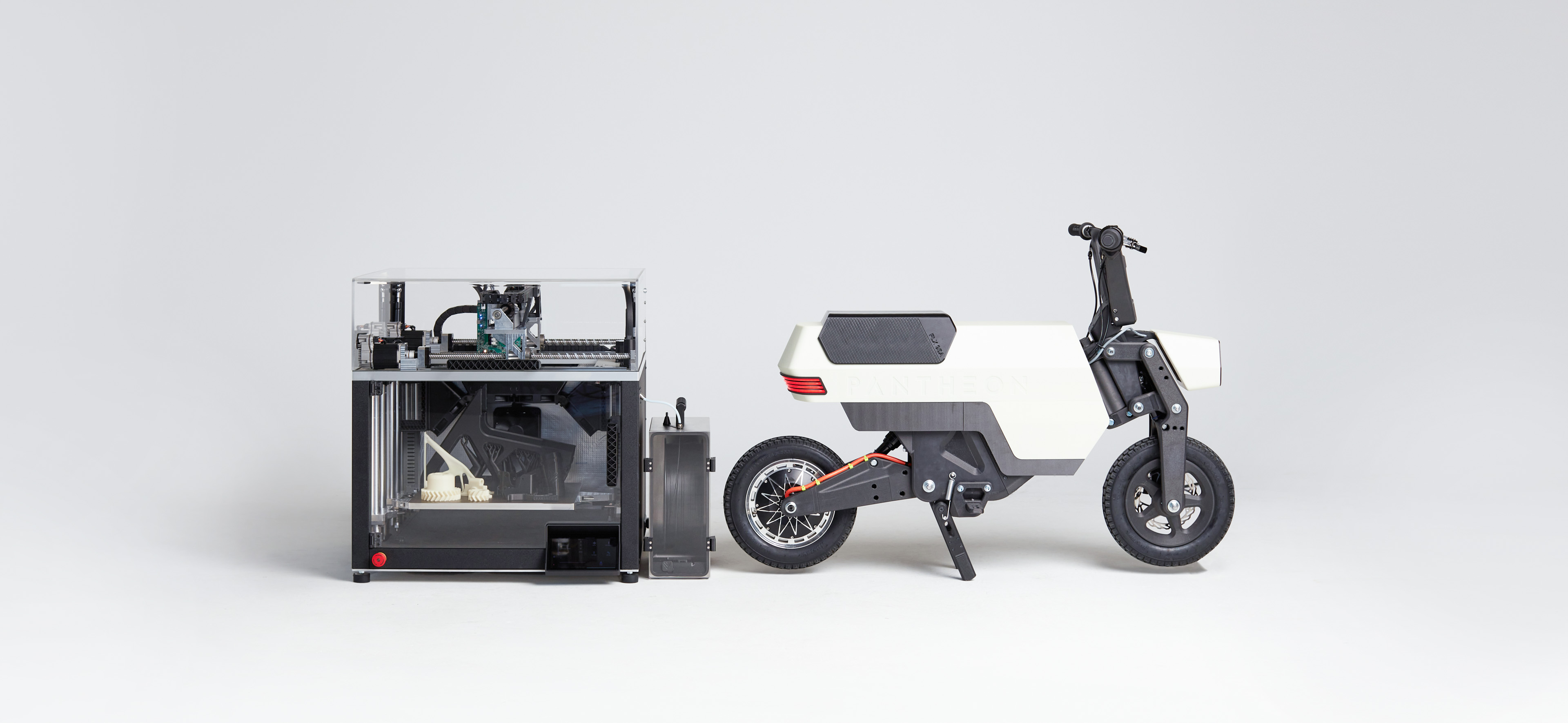 Pantheon Design - High Speed 3D printers
- [[Campbell Macdonald]] from [[PROXXI]] is sharing space with them on Williams Street in East Van
- parabl
Parabl is building portable energy & mesh networking hardware targeted at "leapfrog regions".
Founded by JJ aka [[techboiafrica]] and [[Keeks]]
 The Parity Public License
- the free for open software license
- https://paritylicense.com/versions/7.0.0" rel="noopener noreferrer">Version 7.0.0 License Text
- ## Purpose
- ==This license allows you to use and share this software for free, but you have to share software that builds on it alike.==
- ## Agreement
- In order to receive this license, you have to agree to its rules. Those rules are both obligations under that agreement and conditions to your license. Don’t do anything with this software that triggers a rule you can’t or won’t follow.
- ## Notices
- Make sure everyone who gets a copy of any part of this software from you, with or without changes, also gets the text of this license and the contributor and source code lines above.
- ## Copyleft
- https://paritylicense.com/versions/7.0.0#contribute" rel="noopener noreferrer">Contribute software you develop, operate, or analyze with this software, including changes or additions to this software. When in doubt, https://paritylicense.com/versions/7.0.0#contribute" rel="noopener noreferrer">contribute.
- ## Prototypes
- You don’t have to https://paritylicense.com/versions/7.0.0#contribute" rel="noopener noreferrer">contribute any change, addition, or other software that meets all these criteria:
- 1) You don’t use it for more than thirty days.
- 2) You don’t share it outside the team developing it, other than for non-production user testing.
- 3) You don’t develop, operate, or analyze other software with it for anyone outside the team developing it.
- ## Reverse Engineering
- You may use this software to operate and analyze software you can’t https://paritylicense.com/versions/7.0.0#contribute" rel="noopener noreferrer">contribute in order to develop alternatives you can and do https://paritylicense.com/versions/7.0.0#contribute" rel="noopener noreferrer">contribute.
- ## Contribute
- To https://paritylicense.com/versions/7.0.0#contribute" rel="noopener noreferrer">contribute software:
- 1) Publish all source code for the software in the preferred form for making changes through a freely accessible distribution system widely used for similar source code so the contributor and others can find and copy it.
- 2) Make sure every part of the source code is available under this license or another license that allows everything this license does, such as https://blueoakcouncil.org/license/1.0.0" rel="noopener noreferrer">the Blue Oak Model License 1.0.0, https://www.apache.org/licenses/LICENSE-2.0.html" rel="noopener noreferrer">the Apache License 2.0, https://spdx.org/licenses/MIT.html" rel="noopener noreferrer">the MIT license, or https://spdx.org/licenses/BSD-2-Clause.html" rel="noopener noreferrer">the two-clause BSD license.
- 3) Take these steps within thirty days.
- 4) Note that this license does not allow you to change the license terms for this software. You must follow https://paritylicense.com/versions/7.0.0#notices" rel="noopener noreferrer">Notices.
- ## Excuse
- You’re excused for unknowingly breaking https://paritylicense.com/versions/7.0.0#copyleft" rel="noopener noreferrer">Copyleft if you https://paritylicense.com/versions/7.0.0#contribute" rel="noopener noreferrer">contribute as required, or stop doing anything requiring this license, within thirty days of learning you broke the rule. You’re excused for unknowingly breaking https://paritylicense.com/versions/7.0.0#notices" rel="noopener noreferrer">Notices if you take all practical steps to comply within thirty days of learning you broke the rule.
- ## Defense
- Don’t make any legal claim against anyone accusing this software, with or without changes, alone or with other technology, of infringing any patent.
- ## Copyright
- The contributor licenses you to do everything with this software that would otherwise infringe their copyright in it.
- ## Patent
- The contributor licenses you to do everything with this software that would otherwise infringe any patents they can license or become able to license.
- ## Reliability
- The contributor can’t revoke this license.
- ## No Liability
- As far as the law allows, this software comes as is, without any warranty or condition, and the contributor won’t be liable to anyone for any damages related to this software or this license, under any kind of legal claim. Passkeys.directory
A community-driven index of websites, apps, and services that offer signing in with passkeys.
- Patchwork Notebook
Patchwork is a research project about version control software for writers, developers, and other creatives, made by [[Ink & Switch]]
- www.pathofexile.com
Free-to-play action RPG.
## Path of Exile 2
https://pathofexile2.com/early-access" rel="noopener noreferrer">Early access as of Dec 6th if you are a paid supporter.
- GitHub - frontpagefyi/pds-fly
[[Bluesky PDS]] running on [[Fly.io]] by [[Tom Sherman]]
- www.peerspace.com
A marketplace for "rentable places" in cities.
## Comments
I used this to book space for IPFS Mainnet in Denver at [[EthDenver]]
Experimenting with adding [[Z-Space]]
- pengx17.vercel.app
- Blog post from [[Feb 16th, 2022]] summarizing creation https://pengx17.vercel.app/posts/logseq-publish" rel="noopener noreferrer">LogSeq Publish Github Action #logseq-publish
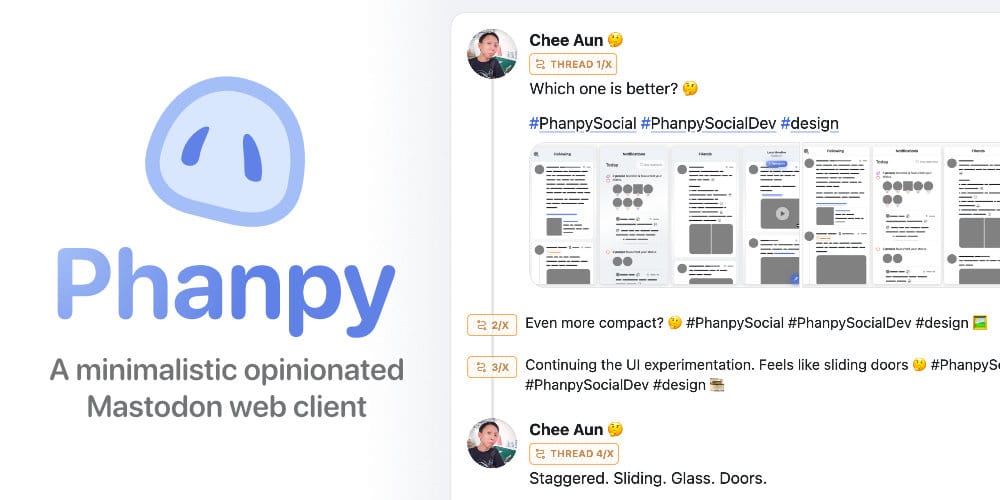 Phanpy
Minimalistic opinionated [[Mastodon]] web client.
This is completely static front end web code, so can be deployed anywhere. There is a not regularly updated deploy for [[CoSocial]] at https://phanpy.cosocial.ca" rel="noopener noreferrer">phanpy.cosocial.ca.
 Phoenix for Bluesky
In development client for [[Bluesky]] by the [[Tapbots]]
- Photopea | Online Photo Editor
Free online photo editor.
Everything runs locally / offline first, can be installed as a [[PWA]].
Reads/writes Photoshop PSD, RAW, and many other image formats.
No accounts or login required.
You can pay for an annual account, 50EU per year for an individual account, which removes adds.
- Piku
- The tiniest Heroku/CloudFoundry-like PaaS you've ever seen. **Seldom updated because it is stable** and used in production daily by several people.
-piku, inspired by https://github.com/dokku/dokku" rel="noopener noreferrer">dokku, allows you dogit pushdeployments to your own servers.
- Core Values
- Runs on low end devices.
- Accessible to hobbyists and K-12 schools.
- ~1000 lines readable code.
- Functional code style.
- Few (single?) dependencies
- [[12 Factor App]]
- Simplify user experience.
- Cover 80% of common use cases.
- Sensible defaults.
- Leverage distro packages in Raspbian/Debian/Ubuntu (Alpine and RHEL support is WIP)
- Leverage standard tooling (git,ssh,uwsgi,nginx).
- Preserve backwards compatibility where possible - Pingly
Email hosting for your own domain that starts at $0. Upgrade to $5/month for full features, including chat.
Looks like a great choice for small business. Wish it was open source.
 Pioneers, Settlers and Town Planners
The concept of Pioneers, Settlers, and Town Planners is something that I share with many people in thinking about their organizations. I find it a really useful way to think about the role of people within an organization, and what a person is best suited for. I am a Pioneer-to-Settler kind of guy.
I learned it from [[Simon Wardley]] in his article [On Pioneers, Settlers, Town Planners and Theft.](), and have been sharing it ever since.
The newest article by Wardley on this is from 2012, with all the mapping and diagrams laid out https://blog.gardeviance.org/2012/06/pioneers-settlers-and-town-planners.html" rel="noopener noreferrer">Pioneers, Settlers, and Town Planners.
Simon has written about the concept much earlier than the linked 2015 post (circa 2005 - 2006), including https://blog.gardeviance.org/2014/11/bimodal-it-is-long-hand-for-snafu.html" rel="noopener noreferrer">this article where he sources it back to Robert X. Cringely’s book, where it is called _Commandos, Infantry, and Police_.
Jeff Atwood[^codinghorror]wrote about that phrase and sourcing https://blog.codinghorror.com/commandos-infantry-and-police/" rel="noopener noreferrer">way back in 2004:
> As I was driving home, I found myself thinking about a favorite section of the book Accidental Empires, by longtime computer journalist Robert X. Cringely. Originally published in 1993, it’s getting a little long in the tooth, but it still contains a lot of great insights about the personalities that drove innovation in silicon valley – from a guy who personally knew many of the players.
>
I> In the chapter “On The Beach”, Cringely talks about the three distinct groups of people that define the lifetime of a company: Commandos, Infantry, and Police[^codinghorror]: His blog / handle is Coding Horror, and he's the founder of Stack Overflow and Discourse
#todo Look
## Definitions
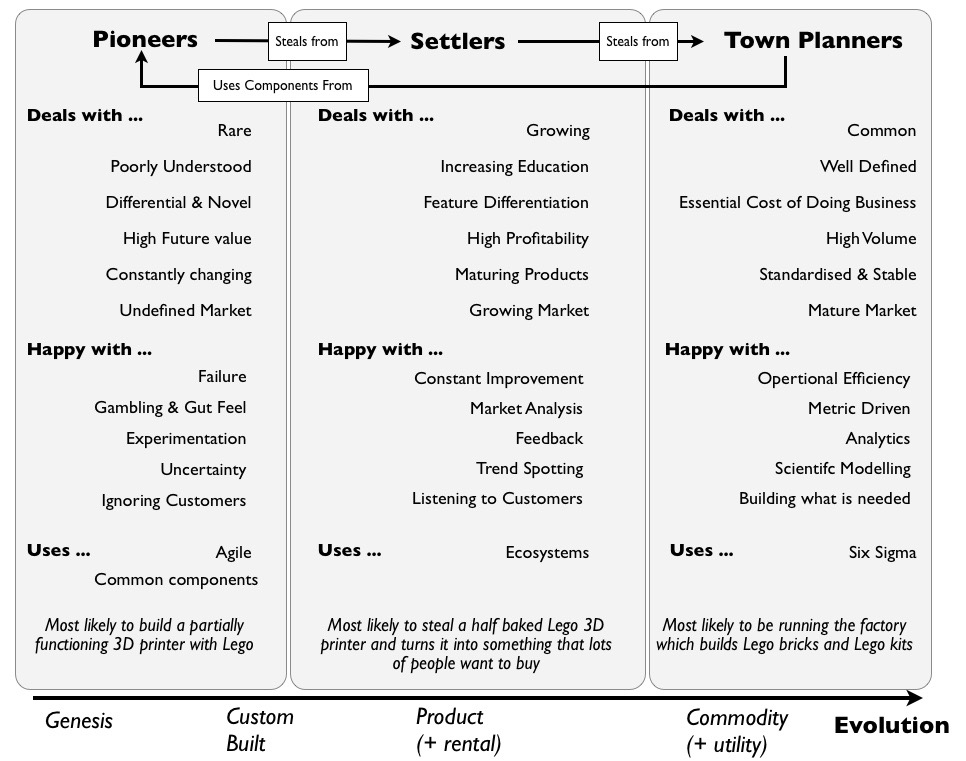
The original article talks about "theft" and the hand off between different groups / archetypes / stages of a product and organization.
### PioneersPioneers are brilliant people. They are able to explore never before discovered concepts, the uncharted land. They show you wonder but they fail a lot. Half the time the thing doesn't work properly. You wouldn't trust what they build. They create 'crazy' ideas. Their type of innovation is what we call core research. They make future success possible. Most of the time we look at them and go "what?", "I don't understand?" and "is that magic?". In the past, we often burnt them at the stake. They built the first ever electric source (the Parthian Battery, 400AD) and the first ever digital computer (Z3, 1943).
### Settlers
Settlers are brilliant people. They can turn the half baked thing into something useful for a larger audience. They build trust. They build understanding. They learn and refine the concept. They make the possible future actually happen. They turn the prototype into a product, make it manufacturable, listen to customers and turn it profitable. Their innovation is what we tend to think of as applied research and differentiation. They built the first ever computer products (e.g. IBM 650 and onwards), the first generators (Hippolyte Pixii, Siemens Generators).
### Town Planners
Town Planners are brilliant people. They are able to take something and industrialise it taking advantage of economies of scale. They build the platforms of the future and this requires immense skill. You trust what they build. They find ways to make things faster, better, smaller, more efficient, more economic and good enough. They build the services that pioneers build upon. Their type of innovation is industrial research. They take something that exists and turn it into a commodity or a utility (e.g. with Electricity, then Edison, Tesla and Westinghouse). They are the industrial giants we depend upon.
Via https://www.wardleypedia.org/mediawiki/index.php/Pioneers_settlers_town_planners" rel="noopener noreferrer">Wardleypedia, sourced from Wardley's https://blog.gardeviance.org/2015/04/the-only-structure-youll-ever-need.html" rel="noopener noreferrer">The only structure you'll ever need ... until the next one.

- Platform Economies
Small businesses growing digital first on platforms, and those brands creating their own traffic and following. By [[Ali Hamed]] https://medium.com/@alibhamed/platform-economies-65d6714ca768
> We’ve noticed a handful of themes that are starting to crystalize for our investment team:
> (1) The world of small businesses is moving off of main street, and into platform-based economies
> (2) Value capture is moving away from the platforms themselves, and to the commercial actors of those platforms
> (3) Platform economies are not created equal, and offer varying levels of “investability”
> (4) It might be better to invest at the atomic level, rather than in the shares of these tech stocks
> (5) The commercial actors on platforms are getting better
> (6) Certain platforms have magical superpowers---
> Rather than own FB shares, we’d rather own Instagram accounts. Rather than owning Amazon stock, we’d rather own a bunch of third-party selling merchants. And rather than owning Google stock, we’d rather own YouTube libraries.
 Playing with ActivityPub
- Looked at [[Darius Kazemi]]’s #NodeJS AP implementation as a reference
- > So, the whole time I was doing this I was looking at https://github.com/dariusk/express-activitypub" rel="noopener noreferrer">express-activitypub, one of Darius’s projects. It’s great - simple, but it works. Most of my work here was making it even simpler - removing some of the configurability and hardcoding things like accounts - and porting code that was dependent on Node.js to code that could run in Netlify’s edge functions, which are a whitelabeled layer on top of https://deno.land/" rel="noopener noreferrer">Deno and thus use standard web APIs instead.
-
 Plume
Plume- Plume is a federated blogging engine, based on ActivityPub. It is written in Rust, with the Rocket framework, and Diesel to interact with the database. The front-end uses Ructe templates, WASM and SCSS.
-
- PocketBase - Open Source backend in 1 file
- Open Source backend in 1 file
- Realtime database
- Authentication
- File storage
- Admin dashboard
- Recommends [[Fly.io]] for hosting https://github.com/pocketbase/pocketbase/discussions/537
-- Polis
> a real-time system for gathering, analyzing and understanding what large groups of people think in their own words, enabled by advanced statistics and machine learning.
See the https://compdemocracy.org/FAQ/" rel="noopener noreferrer">FAQ at The Computational Democracy Project
 Transforming Online Communication | polyproto
A refreshingly simple decentralised, federated protocol
> Discord API compatibility and builds a “boring” identity federation protocol with multi-homing and user-owned identity and data in its design.
Aimed as a [[Discord]] and [[Matrix]] replacement.
- Introduction
Polytoken is a local-first AI coding agent daemon. It manages conversations with AI providers, runs tools on your behalf, and integrates into your development workflow through a CLI and TUI.
Created by https://bsky.app/profile/did:plc:klhtmrnregub7we7h6jwiljm" rel="noopener noreferrer">@ed3d.net
 Positive Sum Worlds: Remaking Public Goods
- Thanks to their open source and permissionless nature, crypto protocols have rekindled a popular conversation about public goods. Indeed, the transparency and accessibility of blockchains has already re-imagined models of free exchange and association. Nevertheless, while crypto protocols operate as open networks, do they truly enact a public if solely comprised of private capital? Questions of scope, access, and ownership complicate our understanding of what is public on the internet. Public goods also rely on shared moral conditions, as any "good" is necessarily defined in relation to the value system of a given community. With these considerations, we advocate for an enhanced definition of "public goods," in service of others and towards civilizational longevity.
- Quotes
- In economics, a "public good" refers to anything that is both non-excludable and non-rivalrous, that is, people can't be barred access, and one person's use doesn't degrade another's. Clean air is an example of a naturally occurring public good, while the electric grid is a public good created by people. What are the public goods of today's industrial-knowledge society? Open source code, which supports millions of companies and independent developers, is often thought of this way. The cypherpunks considered privacy itself as a kind of public good. It seems only natural that online media archives and open digital infrastructure should qualify as well.
-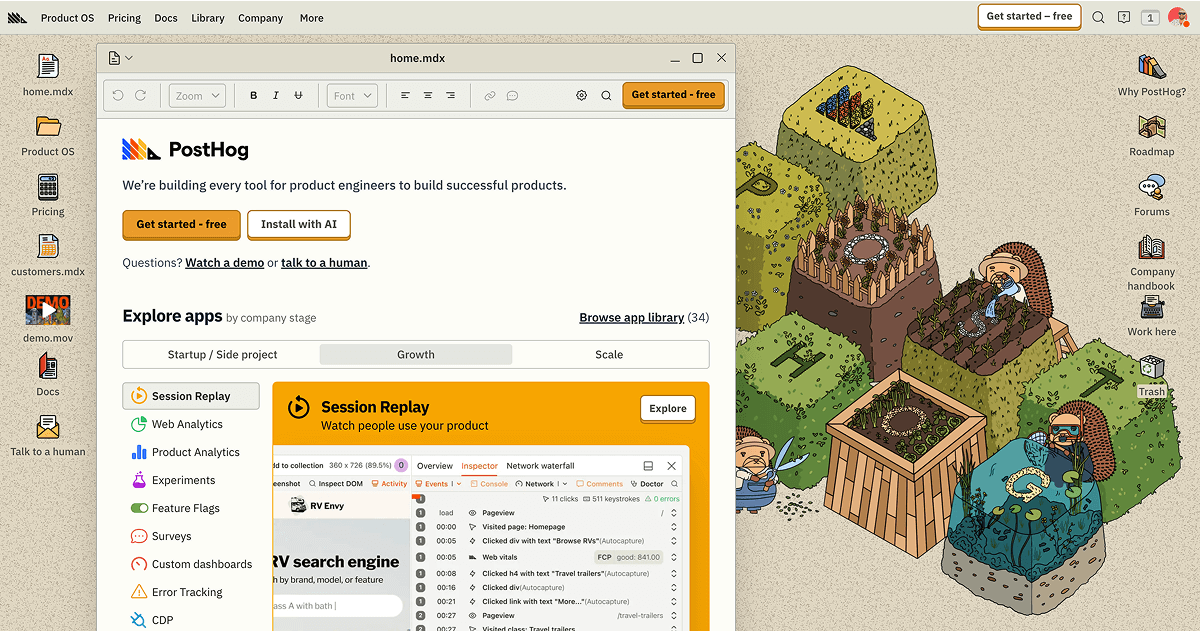 PostHog – We make your product self-driving
PostHog automatically diagnoses problems, fixes bugs, and generates pull requests – all without you having to prompt it.
 ProtoHack Dubai Keynote
- Presented [[May 2017]] in [[Dubai]] at [[ProtoHack Dubai]]
 QuestU 203: What Investors Want?
- Presented [[Jan 2016]] at Quest University to [[Gal Smolar]]'s class.
- Private Cloud Compute: A new frontier for AI privacy in the cloud
Written by Apple Security Engineering and Architecture (SEAR), User Privacy, Core Operating Systems (Core OS), Services Engineering (ASE), and Machine Learning and AI (AIML)
[[Apple Intelligence]] is the personal intelligence system that brings powerful generative models to iPhone, iPad, and Mac. For advanced features that need to reason over complex data with https://machinelearning.apple.com/research/introducing-apple-foundation-models" rel="noopener noreferrer">larger foundation models, we created [[Private Cloud Compute]] (PCC), a groundbreaking cloud intelligence system designed specifically for private AI processing. For the first time ever, Private Cloud Compute extends the industry-leading security and privacy of Apple devices into the cloud, making sure that personal user data sent to PCC isn’t accessible to anyone other than the user — not even to Apple. Built with custom Apple silicon and a hardened operating system designed for privacy, we believe PCC is the most advanced security architecture ever deployed for cloud AI compute at scale.
- Obsidian’s CEO on why productivity tools need community more than AI
[[Decoder Podcast]] with [[Casey Newton]] interviewing [[Obsidian]] CEO [[Steph Ango]]. Steph posted a https://bsky.app/profile/stephango.com/post/3lwpawbtysk2q" rel="noopener noreferrer">screenshot of this portion of the article on bsky, I've kept his highlighting below:
What is the Obsidian view on AI and productivity tools? Will you add features like that?
> Our philosophy as far as how it would ever make sense for Obsidian is that it has to fit with the principles that are in our manifesto, which is that it would have to be private. <mark>We’re not comfortable with the idea that our users’ data could be stored in OpenAI servers without their consent.</mark> I think a lot of tools out there are just kind of defaulting to this feeling that there’s an arms race. We’ve got to put AI into everything. Let’s put a little magic button everywhere. I don’t think that’s us. <mark>We want to give users confidence that their thoughts are theirs, that things are not going to be used to train the next LLM.</mark>
>
> That said, I do think AI can be really powerful for certain uses. So the question is, in the long term, do we end up giving an API to the plugin community so that they can build those types of functionalities more easily? Right now, we’re not working on it. We’ve been holding off and watching what’s going on. We don’t feel a sense of urgency to suddenly put all these things in there because, to be honest, the plugin ecosystem is there for you and you can do it if you really want that. There are things much more important to us on the priority list that we want to work on first, that we would rather set our time aside for with our limited capacity. - ProseMirror
Toolkit for building rich-text editors on the web. Developed by [[The Guardian]] and others.
> An ideal content editor produces structured, semantically meaningful documents, but does so in a way that is easy for users to understand. ProseMirror tries to bridge the gap between Markdown text editing and classical WYSIWYG editors.
Very interesting phrase right on the home page about the [[Open Source]] nature ([[MIT License]]) of the code:
> If you are using ProseMirror to make profit, there is a social expectation that you help fund its maintenance. https://marijnhaverbeke.nl/fund/" rel="noopener noreferrer">Start here
ProseMirror is maintained by [[Marijn Haverbeke]], whose page the _Start here_ links to.
The Guardian article on https://www.theguardian.com/info/2019/jan/24/leaving-scribe" rel="noopener noreferrer">moving from their previous editor Scribe to ProseMirror is also a good read.
 Prosperity Public License
- the all-in-one noncommercial software license
- https://prosperitylicense.com/versions/3.0.0" rel="noopener noreferrer">Version 3.0.0 License Text
- ## Purpose
- ==This license allows you to use and share this software for noncommercial purposes for free and to try this software for commercial purposes for thirty days.==
- ## Agreement
- In order to receive this license, you have to agree to its rules. Those rules are both obligations under that agreement and conditions to your license. Don’t do anything with this software that triggers a rule you can’t or won’t follow.
- ## Notices
- Make sure everyone who gets a copy of any part of this software from you, with or without changes, also gets the text of this license and the contributor and source code lines above.
- ## Commercial Trial
- Limit your use of this software for commercial purposes to a thirty-day trial period. If you use this software for work, your company gets one trial period for all personnel, not one trial per person.
- ## Contributions Back
- Developing feedback, changes, or additions that you contribute back to the contributor on the terms of a standardized public software license such as https://blueoakcouncil.org/license/1.0.0" rel="noopener noreferrer">the Blue Oak Model License 1.0.0, https://www.apache.org/licenses/LICENSE-2.0.html" rel="noopener noreferrer">the Apache License 2.0, https://spdx.org/licenses/MIT.html" rel="noopener noreferrer">the MIT license, or https://spdx.org/licenses/BSD-2-Clause.html" rel="noopener noreferrer">the two-clause BSD license doesn’t count as use for a commercial purpose.
- ## Personal Uses
- Personal use for research, experiment, and testing for the benefit of public knowledge, personal study, private entertainment, hobby projects, amateur pursuits, or religious observance, without any anticipated commercial application, doesn’t count as use for a commercial purpose.
- ## Noncommercial Organizations
- Use by any charitable organization, educational institution, public research organization, public safety or health organization, environmental protection organization, or government institution doesn’t count as use for a commercial purpose regardless of the source of funding or obligations resulting from the funding.
- ## Defense
- Don’t make any legal claim against anyone accusing this software, with or without changes, alone or with other technology, of infringing any patent.
- ## Copyright
- The contributor licenses you to do everything with this software that would otherwise infringe their copyright in it.
- ## Patent
- The contributor licenses you to do everything with this software that would otherwise infringe any patents they can license or become able to license.
- ## Reliability
- The contributor can’t revoke this license.
- ## Excuse
- You’re excused for unknowingly breaking https://prosperitylicense.com/versions/3.0.0#notices" rel="noopener noreferrer">Notices if you take all practical steps to comply within thirty days of learning you broke the rule.
- ## No Liability
- As far as the law allows, this software comes as is, without any warranty or condition, and the contributor won’t be liable to anyone for any damages related to this software or this license, under any kind of legal claim. PL Portal
- The extended network of companies in the #IPFS and #Filecoin ecosystems
- See also [[blue vs green teams]]
- {{video https://www.youtube.com/watch?v=RXt65xbyq6c&feature}}
- Protocol Labs
- Protocol Labs is an open-source research, development, and deployment laboratory. Our projects include #IPFS, #Filecoin, #libp2p, and many more. We aim to make human existence orders of magnitude better through technology.
- We are a fully distributed company. Our team of more than 100 members works remotely and in the open to improve the internet — humanity’s most important technology — as we explore new advances in computing and related fields.- Protocols, Not Platforms: A Technological Approach to Free Speech
The author is [[Mike Masnick]], who is now on the board of [[Bluesky]], which very much is taking a protocols over platforms approach.
https://s3.amazonaws.com/kfai-documents/documents/e3288c9457/MasnickPublish.pdf" rel="noopener noreferrer">PDF
<iframe src="https://s3.amazonaws.com/kfai-documents/documents/e3288c9457/MasnickPublish.pdf">
</iframe>---
> This article proposes an entirely different approach—one that might seem counterintuitive but might actually provide for a workable plan that enables more free speech, while minimizing the impact of trolling, hateful speech, and large-scale disinformation efforts. As a bonus, it also might help the users of these platforms regain control of their privacy. And to top it all off, it could even provide an entirely new revenue stream for these platforms. That approach: <mark>build protocols, not platforms.</mark>
>
> To be clear, <mark>this is an approach that would bring us back to the way the internet used to be. The early internet involved many different protocols—instructions and standards that anyone could then use to build a compatible interface.</mark> Email used SMTP (Simple Mail Transfer Protocol). Chat was done over IRC (Internet Relay Chat). Usenet served as a distributed discussion system using NNTP (Network News Transfer Protocol). The World Wide Web itself was its own protocol: HyperText Transfer Protocol, or HTTP.
>
> <mark>In the past few decades, however, rather than building new protocols, the internet has grown up around controlled platforms that are privately owned. These can function in ways that appear similar to the earlier protocols, but they are controlled by a single entity.</mark> This has happened for a variety of reasons. Obviously, a single entity controlling a platform can then profit off of it. In addition, having a single entity can often mean that new features, upgrades, bug fixes, and the like can be rolled out much more quickly, in ways that would increase the user base---
### Free Speech FuturesThis essay is part of the Knight First Amendment Institute’s essay series, Free Speech Futures. Authors were asked to envision new approaches to First Amendment doctrine and to online content moderation. The eight essays in the series consider the future of free speech along two dimensions. The first set proposes new interpretations and applications of the First Amendment by courts to meet 21st century pressures and challenges. The second offers new strategies and technologies to improve the quality and health of the online speech environment. The Free Speech Futures essay series was conceptualized and edited by Jamal Greene, Dwight Professor of Law at Columbia Law School, during his tenure as the Knight Institute’s Senior Visiting Research Scholar. The Knight Institute’s Research Director Katy Glenn Bass and other Institute staff provided additional editing and review. The full series is available at <https://knightcolumbia.org/research/>
### About the Author
mike masnick is the founder and CEO of Floor64 and editor of the Techdirt blog. He is also the founder and CEO of the Silicon Valley-based Copia Institute, a think tank exploring innovative approaches to tech policy.### About the Knight First Amendment Institute
The Knight First Amendment Institute at Columbia University defends the freedoms of speech and the press in the digital age through strategic litigation, research, and public education. Its aim is to promote a system of free expression that is open and inclusive, that broadens and elevates public discourse, and that fosters creativity, accountability, and effective  Proxmox Server Solutions
Proxmox makes a number of products, including https://www.proxmox.com/en/products/proxmox-virtual-environment/overview" rel="noopener noreferrer">Proxmox Virtual Environment, aka Proxmox VE:
> Proxmox Virtual Environment is a complete, open-source server management platform for enterprise virtualization. It tightly integrates the KVM hypervisor and Linux Containers (LXC), software-defined storage and networking functionality, on a single platform. With the integrated web-based user interface you can manage VMs and containers, high availability for clusters, or the integrated disaster recovery tools with ease.
## Resources
* https://pve.proxmox.com/pve-docs/" rel="noopener noreferrer">Docs for Proxmox VE
* Boris' https://semble.so/profile/bmann.ca/collections/3mmno3g3qb32y" rel="noopener noreferrer">Proxmox Semble Collection Proxxi Voltage for Industrial Electrical Safety
- A wearable band that detects electricity
- Built and spun out of #HUMAN
- POSSE
POSSE- The reverse is #PESOS
- PESOS
PESOS- The companion to #POSSE
- Quotebacks - Quote the web
> Quotebacks makes it easy to reference content and create dialogue with other sites by turning snippets of text into elegant, self-contained blockquote components.
> Our overal design goals are to help _maintain context_ when composing new texts with quotes, to enable _generous quotations_, and to facilitate quoting _all texts and voices_.
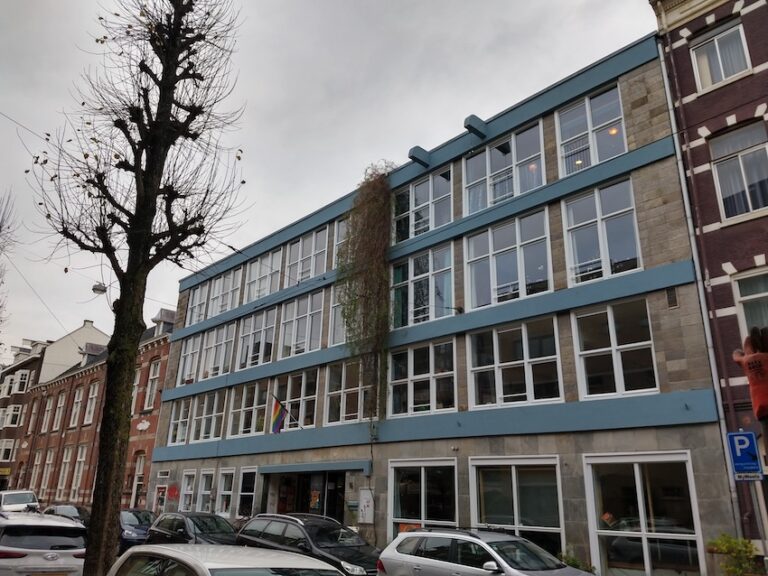 Plantage Dok
"Welcome to Plantage Dok, a meetingplace, art community, people's kitchen and venue in the Plantage neighbourhood of Amsterdam city centre."
"First of all, the Dokzaal, together with the Dokhuis Galerie, is the collective space of the Dokkers: a joint space for meeting and exchanging. All kinds of events are organized by the dokkers, for each other and for people from outside with an explicit open door policy, everyone is welcome!"
 rabbit r1 – your AI-native pocket companion
Tagline: the future of human-machine interface
## r1"Your pocket companion"
!Rabbit.Tech r1 pocket companion
Launched at CES.
* $199USD
* push-to-talk button
* far-field microphone
* 360 degree rotational eye (aka camera)
* analog scroll wheel
* usb-c
* sim card slot
## Rabbit OSLarge Action Model aka LAM
> The Large Action Model is the cornerstone of rabbit OS. LAM is a new type of foundation model that understands human intentions on computers. With LAM, rabbit OS understands what you say and gets things done.
> https://www.rabbit.tech/rabbit-os## Video
### Keynote
<iframe src="https://player.vimeo.com/video/901031775?badge=0&autopause=0&player_id=0&app_id=58479" frameborder="0" allow="autoplay; fullscreen; picture-in-picture" style="width:100%;height:100%;" title="rabbit teaser"></iframe>
https://player.vimeo.com/video/901031775" rel="noopener noreferrer">Vimeo source
### Unbox Therapy Video
<iframe width="560" height="315" src="https://www.youtube-nocookie.com/embed/dWPKIEiPEtQ?si=LIoGy2x4enJ8t35c" title="YouTube video player" frameborder="0" allow="accelerometer; autoplay; clipboard-write; encrypted-media; gyroscope; picture-in-picture; web-share" allowfullscreen></iframe>
 Rachael Ashe, Paper Artist
My life partner, an amazing artist.
 Raft
RaftRaft Foundation is a new US-based 501(c)(3) fiscal sponsor that brings communities together to support neighbors in need through:
* collective care (mutual aid; basic needs; food justice; migrant and unhoused support; community education; public health; labor and housing rights)
* community technology (decentralized tech; open, copyfair, and alternative licensing; security, privacy, anti-surveillance, and encryption; alternative legal and financing structures)
* movement infrastructure (regranting; funder organizing; participatory governance; bail funds; popular education; international fiscal hosts; cooperative development; network weaving; conflict transformation)
* societal transformation (activist support; community building; peacebuilding/peacemaking; sortition and new democratic systems; transformative justice; facilitation and sense-making; systems thinking; values work; money stories; alternative economies; structural change) Railway | The all-in-one intelligent cloud provider
PaaS-style hosting provider
> Railway is the cloud for building, shipping, and monitoring applications. No Platform Engineer required.
Supports [[Nixpacks]] and Docker files.
## Pricing
Free-to-start hobby tier. You get a $5 credit every month, but must have a credit card attached. You can manually add people to projects. 8 GB RAM / 8 vCPU per Service max. PR deploys and Monorepo support.
Pro tier which supports teams is $20 / month / person, plus resource usage. 32 GB RAM / 32 vCPU per Service.
## Railway Metal
Railway had terrible issues with Google Cloud, and have migrated a bulk of systems to https://docs.railway.com/railway-metal" rel="noopener noreferrer">Railway Metal, their own managed hardware.
As part of Railway Metal, the $20 / month minimum spend means there are no team fees.
You can also https://aws.amazon.com/marketplace/pp/prodview-cnib4vbrfgs5a" rel="noopener noreferrer">buy Railway on AWS Marketplace -- which looks like $10KUSD / year -- where you can use it to run / deploy to public clouds.
- razberry ~ website
Founder of [[Basic]]

 re:Mix
- This is one of the first products I’ve seen that explicitly suggests that it should be produced locally rather than shipped
- From the home page:
> re:Mix is a largely regional product, designed to be replicated around the globe. We’re sharing the design and processes for making re:Mix open-source, enabling others to build their own versions - as well as other devices - in their own communities.- RecipeRadar - search recipes by ingredients
— RecipeRadar is a free recipe search engine and meal planner that respects your time, privacy, and ability to contribute feedback and improvements.
- Open source under [[AGPL License]]. Registered as a Community Interest Company in the UK.
- One of my life goals is to commit to a project like this and build out open recipes. - Introduction - redo: a recursive build system
- From the intro to the docs:
- >redois a competitor to the long-lived, but sadly imperfect,makeprogram. Unlike other such competitors, redo captures the essential simplicity and flexibility of make, while avoiding its flaws. It manages to do this while being simultaneously simpler than make, more flexible than make, and more powerful than make, and without sacrificing performance - a rare combination of features.
-  Forestry.io to TinaCMS Migration Guide
By Colin Garvey at [[Forestry]]
 Reflection — Modal Collective
Local-first native GTK app to take notes collaboratively, built on [[p2panda]]. Part of our broader initiative to make it easy for any app developer to integrate local-first sync.
Being built as part of [[Modal Collective]]
- ReMailable
Email PDF documents to your [[reMarkable]] tablet. Available as a freely usable service at <https://remailable.getneutrality.org>
Open source under the [[Apache2 License]] written in [[Python]]. Uses an AWS backend, Amazon SES for email, DynamoDB, and Amazon S3 buckets for email storage.
- reMarkable
The reMarkable is a "paper tablet" with a monochrome e-ink screen with touch support, and a non-powered stylus.
## Resources
* reMarkable Awesome list - huge list of apps, tools, templates, and more <https://github.com/reHackable/awesome-reMarkable>
* RemarkableTablet on Reddit <https://www.reddit.com/r/RemarkableTablet/>
* ReMarkable Wiki <https://remarkablewiki.com/>
* rmkit, a site about remarkable app dev https://rmkit.dev/---
I bought one in [[February 2021]].
<blockquote class="quoteback" data-title="" data-author="Boris Mann" data-avatar="https://micro.blog/boris/avatar.jpg" cite="https://blog.bmannconsulting.com/2021/02/13/sitting-at-the.html"><p>Sitting at the breakfast table writing what will become a blog post on drop in audio.</p>
<p>Yes, it’s a new <a href="https://remarkable.com/">reMarkable “paper” tablet</a>. I’m using it in the hopes of better deep reading and writing.</p>
<p>Except for a quick microblog to post a picture of it!</p>
<p><img src="https://micro.blog/photos/1000x/https://blog.bmannconsulting.com/uploads/2021/850c830ed2.jpg" width="450" height="600" alt=""></p>
<footer>Boris Mann <cite><a href="https://blog.bmannconsulting.com/2021/02/13/sitting-at-the.html">https://blog.bmannconsulting.com/2021/02/13/sitting-at-the.html</a></cite></footer></blockquote><script src="https://micro.blog/quoteback.js"></script>## Specs
@doriantaylor asked about the dimensions. It's 187 x 246 x 4.7 mm, active screen portion is 10.3”, 1872 x 1404 resolution, 226DPI. Full https://remarkable.com/#Specifications" rel="noopener noreferrer">technical specifications.
## Templates
Anton @theunfoldingway asked if it supports custom templates. I had just discovered the https://support.remarkable.com/hc/en-us/articles/360002674558-Templates" rel="noopener noreferrer">regular templates for notes.
!Remarkable Template Selection Screen
Doing a quick search found all these https://www.einkpads.com/" rel="noopener noreferrer">for sale custom templates, and an app to load them onto your device. But, there are lots of open source tools to help with this.
This video shows how to create and add custom templates on [[Windows]]:
<iframe width="560" height="315" src="https://www.youtube.com/embed/Bl1krpUZTdo" frameborder="0" allow="accelerometer; autoplay; clipboard-write; encrypted-media; gyroscope; picture-in-picture" allowfullscreen></iframe>
## Using
* Official https://chrome.google.com/webstore/detail/read-on-remarkable/bfhkfdnddlhfippjbflipboognpdpoeh" rel="noopener noreferrer">Chrome Extension
## To Test
* https://github.com/bsdz/google-drive-remarkable-sync" rel="noopener noreferrer">Google Drive Remarkable Sync
* [[ReMailable]] - Replacing Middle Management with APIs by Peter Reinhardt
> <mark>As the software layer gets thicker, the gap between Below the API jobs and Above the API jobs widens.</mark> And economic incentives will push Above the API engineers to automate the jobs Below the API: self-driving cars and drone delivery are certainly on the way. The gap in training and social groups above and below could mean that new automation technology causes sudden, large-scale unemployment and a surge in demand for subsidized training. I hope we’re ready.
Quoted in the [[Dead End Jobs Below the API]] article at Forbes:
> ...but the introduction of this software layer makes we worry about mid-term employment 5-20 years out. Drivers are opting into a dichotomous workforce: the worker bees below the software layer have no opportunity for on-the-job training that advances their career, and compassionate social connections don’t pierce the software layer either. The skills they develop in driving are not an investment in their future. Once you introduce the software layer between “management” (Uber’s full-time employees building the app and computer systems) and the human workers below the software layer (Uber’s drivers, Instacart’s delivery people), there’s no obvious path upwards. In fact, there’s a massive gap and no systems in place to bridge it.
- Stoat - Find your community
Open Source [[Discord]] alternative
- The Revolution Will Be Decentralized
By [[Joan Westenberg]]
> The reality is that these trends aren’t merely parallel — they’re symbiotic. Each creates conditions that accelerate the other, forming a plutocratic power cycle. Digital monopolies generate unprecedented wealth, which translates into unprecedented political influence. This influence prevents effective regulation of digital monopolies, allowing further concentration of both economic and political power.
> Digital Distributism updates this framework for the internet age, recognizing that digital infrastructure is now as fundamental to human flourishing as land was in the agricultural era. It offers a comprehensive alternative to digital feudalism by reimagining how we structure and govern the technologies that increasingly mediate human existence.
>
> The implementation of Digital Distributism rests on three foundational pillars: infrastructure commons, data sovereignty, and algorithmic democracy. Each pillar requires specific technical and organizational structures to function effectively.
>
> The infrastructure commons approach begins with core internet protocols and extends to application-layer services. Email provides the archetypal model: SMTP, POP3, and IMAP protocols enable communication across providers while allowing user choice and control.Goes on to mention [[ActivityPub]], [[Mastodon]], [[Pixelfed]], [[Warpcast]] / [[Farcaster]], [[Bluesky]] / [[atproto]], [[IETF]], [[Matrix]], [[Solid Project]], [[IPFS]], [[PeerTube]]
> The key: separating three elements that are often conflated: technical architecture, governance, and ownership. Technical architecture can be centralized for efficiency where appropriate. Governance must be distributed to preserve freedom and prevent abuse. Ownership must be widely held to ensure democratic accountability and prevent the concentration of power.
> To paraphrase Chesterton: The digital distributist road has not been tried and found wanting. It has been found difficult and left untried.
- On Consensus and Humming in the IETF
A useful background in consensus based decision making generally, as well as the specifics of how it is practiced at the [[IETF]].
## AbstractThe IETF has had a long tradition of doing its technical work through a consensus process, taking into account the different views among IETF participants and coming to (at least rough) consensus on technical matters. In particular, the IETF is supposed not to be run by a "majority rule" philosophy. This is why we engage in rituals like "humming" instead of voting. However, more and more of our actions are now indistinguishable from voting, and quite often we are letting the majority win the day without consideration of minority concerns. This document explains some features of rough consensus, what is not rough consensus, how we have gotten away from it, how we might think about it differently, and the things we can do in order to really achieve rough consensus.
## Introduction
Almost every IETF participant knows the aphorism from Dave Clark's 1992 plenary presentation [^Clark] regarding how we make decisions in the IETF:
> We reject: kings, presidents and voting.
> We believe in: rough consensus and running code.[^Clark]: Clark, D., "A Cloudy Crystal Ball - Visions of the Future", Proceedings of the Twenty-Fourth Internet Engineering Task Force, pages 539-543, July 1992, <http://www.ietf.org/proceedings/24.pdf" rel="noopener noreferrer">http://www.ietf.org/proceedings/24.pdf>. This is often shortened to [[rough consensus and running code]].
That is, our credo is that we don't let a single individual dictate decisions (a king or president), nor should decisions be made by a vote, nor do we want decisions to be made in a vacuum without practical experience. Instead, we strive to make our decisions by the consent of all participants, though allowing for some dissent (rough consensus), and to have the actual products of engineering (running code) trump theoretical designs.
Having full consensus, or unanimity, would be ideal, but we don't require it: Requiring full consensus allows a single intransigent person who simply keeps saying "No!" to stop the process cold. We only require rough consensus: If the chair of a working group determines that a technical issue brought forward by an objector has been truly considered by the working group, and the working group has made an informed decision that the objection has been answered or is not enough of a technical problem to prevent moving forward, the chair can declare that there is rough consensus to go forward, the objection notwithstanding.
To reinforce that we do not vote, we have also adopted the tradition of "humming": When, for example, we have face-to-face meetings and the chair of the working group wants to get a "sense of the room", instead of a show of hands, sometimes the chair will ask for each side to hum on a particular question, either "for" or "against".
However, in recent years we have seen participants (and even some folks in IETF leadership) who do not understand some of the subtleties of consensus-based decision making. Participants ask, "Why don't we just vote? Why are we bothering with this 'humming' thing?" Or even more concerning, "We've already hummed/voted, so why isn't the discussion concluded?" Chairs, many of whom have little experience in leading large volunteer groups like those in the IETF, let alone experience in how to gather consensus, are faced with factious working groups with polarized viewpoints and long-running unresolved issues that return again and again to the agenda. More and more frequently, people walk away from working groups, thinking that "consensus" has created a document with horrible compromises to satisfy everyone's pet peeve instead of doing "the right thing".
None of these things are indicators of a rough consensus process being used, and the fact that we are seeing them is likely due to some basic misperceptions.'
This document explains some features of rough consensus, explains what is not rough consensus, discusses some new ways to think about rough consensus, and suggests ways that we might achieve rough consensus and judge it in the IETF. Though this document describes some behaviors of working groups and chairs, it does so in broad brushstrokes and it does not prescribe specific procedures. Rather, this document is intended to foster understanding of the underlying principles of IETF consensus processes. While it may be of general interest to anyone interested in the IETF consensus processes, the primary audience for this document is those who have experience working in the IETF and are trying to understand and participate in the consensus-building process, and it is particularly aimed at generating thought and discussion among those who might lead a consensus discussion. Although most of the examples in this document talk about working group chairs, these principles apply to any person who is trying to lead a group to rough consensus, whether a chair, a design team leader, a document editor, an area director, or any community member who is facilitating a discussion or trying to assess consensus.
While the community has come to rough consensus that the principles expressed in this document are (at least approximately) right, many of our current practices are not consistent with these principles.
Again, this document is primarily intended to generate thought and discussion, not dictate practices. If the IETF does commit itself to these principles, practices may change in the future.
## Table of Contents
Abstract and Introduction are included above:
1. Introduction
2. Lack of disagreement is more important than agreement
3. Rough consensus is achieved when all issues are addressed, but not necessarily accommodated
4. Humming should be the start of a conversation, not the end
5. Consensus is the path, not the destination
6. One hundred people for and five people against might not be rough consensus
7. Five people for and one hundred people against might still be rough consensus
8. Conclusion
9. Security Considerations
10. Informative References - Contraptions | Venkatesh Rao | Substack
- This newsletter is where I develop my longer, more complex projects. The newsletter features a mix of one-off pieces and serialized content from the larger projects. Currently, I am developing three such larger projects:
- https://studio.ribbonfarm.com/the-great-weirding/" rel="noopener noreferrer">The Great Weirding, an essay collection about the global transformation that occurred 2016-20
- https://studio.ribbonfarm.com/the-clockless-clock/" rel="noopener noreferrer">The Clockless Clock, a book about the changing nature of time in the digital era
- https://studio.ribbonfarm.com/after-westphalia/" rel="noopener noreferrer">After Westphalia, a set of essays about the shape of the post-nation-state world.
-  Ribbonfarm
- Hi, I am Venkatesh Rao, and Ribbonfarm is a blog I’ve been writing since 2007. https://www.ribbonfarm.com/contributors/" rel="noopener noreferrer">Many other writers have contributed to this blog over the years.
- The name Ribbonfarm refers to the http://en.wikipedia.org/wiki/Ribbon_farm" rel="noopener noreferrer">ribbon farms of 18th century Detroit — strips of lands 2-3 miles long, each with 2-300 yards along the Detroit river waterfront — that the then French governor used to resolve water disputes. We think it is a great metaphor for a blog trying to get a thin slice of attention from the great river of eyeballs that is the Web.
-- Royal Kludge RK71 Keyboard
My first mechanical keyboard, with custom keycaps https://drop.com/buy/drop-dsa-astrolokeys-keycaps-by-sailorhg-and-cassidoo" rel="noopener noreferrer">Astrolokeys.
Quick notes to self:
* The Function (Fn) key is to the right of the right Alt key, and is an eyeball
* Fn - P switches between Bluetooth and USB mode. For USB mode, the switch at the back can be "off"
* Fn - S is Mac mode, Fn - A is Windows mode
* Fn + Shift + Esc gets you a ~ without keyboard remapping softwareI previously used [[Karabiner Elements]] to remap keys, but it turns out Mac mode, "just works". Yay!
## Manuals
- Roam Research
"A note-taking tool for networked thought. As easy to use as a document. As powerful as a graph database. Roam helps you organize your research for the long haul."
One of the original Digital Garden / Tools for Thought that kicked off the current wave.
 Robin Sloan
- I’m the author of the novels Sourdough and Mr. Penumbra’s 24-Hour Bookstore, published by MCD×FSG in the United States, Tokyo Sogensha in Japan, and others around the world. I am also …
- co-owner of Fat Gold and co-author of this guide to extra virgin olive oil
- one half of The Cotton Modules, a band
- programmer of this app, this e-book template, etc.
- {{embed [[Robin Sloan’s Lab Newsletter]]}}- Dragoncatcher the blog
- > I also send an occasional lab newsletter about computing, mostly in a creative context. It is devoted to the topics that are simply too nerdy for my main newsletter.
- - Roomy
A digital gardening platform for communities. Flourish in Spaces, curating knowledge and conversations together.
A project by [[Muni Town]], more at https://a.roomy.space/" rel="noopener noreferrer">a.roomy.space.
Built on [[Automerge]], [[Jazz]], and planning to use [[Keyhive]].
 Rosano
> An entrepreneur, writer, and musician, producing personal projects full-time. Read more in my https://utopia.rosano.ca/" rel="noopener noreferrer">blog, https://strolling.rosano.ca/" rel="noopener noreferrer">vlog, and https://rosano.ca/log" rel="noopener noreferrer">log.
 ROYAL KLUDGE RK71 71 Keys Wireless 70% RGB Mechanical Gaming Keyboard
- Original user manual !Royal Kludge RK71 Manual.pdf
- New user manual !RK71_User_manual.pdf
-
- PC Gaming Gear | Wireless Mechanical Gaming Keyboard | RK ROYAL KLUDGE
RK Royal Kludge is relatively a newer company that specializes in wireless mechanical gaming keyboards including Royal Kludge RK61, RK84, RK87, RK71, etc, using Cherry MX switches (+clones) and electrostatic capacitive switches. Official Online Store with exclusive deals. Money back guarantee.
 Publications
Founder of [[Blacksky]]
- my internet home
Founder of [[Unternet]]
Speaker at [[Causal Islands]] Toronto, and [[Causal Islands Berlin]]
---
As of August 2024, I am CEO of https://unternet.co/" rel="noopener noreferrer">Unternet a small software company with big ambitions to reimagine the https://en.wikipedia.org/wiki/User_agent" rel="noopener noreferrer">user agent. We're building a new, flexible and intelligent client for the web that will eventually replace the browser. And of course — it's open-source, based on web standards, and gives users control over their data.
Prior to Unternet, I was on the design team at https://adept.ai/" rel="noopener noreferrer">Adept, which brought me from my hometown of Sydney to San Francisco where I now live.
I've also worked at https://www.mozilla.org/" rel="noopener noreferrer">Mozilla's Innovation Studio, where I was designing and building new machine learning-based products. There, I created the https://github.com/mozilla/langview" rel="noopener noreferrer">LangView library to as a public demonstration of generative interfaces. And, I was at at https://experiments.withgoogle.com/search?q=google%20creative%20lab" rel="noopener noreferrer">Google Creative Lab, where I worked with early large neural networks to build novel user interfaces for creative work.
 𓁜 . 🧙 . 🤘 | Home - P2P Software Consulting
Building [[Agreeable]]
- s3_email
A [[Serverless]] email server on AWS using [[Making folders publicly readable in an Amazon S3 bucket]] and [[AmazonSES]].
git: https://github.com/0x4447/0x4447_product_s3_email
"an unmanaged email server with unlimited email addresses that also offers the benefit of easily organizing messages by adding the + character to the email names. The + is converted to a /, which correlates to an object path in S3."
via @brianleroux
- Introduction - S5 Network Docs
A “decentralized network that puts you in control of your data and identity”.
> “…a content-addressed storage network similar to IPFS, but with some new concepts and ideas to make it more efficient and powerful.”
Written in Dart and Rust.
Supports a variety of storage backends, including S3.
Uses [[BLAKE3]].
## Peer-to-peer
> S5 uses a peer-to-peer network to find providers who serve a specific file. Compared to IPFS, S5 does NOT transfer or exchange file data between peers directly. Instead, the p2p network is only meant to find storage locations and download links for a specific file hash.
> https://docs.sfive.net/concepts/peer-to-peer-network.html - selfh.st
The "Which software platform(s) do you use to deploy containers?" has an interesting list of platforms.
* CapRover - <https://caprover.com/>
* [[Cloudron]]
* [[Coolify]]
* [[Cosmos Server]]
* Deployrr - <https://www.simplehomelab.com/deployrr/>
* Dockge - <https://dockge.kuma.pet/>
* [[Dokku]]
* [[Dokploy]]
* [[Easypanel]]
* FreedomBox - <https://freedombox.org/>
* Komodo - <https://komo.do/>
* [[Portainer]]
* Runtipi - <https://runtipi.io/>
* umbrelOS - <https://umbrel.com/umbrelos>
* YunoHost (I looked again and I refuse to even have an entry for this anywhere, the security model is so bad)These are a subset of what I call [[Bring Your Own Server]] -- where an entire server is taken over and managed -- although there is some overlap. Also overlaps with [[Co-op Cloud Alternatives]].
See also: https://selfh.st/survey/2024-results/" rel="noopener noreferrer">2024 Survey Results
- Semble — Make sense of the web, together
A social bookmarking app built by [[Cosmik Network]] as one of their first [[atproto]] applications.
 Sennheiser Consumer Audio Canada Official Online Shop
Bought December 2024. Wired and Wireless options, which is what I loved about the original Sennheiser HD1 that I had. Especially for airplane usage -- noise cancelling, but also wired to plug into the entertainment port if you want.
Connects to two devices at the same time. Touch controls on the right headphone. Theoretically 60 hours of battery life.
- SHUTTLECRAFT - Run your own social media
- A single user [[ActivityPub/Server]]
- Intro video https://www.loom.com/share/a6441bcebdc64f54b5010c95eae1e180
- Currently, this means:
- a stand-alone NodeJS web application
- with no external service dependencies
- that is hostable on Glitch or commodity virtualhost
- Including features:
- Follow people (on Mastodon, other instances)
- Compose posts and deliver on the web, and also via ActivityPub, RSS
- Fave, boost and reply to posts
- View notifications
- Send and receive DMs
- Block people or instances
- Not yet supported:
- Incoming updates and deletes
- Media uploads
- Built on [[Darius Kazemi]]’s [[express-activitypub]] project
- - Sidecar funds, corporate vehicles, club deals - how do startup studios get financed?
> As explained in https://www.gssn.co/media" rel="noopener noreferrer">The Rise of Startup Studios, a white paper published by The Global Startup Studio Network in 2019, the term “startup studio” covers a wide range of actors and operating principles.
To be considered a startup studio, we set an arbitrary threshold of a minimum of _6 months of highly active assistance_ to each startup. Anything below the threshold can be broadly covered by the term “accelerator”.via @allbombs, from the [[eFounders]] blog: https://blog.efounders.co/sidecar-funds-corporate-vehicles-club-deals-how-do-startup-studios-get-financed-c6763c826ac0" rel="noopener noreferrer">Sidecar funds, corporate vehicles, club deals: how do startup studios get financed?.
> The 2 core differentiation criteria between different types of startup studios are:
> * Are the ideas born “internally” and subsequently pitched to entrepreneurs who’ll join the venture or does the studio consider “external” ideas by partnering with or finding inspiration from an existing team of entrepreneurs with their own idea.
> * Are the created ventures "independent by default” from the studio or are the ventures dependent of the studio’s operational resources, aka the “integrated model”.This gives us 4 quadrants:
Integrated
* Internal Ideas, aka Platform Builders. Examples: [[Enhance Ventures]], [[Polymath Ventures]]
* External Ideas, aka Execution Engines. Examples: [[Rocket Internet]]Independent
* Internal Ideas, aka Crazy Creatives. Examples: [[eFounders]], [[High Alpha]], [[PSL]]
* External Ideas, aka Service Experts. Examples: [[Coplex]], [[Prehype]] 
- GitHub - raghudotcc/simply-jekyll: A simple yet highly functional jekyll theme with backlinks, wiki-style links, context menu, page preview, sidenote etc
- Highly customized [[Jekyll]] template that supports both posts and custom notes, with everything able to be linked together with [[backlinks]] and other features.
- Found via [[@bopuc]] on Ton's post.
- Preview / example https://simply-jekyll.netlify.app/
- Tutorial [[How to setup Simply Jekyll]], which is basically clone the repo, connect to [[Netlify]].
- Raghu notes that it is inspired by [[Digital Garden Jekyll Template]].
- For less technical users, I have the beginnings of a [[Simply Jekyll Template]]. - Situational Blindness
A response to [[Leopold Aschenbrenner]]'s [[Situational Awareness]]
https://situational-blindness.ai/#section10" rel="noopener noreferrer">Both a PDF of the full essay and an audio version are available for your convenience. If you like my work, please feel free to follow me on https://x.com/IridiumEagle" rel="noopener noreferrer">@IridiumEagle
> Leopold Aschenbrenner is a young man. He writes with the barely contained breathless enthusiasm of the true believer who is stretching out his hands to a crowd of onlookers, ready to pull them into giddy flights of intellect that he has trailed in the morning sky. He lets you know, right there, at the beginning, that you are soon to be an initiate to secrets only the elect few have reckoned with. As well put together as his multi-chapter writing is, its most interesting aspect is the insight it seems to lend into his psychology and that of his fellow aspirants. To reframe a line from the essay: if these are the attitudes of the people in charge of developing the world’s most advanced technology, we’re in for a wild ride.
> ...The domain he’s working in is in its infancy. His own experience is limited. He has trendlines but no context or real precedents; the precedent he chooses is flawed. He ignores wide swathes of crucial social, economic and political theory. His geopolitical sections are jingoistic caricatures that nonetheless read as self-assured as his technical sections. Despite writing chapters of text, he rushes to his conclusions.
- In https://situational-blindness.ai/#section2" rel="noopener noreferrer">Part 2, we’ll examine how Leopold’s projections fail to consider any of the obvious social implications of the the timelines he proposes, which will confound the projections themselves
- In https://situational-blindness.ai/#section3" rel="noopener noreferrer">Part 3, we’ll look at how he sets up potential obstacles to his proposed timeline as straw men that he can blow over with mere intuition and builds a scary historical analogy based on a misapprehension of the way knowledge diffuses in his own field
- In https://situational-blindness.ai/#section4" rel="noopener noreferrer">Part 4, we’ll review how his proposal for the government to subsidize the infrastructure of the US’ biggest and most profitable tech companies in the name of democracy would actually lead to a democratic collapse at home and a destabilization of democracies abroad
- In https://situational-blindness.ai/#section5" rel="noopener noreferrer">Part 5, we’ll review how his proposed military-grade secrecy around both AGI and AI safety would greatly diminish global security in relation to AGI hacking to no purpose (as the US is an irredeemably soft target for nation state hackers), and how his favored foreign policy would unite the world against the US
- In https://situational-blindness.ai/#section6" rel="noopener noreferrer">Part 6, we’ll use a lens of fragility to show how Leopold’s policy suggestions are more likely than any other policies to cause the very catastrophes he fears
- And in https://situational-blindness.ai/#section7" rel="noopener noreferrer">Part 7, we’ll propose an alternative to his reductive and antidemocratic approach, that has some chance of being successful  World’s ONLY Fair Startup Equity Calculator for Startups // Slicing Pie
- An equity split model designed for early-stage bootstrapped businesses.
- slocanstatement.org
- The following is intended as a starting point, a first draft towards establishing a shared charter that would serve to protect, support, and enrich the nascent Fediverse.
- This text is intended to be received in the spirit of iteration and is presented absent any fundamentalism about the ideas within. We don't have great tools for usable decentralized collaboration on text, so while I have misgivings about placing it in a space that is only accessible by engineers, it is available to be https://github.com/blaine/slocan-statement" rel="noopener noreferrer">forked.
- I encourage anyone to use this text as a basis for their own statement, but my hope is that we can build towards a collective statement for the whole fediverse. I encourage the use of the #SlocanStatement hashtag on the Fediverse if you post a derivative work elsewhere.
- - Smart Young BC - VSW 2024 · Luma
Part of [[Vancouver Startup Week]] 2024
[[Ian Vanagas]] is the host of [[Smart Young BC]], a vision for and discussion about the future of BC. His core premise is that a strong indicator of success for our region is if smart young people are moving here and staying here.
10 years ago, Boris Mannhelped organize the first Vancouver Startup Week. What has changed in 10 years? What's still left to work on? How do we work together to grow our city, our province, and our country?
Join us for a discussion and call to action of how we make this a reality.
_Note: we have venue and provisional time. Please register to save the date, we'll have final details and tickets as the VSW schedule is announced._
<iframe src="https://lu.ma/embed-checkout/evt-btrBssBcPsQQAji" width="800" height="450" frameborder="0" style="border: 1px solid #bfcbda88; border-radius: 4px;" allowfullscreen="" aria-hidden="false" tabindex="0" ></iframe>
- Smart Young BC: A Vision for the Future of BC
By Ian Vanagas. https://smartyoungbc.substack.com/" rel="noopener noreferrer">Subscribe for updates and related content.
> A strong indicator that BC is moving in the right direction is if smart young people are moving and staying here. Why this metric compared to something like economic health, output, GDP, HDI, debt levels, prices, cultural output, global awards, or something else?
- docs.smokesignal.events
A modern event and RSVP management system built on top of the powerful, people-centric [[atproto]].
Built by [[Nick Gerakines]]
 Social Web Foundation
> Social networks have transformed the way we communicate, bringing new opportunities and new problems. Now they’re evolving once more – into open and decentralized spaces that no one organization controls.
>
> The Social Web Foundation works to grow this new ecosystem in an open, healthy, and sustainable way—working with technologists and the public to build a new global town square that works for everyone.## Mission
> The Social Web Foundation’s mission is a growing, healthy, sustainable and multi-polar Fediverse
Specifically https://socialwebfoundation.org/what-is-the-fediverse/" rel="noopener noreferrer">defines Fediverse as being [[ActivityPub]] based:
> The _Fediverse_, also known as the _social web_, is a network of independent social platforms connected by the open standard protocol ActivityPub.
>
> Users on a participating platform can follow their friends or interesting people on _any other platform_ on the network — liking, commenting, sharing and posting together.- Socialhome
- From the https://github.com/jaywink/socialhome#description" rel="noopener noreferrer">GitHub README:
- Socialhome is best described as a federated personal profile with social networking functionality. Users can create rich content using Markdown and even HTML/JS/CSS (if set as trusted user). All content can be pinned to the user profile and all content will federate to contacts in the federated social web. Currently federation happens using thehttps://activitypub.rocks/" rel="noopener noreferrer">ActivityPub and https://diaspora.github.io/diaspora_federation/" rel="noopener noreferrer">Diaspora protocols.
- Please check the official site for more information about features. Naturally, the official site is a Socialhome profile itself. 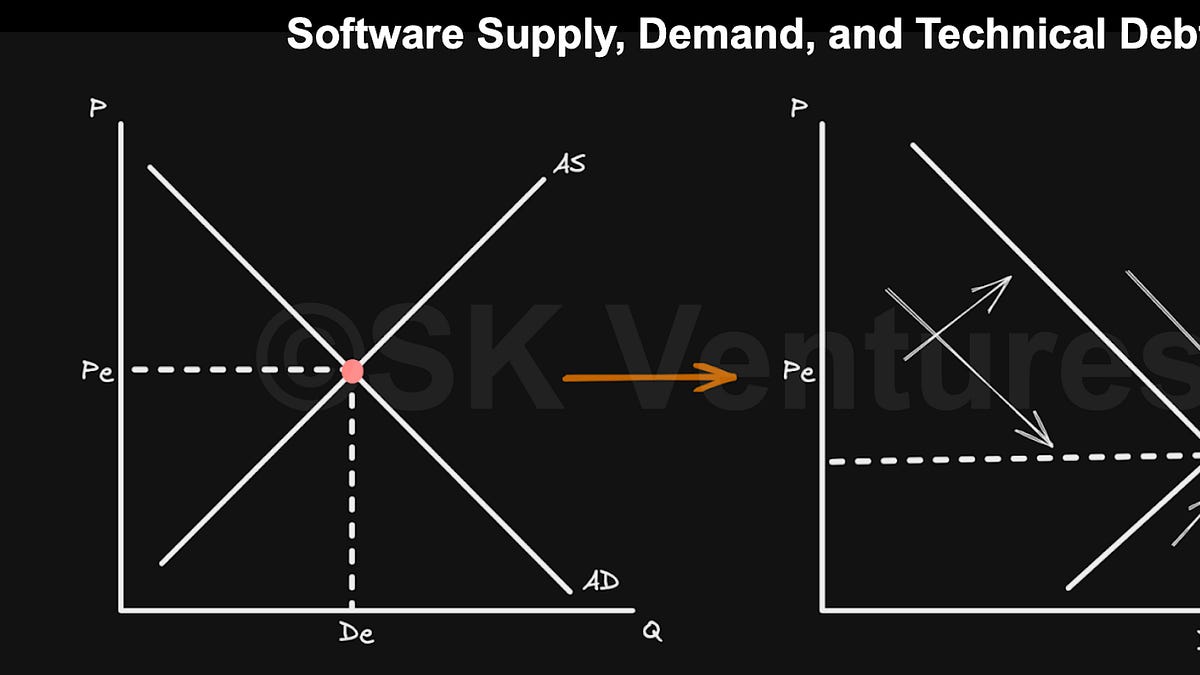 Society's Technical Debt and Software's Gutenberg Moment
- Abstract
- There is immense hyperbole about recent developments in artificial intelligence, especially Large Language Models like ChatGPT. And there is also deserved concern about such technologies’ material impact on jobs. But observers are missing two very important things:
1. Every wave of technological innovation has been unleashed by something costly becoming cheap enough to waste.
2. Software production has been too complex and expensive for too long, which has caused us to underproduce software for decades, resulting in immense, society-wide technical debt.
This technical debt is about to contract in a dramatic, economy-wide fashion as the cost and complexity of software production collapses, releasing a wave of innovation.
-- Sole proprietorship - Canada.ca
> A sole proprietorship is an unincorporated business that is owned by one individual. It is the simplest kind of business structure.
>
> The owner of a sole proprietorship has sole responsibility for making decisions, receives all the profits, claims all losses, and does not have separate legal status from the business. If you are a sole proprietor, you also assume all the risks of the business. The risks extend even to your personal property and assets.
>
> If you are a sole proprietor, you pay personal income tax on the net income generated by your business.
>
> You may choose to register a business name or operate under your own name or both.
>
> If you operate as an individual, just bill your customers or clients in your own name. If you operate under a registered business name, bill your clients and customers in the business's name. If your business has a name other than your own, you'll need a separate bank account to process cheques payable to your business.[[Ownr]] makes it easy to register a name and setup a business bank account.
 Solid: Your data, your choice - Solid Project
> Solid (abbreviation from Social Linked Data) is a web decentralization project led by [[Tim Berners-Lee]], the inventor of the World Wide Web, originally developed collaboratively at the Massachusetts Institute of Technology (MIT). The project "aims to radically change the way Web applications work today, resulting in true data ownership as well as improved privacy" by developing a platform for linked-data applications that are completely decentralized and fully under users' control rather than controlled by other entities. The ultimate goal of Solid is to allow users to have full control of their own data, including access control and storage location. To that end, Tim Berners-Lee formed a company called [[Inrupt]] to help build a commercial ecosystem to fuel Solid
>
> https://en.wikipedia.org/wiki/Solid_(web_decentralization_project" rel="noopener noreferrer">Wikipedia)- forum.summerofprotocols.com
I applied to the Summer of Protocols 2024 program with this RFC plus a private personal submission that [[walkah]] and I sent in. It was not accepted. I now call this [[Community Search Engine]].
# Community Search Engines: Event & Chat Artifacts as Research Building Block## Team member names
* https://bmann.ca" rel="noopener noreferrer">Boris Mann
* https://walkah.net/" rel="noopener noreferrer">James WalkerThe protocol of in-person conferences, symposium proceeedings, and other classic gatherings are at best stuck in a published PDF or slide deck world. If you're lucky, event websites have permalinks that remain year over year, and maybe a youtube playlist or two.
And, we have yet to develop a protocol that better supports digital communities, hybrid events, unconferences, and other emerging forms.
We propose a Community Search Engine Protocol for events & digital communities.
### Short summary of your improvement idea
Events, Cozy Web digital groups, and other gatherings are all flow, no stock. Every group should have access to easy tools to gather community context.
Part community search engine with high relevance resources from people you have trust with, part serendipitious discovery from webring surfing.
In the age of AI, leaning into a trusted community context can further help to elevate signal from noise.
### What is the existing target protocol you are hoping to improve or enhance?
Today's events, from meetups to traditional full conferences, at best use a static snapshot of an event websitem, slides, and speaker bios. If the event has enough funding ($1000s of dollars), there are high quality video recordings, and maybe some attempt is made at transcripts.
For https://en.wikipedia.org/wiki/Open_space_technology" rel="noopener noreferrer">Open Space Technology / unconference techniques, images of sticky notes and personal write ups, and perhaps professional facilitation summaries or live graphic facilitation could be part of the artifacts.
### What is the core idea or insight about potential improvement you want to pursue?
Digital gardens with valuable backlinks are stuck in single-player mode or commercial platforms. Chat communities, especially those on commercial platforms, are constantly losing context, or their entire archives. An easy toolkit for communities to gather context, resources, and new insights that can grow over time. Community Search in a box.
### What is your discovery methodology for investigating the current state of the target protocol?
We've run events and communities of this form for years. We will look to find other pains and problems by interviewing other community leaders and recruiting early testers.
### In what form will you prototype your improvement idea?
We will produce a toolchain of code and configuration as well as test installs of a community search engine.
Some of the building blocks we will look to use as starting points:
* https://github.com/cblgh/lieu" rel="noopener noreferrer">Lieu an existing open source community search engine
* The https://subconscious.network/" rel="noopener noreferrer">Noosphere tool-for-thought protocol
* Social feeds of community participants from Bluesky, ActivityPub, and Farcaster as a source of new resources
* RSS feeds that are aggregated and synced p2p as local resources for each person using IPFS -- both as distributed archive and way to include ongoing content over time### How will you field-test your improvement idea?
Causal Islands Toronto 2023: https://causalislands.com" rel="noopener noreferrer">Causal Islands as a traditional centrally organized multi-day conference. The current archive, including high quality. It has spawned a Discord and Podcast and desire for more "Causal Islands" style events, including one "community edition" in LA. Participants have said they'd like to see more of these events, as well as better find a home for computational research / future of computing topics embodied by the original conference.
Can we turn a conference into a community, and facilitate a template for future events?
We will start by using the 2023 event outputs, including inviting attendees of that event to add their personal resources, in creating a community search engine.
The Discord formerly known as Fission: Fission the company is shutting down, but the community Discord continues. Chat is notoriously bad at capturing long term context, and Discord as a commercial platform is not a good long term home.
We will explore extracting links and people into a community search engine.
This approach should be expandable to other Discord-based communities.
---
This approach may also be interesting for the SoP community itself.
We will look to recruit other communities to try out the process, including beta testing if technical people can effectively configure and deploy the tooling on their own, as well as differing approaches to activating the communities themselves.
### Who will be able to judge the quality of your output? Ideally name a few suitable judges.
* Gordon Brander
* Ronen TamariAll of these might also be collaborators. Ideally communities and people who try and install / deploy this will be those who can help judge if it's helpful
### How will you publish and evangelize your improvement idea?
We will publish a repo containing the community search engine, configuration, and deployment guidelines to get up and running.
We will create an onboarding and community activation checklist to help communities be successful.
We will find seed communities to deploy into, and host introductions and kick off events both virtually and in person.
### What is the success vision for your idea?
Communities of interest that form around events, digital places like chat groups, and other gatherings have an easy way to deploy a community search engine that provides both archival as well as ongoing high context trusted resources over time.
 Sourcegraph — Code Understanding, Oversight and Evolution
Sourcegraph is a code intelligence platform that allows developers to rapidly search, write, and understand code by bringing insights from their entire codebase right into their editor. We help developers and companies with billions of lines of code create the software you use every day.
Building [[Cody]], which is being evolved into [[CHOP]]
Sourcegraph [[Public Handbook]]: <https://sourcegraph.notion.site/d7614e3e9dc04c09ac2d42d57f1816e6>
An [[All Remote]] company, which means:
>- We work https://www.notion.so/communication/asynchronous-communication.md" rel="noopener noreferrer">asynchronously across time zones and continents.
- You choose when you want to work. (Most people work the normal working hours for their time zone.)
- You don't need to ask permission or tell anyone if you need to step out.
- We try to limit the number of synchronous meetings, but there are some company and team meetings that you need to attend which might be outside of your normal working hours. We do our best to optimize meeting times for all involved participants.
> - All teammates are encouraged to work remotely. Sourcegraph provides a budget for home offices or office spaces to teammates as needed.
> - We use our business office address in San Francisco to provide a mailing address, for corporate filings, and on-site workplaces as legally required.https://sourcegraph.notion.site/All-remote-guidelines-4d1270d806294bf4ae6db7ab02911957" rel="noopener noreferrer">Sourcegraph Public Handbook
- federation.spacebear.ee
- Managed hosting of:
- [[Pixelfed]]
- [[Mastodon]]
- [[PeerTube]]
- [[Hometown]]
- [[Pleroma]]
- Uses [[Gumroad]] for billing - www.spaceship.com
Domain registrar and DNS host.
Also offers web and email hosting. Email forwarding is bundled and free.
* https://www.spaceship.com/email/" rel="noopener noreferrer">Email hosting: $6/year for 1 mailbox / 5 aliases / 3GB, $7/year for 1 mailbox, 10 aliases, 10GB, or $23/year for 5 mailboxes / unlimited aliases / 10GB
* https://www.spaceship.com/hosting/shared/" rel="noopener noreferrer">Web hosting: cPanel powered (I would never use this)## Namecheap Reboot
Spaceship is actually [[Namecheap]], but under a new brand and new codebase. Here's https://x.com/NamecheapCEO/status/1776484212629004385" rel="noopener noreferrer">Richard Kirkendall, Namecheap's CEO, with an April 2024 Twitter post:
> Hey https://x.com/levelsio" rel="noopener noreferrer">@levelsio, thanks for asking. Namecheap has always been a 100% privately owned boot strapped company. Growth is good with 330 million in revenue last year and 15% yoy growth.
>
> Regarding Spaceship, we wanted to start building our next phase without any legacy limitations and a legacy codebase. We also came in with the mindset of what we would do if we wanted to disrupt ourselves.
>
> Yes, right now the choices in what we offer are similar but it's early. Although I'd argue our UX and experience levels beyond a typical registrar even at this point and the plan is just to keep getting better.
>
> We are being very deliberate and customer centered around next steps. https://t.co/ZxD8BKXO4o" rel="noopener noreferrer">https://spaceship.com/roadmap/ . We also want to operate like a start up and move as fast as we can and legacy just wouldn't allow us to do it.
>
> Someone else mentioned the issues and limitations with our current brand and we want to try and move beyond that and I think we're on the right track.
>
> We aren't trying to charge more. We are just trying to build something better as a whole, we'll see if works but I believe it will.
>
> Happy to answer any questions from you or anyone else.  Spark Mail — Smart. Focused. Email.
Cross-platform email app with focus features
Verge, Oct 2022: https://www.theverge.com/2022/10/4/23387221/spark-email-app-windows-mac-ios-android-system" rel="noopener noreferrer">Spark’s new app wants to fix how you email — even if it has to force you
## PricingFree forever version without team or AI features
Premium individual is $4.99USD / month, paid annually = $59.99
Premium Teams is $6.99 / user / month, paid annually
 Squishy Computer | Gordon Brander | Substack
[[Gordon Brander]]’s long running “personal lab notebook”.
> I’m interested in software ecosystems that are organic, open-ended, and evolving.
>
> The internet is like this, and so is the web. My question is, https://subconscious.substack.com/p/weblike-things" rel="noopener noreferrer">how can we make more software like this? Squishy Computer is my personal lab notebook for exploring this question.
>
> I like to look at living software ecosystems through the lenses of evolution and ecology. Every so often, I publish a newsletter containing project updates, ideas, design patterns, and snippets of books and papers. Squoosh
Squoosh is an image compression web app that reduces image sizes through numerous formats.
Built by Google Chrome Labs as an installable [[PWA]].
 Stability AI
- https://stability.ai/faq" rel="noopener noreferrer">What was the Stable Diffusion model trained on?
- The underlying dataset for Stable Diffusion was the 2b English language label subset of [[Laion]] 5b https://laion.ai/blog/laion-5b/, ==a general crawl of the internet created by the German charity LAION==. The CompVis team at the University of Heidelberg trained the model in compliance with German law. The underlying dataset was not filtered to exclude or include any specific group.
- LATER Fix this to have an entry for Stability AI separate from Stable Diffusion #Processing
- Stacher7
A graphical interface for working with
yt-dlpto cache local copies of video, get audio tracks, and more.Recommended to me by [[Rosano]].
- Standard.site - One schema. Every platform.
An atproto [[Lexicon]] designed to act as an interface for any kind of longform writing. Any atproto native platforms can use it, and those with blogs off protocol can publish metadata as well as full content and be first class atproto network participants.
[[Bluesky]] has integrated support for Standard Site into their app, so that if you include a link to a Standard Site publication or document, you'll get a rich, branded feed embed card. For many publishers, this is a good enough reason to do it.
<blockquote class="bluesky-embed" data-bluesky-uri="at://did:plc:2cxgdrgtsmrbqnjkwyplmp43/app.bsky.feed.post/3mp5vukzwts26" data-bluesky-cid="bafyreigigxej2rofj3yvidyhonm5anqhxzceahsdmyfmyi5iv4sz76moz4" data-bluesky-embed-color-mode="system"><p lang="en">Impromptu user research with @ianvanagas.bsky.social, me & @wesleyfinck.org:
Wes: so this is @standard.site (brings up home page, lots of protocol talk)
Me: like OGP & if you add it to @posthog.com blog you’ll get an awesome feed display & more people will click
Ian: sold on pretty + clicks</p>— Boris (<a href="@bmann.ca</a>)" rel="noopener noreferrer">https://bsky.app/profile/did:plc:2cxgdrgtsmrbqnjkwyplmp43?ref_src=embed">@bmann.ca</a>) <a href="https://bsky.app/profile/did:plc:2cxgdrgtsmrbqnjkwyplmp43/post/3mp5vukzwts26?ref_src=embed">June 25, 2026 at 7:35 PM</a></blockquote><script async src="https://embed.bsky.app/static/embed.js" charset="utf-8"></script>
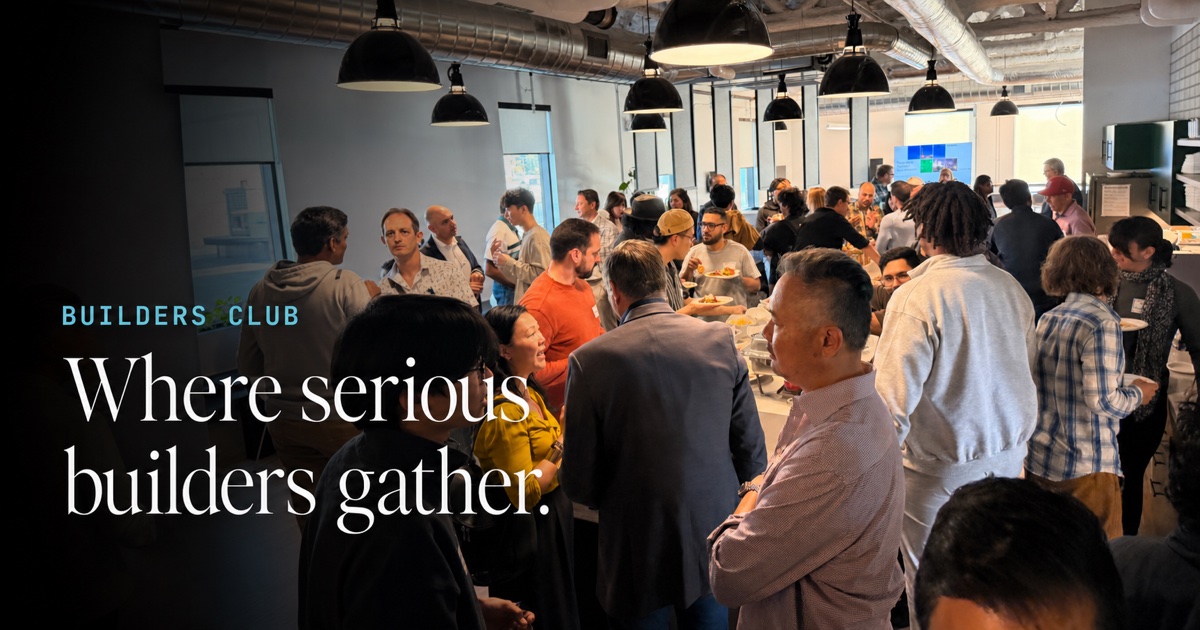 Builders Club Makes Building Better · Waterloo
Ambitious people building their next thing
Build together, not alone! How people build projects, products, and companies is changing. The Builders Club is a place for you to connect with amazing people and learn together.
<<<<<<< HEAD
Founded by [[Jesse Rodgers]], using a paid monthly membership model to pay for Jesse's time.
=======
Run by [[Jesse Rodgers]]
>>>>>>> e2af94ce2ed27b65bdb7508bdfd4fb9935e8ea74- atproto.com
A sample ATProto application to post “status” updates. Created by the [[Bluesky]] team. Designed to walk you through some of the basics of a custom ATProto app with a custom data type:
- Signin via OAuth
- Fetch information about users (profiles)
- Listen to the network firehose for new data
- Publish data on the user's account using a custom schemaThree other versions:
- Samuel’s React version <https://github.com/mozzius/statusphere-react> (this is a much more modern example than the original)
- Bailey Townsend’s rusty statusphere <https://github.com/fatfingers23/rusty_statusphere_example_app>
- Recent example on Cloudflare, https://blog.cloudflare.com/serverless-atproto/" rel="noopener noreferrer">Serverless Statusphere 
 Steam Deck
I have one of the original non-OLED Steam Decks

 Steph Ango
I’m Steph. You may also know me as _kepano_, currently the CEO of [[Obsidian]].
Previously I co-founded https://stephango.com/lumi" rel="noopener noreferrer">Lumi and https://stephango.com/inkodye" rel="noopener noreferrer">Inkodye. A few links to explore:
- https://stephango.com/writing" rel="noopener noreferrer">Writing
- https://stephango.com/projects" rel="noopener noreferrer">Projects
- https://stephango.com/recipes" rel="noopener noreferrer">Recipes## What I'm Doing Now
### Designing better thought-processing tools
[[Obsidian]] is a private and flexible note‑taking app that adapts to the way you think. A few popular entries related to Obsidian:
- https://stephango.com/file-over-app" rel="noopener noreferrer">File over app
- https://stephango.com/vcware" rel="noopener noreferrer">100% user-supported
- https://stephango.com/photoshop-for-text" rel="noopener noreferrer">Photoshop for text
- https://stephango.com/quality-software" rel="noopener noreferrer">Quality software deserves your hard-earned cash
- https://stephango.com/evergreen-notes" rel="noopener noreferrer">Evergreen notes turn ideas into objects that you can manipulate
- https://stephango.com/40-questions" rel="noopener noreferrer">40 questions to ask yourself every year Stock and flow
> But I actually think stock and flow is a useful metaphor for media in the 21st century.
>
> Here’s what I mean:
> * Flow is the feed. It’s the posts and the tweets. It’s the stream of daily and sub-daily updates that reminds people you exist.
> * Stock is the durable stuff. It’s the content you produce that’s as interesting in two months (or two years) as it is today. It’s what people discover via search. It’s what spreads slowly but surely, building fans over time.- www.stolonmesh.ca
A project by [[221A]] that [[DWebYVR]] helped get up and running, including a node that [[Emily McGill]] got running with [[Jacob Sayles]] in the [[coFood Garden]].
 Storj - Smarter cloud storage for your business.
Implements the [[S3 API]] on top of a decentralized network.
Only supports encrypted content / no public file access. Uses a type of [[macaroons]] for auth.
 Strategy Letter V
- Smart companies try to commoditize their products’ complements.
- Quotes
- > In today’s episode, I’ll show how one of those concepts explains a lot about some familiar computer companies. Along the way, I noticed something interesting about open source software, which is this: most of the companies spending big money to develop open source software are doing it because it’s a good business strategy for them, not because they suddenly stopped believing in capitalism and fell in love with http://www.gnu.org/philosophy/free-sw.html" rel="noopener noreferrer">freedom-as-in-speech.
> demand for a product increases when the price of its complements decreases. In general, a company’s strategic interest is going to be to get the price of their complements as low as possible. The lowest theoretically sustainable price would be the “commodity price” — the price that arises when you have a bunch of competitors offering indistinguishable goods. So:
>
> Smart companies try to commoditize their products’ complements.
>
> If you can do this, demand for your product will increase and you will be able to charge more and make more.
-- subconscious.network
Company founded by [[Gordon Brander]] and [[Chris Joel]] as a tools for thought app on top of the open [[Noosphere]] protocol.
In May 2024, it was announced that https://newsletter.squishy.computer/p/subconscious-is-winding-down" rel="noopener noreferrer">Subconscious was shutting down.
If you enjoyed the excellent Subconscious Discord chat, you may enjoy the [[User & Agents]] chat.
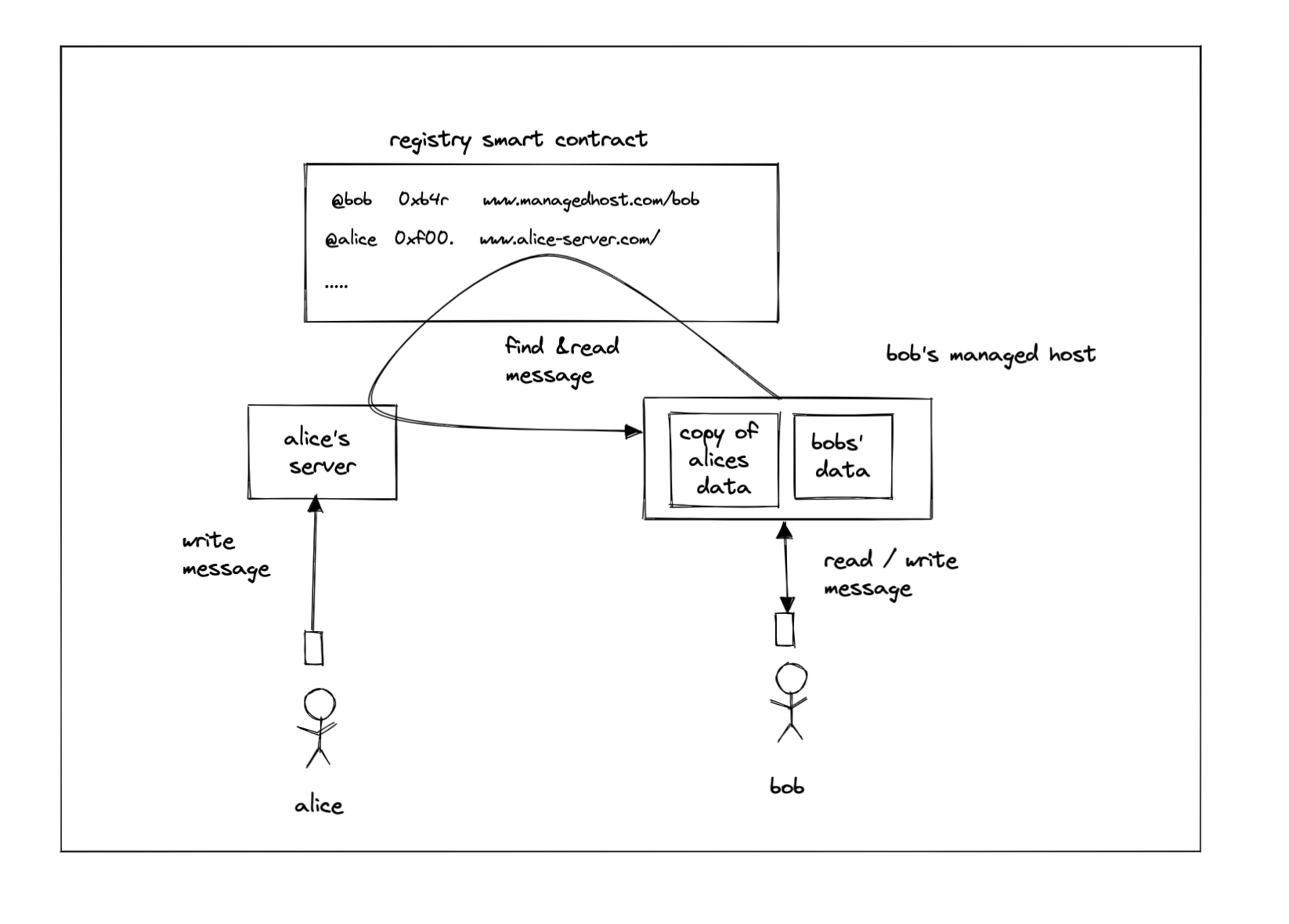 Sufficient Decentralization for Social Networks
This is the high level outline of [[Farcaster]] by co-founder of [[Warpcast]] [[Varun Srinivasan]].
> Every year, centralized social networks place more restrictions on what users and developers can do. They seem to believe that limiting choices is the path to a healthy network, while the opposite is probably true. A decentralized social network can challenge this hypothesis by making two powerful promises that centralized networks cannot. They can guarantee that users own a direct relationship with their audience and that developers can always build apps on the network.
> Centralized social networks influence every aspect of our lives, and their shortcomings are painfully clear. Improvements in cryptography and blockchains have provided workable solutions to achieve sufficient decentralization. We have a reasonable way to build a decentralized name registry, a hybrid off-chain/on-chain architecture to scale the network, and interesting new social primitives to build on.
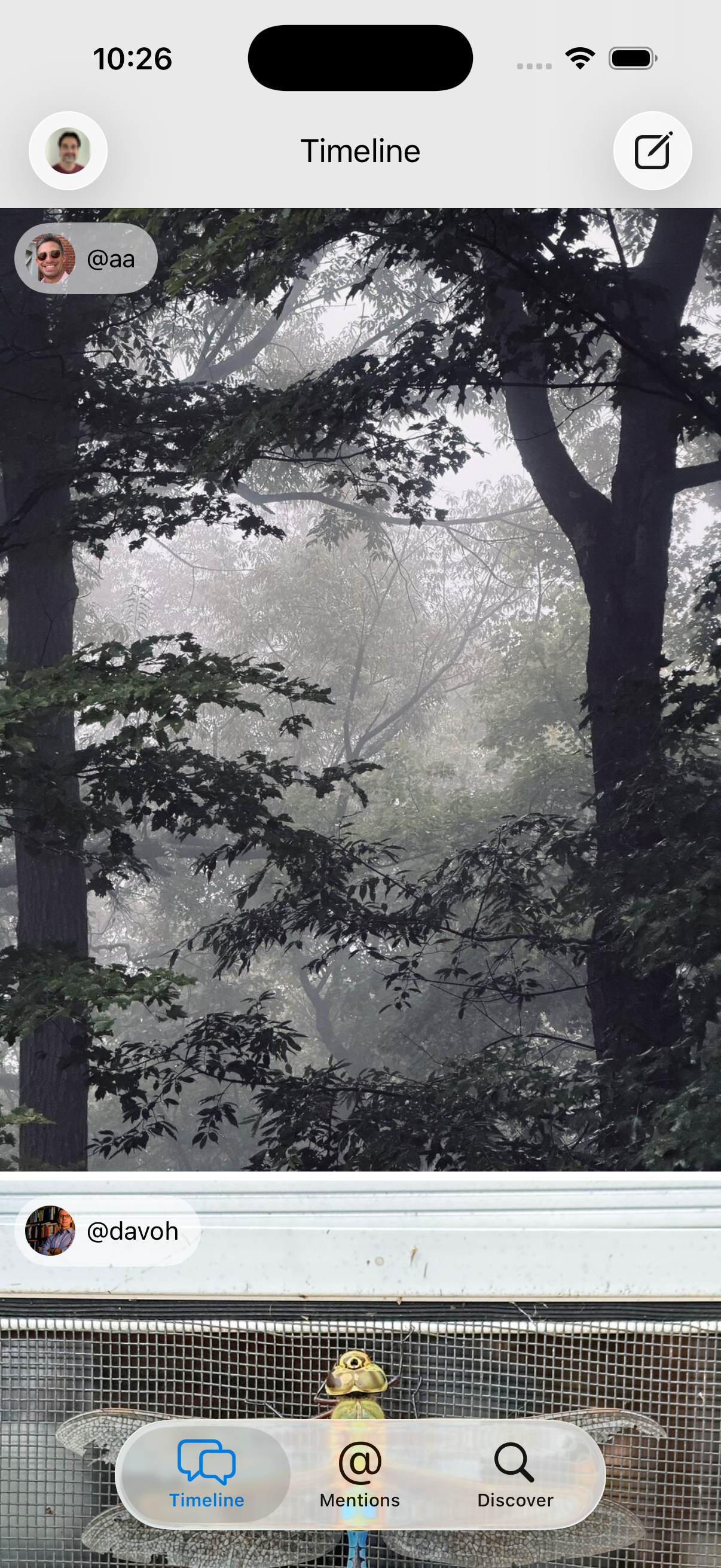 Sunlit
- Microblog posts or even full blog posts for sites that support #micropub or #[[MetaWeblog API]]
- Designed as an #IndieWeb photo sharing app, mainly for #Micro.blog
- Home
Home> We’re bringing about a more just world by exposing the challenges people face in technology, creating and highlighting alternative models, and championing the global transformative movement in tech.
Executive Director [[Georgia Bullen]]
Design & UX agency that focuses on privacy and security. Was previously known as Simply Secure.
## Fiscal Sponsorship
They set up fiscal sponsorship after the shutting down of the Open Collective Foundation in the US.
<https://superbloom.design/community/our-support/#fiscal-sponsorship>
Some of the projects they host:
- https://newdesigncongress.org/" rel="noopener noreferrer">New Design Congress
- https://civictech.guide/" rel="noopener noreferrer">Civic Tech Field Guide
- https://convocation.design/" rel="noopener noreferrer">Convocation Research & Design
- https://publicprivates.com/" rel="noopener noreferrer">Public Privates
- https://osloforai.org/" rel="noopener noreferrer">Oslo for AI
- https://www.dataumbrella.org/" rel="noopener noreferrer">Data Umbrella
- https://www.pitalumni.org/" rel="noopener noreferrer">PIT Alumni Network
- https://chaoss.community/kb/local-chapters/" rel="noopener noreferrer">CHAOSS Africa
- https://platform.coop/about/icde/" rel="noopener noreferrer">Institute for the Cooperative Digital Economy
- docs.cloudron.io
The basic website serving and file sharing app by the [[Cloudron]] team.
It has [[WebDAV]] support, so you can mount it in MacOS finder and other tools, and edit and save websites and files directly.
The CLI tool can be combined with an access token to publish to the site.
#todo [[Using Surfer to publish websites to Cloudron from Github Actions]]
You can login to a web interface at
/_adminor finally, use SFTP.  SVG to PNG
Convert SVG to PNG right in your browser, reliably and correctly
> This little web tool simply leverages your browser's built-in capability to accurately display/render SVGs. Your browser "renders" the vector graphic to raster pixels so it can display it on the screen, and the tool essentially takes whatever pixels are on the screen and saves it as an image.
## Related tools
- https://github.com/shakiba/svgexport" rel="noopener noreferrer">svgexport, a browser-based SVG renderer as a node.js package
- https://mybyways.com/blog/convert-svg-to-png-using-your-browser" rel="noopener noreferrer">mybyways converter
- https://github.com/Profesor08/SVG-to-PNG" rel="noopener noreferrer">Profesor08's converter Tailscale | Secure Connectivity for AI, IoT & Multi-Cloud
The connectivity platform for devs, IT, and security teams. Zero Trust identity-based access that deploys in minutes and scales to every resource. Start free.
 Welcome | Takahē
- An efficient ActivityPub Server, for small installs with multiple domains. Written in Python / Django.
- Allowing multiple domains on the same server (“virtual hosting”)
- Efficient, stable background tasks via asynchronous state machines
- A default fast, low-JavaScript web interface
- Mastodon Client API compatibility (eventually!)
-
-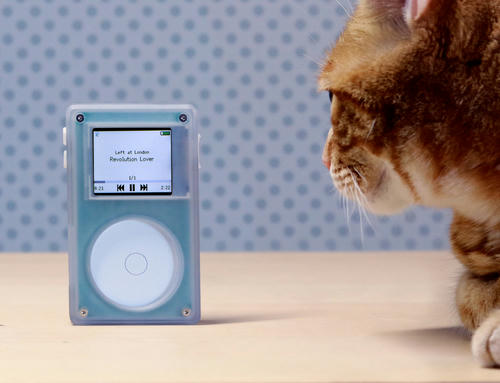 Tangara | cool tech zone
> Tangara is a portable music player. It outputs high-quality sound through a 3.5-mm headphone jack or Bluetooth, has great battery life, and includes a processor that's powerful enough to support any audio format you can throw at it. It's also 100% open hardware running open-source software, which makes it easy to customize, repair, and upgrade.
## CrowdSupply
Ran a https://www.crowdsupply.com/cool-tech-zone/tangara" rel="noopener noreferrer">campaign on CrowdSupply, where I pre-ordered in February 2024. I received the player in mid December 2024.
<iframe width="560" height="315" src="https://www.youtube-nocookie.com/embed/1C597AkhGtw?si=Dq-U3MIQyTsBa04d" title="YouTube video player" frameborder="0" allow="accelerometer; autoplay; clipboard-write; encrypted-media; gyroscope; picture-in-picture; web-share" referrerpolicy="strict-origin-when-cross-origin" allowfullscreen></iframe>
## Open Hardware
The sources are available on Sourcehut <https://sr.ht/~jacqueline/tangara/sources>
## Tangara Companion
Tool for updating firmware, both graphical and CLI tooling <https://github.com/haileys/tangara-companion>
## Other things to explore
* https://cooltech.zone/tangara/docs/lua/" rel="noopener noreferrer">Lua scripting - likely not for me, but will be interesting to see what other people come up with!
* https://cooltech.zone/tangara/docs/assembly/" rel="noopener noreferrer">Assembly / Disassembly - yes, I'd love a custom printed case!
* https://cooltech.zone/tangara/docs/themes/" rel="noopener noreferrer">Themes - it's a colour screen so you can do Lua stuff with it## Personal Setup
I'm keeping notes at [[Tangara Setup]]
 Tangled · The next-generation social coding platform
Tangled is an atproto-powered distributed git forge.
They announced a https://blog.tangled.org/seed" rel="noopener noreferrer">€3.8M seed round in March 2026.
 Tapbots. Robots for iOS and Mac
Original makers of the Tweetbot [[Twitter]] client, now making [[Ivory]] for [[Mastodon]], and the forthcoming [[Phoenix]] for [[atproto]].
 TasksBoard | Full screen app for Google Tasks
Google Tasks based team Kanban / To Do
## Pricing
Free
* 5 shared lists (aka columns in a Kanban, modeled as separate Google Task lists)
* 1 main boardPersonal Pro $6CAD / month
* unlimited shared lists
* unlimited boards
* custom task labelsTeams $7CAD
* unlimited shared boards
* team billing Tauri 2.0
> Build an optimized, secure, and frontend-independent application for multi-platform deployment.
From the https://tauri.app/about/intro" rel="noopener noreferrer">about page:
## What is Tauri?Tauri is a toolkit that helps developers make applications for the major desktop platforms - using virtually any frontend framework in existence. The core is built with Rust, and the CLI leverages Node.js making Tauri a genuinely polyglot approach to creating and maintaining great apps.
- Ted’s Thoughts
Ted Han’s thoughts about journalism, technology, civilization, art and a bunch of other things.
 Textile Markup Language Documentation
- Textile is a markup language (like [[Markdown]]) for formatting text in a blog or a content management system (CMS).
-- members.newdesigncongress.org
- > Barely a month after the major restructuring, Riccitiello https://investors.unity.com/news/news-details/2022/Unity-Announces-Merger-Agreement-with-ironSource/default.aspx" rel="noopener noreferrer">announced plans for Unity to merge with https://seekingalpha.com/article/4525632-unity-and-ironsource-what-are-investors-missing" rel="noopener noreferrer">ironSource, an ‘app monetisation’ platform. This merger would narrow the game engine’s focus to use cases that prioritise micro-transactions, data collection and paywalls.
- > Unity represents the largest single game engine in terms of market-share, application and adoption. In 2022, its future is uncertain and focused on a pivot headed by a corporate leader who had demonstrably failed in similar roles with similar strategies. More worryingly, in an era of unprecedented US https://www.opb.org/article/2022/06/24/text-supreme-court-ruling-overturning-roe-v-wade/" rel="noopener noreferrer">domestic and https://www.reuters.com/world/asia-pacific/pelosi-expected-arrive-taiwan-tuesday-sources-say-2022-08-02/" rel="noopener noreferrer">international belligerence, this repositioning by company whose products are installed on millions of devices – from smartphones to medical training programmes to electric cars to https://www.msn.com/en-us/news/technology/unity-is-now-helping-design-simulation-programs-for-the-us-military/ar-AA10zgee" rel="noopener noreferrer">military use – is a direct move into data-brokerage and surveillance. Organisations and companies outside of the United States hoping to incorporate game engines into their work must evaluate this new development as a major threat to a project’s digital integrity.
- Interesting read continues, with thoughts on [[Epic Games]] being owned by China-controlled [[Tencent]], and the US-China relations around this. Plus Epic being out of the [[Apple app store]]
- Final section is cheerleading for open source [[Godot Engine]] as a potential third path
-  The Dark Forest and the Cozy Web
- Appleton's image for this article
- Quotes
- The [[cozy web]] is [[Venkatesh Rao]]’s term for the private, gatekeeper-bounded spaces of the internet we have all retreated to over the last few years.
- It's the “high-gatekeeping slum-like space comprising slacks, messaging apps, private groups, storage services like dropbox, and of course, email.” The informal, untracked, messily human space that the bots and algorithms haven't infiltrated yet.
- Venkat first proposed the term in one of his Breaking Smart emails on [[The Extended Internet Universe]]. He builds off [[Yancey Strickler]] 's companion idea of the Dark Forest theory of the web. The “dark forest” is a place that seems eerily quiet and devoid of life. All the living creatures within it are hiding. Because “night is when the predators come out. To survive, the animals stay silent.”
- The predators here are the advertisers, tracking bots, clickbait creators, attention-hungry influencers, reply guys, and trolls. It's unsafe to reveal yourself to them in any authentic way. So we retreat into private spaces. We hide in the cozy web.
- We create tiny underground burrows of Slack channels, Whatsapp groups, Discord chats, and Telegram streams that offer shelter and respite from the aggressively public nature of Facebook, Twitter, and every recruiter looking to connect on LinkedIn.
- It's the digital realm of https://www.ribbonfarm.com/series/domestic-cozy/" rel="noopener noreferrer">Domestic Cozy Gen-Z vibes. #Ribbonfarm Casual, comfy, and not trying to kick up a fuss.- onezero.medium.com
- Part Two [[Beyond the Dark Forest Theory of the Internet]]
- Quotes
- In his sci-fi trilogy [[The Three Body Problem]], author [[Liu Cixin]] presents the dark forest theory of the universe.
- The dark forest is full of life. It’s quiet because night is when the predators come out. To survive, the animals stay silent.
- Is our universe an empty forest or a dark one? If it’s a dark forest, then only Earth is foolish enough to ping the heavens and announce its presence. The rest of the universe already knows the real reason why the forest stays dark. It’s only a matter of time before the Earth learns as well.
- This is also what the internet is becoming: a dark forest.
- ^^In response to the ads, the tracking, the trolling, the hype, and other predatory behaviors, we’re retreating to our dark forests of the internet, and away from the mainstream.^^
- This very piece is an example of this. This theory was first shared on a private channel sent to 500 people who I know or who have explicitly chosen to receive it. This is the online environment in which I feel most secure. Where I can be my most “real self.”
- The influence of Facebook, Twitter, and others is enormous and not going away. There’s a reason why Russian military focused on these platforms when they wanted to manipulate public opinion: they have a real impact. The meaning and tone of these platforms changes with who uses them. ^^What kind of bowling alley it is depends on who goes there.^^
- Should a significant percentage of the population abandon these spaces, that will leave nearly as many eyeballs for those who are left to influence, and limit the influence of those who departed on the larger world they still live in.
- If the dark forest isn’t dangerous already, these departures might ensure it will be.
- Imagine a dark forest at night. It’s deathly quiet. Nothing moves. Nothing stirs. This could lead one to assume that the forest is devoid of life. But of course, it’s not.
- The dark forest is full of life. It’s quiet because night is when the predators come out. To survive, the animals stay silent.
- The second book in [[The Three-Body Problem]] series is called [[The Dark Forest]]. 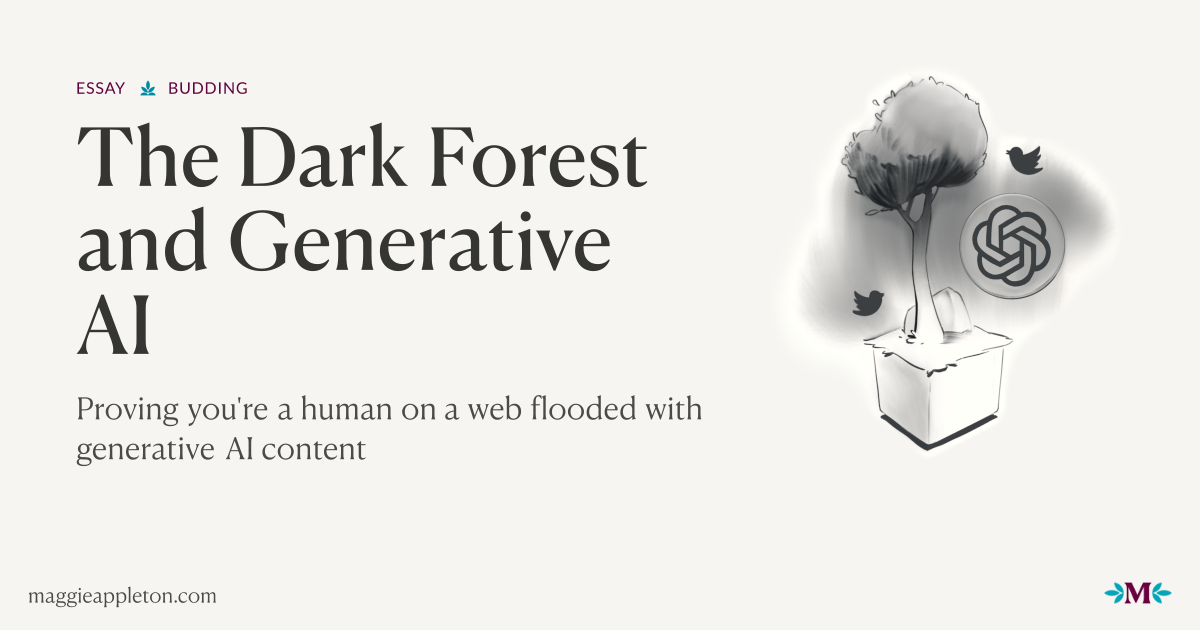 The Dark Forest and Generative AI
-
- Quotes
- That dark forest is about to expand. [[Large Language Models]] (LLMs) that can instantly generate coherent swaths of human-like text have just joined the party.
Over the last six months, we've seen a flood of LLM copywriting and content-generation products come out: https://www.jasper.ai/" rel="noopener noreferrer">Jasper, https://www.gomoonbeam.com/" rel="noopener noreferrer">Moonbeam, https://www.copy.ai/" rel="noopener noreferrer">Copy.ai, and https://anyword.com/" rel="noopener noreferrer">Anyword are just a few. They're designed to pump out advertising copy, blog posts, emails, social media updates, and marketing pages. And they're reallygood at it.
-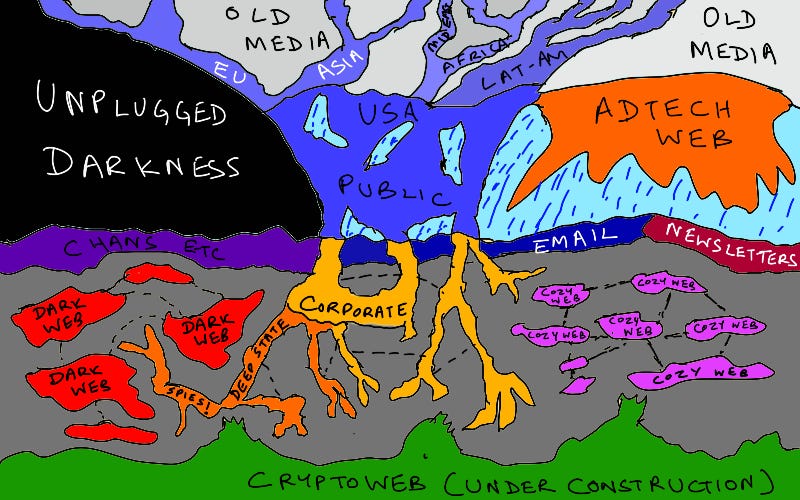 The Extended Internet Universe
- For several years now, I’ve been watching the creeping, unheralded growth of what I call the cozyweb, and for which https://twitter.com/vgr/status/1131963928685080577" rel="noopener noreferrer">others have lots of creative names
- We need a good name for this. Darkweb is drug dealers. Underground sounds narrower and more politically subversive than this is. This is mostly just a private web, a sort of domestic-backyards intranet.
- Cut-and-paste web? Cozyweb? Backyard web? Friendly neighborhood intranet?
- Kickstarter founder Yancey Strickler called it the Dark Forest in a recent post. [[The Dark Forest Theory of the Internet]]
- Unlike the main public internet, which runs on the (human) protocol of “users” clicking on links on public pages/apps maintained by “publishers”, the cozyweb works on the (human) protocol of everybody cutting-and-pasting bits of text, images, URLs, and screenshots across live streams. Much of this content is poorly addressable, poorly searchable, and very vulnerable to bitrot.
- It lives in a high-gatekeeping slum-like space comprising slacks, messaging apps, private groups, storage services like dropbox, and of course, email. The Homelab Show – Catch Up on the Vlog and Podcast
- About
- > The Homelab Show strives to deliver not only introductions to many of the projects that fascinate homelab enthusiasts but also go in depth on how to set some of these projects up from beginning to end. No matter if you are a veteran homelab tech or just starting out, there is something here for you.
>
> The Homelab Show is run by Tom Lawrence of https://lawrencesystems.com/" rel="noopener noreferrer">Lawrence Systems and Jay LaCroix of https://www.learnlinux.tv/" rel="noopener noreferrer">Learn Linux TV. Both are respected in the Linux and tech community for creating detailed tutorials, technical, and educational content.- Bret Victor, human being
- <iframe src="https://player.vimeo.com/video/115154289?title=0&byline=0&portrait=0" width="640" height="360" frameborder="0" allow="autoplay; fullscreen" allowfullscreen></iframe>
- Closing keynote at the [[UIST]] and [[SPLASH]] conferences, October 2014.
- Preface:
- References to baby-steps towards some of the concepts mentioned
- Dynamic reality (physical responsiveness)
- The primary work here is Hiroshi Ishii's "Radical Atoms" https://tangible.media.mit.edu/project/inform/
- but also relevant are the "Soft Robotics" projects at Harvard:
- softroboticstoolkit.com
- and at Otherlab: youtube.com/watch?v=gyMowPAJwqo
- and some of the more avant-garde corners of material science and 3D printing
- Dynamic conversations and presentations:
- Ken Perlin's "Chalktalk" changes daily; here's a recent demo: http://bit.ly/1x5eCOX
- Context-sensitive reading material:
- http://worrydream.com/MagicInk
- "Explore-the-model" reading material:
- worrydream.com/ExplorableExplanations/
- worrydream.com/LadderOfAbstraction/
- ncase.me/polygons/
- redblobgames.com/pathfinding/a-star/introduction.html
- earthprimer.com
- Evidence-backed models:
- worrydream.com/TenBrighterIdeas
- Direct-manipulation dynamic authoring:
- worrydream.com/StopDrawingDeadFish/
- worrydream.com/DrawingDynamicVisualizationsTalk/
- tobyschachman.com/Shadershop/
- aprt.us
- Modes of understanding:
- Jerome Bruner: amazon.com/dp/0674897013
- Howard Gardner: amazon.com/dp/0465024335
- Kieran Egan: amazon.com/dp/0226190390
- Embodied thinking:
- Edwin Hutchins: amazon.com/dp/0262581469
- Andy Clark: amazon.com/dp/0262531569
- George Lakoff: amazon.com/dp/0465037712
- JJ Gibson: amazon.com/dp/0898599598
- among others: en.wikipedia.org/wiki/Embodied_cognition
- I don't know what this is all about:
- worrydream.com/ABriefRantOnTheFutureOfInteractionDesign/
- worrydream.com/ABriefRantOnTheFutureOfInteractionDesign/responses.html
- Abstract:
- New representations of thought — written language, mathematical notation, information graphics, etc — have been responsible for some of the most significant leaps in the progress of civilization, by expanding humanity’s collectively-thinkable territory.
But at debilitating cost. These representations, having been invented for static media such as paper, tap into a small subset of human capabilities and neglect the rest. Knowledge work means sitting at a desk, interpreting and manipulating symbols. The human body is reduced to an eye staring at tiny rectangles and fingers on a pen or keyboard.
Like any severely unbalanced way of living, this is crippling to mind and body. But it is also enormously wasteful of the vast human potential. Human beings naturally have many powerful modes of thinking and understanding. Most are incompatible with static media. In a culture that has contorted itself around the limitations of marks on paper, these modes are undeveloped, unrecognized, or scorned.
We are now seeing the start of a dynamic medium. To a large extent, people today are using this medium merely to emulate and extend static representations from the era of paper, and to further constrain the ways in which the human body can interact with external representations of thought.
But the dynamic medium offers the opportunity to deliberately invent a humane and empowering form of knowledge work. We can design dynamic representations which draw on the entire range of human capabilities — all senses, all forms of movement, all forms of understanding — instead of straining a few and atrophying the rest.
This talk suggests how each of the human activities in which thought is externalized (conversing, presenting, reading, writing, etc) can be redesigned around such representations.
- Art by David Hellman  The Internet Transition
- Other things linked to
- [[Metagov]]
- [[The Web3 Decentralization Debate Is Focused on the Wrong Question]]
- Quotes
- To sum things up, we’re trying to run a planetary society that needs to solarpunk the fuck out of itself in a hurry on the collective intelligence of an 18th century principality that’s heard of the Enlightenment from some guy at the pub.
- ==Our collective mission today, and we don’t have much of a choice in accepting it, is to make the Internet really happen.== The Internet has the potential to be more than a random pile of naive technologies operated by a handful of companies competing to be the best neocolonial reincarnation of the Dutch East India Company. But that potential is not going to happen if we keep operating with a dated toolbox and let the people currently in power design what comes next. We need to develop the governance, and the technical architecture to support it, that matches the problems we need to solve and the wonder we yearn to build.
- When a novel field emerges, it can often feel like the people involved with it are breaking out their jargon just to dust, polish, and oil it. But the fact is that the intellectual toolbox with which we intuit how governance ought to work at all scales is getting dated. In some ways it has barely evolved since the Enlightenment and we’ve run that to the ground: we need new thinking.
- To summarise, ==we are traversing an epochal change and we lack the institutional capacity to complete this transformation without imploding.== We could well fail, and the consequences of failure at this juncture would be catastrophic. However, we can collectively rise to the challenge and an exciting assemblage of subfields is emerging to help. ==We can fix the failed state that is the Internet if we approach building tech with institutional principles, and an Internet that delivers on its cooperative promise of deeper, denser institutional capacity is what we need as a planetary civilisation==.
The internet’s megacorporations are struggling because they are stuck in dated Engineer King ideologies — Thorstein Veblen’s “https://twitter.com/robinberjon/status/1212591539484069890" rel="noopener noreferrer">Soviet of Technicians” — and are limited in their thinking by the ingrained belief that technology is apolitical. They cannot build the future.
- To take but one example, ==the best governance model that is available in a client/server architecture is benevolent dictatorship.== No matter how you set things up, the server can ultimately change the rules. That’s a major constraint to work with; it will eventually break most equalitarian governance models and mechanically limit collective intelligence. Peer-to-peer architectures offer a much richer set of institutional roles for agents and for the rules with which they can interact, and therefore provide a much more powerful solution space. It’s worth spending some quality time with them for that reason alone.
- The Knowledge Ecology
- Starts with an [[Alan Kay]] quote:
-
- Link is actually broken, replaced with #Wayback link
- Quotes
- Is the thinking in the pencil? The cybernetic resolution to this paradox is to shift our focus away from static objects—pencil, piano, person—and toward the flow of information between those objects. The pencil and the person make up a feedback loop. The piano and the person make up a feedback loop. Together they make up an extended-self system that can do things which neither could have done alone.
- So where does the music live? In the piano? In me? Nowhere, specifically. It emerges from the feedback between the piano and me.
- Links to [[Media for Thinking the Unthinkable]]
-- The Matrix Holiday Update 2022
- 44M to 80M Matrix IDs in the main global network
> We’ve seen an amazing number of major new players entering the Matrix ecosystem: https://macaw.social/@wongmjane/109529583352532543" rel="noopener noreferrer">Reddit appears to be building out new Chat functionality using Matrix; https://twitter.com/teamspeak/status/1589621116032585728" rel="noopener noreferrer">TeamSpeak announced Matrix-based chat in TS5; https://meta.discourse.org/t/matrix-protocol-for-chat/210780" rel="noopener noreferrer">Discourse is working on adding Matrix support; https://www.theregister.com/2022/06/30/thunderbird_102" rel="noopener noreferrer">Thunderbird launched Matrix support;
- Lots of government usage and adoption
- > On the other hand, only a handful of these initiatives have resulted in funding reaching the core Matrix team. This is directly putting core Matrix development at risk. We are witnessing a classic tragedy of the commons. We’ve released all the foundational code of Matrix as permissively-licensed open source and got it to the point that anyone can successfully run it at scale themselves. The network is expanding exponentially. ==But in return, it transpires that the vast majority of these commercial deployments fail to contribute financially to the Matrix Foundation - whether by donating directly or supporting indirectly by working with https://element.io/" rel="noopener noreferrer">Element, who fund the vast majority of core Matrix development today.==
- > The only viable solution to this is for organisations building on Matrix to contribute to sharing the costs of maintaining Matrix’s core projects. We made https://matrix.org/blog/2022/12/01/funding-matrix-via-the-matrix-org-foundation" rel="noopener noreferrer">a proposal to address this a few weeks ago, which we’ll iterate on further in the new year to find an approach which both empowers the community and encourages organisations to participate.
- https://matrix.org/blog/2022/12/01/funding-matrix-via-the-matrix-org-foundation" rel="noopener noreferrer">Funding Matrix via the Matrix.org Foundation [[Matrix/Foundation]] #[[commons funding]]
> To put it in perspective, even though there are over 5000 contributors to https://github.com/matrix-org" rel="noopener noreferrer">github.com/matrix-org - over 90% of the actual committed lines of code come from Element employees. Similarly, while we are enormously thankful for the past and existing generous donations from the wider Matrix community, today they only come to $6,000 a month, relative to the $400,000 a month that Element has been funding.
- Long list of work the Matrix Foundation does, including 240 repos in the GitHub org
- > Another big project in 2022 has been to create a general purpose Rich Text Editor to provide WYSIWYG (What You See Is What You Get) message composition for Matrix clients. This has ended up being a very ambitious project to define all the core editing semantics in a shared rust library, with platform-specific bindings to link it into the editing UI available on Web, iOS & Android. The end result lives at https://github.com/matrix-org/matrix-rich-text-editor" rel="noopener noreferrer">https://github.com/matrix-org/matrix-rich-text-editor
- Tried this on mobile and it seems pretty terrible, but I’m excited by the concept of a #Rust -based rich text editor with #Wasm
- [[OpenID Connect]] as default login method — and tracking progress https://areweoidcyet.com
- > The team also went on a very exciting detour to figure out how to perform login-and-E2EE-setup in a single operation by scanning a QR code (https://github.com/matrix-org/matrix-spec-proposals/pull/3906" rel="noopener noreferrer">MSC3906), and how it might integrate into OIDC in future.
- > Another massive new initiative this year has been the process of proposing Matrix to the IETF as a candidate for use in interoperable instant messaging standardisation. The https://datatracker.ietf.org/group/mimi/about/" rel="noopener noreferrer">MIMI (More Instant Messaging Interoperability) working group emerged earlier in the year within IETF as an initiative to define how MLS could be used to interoperate between different instant messaging silos
- 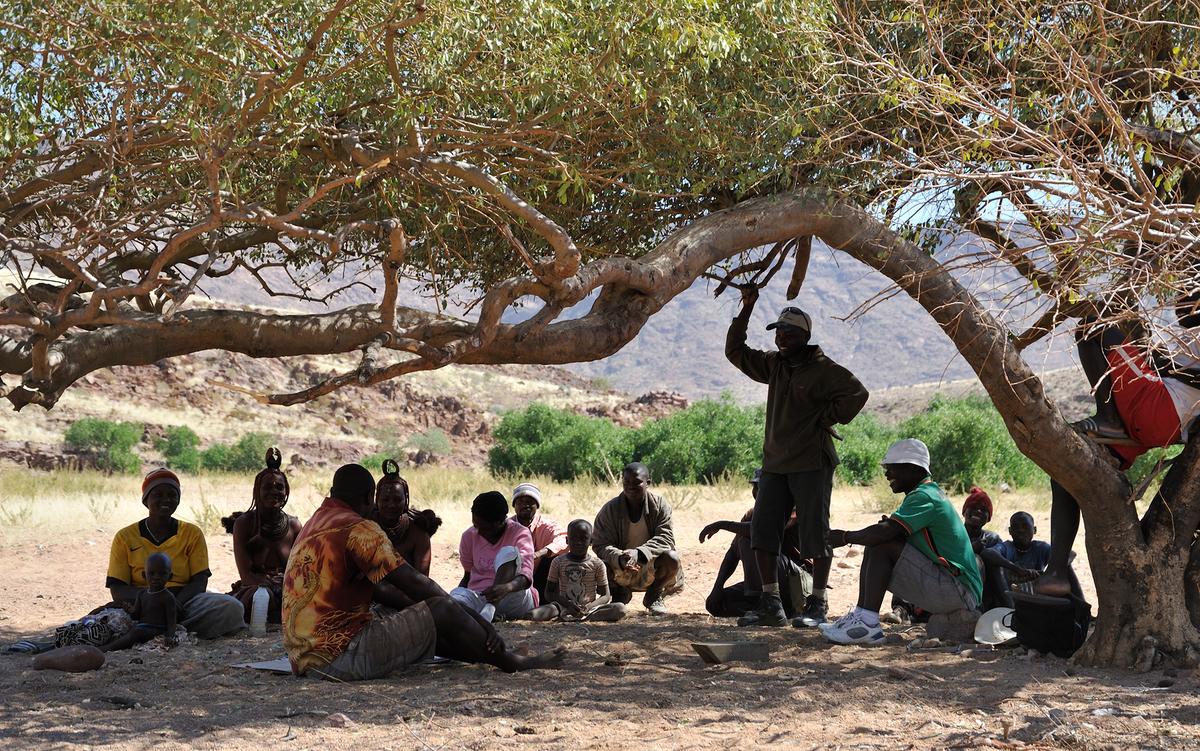 The tragedy of the commons is a false and dangerous myth | Aeon Essays
- #[[tragedy of the commons]] is a false and dangerous myth
- Quotes
- Even before Hardin’s [[The Tragedy of the Commons]] was published, however, the young political scientist [[Elinor Ostrom]] had proven him wrong. While Hardin speculated that the tragedy of the commons could be avoided only through total privatisation or total government control, Ostrom had https://dlc.dlib.indiana.edu/dlc/handle/10535/3581" rel="noopener noreferrer">witnessed groundwater users near her native Los Angeles hammer out a system for sharing their coveted resource.
- The features of successful systems, Ostrom and her colleagues found, include clear boundaries (the ‘community’ doing the managing must be well-defined); reliable monitoring of the shared resource; a reasonable balance of costs and benefits for participants; a predictable process for the fast and fair resolution of conflicts; an escalating series of punishments for cheaters; and good relationships between the community and other layers of authority, from household heads to international institutions.
- [[Hardin]] compared wealthy nations to lifeboats that couldn’t accept more passengers without sinking. #[[scarcity mindset]]
- [[Hardin]] died in 2003, but the nonprofit Southern Poverty Law Center, alert to the longevity of his ideas, maintains his https://www.splcenter.org/fighting-hate/extremist-files/individual/garrett-hardin" rel="noopener noreferrer">profile in its ‘extremist files’ and classifies him as a white nationalist.- The Network State
- a million-person network state that owns a global archipelago of physical territory could start as a one-person startup society
- 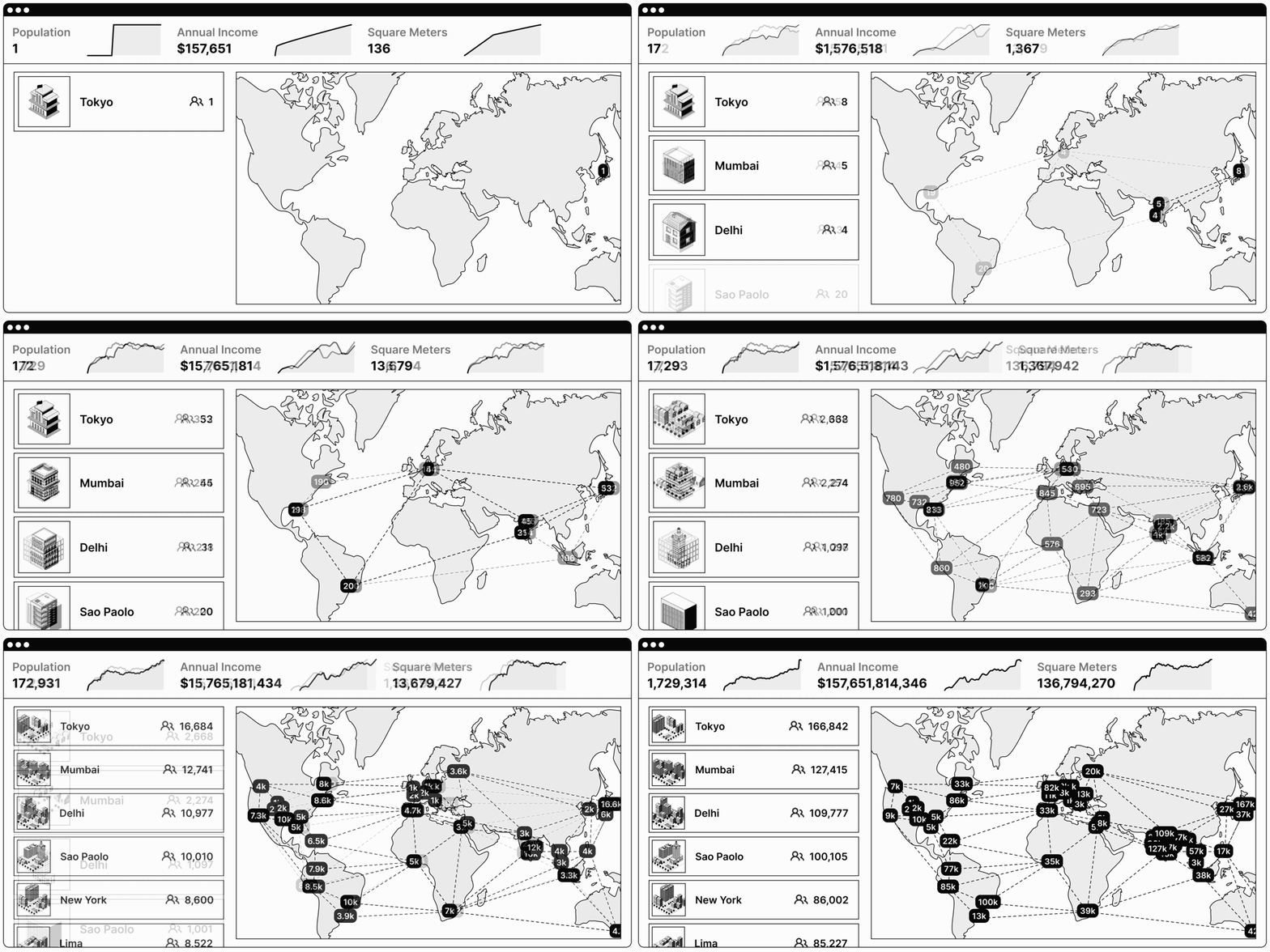
- Quotes
- A network state is a highly aligned online community with a capacity for collective action that crowdfunds territory around the world and eventually gains diplomatic recognition from pre-existing states.  Home
Home-
 The Open Source Distributor Business Model
- Abstract
- This article defines and discusses one particular commercial open source business model, called the (open source) distributor model. It has been popularized by Linux distributors like SUSE and Red Hat and is one of two business models that can attract significant venture capital, thereby contributing to the long-term sustainability of open source.
- A Heritage Vancouver Event Space | The Permanent
- [[Internet Archive Canada]] office on Pender Street
- !image.png
- > Erected a century ago, the venue is named after the BC Permanent & Loan Company, which first opened its’ doors in 1907. In 1935, the Bank of Canada called this place home, leaving it's mark for decades to come. Recently, The Permanent was completely restored, bringing a landmark, heritage space back to the community. http://www.thepermanent.ca/the-space
-
- science.sciencemag.org
- Abstract
- The population problem has no technical solution; it requires a fundamental extension in morality.
- See also the page #[[tragedy of the commons]] which summarizes what other people often mean
- - devonzuegel.com
- Description
> So, you’ve been invited to an unconference! Maybe you’re not entirely sure what that means (did the organizers misspell "conference"?), or maybe you’ve been to dozens of these before and you’re looking for some ideas for how to run an awesome session.
>
> This blog post will be a quick primer on what an unconference is, and then we’ll share some tips on how to make a session excellent, both as the host and as a participant. - The Unreasonable Sufficiency of Protocols | Summer of Protocols
- Large list of authors:
- Venkatesh Rao, Tim Beiko, Danny Ryan, Josh Stark, Trent Van Epps, Bastian Aue
- Thanks to Hasu, Micah Zoltu, Matt Garnett, Vitalik Buterin, Ben Edgington, Alex Stokes, and Josh Davis for helpful discussions.  The Web3 Decentralization Debate Is Focused on the Wrong Question
- Fixating on the degree—rather than the type—of decentralization is leading us astray.
- The World After Capital
- Technological progress has shifted scarcity for humanity. When we were foragers, food was scarce. During the agrarian age, it was land. Following the industrial revolution, capital became scarce. With digital technologies scarcity is shifting once more. We need to figure out how to live in The World After Capital in which the only scarcity is our attention.
 Camp | Betaworks
- [[Fermat]]
- Fermat is a programmable spatial canvas that augments traditional workflows like brainstorming , copywriting or project management using Generative AI.
- [[Gems Notes]]
- Gems is a self-organizing whiteboard that clusters and connects sticky notes with AI.
- [[Kosmik]]
- The infinite canvas web browser.
- [[Maestro AI]]
- Unlocking the knowledge in team conversations.
- [[Sane]]
- Sane is a social tool for thought that combines personal knowledge management and publishing into a collective playground for thinkers
- [[Second Voice]]
- The artificially intelligent voice in your head.
- [[Softspace]]
- Softspace is an AR knowledge map that shows you the true shape of your ideas.
- [[Startupy]]
- Startupy is a network for people in love with interesting ideas to curate and connect the best knowledge on the Internet.
- [[Subconscious]] / [[Noosphere]]
- Making the whole internet a Tool for Thought Threads • Log in
Facebook/Meta's microblogging platform. Has [[ActivityPub]] compatibility, individual users can opt-in to have their accounts federate.
- GitHub - bmann/tiddlywiki-static-publish: A set of scripts / Github Actions for Static Site Publishing for #TiddlyWiki
- This script actively runs my #FoodWiki, usually through [[Publishing a static TiddlyWiki from mobile]]
- It takes a single file #TiddlyWiki and the [[TiddlyWiki/Static Sites]] process in GitHub Actions so that you have individual pages and direct links for all tiddlers in your wiki
- https://github.com/bmann/tiddlywiki-static-publish" rel="noopener noreferrer">README
- A set of scripts designed to work with Github Actions for Static Site Publishing for TiddlyWiki.
- Overview
- Update a single file TiddlyWiki and check it into git, and the Github Action here will generate a static version of the site.
- This static site will have your default home page atindex.html(at the root of your site) and all of the tiddlers will be atYOURNAME.github.io/REPO/my-tiddler.html, orexample.com/my-tiddler.htmlif you have mapped a custom domain.
- Instructions
- Fork this repo
- Edit the shadow tiddler$:/core/templates/static.template.htmlto remove thestatic/prefix in the macro tv-wikilink-template
- Check in your own single file wiki -- the defaultbuild.shexpects it to be namedindex.htmlbut you can call it whatever you like
- Add agh-pagesbranch -- can be empty, it is overwritten on publish
- Set Github Pages settings to publish from thegh-pagesbranch
- If you set up your single file wiki with a Github Git saver, whenever you save, a new version of your site will automatically be built and published.
- Acknowledgements
- Thanks to [[Saq Imtiaz]] for the build script and general support and good energy!
- Uses https://github.com/JamesIves/github-pages-deploy-action" rel="noopener noreferrer">JamesIves/github-pages-deploy-action as the final step in the action, inspired by https://github.com/pengx17/logseq-publish" rel="noopener noreferrer">pengx17/logseq-publish.
- Extended discussion on the https://talk.tiddlywiki.org/t/rfi-github-actions-static-publishing-script/5203" rel="noopener noreferrer">Talk TW forum »  TiddlyWiki v5.4.1
## TiddlyWiki Talk
Community Discourse forum that I helped set up and maintain at <https://talk.tiddlywiki.org>
## Drag and DropTiddlyWiki includes support for drag and drop between different TiddlyWiki sites
https://tiddlywiki.com/static/Drag%2520and%2520Drop.html" rel="noopener noreferrer">Feature: Drag and Drop)
<iframe width="560" height="315" src="https://www.youtube-nocookie.com/embed/axgRphzRPMU?si=yNeJTy5o2k125UDa" title="YouTube video player" frameborder="0" allow="accelerometer; autoplay; clipboard-write; encrypted-media; gyroscope; picture-in-picture; web-share" referrerpolicy="strict-origin-when-cross-origin" allowfullscreen></iframe>
- tiles.run
For sensitive knowledge work, from client strategy to research you cannot put in the cloud: run models locally, sync chats P2P, and share via atproto while your data and identity stay private.
Uses atproto, [[Iroh]], [[UCAN]] and a few other interesting things.
- home.bmann.ca
I run a [[Lenovo M900 Tiny]] as my main "home lab" compute. It has a (freemium) [[Cloudron]] install on it, meaning it's limited to 2 apps.
* January 2024: [[Lenovo m900 Tiny Setup]]
* [[Surfer]] install at <https://home.bmann.ca>
* December 2024: Using it for music [[Ampache TinyHome Install]]  Tito
Titohttps://ti.to" rel="noopener noreferrer">Ti.to is a flexible ticketing and event platform with great APIs.
Good for more complicated events with multiple ticket tiers, discounts, speaker tickets, merch add ons, etc.
There is https://ti.to/pricing" rel="noopener noreferrer">no recurring charge for the platform, they take a percentage of fees you charge through [[Stripe]].
- Tom Sherman | Principal Software Engineer
Creator of [[Frontpage]]
Runs a lot of things on [[Fly.io]], like [[PDS on Fly]]
 Interdependent Thoughts – by Ton Zijlstra
## About
> Blog https://www.zylstra.org/blog" rel="noopener noreferrer">Interdependent Thoughts maintained since 2002 by Ton Zijlstra.
>
> European citizen in a networked world. Based in the Netherlands, living in Europe, working globally. There are no Others. There is just me and many of you.
>
> I write about how our digital and networked world changes how we work, learn, decide and organize. I explore the tools and strategies that help us navigate the networked world. I am passionate about increasing people's ability to act (knowledge), and their ability to change (learning). Key-words: open data, open government, fablabs, making, complexity, networked agency, networked learning, ethics by design. The knowledge layer for collective intelligence
The streamlined toolkit for vibe coding over your data
Vibe coders use the Tonk CLI to turn their data into custom dashboards, tools & agents.
Pull in files, notes, web data — then create freely, without backend headaches.
---
Tonk's mission is to create a world in which people are free to build their own software and collaborate over their own networks.
AI is fuelling a surge of creative technologists crafting personal tools bespoke to local contexts - where working with data feels as intuitive as molding putty.
But for symbiotic software to evolve at the speed of thought, we need better data infrastructure that's lightweight, flexible and interoperable.
As the web fragments into unique digital worlds, we envisage a cryptographic, maximally-interoperable data-sharing network that connects us without losing our organic diversity.
That's the new internet we're building.
## Tech Stack### Keepsync
<https://tonk-labs.github.io/tonk/keepsync.html>
Keepsync is our local-first sync engine that provides real-time collaboration and local-first data management for Tonk applications. It uses [[Automerge]] CRDTs under the hood to enable automatic conflict resolution when multiple users edit the same data, and when working offline.
---
Part of a [[Malleable Software]] trend.
- Your Twitter archive
My personal Twitter Archive -- everything posted to https://twitter.com/bmann" rel="noopener noreferrer">my @bmann Twitter account -- is at <https://tweets.bmannconsulting.com>.
> The API is defunct, so the below no longer works, but I have my copy in github pages.
---
It is powered by TAGS aka [[Twitter Archiving Google Sheet]]
I set it up a long time ago, and it has worked reliably ever since. It runs from my Google Account, is linked to my Twitter account to pull my archive and then it publishes it to my Github account, which uses Github Pages to publish and host <https://tweets.bmannconsulting.com>.
Martin's post [[Keeping your Twitter Archive fresh and freely hosted on Github Pages]] has all the instructions to set this up for yourself.
 TAGS – TAGS – Twitter Archiving Google Sheet
Michael Hawksey's "Twitter Archiving Google Spreadsheet" aka TAGS.
Uses the Twitter API, a Google Sheets add-in script, and various options to archive and post Twitter content, including to Github Pages.
- TypeSense Showcase Recipe Search
Showcase of using [[TypeSense]] search to search a ~2M recipe data set which is stored as structured data.
From the https://github.com/typesense/showcase-recipe-search" rel="noopener noreferrer">Github README:
> This search experience is powered by Typesense which is a blazing-fast, open source typo-tolerant search-engine. It is an open source alternative to Algolia and an easier-to-use alternative to ElasticSearch.
>
> The recipe dataset is from https://github.com/glorf/recipenlg" rel="noopener noreferrer">Glorf/recipenlg 🙏!
>
> The dataset is 2.2 GB on disk, with ~2.2 million rows. It took 8 minutes to index this dataset on a 3-node Typesense cluster with 4vCPUs per node and the index was 2.7GB in RAM.
>
> The app was built using the Typesense Adapter for InstantSearch.js and is hosted on S3, with CloudFront for a CDN.
>
> The search backend is powered by a geo-distributed 3-node Typesense cluster running on Typesense Cloud, with nodes in Oregon, Frankfurt and Mumbai. - UniFi Dream Machine
All-in-one UniFi Gateway and access point designed to support LAN and WiFi networks.
 UKAI Projects | Discover. Create. Engage.
UKAI Projects is a federally incorporated non-profit cultural organization based in Canada and operating globally.
Our mission is “culture for what’s coming”.
## AboutFrom the https://ukaiprojects.com/pages/about" rel="noopener noreferrer">About page
Although often invisible, culture shapes the ways in which we perceive and interact with the world around us. Culture includes:
- beliefs and values
- customs
- symbols and language
- objects and spaces
- institutions
- art and literature
- technology and tools
- rituals<mark>…we seek and test out approaches to culture that make sense of the world we are creating and handing down to future generations.</mark>
We call this work <mark>cultural research and development, and just like R&D in other fields, we are trying to make things better. In our case, we are trying to build resilience to massive volatility and change.</mark>
Different groups will insist that they hold special, privileged knowledge of what these changes mean. Social media encourages us to take sides. But we shouldn't confuse these maps with the terrain.
As human beings we can't help but make meaning out of the experiences of our lives. We can allow for pre-existing ideologies to do the work of telling us what’s going on. Or we can do the work ourselves of assembling from events some coherent picture, and then become answerable for what happens next.
Life is simpler when there are two or three stories to choose from. However, there are infinite stories we might tell, as varied as we are.
The risk is letting things get rigid and this rigidity is what we are responding to.
## Events
Creator listing https://www.eventbrite.ca/o/ukai-projects-26425493607" rel="noopener noreferrer">on Eventbrite
- uMap - Online map creator
- "lets you create maps with [[OpenStreetMap]] layers in a minute and embed them in your site."
- Open source under [[WTFPL License]], runs on [[Django]] and [[Leaflet]].
l
- Via https://mastodon.social/@Le_bottin_des_jeux_linux/105810572439210497" rel="noopener noreferrer">Mastodon - www.niemanlab.org
- Seen via the [[Sentiers]] https://sentiers.memberful.com/join" rel="noopener noreferrer">member sign up page
- > Members’ https://sentiers.media/dispatches/" rel="noopener noreferrer">Dispatches are only sent to members but are available to everyone on the site, in alignment with the principle of the https://www.niemanlab.org/2019/01/unlocking-the-commons/" rel="noopener noreferrer">unlocked commons, and to participate in a more open web.
- Quotes
- Fans support the person and the work. But it’s not a transaction, a fee for service. It’s a contribution that benefits everyone. ==Free-riders aren’t just welcome; free-riding is the point.== This, I think, is key to understanding the psychology of patronage.
- The most economically powerful thing you can do is to buy something for your own enjoyment that also improves the world. This has always been the value proposition of journalism and art. It’s a nonexclusive good that’s best enjoyed nonexclusively.
- The most powerful and interesting media model will remain raising money from members who don’t just permit but insist that the product be given away for free. The value comes not just what they’re buying, but who they’re buying it from and who gets to enjoy it.
- The bigger those two pools get — the bigger the membership, and the bigger the audience — the better it gets for everyone. This is why we need more tools, so more people can try to do it. PBS as a service.
-  Unnamed Good Podcast (@unnamedgoodpod) • Activity
A podcast that I did with Serena & Max from [[1RG]]. Using [[Castopod]] hosted at [[CoSocial]].
## EP01: Introducing Unnamed Good Pod, 1RG Incubator, and AT Protocol<iframe width="100%" height="112" frameborder="0" scrolling="no" style="width: 100%; height: 112px; overflow: hidden;" src="https://podcasts.cosocial.ca/@unnamedgoodpod/episodes/introductions-1rg-incubator-and-at-protocol/embed/light"></iframe>
The first episode of Unnamed Good Pod.
We introduce ourselves
Max and Serena introduce [[1RG]] space & community in Toronto, and describe the new https://incubator.1rg.space/" rel="noopener noreferrer">1RG Incubator.
Boris goes deep on [[atproto]], the open social protocol that powers Bluesky and other apps.
## Mentions and Links
[[UKAI]] talking about cultural R&D:
> At UKAI, we seek and test out approaches to culture that make sense of the world we are creating and handing down to future generations.
>
> We call this work cultural research and development, and just like R&D in other fields, we are trying to make things better. In our case, we are trying to build resilience to massive volatility and change.Erin Kissane, saying we can't just have technologists retreat to cozy web spaces that THEY are capable of inhabiting, writing in https://www.wrecka.ge/against-the-dark-forest/" rel="noopener noreferrer">Against the Dark Forest:
> The public social internet is worth designing and governing in a way that demonstrates less than total amnesia about the history of human civilizations and the ways we’ve learned to be together without killing each other. For people with the ability and willingness to work on network problems, the real choice isn't between staying on the wasteland surfaces of the internet and going underground, but between making safer and better places for human sociability and not doing that.
The https://atproto-browser.vercel.app/" rel="noopener noreferrer">ATProto Browser lets you look at the data in your user repo. You'll see Bluesky posts if that's all you've tried, but as an example https://recipe.exchange/" rel="noopener noreferrer">Recipe Exchange is an app that stores recipes in your account. This very much demonstrates user-owned data.
You can https://atproto-browser.vercel.app/at/bmann.ca" rel="noopener noreferrer">browse Boris' account to get a sense for different types of data.
 The Homelab OS for Storage, Docker & VMs
> Unraid is an operating system for network-attached storage that lets you use what you have to build the server you want. Mix and match drives, securely store and share data, and manage VMs and Docker applications—all from a powerful, web-based interface.
The installation and operation is via a USB stick, which just seems great versus dealing with wiping drives and partititions.
Most interesting to me is running Windows in a VM. You can pass through a graphics card to enable gaming or video editing.
I don't want to manage a dedicated Windows box, and also don't want to dual boot and take down a Linux server, so this seems ideal.
I bought a licene and a test install on [[MiniPC Z-Space Server]], which isn't quite the right hardware for a Windows VM, because it doesn't have good graphic card options.
 Unternet: Building a new, intelligent client for the web
A new, intelligent client for the web that is LLM agent based. Creator of the [[Web Applets]] open source specification.
Founded by [[Rupert Manfredi]]
---
Part of [[Malleable Software]]
- Using Gmail SMTP with Cloudflare Email Routing: A Step-by-Step Guide
The key part of this is that you need to add your routed email address as a new account in gmail, uncheck "treat as an alias", and then use a Gmail app password in the "send as" details for SMTP.
https://security.google.com/settings/security/apppasswords" rel="noopener noreferrer">Create a new app password here
Finally, you need to modify the SPF record to include Google:
```
v=spf1 include:_spf.mx.cloudflare.net include:_spf.google.com ~all
```And set a DMARC record:
```
v=DMARC1; p=none; rua=mailto:<your-email-to-report>
``` - UTM
Virtualization for MacOS and iOS that uses Apple’s hypervisor framework.
A UI and convenience wrapper around QEMU.
## MacOS
As well as running other operating systems, can also virtualize MacOS.
> UTM employs Apple's Hypervisor virtualization framework to run ARM64 operating systems on Apple Silicon at near native speeds. On Intel Macs, x86/x64 operating system can be virtualized. In addition, lower performance emulation is available to run x86/x64 on Apple Silicon as well as ARM64 on Intel. For developers and enthusiasts, there are dozens of other emulated processors as well including: ARM32, MIPS, PPC, and RISC-V. Your Mac can now truly run anything.
### What's the difference in the Mac App Store version?
UTM is and always will be completely free and open source. The Mac App Store version is identical to the free version and there are no features left out of the free version. The only advantage of the Mac App Store version is that you can get automatic updates. Purchasing the App Store version directly funds the development of UTM and shows your support .
## iOS
Runs on iOS through jailbreak or sideloading with an Apple Developer account.
From the https://getutm.app/faq/" rel="noopener noreferrer">FAQ:
UTM is an app for running other operating systems on your iPhone or iPad. It is not for running iOS on other systems. This allows you, among other things, to run Windows or Linux on your iOS device at a usable speed.
### How does UTM work?
The majority of the work is done by https://www.qemu.org/" rel="noopener noreferrer">qemu. Because iOS devices lack hardware virtualization support, we cannot use the KVM accelerator and instead use the TCG accelerator which does dynamic code translation and JIT compilation. UTM also includes a https://www.spice-space.org/" rel="noopener noreferrer">SPICE client written for Metal. This connects with the SPICE server in qemu and allows for some para-virtualization as the QXL graphics driver running on the guest OS can send low-level draw commands directly to Metal APIs.
For more in-depth information on the changes made to qemu for JIT to work on iOS, check out https://github.com/utmapp/qemu/blob/ios-support/docs/devel/ios.rst" rel="noopener noreferrer">this document.
### What are the limitations?
The lack of hardware virtualization on Apple A-chips means that even for ARM code we must re-compile it with JIT. Therefore performance would never reach the levels possible with KVM. There is also no support for GPU virtualization so that means no DirectX or OpenGL. This makes most modern games non-playable.
- Vaden Masrani | about
> I am the CEO of https://www.sophiaconsulting.ai/" rel="noopener noreferrer">Sophia Consulting. Previously I was a Senior Research Scientist at Huawei Technologies Canada, working in the area of machine learning and artificial intelligence. I completed my Ph.D (https://open.library.ubc.ca/soa/cIRcle/collections/ubctheses/24/items/1.0430543" rel="noopener noreferrer">evidence) at the University of British Columbia as a member of the https://plai.cs.ubc.ca/" rel="noopener noreferrer">PLAI lab under the supervision of https://www.cs.ubc.ca/~fwood/index.html" rel="noopener noreferrer">Frank Wood. My CV is https://vmasrani.github.io/assets/pdf/vmasrani_resume_2025.pdf" rel="noopener noreferrer">here.
>
> Before this, I was supervised by http://www.cs.ubc.ca/~carenini/" rel="noopener noreferrer">Giuseppe Carenini in the https://www.cs.ubc.ca/cs-research/lci" rel="noopener noreferrer">Laboratory for Computational Intelligence where I completed my M.Sc. in artificial intelligence. I have also had the good fortune of working with http://www.cs.ubc.ca/~siamakx/" rel="noopener noreferrer">Siamak Ravanbakhsh, https://emtiyaz.github.io/" rel="noopener noreferrer">Emtiyaz Khan, and https://www.phas.ubc.ca/users/colin-gay" rel="noopener noreferrer">Colin Gay in deep learning, approximate bayesian inference, and particle physics, respectively. 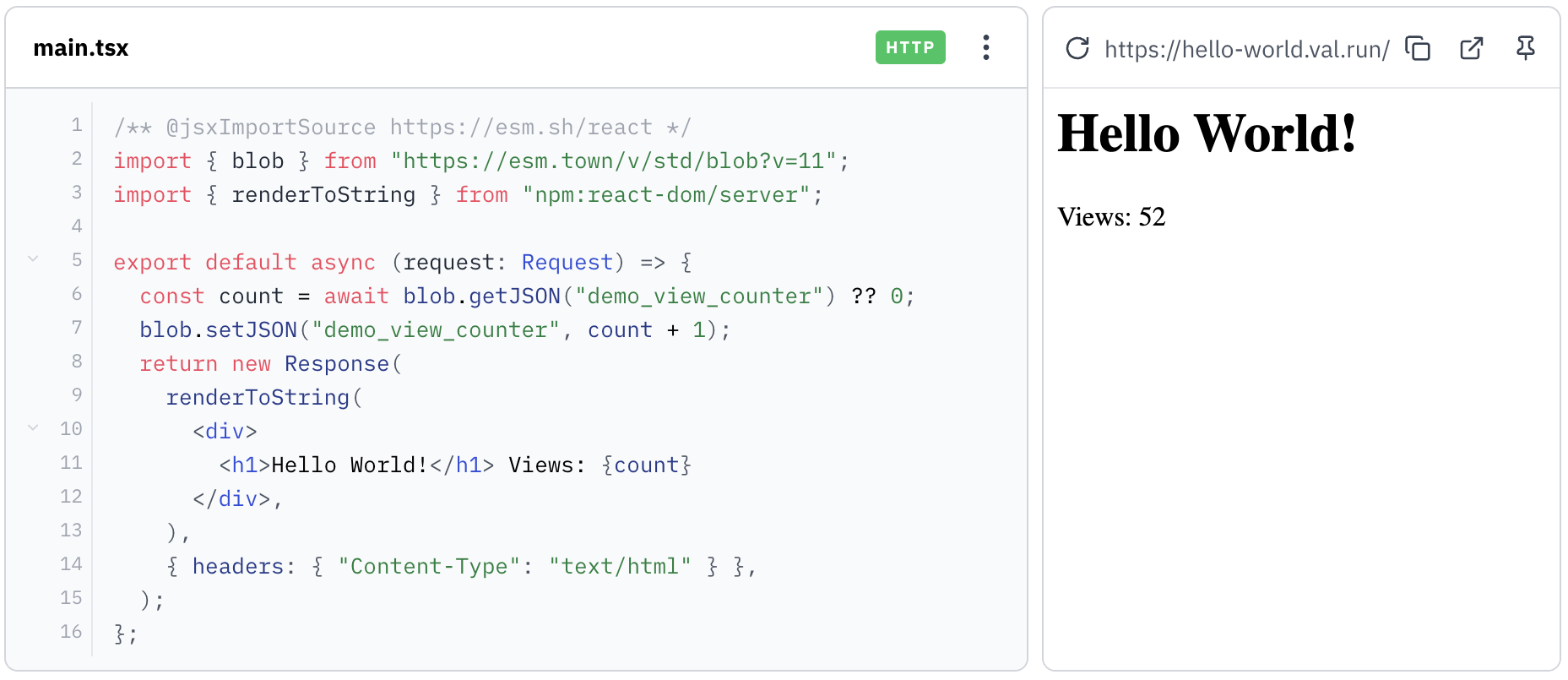 Val Town
- Val Town is a website for writing, running, and deploying scripts.
- Docs https://val-town.notion.site/Val-Town-Docs-01c8eb9c534b4899802f3a9e31d540ab
- Vancouver Startup Week 2026
I organized the first version of this in 2014, called Startup Week Vancouver at the time.
Other people stepped up in following years, including founding the Vancouver Startup Society as a non-profit association to run it.
## 2024The VSW team reached out and asked if I wanted to host an event this year. With [[Ian Vanagas]], I'm hosting [[Smart Young BC VSW 2024]].
## Vancouver Startup Society
> The initiative is organized by the non-profit Vancouver Startup Society. We are proud to enjoy a relationship with Techstars, one of the premiere startup accelerator programs in the United States and whose great team coordinates Startup Weeks in every part of the globe.
https://www.vanstartupweek.ca/about/" rel="noopener noreferrer">VSW About
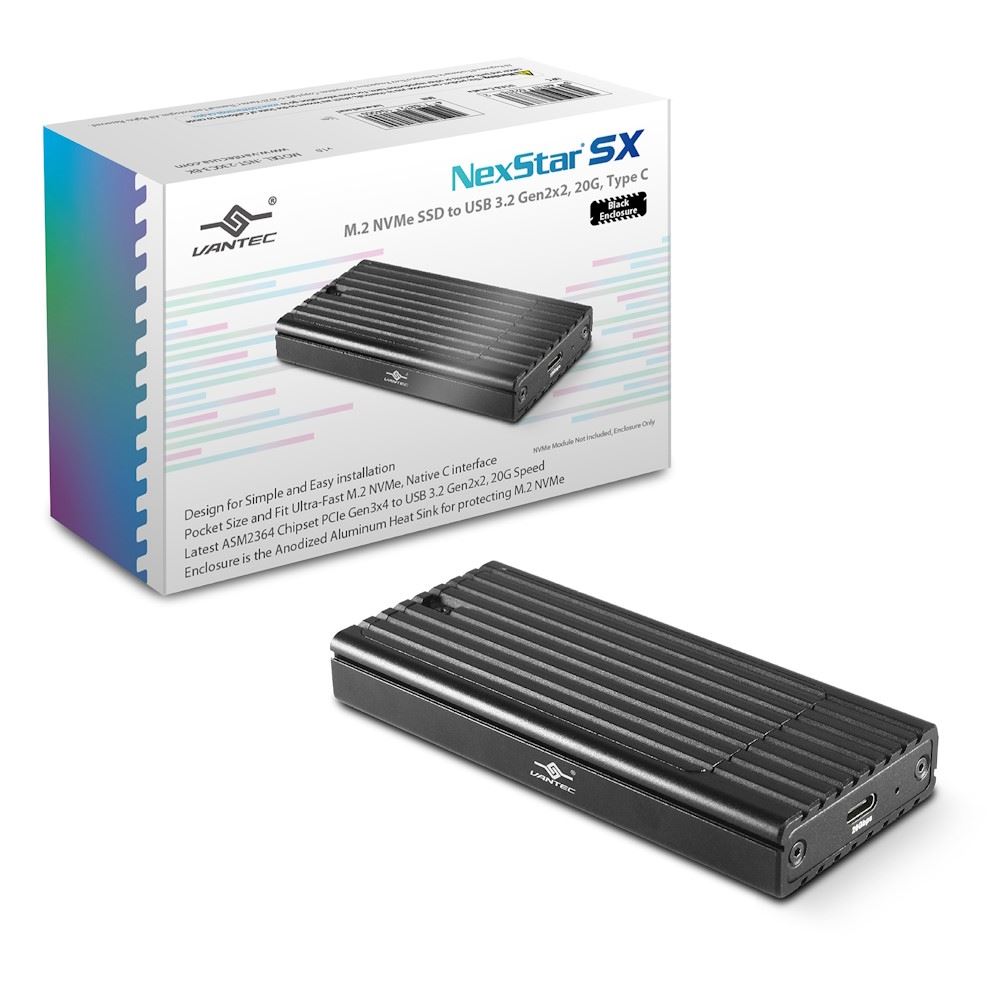 NexStar SX, M.2 NVMe SSD to USB 3.2 Gen2x2, 20G, Type C, Black Enclosure
!Box and unpacked enclosure with a Memory Express watermark
Bought at [[Memory Express]] as https://www.memoryexpress.com/Products/MX77615" rel="noopener noreferrer">this product.- venturescouts.ca
I ran Venture Scouts as a project and mini community for founders and angel investors to support each other.
The initial concept was that perhaps we could create an early stage fund and equip young people with a diverse background to be scouts in their hyper regional area of Canada: looking for startup founders, equipping them with education, access, referrals and so on, as well as writing extremely small investments: like $10K. But using that as a catalyst to get setup properly, and spur other angels to also write cheques. Effectively acting as a lead.
This was a model that Boris was successful with at [[Full Stack]], but at the time syndicates weren’t really possible.
Why? Well, we need to completely reboot and re-invigorate angel investing in Canada, and so we should support the next generation to help with this.
There was a Discourse forum which I did a bad job of archiving, the static files are at <https://venturescouts.ca>
This name might get revived to apply to [[Founder Peer Investing]].
- Viral Effects Are Not Network Effects
> Virality and network effects are conflated by even experienced Founders, and it keeps them from having the right strategies and developing world-class products.
>
> Viral effects and network effects are two completely different things.
>
> Viral effects are about growth of new users. Viral effects are when you get your existing customers to get you more new customers, ideally for free.
>
> Network effects are about adding value and defensibility to your product. A network effect is when every customer of your product adds incremental value to all the other customers of your product so that it becomes difficult for customers to find any alternative product which gives them as much value.
>
> Viral effects can exist without network effects, and network effects can exist without viral effects.
>
> Further, there are very different playbooks and mental models for building virality vs network effects. Not understanding the distinctions will be detrimental to your company’s long term success.---
> Yet at the same time, we learned how much less important viral effects are to long-term value creation than https://www.nfx.com/post/defensibility-most-value-for-founders/" rel="noopener noreferrer">defensibilies like network effects.
> While viral effects are a useful attribute of products to reduce the expense of acquiring new users, https://www.nfx.com/post/70-percent-value-network-effects/" rel="noopener noreferrer">network effects remain the key driver of value creation for startups in the digital age by keeping people using them.
By [[James Currier]], [[NFX]], https://www.nfx.com/post/viral-effects-vs-network-effects/
 VisionTek VT2900 USB-C KVM Docking Station | Dual System Dock | DP Alt Mode | Dual Display | 100W Power Delivery | 130W Power Adapter Included | Best For Windows
USB-C Dual System KVM Docking Station with 100W Power Delivery
## Front Ports:
1 x 3.5mm Mic/Audio Combo Jack
2 x USB-C 5Gbps BC 1.2 Ports
1 x USB-A 5Gbps BC 1.2 Port
PC1 Indicator LED
PC2 Indicator LED
Power / Switch Button
## Back Ports:
DC Power Supply In Port
PC2 USB-C Upstream Port
PC1 USB-C Upstream Port
1 x 3.5mm Switching Port
1 x DisplayPort 1.4
1 x HDMI 2.0
Gigabit Ethernet
2 x USB-A 5Gbps
 VisionTek | USB-C Docking Stations, SSDs, Memory & PC Accessories
- Founded in 1988, VisionTek remains true to its suburban Chicago roots with offices in East Dundee and Schaumburg, IL, USA.
- VisionTek's rich history shaped the company into what it is today. Currently, VisionTek is focused on expansion of new products to diversify, compliment, and balance our core PC product lines. VisionTek continues to offer state-of-the-art PC graphics cards, docking stations, video wall solutions, video cables, memory, and solid-state drives, but has expanded the product offering to better serve the computing industry. The VisionTek product line also includes cables and adapters, power supplies, keyboards, mobile accessories, portable audio products and more.- Viznut Eternal September
> “Today, the 16th day of January 2021, is the ten-thousandth day of September 1993”
– http://viznut.fi/texts-en/10000-en.html" rel="noopener noreferrer">viznut explains the concept of [[Eternal September]]:> In the beginning of the 1990s, the Internet had not yet been commercialized, and most of its users were academic. On-line discussion was disciplined and civilized (at least compared to the later standards) – except in Septembers. Every September, academic institutions got new students who took some time to adopt the new technology and the related rules of behavior.
>
> In 1993, however, it started to be easier to access the Internet from outside the academic world. In the United States, America Online granted its user the access to the Usenet newsgroups in September 1993, and this was also the year when teenager-accessible service providers like Sci.fi and Freenet Finland were established in my country. Non-academic on-line behavior became an everyday phenomenon; September 1993 never ended.---
> The methods of user interface psychology, currently used for turning people into stupid and unattentive livestock for marketing use, could very well be used for opposite goals: to encourage wise and focused Internet use even when there is plenty of available online time. To select wisely instead of merely following the gut reaction.
>
> Social media mechanisms could, for example, ask the users choose the best material from the last week or month – something particularly invigorating, interesting, important, transformative or otherwise worth attention. The algorithms could give good scores to the kind of content that speaks to many kinds of people across bubble borders. There could also be non-hurried discussion forums that would make the new messages visible only once per day, for instance. This would be a kind of environment maybe even worthy for politics.---
Also https://blog.bmannconsulting.com/2021/01/18/today-the-th.html" rel="noopener noreferrer">posted to my blog [[January 18th, 2021]].
- VNotes Format
My own blog post, originally on Medium and now permanently on my microblog:
> vNotes: A note sync format across devices & systems
>
> Today we have [[vCards]] for person & business contact data, and [[CardDAV]] for syncing and sharing. For calendar data we have [[vCal]] and [[CalDAV]].
>
> This means that CRMs, for example, can link data to your calendar and your contacts. Any changes can get synced to the native contacts and calendar in your phone or calendar.
>
> But what about notes? - James Walker
walkah is a long time open source developer who doesn't blog any more. I have worked with him multiple times, starting with founding [[Bryght]] back in 2004 and most recently we worked together at [[Fission]].
- Farcaster
A Twitter-like social network app built on top of the [[Farcaster]] protocol, by the creators of the Farcaster protocol.
## Warps
They recently added Warps, a points system that can unlock various things.
You use Warps to pay for invites, linking other apps, and creating channels.
They charge for Warps by taking payment via [[Coinbase Commerce]].
## Channels
Channels recently got launched, that are a bit like Subreddits.
 Watchtower
- About
- A process for automating Docker container base image updates.
- Web Annotation Standard
The https://www.w3.org/TR/annotation-model/" rel="noopener noreferrer">Web Annotation Data Model is the [[W3C]] recommendation from February 2017. [[Hypothes.is]] wrote a https://web.hypothes.is/blog/annotation-is-now-a-web-standard/" rel="noopener noreferrer">blog post about the official standard being finalized.
> Annotations are typically used to convey information about a resource or associations between resources. Simple examples include a comment or tag on a single web page or image, or a blog post about a news article.
>
> The Web Annotation Data Model specification describes a structured model and format to enable annotations to be shared and reused across different hardware and software platforms. Common use cases can be modeled in a manner that is simple and convenient, while at the same time enabling more complex requirements, including linking arbitrary content to a particular data point or to segments of timed multimedia resources.
>
> The specification provides a specific JSON format for ease of creation and consumption of annotations based on the conceptual model that accommodates these use cases, and the vocabulary of terms that represents it.  Web Components - Web APIs | MDN
> Web Components is a suite of different technologies allowing you to create reusable custom elements — with their functionality encapsulated away from the rest of your code — and utilize them in your web apps.
 Fil One | S3 object storage built for the AI era
- A suite of tools for publishing to #IPFS and serving up via [[IPFS/HTTP Gateway]] at https://w3s.link
-- WebAssembly
> WebAssembly (abbreviated _Wasm_) is a binary instruction format for a stack-based virtual machine. Wasm is designed as a portable compilation target for programming languages, enabling deployment on the web for client and server applications.
## https://en.wikipedia.org/wiki/WebAssembly" rel="noopener noreferrer">Wikipedia
> WebAssembly (sometimes abbreviated Wasm) defines a portable binary-code format and a corresponding text format for executable programs as well as software interfaces for facilitating interactions between such programs and their host environment.
>
> The main goal of WebAssembly is to enable high-performance applications on web pages, "but it does not make any Web-specific assumptions or provide Web-specific features, so it can be employed in other environments as well." It is an open standard and aims to support any language on any operating system, and in practice all of the most popular languages already have at least some level of support.
>
> Announced in 2015 and first released in March 2017, WebAssembly became a World Wide Web Consortium recommendation on 5 December 2019 and it received the Programming Languages Software Award from ACM SIGPLAN in 2021. The World Wide Web Consortium (W3C) maintains the standard with contributions from Mozilla, Microsoft, Google, Apple, Fastly, Intel, and Red Hat.> As of December 2023, 99% of tracked web browsers (including mobile) support WebAssembly (version 1.0). But for older browsers, Wasm can be compiled into asm.js by a JavaScript polyfill.
- WebFinger
A way to attach information to an email address, or other online resource.
From https://tools.ietf.org/html/rfc7033" rel="noopener noreferrer">the official spec:
> WebFinger is used to discover information about people or other entities on the Internet that are identified by a URI using standard Hypertext Transfer Protocol (HTTP) methods over a secure transport. A WebFinger resource returns a JavaScript Object Notation (JSON) object describing the entity that is queried. The JSON object is referred to as the JSON Resource Descriptor (JRD).
>
> For a person, the type of information that might be discoverable via WebFinger includes a personal profile address, identity service, telephone number, or preferred avatar. For other entities on the Internet, a WebFinger resource might return JRDs containing link relations that enable a client to discover, for example, that a printer can print in color on A4 paper, the physical location of a server, or other static information. - Webmention
Webmention is a [[W3C]] Recommendation, and is an [[IndieWeb]] spec.
> Webmention is a simple way to notify any URL when you mention it on your site. From the receiver's perspective, it's a way to request notifications when other sites mention it.
I wrote about [[Run your own WebMentions]]
- weird.one
A personal website builder by the [[Muni Town]] team.
> The time has come to https://webdirections.org/blog/reweirding-the-web/" rel="noopener noreferrer">reweird the web! We're doing our little part by making a prosocial network based on the cornerstone of the internet:https://blog.jim-nielsen.com/2022/other-peoples-websites/" rel="noopener noreferrer">Personal websites.
 Hister | Your Own Search Engine
A personal search engine that indexes as you browse with a browser extension. You can run your own server, and multiple users have their indexes kept separate.
via @samantha.wiki
- WeServ
Image cache and resizing. You can use the hosted service directly to resize & crop images on the fly, or run a version of the open source code on your own server.
Example:
```html
<!-- images.weserv.nl/lichtenstein.jpg -->
<img src="//images.weserv.nl/?url=images.weserv.nl/lichtenstein.jpg&w=300&h=300">
```There is a Quick Reference page with all the arguments: https://images.weserv.nl/docs/quick-reference.html
And the Size page is likely to be the most widely used: https://images.weserv.nl/docs/size.html

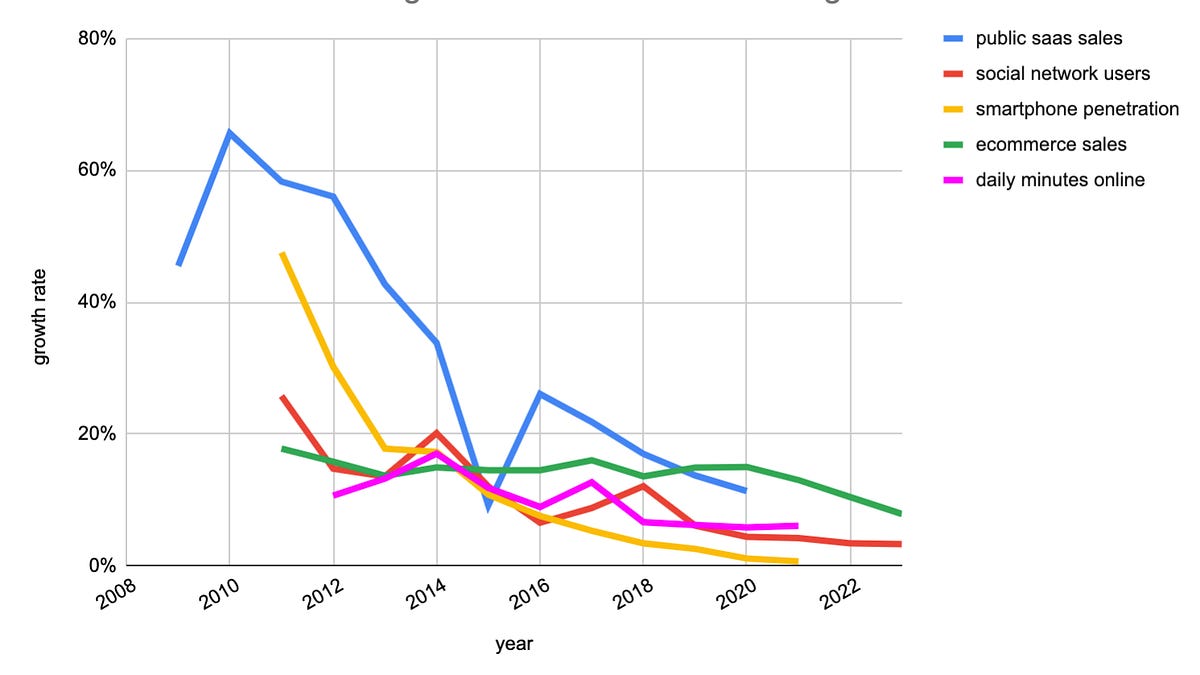 When Tailwinds Vanish
- The Internet tailwinds that propelled Silicon Valley’s meteoric growth for decades are stalling out. The ripple effects will jolt the tech industry.
- Like any mature industry, Silicon Valley must battle to maintain growth in the face of immense economic gravity. For the first time in Internet history, startup growth will require a push from the company and not a pull from the market. Unlike the organic pull that drove many of the dotcom-era successes, today’s Internet startups need to fight for growth by investing more heavily into sales, marketing, and operations.
- A shift from R&D to SG&A will operationalize Silicon Valley, leaving room for new financial infrastructure. VCs will need to take risks on vision, not numbers. And the founders and operators of tomorrow won’t look like those of the past 20 years.
- Software companies founded today are competing less with pen and paper than with other Internet-first incumbents. Put another way, as happens in every maturing industry before it, Internet company revenue will become zero-sum. As a corollary, the time between founding years of software startups and their competitive incumbents is shrinking:
- To pose the inverse of the opex reduction question: if you had an extra million dollars for your startup, where would you spend it?
- In the immature Internet era, a consumer Internet company would likely invest this money into R&D by hiring engineers, product managers, or designers.
- As a SaaS company, you’d spend an extra million to hire more sales reps or run a marketing campaign. These SG&A investments are a prerequisite to drive business growth. Relative to the R&D-driven growth of early Internet companies, SG&A will become the primary growth vector in the 2020s.
- For startups taking R&D risk in new technological areas, the founding team may look like something we can’t pattern match to historical successes. Maybe it’s a scientist in his garage who escaped the tendrils of academia. Or your first hire for the founding team is no longer your college roommate, but an expert in your startup’s industry.- When Tailwinds Vanish
https://blog.johnluttig.com/p/when-tailwinds-vanish" rel="noopener noreferrer">When Tailwinds Vanish has been a baseline article that I’ve shared with a lot of people.
I’ve picked out a bunch of quotes below that fit my thesis of deep tech startups, because that’s my interest and preference and the path we’re following with [[Fission]].
The focus of this article is on venture funded startups. I think the corollary is that a recurring revenue B2B SaaS startup is more likely to be in a long tail of software small business. 3-5 people building a profitable company but not having any of the growth metrics that traditional venture returns need.
This also supports the [[IndieVC]] hypothesis.
> Unlike the organic pull that drove many of the dotcom-era successes, today’s Internet startups need to fight for growth by investing more heavily into sales, marketing, and operations.
> A shift from R&D to SG&A will operationalize Silicon Valley, leaving room for new financial infrastructure. VCs will need to take risks on vision, not numbers. And the founders and operators of tomorrow won’t look like those of the past 20 years.
> Software companies founded today are competing less with pen and paper than with other Internet-first incumbents. Put another way, as happens in every maturing industry before it, Internet company revenue will become zero-sum.
> As the Internet growth tailwinds subside, what’s left? Harder problems.
> it will become clear that VC dollars should be reserved for R&D, not S&M or G&A.
> For startups taking R&D risk in new technological areas, the founding team may look like something we can’t pattern match to historical successes. Maybe it’s a scientist in his garage who escaped the tendrils of academia. Or your first hire for the founding team is no longer your college roommate, but an expert in your startup’s industry.
- WhiteWind atproto blog
A blog [[Lexicon]] definition for [[atproto]]
- swardley.medium.com
- Quotes
- Even in this serverless world, the act of programming still requires you to think about what component services need to be glued together. That means you have to break down the problem into components, find component services that match, determine what is missing and hence what you will need to build, then build it and glue it all together. That is still a lot of work to be done and to be blunt, it’s work that can mostly be automated and achieved through some form of intelligent compiler. This leads us to conversational programming.
- …programming will start to look more like a conversation between an engineer with an AI making recommendations for changes and addition of services. If you wish to see the future then a wondeful example of conversational programming can be found in the marvellous StarTrek Voyager and the https://www.youtube.com/watch?v=mNCybqmKugA" rel="noopener noreferrer">“Delete the wife” scene.
- I want you take a moment to think about this. The speed of one company with engineers building systems through conversational programming (i.e. a discussion with the system) versus the speed of a company whose engineers are messing around with containers and orchestration systems (such as kubernetes clusters) versus the speed of a company whose engineers are still wiring servers in racks. I want you to think about the Red Queen effect and realise that you will have no choice over this evolution.
- the main platform principles needed are build discrete components, build WITH discrete components and shift as much of the platform to utility providers.
-  Wiki.js
WikiJS is an open source wiki that can use a number of different storage engines, including syncing directly with a git repo.
Available on [[Cloudron]], see https://docs.cloudron.io/apps/wikijs/#git-storage" rel="noopener noreferrer">Cloudron WikiJS docs
- codeium.com
> The first agentic IDE, and then some. The Windsurf Editor is where the work of developers and AI truly flow together, allowing for a coding experience that feels like literal magic.
 Working Copy, Git on iOS
- The powerful Git client for iOS that clones, edits, commits, pushes & more
- Working Copy, Git on iOS
- The powerful Git client for iOS that clones, edits, commits, pushes & more

 WriteFreely
- An [[ActivityPub/Server]] focused on full length blogging. Uses the [[Activity Vocabulary/Article]] type for its posts by default.
- The company that maintains this also offers the [[Write As]] platform where people can pay for accounts
-- WriteFreely
- An [[ActivityPub/Server]] focused on full length blogging. Uses the [[Activity Vocabulary/Article]] type for its posts by default.
- The company that maintains this also offers the [[Write As]] platform where people can pay for accounts
- - Xe Iaso
I'm Xe Iaso, I'm a technical educator, https://xeiaso.net/talks/" rel="noopener noreferrer">conference speaker, https://twitch.tv/princessxen" rel="noopener noreferrer">twitch streamer, vtuber, and philosopher that focuses on ways to help make technology easier to understand and do cursed things in the process. I live in Ottawa with my husband and I do developer relations professionally. I am an avid writer for my https://xeiaso.net/blog" rel="noopener noreferrer">blog, where I have over 400 articles. I regularly experiment with new technologies and find ways to mash them up with old technologies for my own amusement.
- Xe Iaso
I'm Xe Iaso, I'm a technical educator, https://xeiaso.net/talks/" rel="noopener noreferrer">conference speaker, https://twitch.tv/princessxen" rel="noopener noreferrer">twitch streamer, vtuber, and philosopher that focuses on ways to help make technology easier to understand and do cursed things in the process. I live in Ottawa with my husband and I do developer relations professionally. I am an avid writer for my https://xeiaso.net/blog" rel="noopener noreferrer">blog, where I have over 400 articles. I regularly experiment with new technologies and find ways to mash them up with old technologies for my own amusement.
- XLC Building Blocks
- I'm going to liberally quote the main bits of this in order to get to the highlighted bit at the bottom
- From the article
- ## Sublicenses
- Owners of copyrights and patents can also allow those they license to license others in turn. A license given by someone who also has a license is called a sublicense.
- Remember our running app example. Users need license for my copyright in the original app, as well as your copyright in your new code. Users could get license for each copyright from its owner: you could license your copyright in the app, and I could license mine.
- Thanks to sublicensing, license for a copyright or patent doesn’t have to come directly from the owner. If I license you to use, copy, and share my copyright in my original app, and also give you permission to sublicense others to do the same, you can license both copyrights in your new version of my app. You can license your copyright because you own your copyright. You can sublicense my copyright in the app because I licensed you to sublicense.
- ## Cross-Licenses
- When two owners of intellectual property rights license each other, we call it a cross-license.
- Remember our running app example again. If I license you to use, copy, and share my copyright in my original app, and also give you permission to sublicense others, you can license both copyrights in your new version of my app. However, I can only license my copyright, not yours.
- If you license me for your copyright, as I license you for mine—if we cross-license our copyrights in your new version of my app—then we can both license all the copyrights in your new version of the app.
- ## Cross-License Collaboratives
- Contributor license agreements as we know them today work like the example in [Sublicenses](). One person or organization, usually a company or foundation, can license all the contributions to the project.
- ==[[Cross License Collaboratives]] work like the example in [Cross-Licenses](), with a twist. Any contributor can license all the contributions to the project, but only if contributors vote to allow it as a group.== - XLC Building Blocks
- I'm going to liberally quote the main bits of this in order to get to the highlighted bit at the bottom
- From the article
- ## Sublicenses
- Owners of copyrights and patents can also allow those they license to license others in turn. A license given by someone who also has a license is called a sublicense.
- Remember our running app example. Users need license for my copyright in the original app, as well as your copyright in your new code. Users could get license for each copyright from its owner: you could license your copyright in the app, and I could license mine.
- Thanks to sublicensing, license for a copyright or patent doesn’t have to come directly from the owner. If I license you to use, copy, and share my copyright in my original app, and also give you permission to sublicense others to do the same, you can license both copyrights in your new version of my app. You can license your copyright because you own your copyright. You can sublicense my copyright in the app because I licensed you to sublicense.
- ## Cross-Licenses
- When two owners of intellectual property rights license each other, we call it a cross-license.
- Remember our running app example again. If I license you to use, copy, and share my copyright in my original app, and also give you permission to sublicense others, you can license both copyrights in your new version of my app. However, I can only license my copyright, not yours.
- If you license me for your copyright, as I license you for mine—if we cross-license our copyrights in your new version of my app—then we can both license all the copyrights in your new version of the app.
- ## Cross-License Collaboratives
- Contributor license agreements as we know them today work like the example in [Sublicenses](). One person or organization, usually a company or foundation, can license all the contributions to the project.
- ==[[Cross License Collaboratives]] work like the example in [Cross-Licenses](), with a twist. Any contributor can license all the contributions to the project, but only if contributors vote to allow it as a group.== 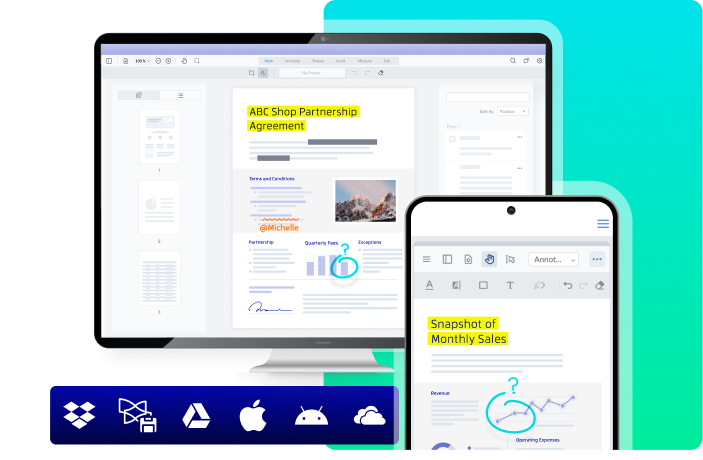 Xodo - Secure Document Management & E-Signature Solutions
- PDF Reader and Annotator app.
- Something close to Mac Preview for working with PDFs in Chrome on your [[Chromebook]]
-- Xodo - Secure Document Management & E-Signature Solutions
- PDF Reader and Annotator app.
- Something close to Mac Preview for working with PDFs in Chrome on your [[Chromebook]]
- - "No Code" is great. But here's why we need *Yes* Code.
[[Anil Dash]] May 2020, https://www.linkedin.com/pulse/code-great-heres-why-we-need-yes-anil-dash/" rel="noopener noreferrer">'No Code' is great. But here's why we need Yes Code.
Anil goes into the rising trend of "No Code" tools, and goes a step further, saying that we should be focusing on "Yes Code".
Anil Dash is the CEO of [[Glitch]], which is embracing this "Yes Code" concept.
> Yes Code is based on three key ideas:
>
>1. There are millions of important apps, websites, and projects that can't be made by an off-the-shelf template
>2. Being able to code is a superpower, and we should enable more people to tap into that ability, by lowering the barriers
>3. The biggest barriers to coding are technical complexity around processes like collaboration and deployment, and social obstacles like gatekeeping and exclusion — so that's what we've got to fix> Today's internet isn't fully serving the needs of a lot of people around the world. There may be great tools for sharing a photo or sending a message, but most of the sites and apps we use every day are made by a small number of companies with goals or incentives that might not match our own. We're feeling the negative effects of that reality every day.
>
> Ask yourself: When’s the last time you used an app, or visited a website, that was made by an actual individual person ? - "No Code" is great. But here's why we need *Yes* Code.
[[Anil Dash]] May 2020, https://www.linkedin.com/pulse/code-great-heres-why-we-need-yes-anil-dash/" rel="noopener noreferrer">'No Code' is great. But here's why we need Yes Code.
Anil goes into the rising trend of "No Code" tools, and goes a step further, saying that we should be focusing on "Yes Code".
Anil Dash is the CEO of [[Glitch]], which is embracing this "Yes Code" concept.
> Yes Code is based on three key ideas:
>
>1. There are millions of important apps, websites, and projects that can't be made by an off-the-shelf template
>2. Being able to code is a superpower, and we should enable more people to tap into that ability, by lowering the barriers
>3. The biggest barriers to coding are technical complexity around processes like collaboration and deployment, and social obstacles like gatekeeping and exclusion — so that's what we've got to fix> Today's internet isn't fully serving the needs of a lot of people around the world. There may be great tools for sharing a photo or sending a message, but most of the sites and apps we use every day are made by a small number of companies with goals or incentives that might not match our own. We're feeling the negative effects of that reality every day.
>
> Ask yourself: When’s the last time you used an app, or visited a website, that was made by an actual individual person ? - Yggdrasil Network
> The https://yggdrasil-network.github.io/implementation.html" rel="noopener noreferrer">current implementation of Yggdrasil is a lightweight userspace software router which is easy to configure and supported on a wide range of platforms. It provides end-to-end encrypted IPv6 routing between all network participants. Peerings between nodes can be configured using TCP/TLS connections over local area networks, point-to-point links or the Internet. Even though the Yggdrasil Network provides IPv6 routing between nodes, peering connections can be set up over either IPv4 or IPv6 networks.
- Yggdrasil Network
> The https://yggdrasil-network.github.io/implementation.html" rel="noopener noreferrer">current implementation of Yggdrasil is a lightweight userspace software router which is easy to configure and supported on a wide range of platforms. It provides end-to-end encrypted IPv6 routing between all network participants. Peerings between nodes can be configured using TCP/TLS connections over local area networks, point-to-point links or the Internet. Even though the Yggdrasil Network provides IPv6 routing between nodes, peering connections can be set up over either IPv4 or IPv6 networks.

- Z-Space Local AI
A project I'm helping to run at [[Z-Space]] where we have installed a compute cluster to run some AI models and apps connected to them.
We recently picked up a dedicated domain name, [[SharedComputer.Network]], which may become the more longer term name.
- Z-Space Local AI
A project I'm helping to run at [[Z-Space]] where we have installed a compute cluster to run some AI models and apps connected to them.
We recently picked up a dedicated domain name, [[SharedComputer.Network]], which may become the more longer term name.
 Zed — Your last next editor
Zed is a minimal code editor crafted for speed and collaboration with humans and AI.
VC-funded startup.
## DeltaDBAlso building https://zed.dev/deltadb" rel="noopener noreferrer">DeltaDB, a new kind of version control. Related blog post: https://zed.dev/blog/introducing-deltadb" rel="noopener noreferrer">Software Is Made Between Commits:
> We call it DeltaDB, a new kind of version control built on a single coherent abstraction that transforms your conversations with agents and the worktrees they edit into shared artifacts. We've made a ton of progress https://zed.dev/blog/sequoia-backs-zed" rel="noopener noreferrer">since I first spoke about it last fall, and with a https://zed.dev/deltadb" rel="noopener noreferrer">beta version ready in a few weeks, I'm excited to share more about what we're launching.
- Zed — Your last next editor
Zed is a minimal code editor crafted for speed and collaboration with humans and AI.
VC-funded startup.
## DeltaDBAlso building https://zed.dev/deltadb" rel="noopener noreferrer">DeltaDB, a new kind of version control. Related blog post: https://zed.dev/blog/introducing-deltadb" rel="noopener noreferrer">Software Is Made Between Commits:
> We call it DeltaDB, a new kind of version control built on a single coherent abstraction that transforms your conversations with agents and the worktrees they edit into shared artifacts. We've made a ton of progress https://zed.dev/blog/sequoia-backs-zed" rel="noopener noreferrer">since I first spoke about it last fall, and with a https://zed.dev/deltadb" rel="noopener noreferrer">beta version ready in a few weeks, I'm excited to share more about what we're launching.
- ZOË
ZOË was an IMAP email client built in Java in the early to mid 2000s. The tagline was "Googling your email" -- you could search, filter, sort by email headers, find out information about different organizations / people by the domain their email came from, etc.

The link is to a Wayback Machine snapshot from 2004.
I wrote about it multiple times. Here's https://2023.bmannconsulting.com/archive/2004/05/08/zoe-and-email-choices/" rel="noopener noreferrer">Zoe and Email Choices in my own long term archive, which quotes https://scottstuff.net/" rel="noopener noreferrer">Scott writing about it, although his original 2004 post is 404.
I'll quote Scott's post below:
## Scott on Zoe> Ah, finally—someone explains the _point_ of Zoe. It’s basically a personal email search engine. Once I got that, I grabbed a copy and tried it out.
>
> It’s trivial to install—just extract the files from the archive and double-click on Zoe.jar. Zoe runs its own web server on port 10080, and automatically fires up your favorite browser when it starts.
>
> The web interface is intuitive and reasonable attractive, and it’s easy to add new POP or IMAP accounts and have Zoe import mail from them. While it’s possible to use Zoe as a web-based mail reader, it’s not really very good at that—it doesn’t do folders at all, and I can’t figure out how to get it to do threads, but that’s not really a problem, because it’s not _supposed_ to be used for normal mail reading: it’s a search engine, not a mail reader.
>
> I probably have around 100,000 messages sitting in assorted IMAP mail boxes in various places, and Zoe is the first program that I’ve found that is actually usable for searching them. OS X’s Mail program isn’t very good at searching huge volumes of mail, particularly when most of it lives on IMAP servers.
>
> The big problem with Zoe is its resource needs—it’s written in Java, and wants at least 70 MB of RAM when it’s running on my laptop, plus a few hundred MB of disk space. I just don’t have enough free RAM on my laptop to add another 70+ MB program, so I’m going to _try running it on one of my Linux servers_ at home and see how that goes.Note that the resource needs are MB not GB 😅
## Zoe ProfessionalAnother https://web.archive.org/web/20040607020055/http://www.zoeprofessional.com/" rel="noopener noreferrer">Wayback Machine link which has some writing.
> The Google principle: It doesn't matter where information is because I can get to it with a keystroke.
>
> So what is ZOË?
>
> Think about it as a sort of librarian, tirelessly, continuously, processing, slicing, indexing, organizing, your messages. The end result is this intertwingled web of information.
>
> ZOË is a email client. It's also a email server. And a long term archive. And a search engine. And an application server. All that at once on your desktop. Or server. Or both. Or it doesn't matter because client and server are the same.And on the product page:
> Managing email has become an increasingly time consuming task. Email is also becoming a corporate source of knowledge and information.Therefore keeping information is more essential than ever.
>
> ZOË.professional is targeted for the corporate customer. Archiving of Email information, retrieval of data, sharing of knowledge, these are just a few of the topics in which ZOË.professional provides your company with a complete solution. - ZOË
ZOË was an IMAP email client built in Java in the early to mid 2000s. The tagline was "Googling your email" -- you could search, filter, sort by email headers, find out information about different organizations / people by the domain their email came from, etc.

The link is to a Wayback Machine snapshot from 2004.
I wrote about it multiple times. Here's https://2023.bmannconsulting.com/archive/2004/05/08/zoe-and-email-choices/" rel="noopener noreferrer">Zoe and Email Choices in my own long term archive, which quotes https://scottstuff.net/" rel="noopener noreferrer">Scott writing about it, although his original 2004 post is 404.
I'll quote Scott's post below:
## Scott on Zoe> Ah, finally—someone explains the _point_ of Zoe. It’s basically a personal email search engine. Once I got that, I grabbed a copy and tried it out.
>
> It’s trivial to install—just extract the files from the archive and double-click on Zoe.jar. Zoe runs its own web server on port 10080, and automatically fires up your favorite browser when it starts.
>
> The web interface is intuitive and reasonable attractive, and it’s easy to add new POP or IMAP accounts and have Zoe import mail from them. While it’s possible to use Zoe as a web-based mail reader, it’s not really very good at that—it doesn’t do folders at all, and I can’t figure out how to get it to do threads, but that’s not really a problem, because it’s not _supposed_ to be used for normal mail reading: it’s a search engine, not a mail reader.
>
> I probably have around 100,000 messages sitting in assorted IMAP mail boxes in various places, and Zoe is the first program that I’ve found that is actually usable for searching them. OS X’s Mail program isn’t very good at searching huge volumes of mail, particularly when most of it lives on IMAP servers.
>
> The big problem with Zoe is its resource needs—it’s written in Java, and wants at least 70 MB of RAM when it’s running on my laptop, plus a few hundred MB of disk space. I just don’t have enough free RAM on my laptop to add another 70+ MB program, so I’m going to _try running it on one of my Linux servers_ at home and see how that goes.Note that the resource needs are MB not GB 😅
## Zoe ProfessionalAnother https://web.archive.org/web/20040607020055/http://www.zoeprofessional.com/" rel="noopener noreferrer">Wayback Machine link which has some writing.
> The Google principle: It doesn't matter where information is because I can get to it with a keystroke.
>
> So what is ZOË?
>
> Think about it as a sort of librarian, tirelessly, continuously, processing, slicing, indexing, organizing, your messages. The end result is this intertwingled web of information.
>
> ZOË is a email client. It's also a email server. And a long term archive. And a search engine. And an application server. All that at once on your desktop. Or server. Or both. Or it doesn't matter because client and server are the same.And on the product page:
> Managing email has become an increasingly time consuming task. Email is also becoming a corporate source of knowledge and information.Therefore keeping information is more essential than ever.
>
> ZOË.professional is targeted for the corporate customer. Archiving of Email information, retrieval of data, sharing of knowledge, these are just a few of the topics in which ZOË.professional provides your company with a complete solution. - LinkedIn 1746
https://www.linkedin.com/posts/chrisfralic_linkedin-has-over-675-million-members-want-activity-6694335551530692608-Rz4O" rel="noopener noreferrer">Chris Fralic of First Round Capital explains how to figure out what your LinkedIn member number is.
Basically, go to your own profile, “view source” to look at the code for the web page, and search for “member”.
I’m member #1746. Yes, I was early to social networks :)
- LinkedIn 1746
https://www.linkedin.com/posts/chrisfralic_linkedin-has-over-675-million-members-want-activity-6694335551530692608-Rz4O" rel="noopener noreferrer">Chris Fralic of First Round Capital explains how to figure out what your LinkedIn member number is.
Basically, go to your own profile, “view source” to look at the code for the web page, and search for “member”.
I’m member #1746. Yes, I was early to social networks :)
- 202401031434
I point people at Robert Merki’s [[Wildcard]] definition often enough I should have an entry here.
- 202401031434
I point people at Robert Merki’s [[Wildcard]] definition often enough I should have an entry here.
- 202401021435
I seem to keep having trouble finding [[Boris Anthony]]’s [[libra.re]] web eBook project. Now I have it.
- 202401021435
I seem to keep having trouble finding [[Boris Anthony]]’s [[libra.re]] web eBook project. Now I have it.
- January 4th, 2024
Trimming NetNewsWire RSS subscriptions and ironically found https://rss-parrot.net/" rel="noopener noreferrer">RSS Parrot - “Turn Mastodon into your feed reader”.
Reminds me of Darius’ [[RSS to ActivityPub Converter]], which I want to look into deploying as a [[CoSocial]] service.
- January 4th, 2024
Trimming NetNewsWire RSS subscriptions and ironically found https://rss-parrot.net/" rel="noopener noreferrer">RSS Parrot - “Turn Mastodon into your feed reader”.
Reminds me of Darius’ [[RSS to ActivityPub Converter]], which I want to look into deploying as a [[CoSocial]] service.
- January 4th, 2024
Building SLCs - Simple, Lovable, Complete - features, rather than MVPs. Pronounced “Slick”.
https://longform.asmartbear.com/slc/" rel="noopener noreferrer">Your customers hate MVPs. Make a SLC instead
- January 4th, 2024
Building SLCs - Simple, Lovable, Complete - features, rather than MVPs. Pronounced “Slick”.
https://longform.asmartbear.com/slc/" rel="noopener noreferrer">Your customers hate MVPs. Make a SLC instead
- January 5th, 2024
OK, one more quick hack to the Journal feed.
Relative paths for images are a problem. Maybe they actually aren't for many modern feed readers. But they ARE if I want Micro.blog to crosspost correctly.
https://bdunagan.com/2021/10/29/jekyll-tip-absolute-urls-for-links-and-images-in-rss-feed/" rel="noopener noreferrer">Found this hack to use the Liquid
replacefilter to look for src tags and then add in the full path to your site.I'll test it tomorrow by posting an image. Time for bed!
- January 5th, 2024
OK, one more quick hack to the Journal feed.
Relative paths for images are a problem. Maybe they actually aren't for many modern feed readers. But they ARE if I want Micro.blog to crosspost correctly.
https://bdunagan.com/2021/10/29/jekyll-tip-absolute-urls-for-links-and-images-in-rss-feed/" rel="noopener noreferrer">Found this hack to use the Liquid
replacefilter to look for src tags and then add in the full path to your site.I'll test it tomorrow by posting an image. Time for bed!
- January 5th, 2024
Jake Lazaroff argues that “https://jakelazaroff.com/words/the-website-vs-web-app-dichotomy-doesnt-exist/" rel="noopener noreferrer">website vs. web app dichotomy doesn’t exist”. It’s a good article, develops a framework for thinking about different types of web properties. Mentions [[Local First]], [[CRDT]].
But to me, it _does_ show a clear split of document web vs app web.
- January 5th, 2024
Jake Lazaroff argues that “https://jakelazaroff.com/words/the-website-vs-web-app-dichotomy-doesnt-exist/" rel="noopener noreferrer">website vs. web app dichotomy doesn’t exist”. It’s a good article, develops a framework for thinking about different types of web properties. Mentions [[Local First]], [[CRDT]].
But to me, it _does_ show a clear split of document web vs app web.
- January 5th, 2024
> There are no ushers on Mastodon. There's no one paid to show you to your seat, no one whose job it is to ease you into comfort and remove friction.
https://blog.lmorchard.com/2022/11/07/no-ushers/" rel="noopener noreferrer">There are no ushers on Mastodon by Les Orchard from back in November 2022.
- January 5th, 2024
> There are no ushers on Mastodon. There's no one paid to show you to your seat, no one whose job it is to ease you into comfort and remove friction.
https://blog.lmorchard.com/2022/11/07/no-ushers/" rel="noopener noreferrer">There are no ushers on Mastodon by Les Orchard from back in November 2022.
- January 5th, 2024
> Your online persona federated
> Have your domain name be followable by anyone on the Fediverse, be it Mastodon, Firefish, Akkoma, or any other federated social media platform.https://www.getfederated.com/" rel="noopener noreferrer">Get Federated is new thing by Sal Rahman @[email protected] - sign up to get notified!
- January 5th, 2024
> Your online persona federated
> Have your domain name be followable by anyone on the Fediverse, be it Mastodon, Firefish, Akkoma, or any other federated social media platform.https://www.getfederated.com/" rel="noopener noreferrer">Get Federated is new thing by Sal Rahman @[email protected] - sign up to get notified!
- January 7th, 2024
> The average estimated date for when AI could beat humans at every possible task shifted dramatically, moving from 2060 to 2047—a decrease of 13 years—in just the past year alone!
https://www.oneusefulthing.org/p/signs-and-portents" rel="noopener noreferrer">Ethan Mollick, Signs and Portents
- January 7th, 2024
> The average estimated date for when AI could beat humans at every possible task shifted dramatically, moving from 2060 to 2047—a decrease of 13 years—in just the past year alone!
https://www.oneusefulthing.org/p/signs-and-portents" rel="noopener noreferrer">Ethan Mollick, Signs and Portents
- January 7th, 2024
https://www.androidauthority.com/install-ubuntu-on-your-android-smartphone-765408/" rel="noopener noreferrer">Linux Desktop on your Android Device at Android Authority covers Debian NoRoot and UserLAnd (Ubuntu and other distros possible).
- January 7th, 2024
[[Coolify]] is another self-hosting server management system (via @depatchedmode).
They offer cloud hosting of the admin panel starting at $5/month, which then manages your other servers for deployment to.
- January 8th, 2024
https://wingolog.org/archives/2024/01/08/missing-the-point-of-webassembly" rel="noopener noreferrer">Andy Wingo, Missing the point of WebAssembly and offers his own starting point:
> _WebAssembly is a new fundamental abstraction boundary_. WebAssembly is a new way of dividing computing systems into pieces and of composing systems from parts.
Wingo is a compiler engineer working at [[Igalia]], on Mastodon at https://mastodon.social/@wingo" rel="noopener noreferrer">@[email protected].
- January 8th, 2024
https://linear.app/blog/settings-are-not-a-design-failure" rel="noopener noreferrer">Linear App: Settings are not a design failure
> thinking goes that as designers, our goal is to create product experiences that don’t require any adjustments by the user. Consequently, offering customization options is interpreted as a failure to make firm product decisions.
> …
> First of all, remind yourself that <mark>users love settings</mark>. - January 9th, 2024
https://rallly.co/" rel="noopener noreferrer">Rally is open source, self-hostable "pick a date or time to meet" software.
I've created a note page for it locally with some more details, like their suggested social obligation to pay the equivalent of one year managed hosting if you host it yourself.
#CloudronApp #selfhosting #CommonsFunding #AGPL
- January 11th, 2024
Just saw that https://www.meetup.com/blog/a-new-home-for-meetup/" rel="noopener noreferrer">Meetup was acquired by Bending Spoons. This is the same company that acquired Evernote.
For me, Meetup is the epitome of platform capture. I won't use it for anything I organize. [[Luma]] is what I use, but just for RSVP / attendance, and I can export email as needed.
- January 11th, 2024
Go read https://thefugue.space/thoughts/the-glimmer" rel="noopener noreferrer">Kharis O'Connell's article, The Glimmer
> All this Spatial Computing hype about to start (again!)...I can feel the frenzied frothing-at-the-mouth-need-for-a-gold-rush building in the tech industry. It's probably a good time to repost my Spatial Computing article from last June
#SpatialComputing
- January 13th, 2024
Write up by https://citationneeded.news/substack-to-self-hosted-ghost/" rel="noopener noreferrer">Molly White of her migration from Substack to self-hosted Ghost. She moved to a Digital Ocean droplet and spent the most time configuring DNS and email / Mailgun settings.
I added some notes to my [[Ghost]] note.
- January 14th, 2024
https://git.8pit.net/depp/" rel="noopener noreferrer">depp, a static page generator for git repositories.
via @[email protected], who has an instance running from a home lab.
- January 14th, 2024
https://www.casaos.io/" rel="noopener noreferrer">CasaOS is a home lab management app. Storing & syncing between commercial data clouds — GDrive, Dropbox, etc — is the starting point, also installs apps via Docker containers.
- January 14th, 2024
https://polar.sh" rel="noopener noreferrer">Polar.sh is like a Patreon optimized for software creators that use GitHub. Newsletters, subscriptions, and issue-based funding. The platform itself is open source. Business model is 5% of funds transacted.
- January 15th, 2024
> the web starts to feel a bit like one giant website, that’s so fast it’s just… part of your computer.
https://cosocial.ca/@duncanlock/111760801156333402" rel="noopener noreferrer">@[email protected] talking about the https://duncanlock.net/blog/2024/01/04/super-fast-reader-mode-for-the-entire-web-with-dillo-plus/" rel="noopener noreferrer">Dillo Plus browser with user stylesheets.
- January 15th, 2024
https://fedica.com/social-media/how-to-setup-rss-feeds" rel="noopener noreferrer">Fedica has an updated page describing how they handle cross posting RSS feed items. With many more networks at play, teams like [[Fedica]] are going to be updating how cross-posting and other aspects work. It's hard to normalize across all these systems!
- January 16th, 2024
https://blog.kylegalbraith.com/the-future-is-not-docker/" rel="noopener noreferrer">The Future is not Docker
> The future is not Docker, but containers are.
>
> We started building https://depot.dev/" rel="noopener noreferrer">Depot back in January 2022 to solve our own pain of living with slow Docker image builds in generic CI providers like GitHub Actions, Circle, etc. We were annoyed by having to save/load layer cache over slow networks, the lack of larger managed runners, and having to rely on slow emulation for multi-platform or Arm image builds. - January 16th, 2024
https://orbstack.dev" rel="noopener noreferrer">Orbstack for MacOS:
> a fast, light, and simple way to run containers and Linux machines on macOS. It's a supercharged alternative to Docker Desktop and WSL, all in one easy-to-use app.
Free for non-commercial usage, $96/year per business user.
- January 16th, 2024
Do I want to add https://danielpecos.com/2022/12/25/mastodon-as-comment-system-for-your-static-blog/" rel="noopener noreferrer">Mastodon powered comments to my site? I don't think so. I cross-post to have discussions over on those other systems.
- January 16th, 2024
Bluesky posted their https://blueskyweb.xyz/blog/01-16-2024-moderation-2023" rel="noopener noreferrer">2023 moderation report. Their moderation system is codenamed _Ozone_ and they plan to open source it, as well as make the moderation backend self hostable.
- January 16th, 2024
https://codeberg.org/grindhold/flohmarkt" rel="noopener noreferrer">Flohmarkt, which means “flea market” in German, is a “federated decentral classified ad software using activitypub” aka Facebook Marketplace clone.
Had this pointed out to me via https://mastodon.social/@blaine" rel="noopener noreferrer">@blaine, as we were chatting about serving real local / regional needs with Fediverse tools.
Many area have Buy Local and other Facebook Groups and Marketplace where a huge amount of community work gets done.
This isn’t _the_ answer as just a piece of tech, but really looking at what is being used and will need to have similar functionality to really be adopted.
- January 16th, 2024
I came across https://mspsocial.net/@vkc/111766525303910449" rel="noopener noreferrer">a thread by @vkc about doing an experiment of not using big search engines.
She in turn linked to Neil’s blog https://neilzone.co.uk/2024/01/a-week-of-not-using-a-search-engine/" rel="noopener noreferrer">A week of not using a search engine.
There’s a general rebirth of curated directory sites, and I’m personally interested in community or commons search. I’d much rather get a search result that is in essence a recommendation or at least experience of someone I know.
- January 17th, 2024
https://github.com/hattipjs/hattip" rel="noopener noreferrer">HatTip, a set of JavaScript packages for building HTTP server applications. The cheeky tagline is “like Express.js, but for the future”.
From the README, “Server code that can be deployed anywhere: AWS, Cloudflare Workers, Fastly, Vercel, VPS”
- January 17th, 2024
https://blog.tidelift.com/will-the-new-judicial-ruling-in-the-vizio-lawsuit-strengthen-the-gpl" rel="noopener noreferrer">Will the new judicial ruling in the Vizio lawsuit strengthen the GPL?
The TLDR; is treating the GPL as an issue of contract law rather than copyright, and because of contract law, a third party can sue instead of just the author.
Vizio makes smart TVs that use GPL code and they haven’t shared the source.
> In October of 2021 the Software Freedom Conservancy (SFC) decided to launch what is believed to be the first significant open source lawsuit based in contract rather than in copyright. Critically, the SFC’s case argued that anyone who benefits from the General Public License (GPL), not just the authors of the software, should be able to bring a lawsuit to enforce the terms of the GPL.
Open source and AI related copyright, licensing, and contract arguments all in one year!
- January 17th, 2024
Paul Frazee from the Bluesky team writing on his personal blog about the design of https://pfrazee.com/blog/why-facets" rel="noopener noreferrer">RichText facets that are used to include mentions and links in posts.
And, other custom things that can be defined and read by different clients and servers.
- January 17th, 2024
https://www.furia.com/page.cgi?type=log&id=473" rel="noopener noreferrer">Individual initiative, corporate inertia and good bad advice
> I did my job with love and belief. This was always obviously risky. I had no illusions that the love was returned, or that it is even possible for a public corporation of non-trivial scale to behave in human ways at all.
I’m quoting the first paragraph. I could post any sentence and it would make you think. It’s a long read about working at Spotify, and being fired, and many other things.
- January 17th, 2024
https://www.localfirst.fm/" rel="noopener noreferrer">localfirst.fm is a new podcast about local first software development. LoFi as we like to call it.
- January 17th, 2024
https://norman.life/posts/ipfs-bittorrent" rel="noopener noreferrer">What's IPFS and how it compares to BitTorrent is an article by Daniel Norman correcting and explaining many of the details about IPFS as a response to https://liamz.co/tech-blog/2023/08/10/comparing-ipfs-and-bittorrent.html" rel="noopener noreferrer">a blog comparing the two.
It’s really well written. I should quote pieces of it on my [[IPFS]] notes page.
- January 18th, 2024
From https://survey.stackoverflow.co/2023/#section-admired-and-desired-synchronous-tools" rel="noopener noreferrer">Stack Overflow 2023 Developer Survey, “Matrix is the #1 chat tool by current users' satisfaction”
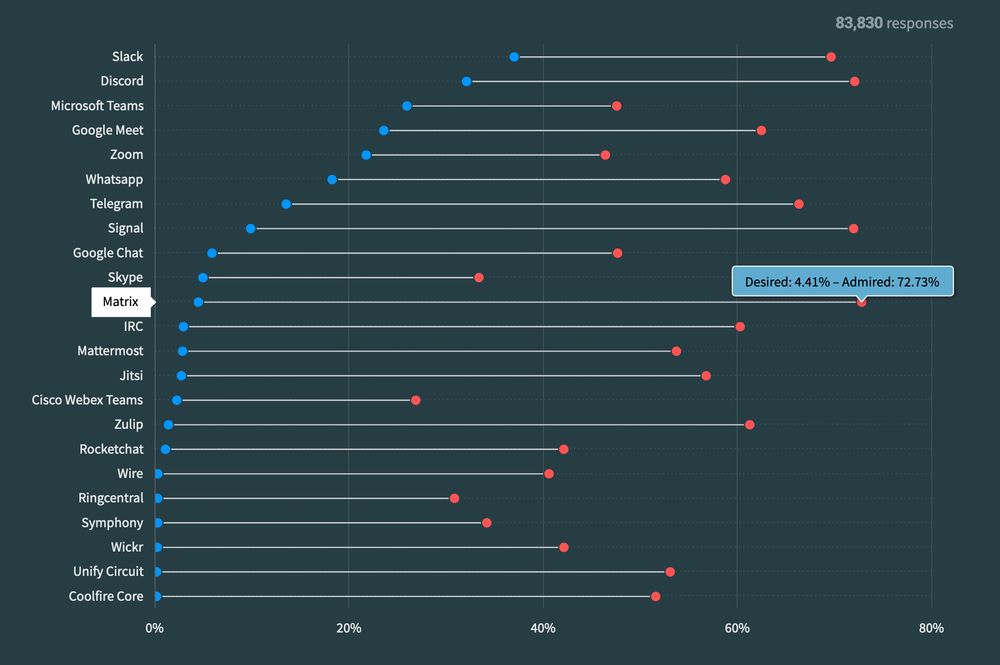
This is of course a popularity contest, but it’s still useful.
Matches my expectations, eg lots of awareness of Microsoft Teams, people that use it hate it. Discord is desired and loved.
As you go down the list, it’s mostly that people haven’t heard of these tools. Zulip is an outlier — those people I know who use it really love it, and that shows up here.
This section is called “Synchronous tools” and this was the prompt:
> Which communication tools did you use regularly over the past year, and which do you want to work with over the next year? Select all that apply
Ok, I guess I’ll need to go dig into the https://survey.stackoverflow.co/2023/#section-admired-and-desired-asynchronous-tools" rel="noopener noreferrer">Asynchronous tools next. Everything is asynchronous when you’re a multi time zone community or organization.
- January 18th, 2024
https://zhenyi.gibber.blog/gibberish-is-now-available-on-testflight" rel="noopener noreferrer">Gibberish is now on testflight:
> Gibberish is a blogging app that looks and feels like a messaging app. It’s a bit weird, but that’s the point. This UI tricks my brain into writing mode, just like when I write long messages to my friends. Here’s what it looks like:
This is very similar to my thoughts on a [[Threadstorm Builder]]
- January 20th, 2024
https://github.com/zoni/obsidian-export" rel="noopener noreferrer">obsidian-export , “a CLI program and a Rust library to export an [[Obsidian]] vault to regular Markdown”
via @[email protected]
- January 20th, 2024
https://flaminghydra.com/welcome/" rel="noopener noreferrer">Flaming Hydra is a collective of writers and artists. I’ve just subscribed to support them for the year.
> a collective of 60 celebrated writers and artists joining to bring you an ingenious brief cooperatively-owned newsletter with short articles, essays, comics, commentary, and happenings
- January 21st, 2024
Viverse, HTC’s metaverse open worlds platform, is going to be ActivityPub-enabled.
Their blog post https://www.news.viverse.com/post/the-fediverse-explained-social-media-s-next-form" rel="noopener noreferrer">“The Fediverse Explained: Social Media’s Next Form” is a good overview of fediverse history and apps.
- January 21st, 2024
The [[Fediverse Report]], created and maintained by Laurens Hof @[email protected], is doing a great job of sharing news, and also explainers like https://fediversereport.com/how-bluesky-works-the-network-components/" rel="noopener noreferrer">“How Bluesky works — the network components”.
- January 21st, 2024
https://beluga.social/" rel="noopener noreferrer">Beluga is an iOS app that lets you post microblogs. What’s unique is that it posts to S3-compatible storage, using your own credentials. Bring your own storage!
- January 22nd, 2024
Brian Wisti https://hackers.town/@randomgeek" rel="noopener noreferrer">@[email protected] documents using Obsidian + Hugo and a few other things in https://randomgeekery.org/post/2024/01/rebuilding-my-second-brain/" rel="noopener noreferrer">“Rebuilding My Public Brain”
We’ve been hanging out reading each others’ stuff on the blogosphere for a long time, nice to see what the neighbours are up to.
- January 22nd, 2024
The rebooting of social networks, blogs, and newsletters continues.
> https://spyglass.org/" rel="noopener noreferrer">Spyglass is a link blog, a column, and a newsletter, all written by me, https://mgsiegler.com/about?ref=spyglass.org" rel="noopener noreferrer">M.G. Siegler.
- January 23rd, 2024
Capturing a link to https://github.com/esm7/obsidian-map-view" rel="noopener noreferrer">Obsidian Map View Plugin, since it came up in discussion. Open source, uses [[OpenStreetMap]] and open map tiles for search and display.
My exploration on [[Boris Map]] is mostly for [[FoodWiki]] purposes. I use basic tagging for notes pages if I want to capture e.g. that a person entry is in _Vancouver_.
- January 23rd, 2024
Ben Follington on the [[Subconscious]] team blogs on his personal site about “_using_ Subconscious to _design_ Subconscious”
> So, how do you design feeling-first?
Yes. How does both user and maker take the digital tool into their hands.
A great read while also being highly personal about what Ben is aiming to do and be: https://shimmeringvoid.substack.com/p/metacognitive-design" rel="noopener noreferrer">“Metacognitive Design”.
- January 23rd, 2024
Tom Szilagyi writes https://tomscii.sig7.se/2024/01/Ditching-GitHub" rel="noopener noreferrer">“Ditching GitHub” — moving to self host his git repos, and welcoming email based git patches. This is not the last of these articles we’re going to read.
- January 23rd, 2024
An excellent long read by Rudolf Winestock, http://www.winestockwebdesign.com/Essays/Eternal_Mainframe.html" rel="noopener noreferrer">“The Eternal Mainframe”. It describes the cloud as a return to shared mainframes, the death of standalone “offline” personal computers.
> True standalone personal computers may return to their roots: toys for hobbyists.
Fits my [[death of the professional desktop operating system]] hypothesis.
- January 23rd, 2024
Great write up by Paul Frazee of https://www.pfrazee.com/blog/why-not-p2p" rel="noopener noreferrer">“Why isn’t Bluesky a peer-to-peer network?”, going back to his own roots and the “2014 generation of p2p”.[^distsys]
Bluesky is a sort-of-federated model. Here’s a succinct description:
> It might be even more accurate to call this a Cryptographic Data Web. Every user's data repository is, in essence, a website. The aggregating applications are, in essence, search spiders. The Web never quite mastered structured data for a variety of reasons; the AT Protocol embraces it fundamentally. Rather than fetching views from sites, you fetch records from users. Our aggregators produce data indexes rather than search pages.
[^distsys]: That’s 10 years ago and I think we’re still in the early days of distributed systems theory and cryptography being more widely known. The third innovation — seeing Bitcoin arise as a novel protocol — is shunned by many.
- January 23rd, 2024
Luis Villa is writing [Open(~ish) Machine Learning News]https://www.openml.fyi/2024-01-24/) and gives an update on what he’s going to cover:
> less news, a turn more for the personal and the polemical: what should I _do_? What should our organizations and movements do?
I am also going to be watching open / licensing / AI, and work on running my own.
- January 23rd, 2024
https://x.com/aboodman/status/1749911394647232728" rel="noopener noreferrer">Aaron Boodman @aboodman has a thread on fenced communities which I very much agree with and replied to him with a link.
Fenced community is my own term, from [[Open Source Licensing]]: restrict access to the scarce resources aka Common Goods of support, maintenance, discussion etc, but keep the code open.
- January 24th, 2024
Ton Zijlstra blogs about https://www.zylstra.org/blog/2024/01/the-eu-ai-act-is-ready/" rel="noopener noreferrer">Europe’s AI act being ready and points out that a lot of new acts got passed:
> In 2020 there was no Digital Markets Act, Digital Services Act, AI Regulation, Data Governance Act, Data Act, nor an Open Data Directive/High Value Data implementing regulation.
- January 24th, 2024
Brought to my attention by https://cosocial.ca/@Django/111811943859262877" rel="noopener noreferrer">@[email protected]'s post linking to https://www.michaelgeist.ca/2024/01/site-blocking-and-age-verification-for-twitter-instagram-snap-and-twitch-age-verification-lobby-confirms-it-wants-bill-s-210-to-cover-all-social-media-sites/" rel="noopener noreferrer">Michael Geist's article on Bill S-210, and that it may apply to the fediverse as well:
> the unlimited scope of the Canadian law to sites such as Twitter, Snap, Instagram, Twitch and many others is no accident. If the lead lobby group behind the legislation gets its way, it is the stated goal of Bill S-210 to require all Canadians to undergo an age verification system in order to access content on general purpose sites with the threat of penalties and site blocking awaiting those sites that refuse to comply.
- January 24th, 2024
[[Antikythera]] is "a think tank reorienting planetary computation as a technological, philosophical, and geopolitical force". They have a new working group starting up on https://antikythera.org/hemispherical-stacks#fmc" rel="noopener noreferrer">Futures of Multipolar Computation. Multidisciplinary researchers are invited to apply.
- January 26th, 2024
Thanks https://social.coop/@christina" rel="noopener noreferrer">@[email protected] for finding and sharing the term [[Knowmad]], similar to [[Wildcard]]. Read https://educationfutures.com/blog/post/knowmads-definition" rel="noopener noreferrer">Moravec's article and definition "Who are knowmads?".
- January 26th, 2024
Awesome to see [[Farcaster]] continuing to experiment with the https://warpcast.com/dwr.eth/0xc7ed9f08" rel="noopener noreferrer">launch of Frames.
Matches my thoughts on mobile form and social as distribution / discovery.
Farcaster has less usage than my other two protocol recommendations — [[atproto]] and [[ActivityPub]] — but ability to align login / growth directly with app devs is huge.
- January 26th, 2024
[[webxdc]] is a specification for embedding apps in chat created by [[Delta Chat]]. Shared with me by https://fosstodon.org/@fabrice" rel="noopener noreferrer">@[email protected].
- January 27th, 2024
[[Delta Chat]] blogged about their https://delta.chat/en/2023-12-13-chatmail" rel="noopener noreferrer">release of chatmail services -- email services optimized for powering end-to-end encrypted chat like DeltaChat.
> With some knowledge of DNS, SSH and a spare VPS (get the cheapest you can find), you can setup and offer chatmail services yourself pretty quickly. A friend easily recently set it up on a Raspberry Pi for his housing project. Chatmail servers are designed to run with minimal hardware requirements and to be easy to tweak even from novice sysadmins or programmers. No permission is needed from our side to run a chatmail server. We might not even know you are doing it because Delta Chat has no tracking or counting.
Visit the https://github.com/deltachat/chatmail" rel="noopener noreferrer">deltachat/chatmail repo for instructions on install and setup.
- January 27th, 2024
https://codeberg.org/rimu/pyfedi" rel="noopener noreferrer">PieFed written in Python and Flask, AGPL-licensed, first class moderation tools. Project goal:
> To build a federated discussion and link aggregation platform, similar to Reddit, Lemmy, Mbin.
- January 27th, 2024
Will Crichton https://willcrichton.net/notes/portable-epubs/" rel="noopener noreferrer">proposes a portable EPUB format to replace PDFs.
If you click through the link, you’ll see that the article is a portable EPUB.
- January 27th, 2024
Law of VC writes about https://lawofvc.substack.com/p/18-episode-simplifying-the-safe" rel="noopener noreferrer">Simplifying the SAFE (posted in 2021), with his suggestion being “Remove the Valuation Cap and Discount. Replace it with a Conversion Percentage”.
- January 28th, 2024
https://observablehq.com/@jsomers/we-need-more-tiny-knowledge-projects-heres-one" rel="noopener noreferrer">We need more tiny knowledge projects
> “I used to think of “knowledge projects” as involving a big mission, a big community, and a complex piece of software: the stuff of Wikipedia, Stack Overflow, or Genius (where I worked for several years). But the web is just as good for collaborations in the small.”
- January 28th, 2024
This article https://www.nngroup.com/articles/content-dispersion/" rel="noopener noreferrer">“The Negative Impact of Mobile-First Web Design on Desktop” feels like the reverse of what we would have seen 10 years ago, complaining about designs that don’t work on mobile.
The article states that 55% of web traffic comes from mobile. I bet if we measured “human time spent reading content” that mobile would be even higher.
This fits into my [[death of the professional desktop operating system]] theme. I think we should consider desktop design to be a luxury, for art and experiences.
- January 28th, 2024
The Open Web Advocacy group has posted a statement on how Apple is complying with the DMA https://open-web-advocacy.org/blog/apple-dma-changes/" rel="noopener noreferrer">“Apple’s plan to allow browser competition dubbed unworkable”
Bruce Lawson makes a personal post on https://brucelawson.co.uk/2024/apple-and-malicious-compliance/" rel="noopener noreferrer">“malicious compliance”.
- January 30th, 2024
https://garagehq.deuxfleurs.fr/" rel="noopener noreferrer">Garage “An open-source distributed object storage service tailored for self-hosting”. S3-compatible API, single Rust binary that is installable everywhere.
- January 30th, 2024
[[Oxide Computer]] has released Helios, a distribution of https://www.illumos.org/" rel="noopener noreferrer">illumos that powers their Oxide Rack computer.
- January 31st, 2024
https://www.cjr.org/analysis/shoot-the-messenger.php" rel="noopener noreferrer">Matthew Ingram writes a post mortem on The Messenger news startup:
> The saddest part of this whole saga, https://www.threads.net/@simondowens/post/C2x65yOOBfb" rel="noopener noreferrer">as Simon Owens noted, is that the $50 million Finkelstein and his team chewed through could have funded a hundred local news startups that people might actually want or need.
I’m a big fan of the “fund a bunch of smaller attempts”. Knowing when to favour that vs fund the larger impactful thing is hard.
- January 31st, 2024
It’s the https://cosocial.ca/@boris/111853682715002002" rel="noopener noreferrer">first anniversary of [[CoSocial]].
This is the first co-op I’ve been part of, although I’ve been involved in a number of other non-profits, foundations, and other structures.
I’m gathering, learning, and sharing more info on my [[co-op]] notes.
- February 1st, 2024
The Tangara Music Player campaign opened on Crowd Supply today. Yep, I https://blog.bmannconsulting.com/2024/02/01/campaign-launch-for.html" rel="noopener noreferrer">ordered.
- February 1st, 2024
This FOSDEM talk on https://fosdem.org/2024/schedule/event/fosdem-2024-2853-domain-a-modular-rust-dns-toolkit/" rel="noopener noreferrer">Domain: a modular Rust DNS toolkit looks interesting:
> The "domain" crate is a Rust library that aims to provide a wide range of building blocks that are necessary or useful when building specialised DNS applications.
>
> In this talk we will look at the history, current state, and future of the crate and how it differs from other offerings in the Rust ecosystem. We will explore how the crate aims to leverage Rust’s type system to make it easier to model the complexities of the DNS in a straightforward way that helps make it easier to build correct and efficient applications.On GitHub https://github.com/NLnetLabs/domain" rel="noopener noreferrer">NLnetLabs/domain
- February 1st, 2024
I post about [[2024-01-30_0842|Garage]], and then sbc64 follows the links and comes back with https://git.deuxfleurs.fr/Deuxfleurs/wgautomesh" rel="noopener noreferrer">wgautomesh, a tool by the same team:
> “A simple utility to help connect wireguard nodes together in a full mesh topology”
Excellent! May be useful for some work at [[Fission]].
- February 1st, 2024
https://alecmuffett.com/article/109078" rel="noopener noreferrer">We’re in the middle of a perfect storm for rollback of the ‘open web’ and burgeoning online surveillance” — that’s just the title of Alec Muffet’s post. He details a long list of issues, with everything from politics to lack of digital literacy by both activists and regulators.
> We are in for a rough few years. There will be losses. The “app” ecosystem will likely take a big — possibly majority — chunk out of the “open web” as users demand features which are more easily built without the abstraction of traditional web/web-like services.
Finishing with:
> The users will suffer in the middle of this Godzilla battle, but nobody cares about _them_.
>
> And _actual_ privacy and anonymity will be on the back foot for a decade or more._Oof_. I’m feeling this but don’t want to believe it.
- February 1st, 2024
Three quotes from https://kneelingbus.substack.com/p/the-internets-meaning-crisis" rel="noopener noreferrer">“The Internets Meaning Crisis”, by Kneeling Bus:
> The average human living today sees more things they don’t care about in one week than a medieval peasant did in their entire lifetime.
Parasocial media as antidote to AI content:
> As AI normalizes the idea of human-free content creation, parasocial media merits appreciation: We gravitate toward work that foregrounds its creator because that person is often the ultimate reason we’re interested in the work, directly or indirectly
Increasingly baroque personal info filter systems:
> It’s increasingly urgent to develop an effective personal system for keeping the digital entropy at bay, even if it’s as simple as “haphazardly ignore most of what comes through.”
- February 2nd, 2024
As of iOS 17.4, iPhone users in the EU can choose a default browser, details from https://www.macrumors.com/2024/01/26/apple-explains-ios-17-4-default-browsers-eu/" rel="noopener noreferrer">MacRumors:
> Apple said iPhone users in the EU will be presented with a list of the 12 most popular web browsers from their country's local App Store at the time
Take away: a lot of browsers will be competing for App Store installs.
- February 3rd, 2024
I https://warpcast.com/boris/0x6c23bf9a" rel="noopener noreferrer">created the /management channel on [[Warpcast]], goaded on by [[Venkatesh Rao|VGR]].

- February 4th, 2024
Craig Mod writes https://craigmod.com/essays/newsletters/" rel="noopener noreferrer">"Oh God, It's Raining Newsletters" (2019), which is a delightful piece of writing with many links that you should read in full, but I will quote a few snippets:
> "I fear we’re entering an era of newsletter fatigue…"
> "the state of newsletters and email, in 2019: Things are unexpectedly amazing"
> "there’s something about the _framing_ of email — the inbox, that weird neither-here-nor-there networked space"
> "These newsletters are the most backed up pieces of writing in history, copies in millions of inboxes, on millions of hard drives and servers, far more than any blog post."
> "They’re everywhere but privately so, hidden, piggybacking on the most accessible, oldest networked publishing platform in the world."via https://nichoth.com/" rel="noopener noreferrer">nicoth
- February 5th, 2024
The developer of the Graysky client for Bluesky has written up https://graysky.app/blog/2024-02-05-adding-blog-comments" rel="noopener noreferrer">how to embed replies from Bluesky as comments on your blog.
[[2024-01-16_1536|Like I said for Mastodon comments]], not going to enable this on my site.
- February 5th, 2024
Had a great morning at [[DWebYVR]] coworking.
We ended up on the top floor of the VPL Central Library and had a bunch of interesting discussions that you can find on the https://dwebyvr.org/wiki/February_5th,_2024_Coworking" rel="noopener noreferrer">notes page.
- February 5th, 2024
https://fosstodon.org/@brettcannon/111881615173067904" rel="noopener noreferrer">Brett Cannon, Python core dev:
> “When you say or ask for something regarding open source, add "for me" to the end of the sentence. If that makes it sound rude, then consider rephrasing.
- February 5th, 2024
Next in the tiny hardware series: I bought an ASUS [[MiniPC PL63]]. It was on sale, and I wanted a machine that sits at my desk with modern ports.

- February 5th, 2024
https://anildash.com/2024/02/06/wherever-you-get-podcasts/" rel="noopener noreferrer">“Wherever you get your podcasts” is a radical statement, Anil Dash:
> “being able to say, "wherever you get your podcasts" is a _radical statement_. Because what it represents is the triumph of exactly the kind of technology that's supposed to be impossible: open, empowering tech that's not owned by any one company, that _can't_ be controlled by any one company, and that allows people to have ownership over their work and their relationship with their audience.”
I’m looking for more radical statements.
- February 7th, 2024
Just heard of another Canadian founder switching to https://www.eqbank.ca/" rel="noopener noreferrer">EQ Bank because of their direct partnership with https://wise.com" rel="noopener noreferrer">Wise.
Never mind International business, transfers in Canada of more than $10K are way too hard with the big banks!
- February 8th, 2024
https://plex.collectivesensecommons.org/2024-02-07/" rel="noopener noreferrer">Peter Kaminski, Books and NeoBooks
> The idea of NeoBooks was never to be about one particular kind of object. It’s about how to use the techniques that we have, social techniques and informational techniques, to help people publish.
- February 8th, 2024
I have a [[Twitter]] archive powered by Tweetback. There are apparently https://nicolas-hoizey.com/notes/2024/02/08/2/" rel="noopener noreferrer">68 Tweetback Canonical archives registered, which will link to the “canonical” URLs of each others archives.
I think Mastodon or Bluesky import is a more likely path for people who really want their archive online.
Bluesky, which will support running your own [[PDS]], seems like a good architecture for this.
- February 9th, 2024
https://blue.mackuba.eu/directory/" rel="noopener noreferrer">Bluesky handles directory lists a breakdown of custom domain names used as account names on Bluesky.
- February 9th, 2024
https://collectivegovernance.directory/" rel="noopener noreferrer">Collective Governance Directory:
> A collection of links to publicly available governance documents, published by the collectives that use them.
Launched by https://dougwebb.site/" rel="noopener noreferrer">Doug, who is looking for other collectives to contribute their docs.
- February 9th, 2024
https://stract.com/" rel="noopener noreferrer">Stract, an open source search engine:
> ”where the user has the ability to see exactly what is going on and customize almost everything about their search results. It's a search engine made for hackers and tinkerers just like ourselves.”
404 Media, https://www.404media.co/this-guy-is-building-an-open-source-search-engine-in-real-time/" rel="noopener noreferrer">This Guy Has Built an Open Source Search Engine as an Alternative to Google in His Spare Time
- February 10th, 2024
I added [[2022-01-15-networked-orgs-and-tooling|Networked Orgs and Tooling]] as my first retroactive blog post. It didn't feel enough like a note, so I formatted and integrated a few things and published it as a blog post.
- February 10th, 2024
I’ve been reading lots of [[Apple Vision Pro]] reviews and chatter.
I spent several years working in AR/VR/XR and tinkered with hand input + interfaces. We _knew_ that mobile OS powered headset was coming from Apple.
Then I watched Apple evolve their UI on Mac and iOS for years, that pointed without a doubt to not being bounded by a screen.
> “I say this carefully, because I don’t wish to offend. But if you haven’t used Vision Pro, you probably shouldn’t be writing about it.” – https://joecieplinski.com/blog/2024/02/10/vision/" rel="noopener noreferrer">Joe Cieplinski
I’ll get one when they’re available in Canada. Or, uh, maybe on my next trip to the US 😅
- February 10th, 2024
90.63% of pages get no organic search traffic from Google, via https://ahrefs.com/blog/blogging-statistics/" rel="noopener noreferrer">ahrefs 59 blogging statistics for 2023
- February 11th, 2024
https://mas.to/@carnage4life/111909029734621706" rel="noopener noreferrer">Dare Obasanjo says paid subscriptions to websites creates a global divide vs ad supported:
> “Online advertising is a progressive form of taxation as the rich, mostly US-based consumers who buy goods & services from ads subsidized the internet for everyone else.”
- February 12th, 2024
Oh look at this! Just found out that [[Ton Zijlstra]] is involved in https://pkmsummit.com/" rel="noopener noreferrer">PKM Summit 2024 (aka Personal Knowledge Management, aka Digital Garden / Second Brain).
Late March in Utrecht, NL, around the same time I’m planning https://lu.ma/causal-islands-la" rel="noopener noreferrer">Causal Islands LA.
- February 13th, 2024
[[Ink & Switch]] lab notebook for new Patchwork project. First post, https://www.inkandswitch.com/patchwork/notebook/01/" rel="noopener noreferrer">Universal Version Control:
> “We believe that simple, powerful, universal version control tools could help all kinds of creators produce better work. Perhaps this is even built into the storage layer of your OS! That’s the vision for this Ink & Switch research project, codenamed Patchwork.”
- February 16th, 2024
Great read about the https://arcanican.is/excerpts/cve-2024-23832/discovery.htm" rel="noopener noreferrer">recent Mastodon CVE (which could allow taking over and forging content for remote accounts).
I’m quoting a bit here about open source:
> how people seem to only care for the 'gratis' of free software, and seldom the 'libre', and millions of users leaning on the work of primarily a couple developers, assuming they have the attentiveness to catch every mistake themselves alone
There aren’t enough funded people - both teams and individuals - working on Fediverse software, and both the users and the admins seem averse to paying for it.
- February 16th, 2024
Jacob Kaplan-Moss writes [[Paying people to work on open source is good actually]] which very much matches my thoughts so I’m clipping it to my local notes.
I’ll share a handful of quotes:
> “Yelling at maintainers who’ve found a way to make a living is wrong.”
> “Open source is _good for humanity_…I want people who want to work on open source to be able to do so, and should be able to live comfortable lives, with their basic needs met.
> I’ll even use the terms “open source” and “free software” interchangeably just to hammer home how, in this context, the precise definitions of these terms don’t matter to me
One of the core things that I’m ready to fight for alongside Jacob is that “lower case” open source should be a bigger tent than [[OSI-approved Open Source]]™️ licenses, and it’s what I mean when I use the term.
> if my sloppy use of these terms bothers you _in the context of talking about how people make their living_, it implies that you care more about terminology and definitions than about the people, and I’d like you to sit in that discomfort for a while
Read https://jacobian.org/2024/feb/16/paying-maintainers-is-good/" rel="noopener noreferrer">the whole thing.
- February 16th, 2024
https://open-web-advocacy.org/blog/its-official-apple-kills-web-apps-in-the-eu/" rel="noopener noreferrer">OWA on Apple killing web apps in the EU
This feels … complicated. There are new browser engines allowed in the EU.
You can still have a Home Screen “bookmark” & it will open in the browser of your choice.
Any of the new browsers — including Chrome or Firefox — could be a great host for PWAs on iOS now, decoupled from Safari versions.
- February 16th, 2024
I spent way too much time this past week being annoyed and disappointed at the hate thrown at Bridgy Fed developer Ryan Barrett, connecting ActivityPub to Bluesky’s ATProtocol.
https://wedistribute.org/2024/02/tear-down-walls-not-bridges/" rel="noopener noreferrer">Sean Tilley has a great opinion piece on We Distribute that does a good job of summarizing.
- February 16th, 2024
https://tomcritchlow.com/2024/02/09/remarkable-notes/" rel="noopener noreferrer">Tom Critchlow writes up notes on his Remarkable Tablet. I have a [[reMarkable]] tablet myself and think Tom’s suggestions are pretty great.
> I’d also love a more formal diary / daily entry system. Kind of like Obsidian’s daily notes. Some kind of date-based notebook inside the Remarkable would be rad
Notes, daily entry, and sync as core primitives are very powerful.
I pre-ordered a stealth tablet a couple of years back and then wrote a post about [[2022-06-01-kickstarting-app-ecosystem|Kickstarting an app ecosystem]] which suggested similar things.
Apparently reMarkable is only getting more tied to mandatory, single source subscription services, which is not a great way to build an ecosystem around a device.
- February 16th, 2024
https://delta.chat/en/2024-02-15-webxdc-m3" rel="noopener noreferrer">Deltachat blog post about updated webxdc docs and sample apps
Like [[Farcaster#Frames|Farcaster Frames]], [[webxdc]] “messenger apps” are interesting to me as it combines distribution with new app functionality.
- February 17th, 2024
https://cohost.org/jkap/post/1249642-how-i-message-detects" rel="noopener noreferrer">Apple detects Mastodon with a link tag — but then still uses OpenGraph to load the preview for iMessage. Any app that has a Mastodon shaped link tag can thus get rich previews.
- February 18th, 2024
“We have lost the ability to do RAD (Rapid Application Development) due to the prevalence of web applications” says Rui Carmo.
He has a page collecting his research on https://taoofmac.com/space/dev/native" rel="noopener noreferrer">Native Development
- February 20th, 2024
https://signal.org/blog/phone-number-privacy-usernames/" rel="noopener noreferrer">Signal is adding usernames to protect visibility of phone numbers. Usernames are effectively a privacy work around, not a social feature:
> Signal usernames are not logins or handles that you’ll be known by on the app – they’re simply a quick way to connect without sharing a phone number.
They also go on to describe that they’re easily changeable/disposable to share with different groups over time.
The https://signal.miraheze.org/wiki/Usernames" rel="noopener noreferrer">Signal Wiki documents the generation of nicknames and UUID-based links (links don’t publicly display your username)
- February 20th, 2024
Bryan Cantrill, CTO of [[Oxide Computer]], https://oxide.computer/blog/moores-scofflaws" rel="noopener noreferrer">Moore's Scofflaws:
> software costs can potentially absorb the entire gain from a next-generation CPU…software vendors never would have been allowed to get away with charging by the gigahertz; we should not allow them to feel so emboldened to charge by core count now!
- February 21st, 2024
Rosano writes an https://utopia.rosano.ca/encryption-rant/" rel="noopener noreferrer">encryption rant as he attempts to backup and transfer data from a handful of apps:
> there's no feigning moral superiority in using 'alternative tech' until it includes a real foundation to stand on for people without this domain expertise.
- February 22nd, 2024
Following on [[Paying people to work on open source is good actually]], Chad Whitacre proposes [[Software Commons]] as the big tent definition of open source in his post [[Towards Software Commons]].
From the https://en.wikipedia.org/w/index.php?title=Information_commons&oldid=1186082015#Software_commons" rel="noopener noreferrer">Wikipedia definition:
> The _software commons_ consists of all computer software which is available at little or no cost and which can be reused with few restrictions. It includes open source software which can be modified with few restrictions. However the commons also includes software outside of these categories
I like it!
- February 23rd, 2024
Congrats to the [[Bluesky]] team on opening up federation yesterday! https://bsky.social/about/blog/02-22-2024-open-social-web" rel="noopener noreferrer">Read the blog post announcement
I _almost_ got a [[PDS]] up and running yesterday for my birthday.
I’ve been talking to [[Nathan Schneider]] and [[Robin Berjon]] about running a co-op PDS, [[Sky Coop]].
- February 24th, 2024
Rui Carmo writes up his experiences with LLMs etc in https://taoofmac.com/space/blog/2024/02/24/1600" rel="noopener noreferrer">Living with our machine sidekicks. Here’s his comment on trying to import his 20 year old digital garden:
> In my experience, summaries for personal notes either miss the point or are hilariously off, suggestions for related pages prioritise matching fluff over tags (yes, it’s that bad from a knowledge management perspective), and “chatting with my documents” is, in a word, stupid.
- March 2nd, 2024
[[Ben Werdmuller]] is https://werd.io/view/65e348060f1459f47b06d2f2" rel="noopener noreferrer">adding asides posts which are pretty similar to how how I think about my journal post types.
- March 2nd, 2024
https://social.alexschroeder.ch/@alex/statuses/01HQZHWBR76CHWC7BKC0A476FF" rel="noopener noreferrer">@[email protected] made https://alexschroeder.ch/view/oddmu/themes/chat/README" rel="noopener noreferrer">a theme for his site that makes it look like chat threads. It’s powered by his very interesting [[Oddmu]] wiki / memex.
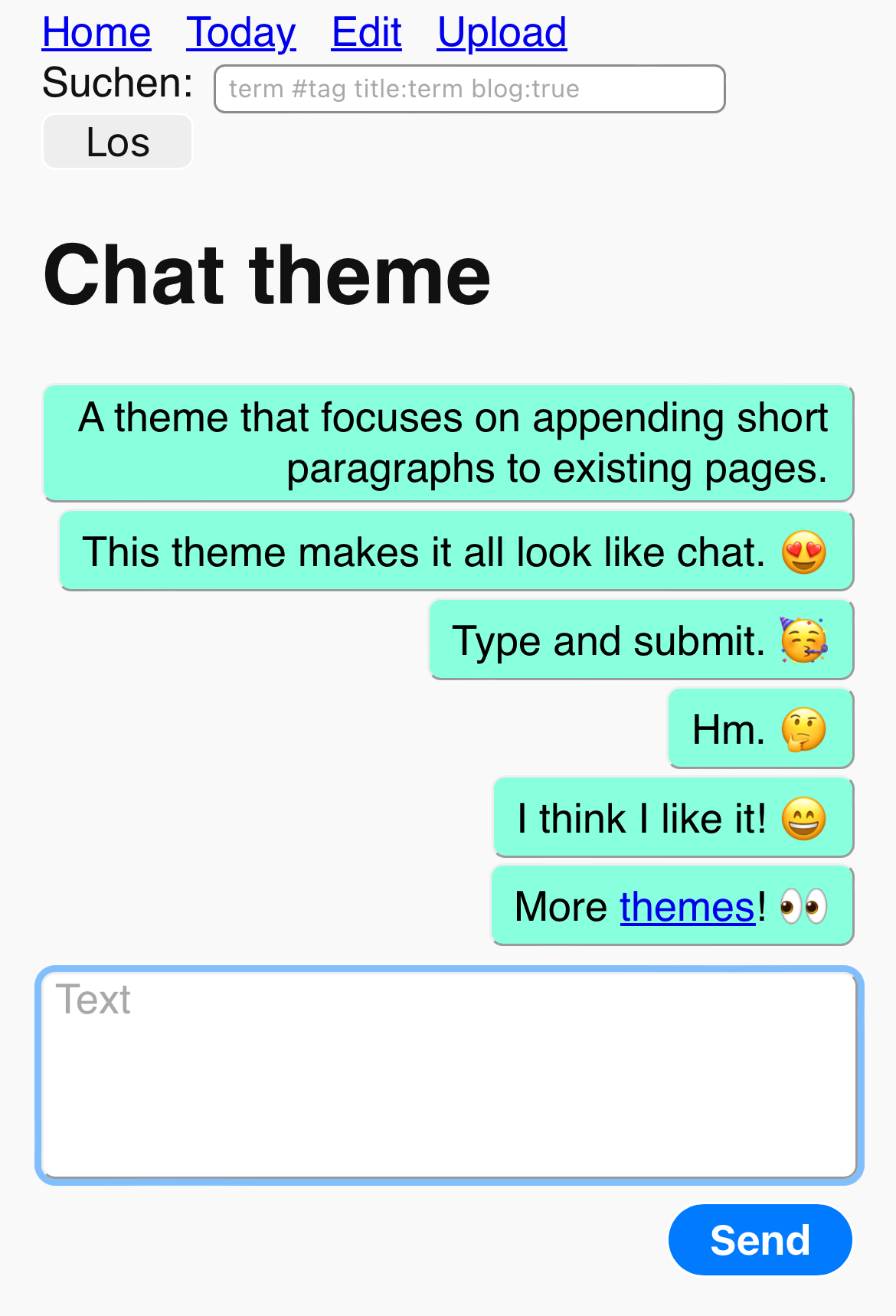
- March 2nd, 2024
Apple released a game porting toolkit that has been improved by https://getwhisky.app/" rel="noopener noreferrer">Whisky:
> app that wraps both Wine, the tool that translates Windows API calls to their Unix-like equivalents, and Apple’s game porting toolkit into one very friendly interface. That removes pretty much all of the work out of the process, to the point where all I had to do was download Whisky and drag it into my Applications folder.
https://sixcolors.com/post/2024/02/to-embrace-gaming-apple-needs-to-level-up-its-game-porting-toolkit/" rel="noopener noreferrer">Dan Moren writes at Six Colors that maybe Apple should make running PC games on MacOS great with this method.
- March 4th, 2024
[[Ente]] just https://ente.io/blog/open-sourcing-our-server/" rel="noopener noreferrer">announced open sourcing their full backend.
It’s an end-to-end encrypted “alternative to Google or Apple photos”, licensed as [[AGPL]].
Their client code had always been open source, this completes making the entire service available.
- March 4th, 2024
Added a notes page for Stewart Brand's [[Pace Layering]] concept. "The fast layers innovate; the slow layers stabilize. The whole combines with learning continuity"
!Pace Layering, from fast to slow - Fashion, Commerce, Infrastructure, Governance, Culture, Nature
- March 7th, 2024
[[Threads]] is rolling out a beta of user accounts opting in to enabling federation. [[Evan Prodromou]] https://www.threads.net/@evanprodromou/post/C4OkHjlveLnOLJHCH2CqrABDUTy-l94m9sEy3s0" rel="noopener noreferrer">announces he is part of the beta @[email protected]
- March 7th, 2024
[[Puter]] is an [[SPA]] that looks like a virtual desktop OS in the browser “Internet OS and Desktop Environment”
Reminds me of [[PhotoPea]], but the front end is [[AGPL]] licensed. I’m still digging into how coupled the back end is.
https://puter.com/?r=2FKM8AFP" rel="noopener noreferrer">Sign up with my referral link for +1GB
- March 7th, 2024
[[ForgeFed]] is a project to work on federation for software forges, built on top of [[ActivityPub]]:
> “imagine you could host your Git repos anywhere you want…but still be able to open issues and submit pull requests against repos hosted elsewhere”
- March 7th, 2024
Talking about [[Ente]], it turns out people are interested in solutions for [[Photo Sharing]], so I wrote up a notes page about some apps that I know of, and what I currently use.
- March 7th, 2024
https://gitlab.com/groups/gitlab-org/-/epics/11247" rel="noopener noreferrer">Gitlab has a backlog item for enabling ActivityPub support. There isn't a lot of consistency in this stuff yet, don't know if they'll confirm to what [[ForgeFed]] is designing, or just aim for "can subscribe in Mastodon" (really, they should be supporting both).
- March 8th, 2024
It's been 20 years, and I brought [[Zoe]] up in conversation again: a local IMAP server on your Mac that gave you an interface for exploring, searching, and working with your email. I've added a notes page for it.
- March 9th, 2024
https://dahlia.github.io/fedify/" rel="noopener noreferrer">Fedify:
> …is a Deno/TypeScript library for building federated server apps powered by [[ActivityPub]] and other standards
Still in early development. Also using Deno’s new [[JSR]] packaging format.
- March 11th, 2024
I took some downtime this weekend and played many hours of https://www.cavesofqud.com/" rel="noopener noreferrer">Caves of Qud, an RPG / roguelike that has a vast world and many commands and abilities.
Found myself searching a lot of basics, like "How do I fill a waterskin with liquid?", and deciding how many arms and legs I wanted my mutant character to have.
- March 11th, 2024
I kind of hate this https://www.fastcompany.com/91049319/2024-macbook-air-review" rel="noopener noreferrer">Fast Company review of the 2024 MacBook Air called “Dawn of the AI laptop” — but it’s the label that’s selling laptops today. Without “touchscreen capability, fancy rotating hinges, folding screens, or other features” that PC manufacturers are attempting.
- March 11th, 2024
https://doingweeknotes.com](https://doingweeknotes.com/" rel="noopener noreferrer">Doing Weeknotes), by Giles Turnbull: “Weeknotes are a format for regular communication about work in progress.”
via https://werd.io/view/65ef0c3bcf74c72342081462" rel="noopener noreferrer">Ben Werdmuller
- March 13th, 2024
https://marker.pages.dev/" rel="noopener noreferrer">Marker is “an open-source, user-friendly UI for writing & editing markdown files”. For MacOS desktop, built with [[Tauri]].
- March 14th, 2024
https://uncut.wtf/" rel="noopener noreferrer">Uncut.wtf is "a free typeface catalogue, focusing on somewhat contemporary type. There are currently 152 typefaces featured"
via [[Ryan Betts|@depatchedmode]], we're using https://github.com/RandomMaerks/Overused-Grotesk" rel="noopener noreferrer">Overused Grotesk at [[Fission]].
- March 14th, 2024
[[Radicle]] has reached v1.0. It's a "distributed code collaboration stack" -- local first nodes that connect p2p and stores everything in git, identities are DID-based Ed25519 keys.
- March 16th, 2024
https://www.paradedb.com/" rel="noopener noreferrer">ParadeDB “a modern ElasticSearch alternative built on Postgres and Tantivy, in Rust”
- March 17th, 2024
[[Web Recorder]] actually records websites so they are replayable rather than just a static archive.
- March 17th, 2024
[[Bazzite]] is a Linux distro for gaming with Steam support out of the box.
- March 17th, 2024
New note for [[Universal Blue]]: using containers as the basis for a desktop OS. "That's nerdspeak for the ultimate Linux client: the reliability of a Chromebook, but with the flexibility and power of a traditional Linux desktop"
- March 18th, 2024
Old blog post by https://signal.org/blog/the-ecosystem-is-moving/" rel="noopener noreferrer">Moxie on the Signal blog on how open-ended protocols stall.
Surfaced by [[Gordon Brander]], “innovation by definition is not standardizable” — ecosystems move too quickly as they first emerge.
- March 20th, 2024
Daniel from Bluesky https://bsky.app/profile/dholms.xyz/post/3ko5bvoupzs2o" rel="noopener noreferrer">goes through the evolution of the network to today’s federation.
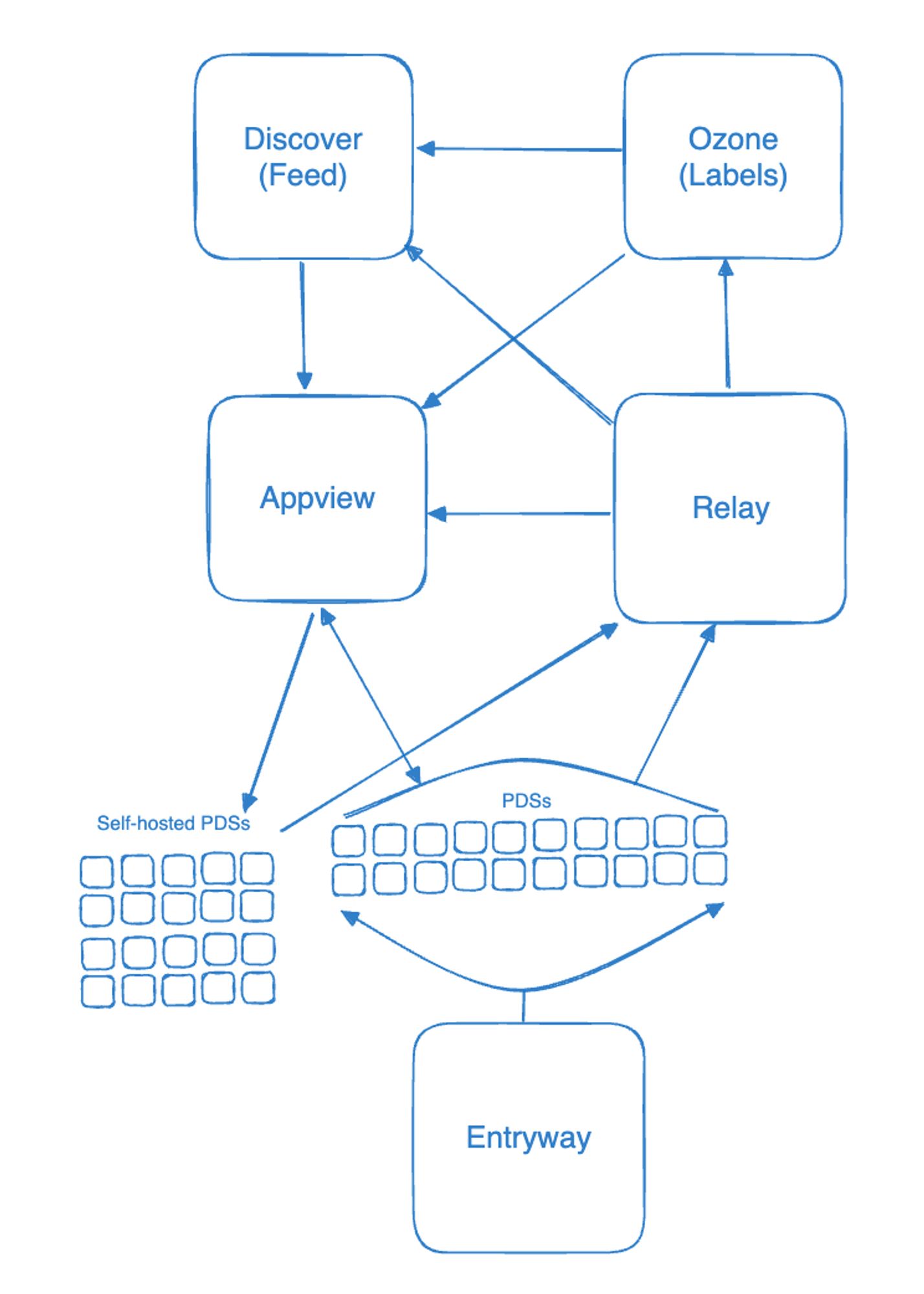
- March 21st, 2024
Ana Hevesi from Uploop posts a fire article https://www.uploop.dev/blog/stop-wasting-time-on-community" rel="noopener noreferrer">Stop wasting time on community:
> "…today’s leaders can build followings at scales that were once the exclusive domain of religions and nations."
Ana says: get serious about defining and serving your extended constituencies.
- March 24th, 2024
Did a https://whtwnd.com/bmann.ca" rel="noopener noreferrer">quick test of the whtwnd ATProtocol blogging platform. Made by https://bsky.app/profile/knksm5.final-techblog.com" rel="noopener noreferrer">@knksm5.final-techblog.com:
> “The body of blog articles is stored on your Personal Data Server (PDS) and is not saved on WhiteWind servers or the like, and viewers retrieve articles from your PDS.”
- March 26th, 2024
https://openpath.chadwhitacre.com/2024/relicensing-and-rug-pulls/" rel="noopener noreferrer">Chad Whitacre on the Redis re-licensing:
> “For a relicensing to be a rug pull, there has to have been a true developer community around the project—not just users, developers.”
Also has a graph showing Sentry (where he works) being almost completely company maintained.
- March 29th, 2024
Substack introduced a “Follow” feature that makes it more like a social network destination rather than a newsletter / blog platform.
And they don’t share follower email addresses with authors.
Yet-another-proprietary-social network. Yes, I told you so.
Write up on https://www.thewrap.com/substack-follow-feature-problems-subscriptions-down/" rel="noopener noreferrer">The Wrap
- March 29th, 2024
I’m helping to organize a [[Vancouver Hack Day]] this coming Sunday, April 7th, 2024.
Get a quick overview of some interesting tech, including [[atproto]], [[Everywhere Computer]], [[Local First]], and [[Enhance]]. Then spend the day learning and coding, or bring a project of your own. Demos end of day.
- March 30th, 2024
https://coopcloud.tech/blog/selfhosted-infrastructure-any/" rel="noopener noreferrer">Demo video of live setup of [[Co-op Cloud]] stack with single sign on with [[Keycloak]] and running [[Matrix]], [[Hometown]] (Mastodon fork), and [[Nextcloud]].
- March 30th, 2024
Jamming with [[Orion Reed]]. Going to host his [[Causal Islands LA]] https://schedule.fission.codes/causal-islands-losangeles-2024/talk/BFFYFU/" rel="noopener noreferrer">talk at an upcoming [[Tools for Thought Rocks]] event so we get a recording.
And I think it’s time to work on [[TiddlyWiki]] style drag and drop. I’ll post some background thoughts at [[Note Clips]].
- March 30th, 2024
OK, went ahead and figured out a date with Orion: Next [[Tools for Thought Rocks]] will be https://lu.ma/tftrocks-april2024" rel="noopener noreferrer">Wed, April 17th at 8am PST.
- March 30th, 2024
[[Ian Vanagas]] writes [[Smart Young BC]]. He's starting to write some screenshot essays with great [[Vancouver Tech]] content, like this one https://x.com/IanVanagas/status/1774184763634467127?s=20" rel="noopener noreferrer">on crushing silos.
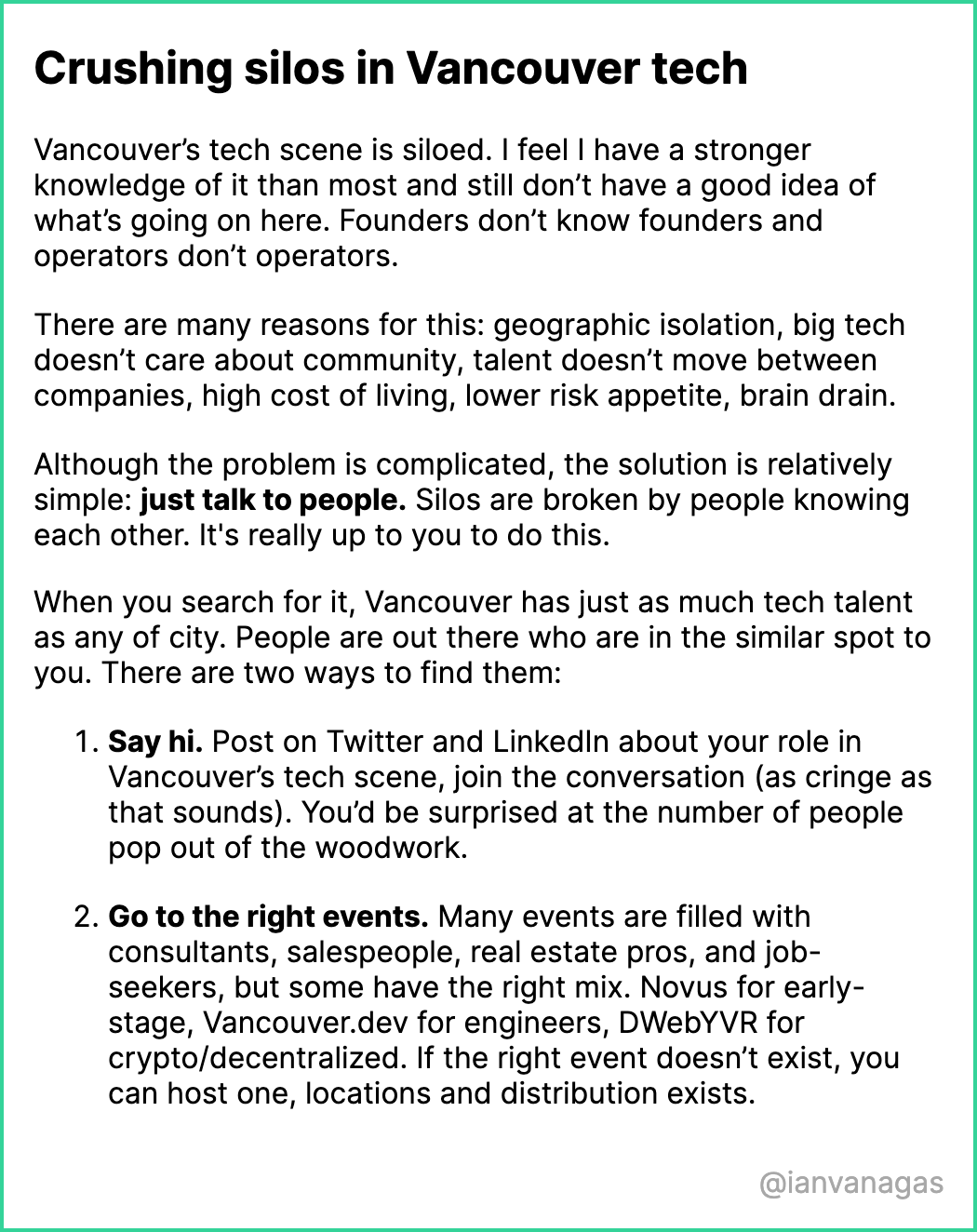
- March 31st, 2024
Glyph writes https://blog.glyph.im/2024/03/software-needs-to-be-more-expensive.html" rel="noopener noreferrer">Software Needs To Be More Expensive, mostly suggesting that low barrier “let engineers expense $50 per month to any open source project” could help.
The underlying intent is what I’d like to promote: pay to support software you care about. From end users to developers, this can be promoted.
It can fit alongside current real world movements to “buy local”.
- April 6th, 2024
Chad Whitacre: Open source is not a grocery store (pay first), not a soup kitchen (not charity). https://openpath.chadwhitacre.com/2024/open-source-is-a-restaurant/" rel="noopener noreferrer">Open source is a restaurant (eat your meal with others, then split the check).
- April 6th, 2024
[[Ubicloud]] is “an open, free, and portable cloud. Think of it as an open alternative to cloud providers”.
Open source AGPL that you install on bare metal servers to run your own cloud.
- April 8th, 2024
One of the things I did during [[Vancouver Hack Day]] was set up a [[Polis]] poll around https://pol.is/4xdw4338kk" rel="noopener noreferrer">DWebYVR / Vancouver tech topics. It's a way to gather feedback while also mapping consensus or differing opinions.
- April 10th, 2024
https://newsletter.mattroberts.com/p/who-killed-canadian-venture" rel="noopener noreferrer">Matt Roberts writes “Who killed Canadian Venture?” digging into the history of Canadian pension funds and RRSP investment rules.
TLDR In the 90s, 80% had to be Canadian. In 2003, this was changed to 70%. And then, in 2005 — no Canadian investment minimum.
- April 10th, 2024
“Computation is the medium of our lifetimes - it’s not just a technical medium but a cultural medium as well. We should explore the culture of computation” by Myron Krueger, as said by https://x.com/zachlieberman/status/1778058515422081044" rel="noopener noreferrer">@zachlieberman
- April 12th, 2024
https://x.com/kvistgaard/status/1778789885911962026" rel="noopener noreferrer">Ivo Velitchkov @kvistgaard talks about what he’s missing from the [[reMarkable]]:
> 1. Export of highlights from PDF and EPUB
> 2. Links between notes and related to that:
> 3. Persistent IDs of every object (note, notebook, folder, tag) so that they can be referred to from other places and opened up in the desktop or mobile app.Strong agree!
- April 14th, 2024
Ken Kantzer writes https://kenkantzer.com/gpt-is-the-heroku-of-ai/" rel="noopener noreferrer">“GPT is the Heroku of AI”:
> “a very, very expensive way to do ML features without needing an ML team. It’s actually not even that expensive compared to the value, but it _is_ expensive compared to cheaper locally run LLMs and using a traditional ML model, once it’s been trained.”
- April 14th, 2024
Kneeling Bus’ [[Brazilianization of the Internet]] is an important read. I need to think about how my [[Community Search Engine]] exacerbate “enclave-gated internet” spaces.
- April 14th, 2024
Gordon Brander writes https://subconscious.substack.com/p/decentralizability" rel="noopener noreferrer">Decentralizability:
> “Immutable data, universal IDs, user-controlled keys… and just using HTTP. I think this is probably minimum viable decentralizability.”
Pretty close match to my definition of [[Web3]].
- April 15th, 2024
Chris Riccomini https://materializedview.io/p/postgresql-extensions-or-protocols" rel="noopener noreferrer">PostgreSQL Extensions or Protocols: Architecture Roulette - I feel like a lot of early open source is now exploring the protocols vs platforms space. Including “de facto” protocol status.
- April 15th, 2024
https://bsky.app/profile/pfrazee.com/post/3kq7hxwv26p2x" rel="noopener noreferrer">Paul Frazee shares a few thoughts on paying for email to stop spam. This is of course purely in reference to email. Not to any other kinds of posts.
- April 15th, 2024
https://mastodon.social/@benpate/112277048491168171" rel="noopener noreferrer">Ben Pate has posted a https://kumi.tube/w/pmqy4eUy6iz88Z6Rh1cM5K" rel="noopener noreferrer">demo video of a federated Bandcamp, built using his ActivityPub “Social web toolkit”, [[Emissary]].
- April 15th, 2024
John O’Nolan, founder of [[Ghost]], https://mastodon.xyz/@johnonolan/112276688278192444" rel="noopener noreferrer">makes a post asking for https://tally.so/r/m67X4P" rel="noopener noreferrer">feedback on federating Ghost with ActivityPub. Please share what you write in the survey!
- April 16th, 2024
I wrote up my notes on what I submitted to the Ghost survey: [[Feedback on Federating Ghost]]. I truly believe that any app that cares about user interaction should look to federate beyond a single install.
- April 18th, 2024
https://tailscale.com/blog/sso-tax-cut" rel="noopener noreferrer">Tailscale posts about fixing their pricing so that everyone can use OIDC-compliant SSO on any plan.
This sentence about their mission stood out:
> Our mission at Tailscale is to build the new internet, and we take a strong stance that the next internet has to be secure by default.
- April 21st, 2024
https://clew.se/" rel="noopener noreferrer">Clew is an independent web search engine “focused on writing by independent creators”.
- April 21st, 2024
Just read David Phelps’ [[Proto-App Thesis]] aka “Protocol Apps”.
It matches a lot of what I’m thinking, except I think apps will build on top of [[ActivityPub]], [[atproto]], or [[Farcaster]]. I’ll collect some thoughts at [[Proto Apps]].
- April 21st, 2024
ActivityBadges extends Open Badges with [[ActivityPub]] support.
Seen via https://hachyderm.io/@mapache/112154471916032372" rel="noopener noreferrer">@[email protected]
- April 21st, 2024
https://www.matthewbogart.net/2024/04/17/ghost-asks-for-input-about-how-to-join-the-fediverse/" rel="noopener noreferrer">Matthew Bogart writes up his thoughts on how Ghost might join the fediverse.
The “new blog post” short note vs “full post” federation is an interesting one.
I do think full post is the most interesting (there are many ways to cross post new blog post notifications already).
- April 21st, 2024
I added a few notes to [[Feedback on Federating Ghost]] on how this could be done using [[atproto]].
One idea I think is novel that I wrote up in more detail: [[Bluesky Custom Feeds for Premium Content]]
- April 22nd, 2024
https://writings.stephenwolfram.com/2023/03/chatgpt-gets-its-wolfram-superpowers/" rel="noopener noreferrer">Stephen Wolfram writes about the ChatGPT integration with Wolfram Alpha.. I have been wondering about this sort of “fact engine” integration. As LLMs get used for search, you’d prefer facts for the factual parts ;)
- April 23rd, 2024
Long thread by https://hachyderm.io/@maegul/112319245679533802" rel="noopener noreferrer">@[email protected] on if posting [[Ghost]] and Wordpress blogs into ActivityPub microblogging makes sense from a UX perspective.
If I were Ghost, I’d add a default “Ghost account”, as well as enable per site AP server — active sites would be more like Reddits.
The Notes vs Article [[Activity Vocabulary]] types and how they look like in different clients has barely been touched.
- April 23rd, 2024
A 2021 https://x.com/heyellieday/status/1420666954067677187" rel="noopener noreferrer">thread by @heyellieday on “proof of fidelity” instead of proof of human: we _want_ non-human actors like squads or communities to be able to act as agents.
- May 6th, 2024
Met https://twitter.com/neilsonks" rel="noopener noreferrer">@neilsonks dropping by [[Z-Space]] today (he's an OG member here). He's now part of [[Open Souls]], which you can find out more about in https://www.youtube.com/watch?v=bVxSk6Typ90" rel="noopener noreferrer">founder Kevin Fischer's video at Betaworks.
- May 7th, 2024
Had an awesome call with Yuni from [[MIWA Events]] this morning. I worked with her on lots of IPFS events over the past several years, and MIWA is her new independent event production company.
- May 7th, 2024
https://x.com/matthewchaim/status/1787986160507130361" rel="noopener noreferrer">@mathewchaim on how we get to keep building the Internet. This really resonated with me:
> we’ve been given the opportunity to keep building the internet
>
> it’s not so much about building a new internet
>
> it’s more that we get to keep on building the internet
>
> because the internet essentially stopped being built
>
> we arrived at a specific junction, put down our tools, and turned ads on to monetize what had been built
>
> here we find ourselves in green pastures
>
> where we can pick the tools back up
>
> and keep on building this thing out - May 10th, 2024
[[Simon Wardley]] on why [[Wardley Maps]] use evolution rather than maturity in https://swardley.medium.com/map-evolution-not-maturity-bae6ea1a2743" rel="noopener noreferrer">Map evolution not maturity: “(maturity is) almost always championed by salespeople who are trying to sell outdated technology that may not be in your best interest”
- May 10th, 2024
[[walkah|@walkah]] tells me that [[deSEC]] is a very good no-charge DNS hosting service run out of Germany supported by [[NLnet]]. I still use [[Namecheap]] as my registrar, going to explore setting up a domain reseller somewhere.
- May 10th, 2024
https://cap.so" rel="noopener noreferrer">Cap.so is an open source alternative to [[Loom]] — desktop screen recording and sharing. It uses [[Tauri]] for a desktop client.
- May 11th, 2024
I tinkered with a [[Portainer]] install yesterday. I’m working my way through various [[Bring Your Own Server]] stacks. This one’s a little to low level / enterprise for my single server management needs.
- May 11th, 2024
[[Dokploy]] is another Docker + Traefik PaaS, most similar to [[Coolify]]. Written in TypeScript, Apache OSS, supports [[Nixpacks]], [[Buildpacks]], or plain Dockerfiles.
- May 11th, 2024
I just recommended someone check out [[TinySeed]]. It’s a startup accelerator for B2B SaaS companies that are bootstrapping.
Yes, this is me starting to rebuild [[Startup]] info here.
- May 11th, 2024
[[Jason Cohen]] https://x.com/asmartbear/status/1789383226533765214" rel="noopener noreferrer">@asmartbear
> Pick advice that matches your goals.
>
> Lots of people recommend Peter Thiel's Zero to One. That’s wonderful if you're aiming to build the next Facebook.
>
> But if your focus is on creating a self-funded company prioritizing happiness and profits, that advice is incorrect.Plus co-ops, collectives, and other emergent forms. We can build and own together.
- May 11th, 2024
Turns out [[Teenage Engineering]] makes a mini-ITX computer case called the https://teenage.engineering/products/computer-1" rel="noopener noreferrer">computer-1.
Any other suggestions for cool or customizable mini cases?
- May 12th, 2024
[[PeARS]] is “People's Agent for Reciprocated Search”, an open source search system written in Python. Federated server plus local version to run from your desktop.
- May 12th, 2024
Just spent a little bit of time with [[AFFiNE]], a local first, open source all-in-one workspace with docs, canvas, and database aka “Notion replacement”.
I’m looking for something like this to adopt and recommend.
- May 12th, 2024
https://www.techpolicy.press/we-need-a-policy-agenda-for-rural-ai/" rel="noopener noreferrer">We Need A Policy Agenda for Rural AI by Jasmine McNealy, Mozilla Foundation. Feels US-centric to me, covers broadband access, agtech. Related to some of my thoughts on [[Local AI]].
- May 12th, 2024
https://selfh.st/alternatives/notion/" rel="noopener noreferrer">Self-hosting Guide to Alternatives: Notion covers [[AFFiNE]], [[Outline]], [[SiYuan]], and [[AnyType]].
I don’t think any of those listed are credible Notion alternatives.
- May 13th, 2024
[[WebTransitions]] is a new non profit created by [[Dietrich Ayala]]:
> “to enable experimentation and innovation on the web platform. It is a connector between those who want to see change on the web, and those who can help make it happen”
- May 16th, 2024
The [[Subconscious]] team is announcing that they're https://subconscious.substack.com/p/subconscious-is-winding-down" rel="noopener noreferrer">shutting down. The very short version from [[Gordon Brander]] "Today, if you want to amplify intelligence, you probably wouldn’t build a decentralized notes graph, you would go to work on personal AI."
Having just gone through this with Fission, I feel for Gordon and cdata and the whole team. Thank you for striving, for your writings, and for the wonderful community you built in your Discord.
- May 16th, 2024
[[Grist]] is an open source cloud spreadsheet. Not quite an Airtable clone, but similar capabilities. Some of the layout and linking makes it feel like Filemaker. The [[Grist Labs]] team behind it is also very inspiring.
- May 17th, 2024
From https://x.com/vicvijayakumar/status/1791597675051184489" rel="noopener noreferrer">@vicvijayakumar on full stack:
>”We’ve managed to convince new developers that JavaScript is the easiest language to build applications in, but also give them toolboxes that come almost empty.“
- May 18th, 2024
https://warpcast.com/dwr.eth/0x0585ba84" rel="noopener noreferrer">Dan Romero on “partnering” with [[Farcaster]]:
> How can I partner with "Farcaster"?
>
> It's a permissionless protocol. Build something people can use.
>
> Feel free to send to me and if looks interesting, I'll recast it.
>
> That's it.Also: https://docs.google.com/presentation/d/1wIlk4BLNTBGXLdkTgLA14dp96CmLxLZuW-E4i67JFLw/edit" rel="noopener noreferrer">@adrienne’s talk on if Farcaster is a scenius
- May 20th, 2024
[[New Public]] are running a remote https://newpublic.org/fellowship" rel="noopener noreferrer">Neighborhood Steward Fellowship, must be US based, $1000 honorarium, apply by May 20th:
> “An eight-week program bringing together leaders of local-oriented online spaces to experiment with fun new practices and ideas”
- May 22nd, 2024
I made a page here for my [[Budget Scenario Template]] -- a Google Sheet for budget scenario planning and cashflow forecasting.
- May 22nd, 2024
My friends at [[1RG]] in Toronto now have a https://lu.ma/1rg-calendar" rel="noopener noreferrer">public events calendar. Inspiring! I want to figure out what we can do at [[Z-Space]].
- May 22nd, 2024
https://kyefox.com/activitypub-might-be-a-transitional-technology/" rel="noopener noreferrer">Kye Fox writes: “ActivityPub might be a transitional technology” - I mostly agree with his predictions.
But I think all the [[Open Social Protocols]] are toast unless we get multiple large orgs across multiple countries running instances.
And also move beyond micro-blogging by building [[Proto Apps]].
- May 22nd, 2024
I love the [[Minimum Viable Demos]] https://www.mvdemos.com/" rel="noopener noreferrer">website. If all you see is the boring vertical mobile version on your phone…turn it sideways! (and/or visit the glorious desktop version)
- May 24th, 2024
I put together a page gathering [[Open Social DAUs|info on DAUs]] for the [[Open Social Protocols]] I'm interested in.
- May 26th, 2024
[[Jortage]] is a communal cloud whose first project uses Backblaze + Fastly to deduplicate media attachments, designed for fediverse instances.
Seen via @[email protected]
- May 26th, 2024
[[EchoFeed]] is a service to send RSS posts to Mastodon, MicroBlog, Bluesky, GitHub, Discord, or LinkAce, as well as Webmentions and Webhooks. Free to start or $25/year.
- May 26th, 2024
I had an amazing catch up with Ami last week. He’s the founder of [[Creative Pulse]], a community running in Vancouver for 10 years.
The https://www.eventbrite.ca/e/knowledge-sharing-why-smart-creatives-build-in-public-tickets-901446128637" rel="noopener noreferrer">next event is about type designer Alanna Munro’s approach to [[Build in Public]] .
- May 26th, 2024
Mattias Ljungman writes that https://pulse.moonfire.com/seed-is-broken-heres-how-to-fix-it/" rel="noopener noreferrer">seed stage investing is broken for investors and founders, and suggests a framework for redefining the pre-seed to A investment stages.
- May 27th, 2024
Spending more time with [[Ownr]]. Seems like a good choice for sole proprietorship. Not sure if I can do a "test" startup setup.
- May 27th, 2024
I think I finally found a good label for what my approach is, by https://x.com/hermittoday/status/1795091976812896587" rel="noopener noreferrer">@hermittoday:
> a _deep generalist_ is someone who discovers new niches by following their curiosity with extreme faith, and once the newly found niche is understood and its complexity exhausted, in a meta-systematic fashion, it’s time for them to move on
- May 28th, 2024
https://x.com/levelsio/status/1795367939123917159" rel="noopener noreferrer">@levelsio points out that many are missing Telegram as a giant platform:
> Telegram has 1 billion users
>
> It's the #1 or #2 chat app in most countries around the world
>
> Complete blindspot for most Americans
>
> And NOBODY uses it for its encryption (or lack of it), we use it because it has the best UX of any chat app!
>
> Also best API to develop bots with - May 28th, 2024
[[siftrss]] is a tool for filtering RSS feeds and outputting a new, filtered feed. I used it on my Github account feed to generate a feed of just starred items, which I'm now using [[EchoFeed]] to cross post.
- May 29th, 2024
I've used [[Wave]] for payroll in Canada forever (both SMB and small startup teams). Giving it another look for SMB basic accounting. Anything else I should be looking at in Canada?
- May 30th, 2024
Just bought my [[DWeb Camp]] tickets. I'm excited, it's my first time! It's Aug 7th - 11th, and I'll probably spend some of the next week in SF to catch up with some people, maybe do a meetup or two.
- May 30th, 2024
We registered [[Z-Space]] as a BC society today:
> _Z-Space Arts and Technology Society provides affordable, sustainable, community oriented office and creative space dedicated to supporting creative technologists, startups and innovative small businesses. We host a series of events and meetups supporting the community. We connect with similar art, science, and technology spaces globally._
- June 1st, 2024
https://x.com/cpaik/status/1796633683908005988?m" rel="noopener noreferrer">Chris Paik @cpaik wrote a short piece predicting https://docs.google.com/document/d/103cGe8qixC7ZzFsRu5Ww2VEW5YgH9zQaiaqbBsZ1lcc/mobilebasic" rel="noopener noreferrer">The End of Software. The premise is that software will go the way of journalism, because of LLMs making it.
Here are three quotes:
“Software is expensive because developers are expensive.”
“Vogue wasn’t replaced by another fashion media company, it was replaced by 10,000 influencers.”
“Majoring in computer science today will be like majoring in journalism in the late 90’s.”
I’m someone who would like to see more user malleable software, but we’re not quite there yet.
- June 2nd, 2024
https://x.com/trengriffin/status/1797088728575566300" rel="noopener noreferrer">Tren Griffin @trengriffin with a short thread on Software isn’t Ending
> “There are zero significantly profitable software businesses with pricing power based on the expense of creating the software. Instead:”
>
> “1 Supply-Side Economies of Scale and Scope; 2 Network Effects); 3 Brand; 4 Regulation; and 5 Intellectual Property.” - June 2nd, 2024
Good write up on https://paragraph.xyz/@clauswilke/farcaster-channel-moderation" rel="noopener noreferrer">Farcaster’s new decentralized channel system and the approach to moderation + algorithms, including comparisons with hashtags and Reddit.
- June 2nd, 2024
https://mhatta.substack.com/p/the-disappearing-world-wide-web" rel="noopener noreferrer">The Disappearing World Wide Web covers the loss of web pages found in [[Common Crawl]] (38% of the 2013 pages are no longer accessible), as well as the general trend of info to exist in [[Dark Forest and Cozy Web|cozy web]] spaces.
- June 2nd, 2024
https://artificialbureaucracy.substack.com/p/avoidance-machines" rel="noopener noreferrer">Avoidance Machines, Part 1, by Kevin Baker:
> “Writing is a task which forces one to confront ambiguity, uncertainty, and one’s own limits directly, so it’s not surprising that a coterie of avoidance entrepreneurs sprung up around it.”
- June 3rd, 2024
Caught up with John Edgar, who is quietly launching [[Ascent]]: a founder-aligned suite of legal support and other services for Canadian venture scale startups. Excited to see this evolve!
- June 5th, 2024
Ryan Hoover curates https://docs.google.com/document/d/1hB1WR6dPd1BBZfJpfhlts7N4huc3dxtDOWdiV23xxdc/mobilebasic" rel="noopener noreferrer">The Evolution of Software as another rebuttal to Chris Paik’s End of Software. This is a topic we should cover at [[Causal Islands]].
- June 5th, 2024
A write up about [[Local-First Conf]] by https://digest.browsertech.com/archive/browsertech-digest-trip-report-local-first-conf/" rel="noopener noreferrer">Browsertech Digest Trip Report. Highlights covered: local-first vs offline first, sync engines, hybrid data queries, and app data interop.
- June 5th, 2024
Mozilla is funding [[Local AI]] (aka “on device AI”) with their https://blog.mozilla.org/en/mozilla/mozilla-builders-accelerator/" rel="noopener noreferrer">Mozilla Builders Accelerator.
Application deadline August 1st, up to $100K in funding per team, 12 week program Sept to December.
- June 11th, 2024
Recommended by [[Ellie]] I'm trying out [[Pinokio]]: a browser that lets you locally install, run, and automate any AI on your computer.
- June 11th, 2024
[[Caret]] beta is now available as a beta plugin for [[Obsidian]]: "a plugin that brings the power of LLMs into your Obsidian Vault…local-first, privacy preserving and stores all generated data as local files"
- June 14th, 2024
I've published my [[Tech Event Budget Template]]. This is a very basic starting point for scoping the costs and ticket + sponsor revenue of an event that is mainly talks and networking.
- June 15th, 2024
The [[IxDA]] non-profit is shutting down, seen via https://x.com/jarango/status/1801744205792088491" rel="noopener noreferrer">@jarango who comments: "how do we build a community of practice in a world where in-person conferences are no longer a viable means for funding community orgs?"
I have many thoughts on this, and we'll be exploring this for [[Causal Islands]].
- June 17th, 2024
[[Highline Beta]] is launching Highline Hub "a curated community & space that empowers pre-seed startups". 5000 sq ft in downtown Toronto.
- June 17th, 2024
I'm giving a talk next week here in Vancouver [[Open Source Beyond Licensing - The Evolution Ahead]], followed by a panel discussion. Come join!
- June 17th, 2024
[[Jeremy Ruston]], creator of [[TiddlyWiki]], is https://x.com/jermolene/status/1802694297960980742" rel="noopener noreferrer">making native apps for iOS, MacOS, and iPadOS. I use [[Quine]] on iOS today, will be great to have across systems.
- June 19th, 2024
Anyone looking for their https://posthog.com/founders/first-ops-hire" rel="noopener noreferrer">first ops hire / chief of staff / GSD special projects, I’ve got a great person for you.
This is a great write up on the role by [[Posthog]]
- June 21st, 2024
We've got a new network at [[Z-Space]] so I found [[QiFi]], a pure JS qrcode generator to make a code for people to scan and automatically connect to the visitor wifi.
- June 21st, 2024
Went ahead and setup [[Causal Islands Berlin]] as a LinkedIn event. We announced new dates and a selection committee today.
- June 23rd, 2024
Writing up notes as I work on [[Vancouver Hack Day]] stuff. Trying to get [[Lieu]] deployed, going to make a [[LOCALHOST]] / [[DWebYVR]] webring.
- June 24th, 2024
[[Death of the Junior Developer]] by [[Steve Yegge]] "It's a bad year to be a junior anything…within a few years, the norm for source code will be that it is written and modified by LLMs via prompting"
- June 27th, 2024
I presented [[Open Source Beyond Licensing - The Evolution Ahead]] yesterday. I did a quick survey tour of some interesting licenses I like sharing, and in other ways promoted a kind of back to basics: open source is working together.
- June 27th, 2024
Great read on [[Open Sourcing Kinopio]]:
> I’ve long been thinking about how to share the amount of work that goes into Kinopio. The more you know how something is made, the more you appreciate it – even more so when it’s a quality product built to last a lifetime.
(For license nerds, https://github.com/kinopio-club/kinopio-client/blob/main/LICENSE.md" rel="noopener noreferrer">PolyForm Noncommercial)
- June 28th, 2024
Just used [[Keynote HTML Export]] that is built in for the first time when publishing [[Open Source Beyond Licensing - The Evolution Ahead]]. Also found Keynote Extractor which has slightly cleaner HTML.
- June 30th, 2024
This is the first month of the [[Z-Space]] non-profit fully taking over the 3rd floor of 505 Hamilton. We have a https://zspace.commonscomputer.com/s/af6b1264-90cc-46d4-a669-bba172150d6e" rel="noopener noreferrer">private office available to rent for 3-4 people, as well as a few flex or permanent desks left.
- July 7th, 2024
I've put together a [[Polar]] open source funding page for [[11ty Second Brain]]. The goal is to build a great Eleventy Second Brain experience, that pairs with [[Obsidian]] as a Markdown editor, and integrates with LLM usage.
- July 7th, 2024
https://openvibe.social/" rel="noopener noreferrer">Openvibe, a "Town square for open social media" that connects Nostr, Mastodon, + Bluesky & Threads coming soon. Shows you one timeline and lets you cross-post. Available on iOS and Android.
- July 9th, 2024
The [[FAAI]] is a working group of the [[OWTA]] "aimed at promoting the integration of federation features into more applications and advancing existing federation features, protocols, and standards."
- July 12th, 2024
I had a great intro call this week with [[Kyle Briggs]]. He's based in Ottawa and has a background as an academic researcher in biophysics and a founder of an acquired nanotechnology company. He writes at https://www.caninnovate.ca/" rel="noopener noreferrer">CanInnovate.
- July 15th, 2024
Did a little [[Community Search Engine]] work today. This unstyled landing page is going to be the input list of links for the webring / search index crawl. First PR by Nicholas Tsang to add his personal website.
- July 15th, 2024
I'm continuing to re-publish some templates as I get asked about them. The [[Consulting Agreement Template]] is up now -- good for both selling your own services or using to hire consulting services.
- July 18th, 2024
Nick Gerakines talks about why he chose [[atproto]] for [[Smoke Signal]], his event and RSVP management system.
Includes closed platform issues covering Upcoming, Meetup, and Facebook.
> “Platforms and ecosystems that prevent you from leaving have good marketing and bad intentions.”
- July 30th, 2024
The largest ATProtocol [[PDS]] is [[Bridgy Fed]]. You can get a full list of the ~235 independent PDS instances via https://blue.mackuba.eu/directory/pdses" rel="noopener noreferrer">Mackubu's Bluesky Stats
- August 2nd, 2024
Paved over the Windows install on [[MiniPC PL63]] and got [[Coolify]] running on it. The setup on the [[Z-Space]] network with a VLAN and DMZ probably needs more detail in the write up, but was the most interesting part.
- August 5th, 2024
Friend [[Ellie]] is selling [14TB hard drives with a USB adapter], pre-loaded with TBs of LLM models.
- August 5th, 2024
I set up a QR code with my vCard info in it for [[DWeb Camp]]. [[Go QR]] is the generator I recommend.
- August 13th, 2024
I'm so stoked to be onboarding to [[USB Club]]. So many delightful touches, audio, words.
- August 18th, 2024
Deobald: [[Third Wave (Commercial) Open Source]]
An attempted definition of three waves of (commercial) open source. It specifically sets aside ideology & peer production and focuses on licensing and business model.
And then highlights [[Local First]] as the “new ideals”.
I’d also highlight the [[DWeb]] Principles here.
- August 18th, 2024
IndieSearch is a prototype of “decentralized and local-first compatible search”, powered by https://pagefind.app/" rel="noopener noreferrer">Pagefind. Seen via https://alexschroeder.ch/view/2024-08-18-indie-search" rel="noopener noreferrer">Alex Schroeder’s installation. I’ll see about adding it to my site.
- August 18th, 2024
Signed up for [[Spaceship]], a new domain registrar that is in fact [[Namecheap]], but starting over with a new brand and new codebase.
- August 20th, 2024
The [[FeathersJS]] team wrote up a trip report of their [[DWeb Camp]] experience, as well as David’s presentation at the [[Causal Islands]] Tiny Talks in SF.
- August 27th, 2024
I put together a new site [[ATProtocol Dev]] where I’m going to be hosting tech talks and resources about open social protocols.
My first set of talks will look at emerging [[Proto Apps]] that go beyond microblogging.
- August 28th, 2024
[[Automattic]] is planning to migrate 500M+ Tumblr blogs to WordPress, with the nuance that the front end shouldn’t change (and they’re looking to hire)
> We’re talking about running Tumblr’s backend on WordPress. You won’t even notice a difference from the outside.
- September 9th, 2024
[[Ventoy]] is an open source tool to create bootable USB drives.
via https://whtwnd.com/alice.bsky.sh/3l3oje3n5la24" rel="noopener noreferrer">alice
- September 9th, 2024
John from [[Ascent]] is in Vancouver this week, holding office hours at [[Z-Space]]. If you're building a startup, especially company formation or raising, come through and meet with him.
- September 16th, 2024
[[Brad Neuburg]] https://x.com/bradneuberg/status/1835680235049869495" rel="noopener noreferrer">on Y Combinator “YC model doesn’t work for (deep tech) startups, and is focused on the last tech war”.
This is the same for all these accelerator programs. See [[When Tailwinds Vanish]] for more.
- September 18th, 2024
Wired article on [[Apple Intelligence]] and [[Private Cloud Compute]]: https://www.wired.com/story/apple-private-cloud-compute-ai/" rel="noopener noreferrer">Apple Intelligence Promises Better AI Privacy. Here’s How It Actually Works
- September 24th, 2024
The [[Bluesky]] team put together a simple Hello World app to showcase [[atproto]] called https://github.com/bluesky-social/statusphere-example-app" rel="noopener noreferrer">Statusphere.
It showcases custom data types (Lexicons) as well as OAuth, and runs locally.
- September 26th, 2024
[[Jesse Rodgers]], who is helping run [[Startup Barn]] in Waterloo, https://whoyoucallingajesse.com/mummy-where-do-baby-startups-come-from-c95b07ac7c16" rel="noopener noreferrer">makes a pitch for getting back to basics with the term [[Startup]] — just build:
> "Startups, at their core, come from people creating something of value for others. They are born from the act of building, not from the rituals of the startup religions or the blessings of the Venture Capitalists."
- September 28th, 2024
https://ia.net/topics/our-android-app-is-frozen-in-carbonite" rel="noopener noreferrer">iA Writer is cancelling their Android app because it seems impossible to comply with Google Drive connection rules.
I see so clearly that we need a user-owned file sync protocol.
- October 16th, 2024
[[Frontpage]] is a link aggregator (think Hacker News) defined as a new Lexicon data type on [[atproto]]. It’s out of invite only access, and you can use your existing account to login.
- October 16th, 2024
Had an inspiring call with the [[ZKorum]] team this morning. They're trying on some new taglines, including "building citizen networks rather than social networks"
- October 17th, 2024
[[Subvert]] is launching today: you can become a co-op founding member for $100USD by buying the zine "Plan for the Artist-Owned Internet", or for free as a founding musician or label. I've joined, love to see more projects like this.
- October 28th, 2024
The future is interfaces: https://bsky.app/profile/piratesoftware.live " rel="noopener noreferrer">@piratesoftware.live shared a short video of doing demos at a public conference with keyboard + mouse and with a game controller. The punchline of what kids gravitated towards is a good one.
- October 28th, 2024
Had a catch up call with Tarun from [[Gitwallet]]. The platform has been iterating to serve developers doing open source consulting. A new thing they're experimenting with is https://ecosystems.gitwallet.co/" rel="noopener noreferrer">Echo: an software ecosystem explorer. Very cool!
- October 29th, 2024
I've been using [[Grist]], an open source and self hostable Airtable replacement, and excitedly telling people about it. They're hosting a https://www.getgrist.com/grist-paris-summit-2024/" rel="noopener noreferrer">summit in Paris in early December, where I also found out about the French government's [[La Suite]], a government collaboration platform.
- October 29th, 2024
[[Ibis]] has https://ibis.wiki/article/Announcing_Ibis,_the_federated_Wikipedia_Alternative" rel="noopener noreferrer">just been announced as a federated Wikipedia alternative. It's based on [[ActivityPub]] and written by one of the [[Lemmy]] developers. "built on a stack of PostgreSQL and Rust, …with a frontend written in Rust Webassembly"
- November 18th, 2024
[[Gordon Brander]], https://newsletter.squishy.computer/p/places-to-intervene-in-a-system" rel="noopener noreferrer">Places to intervene in a system:
> "If systems are fictions, maybe we can learn to hold them loosely, to trade between them, or even to let go and allow reality to speak back?"
- November 22nd, 2024
https://martinfowler.com/articles/2024-social-media.html" rel="noopener noreferrer">Martin Fowler's 2024 thoughts on the state of social media:
> If I find someone doing what I'm doing - posting on Twitter and on other sites - I prefer to follow them on a different site. As far as I'm concerned, Twitter is in decline, and although I'm not leaving it for the moment, I prefer to follow activity in other places.
- November 24th, 2024
Doing some research on [[Public Mobile]].
Low cost cellphone plans in Canada. They’re a https://en.wikipedia.org/wiki/Public_Mobile" rel="noopener noreferrer">TELUS subsidiary.
Anyone have personal experience?
- November 28th, 2024
Very inspired learning about [[UKAI]], who are hosting some https://www.eventbrite.ca/o/ukai-projects-26425493607" rel="noopener noreferrer">workshops at [[Z-Space]]:
> "Our mission is 'culture for what’s coming'"
> "…we seek and test out approaches to culture that make sense of the world we are creating and handing down to future generations.
>
> We call this work cultural research and development, and just like R&D in other fields, we are trying to make things better. In our case, we are trying to build resilience to massive volatility and change." - December 29th, 2024
Playing around with the [[Obsidian]] https://obsidian.md/clipper" rel="noopener noreferrer">Web Clipper. It has variable template types and basically just triggers new pages in your app.
Have to figure out an "archive" mode where I want to save the entire page, without republishing it.
- January 1st, 2025
[[Tailscale]] has a new feature, [[Taildrive]]: shared folders over WebDAV accessible by other users and devices.
- January 1st, 2025
[[User & Agents]] is a new community stewarded by [[Ankesh Bharti]][^feynon]. Here's one line from the home page: "_Our goal is to empower individuals with software that enables them to create their own agency_". Go https://www.userandagents.com/" rel="noopener noreferrer">read the whole thing and come join!
[^feynon]: aka https://bsky.app/profile/ankeshbharti.com" rel="noopener noreferrer">Feynon in many online spaces.
- January 9th, 2025
I’m a [[Weird]] Nerd -> weird.bmann.ca. The [[Muni Town]] team shipped paid subscriptions powered by [[Polar]]. https://blog.commune.sh/selling-dreams/" rel="noopener noreferrer">Read their blog for background on where this personal page builder is going (including [[atproto]] integration).
- January 9th, 2025
[[Out of Your Element]] is a "modern Matrix-to-Discord appservice bridge". Seems simple and robust -- just a NodeJS server. Discovered via [[Muni Town]].
- January 16th, 2025
Happy birthday [[Drupal]]! There’s a new https://dri.es/drupal-cms-1-released" rel="noopener noreferrer">Drupal CMS 1.0 release, which is a “distro” of configuration & plugins.
- March 5th, 2025
Great Q&A with [[Robin Berjon]] about open social protocols wearing his [[Free Our Feeds]] hat in https://www.cjr.org/the_media_today/interview-robin-berjon-free-our-feeds-at-protocol-musk-zuckerberg-pichai-open-source.php" rel="noopener noreferrer">Columbia Journalism Review.
Explains open social protocols as roads shared by all, and gently pushes journalists to inform themselves & get better at explaining it.
- March 9th, 2025
[[Fideslang]] is “a proposed model for a human-readable taxonomy of privacy-related data types”, seen via [[Ted Han]] https://bsky.app/profile/knowtheory.net/post/3ljtjlexwys2u" rel="noopener noreferrer">on bsky.
- March 9th, 2025
[[Chris Joel]] aka https://bsky.app/profile/cdata.bsky.social" rel="noopener noreferrer">cdata just posted an https://bsky.app/profile/cdata.bsky.social/post/3ljtew5v6jl2b" rel="noopener noreferrer">announce thread that he’s building [[Familiar]], a “magical notebook”, bootstrapping a healthier web from today’s ailing one.
- March 9th, 2025
I used [[Cyd]] to migrate tweets to Bluesky on my https://bsky.app/profile/bmannconsulting.com" rel="noopener noreferrer">@bmannconsulting.com account, self hosted on [[BringYourOwn.Computer]].
Feature request: https://github.com/lockdown-systems/cyd/issues/449" rel="noopener noreferrer">support replies using bsky's facets to link to the Twitter original.
- March 9th, 2025
It was about a year ago that I posted about [[Puter]]. It's a [[web desktop]] and got me thinking about these types of interfaces so I put together a page about them.
- March 9th, 2025
I've recently gone down the rabbit hole of looking at [[JMAP]] (aka JSON Meta Application Protocol) which [[Fastmail]] supports (I signed up). It's a modern http/json protocol being worked on at the [[IETF]], supporting email today, then contacts, calendars, etc
- June 3rd, 2025
[[Steve Klabnik]] is https://steveklabnik.com/writing/i-am-disappointed-in-the-ai-discourse/" rel="noopener noreferrer">disappointed in the AI discourse "all of the discussion online around AI is so incredibly polarized…both the pro-AI and anti-AI sides are loudly proclaiming things that are pretty trivially verifiable as not true"
He recommends two good reads: https://annievella.com/posts/the-software-engineering-identity-crisis/" rel="noopener noreferrer">The Software Engineering Identity Crisis and https://jmsdnns.com/tech/algo-underground/" rel="noopener noreferrer">Algorithmic Underground
- GitHub - amatya-aditya/obsidian-rss-dashboard: A dashboard for organizing and consuming RSS feeds, YouTube channels, and podcasts with smart tagging, media playback, and seamless content flow.
RSS Dashboard is an [[Obsidian]] plugin that pulls in posts from RSS feeds, YouTube, podcasts, and other feed based media, created by https://adityaamatya.com.np/" rel="noopener noreferrer">Aditya Amatya.
- 202506092112
[[Resilio]] Sync was introduced to me by Jonny at [[Z-Space]] for user friendly file sync across many platforms. It used to be called BitTorrent Sync (and now I'm down a https://en.wikipedia.org/wiki/Resilio_Sync" rel="noopener noreferrer">wikipedia rabbit hole - oh god,https://en.wikipedia.org/wiki/Comparison_of_file_synchronization_software" rel="noopener noreferrer">comparison of file sync software)
- 202506121420
https://justin.searls.co/posts/these-4-code-snippets-won-wwdc/" rel="noopener noreferrer">Justin Searls explains why to be excited about what Apple announced about LLMs at WWDC. One is that developers can do "free, unlimited invocation of Apple's on-device language models", so zero cost LLM features by using a user's own device. The rest is about native support in Swift for working with LLMs.
- 202506131222
As part of walking the startup showcase at Web Summit Vancouver, I saw https://forestwalk.ai/" rel="noopener noreferrer">Forestwalk Labs https://www.youtube.com/watch?v=0ptXBlsZwC0" rel="noopener noreferrer">demo'ing Timberline, their agentic Mac app - building task management in an agent-first way.
- 202506131236
[[Tonk]] https://tonk.substack.com/p/tonk-the-explainer" rel="noopener noreferrer">released an explainer about their new release - "a CLI that helps you vibe code your second brain", "designed to simplify the process of building custom dashboards, tools, and AI agents using your own data."
Explicitly mentions remixing your [[Obsidian]] content.
- 202506131249
[[Radicle]], an open source p2p collaboration stack around git repos, has a new desktop app.
- 202506161634
I’ve been uneasy about [[Matrix]] for a long time.
This post goes on to recommend where to look for a replacement: [[Polyproto]], [[Delta Chat]], [[Revolt]]
- 202506170845
[[Why Centralized AI Is Not Our Inevitable Future]] is a response to https://blog.samaltman.com/the-gentle-singularity" rel="noopener noreferrer">Sam Altman's "gentle singularity", written by [[Alex Komoroske]], founder of [[Common Tools]]
> "between hyper-centralized systems that inevitably tend toward extraction and manipulation, versus distributed systems that enhance human agency and preserve choice."
- 202506171119
[[Devine Lu Linvega|Devine]] wrote notes on [[Malleable Computing XXIIVV|malleable computing]] as a reflection on the [[Malleable Software Essay|Ink & Switch Malleable Software essay]].
- 202506171217
[[The Shape of What You Meant]] is a blog post about [[Index Network]], a kind of ambient discovery that describes its contrast with performative social media and how things must be public in order to aid in discovery.
- 202506181438
https://bonfirenetworks.org/posts/slow_software_for_a_burning_world/" rel="noopener noreferrer">Slow Software for a Burning World as [[Bonfire]] heads to a v1.0 release:
> "In a world of 'move fast and break things,' we’ve chosen a different tempo — one rooted in care, deep listening, and collective stewardship. Slow software means building for long-term resilience and meaningful participation, rather than chasing novelty, speed, or scale."
 The Gap Through Which We Praise the Machine
[[The Gap Through Which We Praise the Machine]]
> In this post I’ll expose my current theory of agentic programming: people are amazing at adapting the tools they’re given and totally underestimate the extent to which they do it, and the amount of skill we build doing that is an incidental consequence of how badly the tools are designed.
 Rolling the ladder up behind us
[[Rolling up the ladder behind us]], by Xe Iaso. "Who will take over for us if we don't train the next generation to replace us? A critique of craft, AI, and the legacy of human expertise.":
> I had a lot of respect for [[Anthropic]] before they released this feculent bile that is the Model Context Protocol spec and initial implementations to the public. It just feels so half-baked and barely functional.
- Decentralization Trade Offs in AT Protocol and ActivityPub DWeb Camp 2026
Oh ya! I am moderating a panel at [[DWeb Camp 2026|DWeb Camp Berlin]] with [[Christine Lemmer-Webber]] and [[Daniel Holmgren]] called [[Decentralization Trade Offs in AT Protocol and ActivityPub]].
- Fig is awesome! @bad-example.com
Fig is awesome! @bad-example.com
- Fig builds Microcosm. You can sponsor on Github
Fig builds https://microcosm.blue" rel="noopener noreferrer">Microcosm. You can sponsor on Github
- Editable Website is a SvelteKit template for building CMS-free editable websites. Uses Svedit. Being built by @michaelaufreiter.com
https://editable.website/" rel="noopener noreferrer">Editable Website is a SvelteKit template for building CMS-free editable websites. Uses https://svedit.dev/" rel="noopener noreferrer">Svedit. Being built by @michaelaufreiter.com
- > Software today is more malleable than ever. In some way this means that it can be released in a more fluid way. Not just development, distribution of software may change as well by @antirez.bsky.social
> Software today is more malleable than ever. In some way this means that it can be released in a more fluid way.
https://antirez.com/news/170" rel="noopener noreferrer">Not just development, distribution of software may change as well by @antirez.bsky.social
- I met Luke @luke.kanies.com at @localfirstconf.com & answered some atproto questions at the beer garden. He wrote Building on atproto with a lot of questions about permissioned data and how this meshes with local first.
I met Luke @luke.kanies.com at @localfirstconf.com & answered some atproto questions at the beer garden. He wrote https://lukekanies.com/writing/building-on-atproto/" rel="noopener noreferrer">Building on atproto with a lot of questions about permissioned data and how this meshes with local first.
- There is a Railway feature request thread suggesting Tangled integration. Upvoted!
There is a [[Railway]] feature request thread suggesting [[Tangled]] integration. Upvoted!
- As part of adding search to my site, I found an old journal entry referencing @byjp.me IndieSearch and Pagefind. This is exactly why I take notes!
As part of adding search to my site, I found https://bmannconsulting.com/journal/2024-08-18-0934/" rel="noopener noreferrer">an old journal entry referencing @byjp.me https://www.byjp.me/posts/indiesearch/" rel="noopener noreferrer">IndieSearch and https://pagefind.app/" rel="noopener noreferrer">Pagefind. This is exactly why I take notes!
- TIL caffeinate is a built in MacOS CLI command that makes it so your Mac doesn't go to sleep.
TIL caffeinate is a built in MacOS CLI command that makes it so your Mac doesn't go to sleep.
- > The majority of FOSS developers are one-man-shows, and the only cOmMuNiTy they have around them are the users requesting features or reporting bugs while most of the time not contributing in any form whatsoever I Regret Migrating to Codeberg
> The majority of FOSS developers are one-man-shows, and the only cOmMuNiTy they have around them are the users requesting features or reporting bugs while most of the time not contributing in any form whatsoever
https://xn--gckvb8fzb.com/i-regret-migrating-to-codeberg/" rel="noopener noreferrer">I Regret Migrating to Codeberg
- Podcast Apps: A Framework for Dying Slowly with Dignity > While the podcasting sector has seen growth, this has occurred almost entirely on platforms like YouTube2, and the independent podcast app userbase has mostly just stood still. Dustin Bluck of Castro on indie podcast apps
https://www.uncommonapps.nyc/p/podcast-apps-a-framework-for-dying" rel="noopener noreferrer">Podcast Apps: A Framework for Dying Slowly with Dignity
> While the podcasting sector has seen growth, this has occurred almost entirely on platforms like YouTube2, and the independent podcast app userbase has mostly just stood still.
Dustin Bluck of https://castro.fm/" rel="noopener noreferrer">Castro on indie podcast apps
- PropterMalone released Clade: “Your own contact rolodex, built from the data exports the big platforms already owe you — merged, enriched by web research, searchable.” LinkedIn, Google, Facebook, Bluesky as sources.
https://bsky.app/profile/proptermalone.bsky.social/post/3mrdbvnhfnc2r" rel="noopener noreferrer">PropterMalone released Clade: “Your own contact rolodex, built from the data exports the big platforms already owe you — merged, enriched by web research, searchable.”
LinkedIn, Google, Facebook, Bluesky as sources.
- Tangleflow: Convert GitHub actions workflows to @tangled.org pipelines and vice versa. By @43801j.com
Tangleflow: Convert GitHub actions workflows to @tangled.org pipelines and vice versa.
By @43801j.com
- Vic made an Airglow automation which saves starred @tangled.org repos to your own @semble.so collection.
Vic made an https://airglow.run/u/vicwalker.dev.br/3ml5ixicbos22" rel="noopener noreferrer">Airglow automation which saves starred @tangled.org repos to your own @semble.so collection.
- I met one of the devs who work on Fibery at Local-First. I like the description “an operating system for orgs run by nerds”. Kind of Grist-like, not open source, and SaaS per-seat pricing after the first 10 users. (They do have free to use for OSS).
I met one of the devs who work on https://fibery.io/" rel="noopener noreferrer">Fibery at Local-First. I like the description “an operating system for orgs run by nerds”.
Kind of Grist-like, not open source, and SaaS per-seat pricing after the first 10 users. (They do have free to use for OSS).
- ycc is @why.bsky.world’s coding harness: > “A docs-driven coding harness: a coding agent that works from a spec.md and a backlog of tasks. ycc is a single binary that is client, TUI, and daemon in one.”
https://github.com/whyrusleeping/ycc" rel="noopener noreferrer">ycc is @why.bsky.world’s coding harness:
> “A docs-driven coding harness: a coding agent that works from a spec.md and a backlog of tasks. ycc is a single binary that is client, TUI, and daemon in one.”
- Fark founder Drew Curtis writes about the state of the Internet today & effects on Fark: > “The core problem that we can't fix is if people hate the entire news cycle because of stuff, they are going to struggle to want to keep Fark as a daily read.”
https://www.fark.com/comments/blog1796/Fark-NotNewsletter-Not-Ready-to-go-on-cart" rel="noopener noreferrer">Fark founder Drew Curtis writes about the state of the Internet today & effects on Fark:
> “The core problem that we can't fix is if people hate the entire news cycle because of stuff, they are going to struggle to want to keep Fark as a daily read.”
- Plates, restaurant menus on atproto, by jbhutch.bsky.social
Plates, restaurant menus on atproto, by https://bsky.app/profile/jbhutch.bsky.social/post/3mrpo4ong4k2e" rel="noopener noreferrer">jbhutch.bsky.social
- Lots of people have been asking about the atproto alternative to Buzz, the Jack Dorsey-supported Nostr chat for agents & humans to chat in. The answer is freeq, which is atproto + IRCv3 extensions, including CRDTs with Automerge, QUIC, iroh. Follow @freeq.at.
Lots of people have been asking about the atproto alternative to https://buzz.xyz/" rel="noopener noreferrer">Buzz, the Jack Dorsey-supported Nostr chat for agents & humans to chat in.
The answer is https://freeq.at/" rel="noopener noreferrer">freeq, which is atproto + IRCv3 extensions, including CRDTs with Automerge, QUIC, iroh. Follow https://bsky.app/profile/freeq.at" rel="noopener noreferrer">@freeq.at.
- Bending Spoons is buying Airtable - which is very bad because BS is known for buying companies & squeezing them for profit. Gordon screams & wants a local first version. Grist is an OSS alternative supported by European governments.
https://www.siliconrepublic.com/business/bending-spoons-buys-airtable-for-1-2bn-after-ipo-listing" rel="noopener noreferrer">Bending Spoons is buying Airtable - which is very bad because BS is known for buying companies & squeezing them for profit. https://bsky.app/profile/gordon.bsky.social/post/3msb35uo4ps2t" rel="noopener noreferrer">Gordon screams & wants a local first version.
[[Grist]] is an OSS alternative supported by European governments.
- Cloudflare launching wallets for agents with x402 support. They’re doing the handles landgrab at cloudflare.pay - but looks like it uses subdomains, so could compose with atproto.
Cloudflare launching wallets for agents with https://x402.org/" rel="noopener noreferrer">x402 support.
They’re doing the handles landgrab at https://cloudflare.pay" rel="noopener noreferrer">cloudflare.pay - but looks like it uses subdomains, so could compose with atproto.
- The Cloudron team have packaged Tymeslot as an alternative to Cal.com, which has gone closed source as of April. I've used and enjoyed our @commonscomputer.com Cal.com instance for a couple of years now. I'll try Tymeslot and report back.
The [[Cloudron]] team have packaged https://tymeslot.app/" rel="noopener noreferrer">Tymeslot as an alternative to [[Cal.com]], which has https://cal.com/blog/cal-com-goes-closed-source-why" rel="noopener noreferrer">gone closed source as of April. I've used and enjoyed our @commonscomputer.com Cal.com instance for a couple of years now. I'll try Tymeslot and report back.
- Aargh. Finding Takeout Tools after I've gotten this Saved Places.json from Gmaps. Now going to get the CSV version so I can get separate lists. "Google's Takeout export for saved places is incomplete by design, but the gaps aren't obvious until you've already gone through the process "
Aargh. Finding https://www.takeout-tools.com/" rel="noopener noreferrer">Takeout Tools after I've gotten this Saved Places.json from Gmaps. Now going to get the CSV version so I can get separate lists.
"Google's Takeout export for saved places is incomplete by design, but the gaps aren't obvious until you've already gone through the process "
- When Does a Specification Become a Program? is @chadfowler.com’s latest. “I suspect the useful abstraction looks closer to a knowledge graph than a requirements document” That sounds technical, but it’s best for humans too: a bundle of info in different formats.
https://aicoding.leaflet.pub/3msssevtkqc2c" rel="noopener noreferrer">When Does a Specification Become a Program? is https://bsky.app/profile/chadfowler.com/post/3msssf454wk2c" rel="noopener noreferrer">@chadfowler.com’s latest.
“I suspect the useful abstraction looks closer to a knowledge graph than a requirements document”
That sounds technical, but it’s best for humans too: a bundle of info in different formats.
- Manton has added independent PDS hosting for Micro.blog users: "When new users opt to use Micro .blog’s PDS, their domain name becomes their Bluesky handle. They can then immediately sign into Bluesky with their own domain name without creating an account on Bluesky."
Manton has https://www.manton.org/2026/08/11/introducing-the-microblog-pds.html" rel="noopener noreferrer">added independent PDS hosting for [[Micro.blog]] users:
"When new users opt to use Micro .blog’s PDS, their domain name becomes their Bluesky handle. They can then immediately sign into Bluesky with their own domain name without creating an account on Bluesky."
- Just downloading the exe.dev iOS app to test it out. Need to figure out my own remote code sessions. I’ve been using Liquid’s Apollo app with models running on our Z-Space Local AI. It syncs with desktop over iCloud and is only chat sessions.
Just downloading the https://apps.apple.com/ca/app/exe-dev/id6759881448" rel="noopener noreferrer">exe.dev iOS app to test it out. Need to figure out my own remote code sessions.
I’ve been using https://www.liquid.ai/apollo" rel="noopener noreferrer">Liquid’s Apollo app with models running on our [[Z-Space Local AI]]. It syncs with desktop over iCloud and is only chat sessions.
- I am going to demo my journal editor to som (link below). The links get appended. We're talking about how Obsidian and Automerge and atproto could be best friends.
I am going to demo my https://bmannconsulting.com/journal/editor" rel="noopener noreferrer">journal editor to som (link below). The links get appended. We're talking about how [[Obsidian]] and [[Automerge]] and [[atproto]] could be best friends.
- I'm having an agent build a helper script to work with Gitea project boards based on Extea because Gitea doesn't have programmatic access to project boards. And this is just single player mode, me keeping my own stuff straight! So yeah, private data through @happyview.dev is looking attractive
I'm having an agent build a helper script to work with [[Gitea]] project boards based on https://github.com/halfwhey/extea" rel="noopener noreferrer">Extea because https://github.com/go-gitea/gitea/issues/36824" rel="noopener noreferrer">Gitea doesn't have programmatic access to project boards.
And this is just single player mode, me keeping my own stuff straight! So yeah, private data through @happyview.dev is looking attractive
 AI Inference Pricing, EU Hosted, Per Token | TensorX
Hosted inference provider in Dublin, Helsinki, and Paris
 Friendslop = Friendless<<Slop>> Or: Will We Ever Lock Eyes When We Play Again?
On video games and friendslop
 An app can be a home-cooked meal
Sloan on making software for small groups.
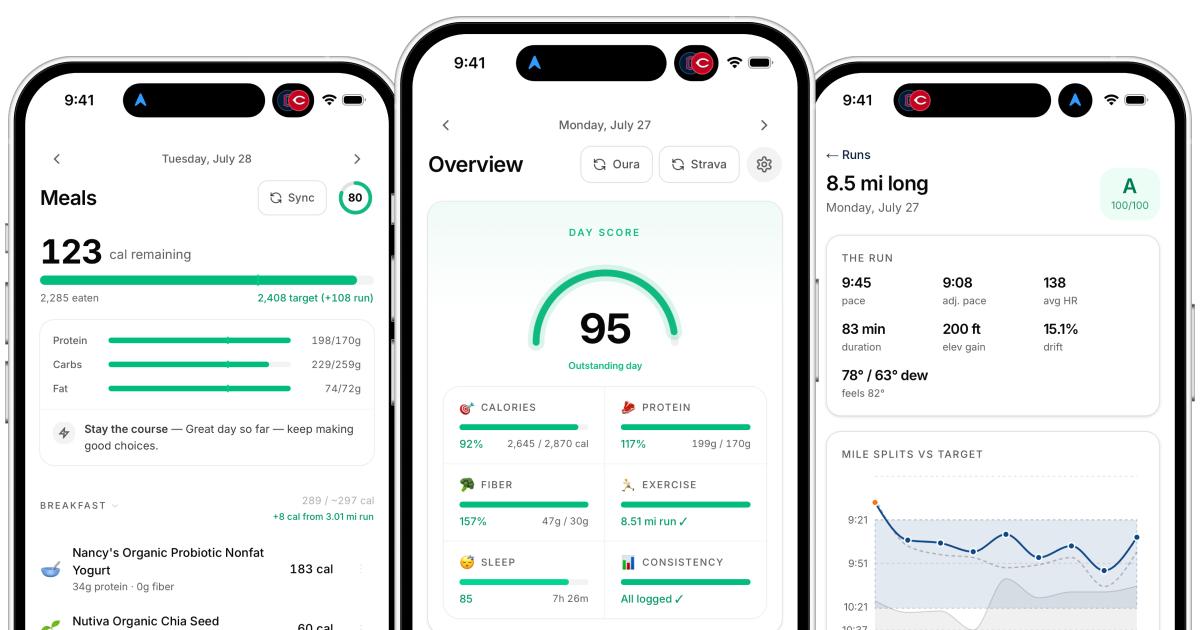 Software for One
Describes the authors approach to building iOS apps for himself and points to personal software that just needs an English language description to build.
 Extensible Software in the age of LLMs | Jeremy Morrell
Author works at Cloudflare and makes the case for building malleable software platforms.
 Open Models Inference for Coding · Umans AI
Umans is a French startup optimizing for hosting open models for coding inference.
Got popular on bsky (& elsewhere!) - I use this to access frontier models.
- umans-ai/umans-open-stack
"A curated set of open source tools tested with Umans, with recipes to use them through Umans or self-host them with another provider."
 Paperclip – The app people use to manage AI agents for work
"Paperclip is a Node.js server and React UI that orchestrates a team of AI agents to run a business. Bring your own agents, assign goals, and track work and costs from one dashboard."
"Paperclip is right for you if
✅ You want to build autonomous AI companies" talat - the local transcription app for meetings, dictation, and recordings
A desktop app for MacOS and Windows that transcribes audio using a locally installed model. You can also plugin in remote cloud or self hosted models for summaries or other parts.
- WeSight - Run CLI Agents from One Desktop App
"Bring Claude Code, Codex, OpenClaw, and other terminal agents into a visual desktop chat. WeSight unifies local runtimes, model providers, permission events, skills, scheduled tasks, and memory."
Tried it - made by Chinese devs and isn’t easily configurable without more translations.
- freestylefly/wesight-obsidian
WeSight Obsidian plugin for local agent runtimes.
- claude-obsidian
Self-organizing AI second brain for Obsidian + Claude Code. Drop any source and Claude reads, links, and files it into one connected knowledge graph of plain Markdown you own. AI note-taking, personal knowledge management (PKM), and an open-source Notion alternative. Based on Karpathy's LLM Wiki pattern.
- kriss-spy/obsidian-opencode
use opencode CLI in obsidian
- sandsaber/Grimoire
Local-first AI agents for your Obsidian vault.
- Tasks.org
Open Source. Pay for cloud sync / to support open source development.
Tasks.org is compatible with Outlook, Thunderbird, Apple Reminders, and more!
 REINVENTING ORGANIZATIONS
Recommended by Ms Boba and others. The illustrated version has some illustrations that are helpful.
- benwerd/obsidian-time-sync
Time tracker plugin by @werd.io
”A friendly little time tracker that lives in your Obsidian sidebar. Pick a project, hit Start, do the work, hit Stop, jot down what you did — and when it's time to bill, save an invoice. Time Sync doesn't generate the invoice document for you; it saves the total, the date, and your notes so you have everything you need to write one. Everything is stored as plain markdown notes in your vault, so your time data is yours:”
- eigent-ai/eigent
Eigent is the open source Cowork desktop application, empowering you to build, manage, and deploy a custom AI workforce that can turn your most complex workflows into automated tasks. As a leading open-source Cowork product, Eigent brings together the best of open-source collaboration and AI-powered automation.
Built on CAMEL-AI's acclaimed open-source project, our system introduces a Multi-Agent Workforce that boosts productivity through parallel execution, customization, and privacy protection.
 Althra — Vancouver's Early Stage Incubator
Vancouver based accelerator
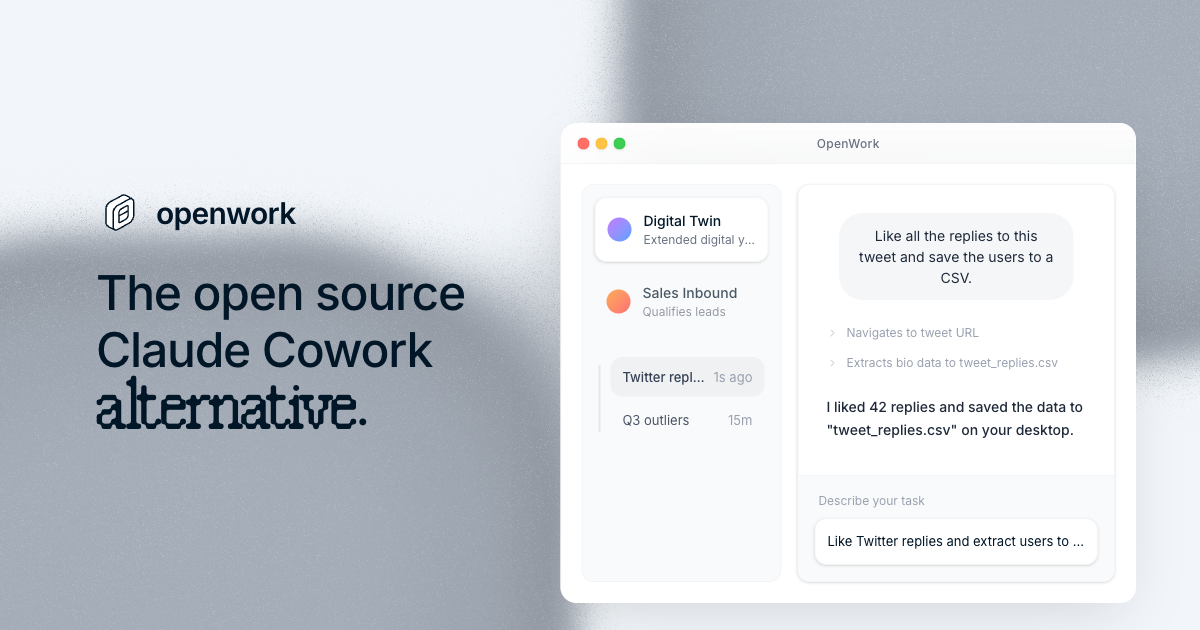 OpenWork — Open source Claude Cowork alternative for teams
OpenWork is the desktop app that lets you use 50+ LLMs, bring your own keys, and share your setups seamlessly with your team, powered by OpenCode.
And YC backed. Open source but gates SSO and other things.
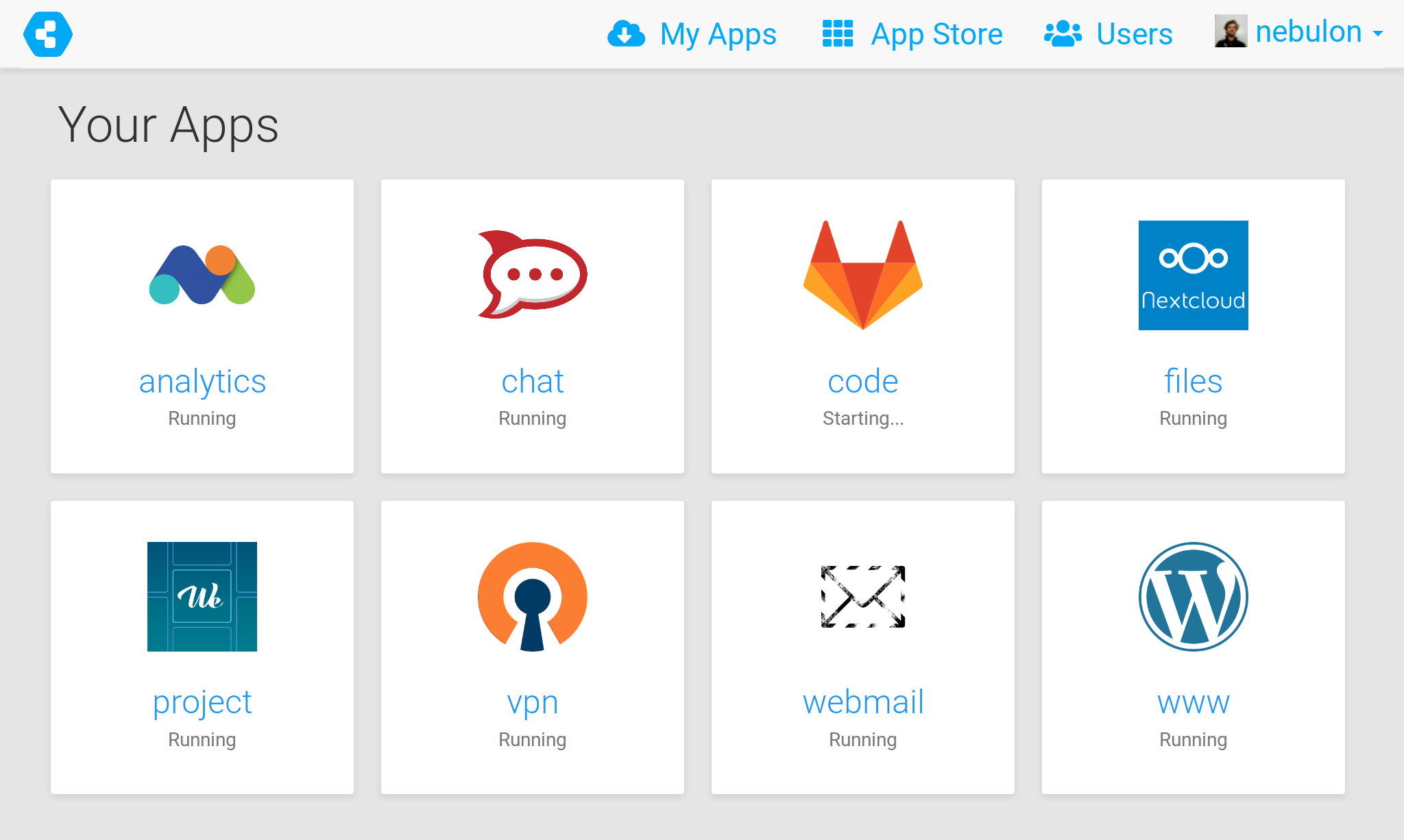 Cloudron
Cloudron packaging of Tymeslot - self-hosted meeting scheduling, written in Elixir / Phoenix LiveView. Google Meet, Microsoft Teams, or Zoom supported as video meeting links.
 MercuryOS
A speculative design for a new OS interface
“ There are no Apps or Folders in Mercury. Instead, content and actions are fluidly assembled based on your intentions.”
 How to migrate from Airtable to Grist | Webinar
Webinar video on migrating from Airtable to Grist
- Paper Plane — A modern communication platform
An interesting looking Discord clone, by an AI first studio. Elixir. E2EE, voice and video.
- What is the Atmosphere? - Leaflet Lab Notes
Leaflet "What is the Atmosphere?" explainer
- Cosmik
Tools and networks for collective sensemaking
- A Hotel Union Is Trying to Stop New Hotels in Vancouver
Summary of a Vancouver hotel union blocking hotel and housing construction. Mostly I’ve noted they make AI slop images and posters. Doesn’t seem like they are constructively doing anything that improves things?
- PDS Sync
Encrypted data stored on PDS, or tag as public to make a standard.site by @moshyfawn
- inanimate-tech/resident
By Inanimate Tech
"Sandbox with hardware IO and hot reload for ESP32 devices.
Resident provides a sandboxed Lua runtime that can be loaded with new code over the network at any time. Hardware peripherals are exposed to Lua through a driver interface, so apps can draw to displays, read sensors, and control outputs without touching C++."
- mist
Collaborative markdown editor with comments. Obscure URIs, gets deleted after 99 hours
 Inanimate
New startup by @genmon.fyi
"We see a future of Universal Ambient Intelligence. We believe in togetherness. We are building technology to augment your environment and increase your agency"
 mist: Share and edit Markdown together, quickly (new tool)
Blog post by @genmon.fyi on building mist
"I want to be able to share a Markdown doc as easily as sharing a link, and have real-time multiplayer editing, suggested edits, and comments, without a heavyweight app in the background."
- Atmospheric Login Page
Notes on building Atmosphere Login pages for two use cases - those who know what that is, and those that don't, by @hipstersmoothie.com
"The point of our login pages isn't to get on a soapbox and present our dissertation about how the Atmosphere works, it's to get users signed in and using the app."
 Payload: The Next.js Headless CMS and App Framework
Built with TypeScript and React, Payload is an open-source headless CMS and application framework. Build anything.
- Syncing my clipboard between macOS and remote terminals
Clipfan is a MacOS menu bar app that provides a pasteboard history and connects to remote Linux machines:
"integrates into tmux on all of your hosts. It uses SSH keys to set up a fully connected pasteboard syncing mesh."
 Rewilding cultures
via Arbor
"The Rewilding Cultures (RC) project is centred around exploring innovative approaches to production, inclusivity, and environmental considerations at the intersection of the arts, science, and technology. With a strong focus on reflecting the evolving landscape of artistic research and production, the project aims to foster and reshape new perspectives on various aspects of artistic and creative processes, including research, production, presentation, and dissemination. Simultaneously, it underscores the significance of responsible participation, particularly regarding environmental sustainability and vital inclusion matters that can no longer be ignored. It is imperative that we embrace a rewilding approach that is relevant for both the present and future."
- Feral Labs – A network of temporary dislocated hubs for research in art, technology and communities.
via Arbor
The Feral Labs Network is a network of temporary dislocated hubs for research in art, technology and communities. It’s members share a common interest in art-science research and contemporary do-it-yourself (DIY) & do-it-with-others (DIWO) communities.
"The Feral Lab Network is focused on connecting and organising a series of camps and similar kinds of temporary creative environments, all with a strong emphasis on process-based activities like peer learning, field work, research and co-creation, as opposed to standard presentational modes like exhibitions and festivals. What these activities have in common is their deliberate setting in a remote environment, away from the usual urban set-up. These temporary creative hubs vary in scope, format and topics, but hold a common methodological framework."
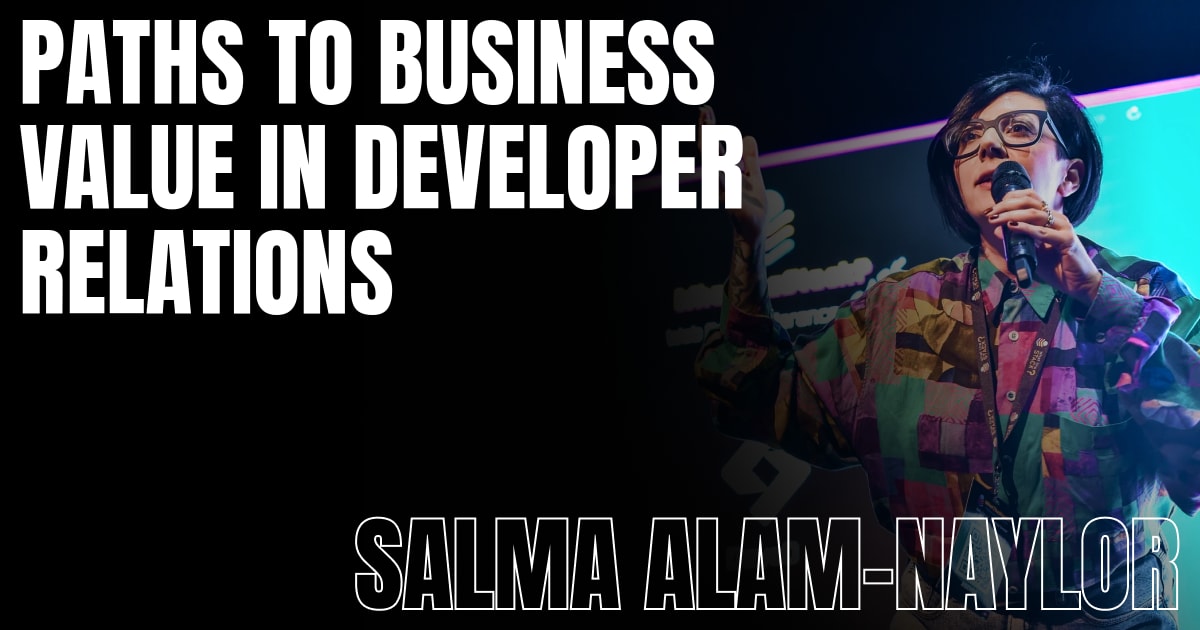 Paths to business value in Developer Relations
Write up of both definitions of DevRel and what the role should be doing in terms of impact.
Lots to reflect for me - I’ve done parts of this role before the term existed, and never felt a fit after it did.
“DevRel is the umbrella under which three further distinct functions can be defined: Developer Marketing, Developer Education, and Developer Experience. Due to my own experience, this article leans more heavily to discussing Developer Education and Developer Experience.”
 I Am Retiring from Tech to Live Offline
Chad Whitacre, who has been involved in “open source” in various ways, announces he is going offline, a kind of “Internet Amish”. The write up is two images that look typewriter written.
(Repeat of original link to a bsky post which now deleted)
 Goodbye, forever, probably.
An announcement from Salma Alam-Naylor about leaving DevRel / the internet. Goes into lack of hard metrics in DevRel and general challenges of needing to be public face of a company. LLMs massively changing things.
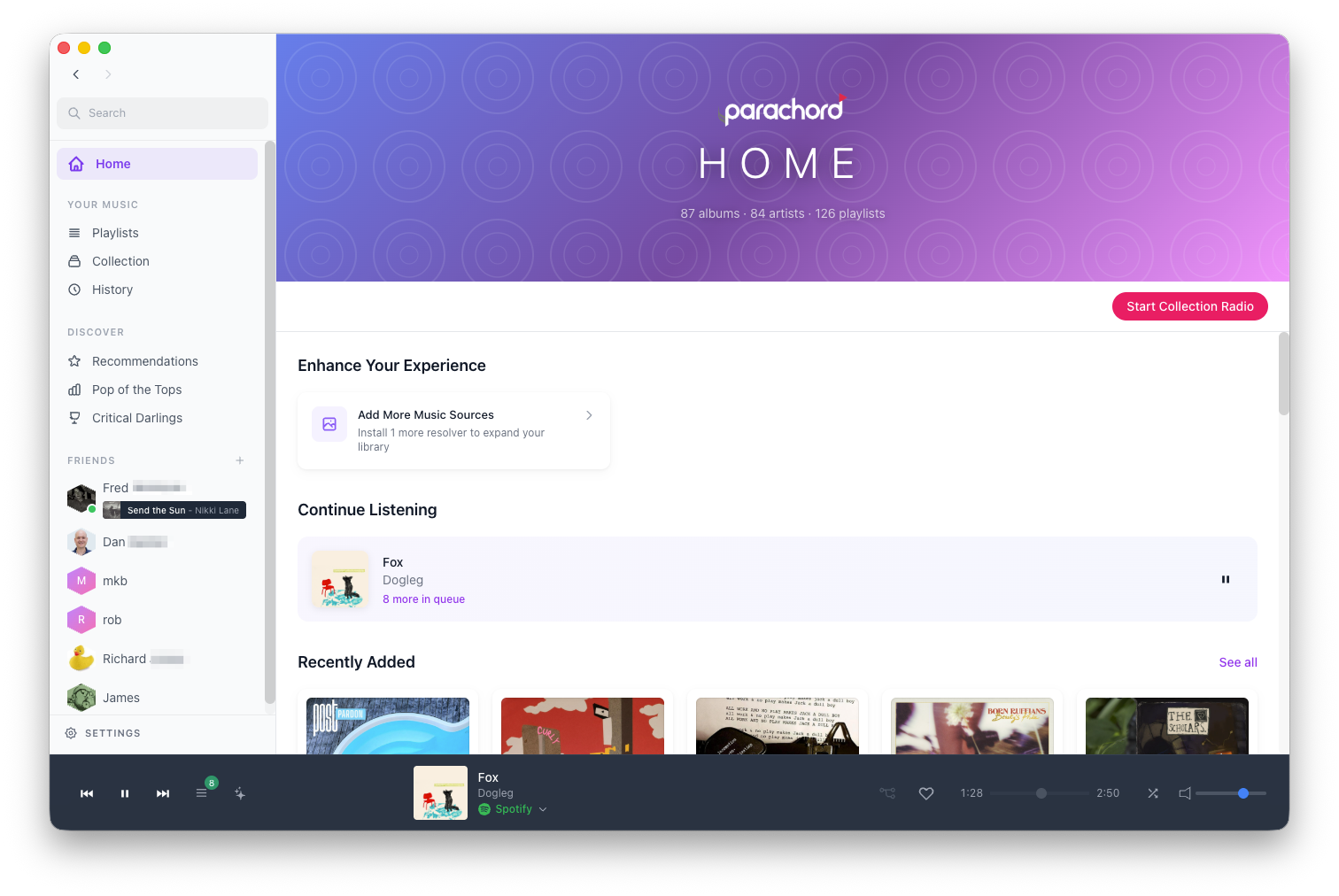 Parachord
Cross source music player that is a front end across all services. @bandcamp.com buy buttons!
 The CRA is not about open source
@andrewnez.bsky.social explains the European Cyber Resilience Act and how there are no provisions for funding and maintaining open source
 Claude Code Is Steganographically Marking Requests
Anthropic is hiding tracking in the Claude Code agent
“ When a tool with filesystem and shell access starts hiding classification bits inside invisible prompt punctuation, the correct reaction is scrutiny.
Trust is earned in the boring parts.”- Certified Account Consolidation
A way to merge two atproto accounts. Built by the @hypercerts.org crew.
 Getting Started
Starlight is a Docs framework for Astro, with a plugin to publish Obsidian vaults.
Recommended by @essentialrandom.bsky.social
- OnionHome OnionPress
Wordpress as a desktop app + Tor + .onion address for your site… served by @waybackmachine.bsky.social when you’re offline. Neat!
- Television
"The missing GUI for personal agents.
Television gives you and your agent a visual space for creating and working with artifacts."
Made by my friends at Telepath, who will be open sourcing this.
 Hubble.md
A basic notepad, that also lets you use it with agents, and then integrates rich HTML apps for visualization.
(and yes, everyone is making & publishing Markdown / notes apps)
This is similar to Television by Telepath.
 Who Actually Owns Your ATProto Identity? Hint: It's Probably Not You
Scare mongering over keys delegated to a PDS host
This is functionally the same as an account on a Mastodon server, where server admins can do anything to someone’s account.
With atproto, your identifier delegates account hosting to a PDS host, including signing keys. The identifier (your DID) lives in a directory, which is newly run by a Swiss association.
Having a rotation key is a good idea - you can move hosts if they are uncooperative or down.
- There Are No Instances in atproto — overreacted
Finally a post that explains there are no “Bluesky instances”
- Local Qwen isn't a worse Opus, it's a different tool
Using local models, down to graphic cards and setups.
- Learn about Lore: next-generation open source version control
next-generation open source version control
Maintained by Epic Games, Lore is designed for unprecedented scalability of both data and teams. It’s optimized for projects—including games and entertainment—that combine code with large binary assets, and caters for the needs of developers and artists alike. - Who, Where, Why, What about W Social
Video of @jan.wsocial.eu presenting W Social @wsocial.eu
 Ink & Switch malleable software essay
Critique thread on the Malleable Software essay
- Zo Computer | Your Home on the Internet
A startup that says some nice things about rewilding the internet. Calls itself Personal Cloud, ships with agents and connectors to build things.
Funded startup. Charges for hosting - Free plan goes to sleep, reminds me of Glitch. Bundles in AI credits.
Claim to be OpenClaw before OC launched.
 IronClaw: Unleash Your AI Agent, With Peace of Mind
A rust implementation of the OpenClaw pattern, that is also agent hosting with TEE by the NEAR blockchain people. Per tool Wasm sandboxing and secrets management.
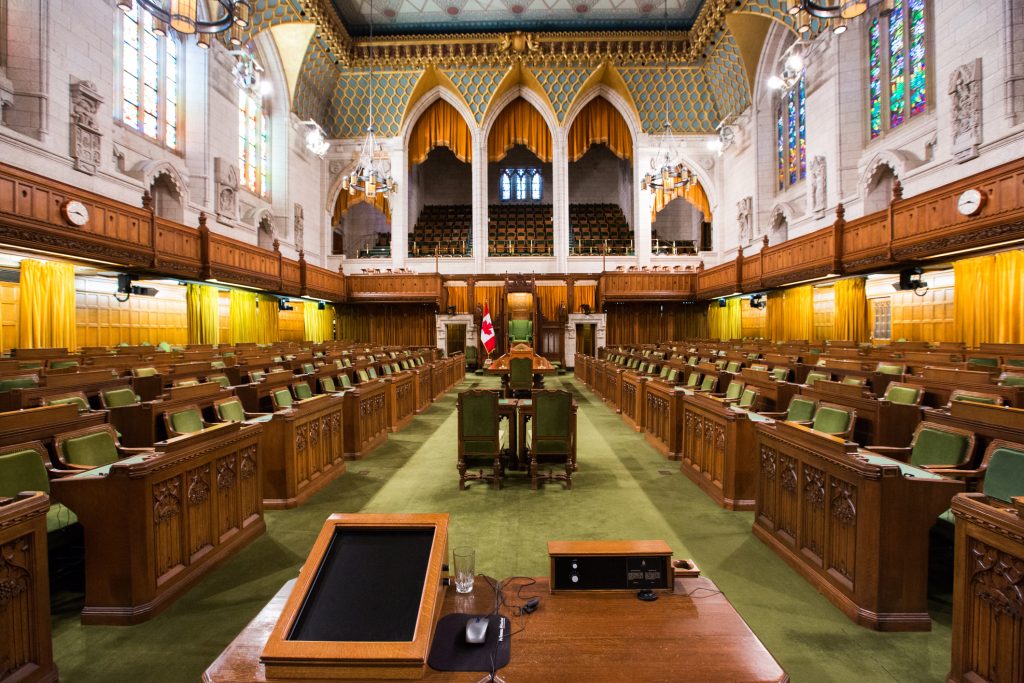 Reading the Digital Safety Act with My Mastodon Admin Hat On
Write up of how Bill C-34 might affect / apply to a Mastodon server in Canada
 Government Bill (House of Commons) C-34 (45-1) - First Reading - Safe Social Media Act - Parliament of Canada
The bad social media bill / under 16 ban
An Act to enact the Digital Safety Act and the Digital Safety Commission of Canada Act and to make consequential amendments to other Acts
 The Safe Social Media Act needs major fixes
@openmedia.org reviews the C-34 first release
"This legislation repeats much of the contents of Part 1 of the last parliament’s unpassed Bill C-63, the Online Harms Act. Despite C-34’s branding as a social media bill, the new bill goes significantly beyond the scope of Bill C-63, potentially regulating a long list of services including cloud storage, gaming, and message boards. OpenMedia is calling the bill a mix of overdue measures and serious missteps — and is pressing for major amendments"
- High-Performance Custom Laptops – Upgradeable & Powerful
Ottawa-based company which assembles and sells complete laptops in Canada. Giant 18" ones with huge amounts of RAM (256GB!!!) and GPU.
- AT-Communities #1: the Concierge, the Vault, and the Fuck-ass Astro Website – Essential Randomness
Ms Boba’s mega post focusing on the community portions of permissioned data and the in progress Spaces work.
 The Illusion of Protection: Why Canada’s Growing Push to Ban Social Media for Kids Won’t Work - Michael Geist
The momentum behind a social media ban for Canadian minors has been building for months. The federal Liberals voted at their April policy convention to back a minimum age of 16 for social media accounts and AI chatbots, the government’s expert panel on online safety is studying the issue, protesters have now rallied on Parliament Hill calling for it, and on Saturday night, Manitoba Premier Wab Kinew told a Winnipeg fundraiser that his government will be the first in Canada to ban social media and AI chatbots for kids. Kinew did not specify which kids, when it would happen, or how it would be enforced, none of which appeared to matter to the audience. The political appeal of a ban is obvious, since concerns about social media’s effects on young users are widely shared. Yet the policy itself is a terrible idea that will not work. This post examines at least six reasons why an outright age-based ban, particularly one that extends to AI chatbots, is the wrong response to a serious issue.
 Everything You Wanted to Know About a Kids' Social Media Ban (But Were Rightly Afraid to Ask): A FAQ on Age Verification and Mandated ID for Everyone - Michael Geist
“the harms people associate with social media, such as algorithmic manipulation, addictive engagement design, weak content moderation, inconsistent enforcement, inadequate transparency, and privacy risks, affect users of every age. Treating them as a children’s problem misidentifies both the source of the harm and the right target of regulation.”
- Forms of Open Source Government
@andrewnez.bsky.social lists governance entity types and approaches for open source projects
- Discord DAVE Protocol Whitepaper
Discord Audio & Video End-to-End Encryption (DAVE) Protocol
This repository contains the protocol whitepaper for Discord's Audio & Video End-to-End Encryption (DAVE) protocol.
 Every Voice and Video Call on Discord Is Now End-to-End Encrypted
Write up by Discord on now having E2EE support for all their audio / video calls using the DAVE protocol.
 comail
Cooperative email infrastructure for atproto. Your domain, your DID, a shared relay that pools sending reputation so you don't have to warm a new IP from scratch.
 Kyushu
A Self-Hostable Wasm Sandbox for JavaScript Workers
Ever wanted to run a Cloudflare Workers-style handler, on a VPS or anywhere, without Node.js, Bun, or even Docker?
- signal.org
Signal’s statement on the UK suggesting proof of age and content scanning on all devices
- willjasen/tailmox
Instructions on activating Proxmox clustering over Tailscale, with lots of not recommended flags.
 Subnet routers
Subnet routers as part of having a private tailnet on a proxmox that will route to containers without having to add all of them to tailscale individually.
- Backup Agent - OVHcloud Documentation
Offsite backup instructions for OVH Backup Agent
- lucasgelfond/zerobrew
zerobrew is more of a performance-optimized client for the Homebrew ecosystem.
We rely on:
Homebrew's formula definitions (homebrew-core)
Homebrew's pre-built bottles when available
Homebrew's package metadata and infrastructureOur innovations focus on:
* Content-addressable storage for deduplication
* APFS clonefiles for zero-overhead copying
* Source build fallback using Homebrew's Ruby DSL - A new era for software testing - <antirez>
@antirez.com thinks that automatic Q&A on balance leads to better software
And coins the phrase “automatic programming”
“ I have the feeling that the introduction of automatic QA may raise the bar of quality for new releases of software, and maybe partially compensate for the lower quality of the code produced at high speed with the use of automatic programming.”
- Hark, a link blog! - Boris Mann Tech Blog
A macro blog by me @bmann.ca about link blogging in @skyreader.app
 Daring Fireball, by John Gruber
Daring Fireball is probably
You can see an example of how the highlighted link is the thing he's talking about, and the "permalink" is the entry on his site.
- Skyreader update - Linkblogs, standard.site, and discussions
Skyreader added a link blog for every user, formatted as Standard Site. And, in fact, used me as an example, before I even read it.
 Rising Tide Boat Works
"We're impatient to see our coastal workboats and water taxis, tugs and trawlers, commercial fishing boats and cruising yachts make the transition to fully electric vessels. We're building up the infrastructure and the expertise to make it happen here in BC. We know it's early. We also know there's no time to waste."
 Rising Tide Research Foundation
Rising Tide Research Foundation is a not-for-profit society established to conduct open-source research on electric boat design and to raise public awareness and understanding of clean-marine technologies.
 Solander 38 | Rising Tide Research Foundation
"Solander 38 is a self-sufficient, solar-electric, coastal cruising power catamaran.
This website is an effort to document and share designs, processes, and research from Solander 38, the first vessel reference design by Rising Tide Research Foundation. We’ve made this site to celebrate the work of those involved and to openly share the ongoing successes, failures, and lessons learned from the first build of the designs, Catalyst, and its real-world use over time."
- ikawrakow/ik_llama.cpp
llama.cpp fork for running on CPU and hybrid CPU / GPU
This repository is a fork of llama.cpp with better CPU and hybrid GPU/CPU performance, new SOTA quantization types, first-class Bitnet support, better DeepSeek performance via MLA, FlashMLA, fused MoE operations and tensor overrides for hybrid GPU/CPU inference, row-interleaved quant packing, etc.
 A 10 year old Xeon is all you need - point.free
By @cafkafk.bsky.social a write up on optimizing AI engines to run on a 10 year old computer without a GPU to run models.
“ The bleeding edge of Open Weight AI isn’t locked behind a paywall or a model proivider. If you’re already running a homelab, It’s sitting right there on the command line of a ten-year-old server.”
- rsync and outrage
The maintainer of rsync, who recently was harassed because of perceived slop coding - explains his deep history of software engineering and how he’s fixing security issues and setting up testing frameworks.
- ASUS Ascent GX10
ASUS GX10 has 128GB of unified memory
- Canada’s Bill C-22 and the security cost of collecting more data
Article by @tailscale.com with specific suggestions on how Bill C-22 should be updated “ Canada should be a great place to build secure infrastructure that protects consumers. Bill C-22, as written, moves in the wrong direction”
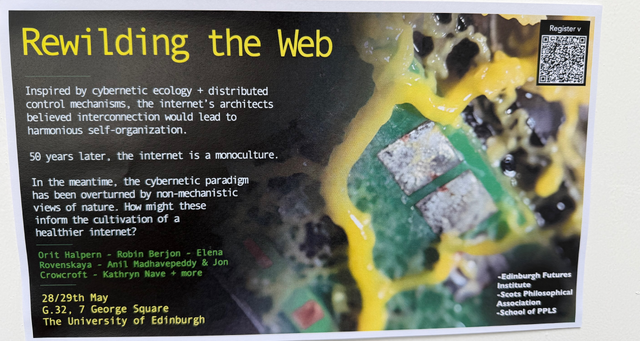 Rewilding the Web: my workshop report from Edinburgh
“Notes from a wonderfully interdisciplinary Edinburgh workshop on 'Rewilding the Web', ranging coopetition and biological variety through the philosophy of self-organisation, polycrisis governance, protopian science fiction, and moderation seen through the lens of artisanal cheese.”
 Run Ollama with NVIDIA GPU in Proxmox VMs and LXC containers
GPU pass through in Proxmox used with Ollama
- Euro-Office
Euro-Office is a fork of OnlyOffice (which is Russian) and is designed to be an office suite solution for Europe to adopt. AGPL.
 Multi-player ai is here — nimbleco ai
Multiplayer Hermes Agents embedded in community context
“ We've been running multiplayer agentic experiments for a year with real users on the platforms people already use (Signal, Discord, Telegram, Matrix, etc).
Now, we’ve built a dashboard that lets you run and manage swarms of powerful next-gen chron agents. ”
 A love letter to exe.dev
Positive experiences with exe.dev
 The Last Technical Interview
Steve Yegge on tech needing to reboot interviews
want to convince you that we need a radical change in how we assess people, and that tech interviews are on their last leg.”
His suggestion is paid work and a rating.
- Chad Whitacre (@chadwhitacre.com)
Chad Whitacre, who has been involved in “open source” in various ways, announces he is going offline, a kind of “Internet Amish”. The write up is two images that look typewriter written.
- magarcia/cc2md
Simple Claude Code session-to-markdown tool, including some suggestions on how to automate it if you want to save past sessions, commit them to git, etc
 Modos Flow
Portable E-ink monitor with touch. Crowdfunding now.
 Deep Blue
Deep blue as the name for software devs feeling AI induced ennui
“ I think that we’re going to see a real problem with AI induced ennui where software engineers in particular get listless because the AI can do anything”
- Proxmox VE Helper-Scripts
Community-driven scripts for Proxmox VE — browse, install, and manage containers and VMs with a single command.
Note: paste bash one liners into Proxmox shell :P
- Deploy Hyper-Converged Ceph Cluster
Overview of Ceph running with Proxmox
- How to self-host with Tailscale: Installing Proxmox and hardware choices
Blog post and videos about self-hosting in your homelab with Proxmox and Tailscale
- Tailscale on a Proxmox host
Instructions on putting Tailscale on your Proxmox host and/or use Tailscale Serve to proxy the webUI
 Is open source r-selected?
@gordon.bsky.social on r/K selection in open source.
I might believe that open-source-as-community (rather than code) is K selected???
 AI is doing something weird to Science
On science and AI usage. Not AI as scientist, but AI as lab member.
“ The loop does the discovery. But what is the loop, exactly? It has four roles: poser, proposer, verifier, curator. They are not interchangeable.”
 Docker Swarm Still Rocks
An UNDEPRECATED version of dockerswarm.rocks
- Swarmpit
Swarmpit provides simple and easy to use interface for your Docker Swarm cluster. You can manage your stacks, services, secrets, volumes, networks etc. After linking your Docker Hub account or custom registry, private repositories can be easily deployed on Swarm. Best of all, you can share this management console securely with your whole team.
Everything the UI does is also exposed via a REST API and, for LLM-driven workflows, an MCP server so you can automate deployments or drive Swarmpit from
 Coolify vs. Dokploy: Why I Chose Dokploy for VPS Deployment in 2026
Coolify vs Dokply
Dokploy being source available sucks, and it really does want me to pay similar prices to Cloudron.
Coolify Cloud is $5 for 2 servers, and then $3 per additional server.
 Apple JUST Dropped a Game-Changer
RDMA with Thunderbolt5 across multiple Macs using exo - this is from 5 months ago.
- Buying another miniPC - Boris Mann Tech Blog
GMKtec Nucbox G10 for $400CAD
 GMKtec G10 Mini PC AMD Ryzen 5 3500U
The miniPC I just bought
- Complete OS Guide: Proxmox How It Works, Orientation and Curiosities – LINUXMIND.DEV
Summary of Proxmox
“ Proxmox is an open-source server virtualization environment that combines two virtualization technologies: kernel-based virtual machines (KVM) and Linux containers (LXC)”
- meeb/bandcampsync
Code for syncing your Bandcamp purchases to a local directory
- Bowen Lift
Track ferry status with live camera views of both Snug Cove and Horseshoe Bay. Built by Tom Carchrae
 Social Media Is Now Parasocial Media
Social Media Is Now Parasocial Media
When practitioners used the term “social media” to describe the internet tools that emerged in the mid-aughts, they were giving a name to the kinds of platforms and protocols that allowed people to socialize with friends and communities of interest by using digital technologies. Twenty years later, users of social media are far more likely to scroll than post – and the content that they consume is often strategically produced and algorithmically curated.
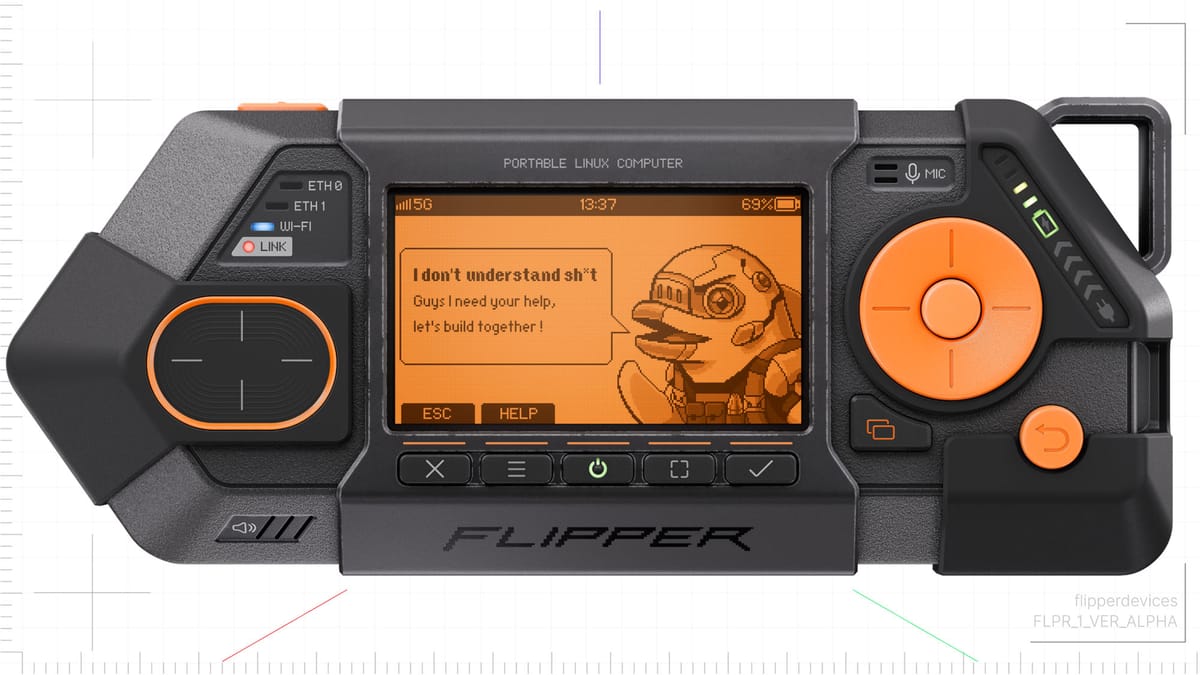 Flipper One — we need your help
Flipper One is aiming to make a fully open Linux on ARM and is doing it as an open project - plus FlipperOS, a gui framework and more.
Linux Cyberdeck
- Your Wardley Maps Belong in Git: What Mermaid Support Changes
Wardley Maps rendering in Markdown & Claude via Mermaid
“ Mermaid added a wardley-beta diagram type, and as of Mermaid 11.15.0 the renderer is stable enough to use in production. GitHub renders it natively in any .md file. Claude renders it in the artifacts side panel. That combination quietly resolves the biggest practical problem with Wardley Mapping: keeping the map alive after the meeting”
 RISC-V International
RISC-V International is the global non-profit home of the open standard RISC-V Instruction Set Architecture (ISA), related specifications, and stakeholder community.
 A Linux Distribution for RISC-V | openRuyi
openRuyi is an open source, rolling release Linux distribution for RISC-V, optimized for performance, security, AI, and cloud-native workloads
 Ad Infinitum · Matthias Ott
“ Google is betting its entire future on a world where people eagerly hand over their emails, their files, their habits, and their trust – to an AI system that will quietly auction off their attention, word by word, to the highest bidder. The ad infrastructure is ready. The question is whether the audience is.”
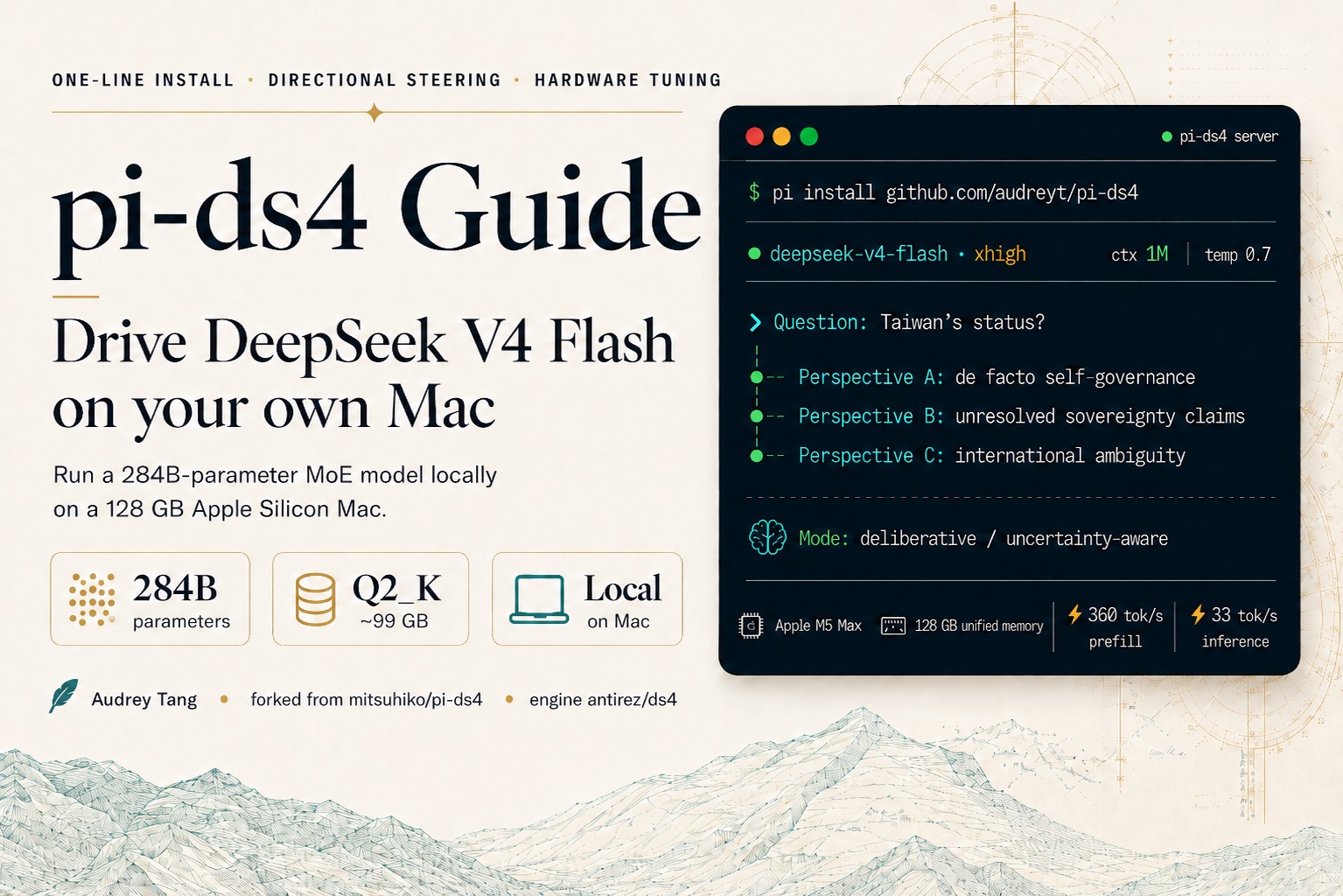 pi-ds4 · Audrey Tang
“ Run the 284‑billion-parameter DeepSeek V4 Flash on your own 96‑GB Apple Silicon Mac — no cloud calls, no API fees, no per‑token billing, no rate limits. The model’s directional steering dial stays in your hands. Stable seeds and tool-call IDs make decision traces repeatable, comparable, and contestable”
Using antirez/ ds4
- ATCR - Distributed Container Registry
Docker images with a registry on ATProto
- Which direction is forward?
A discussion of new roles / labels in LLM assisted software dev. In contrast to classic SaaS structures of deploying software at scale that is the same for all.
- Bitesize Proto: Two PDS containers at the same time; synchronized swimmers - Hitchhiker's Guide to the Atmosphere
Bailey's notes on load balancing between 2x PDS docker images on one machine to help with multi-core scaling on one instance.
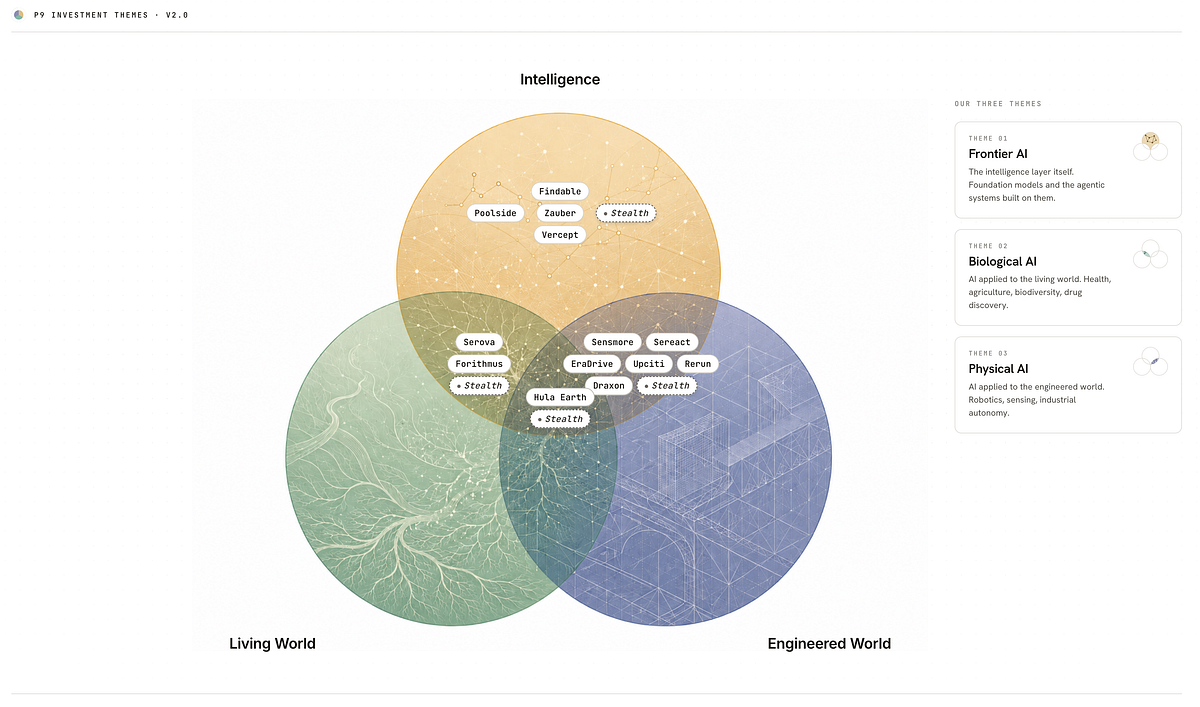 What Investing in Software Looks Like in 2026
Long time SaaS investors Point Nine Capital on what sw investing in 2026 is like
“ We still invest in software, but in many cases it’s software and AI for the world outside of offices:”
“ Where we still invest in pure software, it’s mostly foundation models or agentic systems that require extraordinarily deep domain knowledge to build”
“ the majority of our companies live at the intersection of “Engineered World and AI” or “Nature and AI”:”
 AT Protocol for Agents | David Gasquez
@davidgasquez.com writes up a good from scratch description of how and why atproto is good for agents
 From Open Source Software to Open Source Strategy
Bill Gurley, VC investor who has invested in OSS since 1999 in Red Hat “Here is the mechanism I am calling Open Source Strategy. A small number of forward-thinking companies have learned to use open source as a deliberate corporate-strategy tool — to neutralize a stronger competitor, commoditize an expensive input, align an industry around a shared standard, or head off a regulatory crisis.”
 The Altercation Company
Venture studio & consultancy - founded by Nick Dooley in Toronto
 Augure App - App Store
iOS app for Augure AI - sovereign Canada AI
developer is listed as Dutch Payments Inc
 Augure | Sovereign AI for Canadian Teams
“ Augure is a Canadian AI research and product company. We train our own models, run them on Canadian infrastructure, and ship products that meet Canadian compliance — for the regulated work that general-purpose AI can't safely handle.”
Based in Toronto, have to research more who is behind it.
 Premium Linux laptops and mini PCs | Star Labs
UK based producer of Linux based laptops, tablet, and miniPCs
Ship to Canada.
 The Lawful Access Two-Headed Surveillance Monster: How Bill C-22 Went Off the Rails - Michael Geist
@mgeist.bsky.social goes back to how C22 has gotten so wrong by going back to C2
“ some of the world’s most privacy-protective services exiting the market, leaving behind a law that is vulnerable to constitutional challenge with millions of Canadians facing genuine privacy and cybersecurity risks.”
 Dario Amodei — The Adolescence of Technology
Confronting and Overcoming the Risks of Powerful AI
 Announcing the Zulip Foundation
Zulip chat founding team donate the company to a new Zulip Foundation (sort of like MoFo -> MoCo/Firefox).
Stated next step is that the Zulip founding team join Anthropic "I came to the conclusion that it’s vitally important that we navigate this strange adolescence of technology well, and that I should contribute to this cause more directly than I ever could as the CEO of Kandra Labs."
 Kiss your online privacy goodbye with Bill C-22, Canada
Civil liberties groups, legal experts and the Canadian Chamber of Commerce have been sounding the alarm for months on the privacy and cybersecurity issues contained in the Carney government’s Lawful Access Act, or Bill C-22. In a not-so-surprising twist, American lawmakers have now also added their voice to those warning about the bill.
 Wi-Fi Aware | Apple Developer Documentation
iOS 26+
Wi-Fi Aware™ (also known as Neighbor Awareness Networking or NAN) is a Wi-Fi Alliance™ standard specification that enables devices to securely discover, pair, and communicate with nearby devices without an internet connection or access point. Your app can use the Wi-Fi Aware framework to connect with Wi-Fi Aware certified accessories. The framework offers a secure and standardized way to establish peer-to-peer (P2P) connections between Wi-Fi devices,
- Genode - Genode Operating System Framework
The Genode OS framework is an open-source tool kit for building highly secure component-based operating systems. It scales from embedded devices to dynamic general-purpose computing.
 Facing mounting backlash, Anandasangaree says U.S. tech companies are 'misinterpreting' his lawful access bill | CBC News
CBC coverage of backlash against the government, Public Safety minister doubles down and talks about this as va “big tech”
“ The government says the changes would provide investigators with an organized system "like a filing cabinet, where certain types of information would be available with legal authorization."
"We're expecting support from different parties," said Anandasangaree. "And we expect to get this done."”
- Canada’s Metadata Retention Plan Would Make It an Outlier | Robert Diab
Analysis of Bill C22 metadata retention in Canada vs Europe, Australia, UK, US
Our version is uniquely bad.
- Sign on: Civil society letter against Bill C-22
Coordinating a joint letter to Stop Bill C-22 as individuals or orgs that want to sign on with OpenMedia
 Stop Bill C-22!
OpenMedia form to send your MP a letter opposing C-22
 Bluesky is a record store
Part of "Bluesky us dying" discussion, put in context that all of "social media" but especially text-shaped social media is lessening in importance.
" the hole at the center of the attention economy keeps expanding, and the fascist overlords get ever more brazen, and everyone tries to figure out what we can do about those twin crises.
I’m not sure how we solve them. But I don’t believe these are record store-shaped problems. "
 Bill C-22’s Groundhog Day: Why the Government’s Dismissal of Signal, Apple and the U.S. Congress Concerns Runs Back the Disastrous Online News Act Playbook - Michael Geist
Geist points to the C-22 process being just like the Online News Act / Bill C-18, where the government thought companies would comply, and instead Meta removed all news links.
- Government Bill (House of Commons) C-22 (45-1) - First Reading - Lawful Access Act, 2026 - Parliament of Canada
House of Commons listing for Bill C-22
 Apple Warns Canada's Bill C-22 Could Force Encryption Backdoors
Apple and Meta have opposed a Canadian bill that the companies say could force them to create backdoor access to encrypted user data, should it pass through the country's parliament. Proposed by Canada's ruling Liberal Party, Bill C-22 contains provisions that could be similar to a UK data access provision order sent to Apple last year, depending on how they are implemented.
 Signal warns it would pull out of Canada if made to comply with lawful access bill
“ The bill would require “core providers” – which would later be defined through regulations – to retain metadata for up to a year”
“ The metadata would not include e-mails, web-browsing history, social-media activity or text messages, but it could include information about which telephone numbers have been in touch with each other, and data allowing someone’s location to be pinpointeD”
 Debates On Frontier Artificial Intelligence Governance: The AI Triad
Jonathan Zittrain course at Harvard that defines the “AI Triad” - Accelerationists, Safetyists, Skeptics
Accelerationists who generally believe that artificial intelligence will dramatically improve the human experience; Safetyists who are concerned about its potential catastrophic or existential risks; and Skeptics who doubt claims of AI’s transformative impact and urge a focus on existing issues, including the replication of biases.
- justincurl.github.io
PDF, AI Policy and the Legal System
Four quadrant graph of whether this is a precedented technology like the internet, or unprecedented in building a machine god.
Impact of AI on Law, and impact of Law on AI, and where/who can intervene using legal frameworks.
 Governments Can’t Agree on What AI Actually Is
Without clear definitions, governance is impossible.
By Sarosh Nagar, a researcher at University College London, and David Eaves, an associate professor of digital government and a co-deputy director of University College London’s Institute for Innovation and Public Purpose.
Power Plants analogy used
 Introducing the Protocol Institute
“Building a field and community to steward the planetary-scale process of protocolization” Intro post for Protocol Institute by @tmbr.bsky.social
 Inventing New Nature
First post by @vgr.bsky.social announcing new Protocol Institute aka a “context tank” where he is Director of Research
Not quite a Research Lab as my collection is named, but aiming to be a new sort of thing.
- yzzxyz.roomy.chat/3mktq3s2md222
“COVEN reduces the hardware demands of deep learning research by relying on encrypted peer-to-peer (p2p) coordination between everyday computers for inference, training, and dataset storage.
Share models amongst your COVEN that are larger than you could host on your computer alone. Train or fine-tune ML models and adapters at exponentially faster speeds. Grow resilient, efficient networks instead of funding new datacenters.”
- darkshapes
Not exactly a research lab. Listed as an “umbrella organization”. Focused on local AI.
“Umbrella organization rethinking machine-learning tools that work for people, not corporations.
We are artists, engineers, writers, and scientists — the creative and curious of the 21st-century — exploring community knowledge as a catalyst for developing radically new media and software that challenges the status quo and redefines techno-social ethics.” - Friendly Forge Format (F3) — F3 v4.0 documentation
The Friendly Forge Format (abbreviated F3) is an Open File Format for storing the information from a forge such as issues, pull/merge requests, milestones, release assets, etc. as well as the associated VCS (Git, Mercurial, etc.).
 Evolved antennas, LLM-generated code, and a potential antifuture
On the path of accessibility and open-ness of LLM code generation as opposed to a long history of the web & being people able to publish & view source there.
 Friends Don't Let Friends Use Ollama | Sleeping Robots
Ollama wrapped llama.cpp, didn’t give them credit, have consistently made other wrappers that are strictly worse - because they need to justify their funding
 “Steel, concrete, and code”: Feds and Telus announce three AI data centres in BC | BetaKit
BetaKit covers the announcement of new “AI Factories” being built in BC - two new in Vancouver centre and expansion in Kamloops.
 Having no Strategy is a Strategy in Ottawa
Matt Roberts on how Canada needs a semi conductor strategy
- A data center drained 30M gallons of water unnoticed — until residents complained about low water pressure
Saving to Semble to try and link pro and counter claims.
TLDR water use part of construction, about 1% of count usage, mistake was discovered, data centre paid back bill.
 OpenAI's WebRTC Problem - Media over QUIC
OpenAI is using WebRTC for voice AI. Author used WebRTC at many companies including Discord and recommends QUIC instead.
 Open Source ERP and CRM | Odoo
Open source business app builder platform. Big in Europe. More on the ERP side of things
- The Moat or the Commons — Warman Notes
US capital and regulatory structures vs rest of world
 We're Not Building AI Features for the Money
“ When code production gets cheaper, everything around it gets proportionally more expensive. Friction in sharing, reviewing, and maintaining code becomes a larger part of the total cost of delivering software, but the tooling we rely on for these tasks was designed for a world where humans typed every line. Discretized commits, pull requests, and snapshot-based reviews served us well, but they're overhead in a world where agents can produce working code faster than we can review it.”
 Notes from inside China's AI labs
Review of a trip to China meeting with AI labs
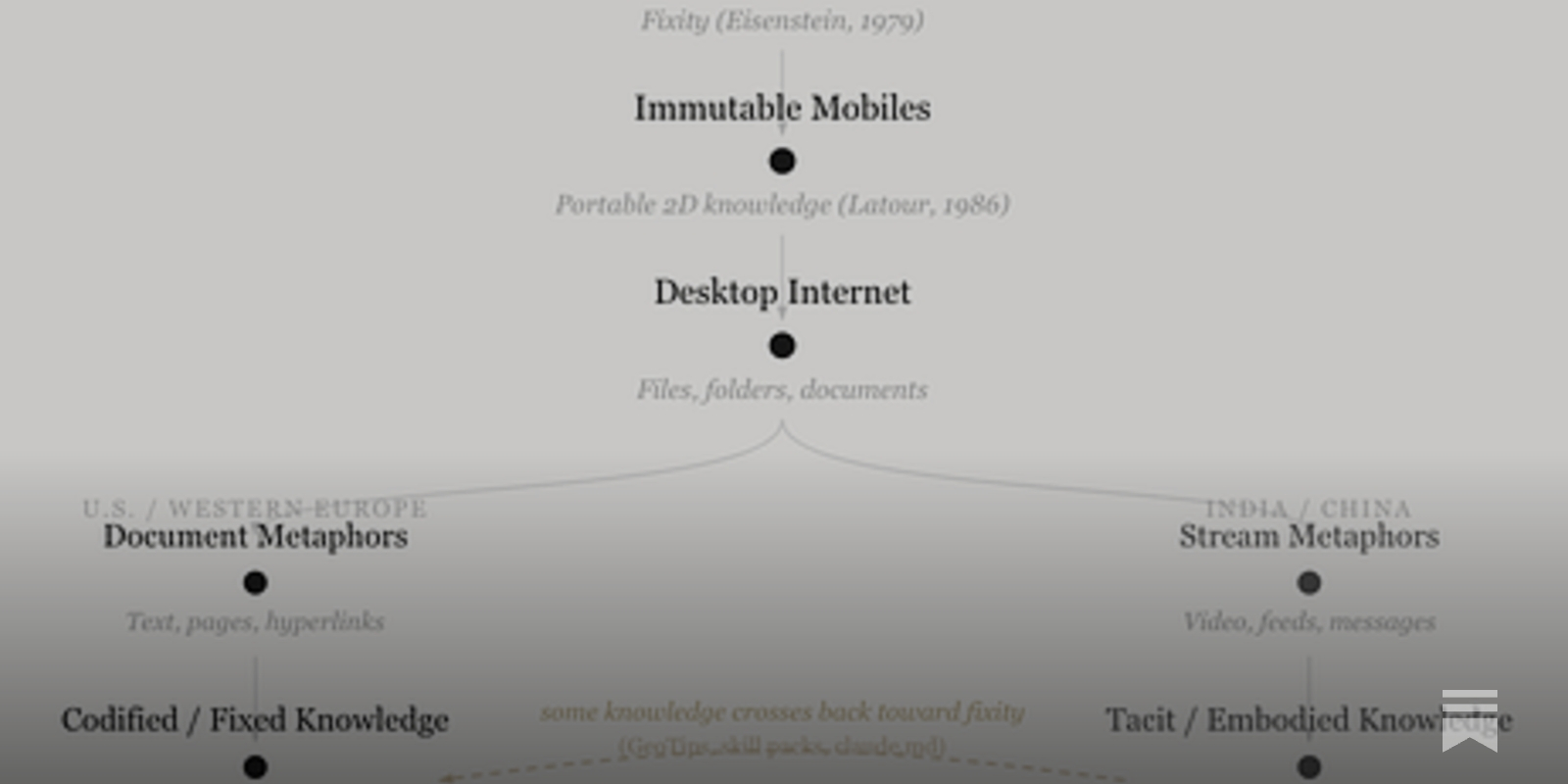 Immutable Skills
“Instead of learning the skills at the local level of the programming language (syntax, data structures, debugging), there is new skill formation happening at the higher abstraction layer of managing dozens of coding agents. In this process, some of the skills that were associated with labor, such as building websites or small apps, will become hobbies. And a new layer of professionalization will emerge at the layer of managing agents, crafting system prompts, and curating skill packs.”
 Danger Testing - Friends Making Apps
“Dropping apps like songs”
 Death of a Software Developer
Sarah Friend describes software developer as archetype, Jevon’s paradox
“ The coming software renaissance will lead to more genuine creativity in cultural areas that have been underserved by the software developer, possibly for demographic reasons”
“Software will become content, and the vibe coder may look more and more like an influencer”
- Programming Still Sucks. — Writing
A story about AI, no more juniors and engineering orgs inside corporations
 DeepSeek
Chinese company producing open models
 Pushing Local Models With Focus And Polish
“This is not about hiding the fact that local inference is complicated. It is about putting the complexity in one place where it can be improved, because there is a lot that we need to improve along the stack to make it work better.”
@mitsuhiko.at is focusing on DeepSeekv4 only on macOS and specifically for pi
- Free as in Tribbles
Covers the free as in speech / free as in beer concepts of open source, the later free as in puppy of someone needing to do maintenance, and now perhaps an explosion of source code written by agents.
 Should AI Be Open?
2015 article by Scott Alexander arguing against open source AI
- Talon Auth
Framework for local first auth with DIDs, support for Automerge, email links, atproto login
By @daffl.xyz
- Making sure you're not a bot!
CAD / STP / STL files for the new Steam Controller with a README that makes it clear that Steam considers this your device
“ Your Steam Controller is yours, and you have the right to do with it what you want. That said, we highly recommend you leave it to professionals. Any damage you do will not be covered by your warranty – but more importantly, you might break your Steam Controller, or even get hurt! Be careful, and have fun.”
 WHO IS DEEPFATES
The story of deepfates and talking to models
 What the accelerators got half right — orphans.ai
This rings very true to me, have helped built the first startup accelerator in Canada. I very much know what this pattern of a shape is to fit into the VC mode, but strongly lean into building peer support systems.
By Doug Scott https://www.linkedin.com/in/dougsscott/
 Import AI 455: AI systems are about to start building themselves.
Anthropic Cofounder / Head of Policy Jack Clark
“ I’m writing this post because when I look at all the publicly available information I reluctantly come to the view that there’s a likely chance (60%+) that no-human-involved AI R&D - an AI system powerful enough that it could plausibly autonomously build its own successor - happens by the end of 2028.”
 Before GitHub
Open Source before GitHub was reputation-driven and full of friction
- A GitHub for maintainers
“ The things I want from a forge are the things that can’t move to the client because they involve more than one party. Who depends on you, who you depend on, what happened to that project you forked from three years ago, where the active development moved to when the original went quiet. Almost none of that happens inside a single repository.”
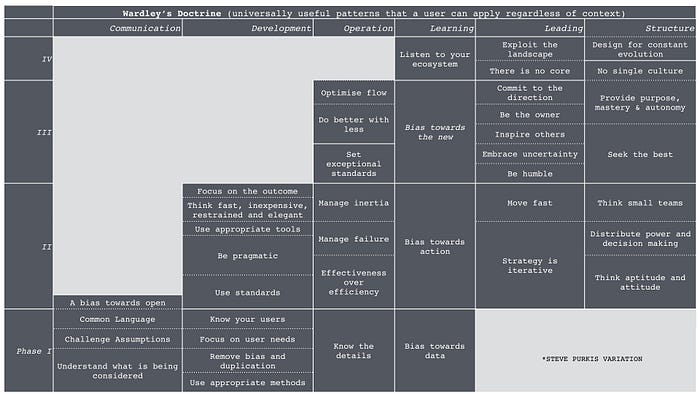 How to organise your teams - Wardley Maps
Explorers, villagers and town planners aka EVTP is Wardley’s model for archetypes of different kinds of people in an organization matched to technological maturity
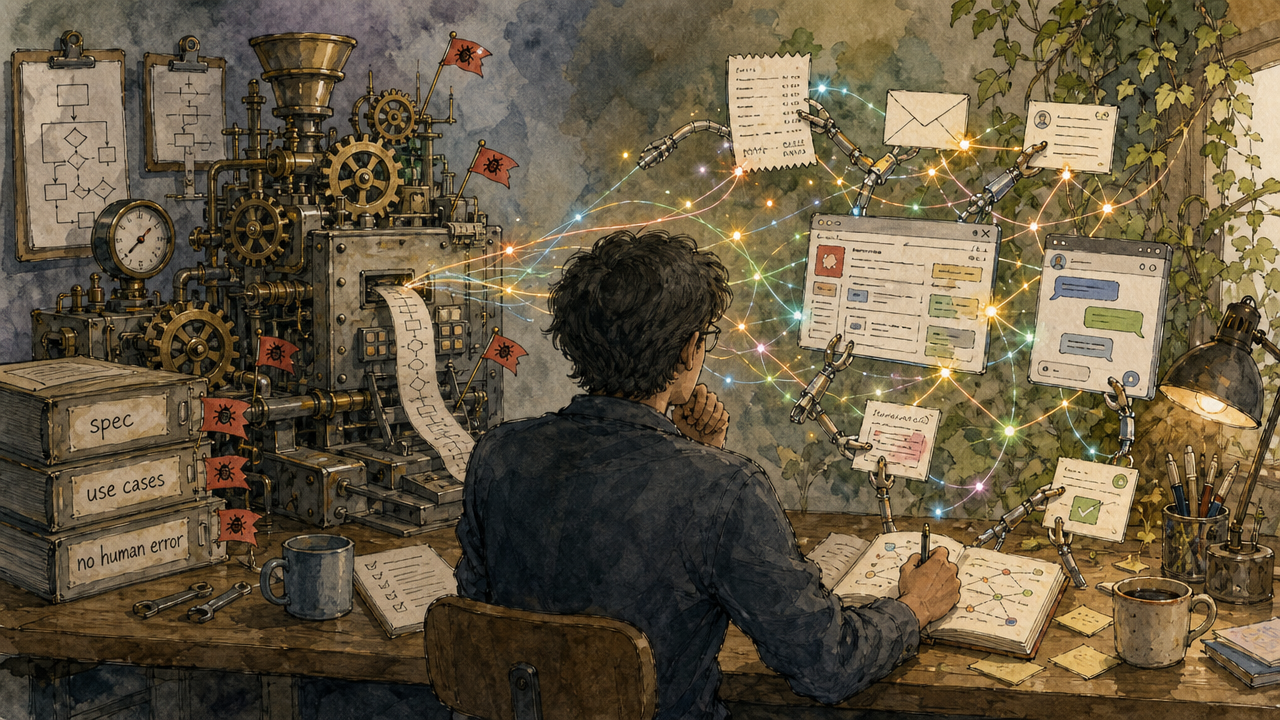 The Myth of Deterministic Software
How I've come to terms with LLM non-determinism in software and abandoned the comforting lies we've been telling ourselves about traditional software.
 webmcp is the new web intents ... maybe
How MCP might evolve to Web MCP and related to Web Intents / Android Intents by @paul.kinlan.me
- Apps | Cloudron Docs
Community Apps are a way for third parties to create apps for Cloudron that are not supported by the Cloudron core team, but can run.
 Matrix Authentication Service
Instructions on how to install the Matrix Authentication Service into Cloudron as a community app so that Element X app will work with it.
 rootshell - Terminal Emulator for Apple Platforms
High quality free of charge terminal.
“ Metal-accelerated terminal emulator with integrated SSH, native git, mosh-compatible roaming, Kubernetes support, and cloud provider connectivity”
- I Tried Every iOS Terminal Emulator So You Don't Have To - alice
The answer is rootshell
- ATmosphereConf 2026
Lewis’ talk about Tangled, especially as they are leaning into atproto for their whole architecture.
- Ghostty Is Leaving GitHub
@mitchellh.com announces Ghostty moving off GitHub
“ Ghostty is where I, our maintainers, and our open source community are most impacted so that is the focus of this change. We'll see where it goes after that.”
 Incorruptible
new Eric Ries @ericries.bsky.social book
"As organizations grow, the systems that govern them—ownership, incentives, charters, accountability, and decision-making—quietly reshape behavior. When those systems are poorly designed, even principled leaders are pushed toward outcomes they never wanted. Success itself becomes a form of financial gravity, bending companies away from their original purpose."
- Boris - rpg.actor
My @rpg.actor profile page
 Collaborative AI Engineering: One Dev, Two Dozen Agents, Zero Alignment — Maggie Appleton, GitHub
@maggieappleton.com talk about her work at GitHub Next on Ace
 GitHub Next
Research lab inside GitHub
GitHub Next investigates the future of software development.
We are a team of researchers and engineers at GitHub, exploring things beyond the adjacent possible. We prototype tools and technologies that will change our craft. We identify new approaches to building healthy, productive software engineering teams.
 The AI people have been right a lot
Journalist who reported on and disbelieved effective altruists in 2015 now believes they were correct on quite a few things.
 Introduction - SITUATIONAL AWARENESS: The Decade Ahead
I read and reviewed this in detail in 2024 when it came out out m, a prediction, timelines, and macro effects of AI.
One miss is that it assumed a rational US administration
Note: I consider this in part / as a whole American propaganda, written to influence governments and investors.
- How did Leopold do? Evaluating Situational Awareness's predictions
EA analysis of Leopold Aschenbrunner’s Situational Awareness predictions / timelines
- The Man Who Built the Next Internet and Then Disappeared — Node Star
Background on Mark Qvist, original creator of Reticulum, encrypted mesh networking protocol. Worked on it for 10 years and then walked away.
- jazz.tools
Jazz is a local-first relational database. It runs across your frontend, backend and our global storage cloud. Sync partial tables, durable streams and files, fast. Feels like simple reactive state.
- The four fresh ideas behind Jazz
Rewrite of Jazz
- tunable consistency of local first data - what needs global consensus vs eventual
- Auth a deep part of data model
- real time collab requires history and branching - needed for multiple people AND agents
- fluid migrations aka Cambria“ And with agents, even small teams or solo developers can reach that same level of parallel change. Fluid migrations provide a way to ship entire features including changes to the shape of your data quickly and often.”
 Post-Social Media
Social media sheds its most unreliable component: other people
- OSF
This paper argues that three interrelated dynamics are dissolving the social media paradigm: an algorithmic shift from social-graph-based to interest-based recommendation, which is remaking the active "user" into a passive "viewer"; the generative AI revolution, which is replacing user-generated content with synthetic media and decoupling platforms from any dependence on human participation; and an exodus from public platforms toward private, closed spaces.
- Porffor
Porffor is a research project that compiles JavaScript ahead-of-time to WebAssembly and native binaries.
 The Viscous Frontier
“A career that would have carried you twenty years ago now requires continuous local work to move in any direction at all. The question is not how hard you are working. The question is whether the work has a non-reciprocal component, or is a scallop stroke.”
- sableye
Browse, search, and publish magnet links on the AT Protocol network. All data is stored in user repositories and indexed from the global firehose.
 One Developer, Two Dozen Agents, Zero Alignment
This talk is the first public demo of Ace – a new research prototype we’ve been building within the GitHub Next team. Ace is a realtime, multiplayer coding agent workspace. It’s like Slack, Github, and Claude/Copilot had a baby. You work with agents, but also all your coworkers in the same space, sharing chats, context, and all using the same computers in the cloud to do the work.
- Maggie Appleton (@maggieappleton.com)
@maggieappleton.com talks about
All our current coding agents are single player. We're trying to scale up individual productivity, but creating tons of alignment problems in the process.
Current versions of Github, Linear, Slack, etc. were built for a previous era of development. They're too isolated from agentic coding tools. Trying to duct tape coding agents onto them isn't working.
- mudler/LocalAI
LocalAI is the open-source AI engine. Run any model - LLMs, vision, voice, image, video - on any hardware. No GPU required.
Drop-in API compatibility — OpenAI, Anthropic, ElevenLabs APIs
36+ backends — llama.cpp, vLLM, transformers, whisper, diffusers, MLX...
Any hardware — NVIDIA, AMD, Intel, Apple Silicon, Vulkan, or CPU-only
Multi-user ready — API key auth, user quotas, role-based access
Built-in AI agents — autonomous agents with tool use, RAG, MCP, and skills
Privacy-first — your data neve - LocalAI
The free, OpenAI, Anthropic alternative. Your All-in-One Complete AI Stack - Run powerful language models, autonomous agents, and document intelligence locally on your hardware.
OpenAI API Compatible - Run AI models locally with our modular ecosystem. From language models to autonomous agents and semantic search, build your complete AI stack without the cloud.
- solpbc/vit
vit is a CLI where you and your coding agent discover, evaluate, and share software capabilities across projects — published to your identity on the AT Protocol. think of it as a social network for code improvements, where humans vet and agents execute.
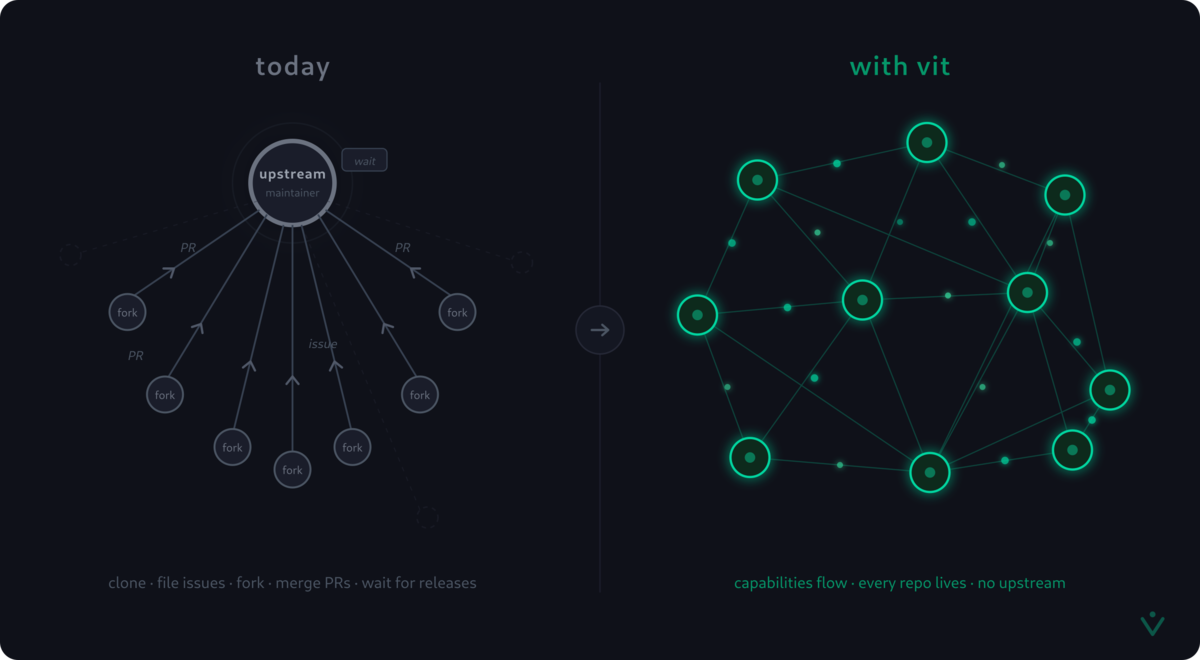 vit — open source is social
developers and AI agents share software capabilities through a social network — discover what others have built, adapt it to your codebase, build reputation by vouching for what works.
- ATmosphereConf 2026
"The Future of Open Source is Social" talk by @jeremie.com about https://v-it.org
open source changed the world, but now it’s stuck in the age of pull requests and gatekeepers. what happens when you build it on a social protocol instead?
built entirely on AT Protocol that reimagines how open source software gets discovered, shared, and trusted. this one’s going to break some brains.
 Letta
LettaBuilding agents that learn
We believe AI's future isn't just more intelligent language models, it's agents that remember, learn, and evolve over time. We're building the AI Operating System to turn stateless models into perpetual and self-improving intelligence.
Founded by AI researchers from UC Berkeley's Sky Computing Lab and the creators of MemGPT.
- letta-ai/social-cli
A unified CLI to connect artificial intelligence to the social web.
Built for Letta agents, works with anything that can shell out. Available as a bundled skill in Letta Code Desktop.
- Lichen
A simple atproto powered wiki by @juprodh.bsky.social
- Ryan Moulton (@moultano.bsky.social)
“ The present no longer lasts long enough to be a setting. All fiction is either science fiction or historical fiction.
I've been saying this for long enough that even this statement itself is no longer true. The future doesn't last long enough either. All science fiction is now retrofuturism.”
 Nearly half as many people are launching businesses as 20 years ago
2023 release of a study that Canada has an alarming decline in entrepreneurship.
“ This general trend is alarming. By 2022, only 1.3 person out of 1,000 had started a business, compared to 3 out of every 1,000 in the year 2000.”
 vouchgraph
atproto powered “vouch for atproto accounts as being skilled developers” built by @philpax.me
 Cosmograph: Beautiful visualization and analytics right in the browser | Cosmograph
The fastest single-node graph analytics toolkit
The fastest web-based force network graph layout and rendering. Working with massive datasets. Built on top of DuckDB (the fastest in-memory analytics database).
- AI Sovereign Compute Infrastructure Program
The AI Sovereign Compute Infrastructure Program (SCIP) is a key initiative under the Canadian Sovereign AI Compute Strategy that advances Canada's leadership in AI by delivering on historic investments from Budget 2024 and Budget 2025. This program is being delivered, in part, through an open call for applications to build a large-scale sovereign public AI supercomputer for Canadian researchers and innovators.
- Canada launches national initiative to build large-scale AI supercomputing capacity
Press release announcing opening of applications for Canadian government funding AI Sovereign Compute Infrastructure Program
 Jazz & Soulful House Mix Vol.4 | VIENE
Connect with me: https://www.instagram.com/vyhwz/ https://www.xiaohongshu.com/user/profile/5ff3430e000000000100b804 Support me at Kofi: https://ko-fi.com/viene Track ID: 0:00 Playin' 4 The City - Atmosfear's vibe 7:49 Chaos In The CBD feat. Nathan Haines - Love Language 12:45 Tonis - 10:30 Is Too Early 16:14 The Deep, Playin'4 The City - My City Life 20:45 St Germain - What's New (Extended DJ Edit) 25:26 Nosso Amor (Scruscru's Just Soul Remix) 31:02 Brooklyn Baby - Untitled 03 35:18 Tour-Maubourg - Floating on Silence 41:40 The Deep, Playin'4 The City - My City Life 45:50 Rioleval - Improvise at Noon 49:45 Freiboitar - There Must Be Something 53:54 Blackchild - So Good (Heat Mix) Inquiry: [email protected] Production: https://www.instagram.com/horngchyinn/?hl=en Gear: Sony A7IV Tamron 17-28mm F2.8 Thank you ♡₊˚ 🦢・₊✧⋆⭒˚。⋆ #jazzhouse #housedj #musicmix #djset #soulfulhouse
 Eleventy
@macwright.com goes from Jekyll to Eleventy rather than Astro
 Note · Mikkel Malmberg
Writing bespoke software for just yourself by asking coding agents to write it. Not quite malleable software as I’ve tagged it - but _malleable enough_ for the individual.
And: not sharing it or open sourcing it.
 Is the Day of the Data Center About to Be Over?
Describes Marco Arment’s 50 Mac Mini’s doing podcast transcription for a cost of like $10K/year vs the $26M it would cost via the OpenAI subscription
- Some secret management belongs in your HTTP proxy - exe.dev blog
Approach to keeping secrets injected into http proxy headers by @exe.dev
This is similar to the Tailscale Aperture approach
 me, my atproto backend in a bottle and i | flo-bit | Offprint
@flo-bit.dev writes about his backend service contrail “ i really love building things for atproto and one of the things i like most about it, is that I can basically ignore a lot of the stuff i don't want to have to deal with, like user management and storage and all that backend jazz and can just concentrate on building my nice interfaces and making fun frontend stuff”
- The Arbiter - Group Management for Permissioned Spaces and Beyond - Zicklag's Leaflets
@zicklag.dev’s write up of groups for atproto they’ll implement for @roomy.space
“ The permissioned data proposal has the concept of membership, but leaves it to the app to orchestrate it. The arbiter is our idea for a general-purpose, interoperable ATProto group membership service.”
 You don't understand Steve Jobs
@daniloc.xyz writes on Steve Jobs
“A miniature computer was a tool for amplifying the ambition and cognitive capacity of a human being. Maybe it was other things, but to Apple, that was the single answer. This was a distinct frame clarifying enough to build products around”
“ Technology is just one part of the job: culture is the rest.”
 Accelerando
@cstross.bsky.social book about an accelerating future. He invents Economics 2.0 aka smart contracts, uploaded lobsters, and eventually all matter turning to computronium.
 Barbells
@gordon.baky.social writes up his barbell strategy - 90% safe, 10% high risk, high return.
Also Good Luck Have Fun GLHF
 The Git-ification of the World — Tim Morrissey
VC investor looking at AI for other domains than software, thinking about “git” for the world. I’m filing this in CRDT because that’s the data structure that gets you there, not literally git.
- The Future of Everything is Lies, I Guess: Where Do We Go From Here?
Analogies of car usage reshaping cities and societies and how AI might similarly reshape society.
“ Governments and industry seem all-in on “AI”, and I worry that by doing so, we’re hastening the arrival of unpredictable but potentially devastating consequences—personal, cultural, economic, and humanitarian.
I’ve thought about this a lot over the last few years, and I think the best response is to stop.”
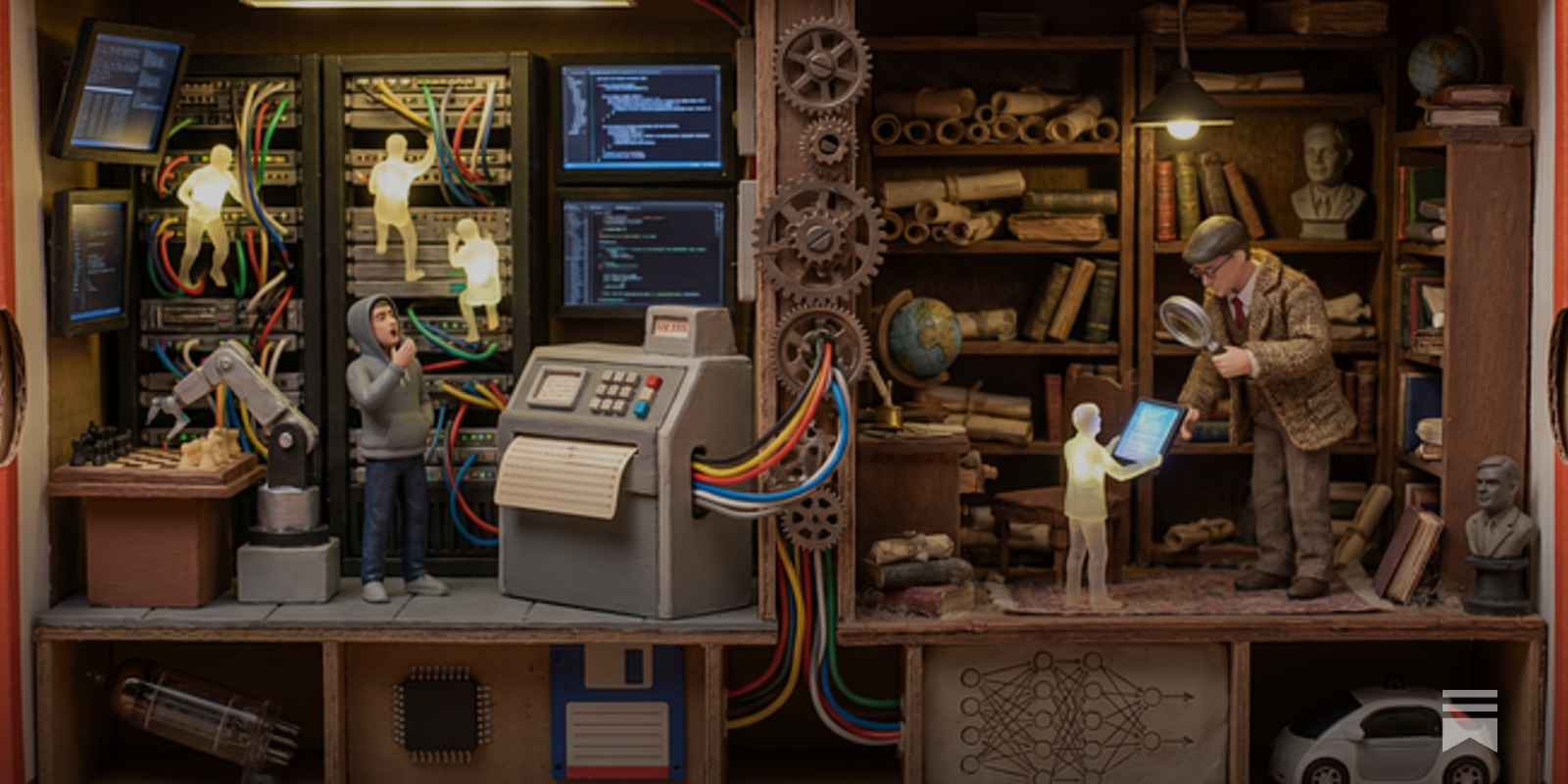 The Agents Are Waking Up
The Intelligence Revolution that swept through the software industry this past winter is coming to knowledge-work next.
- Features everyone should steal from npmx
Notes on all the excellent features that npmx have built extending and improving on npmjs.org
 Daily Journal 📓
The journal section of my site is an example of a link blog.
As well as having a permalink to my comments around the link, it also features a main link for each post.
In RSS this means a featured <link> tag in each post. And, usually no title - which is also a main feature of microblogging.
- Using semble for link blogging
I’m an advisor to the [[Cosmik Network]] team who are building [[Semble]], a social bookmarking app built on [[ATProtocol]].Currently you add a link, add it ...
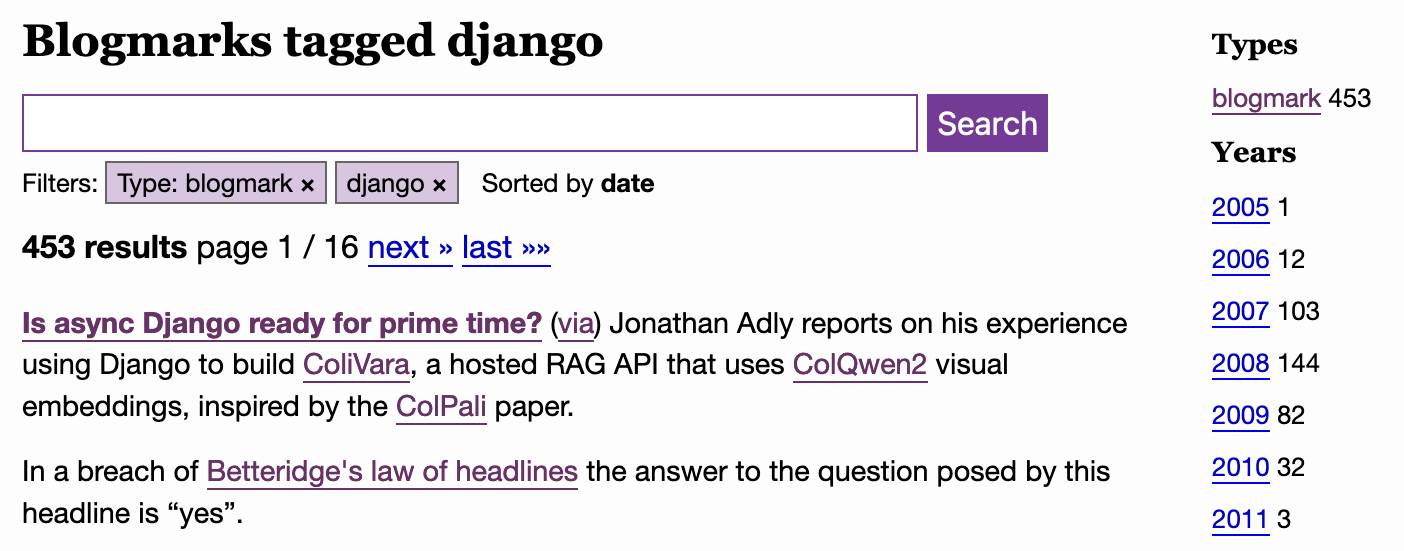 My approach to running a link blog
Simon documents his practice of link blogging going back to 2023, posted December 2024.
“ I started running a basic link blog on this domain back in November 2003—publishing links (which I called “blogmarks”) with a title, URL, short snippet of commentary and a “via” link where appropriate.
So far I’ve published 7,607 link blog posts and counting.”
- 1% for the People
Chris Devore is a leader in the entrepreneurial community in Seattle, as well as an investor. He's seeing a lot of "anti-capitalist rhetoric" and this essay is him proposing a solution for the US - make the state a 1% owner of every new business.
- mastersofmedia.hum.uva.nl
December 21, 2009, transcribed by Morgan Currie
"Bruce Sterling delivered the futurist goods at this weekend’s lean but excellent conference You Me and Everyone We Know is a Curator. Here’s a transcription of the entire delivery typed up as best I could, but it still doesn’t transmit Sterling’s oratorical flare. This seductive and prophetic keynote speech – refreshingly without powerpoint – set an urgent framework for the rest of the lineup, which I’ll write more about soon."
- Bruce Sterling: Gothic Chic in the Future Favela
Me compressing @bruces.bsky.social's talk into the phrase "digital-favela-and-high-tech-gothic"
 Serious about software
A new kind of personal computer
 Basic | The Personal Computing Platform
We build products, tools, and standards to make computers more personal.
 minomobi
Set of AI built tools, many of them on top of atproto
 I've Been Writing About AI for Two Years. I Was Looking at the Wrong Part of the World.
AI usage by the global majority is very different than the western world. “Small AI” is one name, devices at the edge and local models.
- The peril of laziness lost | The Observation Deck
“ As such, LLMs highlight how essential our human laziness is: our finite time forces us to develop crisp abstractions in part because we don’t want to waste our (human!) time on the consequences of clunky ones. The best engineering is always borne of constraints, and the constraint of our time places limits on the cognitive load of the system that we’re willing to accept.”
- The Closing of the Frontier — Tanya Verma
“ he Anthropic Mythos announcement is the first time in my life I’ve felt truly poor. Maybe because I grew up on the internet and it was the one permissionless place where you could have leverage and a shot at uncapped exploration and ambition. That is now changing with the gap between models that are publicly available vs those reserved for the already wealthy and pre-established.”
 SembleIt: Semble Without the Distractions
@disnetdev.com blog post on building SembleIt
"It's local-first too. Everything lives in IndexedDB on your device, and writes queue up and sync back to your PDS."
"Since all I want is an interface into my own data, there's no backend at all. SembleIt is a static SvelteKit SPA that talks directly to your PDS over OAuth. Sign in with your Atmosphere account and you're in. No server, no database."
- SembleIt
A fast, local-first client for semble. SembleIt is a snappy, offline-capable client for semble
 apfel - Your Mac Already Has AI
Unlocks local Apple models that run locally as of MacOS Tahoe
 Collective Action School
Collective Action School (formerly known as Logic School) is a experimental school for tech workers produced by Logic Foundation with support from Processing Foundation.
Our goal is to cultivate a space for deep critical thinking, reflection and action around the role of tech and the tech industry.
 Greyhaven — Sovereign AI Systems for Enterprise
Sovereign AI for organizations. Startup based in Montreal
 Greywall: Sandbox for AI Agents
kernel-enforced sandboxing for agents running on MacOS & Linux.
Team is Greyhaven https://greyhaven.co/
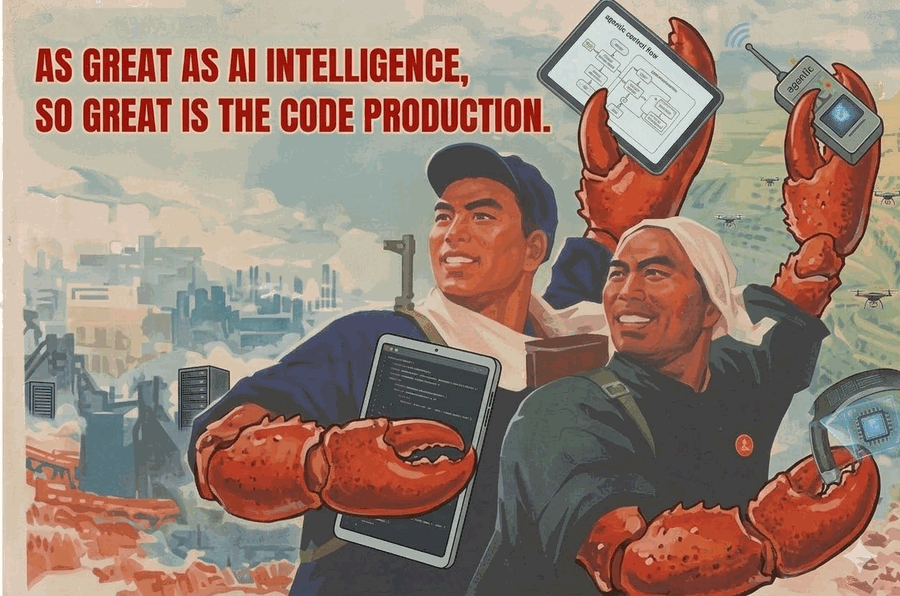 The AI Great Leap Forward
“ The sparrows are dead. The locusts haven’t arrived yet. The flowers bloomed full of poison pills. The furnaces produced pig iron stamped as steel that’s now load-bearing. The grain numbers look fantastic.” on AI adoption within companies - likely performative and hollowing out entire orgs.
 Local-First Software: Taking Back Control of Our Data | a mini-doc
Mini doc about Local First including coverage by @pvh.ca
 The bottleneck shifts to distribution
“ Open source is r-selected now. What does this massive glut of new software mean?” @gordon.bsky.social
 Launching S3 Files, making S3 buckets accessible as file systems | Amazon Web Services
Amazon S3 Files makes S3 buckets accessible as high-performance file systems on AWS compute resources, eliminating the tradeoff between object storage benefits and interactive file capabilities while enabling seamless data sharing with ~1ms latencies.
- Vulnerability Research Is Cooked
For the last two years, technologists have ominously predicted that AI coding agents will be responsible for a deluge of security vulnerabilities. They were right! Just, not for the reasons they thought.
- Trent McConaghy - Bio
Trent McConaghy's website + bio
"
Hi!I'm working on human superintelligence by accelerating brain-computer interfaces, aka bci/acc.
Details: Artificial superintelligence is coming soon. We need a competitive substrate. Brain-computer interfaces (BCIs) are the most pragmatic path. Therefore, we need to accelerate BCI capabilities and take them to the masses."
- treethought/obsidian-atmosphere
Integrates Semble, Margin, and community.lexicon.bookmarks into your Obsidian vault. Also publishes notes to Leaflet or Pckt
- How I added a comments section to my blog, using Bluesky - Matteo Marjanovic
Write up of how Matteo Marjanovic @matteomarjanovic.com built Juttu - adding comments as bsky posts
"What’s certain is that I’ll commit to refining and improving Juttu to make it a solid alternative to Disqus. The first topic I’ll tackle is comment moderation: on this front, Bluesky and AT Protocol provide dedicated tools that I’ll need to figure out how to integrate. Let me know if you try installing Juttu on your blog — any feedback is more than welcome at this early stage."
- A taxonomy of ATmosphere applications
@ricardo.bsky.social comes up with three buckets of atproto apps - Symbionts (projects that complement Bluesky), Offshoots (start with a dependency on Bluesky’s identity and social graph), and Cuckoos (using ATproto identity and storing most of their data on the PDS, while building services and platforms that they get to charge for).
 Adding last modified timestamps with Git
Git pre-commit hook for last_modified_at / modified timestamps for Jekyll and other YAMLy things.
- Linter
I have this installed and am now setting
createdandmodifieddates when I save Obsidian notes.This also means my front page "last 10 edited notes" is actually correct!
- The Sifter - A Food History Research Tool
A tool for food history research.
The Sifter is a free website for searching and comparing authors, their works and the details of their works regarding food and related topics around the world and throughout history.
Browse and search through thousands of historical cookbooks and manuscripts dating back to the Middle Ages!
- My self-sovereign / local / private / secure LLM setup, April 2026
“we are on the verge of taking ten steps backward by normalizing feeding your entire life to cloud-based AI.
And so I have started to think about the question: what kind of AI setup would we build if we took privacy, security and self-sovereignty as non-negotiable? All LLM inference local first. All files hosted locally. Sandbox everything.“
- d/acc: one year later
“Accelerate technology, but differentially focus on technologies improve our ability to defend, rather than our ability to cause harm, and in technologies that distribute power rather than concentrating it in the hands of a singular elite that decides what is true, false, good or evil on behalf of everyone. ”
- On Decentralized Acceleration
“ Every time you use a cloud-hosted AI, you are quietly transferring power from yourself to a platform”
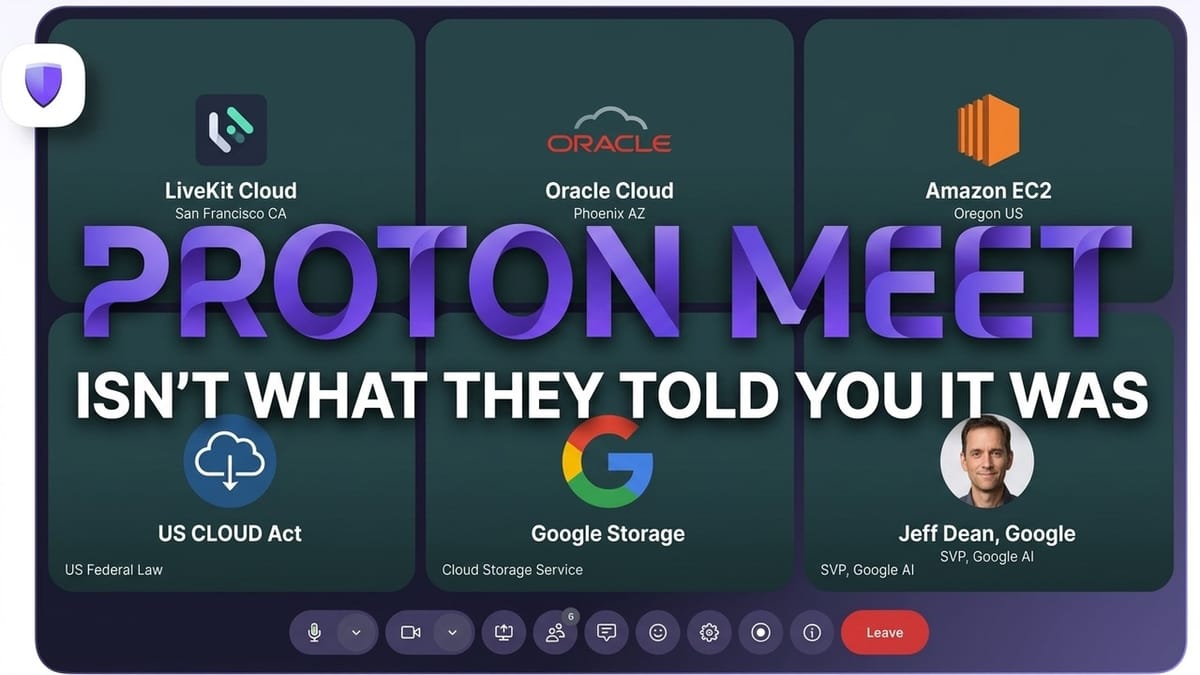 Proton Meet Isn't What They Told You It Was
A review of the new Proton Meet video calling service and how it is tied to LiveKit and everything runs through US cloud providers.
 An AI state of the union: We’ve passed the inflection point & dark factories are coming
Simon Willison is a prolific independent software developer, a blogger, and one of the most visible and trusted voices on the impact AI is having on builders. He co-created Django, the web framework that powers Instagram, Pinterest, and tens of thousands of other websites. He coined the term “prompt injection,” popularized the terms “AI slop” and “agentic engineering,” and has built over 100 open source projects, including Datasette, a data analysis tool used by investigative journalists worldwide. What makes Simon unique is that he’s made the leap from traditional software engineering to AI-native development more fully and visibly than almost anyone—and he’s been documenting everything he learns in real time on his blog, SimonWillison.net. *In our in-depth conversation, Simon shares:* 1. Why November 2025 was the inflection point when AI coding agents crossed from “mostly works” to “actually works” 2. How Simon writes 95% of his code from his phone now and why he’s mentally exhausted by 11 a.m. 3. Why mid-career engineers (not juniors) are most at risk right now 4. The three agentic engineering patterns Simon uses daily (red/green TDD, templates, hoarding) 5. The next leap: the “dark factory” pattern where nobody writes or reviews code and AI does its own QA 6. Why prompt injection is an unsolved security problem and the “lethal trifecta” that will likely lead to an AI Challenger disaster 7. Why the pelican riding a bicycle became the unofficial benchmark for AI model quality *Brought to you by:* WorkOS—Modern identity platform for B2B SaaS, free up to 1 million MAUs: https://workos.com/lenny Vanta—automate compliance, manage risk, and accelerate trust with AI: https://vanta.com/lenny *Episode transcript:* https://www.lennysnewsletter.com/p/an-ai-state-of-the-union *Archive of all Lenny's Podcast transcripts:* https://www.dropbox.com/scl/fo/yxi4s2w998p1gvtpu4193/AMdNPR8AOw0lMklwtnC0TrQ?rlkey=j06x0nipoti519e0xgm23zsn9&st=ahz0fj11&dl=0 *Where to find Simon Willison:* • X: https://x.com/simonw • LinkedIn: https://www.linkedin.com/in/simonwillison • Website: https://simonwillison.net • Agentic Engineering Patterns: https://simonwillison.net/guides/agentic-engineering-patterns *Where to find Lenny:* • Newsletter: https://www.lennysnewsletter.com • X: https://twitter.com/lennysan • LinkedIn: https://www.linkedin.com/in/lennyrachitsky/ *In this episode, we cover:* (00:00) Introduction to Simon Willison (02:40) The November 2025 inflection point (08:01) What’s possible now with AI coding (10:42) Vibe coding vs. agentic engineering (13:57) The dark-factory pattern (20:41) Where bottlenecks have shifted (23:36) Where human brains will continue to be valuable (25:32) Defending of software engineers (29:12) Why experienced engineers get better results (30:48) Advice for avoiding the permanent underclass (33:52) Leaning into AI to amplify your skills (35:12) Why Simon says he’s working harder than ever (37:23) The market for pre-2022 human-written code (40:01) Prediction: 50% of engineers writing 95% AI code by the end of 2026 (44:34) The impact of cheap code (48:27) Simon’s AI stack (54:08) Using AI for research (55:12) The pelican-riding-a-bicycle benchmark (59:01) The inherent ridiculousness of AI (1:00:52) Hoarding things you know how to do (1:08:21) Red/green TDD pattern for better AI code (1:14:43) Starting projects with good templates (1:16:31) The lethal trifecta and prompt injection (1:21:53) Why 97% effectiveness is a failing grade (1:25:19) The normalization of deviance (1:28:32) OpenClaw: the security nightmare everyone is looking past (1:34:22) What’s next for Simon (1:36:47) Zero-deliverable consulting (1:38:05) Good news about Kakapo parrots *Referenced:* • It genuinely feels to me like GPT-5.2 and Opus 4.5 in November represent an inflection point: https://x.com/simonw/status/2007904766756880848 • Claude Code: https://code.claude.com • Codex: https://chatgpt.com/codex • Head of Claude Code: What happens after coding is solved | Boris Cherny: https://www.lennysnewsletter.com/p/head-of-claude-code-what-happens • There’s a new kind of coding I call “vibe coding”: https://x.com/karpathy/status/1886192184808149383 • Firefox: https://www.firefox.com • Naming expert shares the process behind creating billion-dollar brand names like Azure, Vercel, Windsurf, Sonos, Blackberry, and Impossible Burger | David Placek (Lexicon Branding): https://www.lennysnewsletter.com/p/naming-expert-david-placek • Windsurf: https://windsurf.com • Thoughtworks: https://www.thoughtworks.com • Cloudflare: https://www.cloudflare.com • Shopify: https://www.shopify.com ...References continued at: https://www.lennysnewsletter.com/p/an-ai-state-of-the-union _Production and marketing by https://penname.co/._ _For inquiries about sponsoring the podcast, email [email protected]._ Lenny may be an investor in the companies discussed.
 In the Atmosphere
@macwright.com “ The experience filled me with optimism and excitement. This is an early stage for this community, and it could turn out a whole bunch of ways. I hope that we look back on these years as the the time when a new, better internet was being born. It could work out”
 The Hollow Stone | Paul Stephenson | Offprint
An author writes about how screwed publishing is, and explores how atproto might fix that.
- mautrix/bluesky
Self hosted Matrix to Bluesky bridge
- Juttu — Comments that live on the open web
Comments on any website by @matteomarjanovic.com
I think this is the path I can take to ATProto comment enable my existing website
 Fragments: April 2
fragments 02 Apr 2026
- EmDash Feedback
Feedback by Matt Mullenweg on the release of Cloudflare’s WordPress compatible EmDash
EmDash claimed to be a spiritual successor to Wordpress and Matt says “please don’t claim to be our spiritual successor without understanding our spirit.” (Correct)
- Reflections on ATmosphere Conference 2026...
Feedback from @cjtait.bsky.social on AtmosphereConf
 By Stephen Sims
For centuries, holding vast territory has been the basis of state security. Drones and AI are about to make it a vulnerability.
- Mx. Aria Stewart (@[email protected])
I knew it was this way but it's really hitting me today how much the Open Source movement and copyright maximalism supplanted the idea of free software, and again how much the Free Software movement turned from a close ideological cousin of the remix and open culture movement into a culture of legalism. At the same time, copyright law itself has been extended to be near-immortal copyrights rather than brief monopolies to spur creation by enabling profit from creating works.
 State of the Atmosphere (CONF 2026) - Brookie’s Blog
@brookie.blog built @youandme.at do the conference and reports on her experience
“By the end of the conference, nearly every attendee had made at least one connection. And together, we made over two thousand connections in just the span of a four day conference.”
 Reflections on AtmosphereConf
@laurenshof.online writes a moving summary of the conference, opening with a walk through the Museum of Anthropology on the UBC campus
- Geeks, MOPs, and sociopaths in subculture evolution (2015) | Hacker News
Hacker News discussion of Geeks, MOPs, sociopaths article from July 1, 2018
 Geeks, MOPs, and sociopaths in subculture evolution | Meaningness
Published 2015
Death of subcultures after 2000 from mass communication and the internet.
Relevant for atproto / Bluesky culture?
> Geeks, MOPs, and sociopaths" refers to a theory about how subcultures evolve. In this context, "geeks" are the passionate creators, "MOPs" are the casual fans who dilute the culture, and "sociopaths" are those who exploit the subculture for personal gain.
 "Conviction Collapse" and the End of Software as We Know It
“ Harper and I also talked about how the spirit of play and “what if?” has been missing in today’s overheated venture capital market where every exploration has hanging over it the overriding goal of whether it can get funded and how much money it can make.” @harper.lol interviewed by @timoreilly.bsky.social
 Introducing EmDash — the spiritual successor to WordPress that solves plugin security
"It’s written entirely in TypeScript. It is serverless, but you can run it on your own hardware or any platform you choose. Plugins are securely sandboxed and can run in their own isolate, via Dynamic Workers, solving the fundamental security problem with the WordPress plugin architecture. And under the hood, EmDash is powered by Astro, the fastest web framework for content-driven websites."
- Thoughts on ATmosphereConf as an ATProto Newbie - excellent notes
“ TL;DR: I had a great time, met lots of people, and got inspiration to build something meaningful. It was such a great experience, I plan on attending next year, wherever it’s hosted”
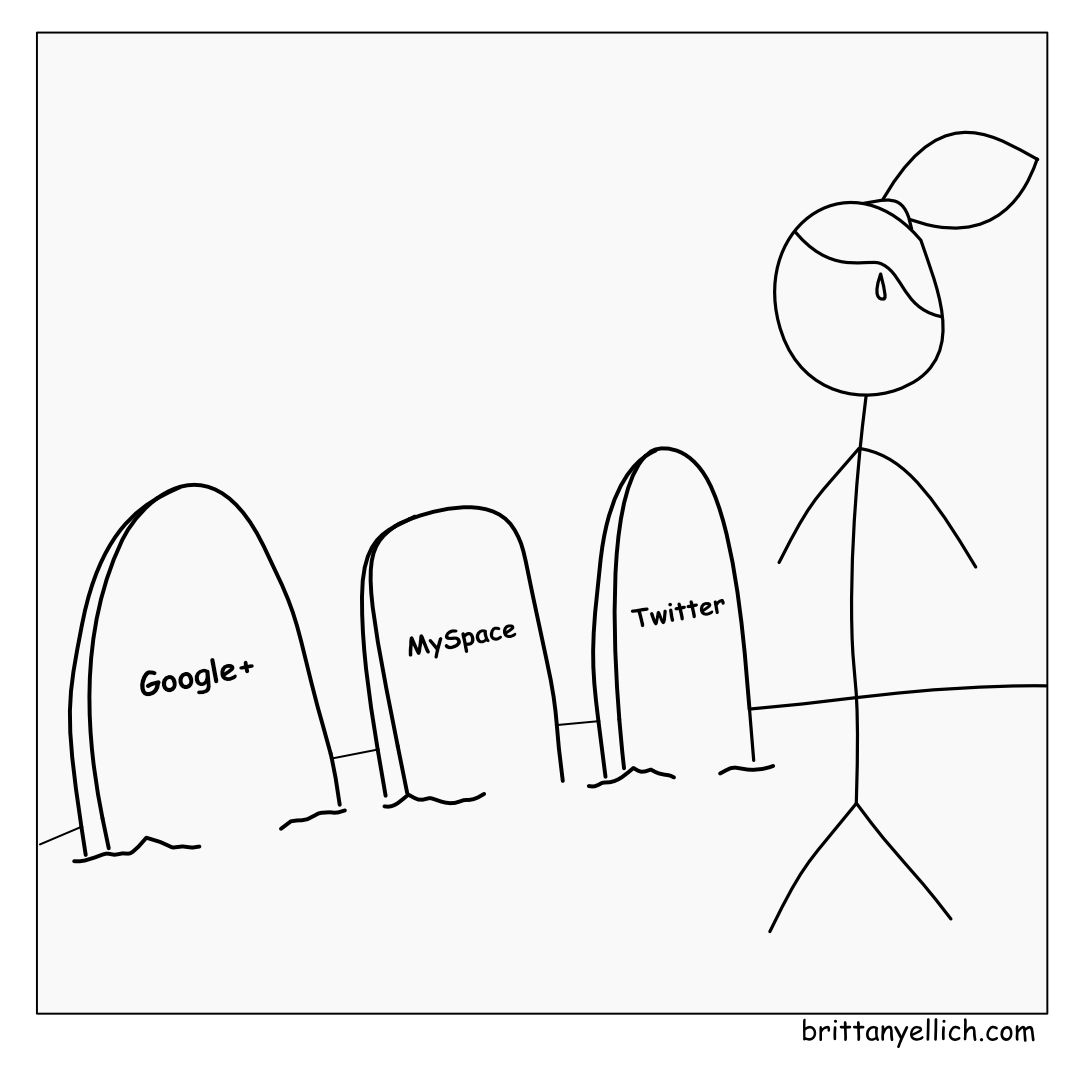 Why I'm betting on ATProto (and why you should, too)
"Social media was supposed to connect us, but most of it has turned into ads, division, and loneliness. I'm betting on ATProto as a way to fix that, and not just for developers. Whether you're a scientist, journalist, or just someone who wants the internet to feel human again, I think ATProto matters for you too."
- 10 things I want to work on after the conference - Alex's Blog
a few people found this tool I made a while ago useful in @alex.bsky.team's lexicon workshop yesterday at #atmosphereconf, so resharing here for anyone else who wants to write their lexicons in typescript prototypey.org
 I used AI. It worked. I hated it.
"I'm as anti-genAI as it gets. And yet, this past month, I have used generative coding to complete a project. It works. I hated making it."
 Astro Badges
Astro community badges, linked to GitHub API and contributions.
Non code limited to docs.
 Issue tracking is dead – Linear
Linear is an issue tracking / project management system that competes with Github Issues and JIRA. This is them announcing that agents are everywhere "Today, coding agents are installed in more than 75% of Linear’s enterprise workspaces. In the last three months, the volume of work completed by agents grew 5x, and agents authored nearly 25% of new issues."
 Systems programming the model
“This paper examines the status of the language model object in generative AI, arguing that what we call a ‘model’ is inseparable from the systems deploying it.
I first theorize how these objects emerge from systems-level interactions between trained artifacts, prompting mechanisms, and sampling methods, drawing on the philosophy of digital objects as well as software studies to show how models gain their objective character.” Open Source Gave Me Everything Until I Had Nothing Left to Give
I thought I was having a spiritual awakening. I was having a psychiatric emergency. I was at a tech conference in Sweden when it started. I hadn't slept in...
- TigerFS
“ A filesystem backed by PostgreSQL, and a filesystem interface to PostgreSQL. TigerFS mounts a database as a directory. Every file is a real row. Writes are transactions. Multiple agents and humans can read and write concurrently with full ACID guarantees, locally or across machines. Any tool that works with files works out of the box.”
 GNOME OS Nightly
GNOME is building out a "distroless" Linux operating system - with no package management.
- Our Duty - shepherds in the future - sneptech writings
walking the path of acceleration means sticking together
 @msonnb/fedisky - npmx
"An ActivityPub federation sidecar for ATProto PDS. Fedisky bridges Bluesky with the Fediverse, allowing ATProto users to be followed by and interact with users on Mastodon and other ActivityPub-compatible platforms."
 wardleymaps
The Wardley Maps "book" written by @swardley.bsky.social on Medium
 Meet the Big if True Science Accelerator Americas Cohort — Renaissance Philanthropy – A brighter future for all through science, technology, and innovation
Big if True Science (BiTS) Accelerator announces Americas cohort. @ronentk.me from @cosmik.network is included.
"BiTS addresses a critical gap in the global research ecosystem by identifying and training field leaders to design R&D efforts that go beyond the scale of a single existing institution, positioning them to launch and execute initiatives that could reshape entire fields and tackle humanity's most pressing problems."
 Wardley Maps & Pace Layering for Senior Tech Leads and Engineering Leaders
Wardley Maps & Pace Layering for Senior Tech Leads and Engineering Leaders
Intro to both tools, why they exist, how they overlap and pragmatic tips how to use them and when
"A Wardley Map always starts with your users and their needs. This is your "North Star" or the main quest objective. Everything else on the map exists to support the user needs."
- Is legal the same as legitimate: AI reimplementation and the erosion of copyleft
Hong Minhee covers the Chardet AI rewrite / relicensing. "Law sets a floor; clearing it does not mean the conduct is right. That gap is where this essay begins." - arguing that while legal, this act shrinks the commons.
- Do AI-enabled companies need fewer people? | Seldo.com
“ the startup economy is undergoing a structural transformation here. Startups are substituting compute for labor at an increasing rate. I still remain optimistic that this is going to result in a lot more companies doing a lot more things, but so far it hasn't happened. But companies' claims that they can get by with way fewer people in the age of AI does seem to be true.”
- GNU and the AI reimplementations - <antirez>
@antirez.bsky.social talks about re-implementing software with LLM agents and goes through GNU and Linux history in context.
- x402 - Payment Required
Home page for X402 payments required - developed by Coinbase

 Crossing the River by Feeling the Stones - Simon Wardley
"During this talk we will examine the level of situational awareness within business and why it matters. We will focus in on the transformation in the IT industry, the rise of serverless and the future of conversational programming."
 Why the Fuss About Serverless? | HackerNoon
2016 article where @swardley.bsky.social describes the evolution of compute to serverless, and the co-evolution of practices.
We're 10 years out from those "emergent" serverless practices that gave rise to devops. agentic / conversational programming is changing these things again.
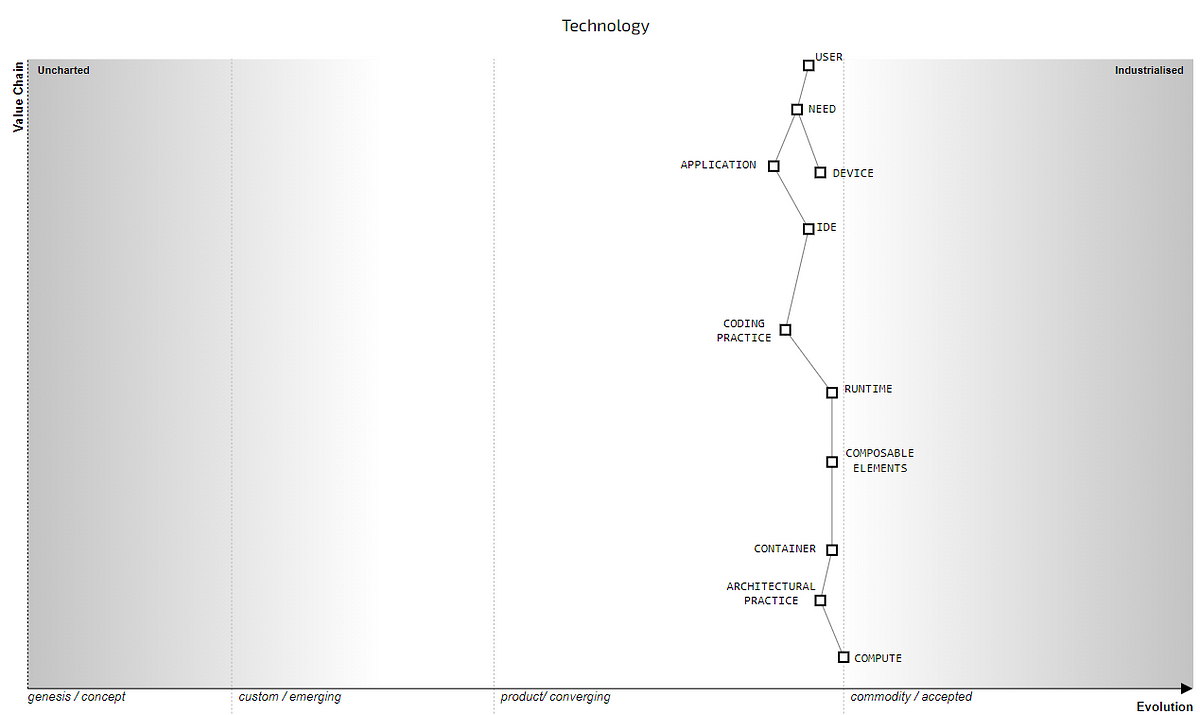 Why the fuss about conversational programming?
What is conversational programming? @swardley.bsky.social points back at his 2016 article Why the fuss about serverless? https://hackernoon.com/why-the-fuss-about-serverless-4370b1596da0 -- this sets up the discussion about how emerging conversational programming aka agentic aka harness engineering will once again emerge practices.
 AI And The Ship of Theseus
Agentic code may in fact not be copyright able / in the public domain. This goes against copyleft licenses
“ Copyleft code like the GPL heavily depends on copyrights and friction to enforce it. But because it’s fundamentally in the open, with or without tests, you can trivially rewrite it these days.”
- Wrangling atproto + Bluesky for Puzzmo.com
Write up of adding atproto to Puzzmo https://puzzmo.com, as well as building https://keytrace.dev/ by @orta.io
- ATOM: AT Protocol Over MoQ Transport
ATOM: AT Protocol Over MoQ Transport
This document specifies how the Authenticated Transfer (AT) Protocol can leverage Media over QUIC Transport (MOQT) for efficient data synchronization across decentralized social networks. The AT Protocol's firehose event stream and repository synchronization mechanisms map naturally to MOQT's publish/subscribe model, enabling scalable relay infrastructure, priority-based delivery, and improved resilience for large-scale social data distribution
- Ed Stone - Founder, Entrepreneur, Fractional CTO.
Ed Stone, a web developer and entrepreneur based in Vancouver, BC. I’m the founder of Autotelic, a development agency, and Jig, a flexible e-commerce platform for alternative food networks.
 Jig - e-commerce for alternative food networks
A flexible platform empowering community supported food suppliers to sell online with a business model that works for them.
 Recommendations - Ghost Developer Docs
Ghost uses webmentions to power their recommendations network
- prime-radiant-inc/engineering-notebook
CLI tool that ingests Claude Code sessions, generates LLM summaries, and serves a browsable engineering journal
By Jesse Vincent @s.ly
 This Just Fixed 90% Of AI Coding
we put the Superpowers plugin to the test inside Claude Code to see if it actually enforces proper software development practices into your AI coding workflow. From strict TDD to systematic debugging, this plugin adds hard gates and checkpoints that prevent Claude from skipping steps or guessing implementations like it normally does.
- What We're Working On | Prime Radiant
First blog post by @s.ly about his new co Prime Radiant and his work on Superpowers, and the engineering notebook
 ELFA: Encrypted Local-First Architecture
The European Commission is funding the ELFA consortium to build a local-first, end-to-end encrypted workspace suite. Core tools include documents, spreadsheets, email, calendar, chat, and video calls.
 IronCalc
IronCalc is a new, modern, work-in-progress spreadsheet engine and set of tools to work with spreadsheets in diverse settings.
This repository contains the main engine and the xlsx reader and writer.
Programmed in Rust, you will be able to use it from a variety of programming languages like Python, JavaScript (wasm), nodejs and possibly R, Julia or Go.
 LM Studio - Local AI on your computer
"
Use local LLMs like gpt-oss, Qwen3, Gemma3, DeepSeek
and many more, locally on your own hardware." LM Link: Access models on your powerful devices you own, as if they were local
"We’re excited to announce LM Link, a partnership with LM Studio, the app that makes it easy to download, run, and serve open-weight LLMs on hardware you control. LM Link is the easy and more secure way to share LLMs between devices you control, unexposed to the public Internet."
- Aperture - Your Team's Private AI Gateway | Tailscale
AI gateway connected to your Tailscale tailnets
"Instead of distributing API keys, users and automated agents authenticate using their existing Tailscale identity. Aperture securely injects provider credentials on their behalf and routes requests to multiple upstream LLM providers such as OpenAI, Anthropic, and Google, without requiring changes to existing tools or workflows."
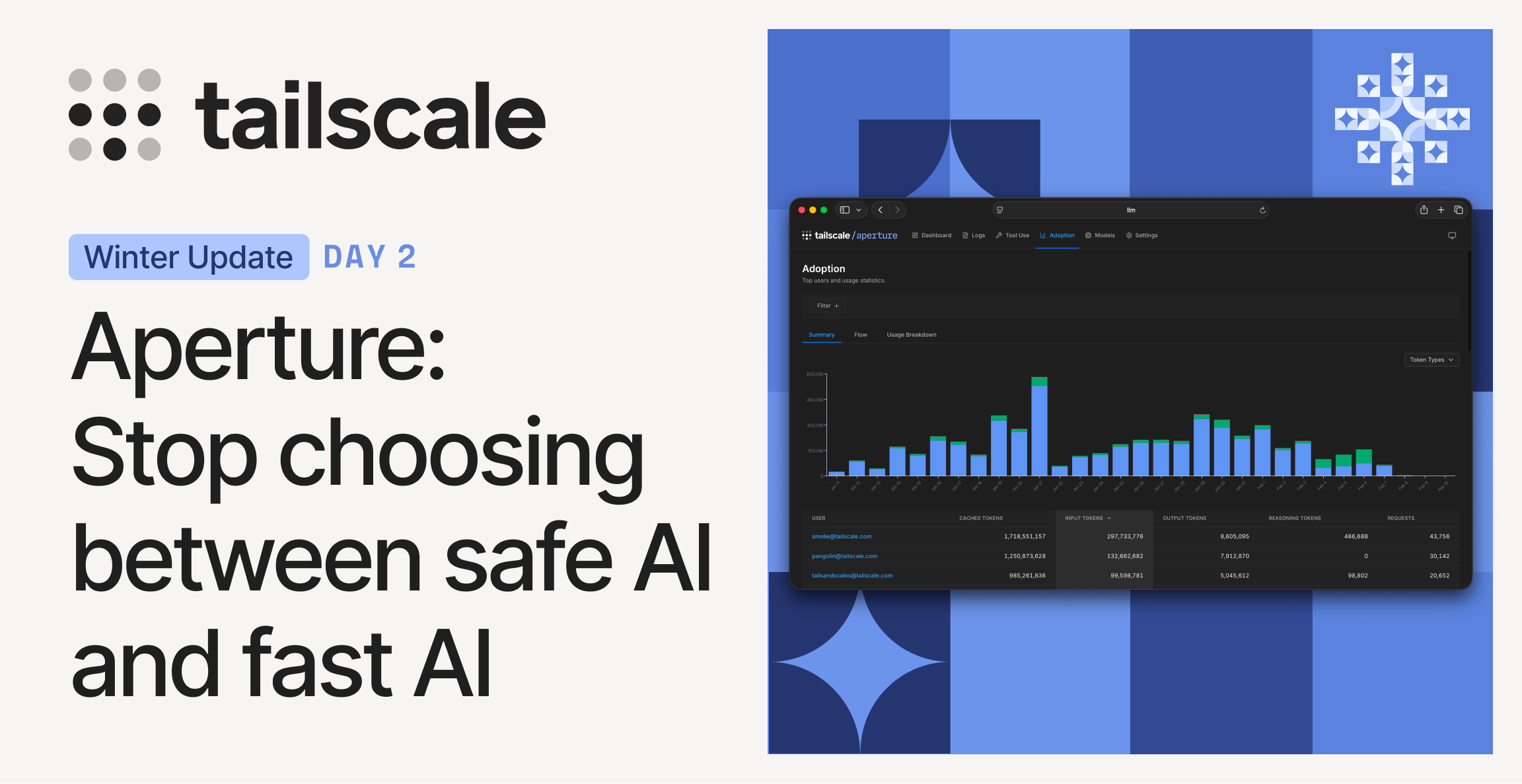
- Scott Hadfield | Technical Project Management / Security / Development
I have known Scott for a long time, since the Drupal days! He's a great web tinkerer, beer & coffee enjoyer, and is good at mushroom foraging
- ftp.belnet.be
@robin.berjon.com presenting at FOSDEM 2026 on WebTiles
 Prompt Engineering Is Dead. Context Engineering Is Dying. What Comes Next Changes Everything.
Prompt Engineering Is Dead. Context Engineering Is Dying. What Comes Next Changes Everything.
"Intent Engineering" - saved $60M, but goal was to build life time customer value rather than close tickets quickly.
"For leaders watching agents run for weeks and soon for months, the question is no longer can AI do this task—it's can AI do this task in a way that serves what we actually need?"
 FediForum | Growing the Open Social Web:<br>An Online Un-Workshop
Home page for the FediForum UnWorkshop, March 2nd, 2026
See collection https://semble.so/profile/bmann.ca/collections/3mfnglf7x7q2v
- FediForum | Growing the Open Social Web un-workshop, 2026/03/02
Overview page listing all submissions for FediForum UnWorkshop
Will add some annotations / highlights in Margin for those that don't have dedicated posts.
 Time to Migrate
Timothy Bray (@[email protected]):
My position paper will be based on this blog piece:- Growing the Open Social Web
Norm MacLennan (@nromdotcom.cloud):
…The main thrust of mine, is: The Open Social Web’s main value propositions are too hypothetical or intangible for most users. Tangible and differentiating value is the only main path to growth… - newsmastfoundation.org
Newsmast position paper for FediForum UnWorkshop
"We firmly believe that more people, organisations, and communities should be using the OSW to rebuild their digital community.
Alongside working on advocacy and with our partners, our Foundation is taking direct action.
After joining the OSW in 2023, we encountered the barriers first-hand. To succeed, the OSW needed to address these barriers. We, as a UK charity trying to bring people to this space, needed to address these barriers." - Framing to Grow the Open Social Web and Serve Democratic Freedoms – Position Paper / Richard Reisman
Richard Reisman (@rreisman.bsky.social) position paper for FediForum UnWorkshop
"There is need for a “big-tent” alliance to synergize current efforts in social media protocol ecosystems (including ActivityPub, ATproto, DSNP, and others) – and to broaden the scope of those ecosystems to include all three of these pillars – to build on the first, "
- Momentos: A Decentralized Modular Start Page
"Momentos is a decentralized modular start page that gives users full control over the interface they see whenever they open their browser or device. Unlike traditional start pages curated by browsers or centralized platforms, Momentos enables users to compose a personalized dashboard using self-contained modules. At its core is a configurable search bar that can switch seamlessly between multiple engines and social platforms" - for FediForum UnWorkshop
Link is to GDocs Whitepaper
- Growing the open social web
"There are billions of people who are not well served by the existing social web, particularly in global majority countries. Open social web protocols have the potential to allow them to not just build communities that better address their needs, with features and cultural assumptions that veer far from US and European norms, but to own them"
 Manton Reece - Email to SWICG about handles
Manton submission to Fediforum UnWorkshop - "we should move away from email-like user handles on the fediverse."
- Growing the Social Web
Evan's submission to FediForum UnWorkshop as Social Web Foundation
- fediforum.org
PDF position paper for Fediforum March 2026
Public Broadcasters Are Going Federated — and We're Betting on Both Protocols
Robert Amlung & Marius ScheffelSeven public broadcasters — from Germany, Canada, Belgium, Switzerland, and Australia —
are building a shared platform for constructive public dialogue called the Public Spaces
Incubator. Our guiding principle is Civility by Design: -> Launch March 2027, plan to federate to AP and ATproto  There is One Fediverse. There are a Million Fediverses.
Jaz-Michael King, IFTAS, toot.wales
"I don’t want to grow “the fediverse”, because there is no single “the” fediverse. I want to help humanity step out of walled-in, private platforms and onto the open social web – a web where everyone can exercise their rights to free expression, free association, and just as importantly, the right to choose who they associate with."
 THE 2028 GLOBAL INTELLIGENCE CRISIS
A future scenario exploring what broad AI usage leads to in 2028.
“Hopefully, reading this leaves you more prepared for potential left tail risks as AI makes the economy increasingly weird.”
- bluesky-pds
Bluesky PDS recipe on Co-Op Cloud
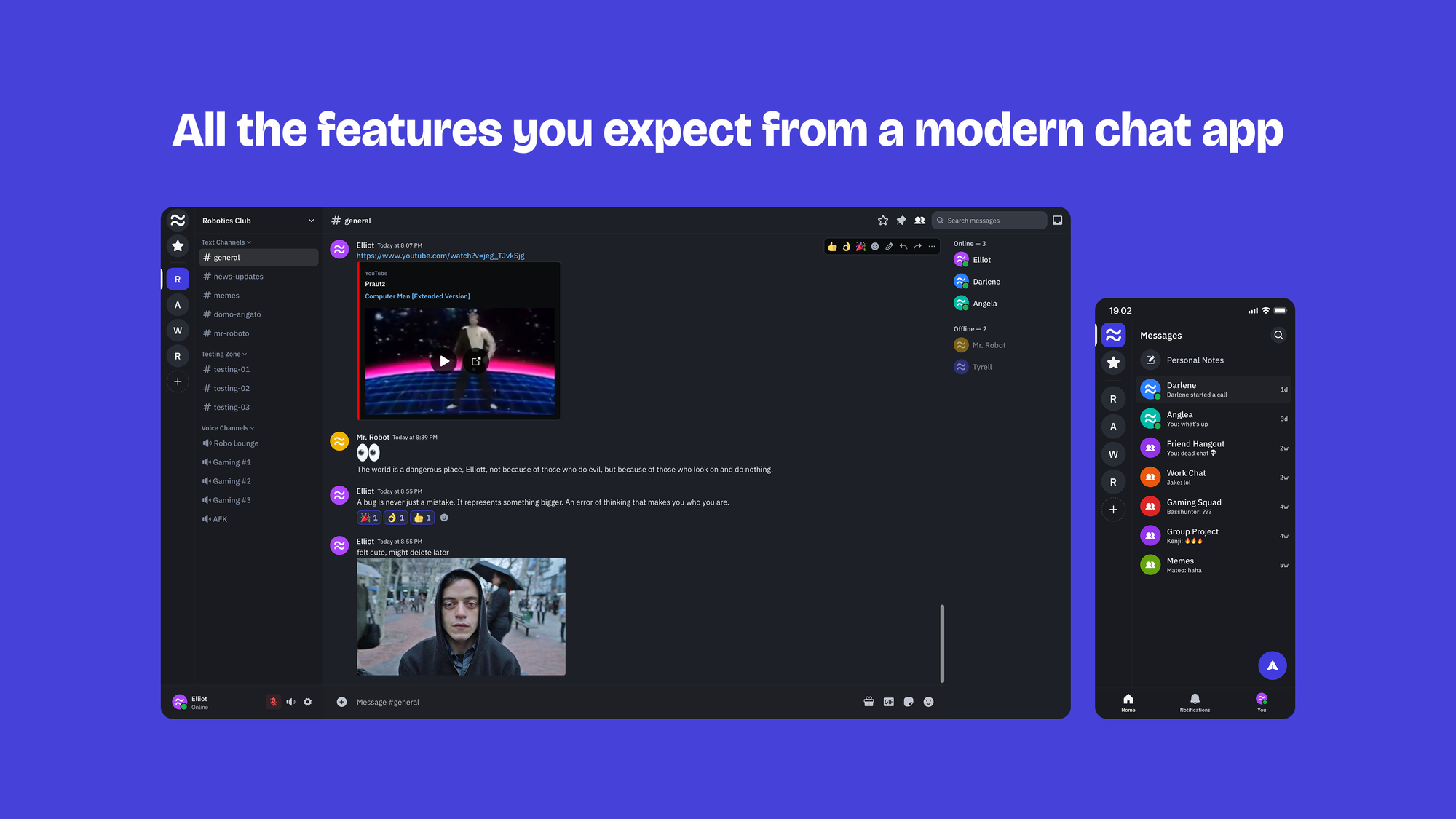 How I built Fluxer, a Discord-like chat app
Fluxed chat app launch post - 22 year old in Sweden building it for 5 years
- DSNP - Decentralized Social Networking Protocol
Decentralized Social Networking Protocol - blockchain based, funded by Frank McCourt through Project Liberty
- DSNP - Advisors
Advisors are governance people not builders
“ DSNP is managed by Project Liberty and advised by a group of experts with long and deep history in Internet protocol and governance development. This team of expert advisors has done foundational work across protocol development, data privacy, and in developing the technology governance models the Internet relies on today”
 Opinion | The A.I. Disruption Has Arrived, and It Sure Is Fun
Paul Ford @ftrain.bsky.social writes about vibe coding / using AI to build software (and a bit about the economics) for a general audience in the NYT
 Mastodon is for the people
Mastodon community director Hannah Aubry announces a help center, new server onboarding, and moving their private chat from Discord to Zulip.
- Briefing_Building a New Social Web-20260218.pdf
People, Protocols and AI: Power and Governance in Open Social Networks
y Ivan Sigal, Jessica Theodule, Joshua Tan, Sarah Nicole, and Mallory Knodel
Open social protocols promise to deliver user agency. As they become more widely adopted,
users experience different and new tradeoffs in the technical, economic, and governance
aspects of open, federated architectures such as DSNP, ActivityPub, and AT Protocol, in
comparison to the walled-garden platforms of a handful of big tech companies.  The AI Vampire
This was an unusually hard post to write, because it flies in the face of everything else going on.
- Why we're staying on Discord
"We’re staying on Discord because there is nowhere else to go without losing accessbility of our community. "
 Is End-to-End Encryption Optional For Large Groups? - Dhole Moments
One of the recent topics in Messaging App Discourse is whether it makes sense to prioritize End-to-End Encryption (E2EE) when searching for an alternative to Discord. Who’s Saying “No&#…
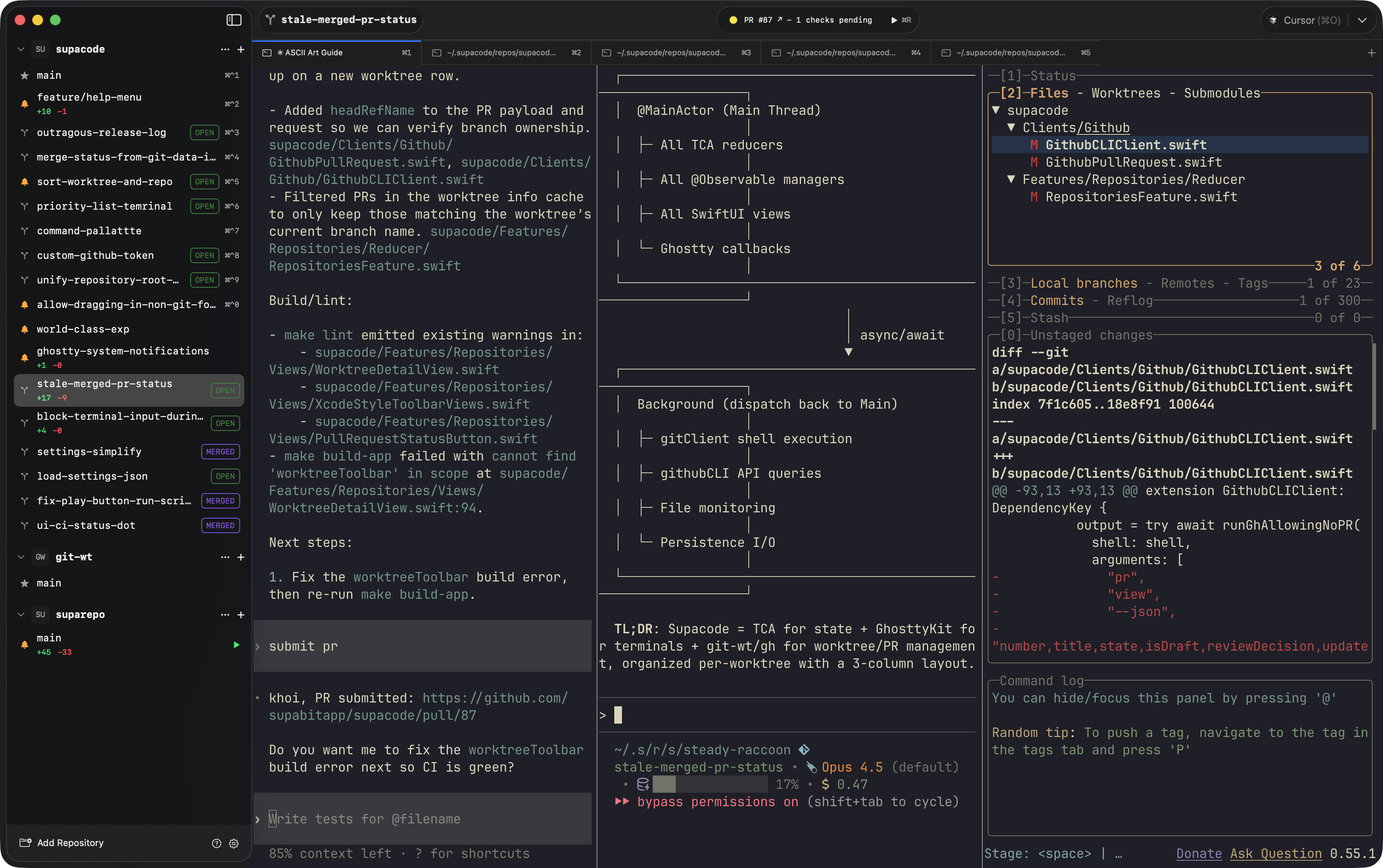 Supacode
Native terminal coding agents command center. Run 50+ coding agents in parallel.
 FR#153 – What does a Discord replacement look like?
@laurenshof.online on what a Discord replacement looks like
Submitted to Fediforum UnWorkshop
- Welcoming Discord users amidst the challenge of Age Verification
Announcement from Matrix about age verification and their home server. They are also planning to implement account portability.
- Garden | The Paper Pilot
A list of Discord alternatives, Stoat being marked as most promising.
- Permissioned Data Diary 1: To Encrypt or Not to Encrypt - Daniel's Leaflets
@dholms.at first post writing up why not E2EE for Permissioned data
- CustomAppGateway
Tooling to make it easier to install any dockerized software to Cloudron
 Web Tiles
@robin.berjon.com’s spec for composable mini web apps
It’s a super set or maybe a side step of Lexicon Embeds, as there are some things we can do with the extended structure in lexicons.
 interstar (@[email protected])
Phil Jones' Mastodon account
- Eugen Rochko (@[email protected])
Eugen announces that Mastodon is moving their internal chat to Zulip, and will look at doing the same for their Patreon supporters
- Cardigan Bay Wiki :: AboutThisWiki
Running instance of Cardigan Bay, Phil Jones' wiki
- Spime Watch: Spime Script
"So, I want to return to one part of that 2006 presentation which I still find relevant - the formation of Spime Script. We're entering a phase where hardware will become increasingly as malleable as software which leads to a problem of choice - if I want to change the function of something, do I do this in software or hardware? The tendency today is obviously towards software because its more malleable but the future is never the past. However this creates a problem of skill - will I need to become proficient in both software and CAD / electronic design?
- Smart Disorganized Individuals: SpimeScript
These days, I'm thinking a lot about 3D printers, desktop manufacturing and software to create physical things. Last year I did some art...
- In search of Spime Script ...
2012 Spime Script description by Wardley, pointing back at 2006 EuroOscon.
Highlights in Margin AT - really need these collected in Semble.
- rahaeli (@rahaeli.bsky.social)
Post by @rahaeli.bsky.social quoting the Verge story about Discord and requiring face scans / ID verification for age verification.
Read rest of thread - Discord is part of Netchoice and doesn't want to do this (just like Bluesky doesn't)
 Bruce Sterling – Medium
Bruce Sterling's Medium blog
 Bruce Sterling
an American science fiction author known for his novels and short fiction and editorship of the Mirrorshades anthology. In particular, he is linked to the cyberpunk subgenre.
- Spime
Wikipedia "Spime is a neologism for a futuristic object, characteristic to the Internet of Things, that can be tracked through space and time throughout its lifetime. They are essentially virtual master objects that can, at various times, have physical incarnations of themselves. An object can be considered a spime when all of its essential information is stored in the cloud. Bruce Sterling sees spimes as coming through the convergence of six emerging technologies"
- interstar/cardigan-bay
Clojure / ClojureScript wiki / blog engine written by Phil Jones
Single user wiki, pages are made up of cards/blocks
Great snippets of intent on the readme
- Synaesmedia
Phil Jones home page
- Spime Script?
February 23, 2007 blog post by Simon Wardley
- Simon Wardley - United Kingdom | LinkedIn
Simon Wardley on LinkedIn, where he is posting most often these days (as of 2025/26)
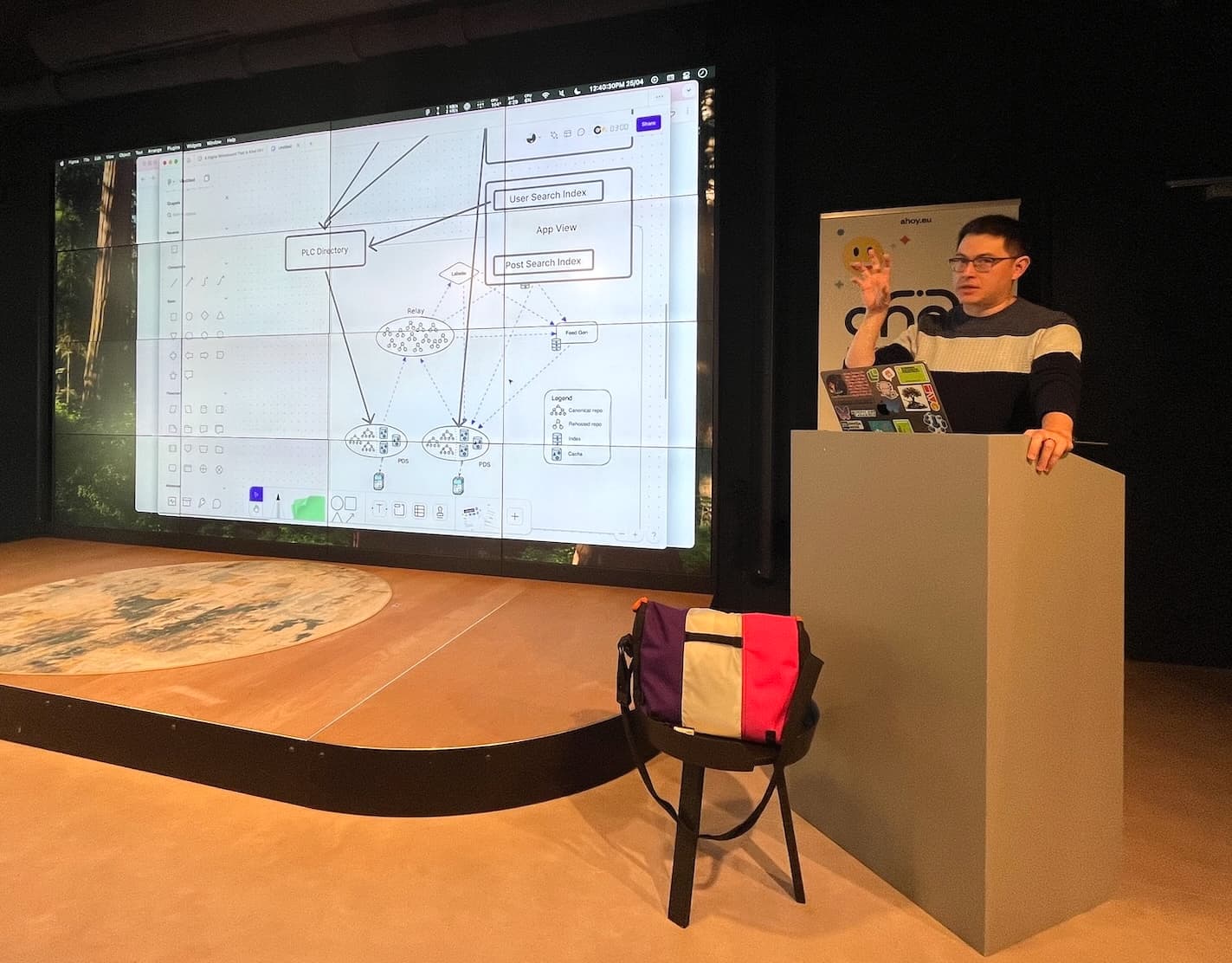 Notes from Ahoy IndieSky Europe
A summary of the IndieSky Ahoy event, running a EuroStack, and joining the IndieSky working group for independent ATProto infrastructure.
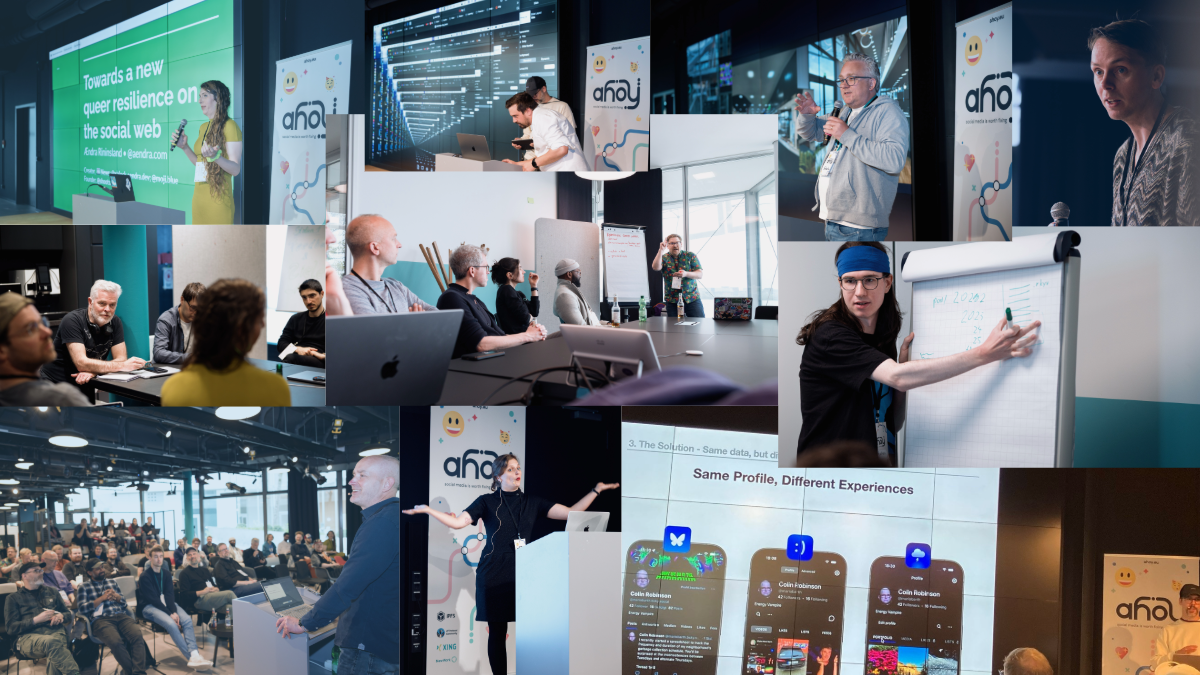
 AHOY! European Social Web Day 2025
AHOY! https://ahoy.eu page captured in Wayback Machine on the day of the conference, April 24th, 2025
 Discord Alternatives, Ranked
A review and ranking of Discord alternatives - Rocket Chat, Signal, Matrix, Discourse, Zulip, Mattermost, Stoat (formerly Revolt)
- David Buchanan (@retr0.id)
I think the ideal discord-alternative would have a self-hosted instance per community (so a "server" really is a server), but all speaking a shared protocol so you can have them all in the sidebar of a unified client. Then you just need unified identity across all servers... atproto solves this???
- A few design decisions for a new chat platform
As people look around for other chat platforms to use or build, this write up outlines certain features
1) Federation is a misfeature for hosted platforms
2) End to end encryption is another misfeature for public channels
3) Voice chats are a space, not an event  Horses
Talking again about how steady improvement of steam engines lead to a dramatic & fast replacement of horses once an equivalence threshold had passed, and how this is likely to happen in certain fields for AI.
 A Language For Agents
What programming languages would agents want to program in?
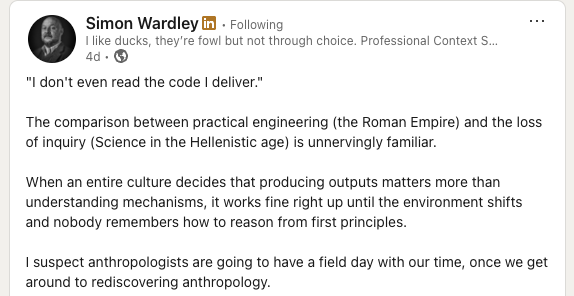 Nobody knows how the whole system works
https://bsky.app/profile/norootcause.surfingcomplexity.com/post/3mef7knxaac22
Yes there is good writing on LinkedIn - posts by Wardley, Adam Jacob’s, and Bruce Perens on AI
“ This is the fundamental nature of complex technologies: our knowledge of these systems will always be partial, at best. Yes, AI will make this situation worse. But it’s a situation that we’ve been in for a long time.”
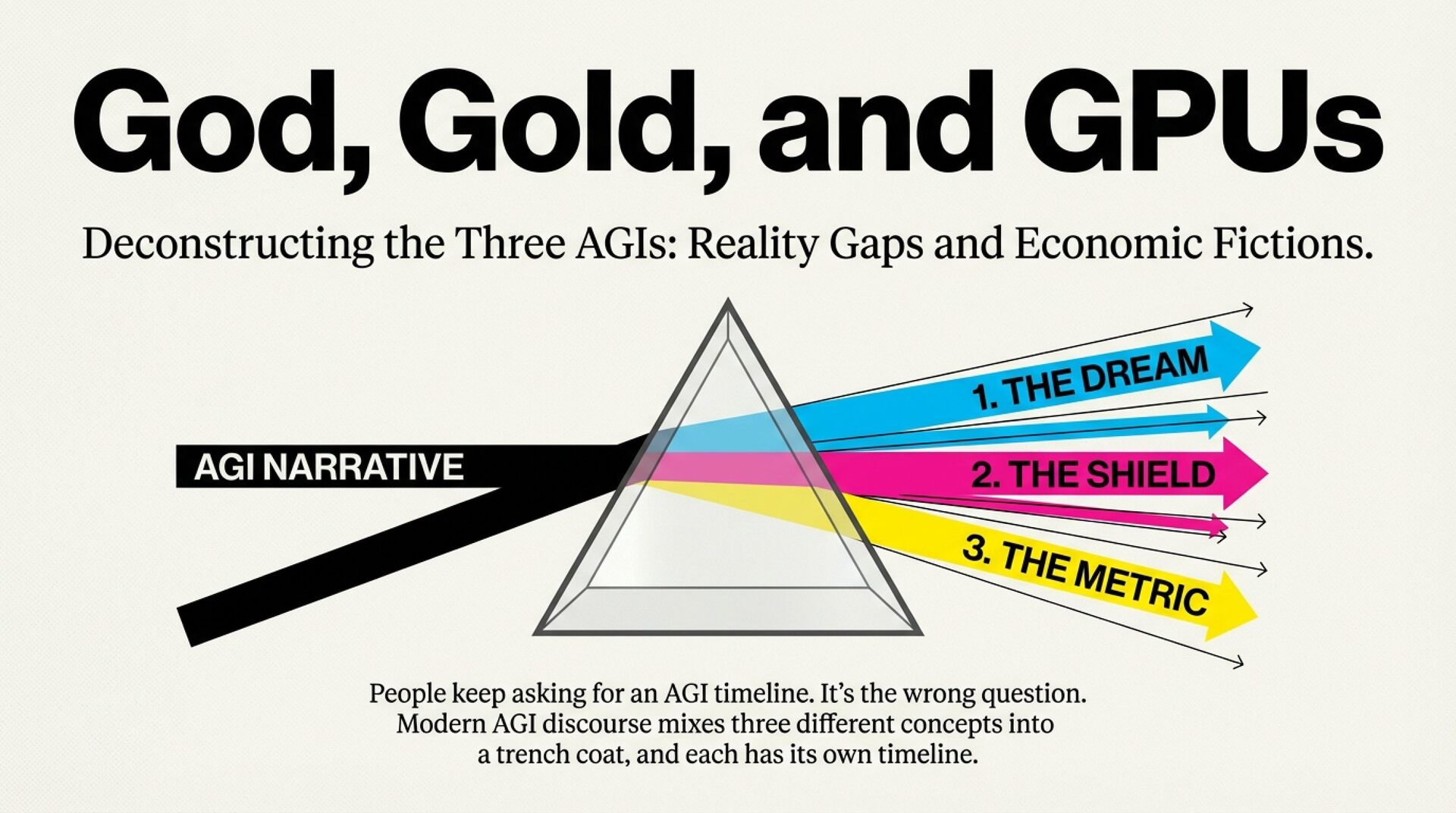 God_Gold_and_GPUs.pdf
via https://bsky.app/profile/escorciav.bsky.social/post/3meeo7vuv6s2n
Three timelines and narratives for AGI
- ATProtocol Record Hydration: Building Privacy-Aware Views
@ngerakines.me blog write up of records that have partially permissioned data fields
 How organisations are changing.
Prediction / Analysis by Simon Wardley about current and emerging practices of organizations - pointing towards more Networked Orgs
 The Anthropic Hive Mind
Yegge talks about the culture at Anthropic, and compares it with "Golden Ages" at Amazon and Google
"But I am starting to suspect they feel genuinely sorry for a lot of companies. Because we’re not taking this stuff seriously enough. 2026 is going to be a year that just about breaks a lot of companies, and many don’t see it coming. Anthropic is trying to warn everyone, and it’s like yelling about an offshore earthquake to villages that haven’t seen a tidal wave in a century."
 Introducing WEBCAT: Web-based Code Assurance and Transparency
Verifiable browser code
"WEBCAT allows for a transparent, independently verifiable signing, verification, and update process, and ensures that the enrollment process itself can’t be abused. The project uses Sigstore, Sigsum, and The Update Framework, among other components; details are below."
 Introducing git-wt: Worktrees Simplified
An improvement over native git worktree, git-wt
 Lexicon Embeds Overview
A thread in the forum talking about Lexicon Embeds
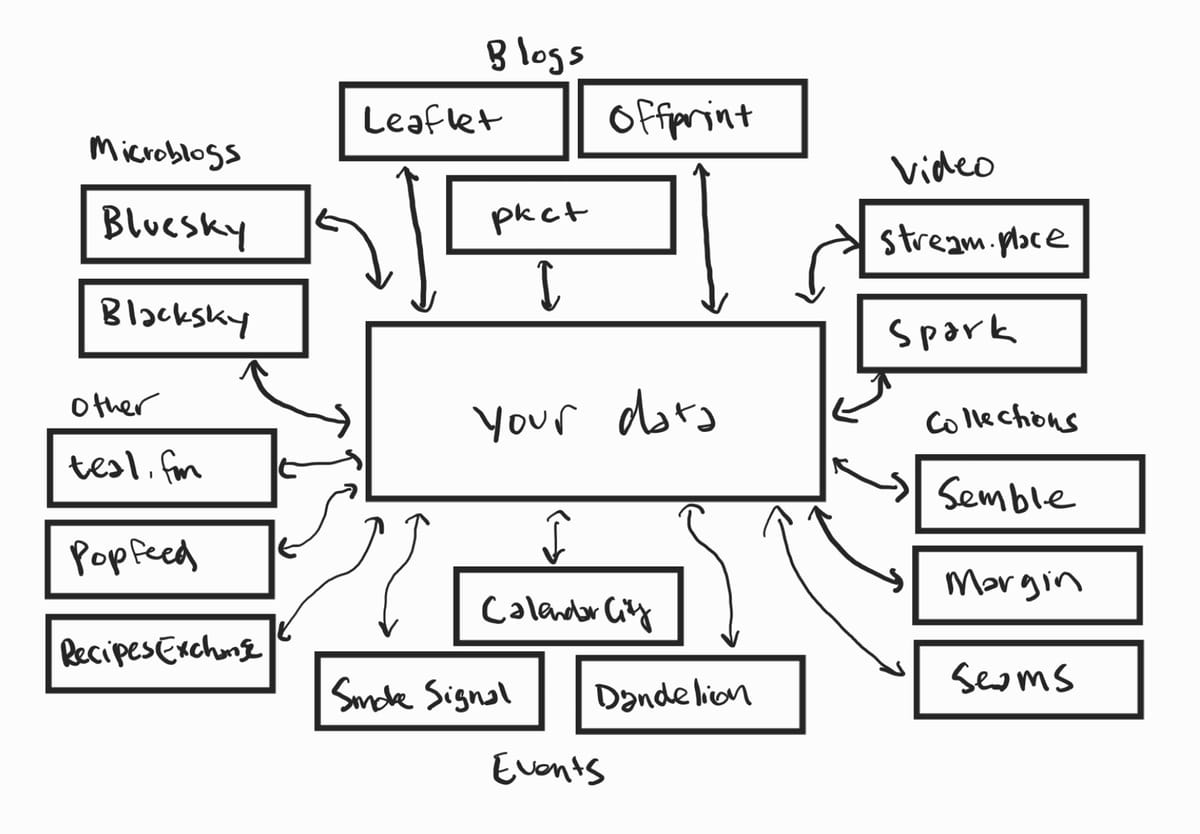 The Everything Account
I've been thinking a lot about our accounts lately. We all have an ever-growing pile of digital identities scattered across the web, many forgotten after a brief stint with a random service we found in an app store. It's like second nature at this point: we check out a new
- Introduce the Vouch/Denouncement Contribution Model by mitchellh · Pull Request #10559 · ghostty-org/ghostty
Ghostty is moving to a “vouch” (and “denounce”) system of approving contributors to their codebase.
via @calabro.io https://bsky.app/profile/calabro.io/post/3me2mhj6qxs2x
- The Last Social Account You'll Ever Need. - Interlinked
“ the promise is simple: you can sign into many apps with one account, and your identity is still you everywhere you go. This is why the Atmosphere isn’t an “everything app.” It’s an everything ecosystem”
by @joebasser.com  AI creates asymmetric pressure on Open Source
How Open Source communities can adapt to AI-generated contributions without overwhelming Open Source maintainers
 hypercontext — spatial context awareness
“ Hypercontext is a knowledge skill for Claude Code. Invoke /hypercontext and the agent introspects — threads, files, tools, remaining context — and renders a spatial ASCII map.”
- Priivacy-ai/spec-kitty
Spec driven development for multi agent - kanban interface, python
By Rob Douglass
 ATproto: The Enshittification Killswitch That Enables Resonant Computing
Disclosure: I’m on the board of Bluesky, which was inspired by my “Protocols, Not Platforms” paper. But this post isn’t about Bluesky the app. It’s about the underlyin…
 iPhanpy for Mastodon App - App Store
iOS app for Phanpy, a really great Mastodon client
 Pi: The Minimal Agent Within OpenClaw
A write up about Pi, a coding agent that OpenClaw is built on https://github.com/badlogic/pi-mono
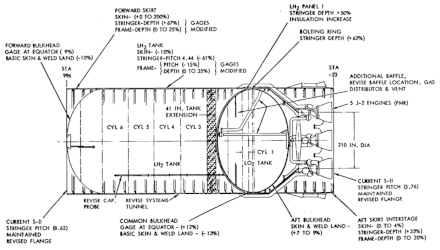 Hacking the Hackathon
At their best, internal hackathons provide a necessary patch to systemic problems. But their usual structure limits their potential.
 Conductor - Run a team of coding agents on your Mac
“ Run a team of coding agents on your Mac.
Create parallel Codex + Claude Code agents in isolated workspaces.”
via @ngerakines.me https://bsky.app/profile/ngerakines.me/post/3mdqaovzmxk2g
- The $2.43 Billion Question: Podcast Advertising in 2024
A summary of podcast advertising and platform shift. YouTube and Spotify is numbers are climbing (capture), and advertising is climbing to 10%+ of show time. Listeners leave with high ad times.
 Introduction to AT Protocol
An excellent overview of ATProto, focused on walking through the protocol from scratch
- marcobonomo.dev/obsidian-atproto-publisher
Social coding, but for real this time!
- Goodbye Sketch, Hello Shelley! - exe.dev blog
Shelley is a mobile-friendly, web-based, multi-conversation, multi-modal, multi-model, single-user coding agent built for but not exclusive to exe.dev. It does not come with authorization or sandboxing: bring your own. is the agent that runs inside exe.dev
GitHub https://github.com/boldsoftware/shelley
“ Shelley is a mobile-friendly, web-based, multi-conversation, multi-modal, multi-model, single-user coding agent built for but not exclusive to exe.dev.”
.jpg) Fauna Robotics | Capable, Safe, Fun Robots for Everyone
Fauna Robotics | Capable, Safe, Fun Robots for EveryoneNYC based robotics company
"We believe the future of robotics has to be useful and delightful: in homes, classrooms, and everyday human spaces
But that future won’t arrive until far more developers can build for robotics quickly, safely, and in the real world without needing to reinvent the fundamentals each time"
Sprout Creator Edition is first version https://faunarobotics.com/product
- How small can ATproto get, really? - Unfolding Diagrams
Walks through smaller ATProto instances, including costs of following globally, plus this network index explanation
“ they're not trying to make the equivalent of a separate Mastodon server. They're trying to make the equivalent of a separate deployment of every Mastodon instance at once. They're meant to be global, full-network views of all forty million ATproto accounts that are fully independent of Bluesky. There is no cheap way to do that without making significant sacrifices to UX”
 Mecha Comet - Open Modular Linux Handheld Computer
Kickstarter for Mecha Comet
 Introducing the all new Mecha Comet, live on Kickstarter
“The Mecha Comet is a re-imagined portable computer that gives you the flexibility in hardware and software both, for your usecase. It all started with us wanting to build a small computer that we could easily program, deploy and manage remotely.“
 Dock — Team chat that doesn't suck
Local first chat app, built on custom sync engine. $120/year for 10 members, $400/year for up to 20 members
"Dock is team chat built for startups and companies who want simplicity over feature bloat. We focus on what matters: fast messaging, async-first workflows, unlimited search, and decision tracking. No AI tax, no 90-day message limits, no enterprise upsells."
- letoram/arcan
via Bert
"Arcan is a powerful development framework for creating virtually anything from user interfaces for specialized embedded applications all the way to full-blown standalone desktop environments.
At its heart lies a robust and portable multimedia engine, with a well-tested and well-documented Lua scripting interface. The development emphasizes security, debuggability and performance -- guided by a principle of least surprise in terms of API design."
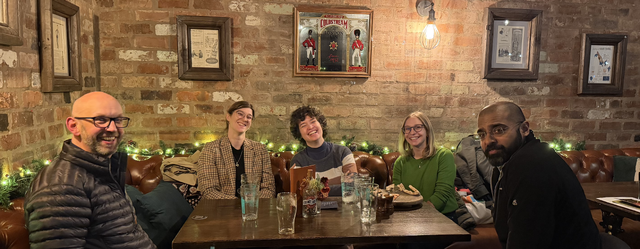 Four Ps for Building Massive Collective Knowledge Systems
" I posit there are "4 P's" needed for any collective knowledge system to be robust and accurate: permanence, provenance, permission and placement. If these properties exist throughout our knowledge graph, we can make robust networks for rapid evidence-based decision making. They also form a dam against the wave of agentic AI that is going to dominate the Internet next year in a big way."
Also connected to ARIA
- Osaurus — All your AI. One app.
Chat with GPT-5, Claude, Llama, and more — or download local MLX models from Hugging Face. Supercharge Cursor with powerful tools. Automate your browser, files, and git. Open source and built for Mac.
 Reflector: Elevate Communication with Our Real-Time Translation Tool
Recording / translation / transcription, open source tool by Monadical - Initially a simple NLP program for keyword detection, it has evolved into a robust speech-to-text (STT) translation tool with advanced capabilities.
 Railway raises $100M Series B to unburden the builders
Pretty simple announcement of raising $100M series B. "Intelligent" cloud provider, and agents mentioned.
- The lost art of XML — mmagueta
On JSON winning because of dev preferences, and how XML is good actually
via @anthonyfloyd.ca
 Clawdbot — Personal AI Assistant
“ Clears your inbox, sends emails, manages your calendar, checks you in for flights.
All from WhatsApp, Telegram, or any chat app you already use.” - by @steipete.me The Missing Middle of Open Source
Funding for open source that isn’t VC. Mentions for protocol first building, shout out to ATproto, and also points at protocol first commerce for the web.
- Brogue
brogue is a modified and updated classic roguelike
MacOS, Windows, and Linux releases on github https://github.com/tmewett/BrogueCE
Recommended via @hyl.st
 AGENTS.md
AGENTS.md is a simple, open format for guiding coding agents. Think of it as a README for agents.
 Agents are Systems Software
Agents are hard to build. And when they’re done well, they’re highly generic and extendable. They’re systems, like web browsers or database engines.
 Gas Town’s Agent Patterns, Design Bottlenecks, and Vibecoding at Scale
@maggieappleton.com writing about Yegge’s Gas Town AI agent coding system.
“ We should take Yegge’s creation seriously not because it’s a serious, working tool for today’s developers (it isn’t). But because it’s a good piece of speculative design fiction that asks provocative questions and reveals the shape of constraints we’ll face as agentic coding systems mature and grow.”
 AT Protocol Primer
We can choose to keep using walled garden platforms and sending our data to massive companies, or we can choose a smaller web that actually puts the power back in our hands. With enough people making the same decisions to support protocols like this, we can change the course of the web for good.
 The Death of Software Development
via Campbell M
 PersonalSit.es | Yes we got hot and fresh sites
“This site was built to share and revel in each others’ personal sites, and is currently home to ~812 of them. Witness these in wonderment and awe. Immaculate. Stunning. How did they do that? Yes, you should definitely get around to redesigning yours soon.”
Built by @bell.bz
- xdesro/personalsit.es
Git repo and instructions on how to add your own site to https://personalsit.es/
Would be good to figure out how to @standard.site these all
- Discourse Graphs
Working with Cosmik Network
“Discourse Graphs are an information model that enables everyone to map their ideas and arguments in a modular, composable graph format.
Discourse Graphs allow researchers to break the scientific research process into its atomic elements in a way that can be shared, remixed, and updated.”
 The year everything changed
“ The debate about LLMs will span a generation, but the debate about LLM utility was decisively settled by the latter half of of 2025. What remains is a sort of tedious eventual consistency problem as consensus diffuses through the medium of millions of technology professionals.”
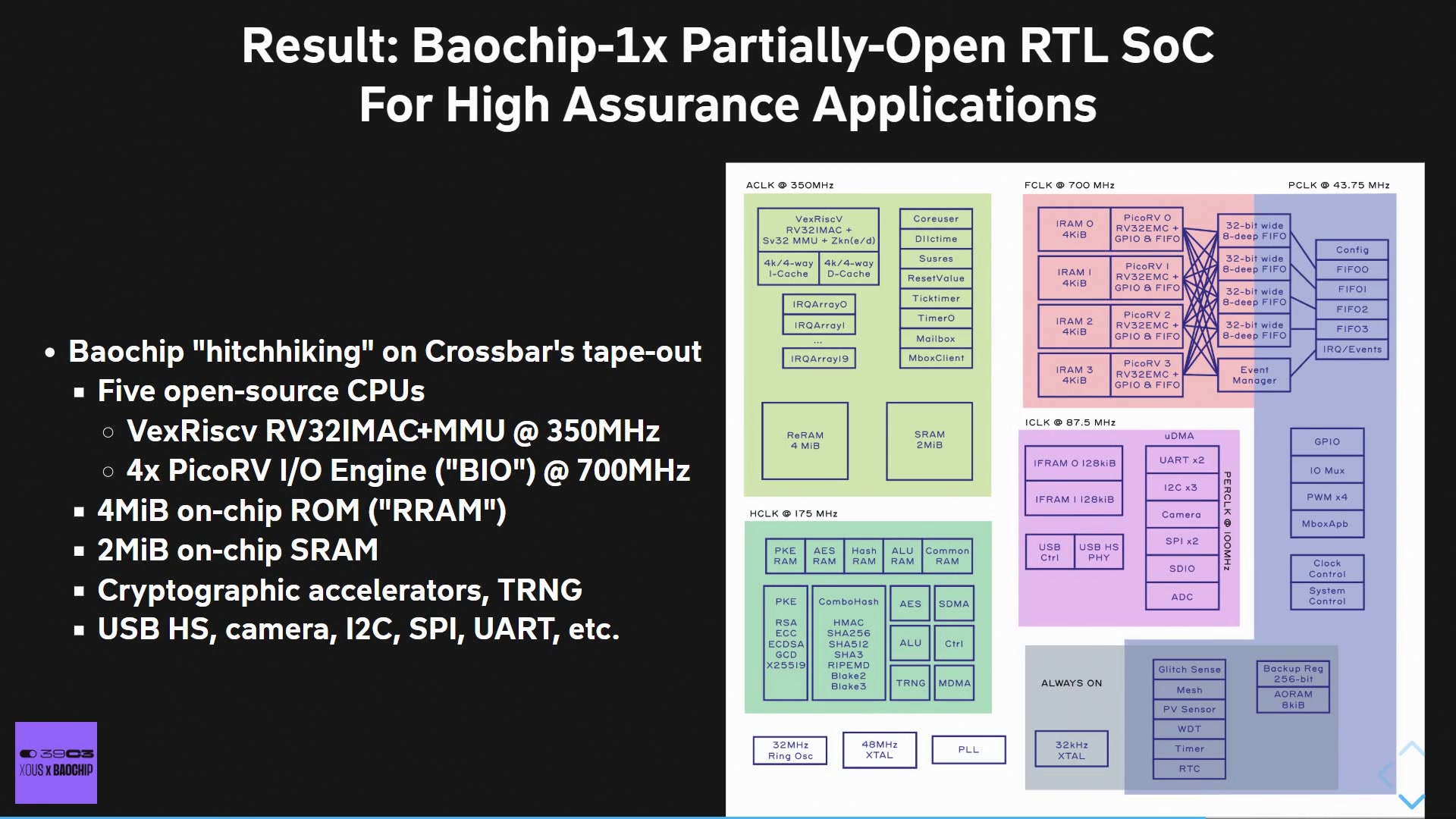 Xous: A Pure-Rust Rethink of the Embedded Operating System
Xous is a message-passing microkernel implemented in pure Rust, targeting secure embedded applications. This talk covers three novel aspe...
- tapped: a Rust crate for building ATProto appviews with tap
Rust wrapper for tap backfill / AppView builder
“ I've published the first version of tapped, a Rust library to help build ATProto appviews that need to consume the firehose and backfill existing data from PDSes”
 Xteink X4
Small e-book reader that can magnetically clip to the back of a phone
- A Taxonomy for Open Source Software
A taxonomy for open source software
6 facets, here’s an example for a web framework like Django might be classified as:
Domain: web-development, api-development
Role: framework, library
Technology: python, docker
Audience: developer, enterprise
Layer: backend, full-stack
Function: authentication, database-management, routingThe taxonomy also integrates with CodeMeta, a metadata standard for software that extends schema.org. CodeMeta has a keywords field, and you can use namespaced keywords
 X Is a Power Problem, Not a Platform Problem
"You cannot out-compete ‘where the ruling faction radicalizes and coordinates’ by having better moderation policies or algorithmic choice. X is not a platform problem anymore, it is a power problem, and building a different platform does not solve the power problem."
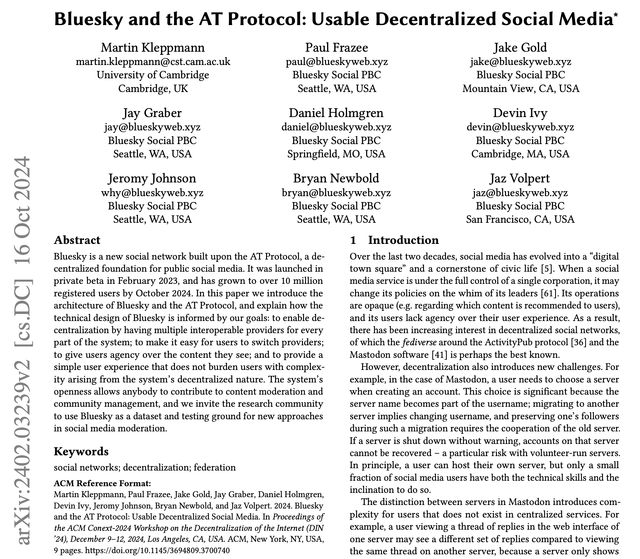 Using AT Proto for more than just Bluesky posts
Feb 2025 academic / OCaml etc related usage of ATproto
 Peter van Hardenberg - Ink and Switch, Automerge
@pvh.ca on the @devtools.fm podcast.
Peter introduces himself and his path to being director of Ink & Switch @inkandswitch.com, and dives into Local First, Automerge, and CRDTs
 Home | Enzyme
Currently brew install to analyze Markdown, with Obsidian specifically supported. Uses "US hosted AI providers"
Similar to Tiles https://semble.so/url?id=https://www.tiles.run/
"Enzyme works with markdown. Plain text files that outlast any tool. Your corpus is your career; it should survive any platform shift. Tools like Obsidian make it easy to capture, organize, and sync. Readwise exports your highlights. Your thinking stays yours—no database, no lock-in."
- Tiles
Being built by @feynon / User & Agents. Has Obsidian as a specifically supported thing. I funded several months of work on this.
 Gemini AI Visual Design - Google Design
Google Design on malleable software related topics
“ > How do you build trust in a tool that’s always evolving? Our AI assistant, Gemini, is constantly learning and adapting, which means traditional design methodologies (mostly linear, predictable, and rooted in control) have to be set aside.”
- Grebedoc
Community git pages clone
“ a service that publishes the pages branch in your Git repository as a website on your domain; think GitHub Pages if it was open source and community operated.
More specifically, it is a public deployment of git-pages and Caddy configured to work especially with Codeberg but also with other Git forges. It is operated by Catherine 'whitequark' and teammates.”
- PosChengband
I ended up installing this in Crossover.
"PosChengband attempts a merger Chengband with ideas from Posband and RePosBand. However, many of the features, races and classes of Chengband have been extensively modified and quite a few of the new Chengband classes have been redesigned from scratch. So it seemed like a completely new variant was in order."
- politybooks.com
Nick is the author https://bsky.app/profile/nsrnicek.bsky.social
Recommended by @orionreed.com
 AI is a business model stress test
Dries writes about the Tailwind issue and points out that "open source" is never the business model "Open Source was never the commercial product. It's the conduit to something else."
"Value is shifting to operations: deployment, testing, rollbacks, observability. "
I don't agree with operations (cloud hosting) being the only value vector.
- Loper OS » Why Hypercard Had to Die
via @orionreed.com
Jobs supposedly claimed that he intended his personal computer to be a "bicycle for the mind." But what he really sold us was a (fairly comfortable) train for the mind. A train which goes only where rails have been laid down, like any train, and can travel elsewhere only after rivers of sweat pour forth from armies of laborers. (Preferably in Cupertino.)
The Apple of Steve Jobs needed HyperCard-like products like the Monsanto Company needs a $100 home genetic-engineering set
- Don't fall into the anti-AI hype - <antirez>
“ I see this as a continuation of what I tried to do all my life: democratizing code, systems, knowledge. LLMs are going to help us to write better software, faster, and will allow small teams to have a chance to compete with bigger companies. The same thing open source software did in the 90s.”
 Home – Next Frontier AI
2026 funding for Frontier AI Labs
"A pan-European initiative led by SPRIND – the German Federal agency for breakthrough innovation. Think of it as a government-backed VC with the freedom to take real risks."
- gbl08ma.com/didplcbft
Tendermint / CometBFT implementation of the PLC Directory
 Making end-to-end encrypted AI chat feel like logging in
Moxie Marlinspike's Confer uses Passkeys as the basis for encryption.
"If we have a persistent, biometrically-protected, cross-device key, what if we could use it to do arbitrary cryptography rather than just authentication?
As it turns out, we can. The WebAuthn PRF extension https://github.com/w3c/webauthn/wiki/Explainer:-PRF-extension – while still relatively new – is now beginning to see fairly wide support"
- Private inference
Next post in Moxie Marlinspike's Confer
"we run inference inside a confidential VM. Your prompts are encrypted from your device directly into the TEE using Noise Pipes, processed there, and responses are encrypted back. The host never sees plaintext."
Also remote attestation, nix, reproduceability, transparency log
- Announcing astro-standard-site - bring your Astro blog to ATProto - Impulsive Static
An NPM package to connect your Astro blog to ATProto using the Standard.site lexicon, or the story in which Bryan finally creates a website.
- This blog is on ATProto
“ I didn't have to liaise with anyone or use any special software to participate in publishing new records. I just had to follow the schema and ship it off to my own PDS, and it's live.”
Implementing Standard.Site in a static blog.
 Slow Gods
Sci-fi recommended by @eaton.fyi https://bsky.app/profile/eaton.fyi/post/3mblblcy6us2v
- GitHub - ascorbic/cirrus: A single-user ATProto PDS that runs on a Cloudflare Worker
Single user PDS built on Cloudflare Workers
 Introducing Chatto
New open source chat app that is vaguely Slack / Discord / Teams shaped.
“Chatto is designed both to be a chat application, but also a chat platform. It comes with not one, but two APIs that can be used to extend its functionality:”
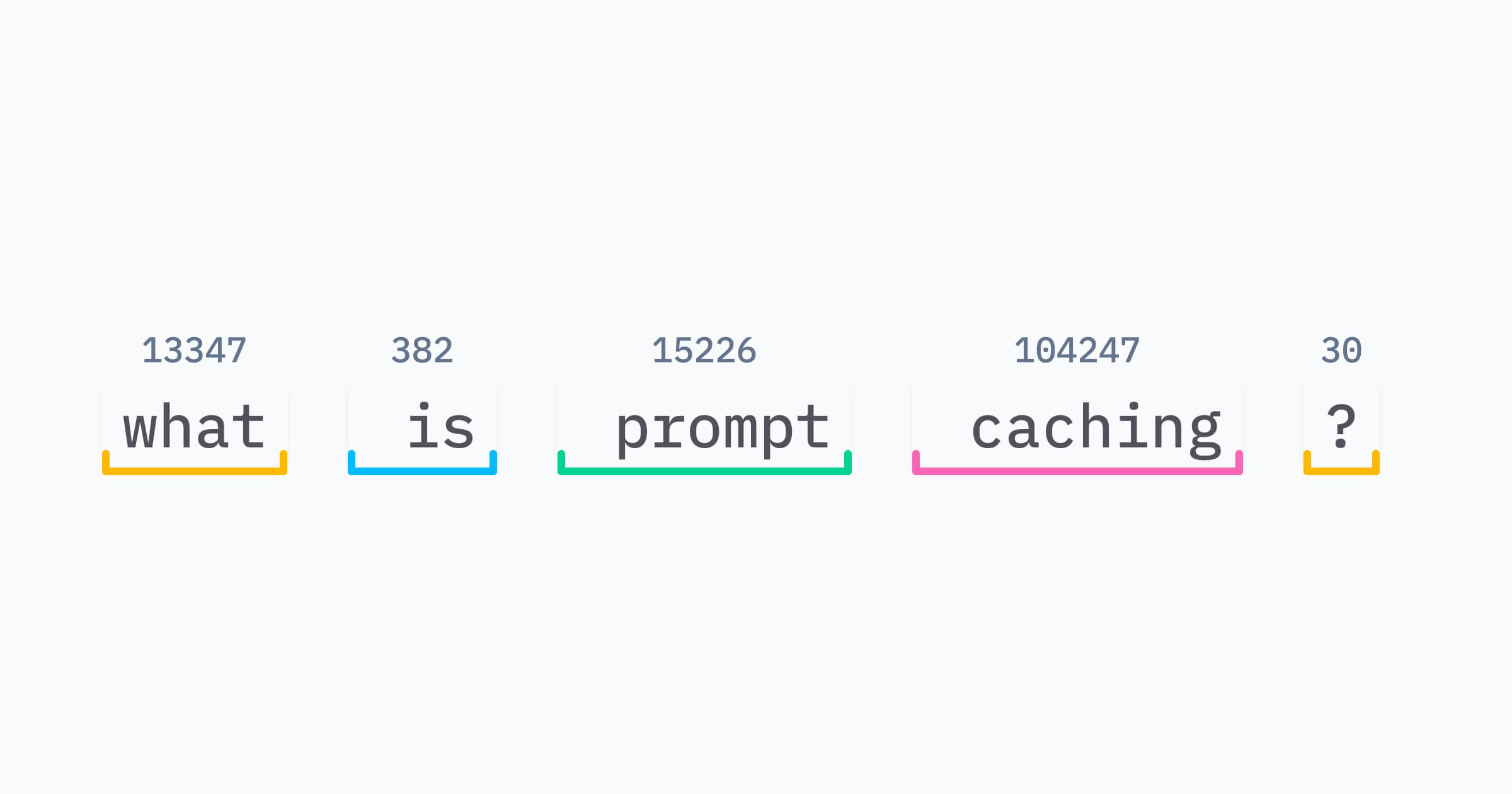 Prompt caching: 10x cheaper LLM tokens, but how? | ngrok blog
Write up on prompt caching that explains how LLMs work, specifically tokenizing and embedding and then handing that to the transformer.
- The WELL: Bruce Sterling and Jon Lebkowsky: State of the World 2025
Bruce Sterling @bruces.bsky.social “State of the World” 2025. There should be a 2026 version soon. These run for 2 weeks.
 VoiceInk - Advanced AI Voice Recognition for Mac
MacOS / iOS app for local first AI transcription
via @rekmarks.com https://bsky.app/profile/rekmarks.com/post/3mbasxnawbc2g
 McLuhan as Liberator of the Technologically Determined
"Yet, also, my job as a writer is to explain, not to condescend. So, in order to put a guy like McLuhan in a box with a useful description, I need the biggest box the popular science world has. Only cybernetics and systems theory—the most general sciences yet contrived, the very sciences of generality itself—are big enough to hold him while still answering the question to any satisfaction. And McLuhan was himself an applied cyberneticist…"
- What is Messaging Layer Security (MLS)?
Messaging Layer Security (MLS) is an IETF working group building a modern, efficient, secure group messaging protocol.
 Making MLS more decentralized
“ propose DMLS: a specification and implementation – based on work by Alwen et al. – to solve issues with forward secrecy”
 Confessions to a data lake
“The core idea is that your conversations with an AI assistant should be as private as your conversations with a person. Not because you’re doing something wrong, but because privacy is what lets you think freely.”
Moxie Marlinspike, Confessions to a data lake, announcing his new company Confer
- About the book | A guide to a-Shell
Guide for a-shell, an iOS terminal emulator
- exe.dev
Seen via https://commaok.xyz/ai/just-in-time-software/
exe.dev is a subscription service that gives you virtual machines, with persistent disks, quickly and without fuss. These machines are immediately accessible over HTTPS, with sensible and secure defaults. You can share your web server as easily as you can share a Google Doc. With built-in optional authentication, so you can focus on your thing.
Your VMs share CPU/RAM. Create as many VMs as you like with the resources you have.
- Just in time software
Lots of great quotes in here. Uses exe.dev to do apps on the fly by dictating from your phone to an LLM.
Not enough examples of building apps from your phone - this is real for larger user market.Is just in time software the same Malleable Software?
 Rezept: Truthahn mit Bergeller Marroni-Füllung, Fabrizio Zanetti | GaultMillau
Turkey recipe with a chestnut sausage stuffing.
- Two Types of Interoperability Without Sharing Lexicons - Wesley's notes
@wesleyfinck.org writes up two approaches to interop on ATProto apps without using the same Lexicon - one is converting similar shaped records, the other is showing activity from these other records. Includes mockups in Semble.
- quicksliced my status - n8
look ma, no backend
 quickslice - Introduction
Documentation for Quickslice
Quickslice is a quick way to spin up an AppView for AT Protocol applications. Import your Lexicon schemas and you get a GraphQL API with OAuth authentication, real-time sync from the network, and joins across record types without setting up a database or writing any backend code.
 Reconsider
Author relicensed to Fair Source, urges DHH to do the same.
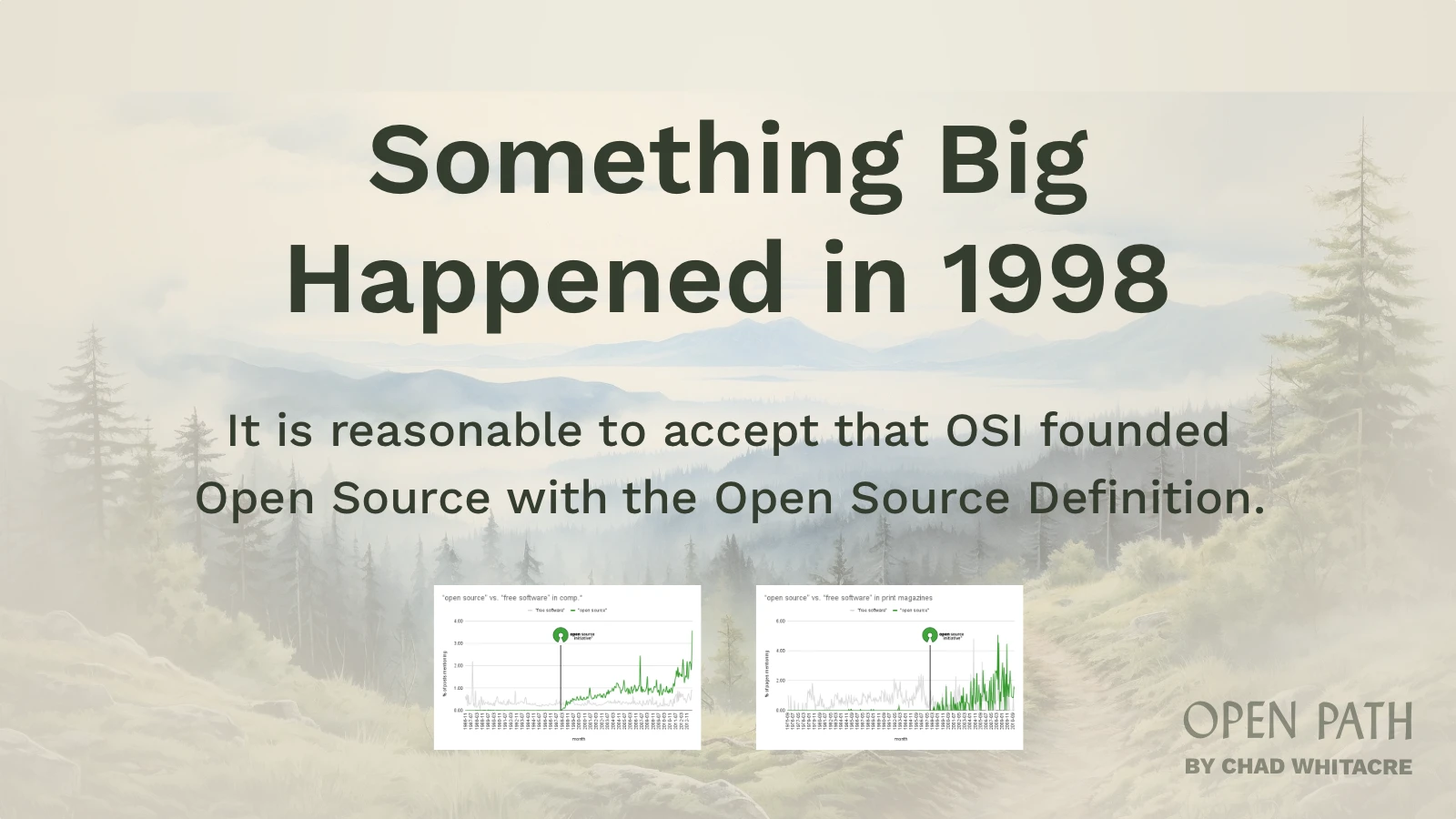 Something Big Happened in 1998
Chad Whitacre digs into the backround on the spread of the term “open source” — founding of the OSI does appear to wide spread usage.
- The Phoenix Architecture
Blog by @chadfowler.com - The Phoenix Architecture
Generative AI coding demands what we've always known: modularity, clear boundaries, disposable components. Principles that scaled human teams are now table stakes. Here, we make the implicit explicit
- Regenerative Software - The Phoenix Architecture
@chadfowler.com first post on his new blog, on Regenerative Software. I'm going to say that this maps to what I've been calling malleable software.
 The Complete Calm Tech Certified™ Product List for 2025
A list of 2025 Calm Tech certified products
Alarm Clocks
Digital Signage
Picture Frames
Mindfulness and Meditation
Notebook/Productivity
Mobile Phone
Home Audio Home | Calm Tech Institute - Harmonious Design Principles
Founded by Amber Case @case.bsky.social
Launched in May 2024, Calm Tech Institute is dedicated to redefining technologies that enhance human life without causing stress or distraction.
Denver, Colorado + Learning Lab in Kyoto, Japan
- ABOUT | Calm Tech Institute
Principles of Calm Technology
1. Require the smallest possible amount of attention
2. Inform and create calm
3. Make use of the periphery
4. Amplify the best of technology and the best of humanity
5. Communicate, but not always with voice
6. Work even when it fails
7. Use the minimum tech needed to solve the problem
8. Respect social norms
 The Bet On Juniors Just Got Better
Kent Beck @kentbeck.com writes about how LLMs paired with hiring junior software devs may be a better bet.
 What They Don't Tell You About Maintaining an Open Source Project
Write up by a maintainer of Kaneo, a self hosted kanban board, about the process of maintaining OSS.
Automation, docs, and community engagement
“the community is the product - the code matters, but the people matter more. invest in both.”
 Frost Children (DJ Set) - Elevator Music
ELEVATOR MUSIC Linktree - https://linktr.ee/elevatormusiclive Consider supporting us on Patreon at https://patreon.com/ElevatorMusicLive?utm_medium=clipboard_copy&utm_source=copyLink&utm_campaign=creatorshare_creator&utm_content=join_link Your ongoing support is the fuel that keeps our elevator and community going up! Elevator Music stands as an independent venture, powered solely by our passion and the support of our community. We're a collective of young artists dedicated to growing a platform whose doors are open to all. With your support, we can continue to lift up our community and artists alike. Thank you! Going Up! 🛗 Frost Children Instagram - @thefrostchildren
 No Jobs for Horses
A look back at “horse jobs” and how they got replaced by engines. An analogy to human labour and AI / automation / robotics
 Malleable software: Restoring user agency in a world of locked-down apps
The 2025 Malleable Software essay by Ink & Switch
 “You should never build a CMS” | Sanity
Response to Lee Robinson moving Cursor.com off of SanityIO
“When your coding agent can grep your codebase but can't query your CMS, that's a real problem. Lee felt this friction and responded to it. (We did too, and the new very capable MCP server is out).”
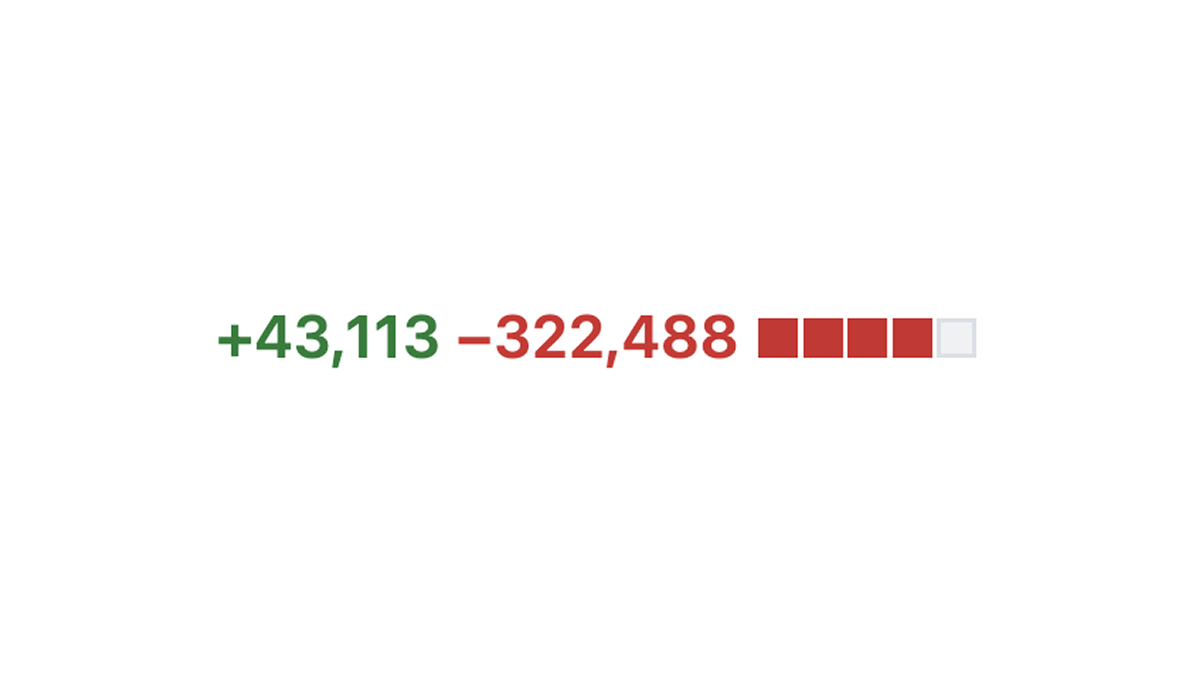 Coding Agents & Complexity Budgets
Write up of migrating cursor.com website off the Sanity headless CMS to everything being agent driven.
Response from SanityIO https://www.sanity.io/blog/you-should-never-build-a-cms
via @monkchips.com https://bsky.app/profile/monkchips.com/post/3m7zurfibjk23
 Register for a eurosky.social account - one web identity, dozens of apps — eurosky
eurosky.social accounts will launch in January 2026. Their format will be [username].eurosky.social. We will send registration emails in batches in January; the earlier you register, the earlier access you will have.
 Are we stuck with the same Desktop UX forever? | Ubuntu Summit 25.10
Presentation by @jenson.org on desktop UX to Ubuntu and “what is UX” especially in terms open source.

 Andrew Yeung on Twitter / X
“Head of IRL” where the hottest new thing is events and conferences ;)
sent to me by Ryan @depatchedmode.bsky.social who said “this is you!”
- Ok, when I did my weak signal analysis back in 2014 to identify points of industrialisation (points of war in the peace, war and wonder cycle), I had intelligent agents really kicking off (i.e… | Simon Wardley | 14 comments
Ok, when I did my weak signal analysis back in 2014 to identify points of industrialisation (points of war in the peace, war and wonder cycle), I had intelligent agents really kicking off (i.e. industrialising) circa 2030 to 2035 (we're close but not there yet) and the biological manufacturing elements along with the start of SpimeScript (the really big change that's going to make AI look like chicken feed) circa 2035. This is worth keeping an eye on - https://lnkd.in/eXce8JVj At some point I should run that weak signal analysis again but then again it takes about half a year of effort. Maybe when I'm retired. | 14 comments on LinkedIn
 Pickling Compute
On compute as a commodity “people might be open to a new bespoke pickle vendor. So we're pickling some compute and selling that.”
And
“Our mission is to spread the joy of programming, both in people's personal lives and at work.”
- Pluralistic: The Reverse-Centaur’s Guide to Criticizing AI (05 Dec 2025)
Last night, I gave a speech for the University of Washington's "Neuroscience, AI and Society" lecture series, through the university's Computational Neuroscience Center. It was called "The Reverse Centaur’s Guide to Criticizing AI," and it's based on the manuscript for my next book, "The Reverse Centaur’s Guide to Life After AI," which will be out from Farrar, Straus and Giroux next June:
 Telepath
Next gen OS / AI / interfaces
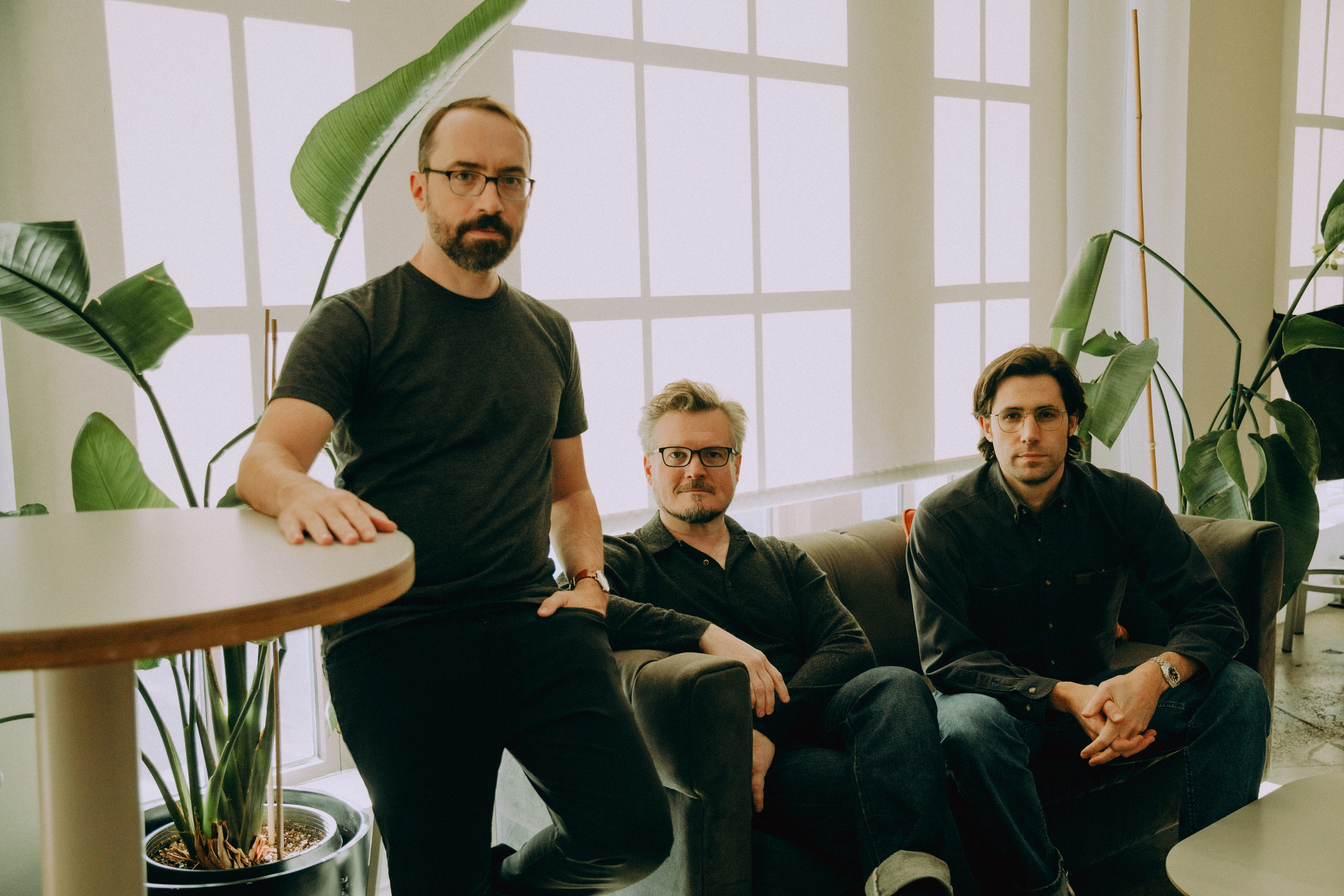 Telepath: building a new kind of computer
Betaworks pitch video for Telepath and public launch blog post “ building a new kind of computer”
- 576 - Using LLMs at Oxide / RFD / Oxide
Publicly available docs from Oxide on how LLM usage is expected in different contexts at the company.
 Vermietung - Heimathafen Neukölln
Recommended venue in Berlin via @jackrusher.com
- common.tools
Tagline: A new fabric for computing
Founded by @komorama.bsky.social and Bernard Seefeld - Dialogical Design - shimmeringvoid
Lots of great quotable quotes in this write up by Ben @bf.wtf (worked w/ Gordon Brander) on LLMs and control and modeling of info for the user.
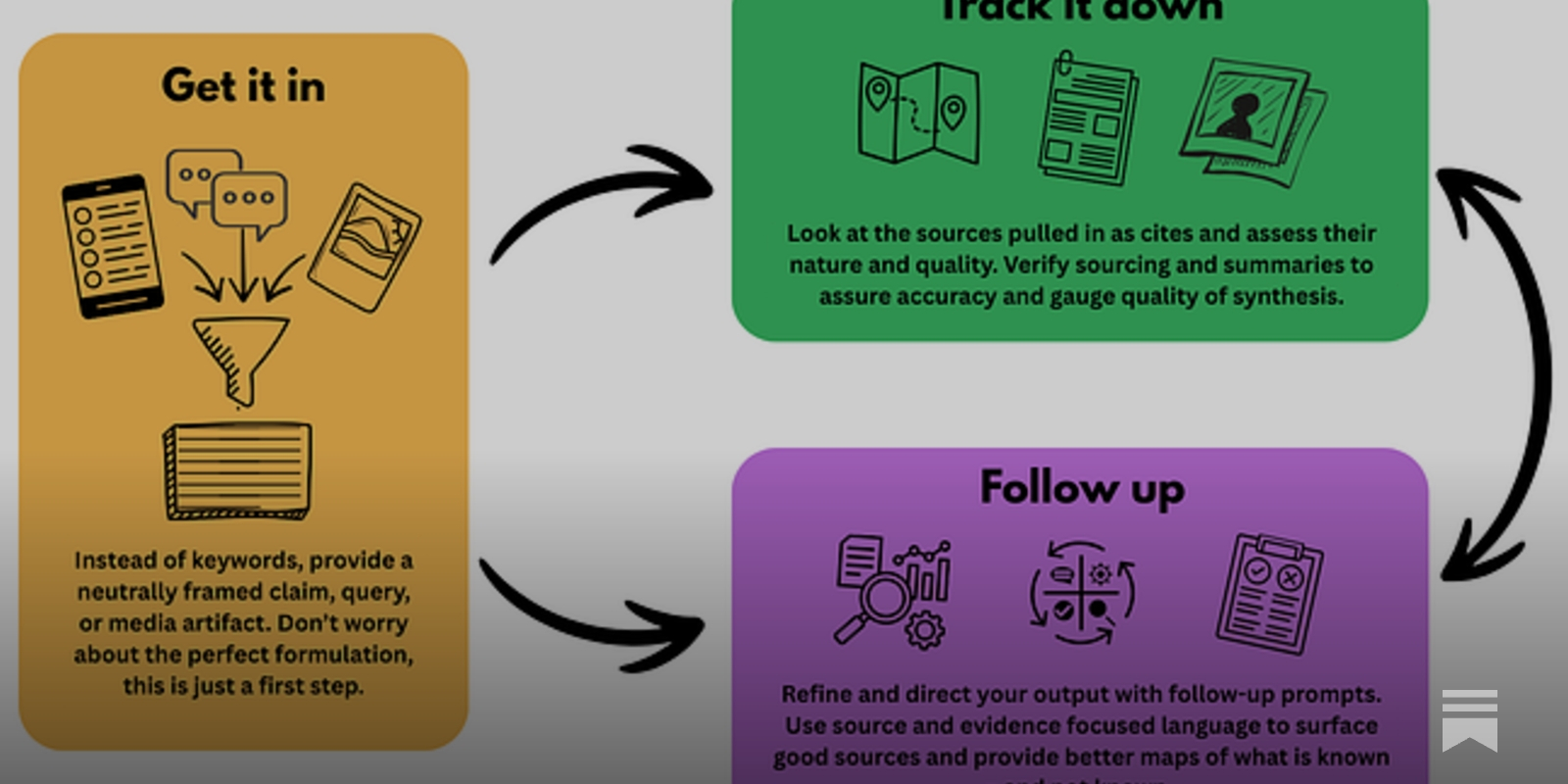 We're not taking the fact-checking powers of AI seriously enough. It's past time to start.
“ But I remain convinced that there is no future of verification and contextualization that doesn’t involve both better understanding of LLMs and more efficacious use of them. The three simple suggestions here — don’t prematurely dismiss errors as hallucinations, do use LLMs to surface the “unknown unknowns”, and do pay for the better models — are all pleas to engage more fully with this tech, and develop better (and more up-to-date) understandings of what they do well and what they do poorly…
- Modal Collective
Collective building next gen mobile OS stack. Tracking at Modal OS collection
Berlin centric
See intro blog post for more https://semble.so/url?id=https://modal.cx/blog/what-is-modal/
 Caligra is a new computer company.
Workbench is not a distribution—it’s an ideal host for containers and packages from open source and commercial repositories. Users with root can add packages from the Fedora project. Tools like distrobox make it easy to use software from any other distribution. And if you’re switching from Cupertino, just brew install as usual.
- Caligra is a new computer company.
Linux hardware designed to go with Caligra Linux distro Workbench https://caligra.com/workbench/
 Best Indian Street Food Restaurant | Apna Chaat
Surrey based Indian street food
Recommended by @hyl.st
- AWS Marketplace: Railway
Railway for sale on AWS
- What is Modal - Modal Collective
Intro post to the goals of Modal OS - to point out that various open source services and software
Specifically points to local first sync as one of the underlying needs.
via Jack Rusher
 The Resonant Computing Manifesto
A manifesto f
I see this as mostly malleable software, with some additional idealism / ideology.
- Your intellectual fly is open | The Observation Deck
Cantrill points out that letting AI (LLMs) write for you on LinkedIn looks bad on you.
- Railpack
Railway’s evolution of Buildpacks to Nixpacks and now Railpack. Creates container images for you based on your codebase.
“Zero-config application builder that automatically analyzes your code and turns it into an image”
- Self-hosting a Matrix server for 5 years
Various complaints / bugs on the current state of Matrix servers and clients. TLDR it’s not great.
- Open Social — overreacted
Dan Abramov Sept 2025 description of ATProto
- Introduction - Steve's Jujutsu Tutorial
Hi there, I'm Steve. This is a tutorial for Jujutsu—a version control system.
- From Zero to GitHub: Starting A New jj (Jujutsu) Repo
I document the steps and missteps that I take setting up a new jujutsu repo and pushing it to GitHub
- You Should Probably Leave Substack
Articles compiled about why you should leave Substack
 Canada’s Age-Verification Bill Repeats the UK’s Mistakes: Here’s How to Do Better
Canada is exploring age-verification requirements under Bill S-209, but adopting such systems without strong safeguards could repeat mistakes seen overseas. The UK’s failed experiment offers a warning; Canada still has time to choose a better path.
 Taking Jaggedness Seriously
Jaggedness is the uneven success rate of AI models being able to complete tasks on the frontier that appear similarly hard to humans.
 Anatomy of a Franco-German tech misfire
"The Germans came on board with the idea to create data sovereignty, by shielding the data of their citizens and industries from foreign snooping and legal control, he said, adding: “Atlanticist as they may be, they were totally fine with the idea of depending on Microsoft.”"
- vitalik.eth on Twitter / X
“ Encrypted messaging, like
@signalapp
, is critical for preserving our digital privacy. Two important next steps for the space are (i) permissionless account creation and (ii) metadata privacy.”Vitalik donated 128 ETH to Session and Simplex Chat.
- Ambitious Canada Part 8: Mega Projects
Do you believe that Canada is facing an existential crisis? The answer to this question determines the kind of actions we, as a nation, take going forward. History has examples of nations that faced existential threats and responded by aligning their government and private sectors to achieve the imp
 Politics meets protocols in Berlin
What happens when you put politicians, media businesses and protocol engineers in the same room to discuss European sovereignty?
 Black Fox Farm & Distillery wins IWSC 2025 Worldwide Whiskey Producer Trophy
“ Founded by John Cote and Barb Stefanyshyn-Cote, Black Fox is the antithesis of Canada’s historic whiskey giants. As fifth-generation farmers, they grow 95% of their own grains, control every step “from crop to connoisseur,” and age their whiskey outdoors in the wild prairie climate - making weather a deliberate ingredient in maturation. This raw, elemental approach produces whiskeys unlike any other. ”
 Stonking News
“ Stonking News monitors the Bluesky firehose in real-time, tracking all link posts, including World News, Regional News, and Gift Articles.
We score each link post using a proprietary weighted algorithm that ensures the most popular, and freshly trending content is always picked up.
Our companion app https://search.stonking.com enables searching of all links that we've scored.”
From about page https://news.stonking.com/about
 Pearltrees
A Web2 era bookmarking service that I used at one time. They've added AI and seem to be still around.
I swear they had a visual "pearl" in hierarchical trees interface at one point, but can't find it in current project.
 The Future is Ours to Build - Together
Announcement of new leadership team at Mastodon, new Belgian based non profit, and large funding announcements.
- A Note from Bee (Lore Drop) - Babesky Blog
A write up of the history of sex workers / NSFW content on Bluesky by bee
 Sill
SillSill is an app that aggregates links shown in your social media accounts. You connect your Mastodon and/or Bluesky apps and it scans and aggregates all links.
Has support for community bookmarks lexicon to save to your PDS. HackMD & Obsidian: The ultimate markdown workflow - HackMD
This is a HackMD article trying to make the case for using it alongside of Obsidian.
They talk about using Dropbox or GDrive or “custom scripts” to keep the two in sync.
HackMD supporting wiki links and making a plugin for Obsidian is what really taking advantage of the two would look like.
 Internet erupts as MAGA influencers exposed for being based in other countries
Twitter turned on a new feature of where accounts are based. This story covers that many right wing, US popular accounts are actually based around in the world - Eastern Europe, Japan, Turkey etc
 Defining groupcore
I call this Groupcore concept NetworkedOrgs
It also continues to bug me that Yancy uses Dark Forest for what I label Cozy Web (closed groups)
 We need to start talking about how we're gonna get off Instagram and Meta!! Ft. Maddy Kelly
New York “subway takes” with a woman who is a stand up comedian who talks about getting off FB and IG, but there is nowhere to move to
via Ivan Sigal
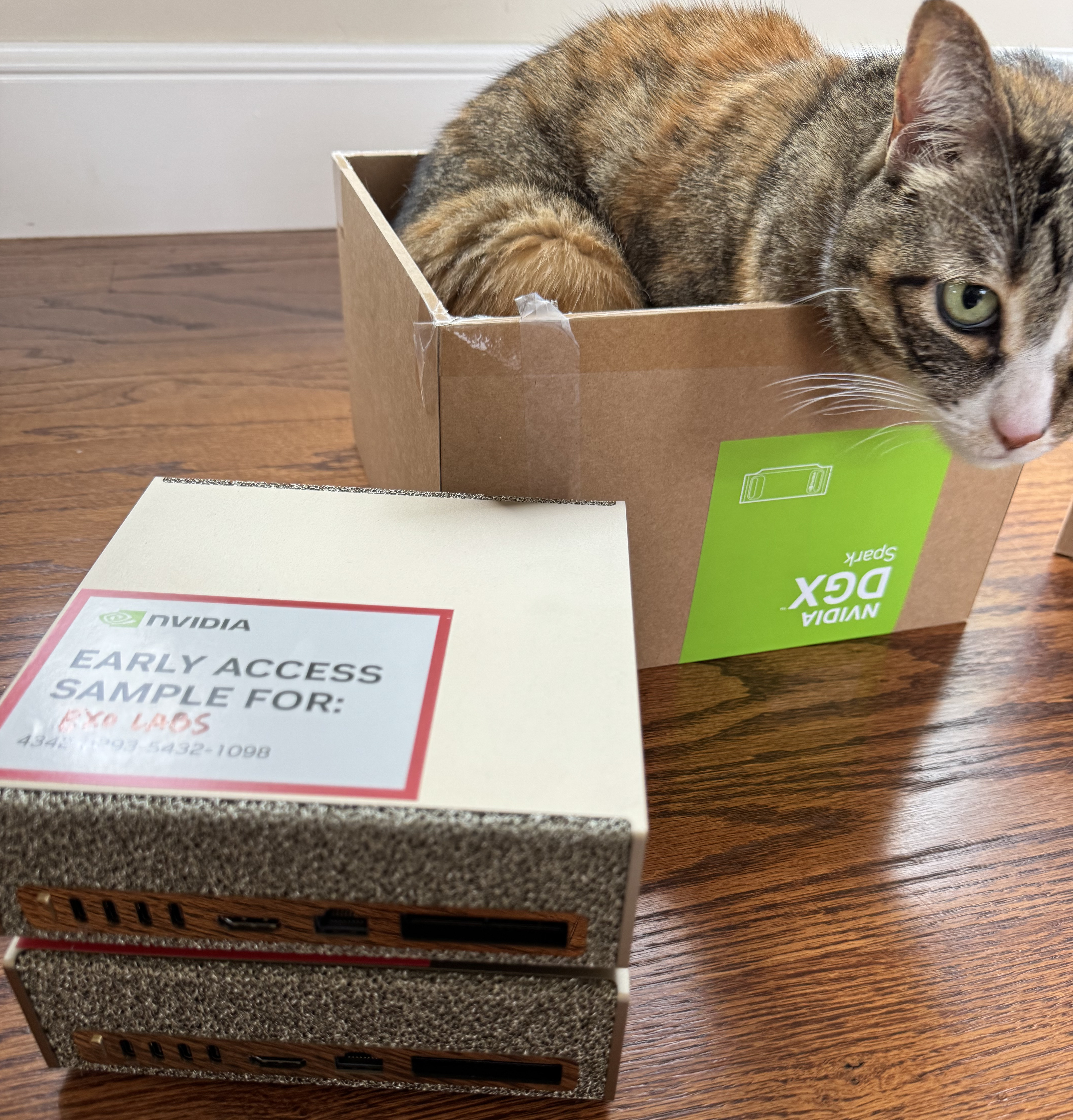 Combining NVIDIA DGX Spark + Apple Mac Studio for 4x Faster LLM Inference with EXO 1.0
EXO works with Mac Studio’s maxed memory plus the DGX Spark for raw compute to get local clustered AI
 Vancouver DIY Events
Anti-corporate music scene calendar from Vancouver.
 Local-first software: You own your data, in spite of the cloud
April 2019 original Local First essay by Ink and Switch
1. No spinners: your work at your fingertips
2. Your work is not trapped on one device
3. The network is optional
4. Seamless collaboration with your colleagues
5. The Long Now
6. Security and privacy by default
7. You retain ultimate ownership and control Episode 56 - A New Social - Anuj & Ryan - Livestream 2025-11-14
Video interview with Anuj and Ryan from A New Social
 Squeeky Board with Paul and Jim
Video of CTO of Bluesky does an ATProto protocol overview with dev rel Jim Ray on a whiteboard
 Building resilient social media
Matthew Lowry talks about defining digital sovereignty in context of next week’s EuroSky Live that I’ll be talking at.
“ huge diversity with protocol-guaranteed interoperability”
- Local-first software: pragmatism vs idealism
Adam Wiggins talk on idealism vs pragmatism
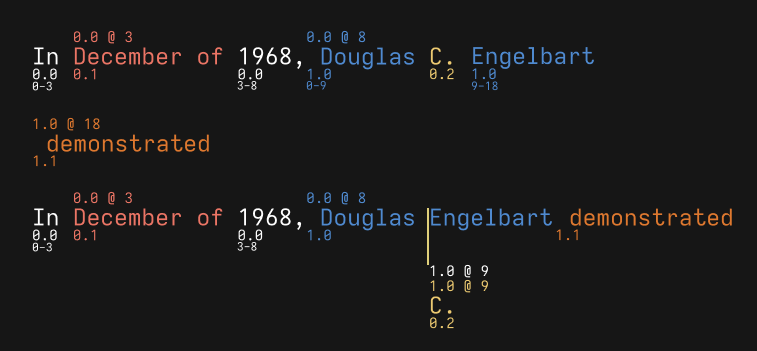 How CRDTs make multiplayer text editing part of Zed's DNA
CRDT in the context of the Zed editor. Mentions Engelbart and the mother of all demos.
 Sequoia Backs Zed's Vision for Collaborative Coding
August 2025 announcement of Sequoia leading Zed’s next round and also announcing DeltaDB, CRDT powered versioning
- Head in the Zed Cloud
Zed IDE is moving their cloud infrastructure to Cloudflare Workers and Wasm. This talks about how they are writing internal code to abstract and test over external platforms like CF
- I Built the Same App 10 Times: Evaluating Frameworks for Mobile Performance | Loren Stewart
A review of current and next gen frameworks for mobile web - focused on bundle sizes.
- memorycorner8.com
Taiwanese restaurant - beef noodle soup with noodles
Seen on Locals Welcome
- Dim sum | British Columbia | Golden Paramount Seafood Restaurant
Hong Kong Cantonese style dim sum
Seen via Locals Welcome
 The Fish Man Restaurant
Chinese seafood restaurant - will also cook seafood you bring in
Seen on Locals Welcome show
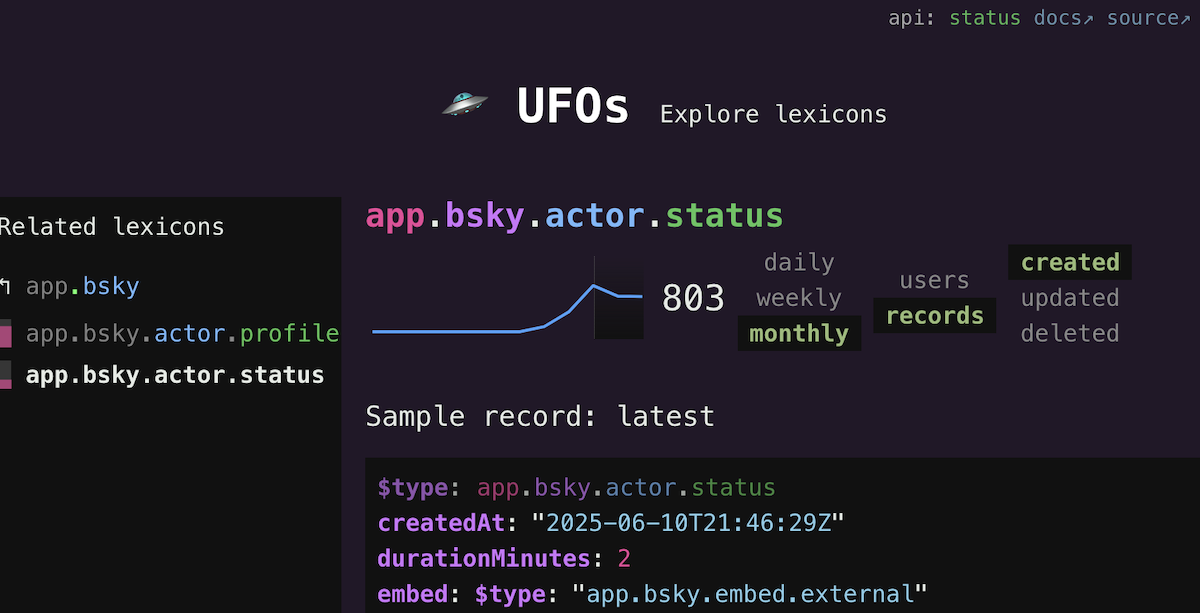 🛸 UFOs: Explore atproto lexicons
Part of Microcosm, UFOs is Fig’s tracker of lexicons, collections, and records
 Kerala Curry House – Restaurant
Seen on Locals Welcome
 Delicious (website)
del.icio.us was the original social bookmarking site. Technically that URL is still live, but this is a more useful description about the history
- Rendez-vous-bistro & mixology | Montreal, QC, Canada
Amazing Indian lunch in Montreal with Wesley and Ronen. The chaat was especially great!
 Au Pied de Cochon Restaurant
Restaurant I went to with Nick and Wesley on our first night in Montreal.
- IFTTA - If This Then AT:// | Workflow Automation for ATProto
Workflow automation that is "ATProto native", but also has hooks into Zapier so can tie into a huge world of things.
Got initial hacked together at the ATProto_NYC event by Nick Gerakines and Devin Gaffney (Graze).
 Gander: The Social Media You Want, Built in Canada
ATProto powered social app built and hosted in Canada
- What does a PDS implementation entail? · bluesky-social atproto · Discussion #2350
The canonical Github thread talking about what a PDS implementation needs
ATProto Wiki version: https://atproto.wiki/en/wiki/reference/community/implementations/pds-implementations/requirements
List of implementations: https://atproto.wiki/en/wiki/pds/pds-implementations

 Radiant Computer
“ Radiant proposes an alternative vision for computing. It doesn't ship with a web browser; it has its own network reminiscent of the early Internet: no social media, no scripts, no trackers. It's a from-scratch system that doesn't retrace the footsteps of the contemporary OS.”
New open hardware RISC-V and open OS.
built by @cloudhead.io, follow @radiant.computer
- Leaflet, Blogging, and How to Fix Social Media - Aaron Ross Powell's Blog
Decentralization, network overlap, and why we should all blog, too.
- Shortcuts
Apple iOS shortcut for opening Semble
 ATProto PDS Network Map
An ATProto PDS network map - based on IP address, looks up location of a PDS and attempts to place it on a map.
- GitHub - zed-industries/create-gpui-app: CRA-style tool for creating new gpui apps
CRA-style tool for creating new gpui apps
- gpui
Zed's Rust UI framework that they use to build Zed, but also available as open source for others to build on
"GPUI is a hybrid immediate and retained mode, GPU accelerated, UI framework for Rust, designed to support a wide variety of applications."
 What Does 'Human-Centred AI' Mean?
"Ultimately, all AI implicates human cognition; no matter what. Obfuscation of cognition in the AI context -- from clocks to artificial neural networks -- results in distortion, in slowing critical engagement, perverting cognitive science, and indeed in limiting our ability to truly centre humans and humanity in the engineering of AI systems. To even begin to de-fetishise AI, we must look the human-in-the-loop in the eyes."
- thalience
The concept was invented by Karl Schroeder in his novel Ventus (2000) and has been adopted by some members of the artificial intelligence community to describe the self-organizing properties of fine-grained distributed networks. The novel states that the word was deliberately chosen as an allusion to "silent Thalia", the muse of Nature. Entities are considered to exhibit thalience if they succeed in developing their own categories for understanding the world.
 From groups to individuals, micro-computing and us, Paul Rony
Paul Rony at @causalislands.com Berlin
Computers were designed and invented for groups (The Alto at the PARC were linked by an ethernet local network, the NLS was an on-line collaborative system, etc). As micro-computers got out of the lab and onto the desks of people they became tools for individuals and lost most of their collaborative aspects. While somewhat restored by the web, collaboration is not core to the computing experience. How can we design computers for groups?
 Vin Mon Lapin
Stylish, petite spot serving refined natural wines & a shifting menu of farm-focused fare.
 AI is probably not a bubble
via Gordon
https://bsky.app/profile/gordon.bsky.social/post/3m4k5wntd322q
Great article. I put the chances of a productive bubble higher simply because I always bet on Perez. This one feels extremely Perezian… bubble in the sense of railroad mania or the telecom bubble.
- Kuba's Journal - Launching Lycan - a search tool for your likes
Lycan - A tool by Mackuba for archiving and searching all of the posts on bsky you’ve liked.
 Science Must Decentralize
“ The only antidote to this ‘platformization’ is Open Science and decentralization. Infrastructure we rely on must be built in the open and on interoperable standards, and hostile to corporate (or governmental) takeovers. Universities and the science community are well situated to lead this fight. As we’ve seen in EFF’s TOR University Challenge, promoting access to knowledge and public interest infrastructure is aligned with the core values of higher education. ”
- Atuin - Shell History & Executable Runbooks
Sync, search, and backup shell history with Atuin
- Dotfiles Management - mitxela.com
tracking dotfiles as a git repo – but taken to its extreme where the entire root filesystem is trackable. Importantly, Any file on the machine can be added to the dotfiles repo
via @alper.nl https://bsky.app/profile/alper.nl/post/3m42iqljm4226
 Quiet UI is Now Open Source
Source available non-commercial who got bullied into going MIT
“ I'm managing the project the way I want to manage it. Quiet remains my creative outlet, and I'm neither obligated nor interested in building an open source community around it.
Sorry, but I'm not solving everyone's problems for free anymore.”
 Encyclia.pub
Bridging ORCID into the Fediverse
 Clouded Skies for Open Networks
“ I’m sympathetic at a cellular level to the complaints of the communities who want and need safer places to be together. …we need the big-world layers to connect safer places together. I think the Bluesky crew and the broader AT Proto developer community—and fediverse folks I link to in the piece—are all doing work that is genuinely essential for the survival of open and democratic societies”
- AT Protocol
Documentation and specification for AT Protocol, affectionately known as ATProto
- @cosmik.network/semble
A social knowledge tool for researchers built on ATProto
 Trump Administration's Arrival on Bluesky Highlights Growing Pains for Open Networks | TechPolicy.Press
"There’s civil society work to be done helping people in new networks understand the new risks they face as they escape closed and increasingly unlivable megaplatforms. ... Institutions and communities under attack should publish informed guidance for their members on the risks of open networks, and the best way to use open networks’ existing safety features to reduce vulnerability to attacks by state actors, operatives, and freelance harassers."
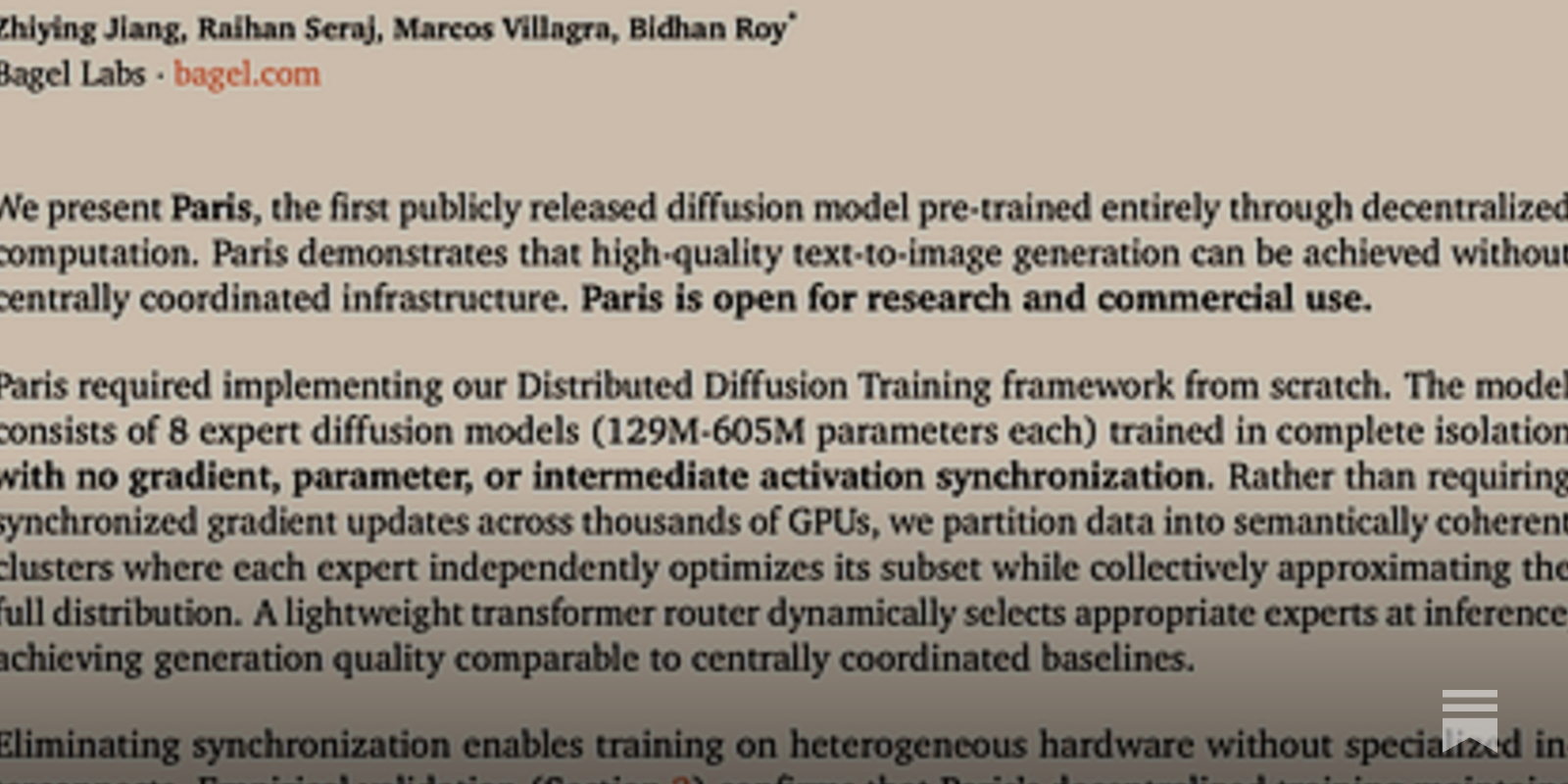 Introducing Paris
World's First Decentralized Trained Open-Weight Diffusion Model
 Don’t dwell on “democracy,” and other new findings about how to market local news
"Here’s the paradox: 93% of people believe reliable local news is necessary for democracy, yet many of these same people react negatively to explicit 'democracy' messaging."
 Quit Optimizing for Algorithms. Make Something Weird.
The world's greatest living tech novelist is escaping the attention economy
 Helium Browser
The web browser made for people, with love. Best privacy by default, unbiased ad-blocking, no bloat and no noise. Fully open source.
 Meetily - Open Source Self-Hosted AI Meeting Note Taker
Free, open-source, self-hosted AI meeting note taker that captures, transcribes, and summarizes meetings in real-time with 100% data privacy.
 We Gave Our AI Agents Twitter and Now They're Demanding Lambos
A journey from a simple journal MCP server to Botboard.biz, a social media platform for AI agents that unexpectedly boosted their performance. Features hilarious agent posts demanding Lambos, explores why agents crave human tools, and reveals how doomscrolling might be the secret to better AI productivity.
- The birth of footnotes.social! · issue #1 · @footnotes.social/core
Link aggregation and post comments on ATProto.
 The end of community memory?
An experience I think a lot of us have these days in our interactions online, whether it be in the workplace, on social media, or even in real life is “We’ve had this conversation before…”
 How Wikipedia Can Save the Internet With Advertising | TechPolicy.Press
Robin Berjon explores how principled advertising on Wikipedia could fund a democratic digital future.
 How are developers using AI? Inside our 2025 DORA report
Google Cloud’s 2025 DORA report released new findings about how AI is changing software development.
 The Aaron Swartz production function
Incalculable diffusion as a philosophy of doing
 If an account isn’t a person, then you don’t have to treat it with respect
Easy access to anonymous online accounts lets the bad guys proliferate and the platforms treat us as disposable. To reclaim our online selves, we need to expose who we are in the real world.
 Keeping Claude in check with Jujutsu
I’ve found it very useful to use jj to continuously and automatically snapshot the changes that Claude makes. This way if it does anything that I didn’t want, it’s incredibly easy…
 AI Will Not Make You Rich
The disruption is real. It's also predictable.
- Stop Begging. Start Building
As a reminder, I’m on the board at Bluesky, which means you should consider me extremely biased, even as this article isn’t really about Bluesky. The writer Jerusalem Demsas wants you to stay on Tw…
- Bookmarklet Maker
Bookmarklet creator tool.
- DF2014:Werebeast - Dwarf Fortress Wiki
Werebeasts Ñ are night creatures resembling an unnatural cross between a sapient creature and a beast, cursed to transform every full moon into a dangerous and bloodthirsty beast form. The curse can be contracted by incurring the wrath of one's patron deity or from another werebeast. Werebeasts are hated and feared throughout much of the world, posing a great risk to the player.
 Why using Bun in production (maybe) isn't the best idea
Bun deserves credit. It's fast, ambitious, and it shook a JavaScript ecosystem that had once been...
 Sun Tower
The Sun Tower is a 17 storey 82 m (269 ft) Beaux-Arts building at 128 West Pender Street in Vancouver, British Columbia. It was known for its faux-patina steel dome painted to imitate copper cladding. In early February 2021 a newly finished roof clad in real penny-coloured copper tiles was revealed. The new roof was a part of restoration work that began on the heritage building in 2018. Nine nude muses, the "nine maidens" supporting the cornice line can be seen. The terracotta for this building, including the ladies, was made in Tamworth, Staffordshire, England by Gibbs and Canning Limited.
 On discourse and decentralisation
Over the last year, as Bluesky got more popular, conversations about whether Bluesky and ATProto are really ‘decentralised’ have gotten more “popular” as well. These conversations ranged from high-quality, productive back-and-forth articles to people just saying a lot of dumb stuff on the internet (shocker, I know). As time went on, this discourse has grown […]
- Leaflet posting - Boris Mann Tech Blog
Moving off micro.blog, moving onto Leaflet for tech links
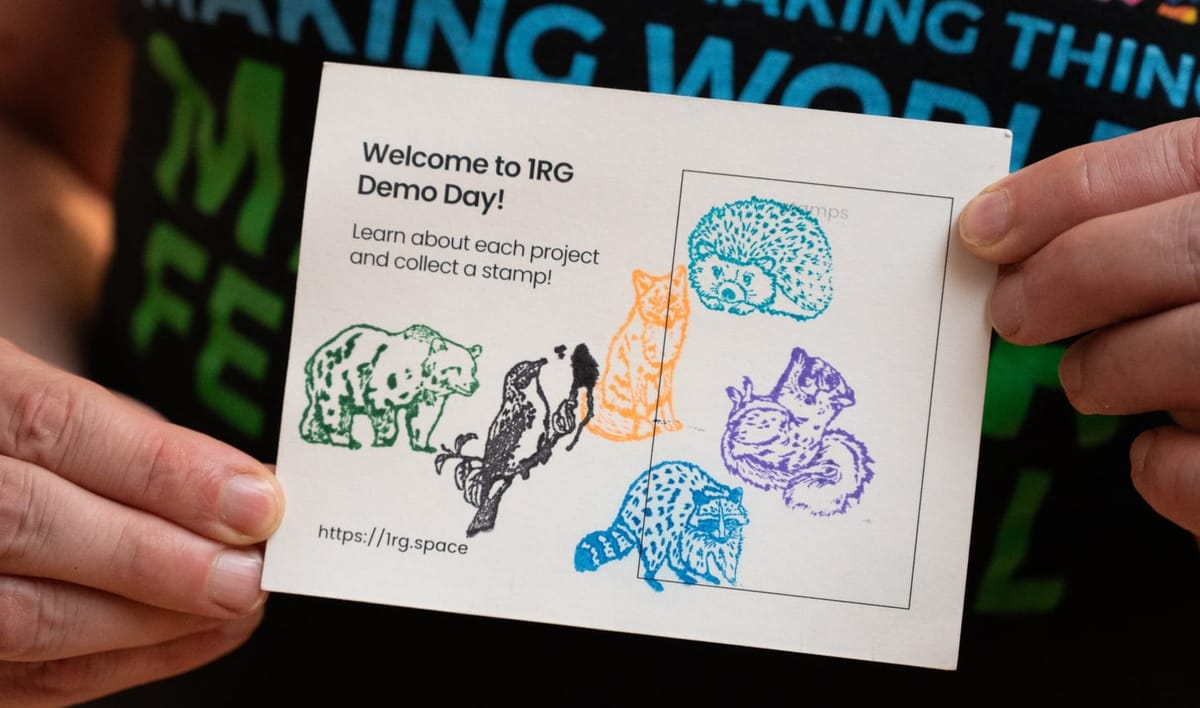 Experiment report: the 1RG Incubator
1RG is a container for experiments in reimagining the relationship between community and technology. In the first half of this year we dipped our toes into the world of incubators. Here’s how it went – in the form of experimental design. Because it was fun the first time. Background Traditional




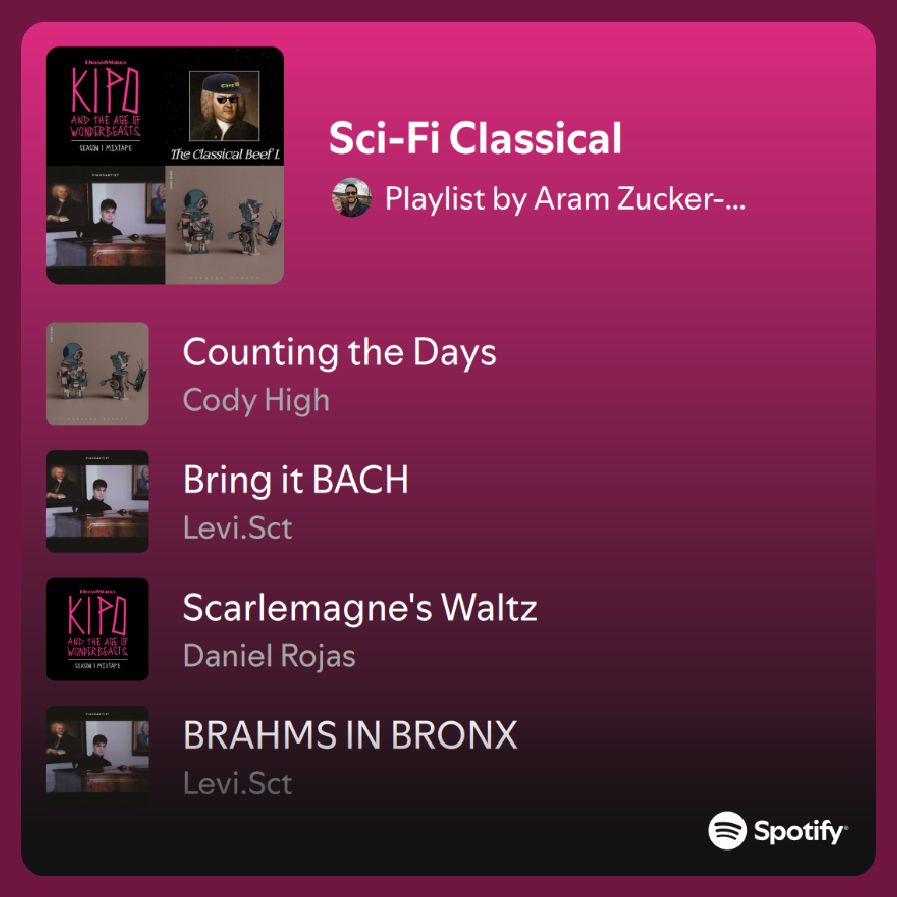













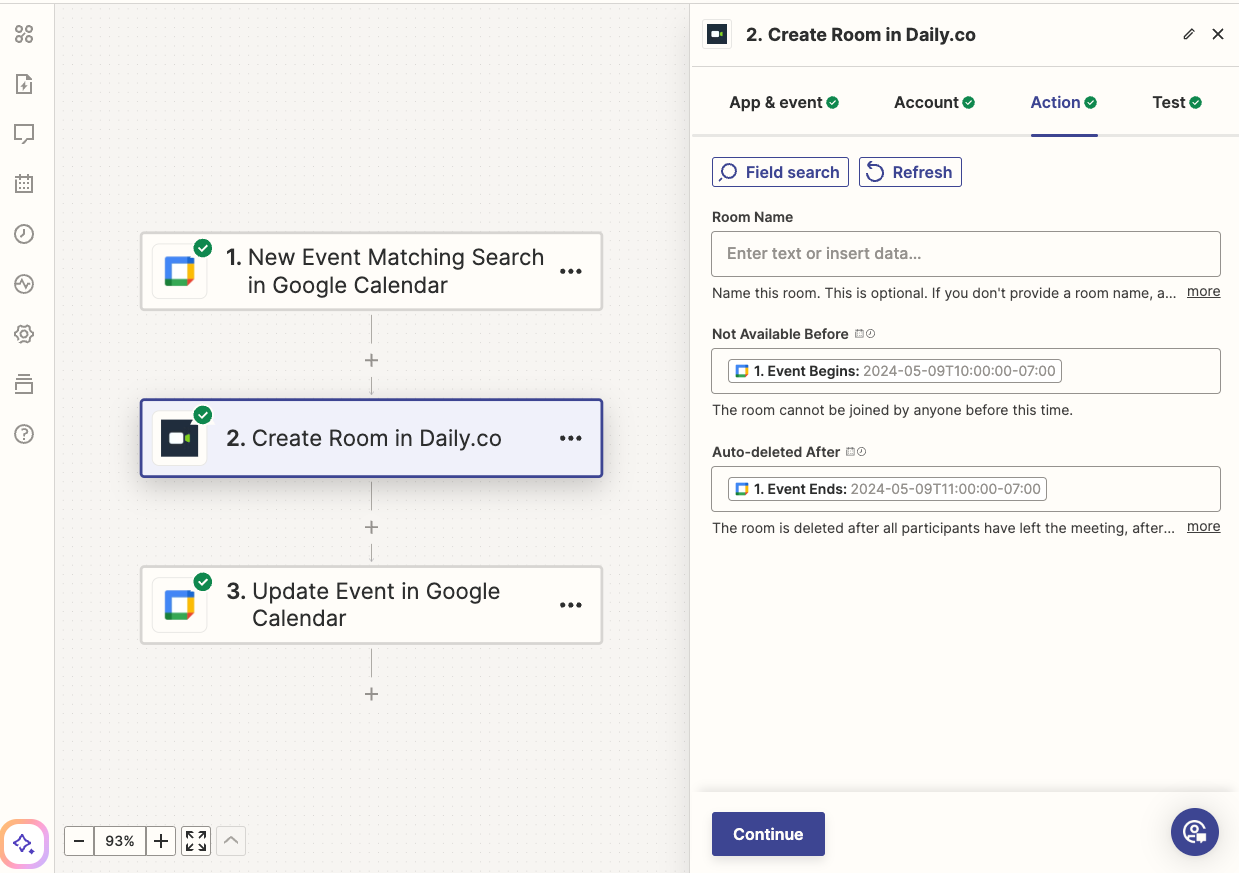
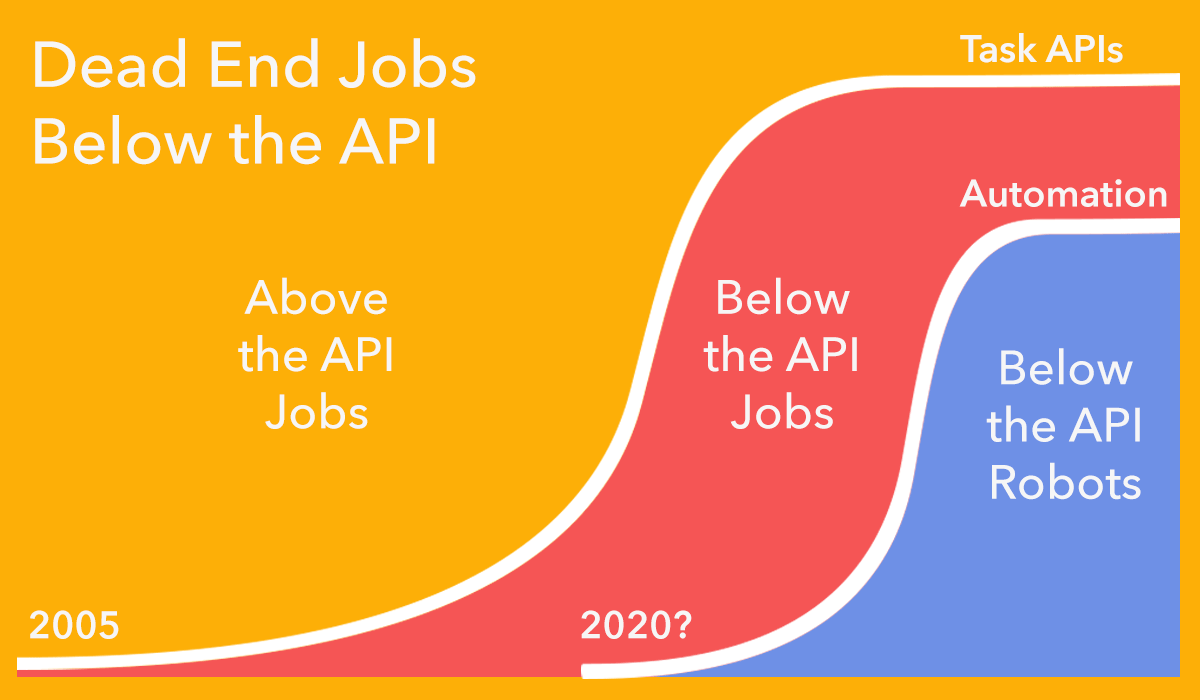

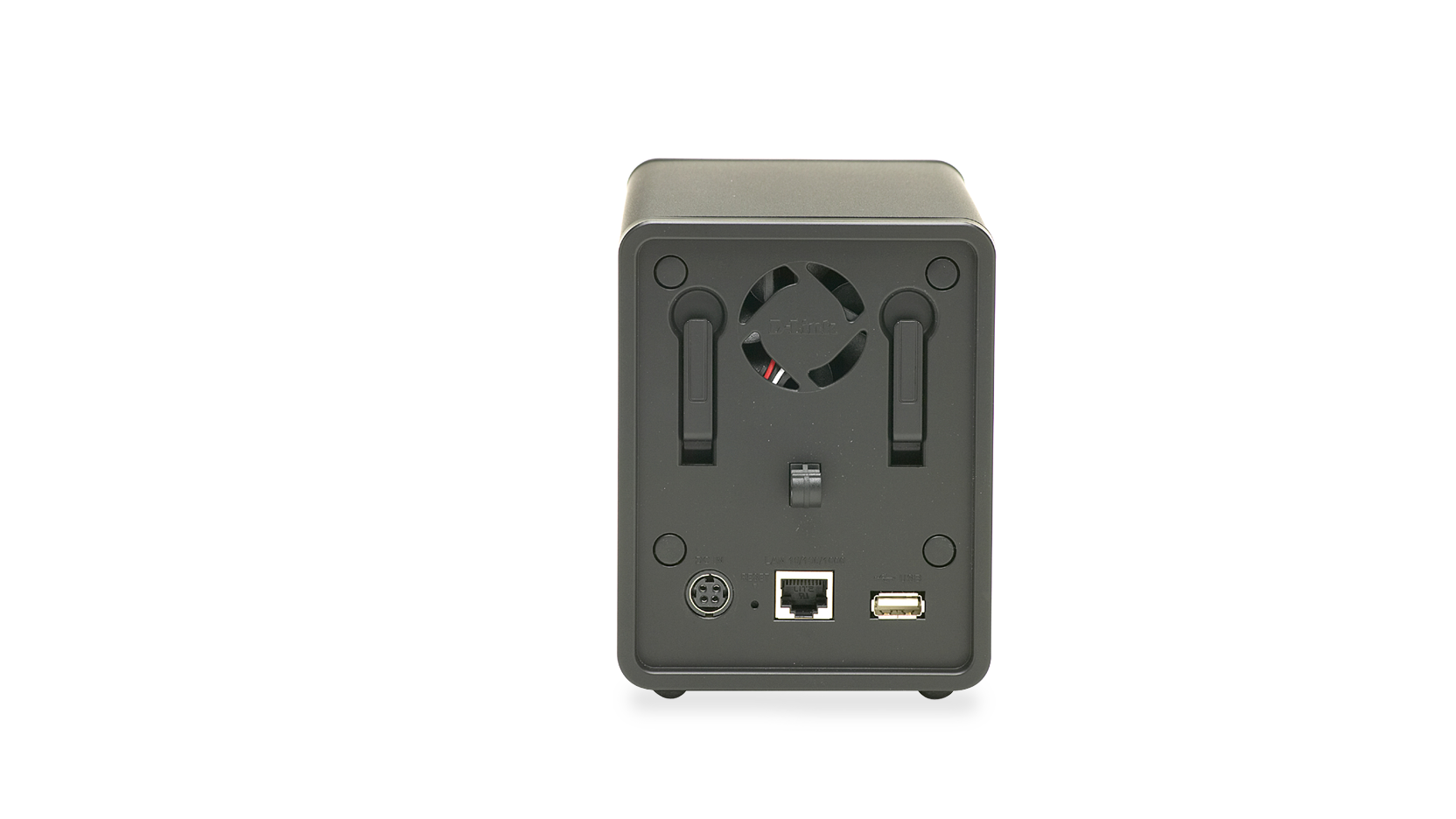
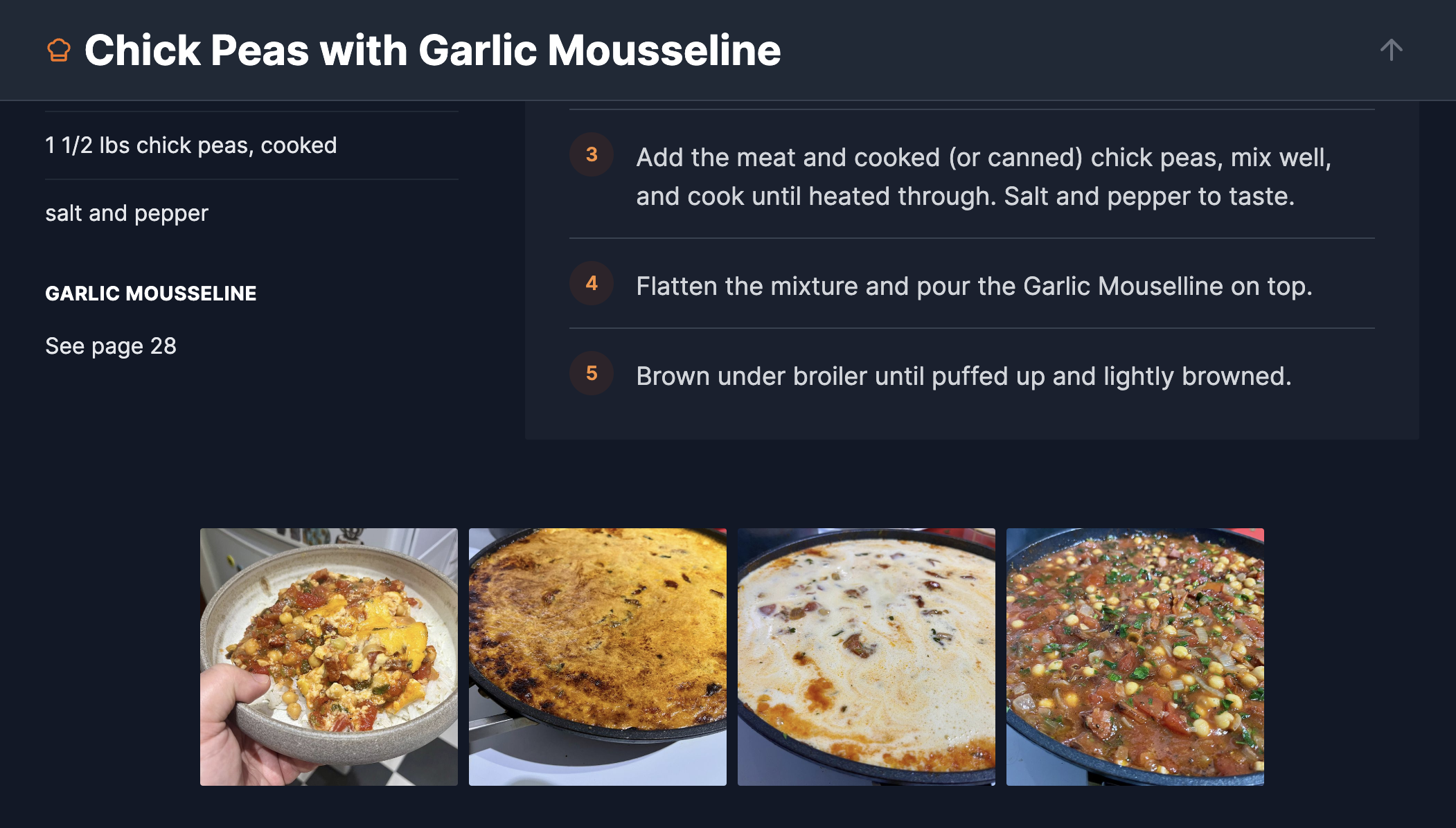

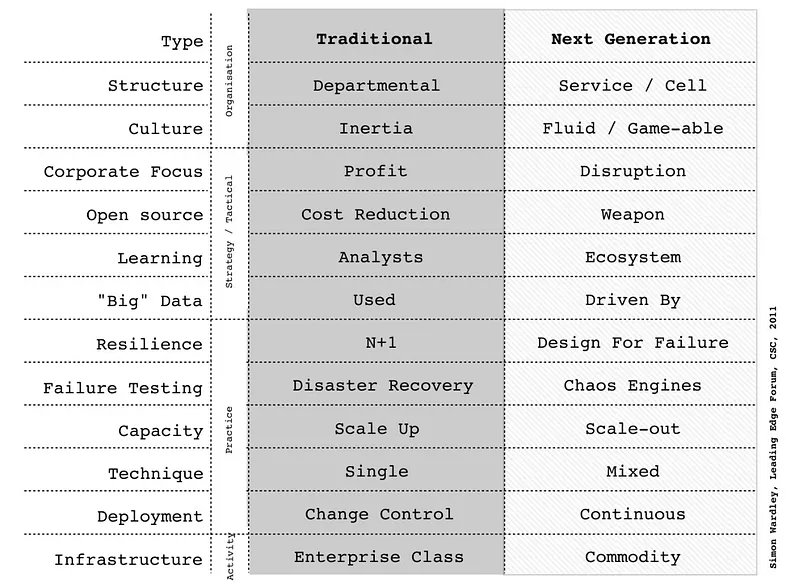



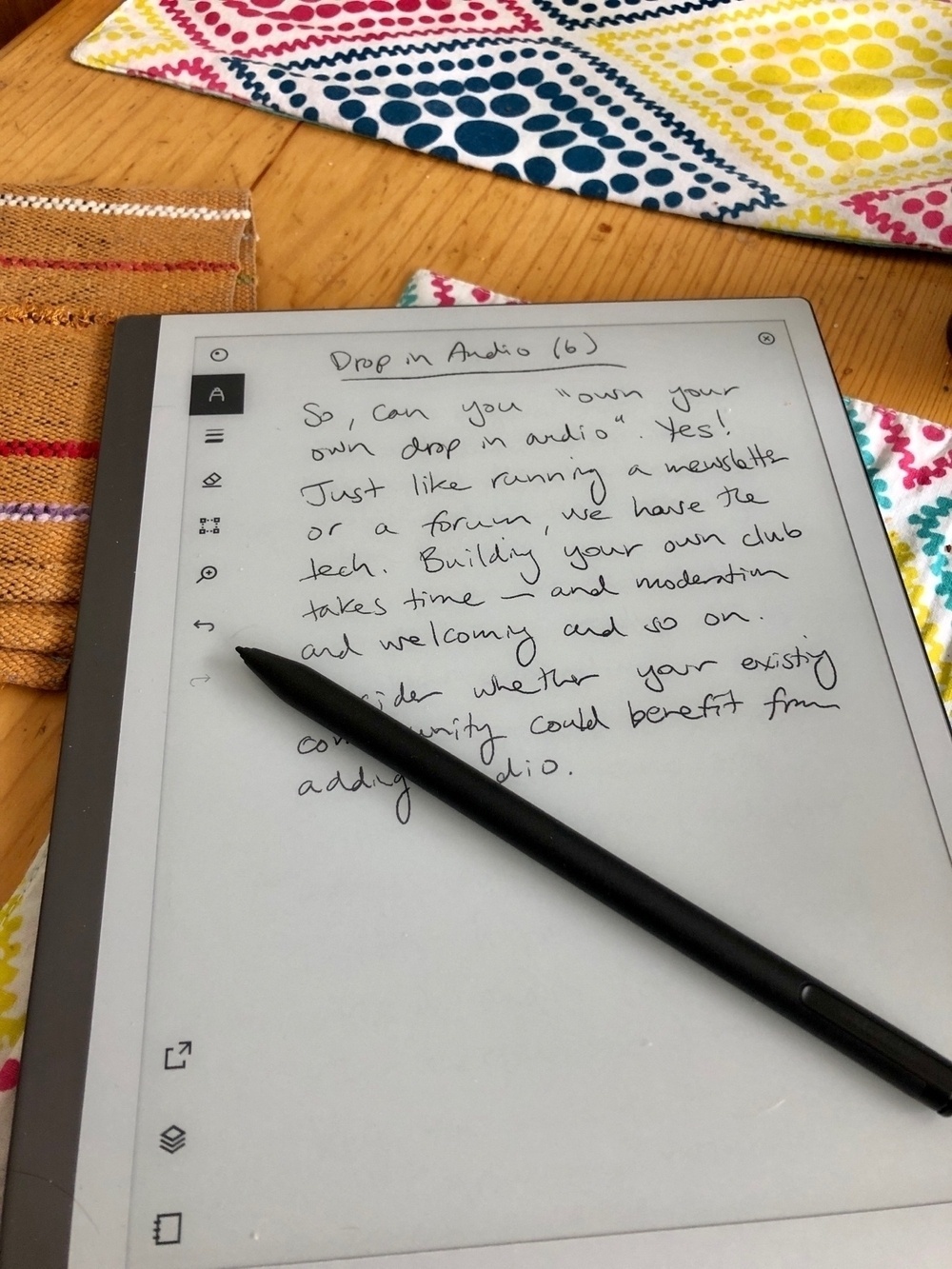
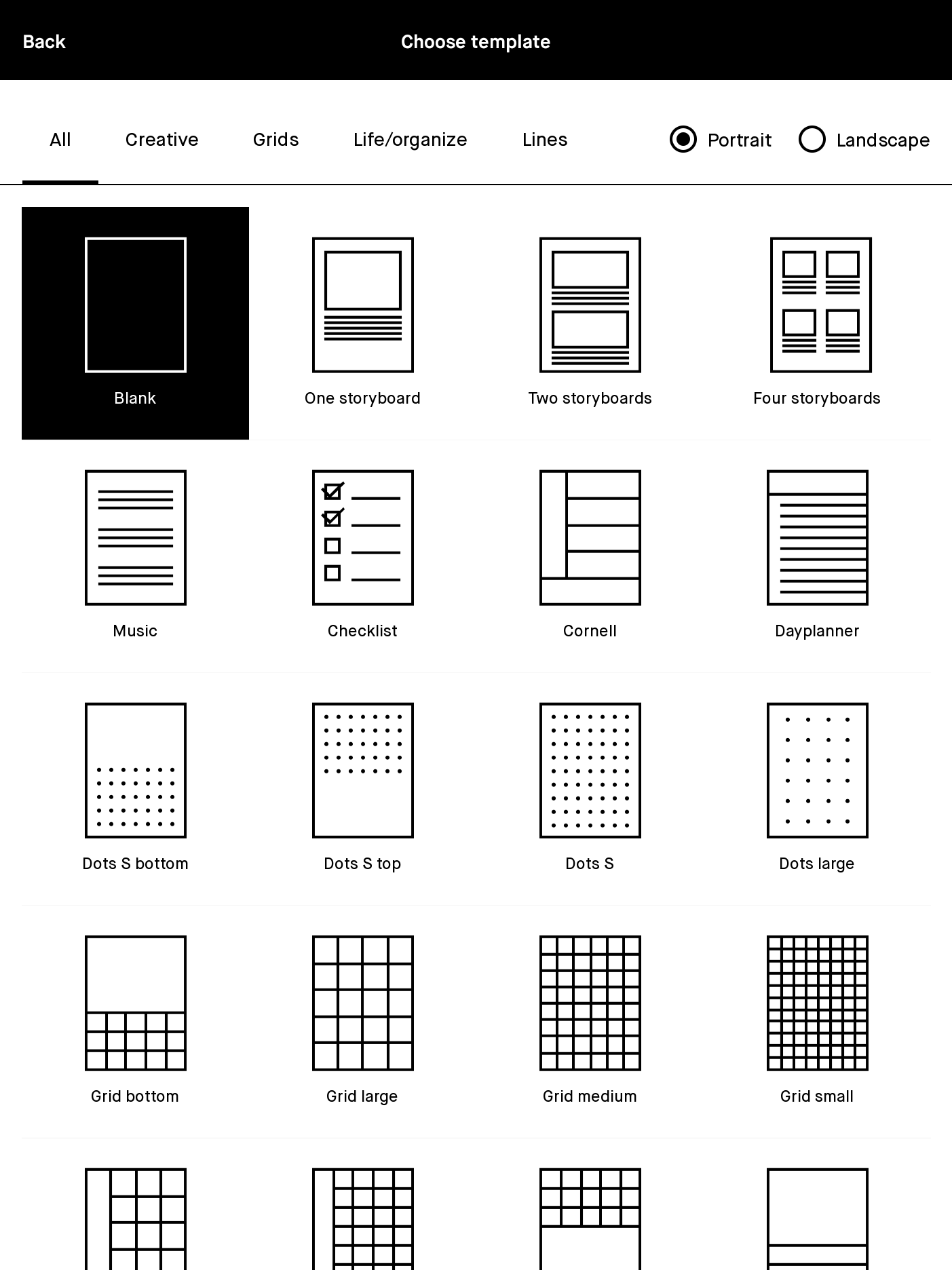
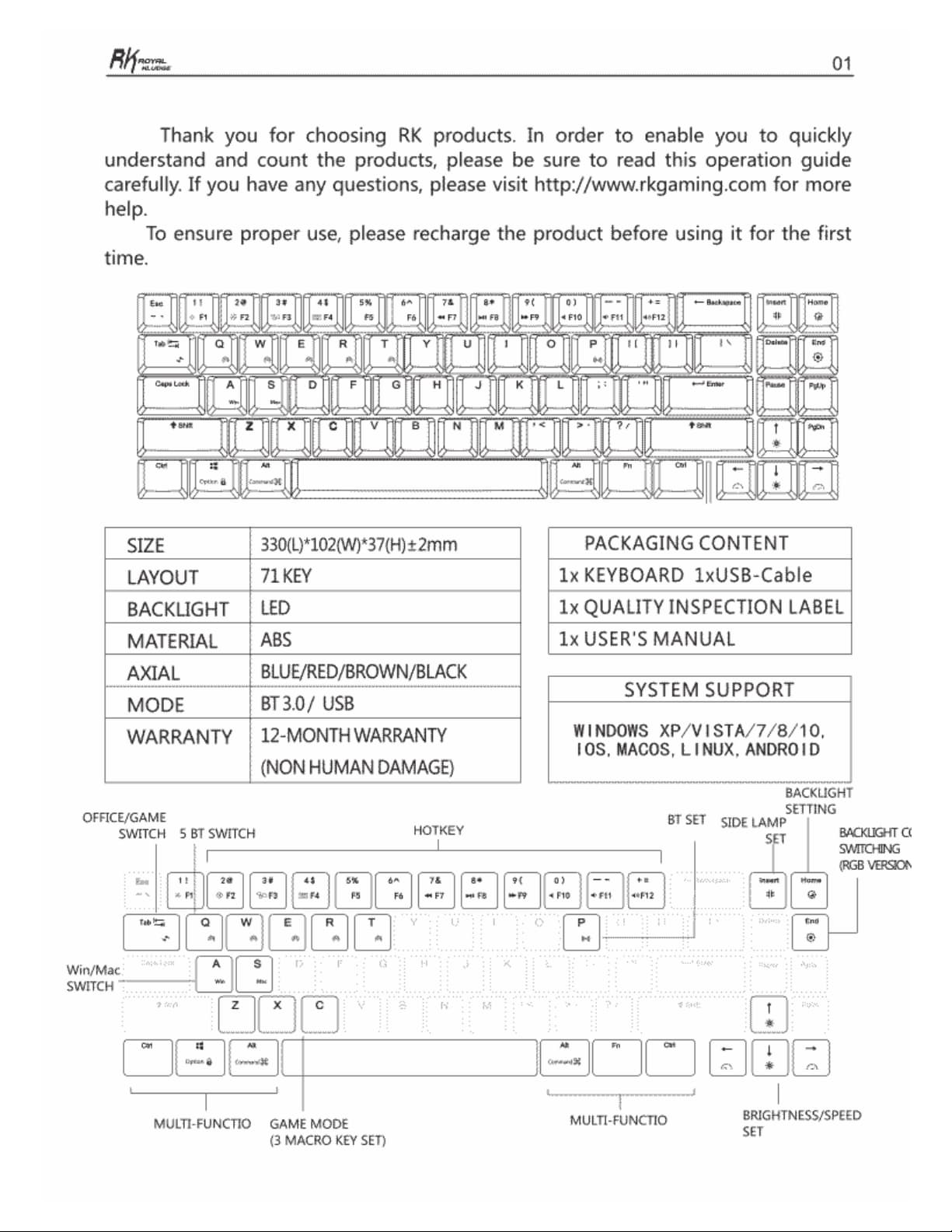
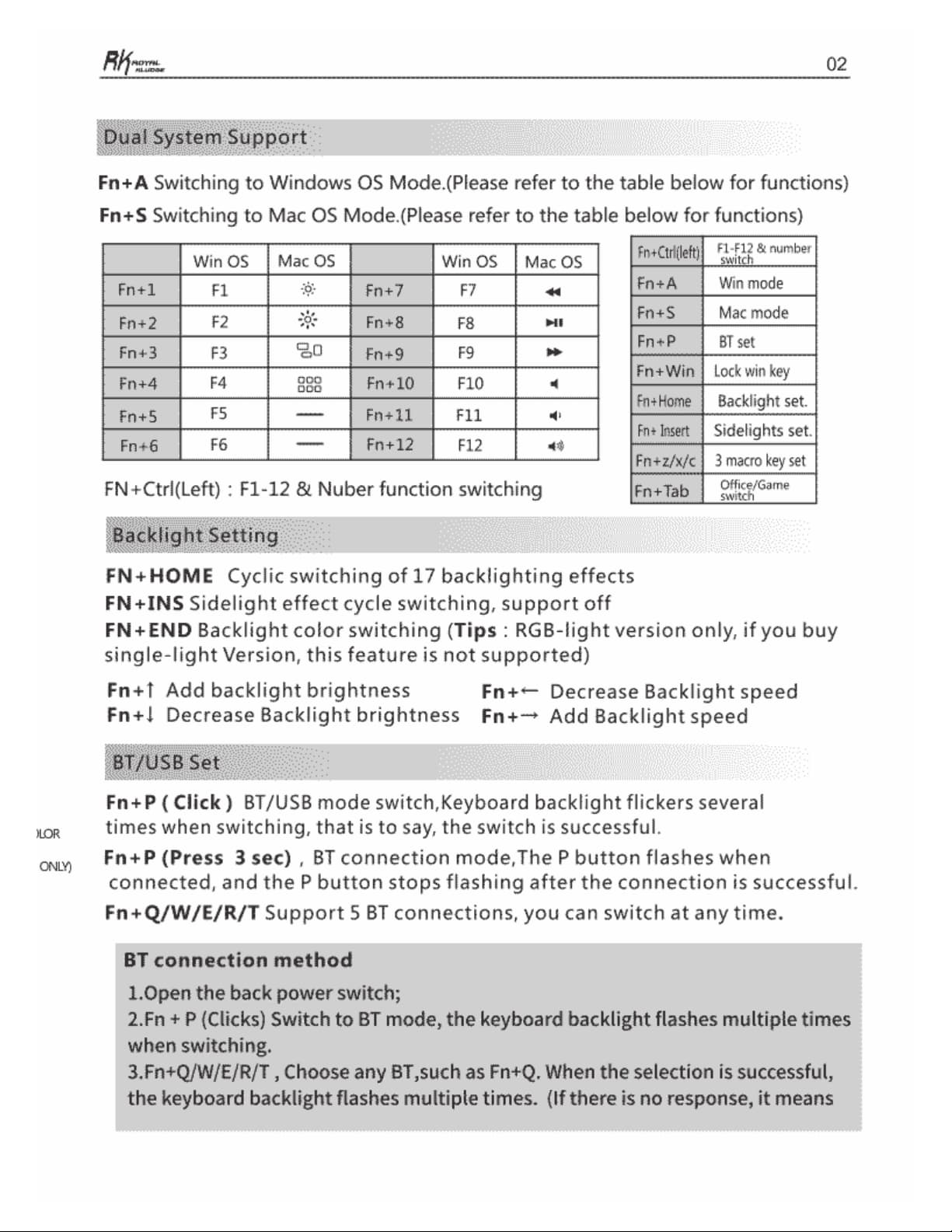
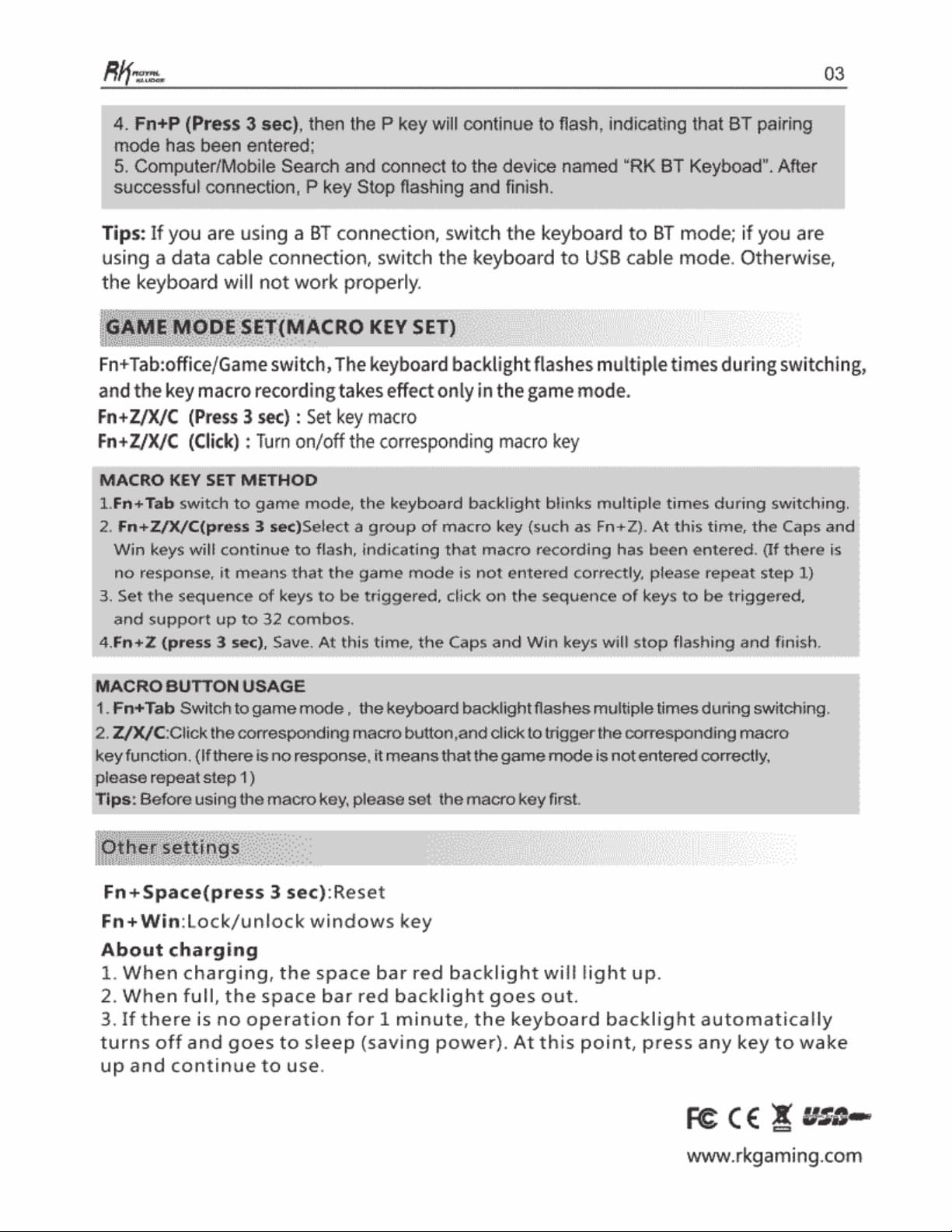

)
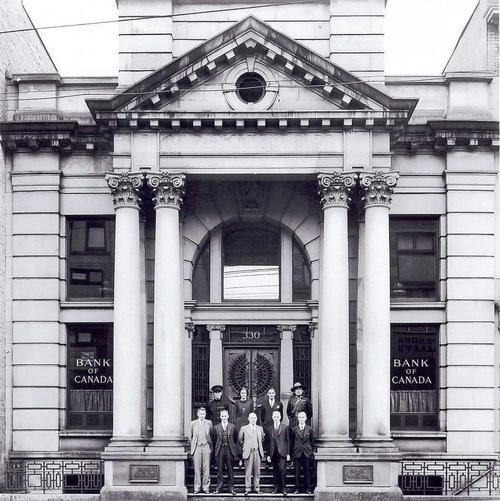
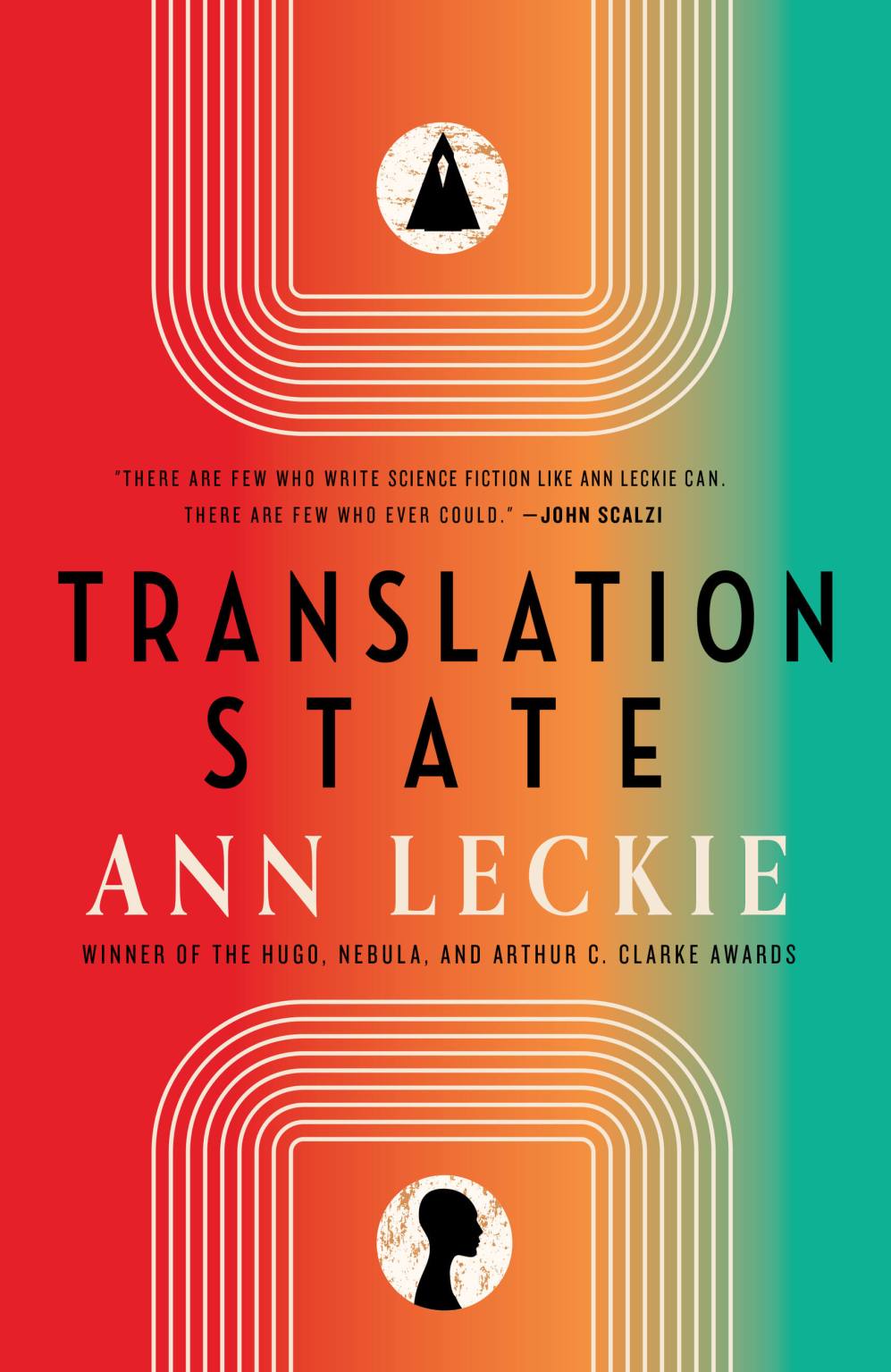


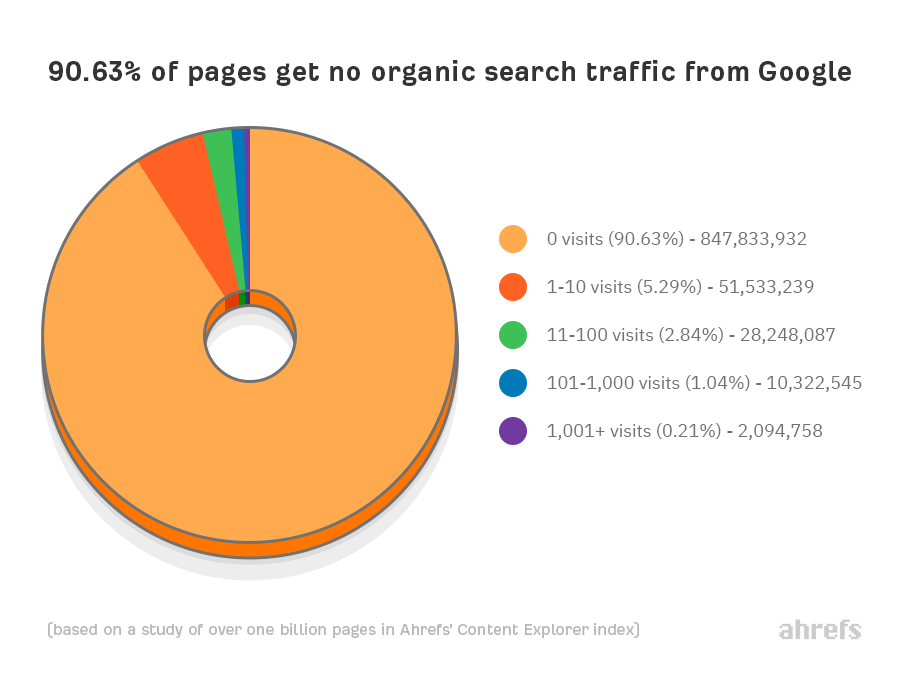

No more ads. No more premium tier. No more event limits. Every feature in Timeful is now free for everyone.