The rebooting of social networks, blogs, and newsletters continues.
Spyglass is a link blog, a column, and a newsletter, all written by me, M.G. Siegler.
Short dated entries, links, and microblog-style notes.
The rebooting of social networks, blogs, and newsletters continues.
Spyglass is a link blog, a column, and a newsletter, all written by me, M.G. Siegler.
Brian Wisti @[email protected] documents using Obsidian + Hugo and a few other things in “Rebuilding My Public Brain”
We’ve been hanging out reading each others’ stuff on the blogosphere for a long time, nice to see what the neighbours are up to.
Beluga is an iOS app that lets you post microblogs. What’s unique is that it posts to S3-compatible storage, using your own credentials. Bring your own storage!
The Fediverse Report, created and maintained by Laurens Hof @[email protected], is doing a great job of sharing news, and also explainers like “How Bluesky works — the network components”.
Viverse, HTC’s metaverse open worlds platform, is going to be ActivityPub-enabled.
Their blog post “The Fediverse Explained: Social Media’s Next Form” is a good overview of fediverse history and apps.
Flaming Hydra is a collective of writers and artists. I’ve just subscribed to support them for the year.
a collective of 60 celebrated writers and artists joining to bring you an ingenious brief cooperatively-owned newsletter with short articles, essays, comics, commentary, and happenings
obsidian-export , “a CLI program and a Rust library to export an Obsidian vault to regular Markdown”
via @[email protected]
The Lenovo M900 Tiny arrived. It came in a big, long box, which turned out to also contain a full keyboard and mouse, plus lots of packaging around the machine, which is metal, sturdy, and heavy. But very small!
One annoying thing right away is that the specs are different than what I ordered: 8GB RAM instead of 16GB (less), a 1TB drive instead of 500GB (more), and a slightly different CPU.
I’m making notes as I update Windows and then put Ubuntu on it Lenovo m900 Tiny Setup
Gibberish is now on testflight:
Gibberish is a blogging app that looks and feels like a messaging app. It’s a bit weird, but that’s the point. This UI tricks my brain into writing mode, just like when I write long messages to my friends. Here’s what it looks like:
This is very similar to my thoughts on a Threadstorm Builder
Just got a $200 credit for Perplexity.ai as an early buyer of Rabbit Tech R1.
From Stack Overflow 2023 Developer Survey, “Matrix is the #1 chat tool by current users’ satisfaction”
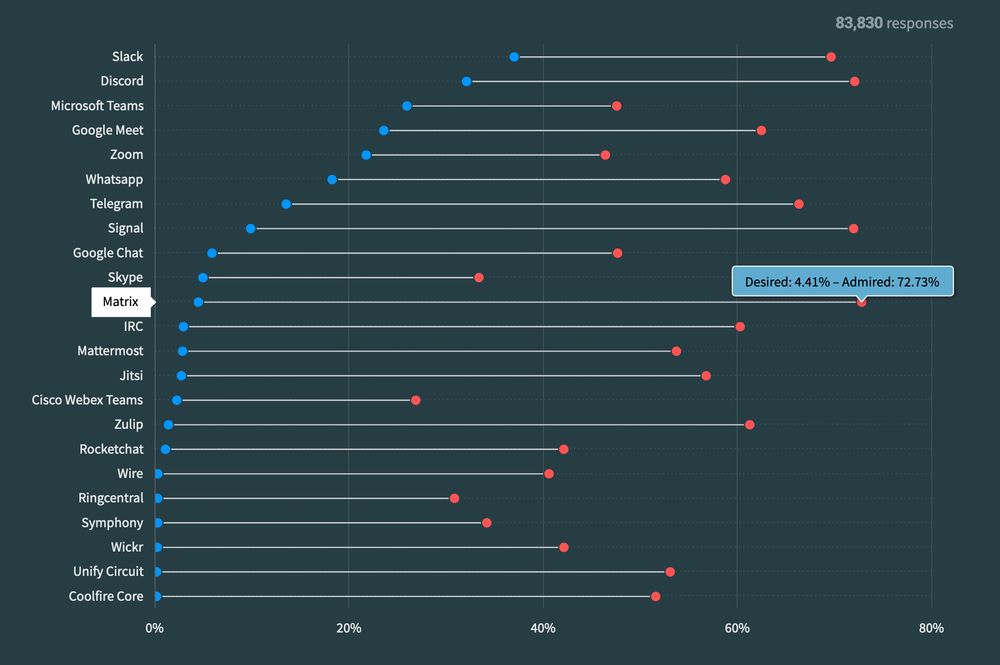
This is of course a popularity contest, but it’s still useful.
Matches my expectations, eg lots of awareness of Microsoft Teams, people that use it hate it. Discord is desired and loved.
As you go down the list, it’s mostly that people haven’t heard of these tools. Zulip is an outlier — those people I know who use it really love it, and that shows up here.
This section is called “Synchronous tools” and this was the prompt:
Which communication tools did you use regularly over the past year, and which do you want to work with over the next year? Select all that apply
Ok, I guess I’ll need to go dig into the Asynchronous tools next. Everything is asynchronous when you’re a multi time zone community or organization.
What’s IPFS and how it compares to BitTorrent is an article by Daniel Norman correcting and explaining many of the details about IPFS as a response to a blog comparing the two.
It’s really well written. I should quote pieces of it on my IPFS notes page.
localfirst.fm is a new podcast about local first software development. LoFi as we like to call it.
Individual initiative, corporate inertia and good bad advice
I did my job with love and belief. This was always obviously risky. I had no illusions that the love was returned, or that it is even possible for a public corporation of non-trivial scale to behave in human ways at all.
I’m quoting the first paragraph. I could post any sentence and it would make you think. It’s a long read about working at Spotify, and being fired, and many other things.
New Public made a directory of “digital social platforms”:
The Directory is a list of spaces that have taken at least some notable steps to build a public-spirited user experience, embody at least one of New_Public’s Civic Signals, and/or implement creative new design patterns.
I love the words on the directory landing page. Seriously, go read the intro, it’s great.
I am annoyed that the directory listing is a bare listing of Airtable records.
The Landscape maps made in Figma are much more engaging.
Paul Frazee from the Bluesky team writing on his personal blog about the design of RichText facets that are used to include mentions and links in posts.
And, other custom things that can be defined and read by different clients and servers.
Will the new judicial ruling in the Vizio lawsuit strengthen the GPL?
The TLDR; is treating the GPL as an issue of contract law rather than copyright, and because of contract law, a third party can sue instead of just the author.
Vizio makes smart TVs that use GPL code and they haven’t shared the source.
In October of 2021 the Software Freedom Conservancy (SFC) decided to launch what is believed to be the first significant open source lawsuit based in contract rather than in copyright. Critically, the SFC’s case argued that anyone who benefits from the General Public License (GPL), not just the authors of the software, should be able to bring a lawsuit to enforce the terms of the GPL.
Open source and AI related copyright, licensing, and contract arguments all in one year!
I get a lot of unsolicited business emails as the founder of a company. Yes, this is spam, but it’s the sort of cold outreach where it’s just a “regular” email wanting to sell me consulting or some SaaS service.
There are some that get sent from unbranded Gmail accounts (why???). I’m considering an email filter that ignores Gmail accounts unless they’re in my contacts.
Other ideas on reducing the volume of these types of emails?
HatTip, a set of JavaScript packages for building HTTP server applications. The cheeky tagline is “like Express.js, but for the future”.
From the README, “Server code that can be deployed anywhere: AWS, Cloudflare Workers, Fastly, Vercel, VPS”
I came across a thread by @vkc about doing an experiment of not using big search engines.
She in turn linked to Neil’s blog A week of not using a search engine.
There’s a general rebirth of curated directory sites, and I’m personally interested in community or commons search. I’d much rather get a search result that is in essence a recommendation or at least experience of someone I know.