Papermark is an open source Docsend alternative. Hadn’t realized Docsend is now part of Dropbox. GitHub optimized for deploying on Vercel is here https://github.com/mfts/papermark
Jan 20249:48pm
Short dated entries, links, and microblog-style notes.
Papermark is an open source Docsend alternative. Hadn’t realized Docsend is now part of Dropbox. GitHub optimized for deploying on Vercel is here https://github.com/mfts/papermark
Linear App: Settings are not a design failure
thinking goes that as designers, our goal is to create product experiences that don’t require any adjustments by the user. Consequently, offering customization options is interpreted as a failure to make firm product decisions. … First of all, remind yourself that users love settings.
I have continued my Jekyll Liquid crimes by using replace to make all the images and notes full links. Journal RSS feed code on Github
Andy Wingo, Missing the point of WebAssembly and offers his own starting point:
WebAssembly is a new fundamental abstraction boundary. WebAssembly is a new way of dividing computing systems into pieces and of composing systems from parts.
Wingo is a compiler engineer working at Igalia, on Mastodon at @[email protected].
BackYourStack is a project started by Open Collective which can scan your code dependencies and show which of them have Open Collective accounts.
All of the code of both projects are open source.
Coolify is another self-hosting server management system (via @depatchedmode).
They offer cloud hosting of the admin panel starting at $5/month, which then manages your other servers for deployment to.
Linux Desktop on your Android Device at Android Authority covers Debian NoRoot and UserLAnd (Ubuntu and other distros possible).
The average estimated date for when AI could beat humans at every possible task shifted dramatically, moving from 2060 to 2047—a decrease of 13 years—in just the past year alone!
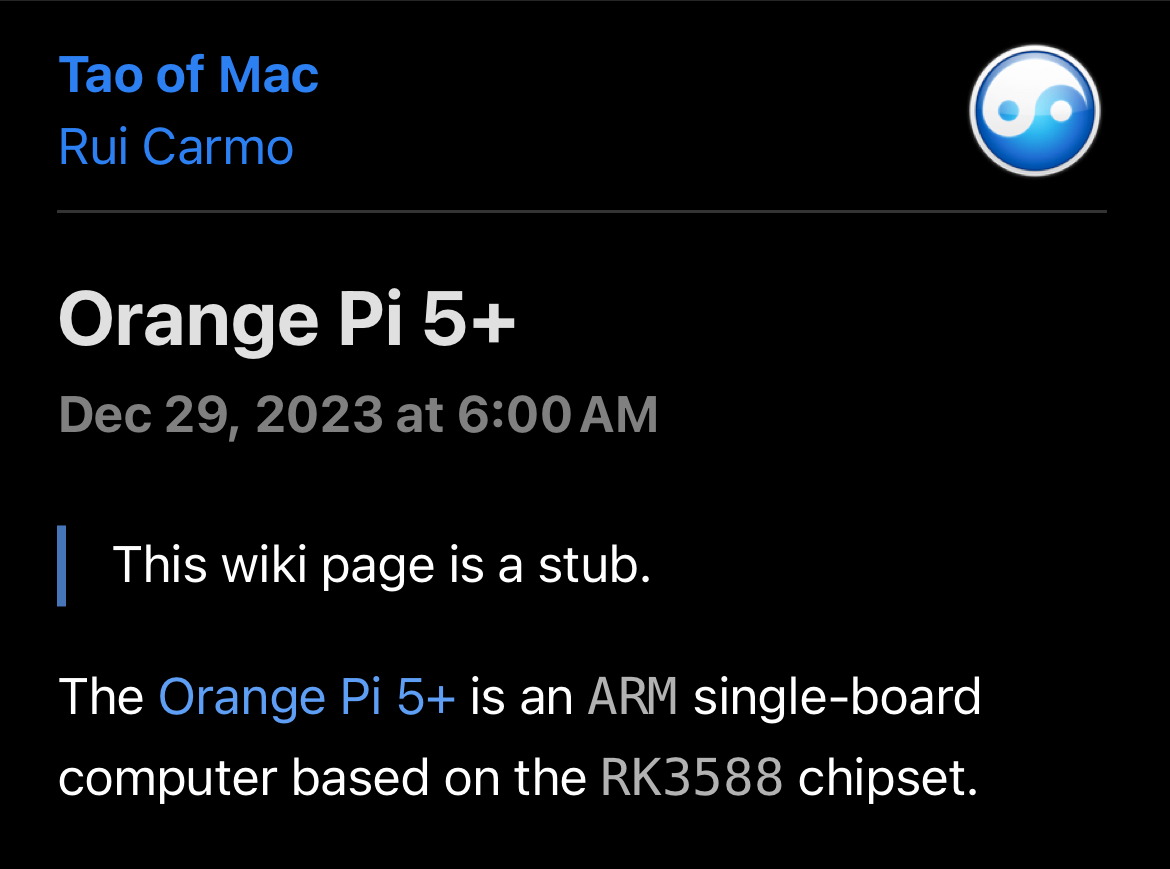
As I think about what subscribing / following / integrating other people’s notes looks like, I found this example from Rui Carmo’s Tao of Mac.
It says “This wiki page is a stub”. It’s also integrated into his main feed.
I use Littlefoot to make inline footnotes1. Turns out NetNewsWire includes similar functionality.
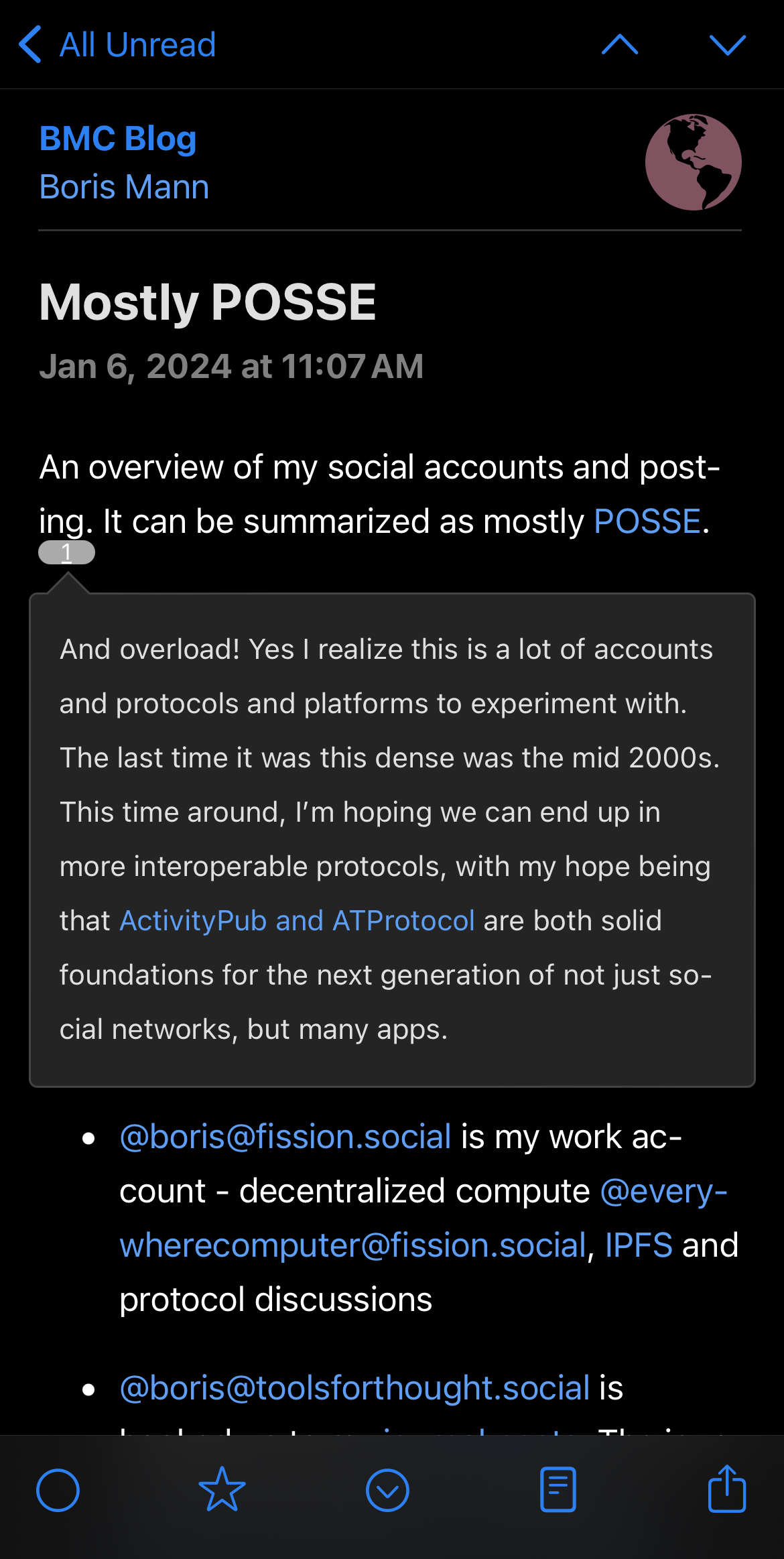
Footnote demo ↩
ZEISS is launching smart glass at CES and talks about holographic displays and switches. And apparently a transparent camera aka “holocam”
With so many different networks and accounts and crossposting, I find myself thinking about rebooting Moa Party. I’d actively run it as a collective of some kind.
I’m going to be talking more about Noosphere, so I better get its note page here setup.
I’m an early beta user of the Subconscious iOS app that uses Noosphere as its backend.
Your online persona federated Have your domain name be followable by anyone on the Fediverse, be it Mastodon, Firefish, Akkoma, or any other federated social media platform.
Get Federated is new thing by Sal Rahman @[email protected] - sign up to get notified!
There are no ushers on Mastodon. There’s no one paid to show you to your seat, no one whose job it is to ease you into comfort and remove friction.
There are no ushers on Mastodon by Les Orchard from back in November 2022.
I’ve been recommending UniFi routers for a while. Turns out there’s a new UniFi Dream Router that’s $266CAD and is the replacement for the $400CAD UniFi Dream Machine . Recommended!
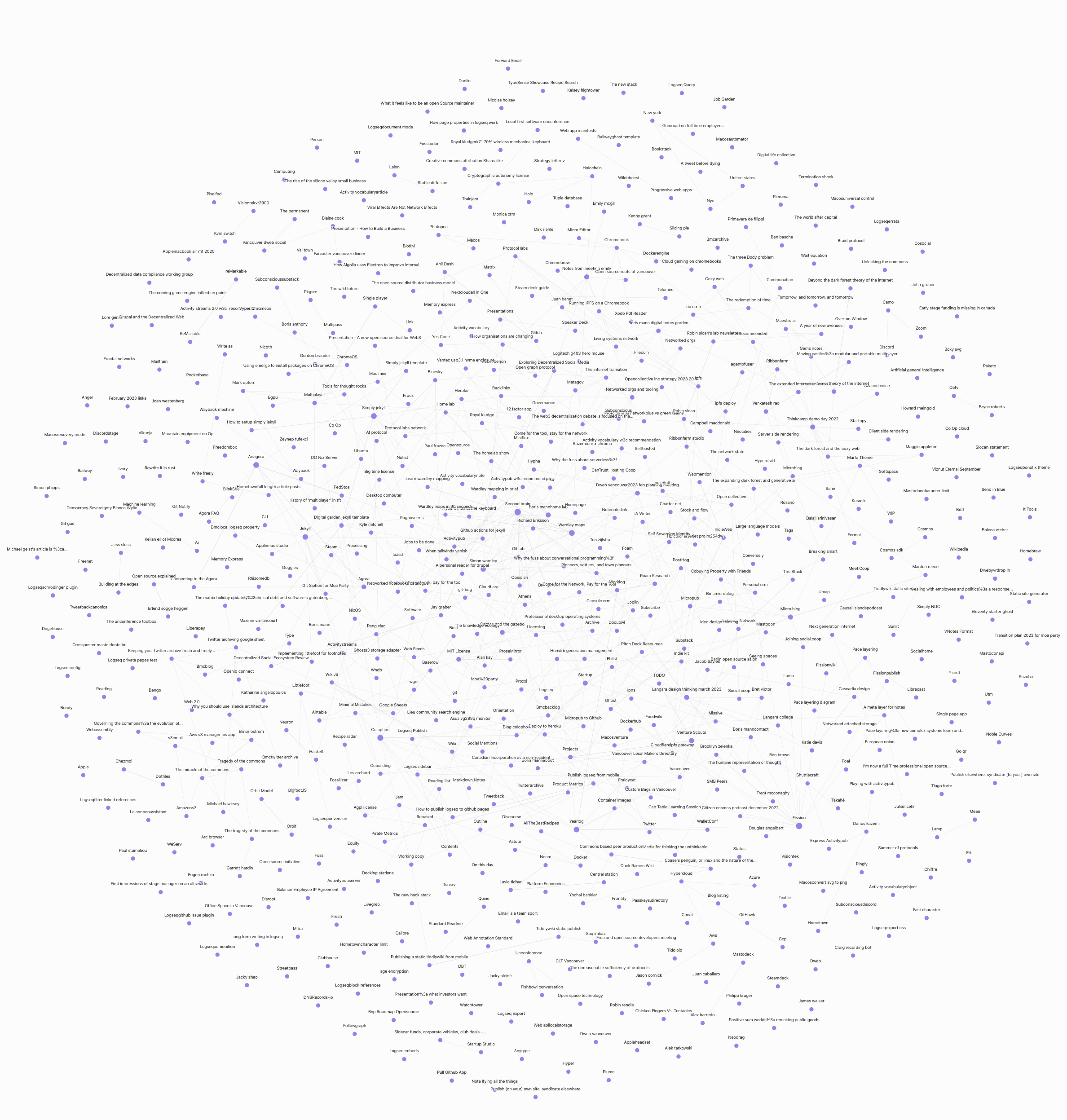
Everyone loves a notes graph! Shout out to the Digital Garden Jekyll Template once more.
It turns out that I had previously done an experimental import of LogSeq into this site template. I probably even have some notes somewhere.
TLDraw has changed its license to non-commercial. The founder Steve Ruizok dropped a note in the Cloudron forums saying that Cloudron may not be in compliance. I left a comment, as there are a number of apps with different licenses, and e.g. me running TLDraw on Commons Computer is not running it commercially.
Jake Lazaroff argues that “website vs. web app dichotomy doesn’t exist”. It’s a good article, develops a framework for thinking about different types of web properties. Mentions Local First, CRDT.
But to me, it does show a clear split of document web vs app web.
OK, one more quick hack to the Journal feed.
Relative paths for images are a problem. Maybe they actually aren’t for many modern feed readers. But they ARE if I want Micro.blog to crosspost correctly.
Found this hack to use the Liquid replace filter to look for src tags and then add in the full path to your site.
I’ll test it tomorrow by posting an image. Time for bed!