Daily Journal 📓 January 2024

Short dated entries, links, and microblog-style notes.


Garage “An open-source distributed object storage service tailored for self-hosting”. S3-compatible API, single Rust binary that is installable everywhere.


Steven Sinofsky writes about Apple and the DMA in “Building Under Regulation”:

As I read the over 60 pages of the DMA when it was passed…my heart sank over the complexity of a regulation so poorly constructed yet so clearly aimed at specific (American) companies and products.

It’s a long post and Sinofsky has a lot of relevant personal experience here. I’ll likely clip the article and look for some more quotes and take aways.


This article “The Negative Impact of Mobile-First Web Design on Desktop” feels like the reverse of what we would have seen 10 years ago, complaining about designs that don’t work on mobile.

The article states that 55% of web traffic comes from mobile. I bet if we measured “human time spent reading content” that mobile would be even higher.

This fits into my death of the professional desktop operating system theme. I think we should consider desktop design to be a luxury, for art and experiences.


We need more tiny knowledge projects

“I used to think of “knowledge projects” as involving a big mission, a big community, and a complex piece of software: the stuff of Wikipedia, Stack Overflow, or Genius (where I worked for several years). But the web is just as good for collaborations in the small.”


Law of VC writes about Simplifying the SAFE (posted in 2021), with his suggestion being “Remove the Valuation Cap and Discount. Replace it with a Conversion Percentage”.


PieFed written in Python and Flask, AGPL-licensed, first class moderation tools. Project goal:

To build a federated discussion and link aggregation platform, similar to Reddit, Lemmy, Mbin.


Delta Chat blogged about their release of chatmail services — email services optimized for powering end-to-end encrypted chat like DeltaChat.

With some knowledge of DNS, SSH and a spare VPS (get the cheapest you can find), you can setup and offer chatmail services yourself pretty quickly. A friend easily recently set it up on a Raspberry Pi for his housing project. Chatmail servers are designed to run with minimal hardware requirements and to be easy to tweak even from novice sysadmins or programmers. No permission is needed from our side to run a chatmail server. We might not even know you are doing it because Delta Chat has no tracking or counting.

Visit the deltachat/chatmail repo for instructions on install and setup.


Awesome to see Farcaster continuing to experiment with the launch of Frames.

Matches my thoughts on mobile form and social as distribution / discovery.

Farcaster has less usage than my other two protocol recommendations — atproto and ActivityPub — but ability to align login / growth directly with app devs is huge.


Antikythera is “a think tank reorienting planetary computation as a technological, philosophical, and geopolitical force”. They have a new working group starting up on Futures of Multipolar Computation. Multidisciplinary researchers are invited to apply.


Brought to my attention by @[email protected]’s post linking to Michael Geist’s article on Bill S-210, and that it may apply to the fediverse as well:

the unlimited scope of the Canadian law to sites such as Twitter, Snap, Instagram, Twitch and many others is no accident. If the lead lobby group behind the legislation gets its way, it is the stated goal of Bill S-210 to require all Canadians to undergo an age verification system in order to access content on general purpose sites with the threat of penalties and site blocking awaiting those sites that refuse to comply.


Ton Zijlstra blogs about Europe’s AI act being ready and points out that a lot of new acts got passed:

In 2020 there was no Digital Markets Act, Digital Services Act, AI Regulation, Data Governance Act, Data Act, nor an Open Data Directive/High Value Data implementing regulation.


Luis Villa is writing [Open(~ish) Machine Learning News]https://www.openml.fyi/2024-01-24/) and gives an update on what he’s going to cover:

less news, a turn more for the personal and the polemical: what should I do? What should our organizations and movements do?

I am also going to be watching open / licensing / AI, and work on running my own.


Great write up by Paul Frazee of “Why isn’t Bluesky a peer-to-peer network?”, going back to his own roots and the “2014 generation of p2p”.1

Bluesky is a sort-of-federated model. Here’s a succinct description:

It might be even more accurate to call this a Cryptographic Data Web. Every user’s data repository is, in essence, a website. The aggregating applications are, in essence, search spiders. The Web never quite mastered structured data for a variety of reasons; the AT Protocol embraces it fundamentally. Rather than fetching views from sites, you fetch records from users. Our aggregators produce data indexes rather than search pages.

Footnotes

  1. That’s 10 years ago and I think we’re still in the early days of distributed systems theory and cryptography being more widely known. The third innovation — seeing Bitcoin arise as a novel protocol — is shunned by many.


Tom Szilagyi writes “Ditching GitHub” — moving to self host his git repos, and welcoming email based git patches. This is not the last of these articles we’re going to read.


Ben Follington on the Subconscious team blogs on his personal site about “using Subconscious to design Subconscious”

So, how do you design feeling-first?

Yes. How does both user and maker take the digital tool into their hands.

A great read while also being highly personal about what Ben is aiming to do and be: “Metacognitive Design”.


Capturing a link to Obsidian Map View Plugin, since it came up in discussion. Open source, uses OpenStreetMap and open map tiles for search and display.

My exploration on Boris Map is mostly for FoodWiki purposes. I use basic tagging for notes pages if I want to capture e.g. that a person entry is in Vancouver.


The rebooting of social networks, blogs, and newsletters continues.

Spyglass is a link blog, a column, and a newsletter, all written by me, M.G. Siegler.


Beluga is an iOS app that lets you post microblogs. What’s unique is that it posts to S3-compatible storage, using your own credentials. Bring your own storage!


Flaming Hydra is a collective of writers and artists. I’ve just subscribed to support them for the year.

a collective of 60 celebrated writers and artists joining to bring you an ingenious brief cooperatively-owned newsletter with short articles, essays, comics, commentary, and happenings


The Lenovo M900 Tiny arrived. It came in a big, long box, which turned out to also contain a full keyboard and mouse, plus lots of packaging around the machine, which is metal, sturdy, and heavy. But very small!

One annoying thing right away is that the specs are different than what I ordered: 8GB RAM instead of 16GB (less), a 1TB drive instead of 500GB (more), and a slightly different CPU.

I’m making notes as I update Windows and then put Ubuntu on it Lenovo m900 Tiny Setup


Gibberish is now on testflight:

Gibberish is a blogging app that looks and feels like a messaging app. It’s a bit weird, but that’s the point. This UI tricks my brain into writing mode, just like when I write long messages to my friends. Here’s what it looks like:

This is very similar to my thoughts on a Threadstorm Builder


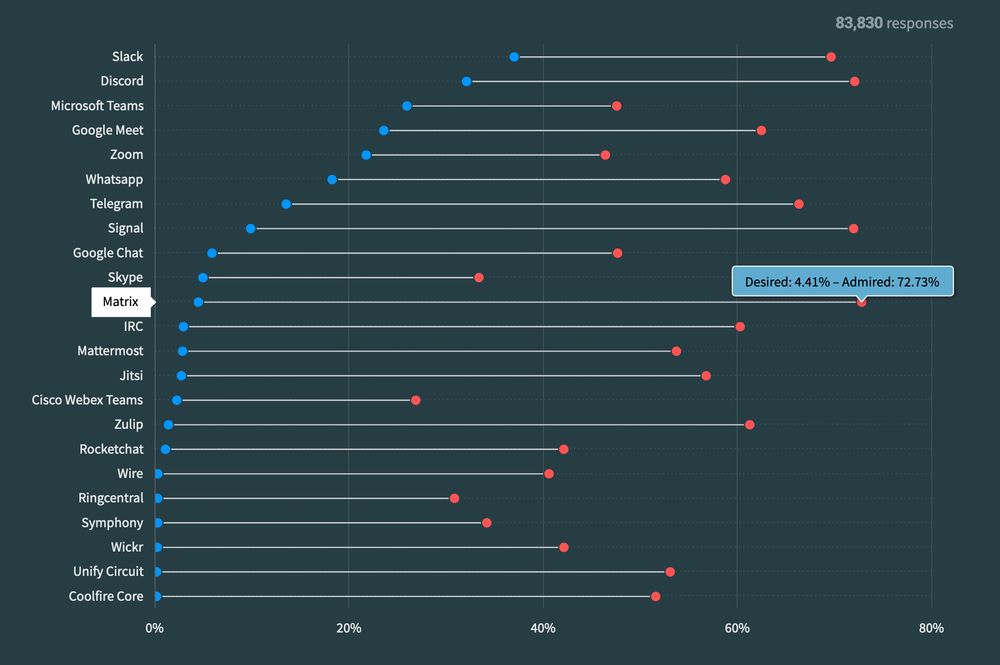
From Stack Overflow 2023 Developer Survey, “Matrix is the #1 chat tool by current users’ satisfaction”

This is of course a popularity contest, but it’s still useful.

Matches my expectations, eg lots of awareness of Microsoft Teams, people that use it hate it. Discord is desired and loved.

As you go down the list, it’s mostly that people haven’t heard of these tools. Zulip is an outlier — those people I know who use it really love it, and that shows up here.

This section is called “Synchronous tools” and this was the prompt:

Which communication tools did you use regularly over the past year, and which do you want to work with over the next year? Select all that apply

Ok, I guess I’ll need to go dig into the Asynchronous tools next. Everything is asynchronous when you’re a multi time zone community or organization.


localfirst.fm is a new podcast about local first software development. LoFi as we like to call it.


Individual initiative, corporate inertia and good bad advice

I did my job with love and belief. This was always obviously risky. I had no illusions that the love was returned, or that it is even possible for a public corporation of non-trivial scale to behave in human ways at all.

I’m quoting the first paragraph. I could post any sentence and it would make you think. It’s a long read about working at Spotify, and being fired, and many other things.


New Public made a directory of “digital social platforms”:

The Directory is a list of spaces that have taken at least some notable steps to build a public-spirited user experience, embody at least one of New_Public’s Civic Signals, and/or implement creative new design patterns.

I love the words on the directory landing page. Seriously, go read the intro, it’s great.

I am annoyed that the directory listing is a bare listing of Airtable records.

The Landscape maps made in Figma are much more engaging.


Paul Frazee from the Bluesky team writing on his personal blog about the design of RichText facets that are used to include mentions and links in posts.

And, other custom things that can be defined and read by different clients and servers.


Will the new judicial ruling in the Vizio lawsuit strengthen the GPL?

The TLDR; is treating the GPL as an issue of contract law rather than copyright, and because of contract law, a third party can sue instead of just the author.

Vizio makes smart TVs that use GPL code and they haven’t shared the source.

In October of 2021 the Software Freedom Conservancy (SFC) decided to launch what is believed to be the first significant open source lawsuit based in contract rather than in copyright. Critically, the SFC’s case argued that anyone who benefits from the General Public License (GPL), not just the authors of the software, should be able to bring a lawsuit to enforce the terms of the GPL.

Open source and AI related copyright, licensing, and contract arguments all in one year!


I get a lot of unsolicited business emails as the founder of a company. Yes, this is spam, but it’s the sort of cold outreach where it’s just a “regular” email wanting to sell me consulting or some SaaS service.

There are some that get sent from unbranded Gmail accounts (why???). I’m considering an email filter that ignores Gmail accounts unless they’re in my contacts.

Other ideas on reducing the volume of these types of emails?


HatTip, a set of JavaScript packages for building HTTP server applications. The cheeky tagline is “like Express.js, but for the future”.

From the README, “Server code that can be deployed anywhere: AWS, Cloudflare Workers, Fastly, Vercel, VPS”


I came across a thread by @vkc about doing an experiment of not using big search engines.

She in turn linked to Neil’s blog A week of not using a search engine.

There’s a general rebirth of curated directory sites, and I’m personally interested in community or commons search. I’d much rather get a search result that is in essence a recommendation or at least experience of someone I know.


Flohmarkt, which means “flea market” in German, is a “federated decentral classified ad software using activitypub” aka Facebook Marketplace clone.

Had this pointed out to me via @blaine, as we were chatting about serving real local / regional needs with Fediverse tools.

Many area have Buy Local and other Facebook Groups and Marketplace where a huge amount of community work gets done.

This isn’t the answer as just a piece of tech, but really looking at what is being used and will need to have similar functionality to really be adopted.


Bluesky posted their 2023 moderation report. Their moderation system is codenamed Ozone and they plan to open source it, as well as make the moderation backend self hostable.


Orbstack for MacOS:

a fast, light, and simple way to run containers and Linux machines on macOS. It’s a supercharged alternative to Docker Desktop and WSL, all in one easy-to-use app.

Free for non-commercial usage, $96/year per business user.


The Future is not Docker

The future is not Docker, but containers are.

We started building Depot back in January 2022 to solve our own pain of living with slow Docker image builds in generic CI providers like GitHub Actions, Circle, etc. We were annoyed by having to save/load layer cache over slow networks, the lack of larger managed runners, and having to rely on slow emulation for multi-platform or Arm image builds.


Polar.sh is like a Patreon optimized for software creators that use GitHub. Newsletters, subscriptions, and issue-based funding. The platform itself is open source. Business model is 5% of funds transacted.


CasaOS is a home lab management app. Storing & syncing between commercial data clouds — GDrive, Dropbox, etc — is the starting point, also installs apps via Docker containers.


Check my Facilmap for storing bookmarked places.

I’m taking notes on building Boris Map using Facilmap: a privacy-friendly, open-source versatile online map that combines different services based on #OpenStreetMap

You can self host it. This feels like another good option for Cloudron.


Go read Kharis O’Connell’s article, The Glimmer

All this Spatial Computing hype about to start (again!)…I can feel the frenzied frothing-at-the-mouth-need-for-a-gold-rush building in the tech industry. It’s probably a good time to repost my Spatial Computing article from last June

#SpatialComputing


Just saw that Meetup was acquired by Bending Spoons. This is the same company that acquired Evernote.

For me, Meetup is the epitome of platform capture. I won’t use it for anything I organize. Luma is what I use, but just for RSVP / attendance, and I can export email as needed.


Welcome to the year of tiny hardware experiments. Just bought a refurb Lenovo M900 Tiny for $179CAD.

Lenovo ThinkCentre M900 Tiny Desktop with a Pencil in front


Rally is open source, self-hostable “pick a date or time to meet” software.

I’ve created a note page for it locally with some more details, like their suggested social obligation to pay the equivalent of one year managed hosting if you host it yourself.

#CloudronApp #selfhosting #CommonsFunding #AGPL


Just launched at CES, the Rabbit Tech r1, “your pocket companion”. A $199USD hardware device with screen, camera, analog scroll, push-to-talk mic, usb-c, sim card.

Rabbit.Tech r1 pocket companion

I pre-ordered and put together a Rabbit Tech notes page.


I’d like to see web hosting look much more like installing an app on an iPhone.

This is at the end of Ben Werdmuller’s response to Giles Turnbull’s Let’s make the IndieWeb easier.

I couldn’t agree more. This is part of the deep dive I’ve been doing on Cloudron and similar Bring Your Own Server management systems.

More generally, I’ve been concerned with the practices of open source software builders. There is very little Design for Deployment that makes it easier for less technical users to self host.

I think open app stack packaging formats like Buildpacks is a good direction.


tally is a funky looking modern commercial SaaS form builder.

I’ve been experimenting with NocoDB, an open source Airtable alternative that supports forms, and is installable on Cloudron.


Linear App: Settings are not a design failure

thinking goes that as designers, our goal is to create product experiences that don’t require any adjustments by the user. Consequently, offering customization options is interpreted as a failure to make firm product decisions. … First of all, remind yourself that users love settings.


BackYourStack is a project started by Open Collective which can scan your code dependencies and show which of them have Open Collective accounts.

All of the code of both projects are open source.


Coolify is another self-hosting server management system (via @depatchedmode).

They offer cloud hosting of the admin panel starting at $5/month, which then manages your other servers for deployment to.


The average estimated date for when AI could beat humans at every possible task shifted dramatically, moving from 2060 to 2047—a decrease of 13 years—in just the past year alone!

Ethan Mollick, Signs and Portents


As I think about what subscribing / following / integrating other people’s notes looks like, I found this example from Rui Carmo’s Tao of Mac.

It says “This wiki page is a stub”. It’s also integrated into his main feed.

Tao of Mac Screenshot wiki stub


With so many different networks and accounts and crossposting, I find myself thinking about rebooting Moa Party. I’d actively run it as a collective of some kind.


I’m going to be talking more about Noosphere, so I better get its note page here setup.

I’m an early beta user of the Subconscious iOS app that uses Noosphere as its backend.


Your online persona federated Have your domain name be followable by anyone on the Fediverse, be it Mastodon, Firefish, Akkoma, or any other federated social media platform.

Get Federated is new thing by Sal Rahman @[email protected] - sign up to get notified!


There are no ushers on Mastodon. There’s no one paid to show you to your seat, no one whose job it is to ease you into comfort and remove friction.

There are no ushers on Mastodon by Les Orchard from back in November 2022.


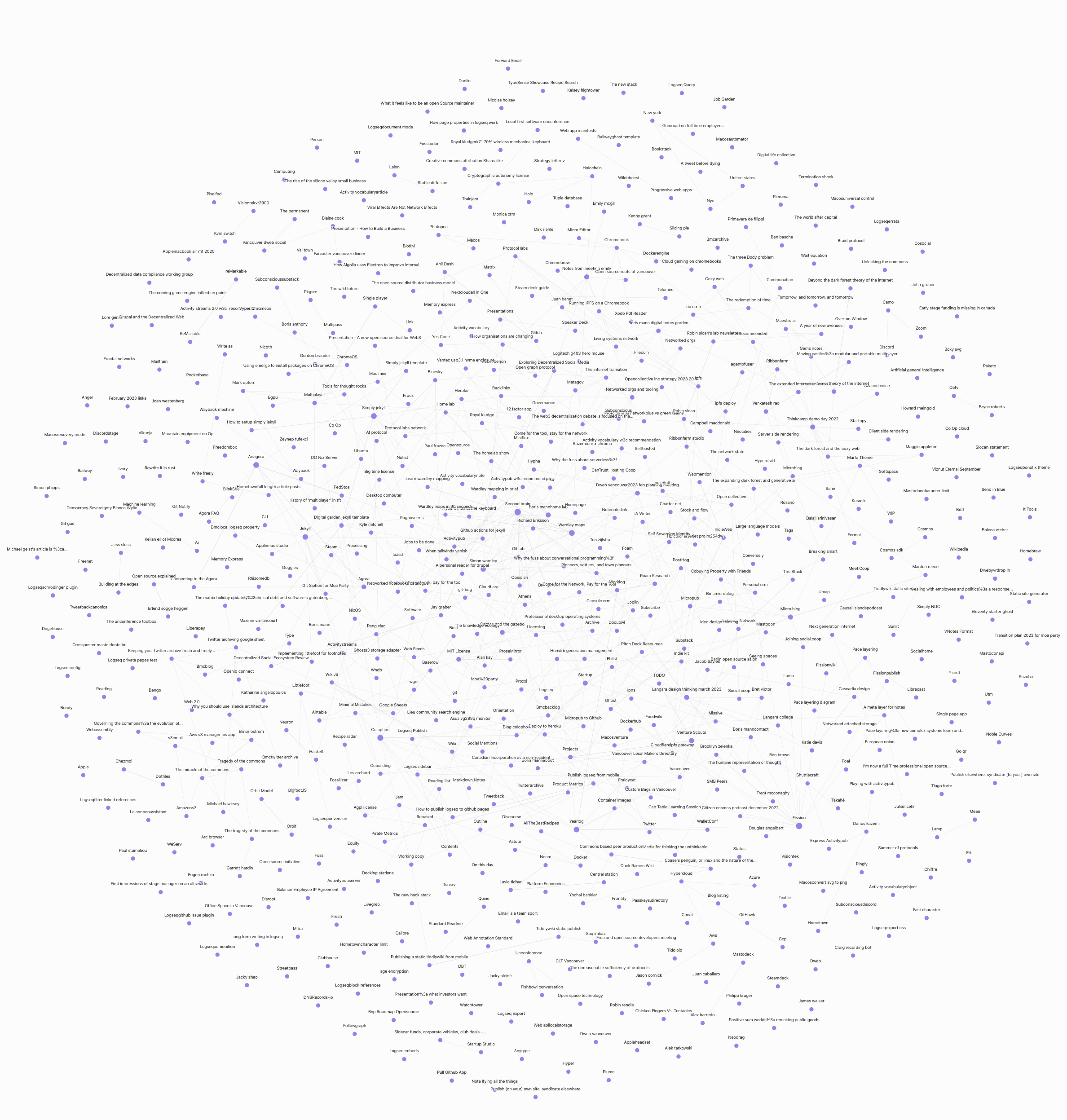
Everyone loves a notes graph! Shout out to the Digital Garden Jekyll Template once more.

It turns out that I had previously done an experimental import of LogSeq into this site template. I probably even have some notes somewhere.

Screenshot of all my LogSeq notes in the Digital Garden Jekyll Template


TLDraw has changed its license to non-commercial. The founder Steve Ruizok dropped a note in the Cloudron forums saying that Cloudron may not be in compliance. I left a comment, as there are a number of apps with different licenses, and e.g. me running TLDraw on Commons Computer is not running it commercially.


OK, one more quick hack to the Journal feed.

Relative paths for images are a problem. Maybe they actually aren’t for many modern feed readers. But they ARE if I want Micro.blog to crosspost correctly.

Found this hack to use the Liquid replace filter to look for src tags and then add in the full path to your site.

I’ll test it tomorrow by posting an image. Time for bed!


Added the journal feed in the link header of all pages so it can be auto-discovered.

Pleasantly surprised to be digging into the IPFS _redirects spec. I guess I can just point to my old archive! /archive/* https://2023.bmannconsulting.com/archive/* 301

Made a BMC page where some TO DO stuff will live.

How many times have I ended up using this JSON Feed#Jekyll JSON Feed Templates? Many times! The special treatment for link front matter has me thinking.

Decided to not mess with feed format right now. It’s working, let’s use it for a bit, and see how various things look once they cross-post through Micro.blog to Mastodon. Where it’s actually putting content on my under-used @[email protected] account.

Added a Journal layout template.

  • Removed LogSeq note site links
  • Added tag display from blog posts layout, which links to /notes/tag (but can’t tell if it exists or not, so might 404)
  • Added via link to the sidebar
  • Used Link as the title if it exists

And I guess this will be a test of what large journal cross-posts do!

Update

Got Redirects working correctly! So https://bmannconsulting.com/blog/2021/02/13/drop-in-audio/ should redirect to https://2023.bmannconsulting.com/blog/2021/02/13/drop-in-audio/ (same theme, so won’t even look that different).

And cross posting of large posts works just fine, with a link back to the post. Nice!


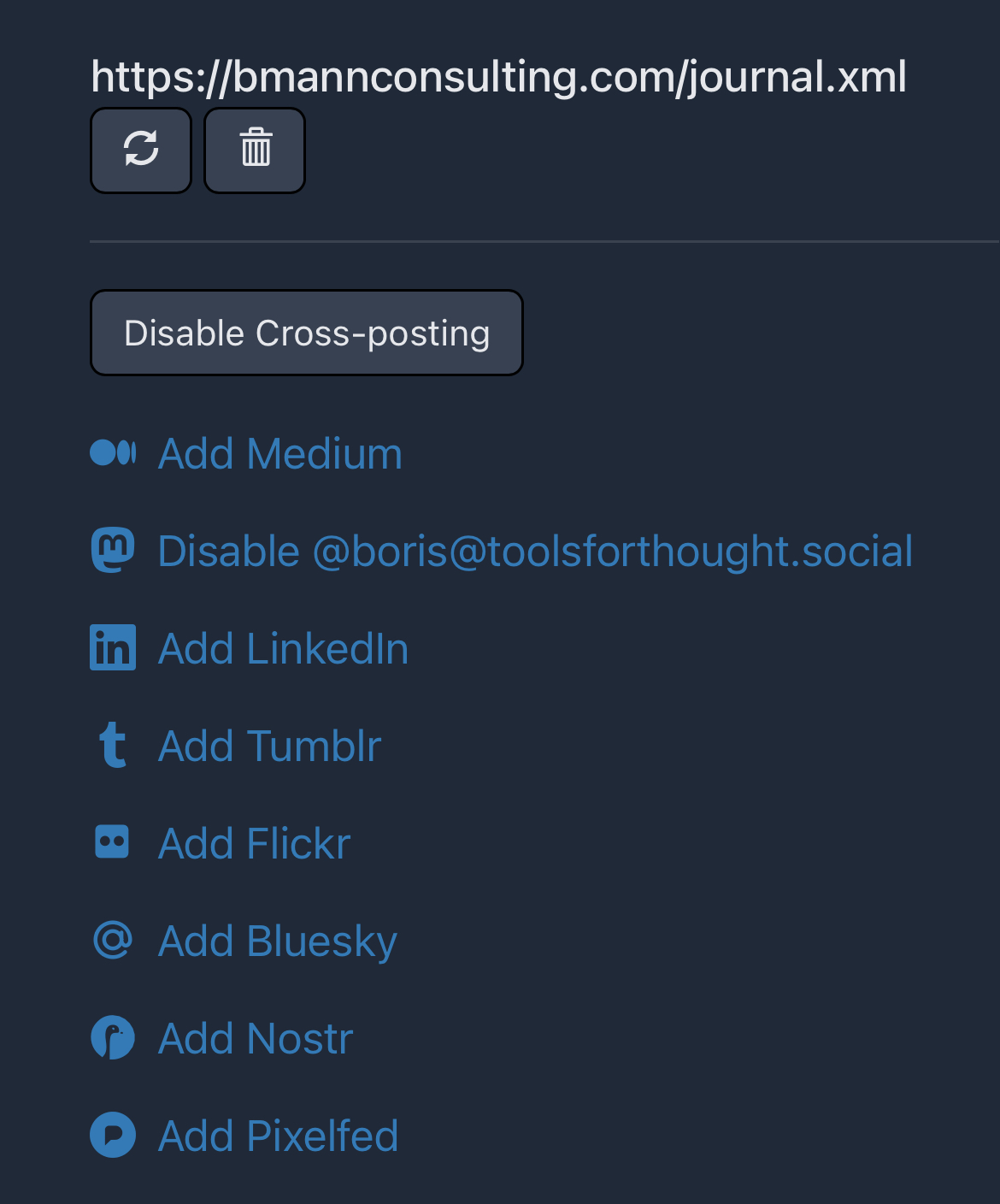
One more journal post! Micro.blog lets you add multiple feeds, and you can set custom cross posting for each feed.

This means I have connected the Journal feed up to my @[email protected] account.

Screenshot of Feed + Crossposting in Micro.blog


Ok, final post of the day now that I’ve learned about Obsidian nuances with Daily notes vs Unique note creator.

I do want to open up a Daily note when I open. But, I want to just use the same format as the Unique note creator so all the files have the same format.

As it turns out, because I made unique page names with a timestamp, the daily journal button effectively becomes a new unique note creator!

The Liquid template for the Journal page then loops through and groups all the posts by day, so you can read them all together, but with permalinks for each one. You can see it in action on the Journal page.

I think it looks pretty good! Maybe even interesting enough to put on the home page?


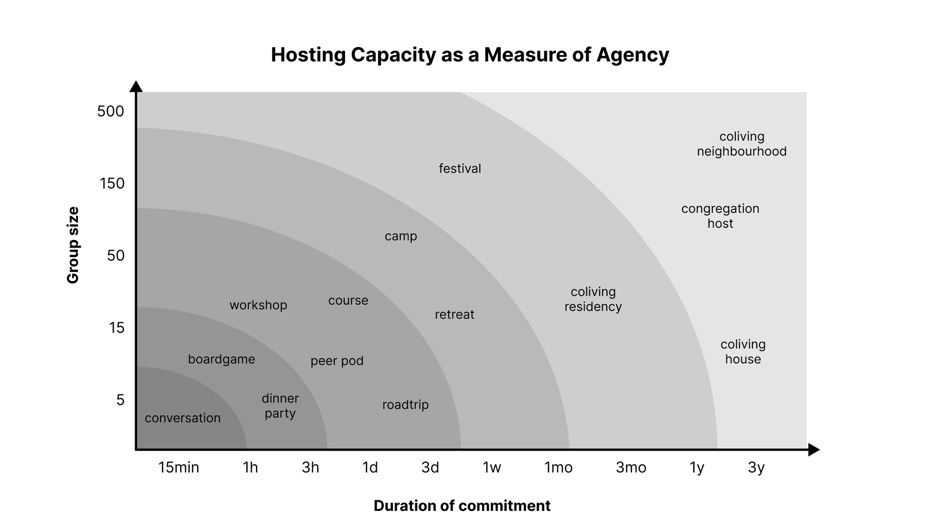
Hosting capacity as a measure of agency

Hosting capacity as a measure of agency

I drew this diagram to illustrate a lot of related insights about agency, hosting, community-building, collaborative leadership & social change

you can use this map to self-evaluate your level of agency: where are you currently? what group experiences do you feel comfortable to host? what feels very doable? what would feel like a tolerable stretch? what would be overwhelming even to attempt?

via Richard D. Bartlett @RichDecibels


I set up Working Copy so I can use Obsidian on my phone with git syncing / publishing. I always forget the order of steps.

  1. Make Obsidian vault on mobile
  2. In Working Copy, clone the git repo
  3. Looking at the repo in Working Copy, click on Repository / Status and Configuration
  4. Click on the disclosure arrow for the repo title, select Link Repository to and select Directory

This “day” should have two other entries, with YYYY-MM-DD_HHmm titles.


I point people at Robert Merki’s Wildcard definition often enough I should have an entry here.