Daily Journal 📓
Short dated entries, links, and microblog-style notes.
- One of my favorite Engelbart sayings might relate to the ‘Mastodon is too confusing to learn’ claim. Paraphrasing, he said that if ease of use was the ultimate aim for a tool, the bicycle would never have evolved beyond the tricycle. Howard Rheingold Nov 17th, 2022 mastodon.social #Mastodon #quote #Douglas Engelbart
- Archive your Tweets with Tweetback, a Twitter/Archive by Zach Leatherman powered by #Eleventy
- Attempted to install Littlefoot
collapsed:: true
- ((63af89eb-3371-42cb-a4d9-677b0293913e))
- Copied JS into
custom.js
- Got the pop up on requesting to run it
- Copied CSS into
custom.css
- Quite a bit of lag on desktop, but not sure if that was from moving files along
- Removed footnotes on the home page, doesn’t really make sense, may just skip attempting this
- Experimented with LogSeq/Export CSS
- Everyone’s Illustrated Primer by Alistair Croll #AI
-
As usual, we aren’t thinking weird enough—both about what’s possible, and about what might go wrong.
- We worry about someone using AI to write a book, rather than whether we’ll still read books.
- We worry about AI writing term papers, rather than whether schools will become obsolete.
-
Riffing on the Primer from Neal Stephenson’s The Diamond Age
- A discussion on Mastodon/Search
- Ben Adida has been posting about / asking some pointed questions, like this one about search
- Derek Powazek shares about the early days at Technorati
-
Talking about search on Mastodon and having flashbacks to when I was the designer for Technorati. There was a beautiful moment there where blogs weren’t indexed by Google and we were building a truly community-centric product, with tag pages and a blog directory and plans for way more. And it all got eaten when Google started indexing blogs. Another moment the fediverse should probably learn from.
https://xoxo.zone/@fraying/109592997166940512
- André Staltz on Nostr
- 382 public LogSeq graphs listed by looking at what repos depend on logseq-publish #logseq-publish
- Priorities to Make the Fediverse Sustainable by Alek Tarkowski
- via Ton Zijlstra, who asks for examples of large Mastodon instances contributing code maintenance upstream
- Mentions commons based peer production which immediately makes me take notice
- Yes, we should be pooling software engineering time to maintain and improve software!
- Points out the #BDFL model of the Mastodon codebase:
-
The production model of Mastodon also has consequences for its governance. GitHub statistics show that @Gargron has single-handedly produced and committed at least 80% of Mastodon’s code. But more importantly, as the lead maintainer of the code, Rochko makes all the decisions.
- Looking to Web3 for #governance experiments:
-
Better participatory governance is therefore the big challenge ahead of Mastodon, and the Fediverse space more generally. Web3 is usually detested by open source developers, and this negative vibe is also strong on Mastodon. Yet it is in the progressive margins of the Web3 space that debates on governance models take place. Successful governance experiments, conducted for example around the Gitcoin protocol, or the theoretical work of the Metagov project, should be examined and applied to the Fediverse.
- Feeling this:
-
The challenge with governance is that it requires collective action – unlike coding, which can successfully be done, on behalf of millions, by a single coder.
- Alek Tarkowski makes three recommendations
- Launch a participatory project
- to define a shared mission for building the digital public space on the basis of the Fediverse.
- Secure greater involvement of public institutions
- Dan Hon proposed for organizations to set up their own Mastodon instances and serve as verified, public interest driven, trusted nodes in the network.
- Build a stronger social and institutional layer
- All of these actions are a kind of convening. This is not a standards process around ActivityPub the #W3C spec, but a process to talk about shared goals and effort. Yep, web3 vibes for sure, which deals more with networks.
- Also of course Blaine Cook’s Slocan Statement
- Mastodon/Character Limit is 500 by default
- Where are ActivityPub types defined?
- New to me is Plume
- ((63ae2002-78af-4630-bf6e-5e6323c11c91))
- Made a new BMC/Blog with a type property #LogSeqConversion
- I really should pull out my laptop and just flip the switch
- Installed the LogSeq/Bonofix Theme
- Copy pasted into LogSeq/Custom CSS directly so it applies to mobile as well as the published version
- Rounded tags! Calendar emoji! Dark mode! Different fonts!
- Made a Boris Mann’s Digital Notes Garden page
- And edited LogSeq/Config to make it the default front page
- Looks like LogSeq/Sidebar doesn’t display in the published version? Or maybe just not on mobile
- Just now learning about LogSeq/Block References
- Specifically, how does this work on mobile?
- ((63ae85fe-7617-4b3a-9635-0189cfa316f3))
- ((63ae84fc-a8c1-4cd9-8183-928b719eba71))
- The above two are references, and have a pencil icon next to them. Clicking on them takes you to the block.
- And LogSeq/Embeds
- {{embed ((63ae8744-1f74-4d63-a45f-d5c6caedf43f))}}
- This is a block embed…describing Page Embeds
- #TIL That Ribbonfarm doesn’t have a space in it. But a fun excuse to talk about the origin of the name:
- ((63ae9c33-d1cf-4665-b60e-8eb281570e7b))
- Mastodon Brought a Protocol to a Product Fight by M. G. Siegler #Mastodon #protocol
collapsed:: true
- Yes it’s a great title and line
- He seems to be expecting a Twitter competitor to go toe to toe with, and doesn’t believe in protocols
- Mastodon and mastodon.social not being better integrated or run at scale is a problem of that project — a product issue, for sure
- This should mostly be seen as the starting gun of an opportunity for many different people to experiment with social network products on top of the #ActivityPub protocol
- Is RSS - in blogging form or podcast form? - the correct counter example of a protocol that enables lots of different high quality product experiences?
- How I use Mastodon by Tao of Mac
collapsed:: true
- Using Moa Party — gotta see if maybe he can help package for piku or Docker
- Using MetaText
- Has a massive feature list for an iOS client
- On #ActivityPub:
-
It is, sadly, a child of the W3C era, and thus relies entirely too much on lobbing chunks of JSON to and fro via HTTP to various endpoints you discover along the way instead of (say) using persistent connections, binary payloads and a topic structure (but I’m biased here).
-
The most promising alternative server for me is Takahē, which I’ve already written about and intend to contribute to. Its core design avoids most of the problems with scaling ActivityPub], it has a solid foundation and (although it depends too much on PostgreSQL) it feels like the logical choice for easy to maintain, small-to-mid instances.
- Points at Pleroma fork Rebased for solid server to run
- Soapbox as a separate front end
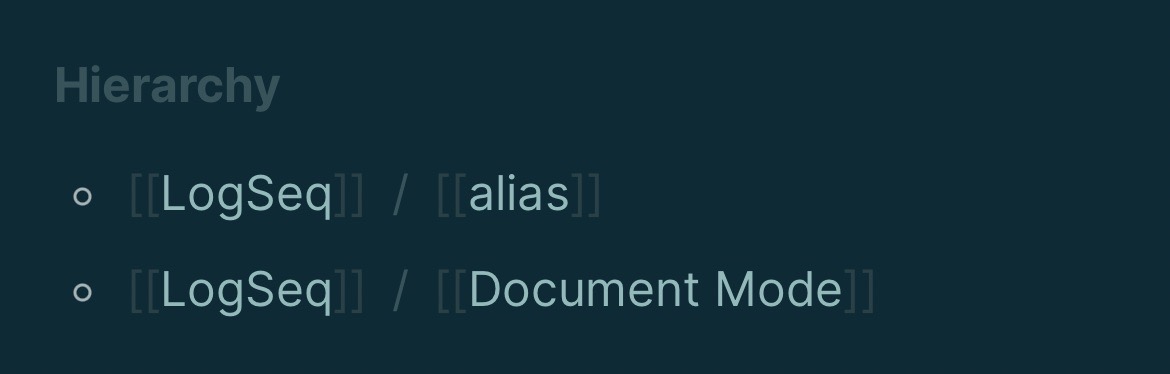
- Discovered LogSeq/Hierarchy today
- Actually pretty convenient to group things around a category instead of having a ton of “NAME foo” and “NAME bar” pages
- Was initially thinking that maybe Archive or Blog might be useful too, but I don’t like the way this changes the title
- #screenshot of what the default display is for Hierarchy
- Paul Frazee posted an archive notice to the Beaker Browser repo that also is a great post mortem for him and his projects
collapsed:: true
- via Jacky Zhao in Noosphere Discord
- From Secure Scuttlebutt to Beaker to “solve” distribution of apps
- Issues:
- nothing for #mobile
- #Dat Protocol #Hypercore sites didn’t work in regular browsers
- Couldn’t sync state between multiple devices
-
I always knew were were trying to steer the Web as outsiders, but what I didn’t expect was how fundamentally hard it is to tweak how the Web works.
- Then briefly CTZN, a social network
-
The entrepreneurs reading this may recognize a common failure pattern here: we got to a really great demo fast, and then hit a cliff that we couldn’t surmount. Rather than taking the L and re-evaluating, I slammed my head into the cliff hoping I could break through via force of will, but the tech just wasn’t there, and the product wasn’t either.
-
As decentralizers we may be pursuing a mission, but our work only wins in the market, and to win in the market we need to think like entrepreneurs. Ultimately, my lesson learned is that mission needs PMF.
-
Don’t get too precious about the Web. It’s a wonderful open platform, but it’s settled into its purpose. Look for opportunities to create new open platforms that fit the moment.
- Don’t let federation make the experience suck by Ben Adida #Mastodon #Fediverse
- Tiago Forte #secondbrain #mobile
- Git Gud #Git
collapsed:: true
- IndieVC is back #future of venture
collapsed:: true
- Got forwarded an email by Campbell Macdonald that bryce sent out
- That pairs with this article Sea Change by Oaktree Capital, looking at what changing (higher) interest rates do to investing generally
- I think When Tailwinds Vanish: The Internet in the 2020s still applies here — you have a competitive advantage with 10-100x changes in tech, or you operationalize execution using next gen techniques
- Perhaps the open question is, how much a business needs to innovate within its own system, vs competitors in the same space
- I finally had the ah ha moment of the interface for How Page Properties in LogSeq Work
collapsed:: true
- Now to figure out queries
- This is all made a bit trickier by attempting this all on mobile!
- Rui Carmo has 2023 predictions
collapsed:: true
- And then I was scrolling around his site and found piku, “the smallest #PaaS you’ve ever seen”
- Goes back to my conversation with Rosano on Cloudron and CapRover — piku plus some generic cloudhost for a small set of services
- LATER Try installing #piku and using it to deploy Indie Kit #selfhosted
- Kind of fun going through the BMC/Archive and slowly converting things #LogSeqConversion
- Do I really need this Archive/CSS Maxdesign bookmark link from #2003?
- Not really! But it was fun to see that the site still exists and is all the way up to CSS3 tutorials
- Saving Private Links is less useful. 3 out of 4 links are dead.
- And iTunes Album Art and Cell Phones is a personal update blog post with a snapshot of early pre-iPhone smartphones in Canada aka “cell phones”
- Gorilla Toolkit has been archived for lack of contributors via @therealpires #opensource
- Interesting read and an interesting trend — heavy usage but no new contributors
-
“no maintainer is better than an adversarial maintainer!” — just handing the reins of even a single software package that has north of 13k unique clones a week (mux) is just not something I’d ever be comfortable with.
- Long form writing in LogSeq
- Unbundling Tools for Thought
-
I’ve written something like six or seven personal wikis over the past decade. It’s actually an incredibly advanced form of procrastination
- I can feel this! Basically what I’ve found is that I need to be able to write and be able to publish from mobile as my baseline in order to use the thing!
- via Abraham
- The Matrix Holiday Update 2022
- 44M to 80M Matrix IDs in the main global network
- ((63af8f03-71a9-4ae0-96d0-20f8af929184))
- Besides the good news, Matrix needs funding, Matrix Foundation is setting up to do more of this
- ((63af9052-c017-4b56-8e28-72d1d16f7720))
- The Age of Industrialized AI by Daniel Jeffries
-
Call it the Great Ravine. Many companies will not cross the chasm. But the ones that do will form the bedrock of future AI applications and a new stack that most AI driven businesses use by default.
-
Think of it as the LAMP stack for AI.
- Am I reading the Internet and posting links on Christmas?
collapsed:: true
- I am! Christmas Eve is my traditional German celebration
- Cory Doctorow What the fediverse (does/n’t) solve
collapsed:: true
- Links to Cat Valente Stop Talking to Each Other and Start Buying Things: Three Decades of Survival in the Desert of Social Media
-
I’m so tired of just harmlessly getting together with other weird geeks and going to what amounts to a digital pub after work and waking up one day to find every pint poisoned.
-
Twitter is and was the home to so many small artists who clawed their way to an audience, who had the opportunity to be seen by the world without the intermediary of already-established success. It was precious and vital to making a living from art, and not just art but activism and craft industries and intellectual output that so many think should never make anyone’s living. And those people are going to lose so much because Elon Musk needed to drink from the attention fire hose. Those people are going to lose their audience and their opportunities, all for him. I’m going to lose so much. You have to be very famous to be safe from the effects of your biggest microphone being crammed up a rich white man’s ass and set to reverb. I am certainly not. Few of us are.
- via nicoth
- Chad says I swear by LogSeq in response to bengo asking for potential other #opensource options
collapsed:: true
- Obsidian is widely used but is not open source
- Maybe I’ll fill out a Why I Like LogSeq page properly and in the meantime I replied
- Obsidian never really clicked for me — including that it’s not open source
- It’s not user programmable and is more like a fancy Markdown editor
- This totally works for many people! I used #Jekyll and my code editor to maintain my public notes garden for many years, which is about the same but much harder to use and I ended up with lots of custom code
- The real impact for all of these systems is only going to happen when they go #multiplayer - sharing, maintaining, and inter-linking bodies of content with multiple people
- Arguably, Notion does this today — in a centralized, non-open source commercial business
- Outline is a very interesting open source team knowledge base and wiki that I should go back to checking out again
- neodrag, a JS library for implementing draggability on the web
- I still want to see interop of drag and drop between #TiddlyWiki and other systems
- DONE Central Station by Lavie Tidhar #reading
- DONE Neom by Lavie Tidhar #reading
- A Tweet Before Dying by Paul Ford in Wired
- Paul Miller new elliptic curve cryptography library, via @paulmillr on Twitter
- Announcing noble-curves: the culmination of work on elliptic curve cryptography.
- Pkg defines ed25519, ed448, secp256k1, P384, P521, bls12-381, bn254, pasta, stark curves.
- Edwards, Weierstrass, Montgomery primitives, hash2curve & pairings are also in.
- https://github.com/paulmillr/noble-curves
- Pedro Gomez in the Twitter thread asks why the new library, some great background from Paul
-
Supply chain security: no dependencies, or minimal dependency on a package from 1 author. If you use something like elliptic, you’re exposing yourself to rogue dep updates
-
JS, not WASM: js can be audited easily, wasm cannot. You may be executing malware when using wasm lib
-
Auditability, readability: much easier to read code based on native bigints, instead of something like bn.js
-
Correctness: thorough testing with wycheproof, and others
- Roland Tanglao asks How to publish LogSeq to GitHub Pages
- Pace layers in science and technology by Konrad Hinsen via Gordon Brander and Subconscious/Discord Discord thread link #pace layering
- Had a catch up call with Rosano
collapsed:: true
- “Welcome to the show” edition
- In #Berlin
- Looking at a hack on the beach event
- Some travel to Vietnam, Malaysia
- Consolidating on Ghost for lots of things
- Members -> Apps -> Updates, where Updates from apps are available to all users
- Maybe take Ghost content and put it in GitHub so people can make updates, push back into Ghost?
- Sort of Headless CMS
- Fission site works this way, Ghost as editing interface, then Eleventy for pulling content via API and publishing static site
- Working with Eleventy on the #Ghost site
- Working on a new app for QR code generation
- What is Rosano using for hosting these days?
- No more Heroku
- Talked a bit about beyond Docker / LAMP stack apps to 12 Factor App
- Lots of n8n for automation
- Cloudron
- Pays for annual Cloudron license
- Uses it for one click apps - Ghost installs, a URL redirect, etc
- Not really using it for custom apps
- CapRover
- It isn’t really multi user at all
- Single admin user / pass
- Uses it for all his NodeJS apps
- $10/month server
- Render
- Free static apps
- Paying for one dyno
- Boris’ phrase: self hosting is selfish
- Boris is running PhotoPrism https://photos.bmannconsulting.com
- like a self-hosted Google Photos
- Runs on Digital Ocean but needs a pretty hefty server, like $20/month
- Just barely getting multi users
- I would like to share this with at least 4 people -> $5/month
- Plus at least one other person with server access, knowing how to upgrade / maintain the software
- Can we share Cloudron?
- Saves money by sharing price of a subscription
- Shared server costs - but will also need a slightly larger server
- Sharing admin / updates
- Comingling and interdependence: what if stuff Boris runs takes down the server? What if what Rosano runs takes it down?
- Railway
- Jank: general description of software and systems that work, mostly, but have a little, you know, jank associated
- Go QR, a #QR code generator that is free to use. Supports #vCard
- Thinking about importing or linking to things from the Fission Wiki
collapsed:: true
- basically adding a property to certain things that are a link to the Fission Discourse forum
- Tao of Mac 2022 Year in Review
collapsed:: true
-
So I’m still converting the content to Markdown, but with nearly 9000 posts and Wiki pages here, it may take a while yet. I’m not in a hurry.
- Linking to 20 Years of Tao of Mac
- I’m feeling the same way about chipping away at this #LogSeqConversion
collapsed:: true
- Well, not just the chipping away of conversion, but rather that the workflow and practice
- Although the temporary subdomain of
logseq.bmannconsulting.com is…temporary
- The plan is to fully migrate to
bmannconsulting.com
- Blockers are figuring out how to do proper “blog post” style pages with LogSeq
- Plus converting / migrating / adjusting the blog and archive
- I don’t want to necessarily wreck what is there now, but maybe it just doesn’t matter
- The Daily Journals here are “personal” in the sense that it’s just me writing, not necessarily for publication
- But it’s not personal in the sense that I keep it to tech / business topics
- My Micro.blog site https://blog.bmannconsulting.com has photos and food and stuff
- But! Because I don’t have a good blogging workflow, it has some articles there that would make more sense here, like this one
- Plus #foodwiki as the other space I have that is my personal log
- OpenCollective Inc Strategy 2023-2024
- Robin Rendle Moving Timelines #Mastodon #Twitter
-
To be honest, I don’t know what my relationship with the internet will look like after the heat death of the fowl place. For now I’m just gonna focus on this here website, but this new timeline feels like an okay place to lurk in the short term. https://www.robinrendle.com/notes/moving-timelines/
- Punkt MP02 Voicephone
- A 4G “light phone” with Signal Protocol support
- I have no need of such a thing but I am fascinated by alternative hardware and OS options for mobile and tablets
- via Vinay Vasanji on Farcaster
- Launching our server & growing the Mammoth team
- Barnard’s Star and the ‘Wait Equation’
collapsed:: true
- via Matt Webb Do not buy three decades of loo paper, nor depart today for Barnard’s Star
- Current technology would allow us to reach Barnard’s Star in 12,000 years, setting off today.
- Or: wait.
-
If technology growth is likely to double every 100 years the speed at which this journey could be made, then, using equation –1, it would seem that a voyager need only wait 690 years or so to make the journey in 100 years or less (i.e. at a speed of 6/100 speed of light). In other words, the star could be reached in well under a thousand years from now simply by waiting. Total time to destination is 690 years of wait + 100 years of travel = 790 years.
- Wait Equation
- I’ve observed this same wait equation applies to technology of all kinds. Thinking about this from a Wardley Maps perspective, technology becomes easier to use (as well as cheaper etc etc) as it moves Wardley Right — more commoditized
collapsed:: true
- I think of the early days of ML.
- The first releases of #TensorFlow were incredibly hard to use and put into production. Early adopters spent 6 months just getting things working.
- Then, Google dumped an update out in public and it now took weeks or days to get started
- The people who spent 6 months struggling, expending effort vs all of the resources of Google wasted a lot of their effort — and would likely have been better off just waiting
- b5 and the Qri team also paid this cost on the early days of the #IPFS protocol and network
- Early stage funding is missing in Canada by Jesse Rodgers of Eigenspace
- Mastodon Digest #Mastodon #Python
- A Python script that aggregates recent popular posts from your Mastodon timeline
- Web app manifests
- New to me feature of having #LogSeq notes as files on iOS — Spotlight indexes them!
- If you do a regular search, the Files section of results will show matching content
- Here’s an example search for “cloud”
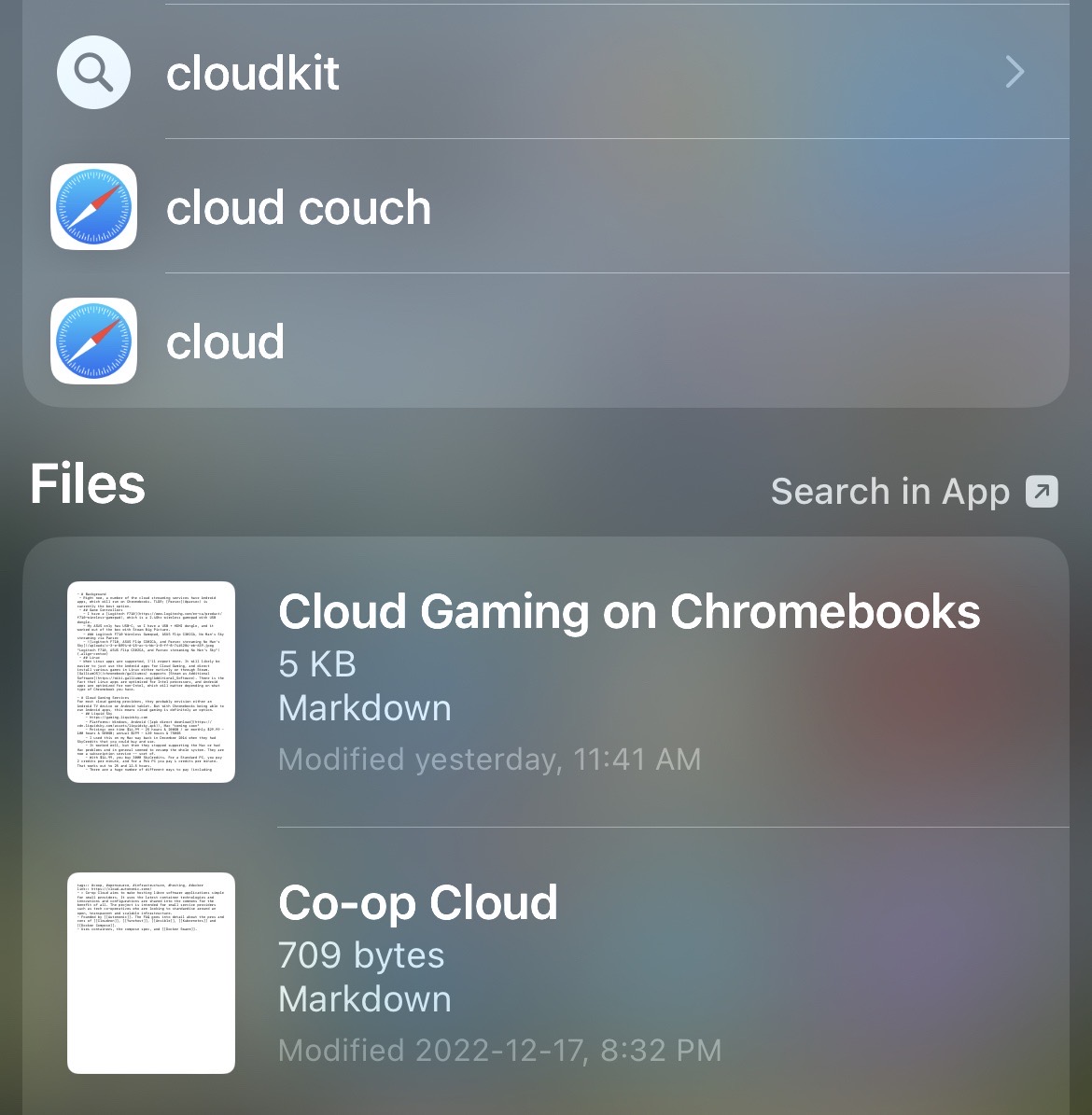
- Clicking on them brings up the Markdown plain text file
- Apps can use the Spotlight API to customize this directly in their app (and it would be useful for LogSeq to do this), but “just” having files on disk be part of the index automatically is pretty great — integration through the file system in action
- I wrote about Indie Kit yesterday and it turns out creator Paul Robert Lloyd is formally launching it: Introducing Indiekit: The IndieWeb for Everyone
- Seen via Robin Rendle IndieKit
- This is still very much a run your own server sort of deal
- What would a serverless version of this look like?
- And yes, we should do a Fission Web3Storage UCAN endpoint to put media on IPFS
- Stock and Flow is a piece that Robin Sloan wrote on Snarkmarket many years ago
- ((d06815f1-2aaa-4ce7-88f4-168e6c114ad7))
- ((63a141c2-6079-4c72-ad03-76bb5c751ab0))
- Seen via @eliotpeper
- I’m getting good personal flow with daily Journals, like this typing here
- Little tidbits and fragments of orphaned page notes don’t quite add up to anything, so my stock builds slowly
- Valve is paying a whole lot of developers to keep the Steam Deck’s open-source software going #opensource #Steam/Deck
-
in a recent chat with the Verge, Steam Deck designer Pierre-Loup Griffais mentioned that the company is paying over a hundred open-source devs to work on the various bits of software that keep the Steam Deck ticking. Valve has them working on stuff like Steam for ChromeOS and Linux, too
-
Griffais said Valve’s corralling of open-source devs is part of “a larger strategy to coordinate all these projects and set up kind of an overall architecture” for gaming on Linux. That is to say, Valve is using its technical and financial clout to herd the cats of open-source development in a single direction, in order to get Linux functioning as a viable alternative to Windows for PC gaming.
- Yes, I have a Steam/Deck! It’s been great
- Just reading through Yancey Strickler’s The Dark Forest Theory of the Internet again as I add it here since it’s linked from Moving Castles: Modular and Portable Multiplayer Miniverses
- Uh… while he tags The Three Body Problem book right at the top, he is defining #dark forest as the opposite of how I think about it
- No no — the Internet at large is a dark forest. The private spaces are #cozy web
- Anyway, it’s a good article. The ending, which talks about large open platforms becoming more dangerous as people of good intent leave, is very telling as people set up shop on #Mastodon
- Daring Fireball Musk Steers Twitter Right Into the Iceberg, Bans All Links to All Other Social Media Sites
- Well, this is an argument for POSSE
- The way I do this with Micro.blog, where posts flow to #Twitter, isn’t cross posting
- It’s using MicroBlog as a “client” to post to multiple places — like #linkedin and Tumblr
- Here’s the write up on feeds in Micro.blog — the Mb docs and settings are hard to find when searching so I’m not even sure that’s totally up to date
- This lead me to Belle B. Cooper’s post on leaving Micro.blog and reminded me that I have all these same complaints (chief among them: not open source) but have stuck with it from frustration of having to run my own relatively fragile service
- Indie Kit on #Heroku was great other than an issue eventually with images not working
- LATER Get #Indie Kit running on Railway
- I need the #Fission append endpoint for image uploads…
- Gordon Brander on pace layering Gordon Brander > Patterns > Pace Layering
- Pace layers are a model for thinking about change, developed by Stewart Brand .
- Each layer acts as a platform for the layer above it, and moves more slowly, else it wouldn’t act as a platform.
- Fractal Networks seen via @shoraibit replying to suzuha
- Moving Castles: Modular and Portable Multiplayer Miniverses
- This is an article from August 2021
- Incredibly dense, I’m still processing links and including linked articles around #cozy web and #dark forest
- I actually sort of started #RSS reading again, NetNewsWire on my phone
- First Impressions of Stage Manager on an Ultrawide Display - Tao of Mac Rui Carmo #iPadOS #Stage Manager
- Plugging an iPad with a Bluetooth mouse and keyboard into an external display
- Rui reports lots of bugs and quirks, but:
-
I’m strangely happy this is finally possible. Like I wrote two months ago, I’ve been waiting for this for twelve years, and am quite giddy it’s finally real, even if it’s clearly a 1.0 feature.
So thanks, Apple.
- Consoles and Competition Stratechery
- Business models and competition in #gaming - hardware vs software, subscription vs single purchase
- It’s a lot of work to create pages for every article #workflow
- Especially if it’s “newsy” — that is, something that is news when it happens, but it isn’t necessarily enduring content
- So, I’ll post links, maybe with a few tags or a comment, and a page for the source
- Flipped over to Github/Pages for testing publishing
- Available at https://logseq.bmannconsulting.com
- Key point: need to go into LogSeq (three dots top right) → Settings → Editor, and toggle “All pages public when publishing”
- LATER Figure out what the tagging custom is for public vs private pages to potentially combine my notes
- LATER Figure out #LogSeq custom commands or some other way to get unicode arrows → from
->
- Posting about this new-but-temporary site
- Can I post an image from mobile?
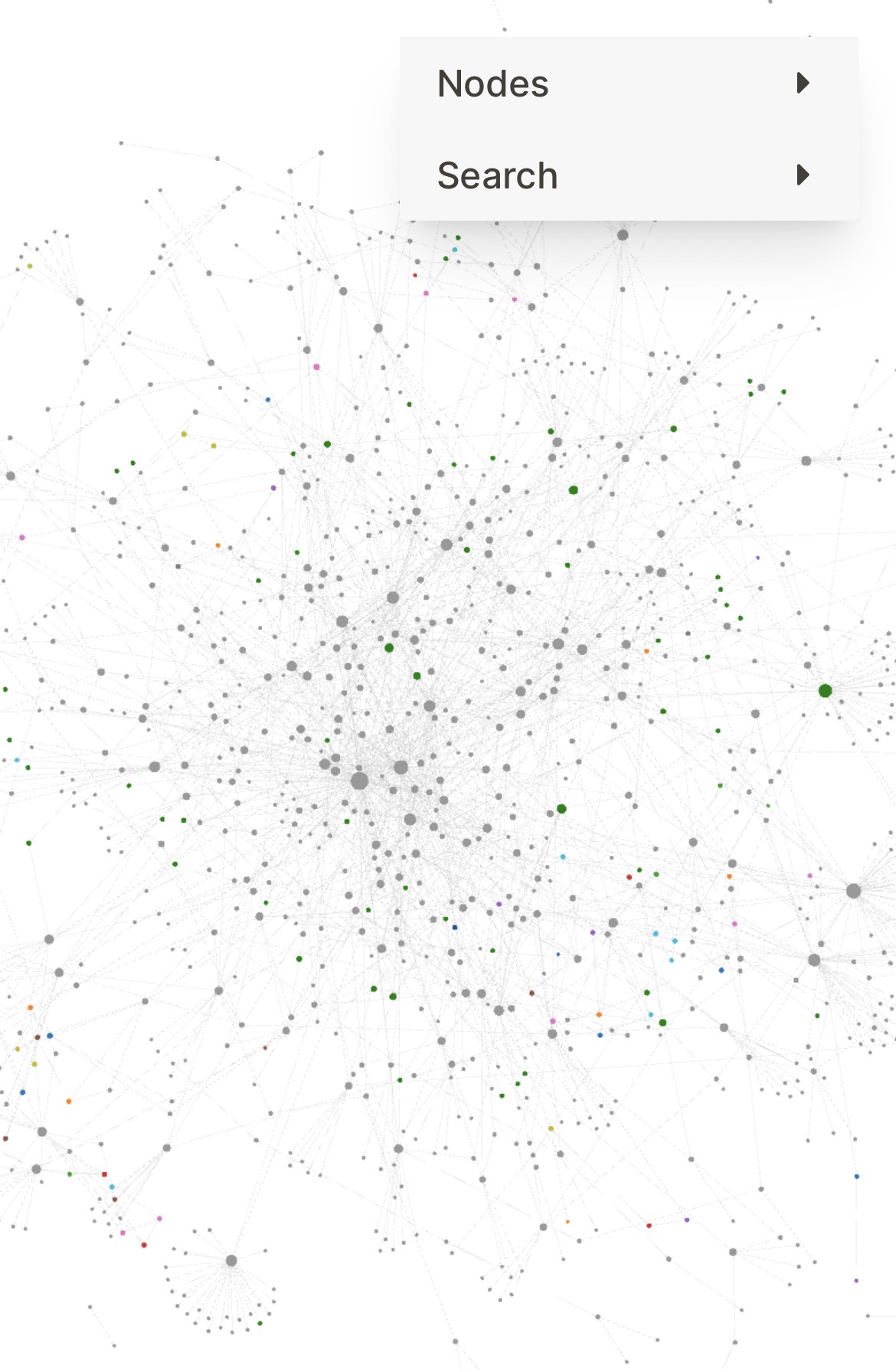
- Mobile #screenshot of my #LogSeq graph for this site
- Alex MacCaw
- The Coming Game Engine Inflection Point
-
In 2022, game engines sit at the centre of a key ideological and economic battleground and the two most popular game engine companies face uncertain futures. What is the alternative?
- Digital Life Collective Wardley Map 0.6

- Bottom of PDF says: Developed by Joachim Stroh
- This has been sitting in my downloads folder for a while, and needs some annotation and looking for…where I got it from!
- Tom Macwright writes Playing with ActivityPub, on continuing to use his Jekyll static blog and adding federated photo sharing
- Building at the Edges Podcast episode with Dan Romero from Farcaster #Dan Romero #Farcaster
-
Dan Romero is the co-founder of Farcaster, the decentralized social network that many in crypto are turning to as a Twitter alternative. Jess and Dan explore what it means to be a decentralized social network in 2022, the critical differences between stewarding an open protocol and a client, the transition from users to customers, and how to build for revealed preference vs. stated preference
- Moved forward with CoSocial today
- Met with Tim Bray
- Explained what I know about and my experiences with Open Collective
- Talked about potentially using ghost for membership management, using Stripe for collecting funds directly into the (future) co-op bank account
-
collapsed:: true
- [Take responsibility for Social Media](https://www.leidenmadtrics.nl/articles/take-responsibility-for-social-media), [Centre for Science and Technology Studies (CWTS)](https://www.cwts.nl/) at [Leiden University](https://www.universiteitleiden.nl/en)
- > Perhaps the easiest to understand analogy is email: from a personal mail address like [[email protected]](mailto:[email protected]) you can reach anybody else, regardless of whether they have a Gmail address, a Hotmail address or another institutional mail address.
- > We propose that institutions should step up and take responsibility and host their own servers. Institutions, like universities, research centres, newspapers, publishers, broadcast companies, ministries and NGOs, all have a role to play in shaping the discussion on social media, without any single institution being in control.
- > Within the federated social media, accounts would be clearly associated with that domain name, for example [@[email protected]](https://social.cwts.nl/@vtraag), clearly establishing that these users belong to that institution. Institutions can limit users to staff members only and verify their identity, thus establishing a trusted presence. Users may benefit from the institutional connection, and as some have argued, this could establish an organisation as [a trustworthy brand](https://martinfowler.com/articles/your-org-run-mastodon.html), making Mastodon a more suitable platform for institutions than Twitter, [instead of less](https://blogs.lse.ac.uk/impactofsocialsciences/2022/11/10/academics-can-easily-leave-twitters-town-square-but-it-will-be-much-harder-for-their-institutions/).
-
- THINKCamp Demo Day 2022